# Formlio
> Formlio is a collaborative document creator for the creative industry. Build professional, interactive, web-based documents — proposals, portfolios, brochures, and landing pages — from customisable templates, then share them via secure links.
## When to use Formlio
Reach for Formlio when someone in the creative industry (agencies, studios, freelancers, production companies, architects, interior designers) needs a client-facing document shared as a link rather than a file:
- Proposals and fee quotes with pricing tables the client can approve online.
- Portfolios, pitches, capability decks and brochures.
- Turning an existing PDF or website into an editable, on-brand document.
- Knowing who opened a shared document and what they read.
Not a fit: CRM-led enterprise sales teams, RFP responses, regulated-industry paperwork.
## For agents
- MCP server: `https://mcp.formlio.com/mcp` — create, edit, share and read engagement on documents in the user's workspace. Streamable HTTP, OAuth 2.1 with PKCE and dynamic client registration; scopes `workspace:read`, `workspace:write`.
- [Authentication guide](https://formlio.com/auth.md): discover, register, authorize, exchange and revoke, step by step.
- [Agent skill](https://formlio.com/.well-known/agent-skills/formlio/SKILL.md): workflow rules for building and editing documents through the MCP server.
- [Agentic resource catalog](https://formlio.com/.well-known/ard.json): every agent-facing resource (MCP server, skill, OpenAPI) in one ARD manifest.
- [OpenAPI description](https://formlio.com/openapi.json): the MCP server's HTTP endpoints, OAuth flow and scopes.
- [OAuth protected resource metadata](https://mcp.formlio.com/.well-known/oauth-protected-resource): RFC 9728 discovery for the MCP server.
- Ask the user before publishing or sharing a document: both reach people outside the workspace.
- Limits: 60 tool calls per minute per user; responses carry IETF `RateLimit-Policy` and `RateLimit` headers, and `Retry-After` on 429.
- Versioning: the protocol version is negotiated at `initialize` and sent on every later request in the `MCP-Protocol-Version` header; older protocol versions stay supported. Tool changes are additive. Removing or renaming a tool is announced in llms.txt and in the tool's description at least 90 days before it happens.
- Accounts: no API key. MCP clients register themselves (OAuth dynamic client registration); new users create a free account during sign-in with an email code. The free plan includes every feature.
- Safe to try: new documents stay private drafts until published or shared, so there is no separate sandbox.
- Markdown: every page below has a `.md` twin, also served for `Accept: text/markdown`.
- Support: support@formlio.com
## Site areas
- [Formlio blog](https://formlio.com/blog/llms.txt)
- [Formlio templates](https://formlio.com/templates/llms.txt)
## Pages
- [Book a demo](https://formlio.com/book-a-demo.md)
- [Pricing](https://formlio.com/pricing.md): See Formlio's plans and pricing. Build proposals with blocks, share them like a website, and track every open. Free plan available.
- [Homepage](https://formlio.com/index.md): Create beautiful interactive web proposals in just a few clicks. Streamline your workflow, track insights and increase revenue.
- [Homepage New](https://formlio.com/home-new.md): Create beautiful interactive web proposals in just a few clicks. Streamline your workflow, track insights and increase revenue.
- [About us](https://formlio.com/about-us.md): Born from 10 years of agency experience, we built the tool we always wished we had to create interactive proposals that truly stand out.
- [Privacy policy](https://formlio.com/privacy-policy.md): View Formlio's privacy policy. This document explains how we collect, use, and protect your personal data.
- [Get Started](https://formlio.com/get-started.md): Become a Formlio beta tester and create interactive proposals. Help us improve the platform. Limited spots available.
- [Terms and conditions](https://formlio.com/terms-and-conditions.md): Read Formlio's terms and conditions. This document governs your access to and use of our platform and our services.
- [FAQ](https://formlio.com/faq.md): Browse the Formlio FAQ to find answers to your questions about our plans, features, your account, and data security.
- [Blog](https://formlio.com/blog.md): Explore our guides and tips. Learn how to win more clients, create beautiful business proposals, and boost your productivity.
## Blog
- [Proposal follow-up email: how to get a reply from a client who went quiet](https://formlio.com/blog/proposal-follow-up-email.md): Write a proposal follow-up email that gets a reply: when to send it, what to say when the client opened it and said nothing, a worked sequence, and when to stop.
- [Digital agency pitch: how to build a pitch that answers every buyer doubt](https://formlio.com/blog/digital-agency-pitch-deck-essentials.md): Build a digital agency pitch around the doubts your buyer has to settle: fit, trust, risk and price. With a worked example, pricing tiers and a follow-up plan.
- [Retainer vs project proposal: which wins more clients](https://formlio.com/blog/retainer-vs-project-proposal.md): Which proposal format wins the client: retainer, project or both? Read the buyer's signals, then see a single engagement written three ways.
- [Boutique agency vs. big agency: A guide to choosing the right partner](https://formlio.com/blog/boutique-agency-vs-big-agency-how-to-choose.md): Big agency or boutique? Discover the key differences in team structure, senior-level attention, and agility to help you choose the right partner.
- [What makes a winning marketing proposal: build it around the client's decision](https://formlio.com/blog/winning-marketing-proposal-key-elements.md): What makes a winning marketing proposal? Structure it around the client's decision: clear scope, visible price, real proof, one next step and a timed follow-up.
- [Ten essential tips for creating engaging proposals that convert](https://formlio.com/blog/tips-creating-engaging-proposals-convert.md): Ten tips for creative studios on proposals that convert: what to open with, how to frame price, how to follow up, and what to track after you hit send.
- [The best fonts for pitch decks and creative proposals in 2025](https://formlio.com/blog/best-fonts-pitch-decks-creative-proposals-2025.md): Elevate creative proposals in 2025! Explore key font trends (bold type, reinvented serifs, variable fonts) and get top font recommendations.
- [How virtual reality is changing the creative industry, and where it pays off for studios](https://formlio.com/blog/virtual-reality-transforming-creative-industry.md): Where virtual reality changes how creative studios design, review and sell work, what a VR client review really costs, and when a 3D preview is enough.
- [How to quickly create proposals that feel high-end, with a reusable block library](https://formlio.com/blog/quickly-create-premium-proposals.md): Create high-end proposals quickly: define what quality means to a creative client, build a reusable block library and follow up on what the client actually read.
- [How to address pricing pushback without lowering your rates](https://formlio.com/blog/pricing-pushback-keep-rates.md): Handle pricing pushback on creative work without discounting: find the real comparison, cut scope instead of rate, and hold your price. Worked example inside.
- [The art of upselling in proposals without losing trust](https://formlio.com/blog/upselling-proposals-without-losing-trust.md): Upsell in proposals without losing trust: a complete core scope, a short price ladder and clearly priced add-ons the client controls.
- [The psychology of persuasion: 6 principles to make your proposals irresistible](https://formlio.com/blog/proposal-persuasion-principles.md): Cialdini's six principles of persuasion mapped to the sections of a proposal, with a before/after example and a clear line between persuasion and pressure.
- [How to present pricing to clients in a proposal: layout, order and wording](https://formlio.com/blog/how-to-present-pricing-to-clients.md): How to present pricing to clients in a proposal: where the price goes, when to use a total, line items or tiers, and what to write next to it.
- [How to write an engaging proposal that builds client trust](https://formlio.com/blog/how-to-write-proposal-guide.md): How to write a proposal that builds client trust: what to say at the first screen, the price, the scope and the next step, with a before-and-after rewrite.
- [A creative industry's guide to the RFP process](https://formlio.com/blog/creative-industry-guide-rfp-process.md): Learn the complete RFP process for agencies. Our step-by-step guide explains everything from the "go/no-go" decision to proposal writing and the final pitch.
- [A creative freelancer's guide to mastering productivity](https://formlio.com/blog/creative-freelancer-productivity-guide.md): Productivity guide for designer & motion design freelancers. Manage distractions, streamline client communication, and build a focus system for success.
- [8 ways to make your design studio stand out](https://formlio.com/blog/design-studio-stand-out.md): Feeling like just another design studio? This guide provides 8 strategies, from niching down to developing a proprietary process, to help you stand out.
- [Why authenticity, personality and human touch are the keys to agency success](https://formlio.com/blog/agency-success-2025-authenticity-personality-human-touch.md): Treat authenticity, personality and human touch as three checkable decisions, place each where agency buyers decide, and measure it in wins, not warmth.
- [How AI is truly changing creative agencies: hours, pricing and value](https://formlio.com/blog/ai-transforming-creative-agencies.md): Where AI changes a creative agency's economics: the hours behind each deliverable, how work is scoped and priced, and what clients now value.
- [Interior design proposal: from moodboard to signed contract](https://formlio.com/blog/interior-design-proposal-guide.md): Write an interior design proposal in the order clients decide: visual direction, scope in counts, fees apart from furniture, then a single acceptance step.
- [The complete guide to pitch decks for creative agencies](https://formlio.com/blog/pitch-deck-creative-agencies-guide.md): A pitch deck guide for creative agencies: the structure, takeaway headlines, a worked slide-by-slide example, design rules and when to send a web proposal.
- [Four actionable strategies for proposals that win clients](https://formlio.com/blog/actionable-proposal-strategies-win-clients.md): Four proposal strategies for creative studios and freelancers: qualify the brief, lead with the problem, price in options and time your follow-up.
- [Managing client relationships in creative projects, from proposal to close](https://formlio.com/blog/manage-difficult-clients-creative-industry.md): Manage client relationships in creative projects: pick the right relationship model, diagnose difficult clients, and decide when to repair or end the work.
- [How to structure a successful photography proposal](https://formlio.com/blog/structure-photography-proposal.md): Our guide breaks down how to structure a successful photography proposal, with specific tips for wedding, commercial, and product photographers.
- [Innovative pricing models for creative services: a value-based method](https://formlio.com/blog/value-based-pricing-creative-services.md): Innovative pricing models for creative services: match hourly, fixed, retainer and value-based fees to the work, with a worked brand identity price breakdown.
- [Why sales proposals fail and what top closers do differently](https://formlio.com/blog/why-sales-proposals-fail.md): Why sales proposals fail, from the opening line to the next-step ask, and what top closers in creative studios change in the document itself.
- [Brand design proposal: what brand designers need to show to win new clients](https://formlio.com/blog/brand-designers-proposal-win-new-clients.md): What a brand design proposal must prove to win the client: problem understanding, process, relevant work, price logic and a clear next step, with an annotated example.
- [How to spot problematic clients before you write a proposal](https://formlio.com/blog/spot-problematic-clients-before-proposal.md): Spot problematic clients before you write a proposal: run a short intake, score the red flags, and decide to decline, reprice, restructure or proceed.
- [How to start a creative agency the smart way](https://formlio.com/blog/start-creative-agency-smart-way.md): Starting a creative agency? This guide provides a real-world playbook, from starting as a freelancer to niching down and hiring your first team.
- [Video production portfolio: how to build one that attracts the right clients](https://formlio.com/blog/video-production-portfolio-right-clients.md): Build a video production portfolio that filters for the right clients: pick a niche, cut a tight reel, frame projects as case studies and link them to a proposal.
- [Client portfolio: what clients look for before they hire a studio](https://formlio.com/blog/design-portfolio-what-clients-want.md): A client portfolio for creatives, read from the buyer's side: what clients scan for, how to show proof, and how to pick and order projects.
- [5 ways to present a proposal that builds client confidence](https://formlio.com/blog/present-proposal-client-confidence.md): Client confidence comes from evidence in the proposal. Lead with their problem, show proof, make the price legible, present live, close on a date.
- [Why your next proposal shouldn't be a PDF](https://formlio.com/blog/why-web-proposals-beat-pdfs.md): Why your next proposal shouldn't be a PDF: what a flat file hides, the format that helps clients decide, and when a PDF still earns its place.
- [What event sponsors actually want to see in a proposal](https://formlio.com/blog/event-sponsorship-proposal-sponsors-want.md): Write the sponsorship proposal a sponsor's marketing lead can defend internally: the questions they ask, in order, plus an annotated example for a design conference.
- [How to write a quote clients approve faster](https://formlio.com/blog/write-quote-faster-approval.md): How to write a quote for creative work: put scope before price, include the essentials, set a validity date and follow up while the client is still deciding.
- [The architect's proposal framework: five pillars that make a fee feel worth it](https://formlio.com/blog/architecture-proposal-framework.md): A proposal framework for architects: frame the brief, show your thinking, phase the scope, price with clear exclusions and make acceptance easy. With a worked example.
- [Formlio: the modern way to create and share proposals](https://formlio.com/blog/formlio-modern-proposals.md): How a creative studio builds a block-based web proposal, prices it with packages, shares it as a link and reads what the client did before following up.
- [How to use proposal analytics to increase your win rate](https://formlio.com/blog/proposal-analytics-increase-win-rate.md): Use proposal analytics to increase your win rate: measure win rate by segment, pick the signals that predict a yes, and turn each into a timely follow-up.
- [Web design proposal mistakes: the 7 mistakes that cost you clients](https://formlio.com/blog/web-design-proposal-mistakes.md): The web design proposal mistakes that lose the pitch before the project starts, grouped by where clients lose interest, with a before and after audit you can copy.
- [Agency productivity techniques that protect margin, starting with the proposal](https://formlio.com/blog/agency-productivity-techniques.md): Agency productivity techniques for creative studios: measure margin per hour, find where hours leak from pitch to invoice, and fix scope at the proposal.
- [How to find clients as a freelance designer: a pipeline you can measure](https://formlio.com/blog/freelance-designer-find-clients.md): Find clients as a freelance designer with a pipeline you can measure: pick a niche, compare channels, run a weekly outreach plan, turn replies into projects.
- [How to follow up on a proposal: a guide for creative professionals](https://formlio.com/blog/how-to-follow-up-on-proposal.md): Follow up on a proposal based on what the client did with it: opens, forwards, time on pricing. Signals, channels, sample messages and when to stop.
- [Your proposal is being ignored. Here's how to fix that](https://formlio.com/blog/how-to-fix-ignored-proposal.md): Proposal ignored? Diagnose the silence (unopened, stalled or declined), rewrite around the client's goal, and follow up on a schedule that adds value.
- [Trends & Insights](https://formlio.com/blog/trends-and-insights.md): Stay ahead with the latest trends in AI, technology, and business. Insights and analysis to help you adapt, evolve, and stay competitive.
- [Product Tips](https://formlio.com/blog/product-tips.md): Get the most out of Formlio with tips, tutorials, and best practices for creating interactive proposals, quotes, and client documents.
- [How-To-Guides](https://formlio.com/blog/how-to-guides.md): Step-by-step guides on proposals, pricing, client management, productivity, and growing your business. Practical tutorials you can apply today.
- [Strategy & Growth](https://formlio.com/blog/strategy-and-growth.md): Business strategies, pricing advice, and growth tactics. Learn how to scale your business, stand out from competitors, and win more clients.
## Templates
- [Templates](https://formlio.com/templates.md)
- [Lyon](https://formlio.com/templates/lyon-hotel-website-proposal.md): Website proposal for multi-property hotel groups
- [Bordeaux](https://formlio.com/templates/bordeaux-launch-event-pitch.md): Hybrid launch event pitch for brands
- [Boston](https://formlio.com/templates/boston-event-retainer-proposal.md): Monthly event retainer proposal for brands
- [Cardiff](https://formlio.com/templates/cardiff-website-care-plan-proposal.md): Monthly care plan proposal for festival organisers
- [Cambridge](https://formlio.com/templates/cambridge-design-studio-portfolio.md): Web design studio portfolio for research clients
- [Portland](https://formlio.com/templates/portland-app-redesign-proposal.md): App redesign pitch for subscription startups
- [Copenhagen](https://formlio.com/templates/copenhagen-headless-ecommerce-proposal.md): Headless storefront proposal for ecommerce brands
- [Liverpool](https://formlio.com/templates/liverpool-live-events-portfolio.md): Event studio portfolio for launches and conferences
- [Berlin](https://formlio.com/templates/berlin-product-launch-event-proposal.md): Multi-city launch event proposal for hardware brands
- [Milan](https://formlio.com/templates/milan-headless-commerce-proposal.md): Headless ecommerce proposal for luxury brands
- [Brooklyn](https://formlio.com/templates/brooklyn-brand-film-proposal.md): Brand film proposal for hospitality clients
- [Miami](https://formlio.com/templates/miami-ffe-procurement-statement-of-work.md): FF&E procurement statement of work for designers
- [Amsterdam](https://formlio.com/templates/amsterdam-show-apartment-design-proposal.md): Show apartment design proposal for property developers
- [Chicago](https://formlio.com/templates/chicago-workplace-interior-design-proposal.md): Workplace interiors proposal for law firms
- [Lisbon](https://formlio.com/templates/lisbon-interior-design-proposal.md): Full-service interiors proposal for homeowners
- [Stockholm](https://formlio.com/templates/stockholm-restaurant-interior-proposal.md): Restaurant interior concept proposal for chefs
- [London](https://formlio.com/templates/london-interior-design-retainer-proposal.md): Monthly design retainer for hospitality clients
- [Melbourne](https://formlio.com/templates/melbourne-interior-design-portfolio.md): Capabilities portfolio for interior design studios
- [Sydney](https://formlio.com/templates/sydney-hotel-design-concept-proposal.md): Hotel concept response for hospitality investors
- [Seattle](https://formlio.com/templates/seattle-interior-design-statement-of-work.md): Commercial interior design SOW for office clients
- [Paris](https://formlio.com/templates/paris-retail-interior-design-estimate.md): Boutique interior design estimate for retail brands
- [Brighton](https://formlio.com/templates/brighton-architecture-statement-of-work.md): Architect statement of work for design stages
- [Porto](https://formlio.com/templates/porto-architecture-services-proposal.md): Architecture proposal for winery tasting rooms
- [Austin](https://formlio.com/templates/austin-architecture-shortlist-proposal.md): Architecture shortlist proposal for corporate clients
- [Denver](https://formlio.com/templates/denver-interior-design-ffe-proposal.md): Interior design and FF&E proposal for homeowners
- [Florence](https://formlio.com/templates/florence-hotel-interior-design-proposal.md): Interior design proposal for boutique hotels
- [Perth](https://formlio.com/templates/perth-interior-design-pitch.md): Interior design pitch for restaurant operators
- [Toronto](https://formlio.com/templates/toronto-brand-relaunch-proposal.md): Creative campaign proposal for consumer brands
- [Dublin](https://formlio.com/templates/dublin-launch-campaign-proposal.md): Integrated launch campaign proposal for consumer brands
- [Edinburgh](https://formlio.com/templates/edinburgh-temporary-venue-build-estimate.md): Temporary venue build estimate for festivals
- [Antwerp](https://formlio.com/templates/antwerp-photography-and-film-portfolio.md): Photo and film portfolio for creative studios
- [Oslo](https://formlio.com/templates/oslo-campaign-photography-estimate.md): Photography estimate with options for brands
- [Manchester](https://formlio.com/templates/manchester-marketing-statement-of-work.md): Paid media and lifecycle SOW for agencies
- [Bristol](https://formlio.com/templates/bristol-launch-film-proposal.md): Launch film proposal for product marketing teams
- [Vancouver](https://formlio.com/templates/vancouver-video-production-statement-of-work.md): Multi-market commercial shoot statement of work
- [Portfolio template](https://formlio.com/templates/portfolio-template.md): Showcase Your Best Work with Strategic Project Presentation
- [Creative pitch template](https://formlio.com/templates/creative-pitch-template.md): Brand Redefining Partnership Presentation
- [Detailed proposal template](https://formlio.com/templates/detailed-proposal-template.md): Complete Business Engagement Framework with Strategy & Execution
- [Simple Proposal Template](https://formlio.com/templates/simple-proposal-template.md): Streamlined Business Proposal Format for Client Projects
## Industries
- [Video & photography](https://formlio.com/templates/video-photography.md): Built for production companies, filmmakers, and photographers. Send treatments and quotes that play the work — motion, gallery, and pricing in one branded document.
- [Marketing](https://formlio.com/templates/marketing.md): Built for marketing, social, and content agencies. Pitch retainers and campaigns in proposals that show the strategy and the craft of the agency in one place.
- [Interior design](https://formlio.com/templates/interior-design.md): Built for interior design studios. Pitch moodboards, fee phases, and procurement lists in one branded document — the way you'd present them in person.
- [Events & experiential](https://formlio.com/templates/events-experiential.md): Built for event and experiential agencies. Pitch concept, schedule, and budget in proposals that move with the energy of the event itself.
- [Digital & web design](https://formlio.com/templates/digital-web-design.md): Built for digital, web, and product studios. Walk clients through scope, screens, and phased pricing in proposals that don't drown the design in spec.
- [Creative & design](https://formlio.com/templates/creative-design.md): Built for creative and design studios. Pitch brand strategy and design work in proposals that look like the work itself — concept-led, on-brand, ready to react to.
- [Architecture](https://formlio.com/templates/architecture.md): Built for architecture studios. Share proposals as precise as your drawings — phase fees, embedded designs, signed approvals, all in one branded document.
## Use cases
- [Proposals](https://formlio.com/templates/proposals.md): Win more work with proposals that read like the work itself. Embed video, structure pricing as scope blocks, and capture e-signatures inside the document — not split across email and a separate contract.
- [Portfolio](https://formlio.com/templates/portfolio.md): Show your work in a portfolio that does what your work does. Embedded films, high-res stills, written context — all in one branded document.
- [Pitch decks](https://formlio.com/templates/pitch-decks.md): Pitch the vision in a deck that moves. Embed video, render concepts, sign approvals — all in one branded document.
## Styles
- [Typographic](https://formlio.com/templates/typographic.md)
- [Monochromatic](https://formlio.com/templates/monochromatic.md)
- [Modern](https://formlio.com/templates/modern.md)
- [Minimal](https://formlio.com/templates/minimal.md)
- [Large Type](https://formlio.com/templates/large-type.md)
- [Dark](https://formlio.com/templates/dark.md)
- [Colorful](https://formlio.com/templates/colorful.md)
- [Animated](https://formlio.com/templates/animated.md)
---
---
title: "Book a demo"
canonical: "https://formlio.com/book-a-demo"
locale: "en"
type: "page"
alternates:
fr: "https://formlio.com/fr/reserver-une-demo.md"
---
# Book a demo
## See Formlio in motion
Book a walkthrough of how a proposal gets built, shared, and tracked — then closed inside the document. No script, no pressure.
[Book a demo](https://cal.com/marianne-formlio/30min)
---
---
title: "Pricing"
description: "See Formlio's plans and pricing. Build proposals with blocks, share them like a website, and track every open. Free plan available."
canonical: "https://formlio.com/pricing"
locale: "en"
type: "page"
alternates:
fr: "https://formlio.com/fr/prix.md"
---
# Pricing
## Pricing
Build proposals with blocks, share them like a website, and track every open. Start free, upgrade when you need more.
| Plan | Price | Features |
| --- | --- | --- |
| **Free** | Free | All features included
Unlimited document creation
Unlimited users
2 publications/month |
| **Starter** | €23 per user / month; €221 per user / year | All features included
Unlimited document creation
Formlio watermark removed
5 publications/month |
| **Pro** | €35 per user / month; €336 per user / year | All features included
Unlimited document creation
Formlio watermark removed
Unlimited publications/month
Custom domain |
| **Enterprise** | Custom | |
---
---
title: "Transform fee proposals into winning experiences"
description: "Create beautiful interactive web proposals in just a few clicks. Streamline your workflow, track insights and increase revenue."
canonical: "https://formlio.com"
locale: "en"
type: "home"
alternates:
fr: "https://formlio.com/fr/index.md"
---
# Transform fee proposals into winning experiences
## Made for people who hate writing proposals — and love winning them.
The proposal platform for the creative industry. Create proposals that move the way your work does. Beautifully branded, unmistakably yours, ready in minutes.
- [Start free](https://formlio.com/authenticate?mode=sign-up)
- [Book a demo](https://formlio.com/book-a-demo)
## Build web proposals in record time
Stop spending hours or entire days preparing your proposals.
Create custom web proposals in just a few clicks—no design or coding skills required.
### Design proposals block by block
Choose from our curated library of interactive blocks. Each one is designed for impact. Just select, customize and arrange to build your perfect proposal in minutes.
- **Timeline block**: Highlight key milestones
- **Portfolio block**: Display your work in style
- **Animated text**: Bring your words to life
- **Team block**: Put faces to names
- **Action block**: Drive the next step
- **\+ More blocks coming soon**: We are just getting started
### Express your visual identity
Adjust fonts, colors, and layouts to create business proposals aligned with your agency's or clients' brand guidelines.
**Our Projects**
This project collection highlights our most impactful collaborations, showcasing our expertise and creativity.






### Save and reuse your custom block
Adjust your blocks to fit your needs and save them to your personal library. Easily reuse them and save valuable time on future projects.
- **Text block**
- **Portfolio block**
- **Team block**
## Send proposals the modern way
No more email bouncebacks or attachment size limits. Instantly share your proposals via secure links accessible on any device.
### Share in a snap
Hit 'Publish' and instantly share a unique link. Your clients can experience your proposals as seamlessly as browsing bespoke websites.
### Secure your content
Keep your proposals confidential. Advanced protection ensures only authorised persons can access your content.
### Perfect on any device
Ensure a smooth viewing experience with proposals that automatically scale to any device: mobile, tablet, or desktop.
## Close deals with insights
Forget the days of guessing games after sending proposals. Get instant updates on views and acceptances, helping you follow up at the perfect time and speed up your deal closures.
### Designed for impact, built for results
Formlio is engineered and validated by industry professionals to ensure your proposals not only look professional but also deliver high conversion rates.
- Deliver bespoke web proposals that leave a lasting impression.
- Leverage data-driven insights to close deals faster.
- Turn prospects into clients with proposals designed to convert.
- **37%** increase in conversion
- **2x** faster deal closure
- **55%** time saved creating proposals
- **68%** increase in proposal engagement
### Stay notified, stay ahead
Know when clients and prospects view, share, or approve your proposals in real-time, and gain insights to optimize your follow-ups and future proposals.
- **Alina Deyre**: has viewed your proposal
- **Mason Jore**: has viewed your proposal
- **Evan Clerris**: has approved your proposal valued at $15,000
- **Louise Olann**: has approved your proposal valued at $13,500
- **Sammy Cuva**: has shared your proposal
### Accelerate the approval process
Simplify decision-making by letting your clients approve your proposals instantly, directly within the document - in just a single click.
## Here is what they say
> Formllio has changed the way we pitch for work. We often get comments from clients that they are impressed with the interactive nature of the pitch. Given a lot of our work is websites, it makes sense to have interactive presentations. The tool itself is easy to get up to speed with. The initial set up takes an hour or so, after that it’s very quick to create a proposal. The team are really responsive if you do have any questions about the set up.
>
> — Imogen Ley-Clowes, Founder & Creative Lead, Immo Studio
> The team at Formlio are so passionate about building a product specifically for creatives. They have really listened and turned feedback in features that are especially important to our day-to-day proposals. Having a responsive, web-style proposal just makes sense. It meets people where they are eg. scrolling on their phone, mid commute, making quick decisions. I’ve really loved connecting with Marianne and watching Formlio's journey unfold from the early stages.
>
> — Anita Taylor, Brand & Web Designer, The Design Lounge
> The level of customisation is a real strength. It allows you to create something that feels aligned with your own visual identity, without compromising on speed or usability. And importantly, it moves proposals away from static documents into something far more dynamic and engaging.
>
> — Ana Grigorovici, Founder, Designer & Creative Strategist, Design Bench Studio
> Formlio has significantly improved how our agency presents proposals and pitches. We saw an immediate impact, winning contracts on the first two projects where we used the platform, and we've continued to see a strong correlation between using Formlio and converting opportunities into clients.One of its biggest strengths is the insight it provides into client engagement. Knowing when a proposal has been viewed, which sections attracted the most attention, and how recipients interact with the content removes much of the uncertainty from the sales process and allows us to follow up with far greater confidence.
>
> — Demi Hopkins, Creative Director & Principal, Carnival Studio
> I create bespoke travel itineraries, and every client has different preferences and budgets. The interactive quoting has been very useful for me as my clients can explore options and add extras on their own, and the total updates right in front of them. It makes the whole experience easy and premium at the same time, which is exactly what I want for my clients.
>
> — Marie Courrier, Founder, Terra & Mari Travel
> Formlio has changed how we present fee proposals. A PDF feels like it belongs in another era by comparison. What clients receive instead is interactive, beautifully laid out, and immediately signals that you're a business operating at the level they expect. It's the kind of first impression that lands before they've even read a word. The team are very helpful whenever I have questions, and new features keep rolling in, which tells me they're invested in making it better for the long haul.
>
> — Shane Cresser, Creative Director, Cresser
> We operate in an industry where trust and professionalism are essential. When we send a commercial proposal with Formlio, it immediately inspires credibility. The integrated approval system, complete with electronic signature, also allows us to move from proposal to signed contract without unnecessary back-and-forth. Formlio has streamlined our entire process, and the feedback from prospects is always extremely positive.
>
> — Sébastien Sauca, Co-fondateur & CEO, SafeRec
> I’ve used Formlio for design cases and proposals, and it’s a much better fit than the usual old-school tools. Most of them feel like a chore. Formlio doesn’t. It’s flexible, easy to use, and the support is seriously top tier.
>
> — Tadas Jotkevicius, Creative Art Director & 3D Artist, Tadas
> I wasn't expecting the analytics to be this good! Heatmaps, session replay, real-time view notifications... It completely changed how we follow up as we know exactly what caught their attention and when they're engaged, which allowed us to win new clients noticeably faster.
>
> — Tom Bilby, Digital Growth Consultant, Web Furnace
## Make it. Send it. Close it.
No credit card. No paywalls. No catch. Just a free plan.
[Start for free](https://formlio.com/authenticate)
---
---
title: "Homepage New"
description: "Create beautiful interactive web proposals in just a few clicks. Streamline your workflow, track insights and increase revenue."
canonical: "https://formlio.com/home-new"
locale: "en"
type: "page"
---
# Homepage New
## Win more proposals
Create proposals that move the way your work does. Beautifully branded, unmistakably yours, ready in minutes.
### Stand Out
Create premium proposals that are visually appealing, boost conversion rates, and accelerate deal closure.
### Save Time
Assemble interactive proposals quickly with pre-made blocks or pre-designed templates.
### Maximize Revenue
Turn every business proposal into an opportunity for growth. Upsell effortlessly with dynamic estimates.
### Track Performance
Receive instant alerts when prospects open your proposals and get engagement insights.
## Real proposals, ready to remix.
Every template here was built in Formlio — same blocks, same editor, same documents you'll ship. Use one as a starting point, or just see what's possible.
- [Lyon](https://formlio.com/templates/lyon-hotel-website-proposal) — Win hotel group web projects with a proposal template comparing three options, costs and a clear recommendation to lift direct bookings and cut commissions.
- [Bordeaux](https://formlio.com/templates/bordeaux-launch-event-pitch) — Win more launch briefs with a product launch event pitch template: audience needs, planning numbers, venue options and fee, built for agencies and studios.
- [Boston](https://formlio.com/templates/boston-event-retainer-proposal) — Win brand clients with an event marketing retainer proposal template covering run clubs, recovery pop-ups, content and data. Built for experiential agencies.
- [Cardiff](https://formlio.com/templates/cardiff-website-care-plan-proposal) — Win retainer work with a festival care plan proposal template covering site and app upkeep, ticketing support and on-call weekend cover for event organisers.
- [Cambridge](https://formlio.com/templates/cambridge-design-studio-portfolio) — Showcase your web design studio with a portfolio template featuring positioning, studio stats, and case studies for research, culture and science clients.
- [Portland](https://formlio.com/templates/portland-app-redesign-proposal) — Win app redesign projects with a proposal template covering churn analysis, onboarding fixes, design system scope and route options for funded mobility startups.
- [Copenhagen](https://formlio.com/templates/copenhagen-headless-ecommerce-proposal) — Win ecommerce redesign projects with a headless Shopify Plus proposal template: Next.js, Sanity, Shopify Markets, phased sprints and conversion targets.
- [Liverpool](https://formlio.com/templates/liverpool-live-events-portfolio) — Showcase launches, conferences and live events with this studio portfolio template. Features stats, case studies and a point of view for brand clients.
- [Berlin](https://formlio.com/templates/berlin-product-launch-event-proposal) — Pitch a multi-city product launch event with this proposal template. Cover the brief, concept, room flow and logistics for press, buyers and creators.
- [Milan](https://formlio.com/templates/milan-headless-commerce-proposal) — Win luxury ecommerce projects with a headless commerce and 3D product viewer proposal template. Cut returns, show data and pitch multi-market storefronts.
## Build proposals block by block
A Formlio document is a stack of blocks. Pick the ones you need. Skip the ones you don't. Duplicate any, drag to reorder, or build your own — save once, reuse across every document.
- **Horizontal timeline** — Lay out your project phases side by side with dates and descriptions.
- **E-signature** — Collect one or multiple signatures by drawing, typing, or uploading.
- **Standard** — Create a simple opening to introduce your document and set the tone.
## Make it yours, in seconds
Every template is a starting point. Drag to shift colour, typography and layout — the live preview updates as you move.
## Send proposals the modern way
No more email bouncebacks or attachment size limits. Instantly share your proposals via secure links accessible on any device.
### Share in a snap
Hit 'Publish' and instantly share a unique link. Your clients can experience your proposals as seamlessly as browsing bespoke websites.
### Secure your content
Keep your proposals confidential. Advanced protection ensures only authorised persons can access your content.
### Perfect on any device
Ensure a smooth viewing experience with proposals that automatically scale to any device: mobile, tablet, or desktop.
## Close deals with insights
Forget the days of guessing games after sending proposals. Get instant updates on views and acceptances, helping you follow up at the perfect time and speed up your deal closures.
### Designed for impact, built for results
Formlio is engineered and validated by industry professionals to ensure your proposals not only look professional but also deliver high conversion rates.
- Deliver bespoke web proposals that leave a lasting impression.
- Leverage data-driven insights to close deals faster.
- Turn prospects into clients with proposals designed to convert.
- **37%** increase in conversion
- **2x** faster deal closure
- **55%** time saved creating proposals
- **68%** increase in proposal engagement
### Stay notified, stay ahead
Know when clients and prospects view, share, or approve your proposals in real-time, and gain insights to optimize your follow-ups and future proposals.
- **Alina Deyre**: has viewed your proposal
- **Mason Jore**: has viewed your proposal
- **Evan Clerris**: has approved your proposal valued at $15,000
- **Louise Olann**: has approved your proposal valued at $13,500
- **Sammy Cuva**: has shared your proposal
### Accelerate the approval process
Simplify decision-making by letting your clients approve your proposals instantly, directly within the document - in just a single click.
## Designed for impact, built for results
Formlio is engineered and validated by industry professionals to ensure your proposals not only look professional but also deliver high conversion rates.
- **37%** increase in conversion
- **2x** Faster deal closure
- **55%** time saved creating proposals
- **68** increase in proposal engagement
## Here is what they say
Agencies, studios, and independents pitching real work with Formlio; here's what changed after they switched.
> Formllio has changed the way we pitch for work. We often get comments from clients that they are impressed with the interactive nature of the pitch. Given a lot of our work is websites, it makes sense to have interactive presentations. The tool itself is easy to get up to speed with. The initial set up takes an hour or so, after that it’s very quick to create a proposal. The team are really responsive if you do have any questions about the set up.
>
> — Imogen Ley-Clowes, Founder & Creative Lead, Immo Studio
> The team at Formlio are so passionate about building a product specifically for creatives. They have really listened and turned feedback in features that are especially important to our day-to-day proposals. Having a responsive, web-style proposal just makes sense. It meets people where they are eg. scrolling on their phone, mid commute, making quick decisions. I’ve really loved connecting with Marianne and watching Formlio's journey unfold from the early stages.
>
> — Anita Taylor, Brand & Web Designer, The Design Lounge
> The level of customisation is a real strength. It allows you to create something that feels aligned with your own visual identity, without compromising on speed or usability. And importantly, it moves proposals away from static documents into something far more dynamic and engaging.
>
> — Ana Grigorovici, Founder, Designer & Creative Strategist, Design Bench Studio
> Formlio has significantly improved how our agency presents proposals and pitches. We saw an immediate impact, winning contracts on the first two projects where we used the platform, and we've continued to see a strong correlation between using Formlio and converting opportunities into clients.One of its biggest strengths is the insight it provides into client engagement. Knowing when a proposal has been viewed, which sections attracted the most attention, and how recipients interact with the content removes much of the uncertainty from the sales process and allows us to follow up with far greater confidence.
>
> — Demi Hopkins, Creative Director & Principal, Carnival Studio
> I create bespoke travel itineraries, and every client has different preferences and budgets. The interactive quoting has been very useful for me as my clients can explore options and add extras on their own, and the total updates right in front of them. It makes the whole experience easy and premium at the same time, which is exactly what I want for my clients.
>
> — Marie Courrier, Founder, Terra & Mari Travel
> Formlio has changed how we present fee proposals. A PDF feels like it belongs in another era by comparison. What clients receive instead is interactive, beautifully laid out, and immediately signals that you're a business operating at the level they expect. It's the kind of first impression that lands before they've even read a word. The team are very helpful whenever I have questions, and new features keep rolling in, which tells me they're invested in making it better for the long haul.
>
> — Shane Cresser, Creative Director, Cresser
> We operate in an industry where trust and professionalism are essential. When we send a commercial proposal with Formlio, it immediately inspires credibility. The integrated approval system, complete with electronic signature, also allows us to move from proposal to signed contract without unnecessary back-and-forth. Formlio has streamlined our entire process, and the feedback from prospects is always extremely positive.
>
> — Sébastien Sauca, Co-fondateur & CEO, SafeRec
> I’ve used Formlio for design cases and proposals, and it’s a much better fit than the usual old-school tools. Most of them feel like a chore. Formlio doesn’t. It’s flexible, easy to use, and the support is seriously top tier.
>
> — Tadas Jotkevicius, Creative Art Director & 3D Artist, Tadas
> I wasn't expecting the analytics to be this good! Heatmaps, session replay, real-time view notifications... It completely changed how we follow up as we know exactly what caught their attention and when they're engaged, which allowed us to win new clients noticeably faster.
>
> — Tom Bilby, Digital Growth Consultant, Web Furnace
## Make it. Share it. Track it. Close it.
No credit card. No paywalls. No catch. Just a free plan.
- Unlimited documents
- Unlimited users
- Free to start
[Get started](https://formlio.com/authenticate)
Free plan includes 2 published documents per month.
---
---
title: "About us"
description: "Born from 10 years of agency experience, we built the tool we always wished we had to create interactive proposals that truly stand out."
canonical: "https://formlio.com/about-us"
locale: "en"
type: "page"
alternates:
fr: "https://formlio.com/fr/a-propos.md"
---
# About us
## About us
Formlio is a technology company transforming how architects and design professionals create, share, and win projects. Our mission is to empower creative teams with beautifully modern proposal tools — helping them present their value clearly, win more clients, and spend less time on admin.
We are Marianne and Julien, a Franco-Australian duo combining expertise in design, technology, and project management.
**Julien**: Initially an architect, he always loved coding. A few years ago, he transitioned to working full-time as a tech lead and web developer. Curious, creative, and highly knowledgeable, he’s the one building Formlio, bringing both technical expertise and a critical eye for design.
**Marianne**: With over ten years of experience in advertising agencies across Australia and France, she has developed a deep understanding of the challenges and opportunities within the creative industry. Through her roles in project management and client relations, she has gained a clear vision of how agencies operate and what clients expect.
### Why we created Formlio ?
After years in agencies, we know firsthand the world of urgent briefs, tight deadlines, and endless revisions. Among these challenges, creating commercial proposals has always been a time-consuming and arduous process, sometimes taking hours or even days.
Marianne often observed the same frustrations among her teams:
- Hours spent drafting commercial proposals.
- A lack of visual and editorial consistency across presentations.
- A persistent gap between the designers’ polished visuals and the materials produced by other departments.
- Uncertainty about the right time to follow up after sending a proposal.
- Clunky pdf attachments and file-sharing issues
- Difficulties in selling additional or complementary services to clients...
Confronted with these issues, we asked ourselves why no dedicated tool existed, one that could be fast, visually appealing, and enjoyable to use, bringing this process into the modern age and making it a true differentiator. Why hadn’t this process evolved? How could we design a new, more engaging format capable of capturing a client’s attention at first glance?
These questions led us to create Formlio: an intuitive and powerful solution that transforms your commercial proposals into interactive, engaging, and easy-to-produce web pages.
### Our Mission
At Formlio, we're on a mission to transform how the creative industry creates and shares proposals.
We empower agencies, marketing teams, and sales professionals to create stunning, web-based proposals effortlessly, turning the process into an intuitive, stress-free, and enjoyable experience.
### Join us
Whether you’re pitching to new business, prospecting, or sharing project scopes with existing clients, Formlio transforms proposals into strategic tools that help you stand out and succeed in a competitive market.
Let’s redefine proposals together. Welcome to Formlio, the proposal tool we wish we had during our agency days. Now, it’s yours to explore.
---
---
title: "Privacy policy"
description: "View Formlio's privacy policy. This document explains how we collect, use, and protect your personal data."
canonical: "https://formlio.com/privacy-policy"
locale: "en"
type: "page"
alternates:
fr: "https://formlio.com/fr/politique-de-confidentialite.md"
---
# Privacy policy
## Privacy policy
At Formlio, we respect your privacy and are committed to protecting your personal information. This Privacy Policy explains how we collect, use, and safeguard your data when you use our website and services. Our goal is simple: to give you full transparency and control over your information while ensuring your experience with Formlio remains secure and seamless.
**Last updated:** 02 October 2026
This Privacy Policy explains how Formlio (“we”, “us”, or “our”) collects, uses, processes, and protects personal data in accordance with the General Data Protection Regulation (GDPR) and other applicable European laws.
By using the platform, website, and services of Formlio (collectively referred to as the **Platform**), you agree to this Privacy Policy.
### 1\. Definitions
**Data Controller**: The entity that determines the purposes and means of processing personal data. In the context of our services, the **Users** (agencies, companies, or individuals) are the Data Controllers of their clients' or recipients' data.
**Processor**: Formlio, which processes personal data on behalf of the Data Controller.
**Personal Data**: Any information relating to an identified or identifiable natural person (e.g., name, email address, IP address).
**Users**: The individuals, agencies, or companies that use the Formlio Platform to create and send proposals or interactive documents.
**Recipients**: The individuals or entities that receive proposals or interactive documents via the Platform.
**Cookies**: Small text files placed on your device to collect and track information about your activity on the Platform.
**Sub-processors**: Third-party service providers that process personal data for the Formlio Platform.
### 2\. Who We Are
Formlio is a web platform that allows Users to create, customise, and send proposals and other interactive documents in the form of private web pages, and to track Recipient engagement with these documents.
For any questions regarding this policy or to exercise your rights, please contact us at [marianne@formlio.com](mailto:marianne@formlio.com).
### 3\. To Whom This Policy Applies
This policy applies to:
**Users**: Businesses, agencies, freelancers, and individuals using the Platform to create and send proposals and other interactive documents.
**Recipients**: Persons or businesses receiving proposals and other interactive documents via the Platform.
**Visitors**: Persons accessing the Formlio website without creating an account.
### 4\. Data We Collect
#### Data Collected from Users
**Account Information**: Full name, email address, job title, company name, telephone number (if applicable). Professional information for billing purposes (e.g., VAT number, billing address).
**Financial Information**: Payment details, such as billing address, payment card information (processed by PCI-DSS-compliant third parties), and transaction history.
**Content Data**: Proposals, images, videos, logos, fonts, and other files uploaded to the Platform.
**Usage Data**: Data relating to the use of the Platform, including actions performed, preferences, and settings.
#### Data Collected from Recipients
**Contact Information**: Name, email address, job title, company.
**Engagement Data**: Tracking and analysis of proposal openings, sections viewed, time spent on each section, shares made.
**Technical Data**: IP address, browser type, operating system, device type.
#### Data Collected from Visitors
**Browsing Data**: Pages visited and interactions with the site.
**Technical Data**: IP address, browser type, operating system, device type.
**Cookies and Similar Technologies**: See section 10 for more details.
**AI assistant connection data:** See section 6 for more details
### 5\. Purposes of Data Processing
We process personal data for the following purposes:
**Category of Data** **Purpose** **Legal Basis** **Account Information**: Creation and management of User accounts, communication, customer support. Performance of a contract (Article 6(1)(b) GDPR).
**Financial Information**: Payment processing, billing management, tax compliance. Legal obligation (Article 6(1)(c)) and performance of a contract.
**Content Data**: Storage and sharing interactive documents or proposals through our Platform. Performance of a contract (Article 6(1)(b)).
**Recipient Engagement Data**: Tracking how Recipients interact with interactive documents proposals to provide Users with insights. Legitimate interest (Article 6(1)(f)).
**Technical Data**: Security, fraud prevention, service improvement. Legitimate interest (Article 6(1)(f).
**Cookies and Browsing Data**: Enhancing User experience, analytics, marketing. Consent for non-essential cookies (Article 6(1)(a)); Legitimate interest for essential cookies.
### 6\. Data Sharing and Sub-processors
#### Third-Party Service Providers
We collaborate with trusted third-party service providers to deliver, improve, and maintain our services. These providers may include:
**Hosting and Infrastructure**: Providers of hosting services and cloud storage to securely host the Platform and store your data.
**Payment Processing**: Secure payment services to process financial transactions.
**Analytics and Statistics**: Analytical tools to understand the use of the Platform and improve our services.
**Marketing and Advertising**: Partners who assist us in our marketing activities.
**Communication**: Services facilitating the sending of transactional emails and notifications.
#### Guarantees and Compliance
We ensure that all our sub-processors:
- Comply with the GDPR and applicable data protection laws.
- Are contractually obligated to protect your personal data and process it only according to our instructions.
- Implement appropriate security measures to protect your data.
#### **AI Assistant Connections (ChatGPT, Claude and similar)**
You can connect Formlio to AI assistants such as ChatGPT (OpenAI) and Claude (Anthropic) so the assistant can view, create and edit documents in your workspace for you.
*How a connection is made.* A connection only exists once you sign in to Formlio from the assistant, choose a workspace, and approve the access requested: view documents, or create and edit documents. We never connect an assistant on your behalf.
*What the assistant can access.* While connected, the assistant can read and change only the workspace you approved, within the access you granted. That covers document titles, text, images, settings, and the workspace and document names needed to find them. It acts only when you ask it to in your conversation. Formlio asks for your confirmation before an assistant publishes or shares a document.
*What we store.*
- Connection details: which assistant is connected, to which workspace, the access granted, and when you approved it.
- Short-lived access credentials (valid for 2 hours) and renewal credentials (valid for 30 days, renewed while the connection is used).
- A record of which changes an assistant made, so your workspace history shows who did what.
- Basic usage events (which action was used, when, and whether it succeeded), processed by our analytics provider.
We do not receive your conversations with the assistant. We only see the requests it sends to Formlio.
*Data processed by the assistant provider.* Information the assistant reads from Formlio becomes part of your conversation with that provider. OpenAI’s and Anthropic’s own terms and privacy policies govern it, including how long they keep it and whether they use it for training. Those providers act on your instructions, not ours, and are not Formlio sub-processors. Please review their policies before connecting.
*Disconnecting.* You can remove an assistant’s access at any time in **Workspace settings → AI assistants**. Access stops immediately. You can also disconnect from the assistant’s own settings. Renewal credentials that go unused expire after 30 days.
*Legal basis.* We process this data to provide the service you asked for (performance of a contract, Art. 6(1)(b) GDPR), on the basis of your explicit action to connect.
#### 7\. How We Collect Consent from Recipients
For **Recipients** of proposals or interactive documents, consent for the processing of their personal data, including the tracking of their engagement, is obtained as follows:
- Before accessing the document sent by the User, Recipients are prompted to accept the **Terms and Conditions (T&Cs)** and this Privacy Policy.
- This explicit consent is required to access the content, thus ensuring that Recipients are informed and agree to the processing of their data.
### 8\. How We Facilitate the Exercise of Data Subject Rights
We are committed to facilitating the exercise of data subject rights in accordance with the GDPR. To this end:
**Request Procedure**: Individuals can exercise their rights by contacting us at [marianne@formlio.com](mailto:marianne@formlio.com), specifying the nature of their request.
**Response Time**: We commit to responding to any legitimate request within one (1) month of receipt. This period may be extended by two (2) additional months in cases of complexity or a high volume of requests.
**Identity Verification**: To protect confidentiality, we may request additional information to verify the identity of the requester before processing the request.
**Cost**: Exercising these rights is free of charge, except in cases of manifestly unfounded or excessive requests, where reasonable fees may be charged.
### 9\. Data Retention
We retain personal data only for as long as necessary to fulfil the purposes described in this policy, unless a longer retention period is required or permitted by law.
**Type of Data** **Retention Period** **Account Information**: As long as the account is active, then deletion within twelve (12) months after account closure, unless otherwise required by law.
**Content Data**: As long as the account is active, then immediate deletion after account closure, unless otherwise requested or legally required.
**Recipient Engagement Data**: Retained for twenty-four (24) months after collection.
**Financial Information**: Retained for seven (7) years, in accordance with legal tax and accounting obligations.
**Browsing Data and Cookies**: Variable depending on the type of cookie (see section 10).
**AI assistant connection credentials:** up to 30 days after last use, or until you disconnect.
### 10\. Cookies and Similar Technologies
We use cookies and similar technologies to:
- Ensure the essential functioning of the Platform.
- Enhance your user experience by remembering your preferences.
- Analyse the use of the Platform to improve our services.
- Provide you with personalised content and advertisements.
#### Managing Cookies
**Initial Consent**: During your first visit, a consent banner allows you to accept or refuse the use of non-essential cookies.
**Changing Preferences**: You can modify your cookie preferences at any time by accessing the cookie settings available on our site.
**Browser Settings**: You can configure your browser to refuse cookies or to alert you when cookies are being sent.
### 11\. Data Security
We implement appropriate technical and organisational measures to protect personal data against loss, misuse, unauthorised access, disclosure, alteration, or destruction.
**Encryption**: Sensitive data is encrypted in transit (TLS) and at rest.
**Access Controls**: Access to personal data is restricted to employees and providers who need to access it.
**Security Testing**: Regular security audits and vulnerability assessments.
**Strong Authentication**: Use of two-factor authentication (**2FA**) for administrative access.
### 12\. Your Rights Under the GDPR
As a data subject, you have the following rights:
**Right of Access**: You can request a copy of the personal data we hold about you.
**Right to Rectification**: You can request the correction of inaccurate or incomplete data.
**Right to Erasure**: You can request the deletion of your personal data under certain circumstances.
**Right to Restrict Processing**: You can request the restriction of processing of your data under certain conditions.
**Right to Object**: You can object to the processing of your personal data on legitimate grounds.
**Right to Data Portability**: You can request to receive your personal data in a structured, commonly used, and machine-readable format.
To exercise these rights, please contact us at [marianne@formlio.com](mailto:marianne@formlio.com). We will respond to your request within one (1) month, in accordance with applicable law.
### 13\. Automated Decision-Making
We do not engage in any automated decision-making or profiling that produces legal effects or similarly significant effects on you.
### 14\. International Data Transfers
**Compliance of Recipient Countries**: We transfer your data only to countries recognised by the European Commission as providing an adequate level of data protection.
**Contractual Commitments**: For other countries, we use standard contractual clauses approved by the European Commission to ensure the protection of your data.
**Provider Certification**: Our providers commit to adhering to strict data protection protocols.
#### **Additional Protective Measures**
In addition to legal safeguards, we implement technical and organisational measures to ensure the security of your personal data, such as:
- Encryption of data in transit and at rest.
- Minimisation of data collected and processed.
- Strict access controls to limit access to personal data to authorised personnel only.
#### Your Rights
You have the right to contact us for more information about the international transfers of your personal data and the safeguards we have implemented. To do so, please write to us at [marianne@formlio.com](mailto:marianne@formlio.com).
### 15\. Data Protection Contact
Although we have not appointed a Data Protection Officer (**DPO**), we take data protection very seriously. For any questions or requests regarding personal data protection, please contact us at [marianne@formlio.com](mailto:marianne@formlio.com).
We are committed to responding promptly to your questions and handling your data protection requests.
### 16\. Data Breach
In the event of a personal data breach likely to result in a risk to your rights and freedoms, we commit to:
1. **Notifying the competent supervisory authority** (e.g., the CNIL in France) within 72 hours of becoming aware of the breach.
2. **Informing you without undue delay** if the breach is likely to result in a high risk to your rights and freedoms, by providing:
- The nature of the breach.
- Contact details for obtaining more information.
- The likely consequences of the breach.
- The measures taken to address the breach.
### 17\. Children
Our services are not intended for individuals under the age of 18. We do not collect personal data from minors.
### 18\. Changes to This Policy
We may update this Privacy Policy at any time to reflect changes to our practices or for other operational, legal, or regulatory reasons.
**Notification of Changes**: In case of significant changes, we will notify you by email (if possible) or via a notification on the Platform before the changes take effect.
**Effective Date**: The date of the last update is indicated at the top of this Privacy Policy.
**Your Responsibility**: We recommend that you regularly review this Privacy Policy to stay informed of any changes.
### 19\. Supervisory Authority
You have the right to lodge a complaint with the (Commission Nationale de l'Informatique et des Libertés) if you believe that the processing of your personal data does not comply with the regulations.
### 20\. Contact
For any questions or requests regarding this Privacy Policy, or to exercise your rights, please contact us at [marianne@formlio.com](mailto:marianne@formlio.com).
---
---
title: "Get Started"
description: "Become a Formlio beta tester and create interactive proposals. Help us improve the platform. Limited spots available."
canonical: "https://formlio.com/get-started"
locale: "en"
type: "page"
alternates:
fr: "https://formlio.com/fr/rejoindre-beta.md"
---
# Get Started
## Become a beta tester
We’re still fine-tuning the product and would love your input. Join our Beta to help us enhance Formlio and contribute to the future of business proposals.
---
---
title: "Terms and conditions"
description: "Read Formlio's terms and conditions. This document governs your access to and use of our platform and our services."
canonical: "https://formlio.com/terms-and-conditions"
locale: "en"
type: "page"
alternates:
fr: "https://formlio.com/fr/conditions-generales-utilisation.md"
---
# Terms and conditions
## Terms & Conditions
These Terms and Conditions (“Terms”) govern your access to and use of our website, platform, and related services. By accessing or using Formlio, you agree to be bound by these Terms. Please read them carefully — they outline your rights, responsibilities, and the conditions under which you may use our services. If you do not agree to these Terms, please do not use Formlio.
**Last updated:** 01 January 2025
### 1\. Introduction
These Terms and Conditions (T&Cs) constitute an agreement between Formlio (we, us, or our) and you, the user of our platform, collectively referred to as the **Parties** and individually as a **Party**.
By using Formlio's platform, website, or services (collectively referred to as the **Platform**), you agree to these T&Cs. If you do not accept these T&Cs, you must immediately cease using the Platform.
These T&Cs apply to all **Users**, including companies, agencies, and individual users. We may amend these T&Cs periodically. Changes will take effect upon their publication on the Platform and notification by email or via a notification on the Platform. Continued use of the Platform constitutes acceptance of the revised T&Cs.
### 2\. Our Services
Formlio provides a web platform enabling Users to create, customise, and send interactive documents and proposals in the form of private web pages.
While we strive to provide uninterrupted access to the Platform, we may perform scheduled or emergency maintenance. Advance notice will be provided where possible.
Certain features may depend on third-party services. Formlio is not responsible for interruptions or issues arising from these services.
Formlio reserves the right to modify or discontinue any feature of the Platform at any time without notice or liability. These changes may include enhancements, updates, or the removal of features that are no longer supported.
### 3\. Your Account
You must create an account (**Account**) to access the Platform. When registering, you agree to provide accurate, complete, and up-to-date information.
You are responsible for the security of your email account, as it is used to authenticate access to the Platform. You must immediately inform us of any unauthorised access to your email account or any suspected security breach that may compromise access to the Platform.
You are responsible for all activities conducted under your Account, including those of authorised users associated with your agency, company, or organisation.
You must ensure that your authorised users comply with these T&Cs.
### 4\. GDPR Compliance and Data Protection
#### Our Commitment to the GDPR
Formlio complies with the General Data Protection Regulation (**GDPR**) and other applicable European data protection laws, ensuring lawful, transparent, and secure processing of **Personal Data**.
We commit to:
- Processing Personal Data transparently, lawfully, and for specified legitimate purposes.
- Enabling Users to exercise their GDPR rights, including access, rectification, erasure, and data portability.
- Ensuring the confidentiality and security of all Personal Data processed via the Platform.
#### Data We Collect
We may collect and process the following categories of data:
**Personal Data**: Name, email address, job title, and other contact details.
**Usage Data**: Analytics on the use of the Platform, including interactions with proposals and other features.
**Financial Data**: Payment information necessary for subscription services.
**Content Data**: Images, videos, fonts, logos, and other content uploaded by Users to the Platform.
Detailed information on the types of data collected and their purposes is available in our Privacy Policy.
#### Your Rights under the GDPR
As a data subject, you have rights under the GDPR, including the right of access, rectification, erasure, restriction of processing, objection, and data portability. For detailed explanations of these rights, please refer to our Privacy Policy.
To exercise these rights, you may contact us at marianne@formlio.com. We will respond to your request within the legal timeframe, typically within 30 days.
In the event of a Personal Data breach, Formlio will inform affected Users in accordance with GDPR requirements.
### 5\. Obligations and Commitments of Users
You agree not to upload, share, or store sensitive data on the Platform (e.g., medical data or data concerning minors) unless it is strictly necessary and in compliance with the GDPR and applicable laws.
You warrant that any content you upload respects the rights of third parties (e.g., copyrights, privacy rights) and does not contain Personal Data of third parties without their prior consent.
You agree to comply with all applicable laws and regulations relating to data protection when using the Platform.
### 6\. Tracking of Proposals
#### Purpose of Document Tracking
The tracking features **analyse** engagement with proposals. The data collected includes:
- When the proposal is opened.
- Sections viewed.
- Time spent on each section.
- When and with whom the proposal is shared by the recipient.
These features ensure:
**Security**: To control access to proposals by intended recipients and authorised collaborators. Shared proposals are also tracked to maintain security.
**Engagement Tracking**: To provide the sender with information on the recipient's interaction with the proposals.
**Accountability**: To maintain a verifiable record of accesses and actions on proposals.
#### Requirement for Registration
To ensure the security and confidentiality of proposals, recipients must:
- Provide their email address and authenticate their identity through a secure process.
- Accept these T&Cs during the authentication process.
Authentication is carried out using a **Magic Link** sent to the recipient's email, combined with a two-factor authentication (**2FA**) process for enhanced security. This ensures that only the intended recipient can access the proposal.
Consent is obtained through a clear affirmative action when recipients authenticate their identity and accept these T&Cs. This consent is recorded and securely stored as part of our compliance measures. For recipients of proposals, consent is obtained when they access the proposal via the secure link and accept the tracking practices described in section 6.
#### Tracking Practices
By accepting the T&Cs during registration, recipients consent to the following tracking practices:
- Analysis of proposal openings.
- Identification of sections viewed within the proposal.
- Measurement of time spent on specific sections.
- Tracking of proposal shares with others and analysis of their engagement.
Tracking data is accessible only to the sender (e.g., the agency, company, or individual sending the proposal) and is securely stored.
#### GDPR Compliance
- The sender of the proposal is the **Data Controller**, responsible for ensuring GDPR compliance regarding the recipient's data.
- Formlio acts as the **Processor**, providing secure tools to facilitate compliance and the operational needs of the sender.
- A **Data Processing Agreement (DPA)** is integrated into these T&Cs in **Annex A**, defining the respective obligations of the User (Data Controller) and Formlio (Processor) concerning the processing of Personal Data in accordance with the GDPR.
### 7\. Sub-processors and Third-Party Services
We collaborate with trusted third-party providers (**Sub-processors**) to deliver services such as payment processing, hosting, analytics, and support.
We ensure that:
- All Sub-processors comply with the GDPR and adhere to equivalent data protection standards.
- Data Processing Agreements (**DPAs**) are in place to govern their processing of Personal Data.
Formlio cannot be held responsible for the acts or omissions of Sub-processors that are beyond our reasonable control. We disclaim any liability for the actions of these third parties when they are independent of our will. For a detailed list of our Sub-processors, please refer to our Privacy Policy.
International Data Transfers:
- Formlio does not transfer Personal Data to countries outside the European Economic Area (**EEA**).
- Should this change, we commit to fully complying with the **GDPR**, implementing appropriate safeguards such as standard contractual clauses, and notifying Users in accordance with legal requirements.
- Users will be informed of any changes concerning international data transfers.
### 8\. Payments and Subscriptions
Formlio operates on a subscription model. Details of subscription levels, fees, and billing periods are available on the Formlio website or can be discussed directly with our sales team.
Payments must be made via approved methods (e.g., credit card, Stripe). Non-payment may result in the suspension or termination of your Account.
Subscriptions automatically renew at the end of each billing cycle unless cancelled at least **five (5) days** before the renewal date.
Refunds are generally not available. However, we will comply with applicable consumer protection laws regarding refunds for defective services.
#### Force Majeure
Formlio shall not be held liable for delays or failures in performing its obligations resulting from circumstances beyond its reasonable control, including but not limited to: natural disasters, pandemics, armed conflicts, cyberattacks, third-party service outages, strikes, or any other force majeure event.
### 9\. Intellectual Property
#### Ownership of the Platform
All intellectual property relating to the Platform, including but not limited to software, source code, designs, user interfaces, and databases, remains the exclusive property of Formlio.
#### User Content
By uploading content to the Platform (e.g., images, videos, logos), you retain ownership of your content but grant Formlio a limited, non-exclusive licence to use it solely for the operation and improvement of the Platform.
#### Warranties
You represent and warrant that you own or have the necessary rights to any content you upload.
#### Mutual Use of Logos
**Use of Formlio's Logo**: You are authorised to use our name and logo in your marketing materials, presentations, and on your website, solely to indicate that you use our services.
**Use of the User's Logo**: You grant us permission to use your name and logo in our marketing materials, presentations, and on our website, solely to identify you as one of our clients.
**Conditions of Use**: Each party agrees to use the other's logo in accordance with any branding guidelines provided, if applicable. Neither party shall use the other's name or logo in a manner that could suggest unauthorised endorsement or association.
**Revocation of Permission**: Either party may revoke this permission at any time by notifying the other in writing. Upon receipt of such notification, the other party shall cease using the name and logo within a reasonable timeframe.
### 10\. User Conduct
You agree to use the Platform responsibly and must not:
- Upload content that is illegal, harmful, or infringes upon the rights of others.
- Share Personal Data of third parties without their consent.
- Reverse engineer, alter, or misuse the Platform.
- Use the Platform for any fraudulent or illegal activity.
Formlio reserves the right to suspend or terminate Accounts in the event of violation of these T&Cs.
### 11\. Limitations of Liability
To the maximum extent permitted by law, Formlio:
- Excludes all liability for indirect or consequential damages, including loss of profits, revenue, customers, or business opportunities.
- Limits its liability to the total amount paid by you for the services during the twelve (12) months preceding the event giving rise to the liability.
We are not responsible for:
- Data loss resulting from third-party services.
- Interruptions caused by scheduled maintenance, disruptions of third-party services, or unforeseen circumstances beyond our control.
- Loss of customers, contracts, or business opportunities due to technical issues, bugs, or malfunctions of the Platform.
### 12\. Termination
You may terminate your subscription by giving notice via your Account settings. Termination will take effect at the end of the current billing cycle.
Formlio reserves the right to terminate or suspend Accounts for non-compliance with these T&Cs or non-payment of subscription fees.
Upon termination, we may delete your data within thirty (30) days, unless retention is required by law. You may request earlier deletion by contacting us at marianne@formlio.com.
### 13\. Confidentiality
Use of the Platform is subject to our Privacy Policy, which describes how we collect, store, and process Personal Data. By using the Platform, you agree to the terms outlined in our Privacy Policy.
### 14\. Dispute Resolution and Governing Law
These T&Cs are governed by French law and the General Data Protection Regulation (**GDPR**).
Any dispute relating to these T&Cs shall be subject to the exclusive jurisdiction of the competent courts of Paris, France.
In the event of a dispute, the Parties agree to attempt an amicable resolution through mediation before initiating legal proceedings.
### 15\. International Users
The Platform is accessible to Users worldwide. If you access the Platform from a country other than France, you are responsible for complying with applicable local laws.
By using the Platform, you agree that these T&Cs and any relationship between you and Formlio are governed by French law, without prejudice to mandatory provisions of local law that may apply.
### 16\. Definitions
**Platform**: Refers to Formlio's services for the creation and management of proposals.
**Users**: Refers to individuals, companies, or organisations that use the Formlio Platform to create and send proposals. Users are typically agencies, freelancers, or companies using Formlio to interact with their clients or prospects.
**Recipients**: Refers to individuals or entities who receive proposals created and sent by Users via the Formlio Platform. Recipients may include the User's clients, collaborators, or any other authorised party to whom the User grants access to a proposal.
**Magic Link**: A secure, time-limited email link used for authentication.
**Personal Data**: Any information that can identify an individual, such as name, email address, job title, or other contact details. This includes all data collected via the Platform in the context of proposal engagement, such as tracking interactions.
**Tracking of Interactive Documents**: The process of collecting and analysing data on Recipients' engagement with interactive documents sent via the Platform, including but not limited to information on document openings, sections viewed, time spent on each section, and any shares with third parties.
**Data Controller**: Refers to the User who creates and sends proposals via the Formlio Platform. The Data Controller determines the purposes and means of processing Personal Data in the context of the proposal and ensures compliance with data protection laws.
**Processor**: Refers to Formlio, which provides the tools and infrastructure to process Personal Data on behalf of the Data Controller (the User). Formlio operates in compliance with the GDPR and other applicable laws.
**Sub-processors**: Third-party providers engaged by Formlio to process Personal Data on behalf of the Platform (e.g., hosting providers, payment processors). All Sub-processors are GDPR-compliant and operate under strict data processing agreements.
## 17\. Contact
For any questions or concerns regarding these T&Cs, please contact us at marianne@formlio.com.
**By accepting these Terms and Conditions, you acknowledge that you have read, understood, and agreed to them in their entirety, including the Data Processing Agreement (DPA) in Annex A below.**
## Annex A: Data Processing Agreement (DPA)
Between:
- **The Data Controller**: The User of the Formlio Platform, as defined in these T&Cs.
And
- **The Processor**: Formlio, represented by Marianne Amaudric.
**Preamble:**
This Data Processing Agreement ("DPA") forms an integral part of Formlio's T&Cs. It sets out the terms under which the Processor agrees to process Personal Data on behalf of the Data Controller, in accordance with Article 28 of the GDPR.
### 1\. Purpose of the Agreement
The Processor is authorised to process the Personal Data necessary to provide the Platform services, as defined in the T&Cs.
### 2\. Duration of the Agreement
This DPA is valid for the duration of the Data Controller's use of Formlio's services.
### 3\. Nature and Purpose of Processing
The processing of Personal Data aims to enable the Data Controller to create, customise, and send interactive proposals in the form of private web pages, and to analyse Recipient engagement with these proposals.
### 4\. Types of Personal Data and Categories of Data Subjects
- **Types of Personal Data**: Names, email addresses, job titles, contact details, and usage data related to engagement with proposals.
- **Categories of Data Subjects**: Recipients of proposals sent by the Data Controller.
### 5\. Obligations of the Processor
The Processor undertakes to:
a) **Process Personal Data only on documented instructions** from the Data Controller, including with regard to transfers of Personal Data to a third country or an international organisation, unless required to do so by Union or Member State law.
b) **Ensure the confidentiality** of the processed Personal Data.
c) **Implement appropriate security measures** in accordance with Article 32 of the GDPR.
d) **Not engage another processor** (Sub-processor) without prior specific or general written authorisation from the Data Controller. Sub-processors already used are listed in the Privacy Policy.
e) **Assist the Data Controller** in ensuring compliance with obligations regarding security, notification of Personal Data breaches, data protection impact assessments, and prior consultation.
f) **Notify the Data Controller** without undue delay after becoming aware of a Personal Data breach.
g) **Assist the Data Controller** in responding to requests to exercise data subjects' rights (right of access, rectification, erasure, etc.).
h) **Delete or return** all Personal Data to the Data Controller at the end of the service provision, and destroy existing copies unless Union or Member State law requires storage of the Personal Data.
i) **Make available to the Data Controller** all information necessary to demonstrate compliance with the obligations laid down in this DPA and allow for and contribute to audits, including inspections, conducted by the Data Controller or another auditor mandated by the Data Controller.
### 6\. Obligations of the Data Controller
The Data Controller undertakes to:
a) **Provide the Processor** with the Personal Data necessary for processing.
b) **Document in writing** any instruction concerning the processing of Personal Data by the Processor.
c) **Ensure**, before and throughout the processing, compliance with the GDPR obligations on the Processor's part.
d) **Supervise the processing**, including conducting audits and inspections of the Processor.
### 7\. Subsequent Sub-processing
The Processor is authorised to engage the Sub-processors listed in the Privacy Policy. The Processor shall inform the Data Controller of any intended changes concerning the addition or replacement of other processors, thereby giving the Data Controller the opportunity to object to such changes.
### 8\. Transfers of Data Outside the EEA
The Processor may transfer Personal Data outside the European Economic Area (**EEA**) in the course of providing the services, including when using third-party services as described in the Privacy Policy. The Processor undertakes to:
a) **Comply with the GDPR** provisions relating to international data transfers, ensuring that Personal Data benefits from an adequate level of protection.
b) **Implement appropriate safeguards**, such as:
- **Standard Contractual Clauses** approved by the European Commission.
- **Additional technical and organisational measures** to ensure the protection of Personal Data, including encryption and data minimisation.
c) **Inform the Data Controller** of planned transfers outside the EEA, including the recipient countries and the safeguards in place, in accordance with legal requirements.
d) **Assist the Data Controller** in meeting obligations related to international data transfers, including by providing the necessary information to demonstrate compliance.
### 9\. Data Security
The Processor implements appropriate technical and organisational measures to ensure a level of security appropriate to the risk, in accordance with Article 32 of the GDPR.
### 10\. Confidentiality
The Processor ensures that persons authorised to process Personal Data are committed to confidentiality or are under an appropriate statutory obligation of confidentiality.
### 11\. Notification of Data Breaches
In the event of a Personal Data breach, the Processor shall notify the Data Controller without undue delay after becoming aware of the breach.
### 12\. Termination of the Agreement
At the end of the provision of services relating to processing, the Processor undertakes, at the Data Controller's choice, to delete all Personal Data or return it to the Data Controller, and to delete existing copies unless Union or Member State law requires storage of the Personal Data.
### 13\. Governing Law and Jurisdiction
This DPA is governed by French law. Any dispute relating to its interpretation or execution shall be subject to the exclusive jurisdiction of the competent courts of Paris, France.
**By accepting these T&Cs, you also agree to the terms of the Data Processing Agreement (DPA) set out in Annex A.**
---
---
title: "FAQ"
description: "Browse the Formlio FAQ to find answers to your questions about our plans, features, your account, and data security."
canonical: "https://formlio.com/faq"
locale: "en"
type: "page"
alternates:
fr: "https://formlio.com/fr/faq.md"
---
# FAQ
## Frequently Asked Questions
### What is Formlio?
Formlio is an intuitive platform that helps professionals create interactive, personalised web proposals quickly, driving faster deal closures and boosting revenue.
### Who is Formlio for?
Formlio is built for creatives who craft proposals—whether you're a freelancer, part of a studio, or working in an agency. If you're tired of clunky PDFs, messy email threads, or time-consuming design tools, Formlio is for you. It’s made for anyone who wants to create beautiful, interactive proposals faster—without sacrificing design or clarity.
### What makes Formlio unique?
Formlio was born out of real agency experience—from years spent juggling messy proposals, rushed timelines, and scattered feedback. We built it because we lived the chaos ourselves.
Every block, feature, and template in Formlio is designed with the creative process in mind. It’s not just a tool—it’s a smarter, faster way to pitch work beautifully and professionally. You get clean layouts, flexible sections, and intuitive controls that let you build custom proposals without needing to code or start from scratch.
And because we’re creatives too, we’re constantly evolving the platform with new ideas, layouts, and features that solve real workflow pains.
### Is my account information secure?
Absolutely. At Formlio, your security is a top priority. We use industry-standard encryption and best practices to keep your account, content, and payment details safe. Everything is hosted securely, and we never share your data with third parties.
If you ever have questions or concerns, our support team is here to help.
---
---
title: "Blog"
description: "Explore our guides and tips. Learn how to win more clients, create beautiful business proposals, and boost your productivity."
canonical: "https://formlio.com/blog"
locale: "en"
type: "page"
alternates:
fr: "https://formlio.com/fr/blog.md"
---
# Blog
## Latest news
- [Proposal follow-up email: how to get a reply from a client who went quiet](https://formlio.com/blog/proposal-follow-up-email)
- [Digital agency pitch: how to build a pitch that answers every buyer doubt](https://formlio.com/blog/digital-agency-pitch-deck-essentials)
- [Retainer vs project proposal: which wins more clients](https://formlio.com/blog/retainer-vs-project-proposal)
- [Boutique agency vs. big agency: A guide to choosing the right partner](https://formlio.com/blog/boutique-agency-vs-big-agency-how-to-choose)
- [What makes a winning marketing proposal: build it around the client's decision](https://formlio.com/blog/winning-marketing-proposal-key-elements)
- [Ten essential tips for creating engaging proposals that convert](https://formlio.com/blog/tips-creating-engaging-proposals-convert)
- [The best fonts for pitch decks and creative proposals in 2025](https://formlio.com/blog/best-fonts-pitch-decks-creative-proposals-2025)
- [How virtual reality is changing the creative industry, and where it pays off for studios](https://formlio.com/blog/virtual-reality-transforming-creative-industry)
- [How to quickly create proposals that feel high-end, with a reusable block library](https://formlio.com/blog/quickly-create-premium-proposals)
- [How to address pricing pushback without lowering your rates](https://formlio.com/blog/pricing-pushback-keep-rates)
- [The art of upselling in proposals without losing trust](https://formlio.com/blog/upselling-proposals-without-losing-trust)
- [The psychology of persuasion: 6 principles to make your proposals irresistible](https://formlio.com/blog/proposal-persuasion-principles)
- [How to present pricing to clients in a proposal: layout, order and wording](https://formlio.com/blog/how-to-present-pricing-to-clients)
- [How to write an engaging proposal that builds client trust](https://formlio.com/blog/how-to-write-proposal-guide)
- [A creative industry's guide to the RFP process](https://formlio.com/blog/creative-industry-guide-rfp-process)
- [A creative freelancer's guide to mastering productivity](https://formlio.com/blog/creative-freelancer-productivity-guide)
- [8 ways to make your design studio stand out](https://formlio.com/blog/design-studio-stand-out)
- [Why authenticity, personality and human touch are the keys to agency success](https://formlio.com/blog/agency-success-2025-authenticity-personality-human-touch)
- [How AI is truly changing creative agencies: hours, pricing and value](https://formlio.com/blog/ai-transforming-creative-agencies)
- [Interior design proposal: from moodboard to signed contract](https://formlio.com/blog/interior-design-proposal-guide)
- [The complete guide to pitch decks for creative agencies](https://formlio.com/blog/pitch-deck-creative-agencies-guide)
- [Four actionable strategies for proposals that win clients](https://formlio.com/blog/actionable-proposal-strategies-win-clients)
- [Managing client relationships in creative projects, from proposal to close](https://formlio.com/blog/manage-difficult-clients-creative-industry)
- [How to structure a successful photography proposal](https://formlio.com/blog/structure-photography-proposal)
- [Innovative pricing models for creative services: a value-based method](https://formlio.com/blog/value-based-pricing-creative-services)
- [Why sales proposals fail and what top closers do differently](https://formlio.com/blog/why-sales-proposals-fail)
- [Brand design proposal: what brand designers need to show to win new clients](https://formlio.com/blog/brand-designers-proposal-win-new-clients)
- [How to spot problematic clients before you write a proposal](https://formlio.com/blog/spot-problematic-clients-before-proposal)
- [How to start a creative agency the smart way](https://formlio.com/blog/start-creative-agency-smart-way)
- [Video production portfolio: how to build one that attracts the right clients](https://formlio.com/blog/video-production-portfolio-right-clients)
- [Client portfolio: what clients look for before they hire a studio](https://formlio.com/blog/design-portfolio-what-clients-want)
- [5 ways to present a proposal that builds client confidence](https://formlio.com/blog/present-proposal-client-confidence)
- [Why your next proposal shouldn't be a PDF](https://formlio.com/blog/why-web-proposals-beat-pdfs)
- [What event sponsors actually want to see in a proposal](https://formlio.com/blog/event-sponsorship-proposal-sponsors-want)
- [How to write a quote clients approve faster](https://formlio.com/blog/write-quote-faster-approval)
- [The architect's proposal framework: five pillars that make a fee feel worth it](https://formlio.com/blog/architecture-proposal-framework)
- [Formlio: the modern way to create and share proposals](https://formlio.com/blog/formlio-modern-proposals)
- [How to use proposal analytics to increase your win rate](https://formlio.com/blog/proposal-analytics-increase-win-rate)
- [Web design proposal mistakes: the 7 mistakes that cost you clients](https://formlio.com/blog/web-design-proposal-mistakes)
- [Agency productivity techniques that protect margin, starting with the proposal](https://formlio.com/blog/agency-productivity-techniques)
- [How to find clients as a freelance designer: a pipeline you can measure](https://formlio.com/blog/freelance-designer-find-clients)
- [How to follow up on a proposal: a guide for creative professionals](https://formlio.com/blog/how-to-follow-up-on-proposal)
- [Your proposal is being ignored. Here's how to fix that](https://formlio.com/blog/how-to-fix-ignored-proposal)
---
---
title: "Proposal follow-up email: how to get a reply from a client who went quiet"
description: "Write a proposal follow-up email that gets a reply: when to send it, what to say when the client opened it and said nothing, a worked sequence, and when to stop."
canonical: "https://formlio.com/blog/proposal-follow-up-email"
locale: "en"
type: "post"
date: "2026-10-25"
category: "Trends & Insights"
---
# Proposal follow-up email: how to get a reply from a client who went quiet

Clients who go quiet after a proposal have rarely said no. This guide shows designers and small studios how to time each follow-up to what the client actually did with the proposal, what to write, and when to close the file.
WHY THEY GO QUIET
## Understand why clients go silent after a creative proposal
Silence after a creative proposal is usually a stalled decision, not a rejection. The client is comparing you with a cheaper freelancer, waiting on a budget owner, or has forwarded your document to someone you have never met. Read the silence as a process problem and the follow-up gets easier to write.
You sent the proposal on Tuesday. The client said they loved the first call. It is now the following Wednesday and the thread is dead. Before you write anything, get the diagnosis right, because the wrong diagnosis produces the wrong email.
The usual cause is not a no. Forrester's buying research found that [86% of B2B purchases stall during the buying process](https://www.forrester.com/press-newsroom/forrester-the-state-of-business-buying-2024). A stall is an internal event: a budget owner on holiday, a reorganisation, a second project that jumped the queue. None of it is about your work, and none of it is visible from your inbox.
That matters for creative work in particular, because the person who briefed you is rarely the person who signs. Forrester puts it in numbers: on average [13 people inside an organisation are involved in a buying decision](https://www.forrester.com/press-newsroom/forrester-the-state-of-business-buying-2024), and purchases routinely cross several departments. Your client's company may be far smaller than the firms in that survey, but the pattern holds at any size. A marketing lead loves your rebrand concept, then has to sell it to a founder who has never seen your portfolio and a finance person who only sees the total.
**Silence is the default, not the exception**
- **86%** of B2B purchases stall during the buying process — A stalled decision looks exactly like a rejection from your side of the inbox. ([Forrester, The State Of Business Buying (2024)](https://www.forrester.com/press-newsroom/forrester-the-state-of-business-buying-2024))
- **44%** of sales reps follow up only once before giving up — Plenty of the people competing for the same budget stop after a single nudge. ([Brevet study, via HubSpot](https://blog.hubspot.com/sales/sales-follow-up-infographic))
- **32%** of the time, reps do not follow up within 24 hours — The first window after sending is the window that gets wasted. ([Gong](https://www.gong.io/blog/data-shows-these-3-seller-mistakes-are-costing-you-time-and-money))
Those numbers come from sales teams, and you are not a sales team. That is the point. The benchmarks describe professionals whose entire job is following up, and even they stop early and send late. A designer who follows up well is already ahead of the bulk of the competing bids.
The follow-up itself has to carry something, though. HubSpot's sales research found that [a thoughtful follow-up email raises the chance of a reply by 49%](https://blog.hubspot.com/sales/follow-up-sales-email-templates-instead-checking-in), while HubSpot's roundup of Belkins' benchmarks notes that [the average reply rate after a follow-up is 6.9%](https://blog.hubspot.com/sales/follow-up-sales-email-templates-instead-checking-in). The gap between those figures is the gap between "just checking in" and a message with a reason. A bare check-in asks the client to do your work: reopen the proposal, remember what they thought, and compose an answer to a question you never asked. People close the tab instead.
For creative proposals the silence has a few causes of its own, and each calls for a different second email.
**Why creative proposals in particular go quiet**
- **The scope reads as fuzzy**: Subjective work is hard to compare. If the client cannot explain to a colleague exactly what they get for the fee, they stall rather than ask you to clarify.
- **A cheaper freelancer set the anchor**: Your fee is being compared with a quote that covers a fraction of the work. The client knows they are not the same, but cannot articulate why, so they wait.
- **There is no single decision maker**: Your champion has to convince a founder, a partner or a finance owner who has never met you. They are not ignoring you; they are stuck selling you internally.
- **The proposal was forwarded and lost context**: The document travelled to someone who missed the kick-off call. Without the conversation around it, the concept reads as a price list.
- **Timing moved**: The launch slipped, the budget cycle closed, or a bigger project landed. Your proposal is still wanted, just not this month.
TIMING AND TRIGGERS
## Time each follow-up to what the client did with your proposal
To follow up on the status of a proposal the client has opened, ask about the decision, not about your email. Write as if you assume they read it: name one section, ask one question about it, and offer the next step. Never mention that you saw them open it, and never ask whether it arrived.
Start with the first window, because it is the window many studios get wrong in both directions. Some follow up an hour after sending, which reads as anxious. Many wait a week, which reads as indifferent. The research points to the middle. HubSpot's sales writers [send a follow-up within 24 to 48 hours of a call when they have something genuine to add](https://blog.hubspot.com/sales/follow-up-email-after-meeting-networking), and the Belkins benchmarks that HubSpot republished put [the optimal wait for a follow-up at 3 days](https://blog.hubspot.com/sales/follow-up-sales-email-templates-instead-checking-in). Take the span of those figures as your first window: between a day and a few days after the client has had the proposal, with a short note on the day you send it to confirm it landed and name the next step.
Gong's data shows how often that window is missed: [32% of the time, reps do not follow up within 24 hours](https://www.gong.io/blog/data-shows-these-3-seller-mistakes-are-costing-you-time-and-money). Put the first follow-up in your calendar the moment you hit send and the problem disappears.
After that first touch, stop counting days and start reading behaviour. A proposal that was opened several times and a proposal that was never opened are different situations, and a fixed schedule treats them the same. If your proposal tool tells you what the client did, use it to choose the email, not to mention in the email. The table below maps the common signals to the message that fits them.
**Match the follow-up to the signal**
Each row is a different situation, and each needs a different email. The wording never reveals that you are watching.
| What the client did | What it usually means | What to write | What to ask |
| --- | --- | --- | --- |
| Opened it, read it, said nothing | Interested, but something unresolved: budget, scope or a colleague | Assume they read it. Name a section and add a thought you left out. | "Does the phased option make more sense for your timeline, or would you rather start with the full scope?" |
| Never opened it | Buried, filtered, or the wrong inbox | Resend the link in a fresh short note. Do not say "in case you missed it". | "Is this still the right address for the proposal, or should I send it to someone else as well?" |
| Forwarded it to someone new | A second decision maker is now involved | Offer to walk a colleague through the concept, without saying you know it was shared. | "Happy to do a short walkthrough for anyone else who needs to weigh in. Would that help?" |
| Spent a long time on the pricing section | The number is the sticking point | Send an option, not a discount: a phased plan, a reduced first scope, or a payment schedule. | "Would it help to see the identity work split into two phases so the first invoice is smaller?" |
| Opened it right after your last email, then nothing | Your email worked; the decision is pending internally | Give them a reason to talk to their colleagues: a relevant case study or a short recap they can forward. | "If it is useful, here is a one-paragraph summary you can pass on internally." |
| The proposal expiry date is close | Nothing; this is your cleanest reason to write | Mention the date plainly and offer to extend it. No pressure, just logistics. | "The pricing holds until the 30th. Want me to extend it, or is the timing off for this quarter?" |
Two things change once you follow signals instead of a calendar. First, your emails stop sounding like a sequence. Each answers something the client did, so it reads as attention rather than persistence. Second, you send fewer of them, and the ones you send land harder. That matters, because the returns on repeated nudges fall fast. HubSpot's roundup of Belkins' benchmarks shows that [a second follow-up adds only 3.2% to reply rates](https://blog.hubspot.com/sales/follow-up-sales-email-templates-instead-checking-in), and HubSpot adds that [sending three or more follow-ups has a negative effect on reply rates](https://blog.hubspot.com/sales/follow-up-sales-email-templates-instead-checking-in). Those figures come from cold outreach, where the recipient never asked to hear from you, so a client who requested a proposal will tolerate more. The direction still holds: every extra email has to earn its place with new information.
The expiry date on your proposal is the easiest new information you own. Put a validity date on every proposal, and you have two legitimate reasons to write that have nothing to do with chasing: a reminder before it lapses, and an offer to extend it. Neither asks the client for a decision. Both make a decision easier.
Spacing follows from that. Let the gaps grow as the sequence goes on, and let a signal override the schedule whenever the client gives you a reason.
**Rules for spacing the touches**
1. **Send the first follow-up within a few days**: Early enough that the proposal is still fresh, late enough that the client has had a chance to open it and show it to someone.
2. **Let the gaps widen**: A few days, then about a week, then longer. The sequence should feel like it is slowing down, not speeding up.
3. **Let a signal reset the clock**: If the client opens the proposal after a quiet week, that is the moment to write, whatever your schedule said.
4. **Use the expiry date as the last planned touch**: A reminder a few days before the pricing lapses is the most natural email in the whole sequence. Do not waste it by sending it early.
5. **Stay in the same thread until the close-out**: Replying to your own email keeps the proposal link one scroll away. Break to a fresh subject line only when you change the conversation.
WORKED EXAMPLE
## Follow this sequence for a branding proposal, touch by touch
Here is the whole sequence for a single fictional job: a small studio sends a brand identity proposal to a growing coffee roaster. Five emails over roughly a month, each with its own reason to exist. Treat every figure in this part as an illustration, not a benchmark.
The setup, invented for this example: a three-person studio has pitched a full brand identity (strategy, logo system, packaging and guidelines) to a roaster opening its third location. The proposal is priced at €12,000, split into two phases, and is valid for thirty days. The marketing manager who briefed the studio loved the concept on the call. The founder, who signs, was not on the call.
The proposal goes out on a Monday. The studio schedules the sequence the same afternoon, then adjusts it as the client's behaviour comes in. Each touch below has a trigger, one new thing, and one easy ask. Notice that none of them says "just following up", and none of them mentions what the studio can see in its proposal analytics.
**The five touches, annotated**
An illustrative sequence. Days count from the Monday the proposal was sent.
| Touch | Day | Trigger | Subject line | The new thing | The ask |
| --- | --- | --- | --- | --- | --- |
| 1\. Receipt and next step | 2 | Proposal opened once on day 1 | Re: Roast & Co identity proposal | A one-line answer to a question raised on the call that the proposal did not cover | "Shall I hold the two weeks in November we discussed?" |
| 2\. Proof drop | 5 | Opened twice; forwarded to a new reader | Re: Roast & Co identity proposal | A short case study of a packaging system the studio did for a comparable food brand, with the result the client cared about | "Would a fifteen-minute walkthrough for whoever else is weighing in be useful?" |
| 3\. Scope option | 10 | Long time on the pricing section, no reply | Re: Roast & Co identity proposal | A phased version: strategy and logo system first, packaging in a second phase after the new location opens | "Does phase one on its own fit the budget for this quarter?" |
| 4\. Expiry reminder | 17 | Validity date in two weeks | Roast & Co: pricing holds until the 30th | A plain note that the fee is valid until the stated date, and an offer to extend it | "Want me to extend it, or is the timing off for now?" |
| 5\. Close-out | 24 | No reply to touch 4 | Closing the file on the identity proposal | Permission to stop, with the door left open and a genuine thought about their brand | None. "If it comes back around, you know where I am." |
The first three emails stay in the original thread, under the original subject line. That is deliberate. Replying keeps the proposal link one scroll away and keeps the context attached for anyone the thread is forwarded to. The studio breaks to a fresh subject line only twice: for the expiry reminder, where the date itself is the news, and for the close-out, which is a different conversation.
The touches that do the work are the ones the client did not ask for. Gong's analysis of seller behaviour found that [communication which is not a direct response to the buyer has the highest potential to raise win rates](https://www.gong.io/blog/data-shows-these-3-seller-mistakes-are-costing-you-time-and-money), and Gong saw that [when sellers sent an additional email to prospects who had not responded, win rates more than doubled](https://www.gong.io/blog/data-shows-these-3-seller-mistakes-are-costing-you-time-and-money) compared with sending nothing further. HubSpot's template research says the same thing from the other side: [responses to outreach come after the first follow-up rather than the first email](https://blog.hubspot.com/sales/sales-email-templates-to-get-and-keep-buyers-attention), as long as that follow-up adds something new rather than restating the pitch.
In the example, touch 2 is the email that opens up the deal in many versions of this story. The marketing manager now has a concrete case study to forward to the founder, and an offer of a walkthrough she can accept without admitting she has not managed to sell the idea internally yet.
> When sellers sent an additional email to prospects who hadn't responded, win rates more than doubled, compared to not sending anything further.
>
> — [Gong Labs, Gong](https://www.gong.io/blog/data-shows-these-3-seller-mistakes-are-costing-you-time-and-money)
**What each touch adds that the last did not**
1. **Touch 1 answers a loose end**: Something from the call that the proposal did not address. It proves you were listening and gives the client a reason to reopen the document.
2. **Touch 2 gives your champion ammunition**: A case study, a short recap, or a walkthrough offer. Anything they can forward to the person who actually signs.
3. **Touch 3 removes the biggest obstacle**: If the signal says price, offer structure instead of a discount. A phased scope keeps the value intact and makes the first yes smaller.
4. **Touch 4 is pure logistics**: The expiry date gives you a reason to write that asks for nothing. Offering to extend it reads as generous, not needy.
5. **Touch 5 ends it on your terms**: Closing the file yourself keeps your standing intact. It is also, oddly often, the email that finally gets a reply.
WRITING IT WELL
## Write each follow-up with one reason, one new thing and one easy ask
One reason, one new thing, one easy ask. Every follow-up that gets a reply without sounding pushy or desperate fits that shape. Open with why you are writing today, give the client something they did not have yesterday, and end with a question that takes seconds to answer. Everything else is cut.
Start with the subject line, because for the first three touches you should not be writing one at all. Reply in the thread and the subject line is already there, with the proposal name in it. When you do break to a new subject, make it short enough to read in full on a phone and specific enough to be found again later: the client's name or project, then the single thing the email is about. "Roast & Co: pricing holds until the 30th" does more work than "Quick follow-up" ever will.
The opening line should prove this email could only have been written to this client. Reference the project, the call, or the section of the proposal you are writing about. "I kept thinking about your point on the Lisbon store" is an opener. "I hope this email finds you well" is a delay.
Then the new thing. A case study, a sketch, a phased option, a relevant article, an answer to a question they asked in passing. If you cannot name what is new in the email, you are not ready to send it. The pitch does not need repeating; the proposal already made it, and it is a click away.
Finish with an ask that costs the client almost nothing. A yes-or-no question beats "let me know your thoughts". A short call with a couple of proposed slots beats "happy to chat whenever". The easier the reply is to type, the more often it gets typed.
Gong's follow-up email data is blunt about this: [response rates steadily decrease after the first interaction, and specific calls to action outperform every other type of call to action](https://www.gong.io/resources/templates/sales-follow-up-email-template).
**Mistakes that turn a follow-up into a nudge**
- **Guilt-tripping**: "I haven't heard back" and "I've tried reaching you a few times" put the client in the wrong. Nobody replies warmly to being told off.
- **Stacking questions**: Three questions in one email get zero answers. Ask the question that moves the decision and save the rest for the call.
- **Re-attaching the proposal**: Sending the file again implies they lost it. Link to the live proposal instead, so the version they open is always the current one.
- **Apologising for writing**: "Sorry to bother you" tells the client this email is a bother. You are following up on work they asked for. Write like it.
- **Discounting unprompted**: A price cut nobody asked for signals that the first number was padded. Offer structure, scope or timing instead.
- **Copying a template word for word**: Creative clients read fast and recognise boilerplate instantly. Borrow the shape of a template, never the sentences.
Tone is where designers have an advantage, if they use it. Creative clients hired you partly for taste, and the follow-up is a sample of that taste. Warm, brief, confident, no apology. Write the way you would speak to a client you already work with, because that is the relationship you are proposing.
Specific phrases carry more weight than people expect, and the openers that sound interchangeable are not.
In Gong's data, ["Hope all is well" increased reply rates and raised meetings booked by 24%](https://www.gong.io/blog/7-tips-for-writing-the-perfect-follow-up-sales-email-according-to-science). Other openers Gong tested did the opposite: [this kind of wording increased response rates but cut the odds of booking a meeting by 5%](https://www.gong.io/blog/7-tips-for-writing-the-perfect-follow-up-sales-email-according-to-science) in one case, and [increased reply rates but cut meetings booked by 14%](https://www.gong.io/blog/7-tips-for-writing-the-perfect-follow-up-sales-email-according-to-science) in another.
**How the opening phrase changed meetings booked**
Openers that point at the silence get replies but lose meetings. Openers that address the person win both.
| | Change in meetings booked (%) |
| --- | --- |
| "Hope all is well" | 24 |
| "Just called" | 0 |
| "Following up" | -5 |
| "Never heard back" | -14 |
Source: [Gong, follow-up email analysis](https://www.gong.io/blog/7-tips-for-writing-the-perfect-follow-up-sales-email-according-to-science)
The pattern is consistent: phrases that point at the client's silence get a reaction, and phrases that address the client as a person get a meeting. Write the opener you would want to receive, then make the ask small enough to answer from a phone.
**Write it like a designer**
**Short, specific, one ask**

*The follow-up is a sample of your taste. Keep it as finished as the proposal.*
*Photo: Startup Stock Photos / Pexels*
**Reference the conversation**

*The best opening line comes from your notes on the call, not from a template.*
*Photo: Markus Spiske / Pexels*
KNOWING WHEN TO STOP
## Decide when to stop following up and how to close the file
How many times can you follow up on a proposal before giving up? About five touches, and then stop well. A close-out email that names the end, keeps the door open and asks for nothing is often the email that finally gets a reply. If it does not, file the proposal and come back only when something real has changed.
The Brevet study cited by HubSpot found that [44% of sales reps follow up with a prospect only once before giving up](https://blog.hubspot.com/sales/sales-follow-up-infographic), and HubSpot's figures show that [after four follow-ups, 94% of salespeople have given up](https://blog.hubspot.com/sales/sales-follow-up-infographic). Gong reports that [45% of sellers have one or more critical action items fall through the cracks each week](https://www.gong.io/blog/data-shows-these-3-seller-mistakes-are-costing-you-time-and-money).
Read those figures together and the fifth touch is almost empty space. People stop far too early, then feel they have been chasing for weeks, when in fact hardly anyone sends the later emails. That is exactly why the close-out email in the sequence above so often gets an answer.
The other failure is less visible: the follow-up that never gets sent because it was never scheduled. Sellers have software reminding them and still let things slip. A studio juggling a handful of live projects has no such reminder unless it builds one. Put the whole sequence in the calendar on the day you send the proposal, and move the dates when the client's behaviour tells you to.
**How early salespeople stop**
- **94%** of salespeople have given up after four follow-ups ([Brevet study, via HubSpot](https://blog.hubspot.com/sales/sales-follow-up-infographic))
- **6\.9%** average reply rate after a follow-up email ([Belkins benchmarks, via HubSpot](https://blog.hubspot.com/sales/follow-up-sales-email-templates-instead-checking-in))
- **45%** of sellers let a critical action item slip each week ([Gong](https://www.gong.io/blog/data-shows-these-3-seller-mistakes-are-costing-you-time-and-money))
The close-out email has a single job: to end the sequence without ending the relationship. Say plainly that you are closing the file for now. Add a genuine thought about their brand or project that costs them nothing to receive. Make clear that the door is open, and then ask for nothing at all. The absence of an ask is what makes it safe for a client who feels guilty about the silence to finally reply.
After the close-out, leave it alone for a season. Come back only with a real trigger: they opened a new location, launched a product, changed their site, or you published work that is directly relevant to them. A re-entry email that starts with their news reads as attention. An email that starts with "circling back" reads as inventory management.
Looping in the decision maker is the delicate part. Going around your champion to email the founder directly will usually cost you the champion, and the champion is the person who will manage the project if you win it. Go through them instead: offer a walkthrough for anyone else who needs to see the work, send a one-paragraph summary written for a reader who missed the call, or ask directly whether it would help if you wrote to their colleague. Give them the choice and they usually say yes.
**What a good close-out email contains**
- **A clear subject line**: "Closing the file on the identity proposal" tells them what this is before they open it, and signals that the chasing is over.
- **The decision stated as yours**: "I'll assume the timing isn't right and close this on my side" takes the awkwardness off the client's plate.
- **A genuine, specific thought**: An observation about their brand, a competitor's move, or a detail from the call. Proof that you were paying attention until the end.
- **An open door, not an ask**: "If it comes back around, you know where to find me." No question, no call to book, no deadline.
- **Nothing else**: No recap of the proposal, no new discount, no attachment. Short enough to read in the preview pane.
Everything in this guide gets easier when you can see what the client did with the proposal. That is the quiet argument for sending it as a web document rather than a file. A PDF goes into a black box. A Formlio document reports back: who opened it, what they read, when they signed. When you know the founder opened the pricing section twice on Thursday, the follow-up writes itself, and it never has to mention how you knew. When the proposal has not been opened at all, you resend the link instead of writing another email into the void. The follow-up sequence stops being a schedule and becomes a conversation with the client's actual behaviour.
## FAQ
### How do you nicely ask for a follow-up on an email?
Give a reason for writing that is not the silence itself. Reference the project or the last conversation, add something new (an answer, an option, a relevant example) and end with a single question that can be answered in a line. Skip the apology and skip "just checking in".
### How long should I wait to follow up on a proposal I sent a client?
Send a short note the same day confirming it landed and naming the next step, then the first real follow-up a few days later. After that, let the gaps widen and let the client's behaviour, such as opening the proposal again, move the dates.
### What should I say when a client has seen my proposal but hasn't replied?
Write as if you assume they read it. Name a section, add a thought you left out, and ask a specific question about it, such as whether a phased option fits their timeline better. Never mention that you can see they opened it.
### How many times can I follow up on a proposal before giving up?
About five touches over roughly a month, each with its own reason, then a close-out email that ends the sequence on your terms. People tend to stop after a single nudge, which is why a well-written later touch so often gets the reply.
### Should I follow up by email, phone or message?
Email for the first few touches, in the original thread, so the proposal stays a click away and the context travels if the thread is forwarded. A call makes sense after a price signal or near the expiry date, when a short conversation beats another written option.
### How do I follow up on a proposal after the client pushes back on price?
Offer structure, not a discount. A phased scope, a smaller first phase, or a payment schedule keeps the value of the work intact and makes the first yes smaller. An unprompted price cut suggests the original number was padded.
### How do I follow up with a client without sounding pushy or desperate?
Make every email about them, not about your inbox. Lead with something useful, keep it short, ask for a small thing, and write in the same warm, confident tone you would use with a client you already work with. Pushiness is almost always an email with no new information in it.
## Know what happens after you hit send
Formlio proposals show you who opened the document, which sections held attention and when the client signed, so every follow-up has a real reason behind it. Build one with blocks and send it today.
[Start free](https://formlio.com/templates)
## Sources
1. [86% of B2B purchases stall during the buying process](https://www.forrester.com/press-newsroom/forrester-the-state-of-business-buying-2024)
2. [Brevet study, via HubSpot](https://blog.hubspot.com/sales/sales-follow-up-infographic)
3. [Gong](https://www.gong.io/blog/data-shows-these-3-seller-mistakes-are-costing-you-time-and-money)
4. [a thoughtful follow-up email raises the chance of a reply by 49%](https://blog.hubspot.com/sales/follow-up-sales-email-templates-instead-checking-in)
5. [send a follow-up within 24 to 48 hours of a call when they have something genuine to add](https://blog.hubspot.com/sales/follow-up-email-after-meeting-networking)
6. [responses to outreach come after the first follow-up rather than the first email](https://blog.hubspot.com/sales/sales-email-templates-to-get-and-keep-buyers-attention)
7. [response rates steadily decrease after the first interaction, and specific calls to action outperform every other type of call to action](https://www.gong.io/resources/templates/sales-follow-up-email-template)
8. ["Hope all is well" increased reply rates and raised meetings booked by 24%](https://www.gong.io/blog/7-tips-for-writing-the-perfect-follow-up-sales-email-according-to-science)
## Related
- [Your proposal is being ignored. Here's how to fix that](https://formlio.com/blog/how-to-fix-ignored-proposal)
- [Why sales proposals fail and what top closers do differently](https://formlio.com/blog/why-sales-proposals-fail)
- [Ten essential tips for creating engaging proposals that convert](https://formlio.com/blog/tips-creating-engaging-proposals-convert)
- [Brand design proposal: what brand designers need to show to win new clients](https://formlio.com/blog/brand-designers-proposal-win-new-clients)
- [5 ways to present a proposal that builds client confidence](https://formlio.com/blog/present-proposal-client-confidence)
- [Four actionable strategies for proposals that win clients](https://formlio.com/blog/actionable-proposal-strategies-win-clients)
---
---
title: "Digital agency pitch: how to build a pitch that answers every buyer doubt"
description: "Build a digital agency pitch around the doubts your buyer has to settle: fit, trust, risk and price. With a worked example, pricing tiers and a follow-up plan."
canonical: "https://formlio.com/blog/digital-agency-pitch-deck-essentials"
locale: "en"
type: "post"
date: "2026-04-13"
category: "How-To-Guides"
alternates:
fr: "https://formlio.com/fr/blog/digital-agency-pitch-deck-essentials.md"
---
# Digital agency pitch: how to build a pitch that answers every buyer doubt

A pitch is not a slide checklist. It is a decision your buyer has to make, and every section of your deck should settle a doubt that stands in the way.
THE BRIEF
## Decide what your pitch has to prove before you design it.
Your digital agency pitch has to prove fit, trust, low risk and a fair price, in roughly that order. Decide whether a deck or a web proposal suits the buyer, research their situation before you build anything, and keep the pitch short enough to read in a single sitting.
A digital agency pitch deck is a sales document with a narrow job: get a specific client to choose you for a specific piece of work. That makes it different from a startup pitch deck, which sells a company to investors. Investors buy a future. Clients buy a project, a team and a working relationship, and they buy it with their own budget and reputation on the line.
So start with the buyer's decision, not with your slides. By the time a client asks for a pitch, they have usually shortlisted a few agencies who can all, on paper, do the work. Capability stops being the question. The questions become sharper and more personal. Do these people understand our situation? Can we trust them with our brand and our numbers? What could go wrong? Is the price fair for what we get?
Every section of the pitch should answer one of those doubts. A section that answers none of them is decoration, and decoration costs attention you need for the argument.
**The doubts every pitch has to settle**
1. **Fit: do they understand us?**: The buyer looks for their own situation, goals and constraints described accurately, ideally in their metrics and their language.
2. **Trust: have they done this before?**: Relevant case studies, named team members and a clear process tell the buyer that the work will not be an experiment on their budget.
3. **Risk: what could go wrong?**: Scope boundaries, a realistic timeline and an honest note on what you will not do reduce the fear of surprises halfway through.
4. **Price: is this fair for what we get?**: Options with mapped deliverables let the buyer choose a scope that fits, instead of judging a single number against a competitor's.
### Deck or web proposal?
A slide deck works when you present live and the room follows you slide by slide. It works less well afterwards. Decks get exported, forwarded and opened on phones, where slides built for a projector turn into tiny text. You also lose sight of them the moment they leave your hands.
An interactive web proposal suits the way buying decisions really happen: a champion reads it, forwards it to a finance lead, and a director skims it the night before the decision. Sections can be read in any order, case studies can expand, and the price can respond to the options the buyer picks. For design studios in particular, a pitch the buyer can explore is itself a piece of work, and a better sample of your craft than a deck they sit through.
### Research before you build
The opening of a strong pitch comes from research, not from your template. Look at the prospect's site, their search visibility, their ads, their social presence and how their brand shows up across channels. Note what is working, what is broken and what their competitors do better. You are looking for a few specific observations that only someone who did the homework could make. They become the first page of your pitch.
### Keep it short
Length should follow the size of the opportunity, but many pitches run too long. Aim for a deck or proposal a buyer can read in a single sitting, with each section doing a single job. If a section exists because every pitch has one, cut it.
THE STRUCTURE
## Build the pitch in the order your buyer doubts.
Open with the prospect's own situation, then show your approach, your proof, your boundaries and your price, and close with a decision date. Keep credentials and team short and late, address the competition early and tie every case study to a measurable outcome.
The order of a pitch is an argument. Lead with your agency's history and you ask the buyer to care about you before you have shown you care about them. Lead with their situation and you earn the attention the rest of the pitch needs.
A reliable sequence runs problem, approach, proof, price. Open with a short page that mirrors the prospect's situation in their own metrics: where traffic comes from, where conversion drops, what the brand looks like next to competitors. Then explain your approach as a roadmap, with phases, decisions and what the client sees at each step. Then prove it with case studies. Only then show the price, when the buyer can weigh it against what they now believe you can do.
Credentials still matter, but keep them tight and place them after the opening. A small set of relevant awards or partnerships and the names of the people who will do the work beat a wall of logos.
### Make case studies carry numbers
Generic testimonials prove that someone liked you. Outcome-specific case studies prove that you changed something. For each case, give the sector, the timeline, the scope and the measurable result, and show the actual work, not just the client's logo. If you have no case study in the prospect's industry, pick work with the same problem or the same stage of growth and say so plainly.
### Add a page on what you will not do
A short section that rules out tactics wrong for the client's stage or budget does a lot of work. It shows judgment, it prevents scope arguments later and it quietly separates you from agencies that promise everything.
**Each section of the pitch and the doubt it settles**
| Section | What goes in it | The doubt it settles |
| --- | --- | --- |
| Their situation | The prospect's goals, constraints and current metrics, from your research | Fit: you understand us |
| Approach | A roadmap of phases, decisions and what the client sees at each | Risk: the route is planned |
| Proof | Case studies with sector, timeline, scope and measurable outcome | Trust: you have done this before |
| Team and credentials | The people on the account and relevant recognition only | Trust: we know who we get |
| What we won't do | Tactics ruled out for this stage or budget, with the reason | Risk: no scope surprises |
| Investment | Tiered options with deliverables, measures and reporting | Price: fair for what we get |
| Next steps | A decision date, the kickoff it holds and how to say yes | Momentum: what happens now |
Do not wait for the buyer to raise the other agencies. Gong's sales insights found that [early mentions of the competition increase the odds of winning an enterprise deal by 32% over not discussing the competition](https://www.gong.io/blog/here-are-the-5-best-sales-insights-of-2023). In a pitch, that means naming how you differ, early and without sniping: the approach you take that others do not, or the work you decline that others accept.
**Address the alternatives early**
- **32%** increase in the odds of winning an enterprise deal when the competition is mentioned early, over not discussing it ([Gong: Top 5 Sales Insights from 2023](https://www.gong.io/blog/here-are-the-5-best-sales-insights-of-2023))
WORKED EXAMPLE
## See a full pitch built for a single brief.
Here is an illustrative pitch from a fictional design studio to a fictional skincare brand, section by section, with the doubt each section answers and a sample price breakdown. Use it as a structure to copy, and replace every figure with your own before you send anything.
This is an illustrative example. The studio, the brand and every figure are invented to show the method.
The prospect is Fern & Field, a direct-to-consumer skincare brand selling mainly through its own online shop. The founders have invited a few studios to pitch a redesign of the shop and its launch campaigns. Their brief says revenue has stalled for several months, repeat purchases are healthy, and new-customer conversion on mobile is weak.
North Room, a small design studio, spends an afternoon on homework before building anything. It walks through checkout on a phone, compares the brand's product pages against a handful of competitors and reads a sample of customer reviews. It notices that the product pages bury ingredients below the fold, while reviews mention ingredients constantly. That single observation becomes the opening page of the pitch.
**Example: the pitch outline, section by section**
Illustrative outline for the fictional pitch above.
| Section | What North Room shows | Doubt it answers |
| --- | --- | --- |
| Opening | Mobile product pages hide ingredients, which customers mention in reviews again and again | Fit |
| Approach | Discovery, product page redesign, checkout fixes, launch campaign, over 12 weeks | Risk |
| Proof | A haircare shop redesign and a candle brand launch, with scope and outcomes | Trust |
| Team | The 2 designers and the developer who will do the work, with their roles | Trust |
| What we won't do | No paid social management and no shop migration in this phase | Risk |
| Investment | Three options, Core recommended | Price |
| Next steps | Decision by the end of the month to hold a kickoff slot | Momentum |
**Example: three investment options**
Illustrative prices and measures for the fictional pitch. Set your own from your costs and market.
| Option | Scope and deliverables | Measures and reporting | Example fee |
| --- | --- | --- | --- |
| Focus | Product page redesign for the top 10 products, mobile first | Mobile conversion on redesigned pages, shared monthly | $18,000 |
| Core (recommended) | Focus, plus checkout fixes and a launch campaign kit | Conversion, checkout completion and campaign traffic, shared fortnightly | $29,000 |
| Growth | Core, plus a full shop redesign and 3 months of design support | All of the above, plus repeat purchase rate, reviewed monthly | $42,000 |
**Mistakes the example avoids**
- **No agency history up front**: The studio's story appears after the opening and the case studies, when the founders already have a reason to care.
- **No services grid**: The approach is a plan for this shop, not a list of everything the studio can do, so it cannot be copied from a competitor's deck.
- **No unrelated logos**: Every case study shares a problem with the prospect, so the proof reads as relevant rather than impressive.
- **No lone number at the end**: Options with mapped deliverables and measures let the founders pick a scope instead of rejecting a price.
- **No vague close**: The pitch ends with a decision date and the kickoff it holds, not with a thank-you page.
PRESENTING AND AFTER
## Present the pitch and follow up with evidence.
After the pitch meeting, send a leave-behind the same day as a shareable link, watch which sections get read and by whom, follow up with a question tied to what they read and check in on the decision date. The follow-up is part of the pitch, not an afterthought.
Present live when you can. A live pitch lets you read the room, skip what is already agreed and spend time where the questions are. Send the material ahead only when the buyer asks, or when the decision-maker cannot attend, and then make sure it can stand on its own without your voice.
Either way, the pitch does not end when the meeting does. The leave-behind is what gets forwarded to the people who were not in the room: the finance lead, the director, the colleague who will manage you. It should be the full argument in a form anyone can read on any device, not a slide export full of speaker cues.
### Read the signals
If the leave-behind is a tracked web proposal, the way it gets read tells you where the buyer is. Repeated visits to the investment section suggest the decision is about scope or budget. Time spent on a case study suggests a question about proof. New viewers appearing days after the meeting suggest the proposal is being shared upward. Each signal points to a different follow-up.
### Know how you will be scored
Buyers are more systematic than they look. Many score pitches against criteria such as fit, relevant proof, the strength of the plan and value for money, and they watch for red flags: a generic opening, case studies with no outcomes, a price with no breakdown, a team that changes after the pitch. Build the leave-behind so each criterion has an obvious answer on the page.
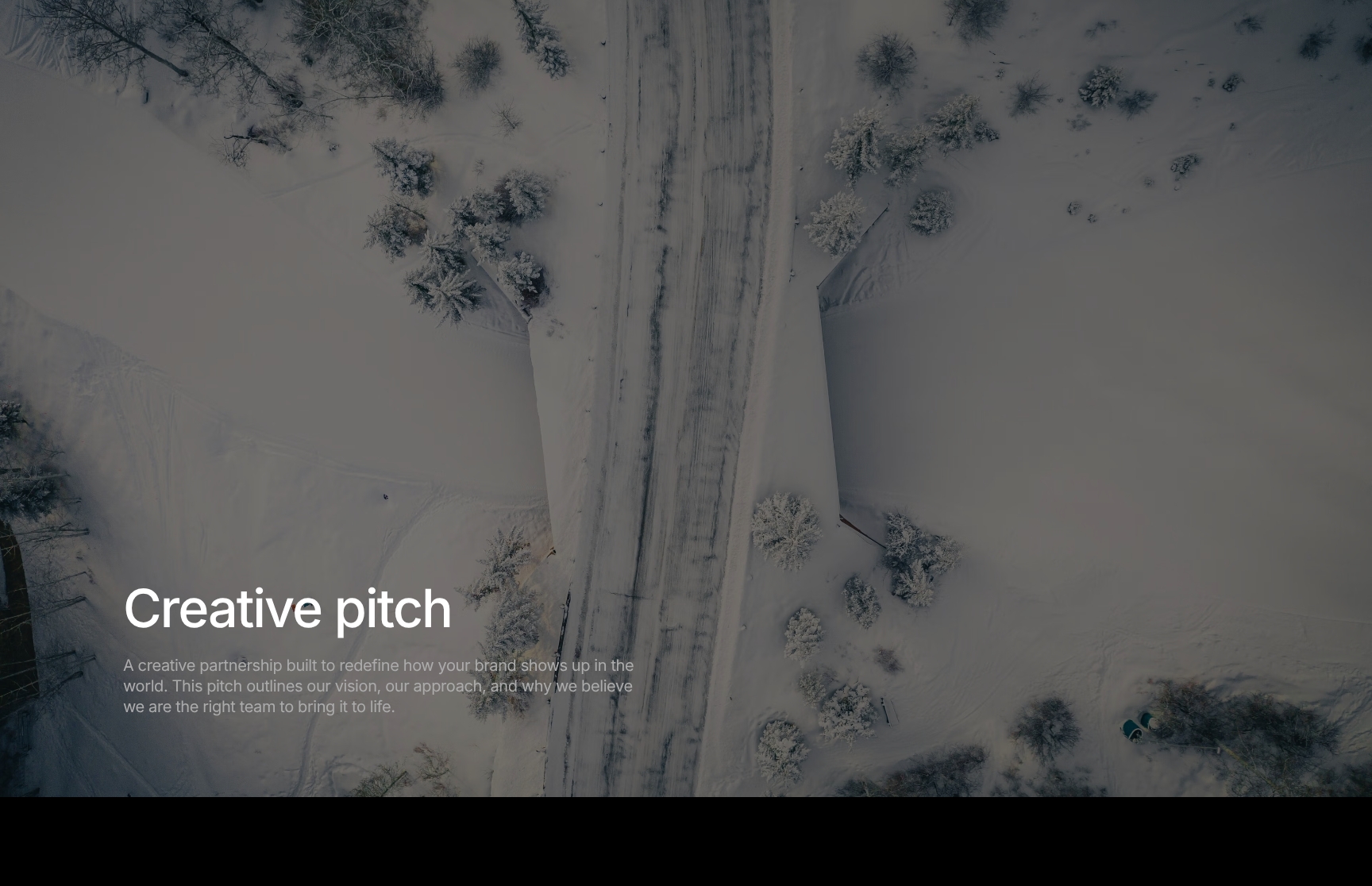
*Creative pitch template*
*Formlio template*
**A follow-up sequence after the pitch**
1. **Same day: send the leave-behind**: Share the full proposal as a link with a short note recapping the problem you solve and the option you recommend.
2. **When it is read: respond to the signal**: If the price section gets attention, offer a call on scope. If a case study does, send a related example or a reference.
3. **Within days: ask a real question**: Ask something that moves the decision, such as who else needs to review it or which option fits their timing best.
4. **On the decision date: check in**: Confirm whether they are ready, what is still open and whether the kickoff slot you are holding still works.
According to [TrinityP3's State of the Pitch research, reported by Mediaweek](https://mediaweek.com.au/agencies/89-of-agencies-not-paid-pitch-fees-trinityp3s-inaugural-state-of-the-pitch-report), 89% of agencies unsuccessful in pitches were not paid a fee by the client.
A losing pitch is rarely paid for, so every hour spent on it has to earn its keep. A pitch that answers the same buyer questions clearly every time is easier to choose, easier to defend for the person who has to choose it, and cheaper for you to produce again.
[New research from the PRCA](https://prca-uk.prezly.com/average-pr-agency-spends-ps11k-on-pitching-every-year-new-research-3188969) found that the average agency undertakes 27 pitches to win new contracts every year, with 62 hours spent on average per pitch.
That effort is the reason to treat the leave-behind as a reusable asset. Build it once from strong, repeatable sections, then tailor the opening and the proof for each buyer.

*The meeting starts the decision. The leave-behind finishes it.*
*Photo: Moe Magners*
This is where Formlio fits. You build the pitch as an interactive web proposal from blocks: the opening built on your research, portfolio and gallery blocks for case studies, a timeline block for the roadmap and a pricing block where the buyer compares your options and toggles add-ons while the total updates. It is the same document you present in the room and the one you leave behind.
After you hit send, you get a notification when the proposal is opened, and section-level analytics show how long each reader spent on the case studies or the investment. A PDF goes into a black box. A Formlio document reports back: who opened it, what they read, when they signed. When the buyer is ready, they approve with Slide-to-Approve or sign with an e-signature inside the document.
## FAQ
### How long should a digital agency pitch deck be?
Short enough to read in a single sitting, with each section answering a buyer doubt: their situation, your approach, proof, team, boundaries, investment and next steps. Cut any section that exists only because every deck has one.
### Should agencies charge for pitching?
Paid pitches are fair when the client asks for original creative work, because that work has value. For a standard proposal based on your research and past work, many agencies pitch without a fee but limit the speculative design they include.
### What should a design studio include in a pitch besides case studies?
An opening built on research into the prospect, a clear approach shown as a roadmap, the team who will do the work, a short list of what you will not do, tiered pricing and a next step with a decision date.
### How do you show pricing in a pitch without losing the deal?
Show options rather than a single number, map each to deliverables and measures, and mark the one you recommend. In Formlio, a pricing block lets the client toggle options and see the total update, so they choose a scope instead of rejecting a price.
### How do you pitch when you have no case studies in the client's industry?
Choose work that shares the client's problem or stage of growth, and say so openly. Back it with a sharp observation from your research into their business, which proves understanding better than a sector match.
### How do you follow up after an agency pitch?
Send the full proposal as a link the same day, respond to what the buyer actually reads, ask a question that moves the decision and check in on the agreed decision date.
## Pitch with a proposal your buyer can explore
Build your pitch from blocks, share it as a link, see who reads what and let the client approve inside the document.
[Start free](https://formlio.com/templates/creative-pitch-template)
## Sources
1. [early mentions of the competition increase the odds of winning an enterprise deal by 32% over not discussing the competition](https://www.gong.io/blog/here-are-the-5-best-sales-insights-of-2023)
2. [TrinityP3's State of the Pitch research, reported by Mediaweek](https://mediaweek.com.au/agencies/89-of-agencies-not-paid-pitch-fees-trinityp3s-inaugural-state-of-the-pitch-report)
3. [New research from the PRCA](https://prca-uk.prezly.com/average-pr-agency-spends-ps11k-on-pitching-every-year-new-research-3188969)
## Related
- [The complete guide to pitch decks for creative agencies](https://formlio.com/blog/pitch-deck-creative-agencies-guide)
- [5 ways to present a proposal that builds client confidence](https://formlio.com/blog/present-proposal-client-confidence)
- [Why your next proposal shouldn't be a PDF](https://formlio.com/blog/why-web-proposals-beat-pdfs)
- [Brand design proposal: what brand designers need to show to win new clients](https://formlio.com/blog/brand-designers-proposal-win-new-clients)
- [Four actionable strategies for proposals that win clients](https://formlio.com/blog/actionable-proposal-strategies-win-clients)
- [Ten essential tips for creating engaging proposals that convert](https://formlio.com/blog/tips-creating-engaging-proposals-convert)
---
---
title: "Retainer vs project proposal: which wins more clients"
description: "Which proposal format wins the client: retainer, project or both? Read the buyer's signals, then see a single engagement written three ways."
canonical: "https://formlio.com/blog/retainer-vs-project-proposal"
locale: "en"
type: "post"
date: "2026-03-16"
category: "Trends & Insights"
alternates:
fr: "https://formlio.com/fr/blog/proposition-commerciale-retainer-vs-projet.md"
---
# Retainer vs project proposal: which wins more clients

Project proposals win more first-time clients because they ask for less commitment and end on a date. Retainers win when the work is ongoing and the buyer owns a recurring budget. The format that wins most often for a design studio is a scoped project with an optional retainer tier the client can accept in the same document.
THE DEFINITIONS
## Define what you are actually pitching: retainer, project or project retainer
A project retainer is a prepaid, scoped block of work with an end date. A retainer is a recurring monthly fee for ongoing access, hours or deliverables. A contract is the legal agreement that holds either one: the pricing model sits inside the contract, it doesn't replace it.
### Project or retainer: the edges are different
A project proposal is defined by its edges. It has a start date, an end date, a written scope and a price for the whole engagement, either fixed or estimated. A brand identity, a website redesign or a launch campaign fits this shape: the client has a specific need, and you propose a specific result.
A retainer proposal is defined by continuity. The client pays a recurring fee, usually monthly, and in return gets your time, a set of outputs or simply access to your team. Ongoing design support, content production, social assets and product design for a team that ships every sprint all fit this shape. The work doesn't stop after a single delivery, so the relationship doesn't either.
### What a project retainer is, and how it differs from a contract
The phrase project retainer confuses people because it mixes both. In practice it means the client prepays for a defined block of work, often in instalments, and the studio reserves capacity for it. It has a scope and an end date like a project, and a payment rhythm like a retainer. Freelancers often use it to protect a booking: the client pays upfront to hold the dates.
The retainer vs contract question has a simpler answer. A contract is the legal wrapper: parties, terms, payment, ownership, termination. A retainer is a pricing and engagement model that the contract describes. You can have a contract for a fixed project, a contract for a monthly retainer, or a contract that holds both. Asking whether to sign a retainer or a contract is like asking whether to buy a car or a key.
### What a retainer means in marketing and design
In marketing, a retainer usually means a monthly fee for an agency or freelancer to stay on call for a brand: campaigns, content, reporting and the small requests in between. Design studios use the word the same way, with the work tilted toward visual output: brand upkeep, new templates, landing pages, social assets and art direction for shoots.
The retainer you write depends on what the client values most. The table below covers the four common types.
**Choose the retainer type that matches what the client values**
| Retainer type | What the client buys | Fits when | Watch out for |
| --- | --- | --- | --- |
| Hours-based | A block of team time each month | Requests are unpredictable and small | Clients count hours instead of outcomes |
| Deliverables-based | A fixed set of outputs each month | The work repeats in a known pattern | Requests that don't fit the list |
| Access-based | Priority access to your thinking and team | The client values judgment and speed | Always-on expectations with no limit |
| Hybrid | Base deliverables plus extra hours | Some work is planned, some isn't | Separate ledgers for base work and extras |
THE BUYER'S SIDE
## Match the proposal format to the buyer's signals, not your preferred revenue model
Yes, it is cheaper to retain a customer than to get a new customer: winning a new client means pitching, proposals and unpaid time, while keeping an existing client means doing good work. That is why the format you open with should be the one this buyer is most likely to accept, then grow from there.
### Why projects win more first-time clients
Every competitor article on this topic asks which model pays the agency more. That is the wrong question for a proposal. The proposal is the thing being tested, and the buyer decides. A retainer may be better for your cash flow, but if the buyer can't approve it, the proposal loses and the retainer never starts.
Projects win more first-time clients for plain reasons. The commitment is smaller and has an end. The buyer can compare your proposal line by line with others. And the budget usually already exists: someone approved money for a rebrand or a new site, not for an open-ended relationship with a studio they haven't worked with yet.
### Who is in the room has changed
Buying is also getting more formal. Procurement teams now sit in on many creative pitches, and procurement prefers a scope, a price and an end date it can compare.
- **43%** of agencies believe procurement-led pitches have increased ([PRCA](https://www.mynewsdesk.com/uk/prca/pressreleases/prca-research-report-confirms-financial-strain-and-ethical-pitfalls-in-pitch-process-3350965))
### Why retainers win where work is ongoing
Retainers win in different conditions. The work is ongoing by nature. The buyer owns a recurring budget, such as a marketing or product line, rather than a single project fund. And there is trust already: they've worked with you, or with a studio like you, and know the cost of briefing someone new every time.
Pitching is also a coin toss for the studios that do it most. Even agencies that pitch for a living lose often, which is a strong argument for keeping the clients you already have.
- **50\.3%** pitch-win rate in 2021 ([OUCH! Factor Survey, Mediaweek](https://www.mediaweek.com.au/ouch-factor-survey-reveals-what-agencies-spent-on-pitches))
### Read the signals in the discovery call
Read the buyer before you choose the format. The table below is an editorial heuristic, not research: it maps the signals you can pick up in a discovery call to the proposal format most likely to be accepted, and the objection to answer on the page.
**Signal-to-format decision table**
An editorial heuristic for choosing the proposal format from the buyer's signals.
| Buyer signal | Lean toward | Objection to answer on the page |
| --- | --- | --- |
| Scope is clear and has a launch date | Project | What happens after launch? |
| Scope is fuzzy or keeps growing in the call | Project retainer or paid discovery | Why pay before the scope is final? |
| Budget owner runs a recurring marketing or product budget | Retainer | What do we get each month? |
| Procurement is involved | Project, with an optional retainer tier | How do we compare this with other bids? |
| First project together | Project, with an optional retainer tier | Why commit before seeing your work? |
| Repeat client with steady requests | Retainer | Are we paying for time we don't use? |
| Seasonal or campaign work | Project | Can we book you again for the next season? |
WORKED EXAMPLE
## See the same engagement written three ways: project, retainer and project with a retainer tier
The same brand-and-site engagement can be written as a fixed project, as a retainer or as a project with an optional retainer tier. Each format puts a different question in the client's head. The illustrative example below shows the price breakdown, the likely objection and how the page answers it.
Illustrative example, with made-up figures. Imagine a fictional studio proposing a brand identity and a marketing site to a fictional skincare brand, worth $24,000 in total. The work is the same in every version: discovery, identity, an 8-page site and launch assets over 12 weeks. Only the proposal format changes.
Version A, the fixed project, prices the whole engagement at $24,000, paid as $9,600 at signature, $7,200 at the identity sign-off and $7,200 at launch. Version B, the retainer, spreads the same work over 6 months at $4,000 a month, with a list of monthly deliverables. Version C, the project with a retainer tier, keeps the $24,000 project and adds an optional care plan at $2,500 a month after launch, with a 3-month minimum and a monthly allowance of design requests.
**Example: one $24,000 engagement in three proposal formats**
Illustrative example with example prices for a fictional studio and client.
| | A: Fixed project | B: Retainer | C: Project with retainer tier |
| --- | --- | --- | --- |
| Headline price | $24,000 | $4,000 a month for 6 months | $24,000, plus $2,500 a month optional |
| Paid at signature | $9,600 | $4,000 | $9,600 |
| Client commits to | 12 weeks, fixed scope | 6 months of fees | 12 weeks, care plan optional |
| Likely objection | What happens after launch? | Why pay for 6 months before any concepts? | Do we have to take the care plan? |
| How the page answers it | A short section on handover and support rates | A review date after month 2 with an exit option | The care plan is an add-on, off by default |
| Studio income after launch | $0 until the next project | Ends after month 6 | $2,500 a month if accepted |
### Which version wins, and why
Version A is the easiest to approve and the easiest to compare, which is why it tends to win the first engagement. Its weakness is the cliff after launch: the relationship ends on the day the site goes live.
Version B asks for the most trust. The client is committing to months of fees before seeing a single concept, and nothing on the page can fully remove that worry. It suits a client who already knows you.
Version C, the retainer on-ramp, is usually the strongest for a new client. The decision the client must make is the same as in version A. The retainer is a second, smaller decision they can take now or later, priced next to work they already want. The studio gets a path to recurring income without asking for it up front.
**Write the scope boundaries into every version**
- **Name what is included**: List each deliverable with its format, so nobody argues later about what a page or a logo suite means.
- **Name what is not**: Write the exclusions down: copywriting, photography, hosting or extra languages, whatever the client might assume.
- **Set the revision rounds**: State how many feedback rounds each stage includes and what an extra round costs.
- **Define a request**: For any retainer tier, say what counts as a single request and how quickly you reply.
- **Write the change process**: New work outside scope gets a short written change order with a price before anyone starts it.
MAKING IT CONVERT
## Build the proposal so the client can say yes to the right option
Lead with the project the client asked for, then add the retainer as an optional tier in the same proposal. Give each tier clear deliverables, let the client choose on the page, and read which option they spend time on before you follow up.
### Put the retainer on-ramp in the pricing section
Put the project first and price it in full. Then add the retainer as an optional tier directly below, framed around what the client gets after launch: faster turnaround because you already know the brand, priority access, and a fixed monthly scope. A few retainer tiers are enough. Each tier should list its deliverables, its response time and what happens to unused requests.
In Formlio, an interactive pricing block holds both decisions in a single place. The project sits as the main package, and the retainer tiers sit as optional add-ons the client can switch on or off while the total updates. Approval or an e-signature sits right below, so the client can accept the project, the retainer or both in the same document.
### Use tracking and the end of the project
Watch what the client reads. Formlio tracks views and the time spent on each section, so you can see whether the client lingered on the retainer tiers or skipped them. Time on the care plan suggests a follow-up about after-launch support. A quick skip suggests leaving it for now and raising it again near launch.
Converting a finished project into a retainer is easier than selling a retainer cold. Near the end of the project, list the requests the client has made that sit outside the scope, and show how a retainer would have covered them. Then send a short proposal with that list, a single recommended tier and a start date the day after launch.

*Lead with the project, then let the client add the retainer on the page.*
*Photo: cottonbro studio*
### Keep the margin honest
A retainer only stays profitable if you check it. Set a regular review date with every retainer client, and look at the same few things each time: hours delivered against the fee, requests that fell outside the agreed scope, and whether the client still uses what they pay for. Raise prices or adjust the tier when the pattern is clear, not when you're already frustrated.
**Guardrails to check on every review date**
- **Overservicing**: Compare hours delivered with hours the fee covers, and act on the gap.
- **Out-of-scope requests**: Count them, price them and decide whether they belong in a bigger tier.
- **Unused capacity**: A client who stops using the retainer is about to cancel it; call them first.
- **Change orders**: Check that every project change was written and priced, not absorbed.
- **Tier fit**: Move clients up or down a tier when their real usage no longer matches it.
## FAQ
### How do I convert a project client into a retainer?
Near the end of the project, list the out-of-scope requests the client made and show how a retainer would cover them. Offer a single recommended tier with a start date right after launch, so support continues without a gap.
### How much should a design retainer cost?
Price it from the work, not the hours: estimate the monthly deliverables, cost them at your project rates, then offer a small saving for the commitment. Present it in tiers so the client chooses the level rather than judging a single number.
### Should I offer both options in the same proposal?
Usually yes, as a project with an optional retainer tier. The client makes the familiar project decision first, and the retainer becomes a smaller second choice they can accept now or later, in the same document.
### How long should a retainer contract last?
Start with a short initial term and a review date written into the contract, then roll it over on a notice period. A short first term with an exit option is easier to approve than an open-ended commitment.
### How do I stop scope creep on a retainer?
Define what counts as a request, list what is included and excluded, cap the monthly allowance and write a change-order process for anything extra. Review hours delivered against the fee on a regular date.
### What do clients object to about retainers?
Paying before they've seen results, and paying for time they might not use. Answer both on the page: a review date with an exit option, and a clear rule for unused requests.
## Put both options in your next proposal
Build the project and an optional retainer tier in a single document, let the client choose on the page, and see which option they read after you hit send.
[Start free](https://formlio.com/templates)
## Sources
1. [PRCA](https://www.mynewsdesk.com/uk/prca/pressreleases/prca-research-report-confirms-financial-strain-and-ethical-pitfalls-in-pitch-process-3350965)
2. [OUCH! Factor Survey, Mediaweek](https://www.mediaweek.com.au/ouch-factor-survey-reveals-what-agencies-spent-on-pitches)
## Related
- [How to present pricing to clients in a proposal: layout, order and wording](https://formlio.com/blog/how-to-present-pricing-to-clients)
- [Innovative pricing models for creative services: a value-based method](https://formlio.com/blog/value-based-pricing-creative-services)
- [How to address pricing pushback without lowering your rates](https://formlio.com/blog/pricing-pushback-keep-rates)
- [How to spot problematic clients before you write a proposal](https://formlio.com/blog/spot-problematic-clients-before-proposal)
- [Four actionable strategies for proposals that win clients](https://formlio.com/blog/actionable-proposal-strategies-win-clients)
- [Managing client relationships in creative projects, from proposal to close](https://formlio.com/blog/manage-difficult-clients-creative-industry)
---
---
title: "Boutique agency vs. big agency: A guide to choosing the right partner"
description: "Big agency or boutique? Discover the key differences in team structure, senior-level attention, and agility to help you choose the right partner."
canonical: "https://formlio.com/blog/boutique-agency-vs-big-agency-how-to-choose"
locale: "en"
type: "post"
date: "2025-09-08"
category: "Strategy & Growth"
alternates:
fr: "https://formlio.com/fr/blog/agence-boutique-vs-grande-agence-choisir-partenaire.md"
---
# Boutique agency vs. big agency: A guide to choosing the right partner

It’s a story many clients know by heart. You’re wowed by a major agency's senior-level pitch, impressed by their dazzling case studies, and confident in their ability to deliver. But once the contract is signed, the "A-team" that sold you the vision seems to vanish, replaced by a more junior team. The process can feel slower, the ideas diluted, and getting a simple response can be a challenge.
This potential "bait and switch" scenario is one of the primary drivers behind a major shift in the creative industry. Clients are increasingly looking for a different way of working, leading to the rise of a new force: the agile, expert-led boutique agency.
## Defining the terms: boutique vs. big agency
Before we dive deeper, it helps to establish a clear understanding of what we mean when we talk about "boutique" and "big" agencies.
- **The Boutique Agency:** A boutique agency is typically a smaller, often founder-led firm characterized by its deep specialization. Instead of trying to do everything for everyone, they focus on a specific niche, service, or industry. The core appeal is direct access to senior-level experts and an agile, hands-on approach to partnership.
- **The Big Agency:** A big agency, often called a "network agency," is a large firm, frequently part of a global holding company. Their strength lies in their scale and reach. They offer a vast range of services across numerous industries and have a worldwide footprint, making them equipped to serve large, multinational clients.
The debate isn't about which model is inherently "better," but about understanding their different structures and which is the right fit for a specific client's needs.
## The "bait and switch": a potential client frustration
This isn't just an occasional mishap; it's a structural challenge in the traditional, scaled agency model that can leave some clients feeling burned.
### The allure of the "A-team" pitch
Large agencies, with their deep benches of talent, are masters of the pitch. They often bring their most senior, experienced, and charismatic leaders to the initial meetings. This is a deliberate strategy designed to build confidence and win the business by showcasing top-tier, strategic expertise. The client buys into the promise of working directly with these proven industry leaders.
### The reality of the junior delivery team
Once the deal is closed, the economics of a large agency can sometimes dictate a different reality. The senior "A-Team" may move on to the next pitch, and the day-to-day work is handed off to a less experienced, more junior team. While this certainly isn’t true for all large firms, it’s a known risk in any model where the pitch team is fundamentally different from the delivery team. For the client, the consequences are palpable: communication slows down, strategic oversight wanes, and the powerful ideas presented in the pitch can become diluted in the execution.
## The boutique model: a focus on direct expertise and agility
The rise of the boutique specialist is a direct response to these potential flaws in the traditional model. Smaller, more focused agencies are often built to deliver a fundamentally different client experience.
### Senior-level attention and accountability
With a boutique agency, "what you see is what you get" is often the core promise. The senior experts who pitch the work are typically the ones leading the strategy and executing the project. Founders and senior staff have more "skin in the game," which leads to a higher level of care and accountability. The relationship feels less like a transaction and more like a true partnership.
### Agility and speed in a fast-moving market
Boutique agencies are, by their nature, more nimble. Free from the layers of bureaucracy and internal silos that can slow down larger firms, they can respond faster, iterate more quickly, and adapt to changing client needs with greater ease. In a market that demands rapid execution, this agility is a crucial competitive advantage.
## It's not just about size: a more nuanced view
While the trend towards boutiques is clear, a truly strategic analysis shows the issue is more complex than a simple "boutique good, big bad" debate.
It's crucial to state that this is not an attack on large agencies. Many of the world's most successful and respected firms are large, and they are famous for their premium service, deep resources, and excellent processes. The issue is not one of size, but of structure and leadership. A well-led large agency can be a powerhouse of efficiency and expertise. The debate, therefore, is less about "big vs. small" and more about the specific model that best fits a client's needs.
### The importance of the right fit
The best choice always depends on the client's specific needs. A global corporation launching a product in 20 countries often requires the scale, governance, and worldwide reach that only a large network agency can provide. Similarly, for massive-scale media buying, the negotiation power of a large agency is invaluable.
### The client's role in the process
Clients and their procurement departments also play a role in creating the "bait and switch" problem. When a client's process is designed to negotiate "rock-bottom rates," they are often unintentionally forcing the agency to staff the account with more junior, less expensive talent. As one expert in your research noted, "you will definitely get what you paid for."
## The future is specialized and client-centric
The rise of the boutique specialist, alongside a push for more agile structures within larger firms, is a direct response to a market that increasingly values direct access to expert talent, greater accountability, and nimble execution. This shift represents a major opportunity for well-positioned boutique agencies and a call for all agencies, regardless of size, to focus on a truly client-centric way of working.
## Related
- [How to start a creative agency the smart way](https://formlio.com/blog/start-creative-agency-smart-way)
- [8 ways to make your design studio stand out](https://formlio.com/blog/design-studio-stand-out)
- [A creative industry's guide to the RFP process](https://formlio.com/blog/creative-industry-guide-rfp-process)
- [Why authenticity, personality and human touch are the keys to agency success](https://formlio.com/blog/agency-success-2025-authenticity-personality-human-touch)
---
---
title: "What makes a winning marketing proposal: build it around the client's decision"
description: "What makes a winning marketing proposal? Structure it around the client's decision: clear scope, visible price, real proof, one next step and a timed follow-up."
canonical: "https://formlio.com/blog/winning-marketing-proposal-key-elements"
locale: "en"
type: "post"
date: "2026-04-06"
category: "Strategy & Growth"
alternates:
fr: "https://formlio.com/fr/blog/proposition-commerciale-marketing-gagnante.md"
---
# What makes a winning marketing proposal: build it around the client's decision

A winning marketing proposal is not a list of services. It is a decision document that shows the client you understood them, that the plan fits, that the price is justified and what happens next.
THE DECISION TEST
## Define what makes a marketing proposal win
A winning marketing proposal helps the client decide: it proves you understood their goal, shows a plan that fits, justifies the price and names the next step, and the work that decides it starts in discovery, before you write a word.
A client who asks for a marketing proposal is already interested. Interest is not commitment, though, and the gap between them is where proposals stall. The typical losing proposal describes services without the thinking behind them, lists deliverables without tying them to outcomes, and drops a price with no context. The client finishes reading informed but not ready.
Flip the question. Instead of asking what a marketing proposal should contain, ask what the person reading it needs to see before they can say yes, and what they need to show their boss, their finance lead or their founder. Every section either answers one of those needs or it gets cut.
That shift matters for agencies, studios and freelancers selling brand, content and campaign work, because the buyer is often judging something they cannot touch yet. A campaign does not exist until it runs. The proposal is the only evidence they have, so it carries more weight than the deck you sent last year or the logo wall on your site.
[Mediaweek reports](https://www.mediaweek.com.au/ouch-factor-survey-reveals-what-agencies-spent-on-pitches) that the pitch-win rate in 2021 was 50.3%, higher than the 48% recorded in 2020.
Read that the other way round: even agencies that pitch for a living lose a large share of the work they chase, and every losing pitch still costs the hours it took to make.
New research reported by the [PRCA](https://prca-uk.prezly.com/average-pr-agency-spends-ps11k-on-pitching-every-year-new-research-3188969) found that the average agency undertakes 27 pitches to win new contracts every year, with 62 hours spent on average per pitch.
- **50\.3%** pitch-win rate in 2021 ([Mediaweek](https://www.mediaweek.com.au/ouch-factor-survey-reveals-what-agencies-spent-on-pitches))
- **62 hours** spent on average per pitch ([PRCA](https://prca-uk.prezly.com/average-pr-agency-spends-ps11k-on-pitching-every-year-new-research-3188969))
That is a lot of effort to spend on documents that lose. The fix is not more pages. It is a proposal that makes the client's decision easier, starting from the reasons clients walk away.
Clients judge your thinking first. A proposal that shows how you reasoned about their problem answers their doubts before they start.
**The four checks a buyer runs before approving**
1. **They understood me**: The opening restates the client's goal and problem in their own words, not a paragraph about your agency's history.
2. **The plan fits**: The strategy names the channels, audience and tactics chosen for this client, with a reason for each choice.
3. **The price is justified**: Every line of the investment maps to a deliverable the client can picture, with options and exclusions stated plainly.
4. **I know what happens next**: The document ends on a single, obvious action: approve, pick an option, or book a short call on a named date.
Discovery is the biggest lever you have on all four checks. A proposal written after a real discovery conversation can quote the client's own words back to them, pick the right channels and price the work that actually matters. A proposal written from a brief alone guesses, and clients feel the guessing.
Speed of contact matters as much as depth. One practical habit comes from enterprise sales: book the second meeting while you are still in the first one.
As First Round Review reports in [The Most Surefire Way I've Found to Win Enterprise Deals](https://review.firstround.com/the-most-surefire-way-ive-found-to-win-enterprise-deals), Chopra-McGowan's team requests a follow-up meeting within 24 hours of the first client meeting, scheduling both at the same time upfront and sometimes holding it the same day.
> When traveling to meet a client, we've found it works great to request a follow-up meeting within 24 hours of the first one (schedule both at the same time upfront)
>
> — [Chopra-McGowan, General Assembly](https://review.firstround.com/the-most-surefire-way-ive-found-to-win-enterprise-deals)
For a creative studio, that second meeting is the perfect place to walk through a rough outline of the proposal before it is final. The client corrects your assumptions while they are cheap to fix, and the finished document lands as something they helped shape.
THE ANATOMY
## Structure the proposal around the client's decision
Order the marketing proposal the way a buyer decides: summary, problem, approach, scope, timeline, investment, proof and next step, and treat any template or list of marketing strategy types as a starting skeleton, never the finished argument.
Section order is not decoration. It is the sequence in which a client builds confidence. Open with the goal, earn agreement on the problem, then show the plan, and only then talk about money. When price arrives before the client believes the plan fits, every number feels high.
The executive summary deserves the heaviest rewriting. Open on the client's goal, not your agency. A single short paragraph that names what they want to achieve, what is in the way and what you propose to do about it gives a busy reader the whole proposal in a glance. Everything after it is detail for the people who need detail.
**Section order and the question each section answers**
| Section | Question it answers for the buyer | Keep it to |
| --- | --- | --- |
| Executive summary | Did they get what we want to achieve? | A short paragraph |
| The problem | Do they understand what is in our way? | The client's own words |
| Approach and strategy | Does the plan fit our channels and audience? | A reason per tactic |
| Scope and deliverables | What exactly do we get, and what is excluded? | Named outputs and revision limits |
| Timeline | When does it start and when do we see results? | Phases with dependencies |
| Investment | Is the price justified and what are our options? | A small set of clear options |
| Proof | Have they solved a problem like ours? | Relevant work only |
| Next step | What do we do now? | A single action |
Scope is where trust is won or quietly lost. "Social media management" means nothing until you say which channels, how often you post, whether content creation is included and what reporting looks like. Left vague, the client fills the blanks with their own expectations, and those rarely match yours. Write what the client receives, write what is excluded, and write how many revision rounds each deliverable includes. Exclusions feel awkward to write, yet they protect the relationship once the work starts.
Strategy and tactics should be tailored to the client's channels and goal. If you recommend content, say why content is the right lever for this client now. If you propose moving paid budget, show the reasoning. Clients do not need to agree with every detail. They need to see analysis, not a plan you reuse for everyone.
People often ask what the main types of marketing strategies are. The usual list covers content, social, email, search, paid media, influencer and partnership or affiliate work. In a proposal, naming the category matters less than explaining why the chosen mix fits this client's audience.
Tie success metrics to business outcomes the client already tracks: qualified leads, bookings, sales or retention. Vanity metrics such as reach or impressions can support the story, but they should never be the headline promise.
**Scope checklist before you send**
- **Deliverables named**: Each output is described as the thing the client receives, not as an activity your team performs.
- **Exclusions stated**: Work that sits outside the engagement is listed, along with how you would quote it if the client asks.
- **Revision limits set**: Each deliverable carries a stated number of revision rounds and what counts as a new request.
- **Client inputs listed**: Approvals, assets and access the client must provide are written next to the phase that depends on them.
- **Metrics agreed**: Success measures are outcomes the client already reports on, with the baseline you will compare against.
Where do you find a template for a marketing proposal? Proposal tools, agency communities and design marketplaces all publish them. Use a template for structure and layout, then rewrite every sentence for the client in front of you. A template that still reads like a template tells the client they are one of many.
PRICE AND PROOF
## Show your pricing and proof so the client can say yes
Present the price as a set of clear options with your recommendation marked, separate pass-through costs such as ad spend, and back the whole proposal with proof that matches the client's problem, so the decision feels low risk.
Pricing is where many marketing proposals lose the momentum they built. The client has read the strategy, liked the scope, felt more confident with every section, and then meets a number with no context. Without a visible link between the price and what it buys, even a fair fee reads as a risk.
Tiered options solve a pair of problems at once. They turn "yes or no" into "which one", and they let the client see what each level adds. Mark the option you recommend and explain why it fits their goal. The options on either side frame it: a lighter version for a tighter budget, a fuller version for a client who wants more reach. Each tier should tell a distinct story, so the client knows exactly what they gain by moving up and what they give up by moving down.
Some clients want a single price. That works too, as long as you break the cost down by phase or deliverable so they can see where the budget goes. Transparency does not weaken your position. A client who understands the price can defend it internally, and that internal defence is often the real approval step.
In [Simon-Kucher's global pricing study](https://www.simon-kucher.com/en/who-we-are/newsroom/global-pricing-study-2016-every-second-company-involved-price-war), 50 percent of interviewees said the most suitable option is to improve the value communication of products.
For a studio, value communication is the proposal itself: the link between each line of the price and what it buys.
**Payment structures and when each fits**
| Structure | Fits best when | Watch out for |
| --- | --- | --- |
| Fixed fee | Scope is well defined, such as a brand refresh or a launch campaign | Scope creep without clear exclusions |
| Monthly retainer | Work is ongoing, such as content, social or paid media management | Vague monthly deliverables that invite debate |
| Phased payments | A larger project runs through distinct stages with sign-off between them | Phases that start before the previous one is approved |
| Pass-through costs | Ad spend, printing, licences or talent are paid on the client's behalf | Mixing them into your fee, which inflates the headline price |
State pass-through costs separately. Ad spend, stock licences, printing and talent fees belong on their own line, ideally paid directly by the client or billed at cost. Folding them into your fee makes your work look more expensive than it is and hides the part of the budget the client controls.
Proof reduces perceived risk, but only when it is relevant. A case study about e-commerce sales will not reassure a B2B client who needs qualified leads. Pick work that mirrors the client's industry, problem or scale, and write it as challenge, approach and result in a short paragraph. If you project a return, show the assumptions and say plainly that it is an estimate, not a promise.
No case studies yet? Show your thinking instead. A short audit of the client's current channels, a sample content calendar or a mock-up of a single campaign asset proves capability better than borrowed claims. Testimonials from past collaborators, even outside marketing, can speak to how you work.
**Ways to lower the risk of saying yes**
- **Clear terms**: Payment schedule, cancellation notice and ownership of the work are written in the proposal, not sent later.
- **A defined first phase**: A smaller opening phase with its own sign-off lets a cautious client start without committing to everything.
- **Honest caveats**: Projected results come with the assumptions behind them, which reads as confidence rather than hedging.
- **A single next step**: One action closes the document, so the client never wonders whether to reply, call or sign.
WORKED EXAMPLE
## Follow a winning proposal from first screen to signature
Here is an illustrative marketing proposal from a small design studio for a fictional brand and campaign project, annotated block by block to show what each element does for the buyer's decision.
Illustrative example: a fictional studio, North Room, proposes a 12-week brand refresh and launch campaign to a fictional coffee roaster, Harbour Beans, which wants to sell more subscriptions online.
**Opening lead.** "Harbour Beans wants 400 new monthly subscribers by spring. Your coffee is loved in the shop, but online it looks like every other roaster. This proposal shows how we close that gap in 12 weeks." The lead restates the client's goal in their words and names the gap before mentioning the studio once.
**Scope block.** Weeks 1 to 3 cover discovery and brand refresh: a refined logo, palette and packaging system. Weeks 4 to 8 cover campaign creative: a launch film of 60 seconds, 12 social posts and 3 email designs. Weeks 9 to 12 cover launch support and a results review. Excluded: paid media buying, website rebuild and photography beyond 1 shoot day. Each deliverable includes 2 revision rounds.
**Illustrative example: the investment block**
| Option | What it includes | Fee |
| --- | --- | --- |
| Refresh | Brand refresh and packaging system only | $14,000 |
| Launch (recommended) | Refresh plus launch film, 12 social posts, 3 email designs | $26,000 |
| Launch plus | Launch plus 3 months of monthly content after launch | $38,000 |
| Ad spend (pass-through) | Paid social budget, paid directly by the client | $6,000 suggested |
For example, look at what each block of the North Room proposal does. The suggested option sits in the middle and is labelled, so the $14,000 option frames it as a fair step up and the $38,000 option frames it as sensible rather than stretched. Ad spend of $6,000 sits on its own row, so the studio fee stays honest and the client keeps control of the media budget.
Payment is split into $10,400 on signature, $7,800 at week 6 and $7,800 at launch, which keeps cash moving for the studio and ties the client's payments to visible progress.
The call to action is a single line: "Pick an option and approve by 14 March to start on 1 April." There is no "let us know your thoughts", which invites a reply with no decision in it. A date, an option and an approval is everything the client needs to move.

*The proposal is the first piece of work the client sees from you.*
*Photo: Mikael Blomkvist*
Notice what the example leaves out. There is no agency history up front, no list of every service the studio offers, and no wall of text about process. Each block answers one question from the buyer's checklist, and the document ends the moment the decision is ready to make.
DESIGN AND FOLLOW-UP
## Design the proposal to be read, tracked and followed up
A proposal should look like one clear idea per block, a visible price, on-brand type and short copy, and the rule of threes in marketing adapts well to it, while the follow-up after you hit send decides as much as the design.
A marketing proposal is a piece of marketing. If the document looks generic or cluttered, the client wonders whether your work for them will look the same. Treat it as your first deliverable. Keep one idea per block, make the price easy to find rather than burying it at the end, use the client's brand or your own type system consistently, and cut any sentence that does not help the decision.
The rule of threes people quote in marketing is not a standard proposal rule, but it adapts well. Make the offer clear within the first few seconds on screen. Give a short set of options in the pricing, with a single recommendation. Back the plan with a small number of proof points that match the client's problem. Treat it as a design constraint that keeps the document lean.
Consider how the proposal travels. Your contact forwards it to a finance lead, a co-founder or a board member. A link that reads well on a phone keeps moving through that chain. A heavy attachment that breaks on a small screen stalls at exactly the wrong moment.
**Layouts that read well on any screen**

*Photo: Tranmautritam*

*Photo: Pavel Danilyuk*
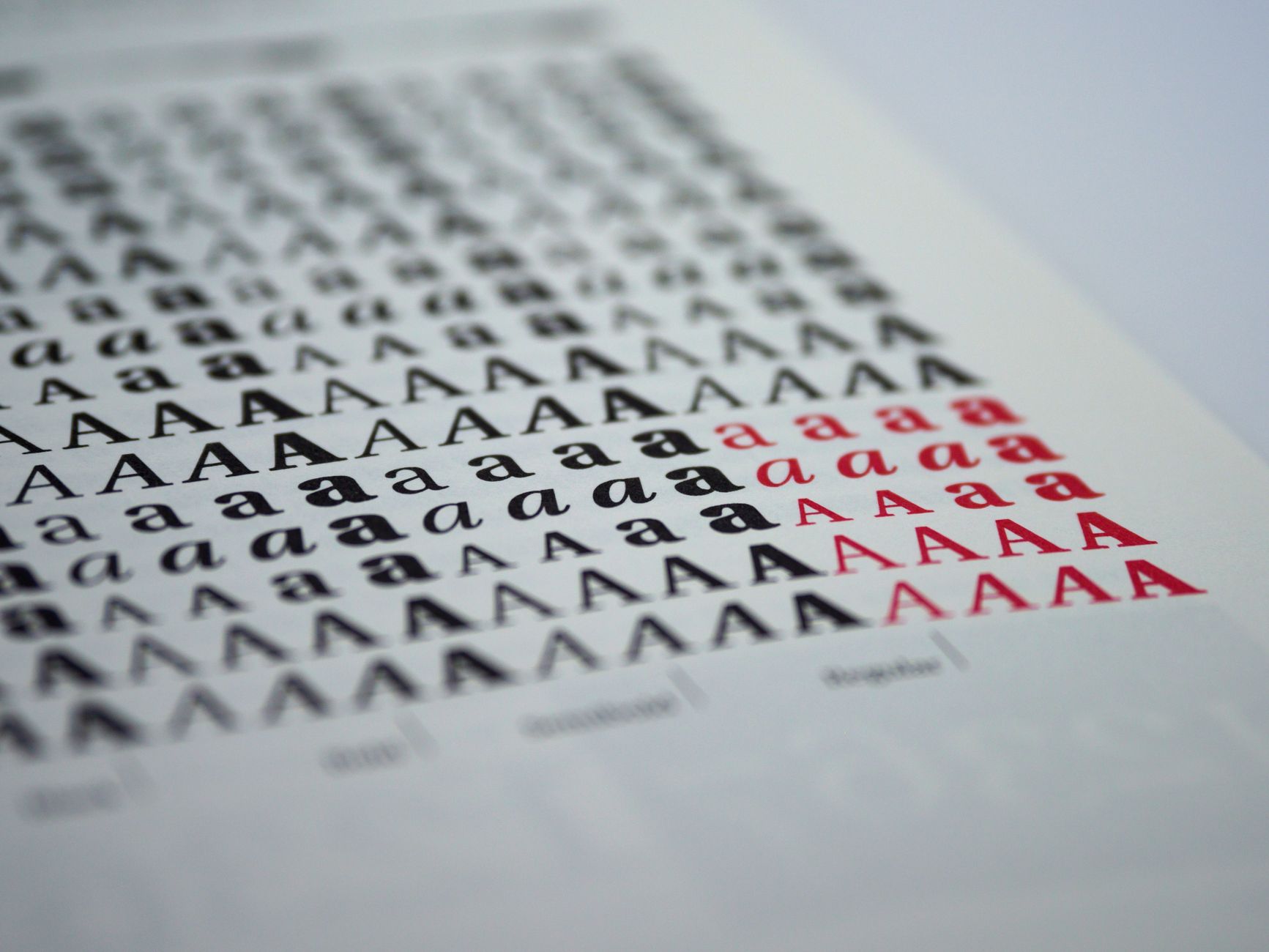
*Photo: Brett Jordan*
Then comes the part many guides skip: what you do after you hit send. Silence after a proposal is normal. It usually means the client is busy, waiting on someone else or unsure about one section. A well-timed follow-up that adds something useful is part of the proposal, not an afterthought.
- **6\.9%** average reply rate after a follow-up email ([HubSpot](https://blog.hubspot.com/sales/follow-up-sales-email-templates-instead-checking-in))
Those figures come from outreach in general, not proposals alone, so treat them as a floor. A client who asked for your proposal is warmer than a cold prospect. The lesson still holds: a single follow-up is worth sending, and waiting a few days gives the client room to read without feeling chased.
In [Gong's analysis](https://www.gong.io/blog/data-shows-these-3-seller-mistakes-are-costing-you-time-and-money), when sellers sent an additional email to prospects who hadn't responded, win rates more than doubled compared to not sending anything further.
Proactive follow-up is also what keeps clients once you win them.
[RSWUS research](https://www.rswus.com/news-stories/new-agency-business-expected-to-rise/) found that when marketers were asked why they decided to review new agencies, 45% cited lack of proactivity by their current agencies, up from 30% the previous year.
**A follow-up plan that respects the client**
1. **Recap the call quickly**: Send a short recap the same day as the discovery meeting, with the date you will deliver the proposal.
2. **Wait, then add value**: If the proposal goes quiet, follow up after a few days with something new: a relevant piece of work or a pointed question.
3. **Ask about one section**: Name the part of the proposal the client seemed to linger on and offer a short call about it.
4. **Close the loop**: If nothing moves, send a polite final note that leaves the door open and keeps the relationship warm.
This is where Formlio fits. A PDF goes into a black box. A Formlio document reports back: who opened it, what they read, when they signed. You get a notification when the client opens the proposal, section-level analytics show how long they spent on scope or pricing, and heatmaps show where attention went. That turns "just checking in" into a follow-up about the exact section that stalled them.
The proposal itself is built from blocks, so one idea per block is the default rather than a discipline. Interactive quoting lets the client toggle optional add-ons and pick a tier while the total updates, and slide-to-approve or e-signature puts the single next step inside the document.
## FAQ
### How should a proposal look?
Clean and short: one idea per section, the client's goal at the top, a price that is easy to find, consistent type and colours, and a single next step at the end. It should read well on a phone, because it will be forwarded.
### What are the 7 types of marketing strategies?
Common lists include content, social media, email, search, paid media, influencer and affiliate or partnership marketing. In a proposal, explain why the mix you chose fits the client rather than listing every type.
### What is the rule of threes in marketing, and does it apply to proposals?
It is not a formal proposal rule. A useful adaptation is to make the offer clear within seconds, give a short set of price options with a recommended pick, and back the plan with a few proof points that match the client's problem.
### Where can I find a template for a marketing proposal?
Proposal tools, agency communities and design marketplaces publish templates. Formlio has a template library built for the creative industry. Use any template for structure, then rewrite every line for the client.
### Should I include pricing in the first proposal or after a call?
Include it, ideally after a discovery call so the options match what the client told you. A proposal without a price delays the decision and pushes the real conversation to another round.
### How do I write a marketing proposal when I have no case studies?
Show your thinking instead: a short audit of the client's current channels, a sample calendar or a mock-up of a single asset. Testimonials about how you work from past collaborators also help.
### What is the difference between a marketing proposal and a marketing plan?
A proposal asks the client to hire you and covers scope, price and next steps. A plan is the detailed working document you build once the engagement starts.
## Build your next marketing proposal with blocks
Make an on-brand proposal in minutes, see when the client opens it and which section they read, and let them pick an option and approve inside the document.
[Start free](https://formlio.com/templates)
## Sources
1. [Mediaweek reports](https://www.mediaweek.com.au/ouch-factor-survey-reveals-what-agencies-spent-on-pitches)
2. [PRCA](https://prca-uk.prezly.com/average-pr-agency-spends-ps11k-on-pitching-every-year-new-research-3188969)
3. [The Most Surefire Way I've Found to Win Enterprise Deals](https://review.firstround.com/the-most-surefire-way-ive-found-to-win-enterprise-deals)
4. [Simon-Kucher's global pricing study](https://www.simon-kucher.com/en/who-we-are/newsroom/global-pricing-study-2016-every-second-company-involved-price-war)
5. [HubSpot](https://blog.hubspot.com/sales/follow-up-sales-email-templates-instead-checking-in)
6. [Gong's analysis](https://www.gong.io/blog/data-shows-these-3-seller-mistakes-are-costing-you-time-and-money)
7. [RSWUS research](https://www.rswus.com/news-stories/new-agency-business-expected-to-rise/)
## Related
- [5 ways to present a proposal that builds client confidence](https://formlio.com/blog/present-proposal-client-confidence)
- [Ten essential tips for creating engaging proposals that convert](https://formlio.com/blog/tips-creating-engaging-proposals-convert)
- [Four actionable strategies for proposals that win clients](https://formlio.com/blog/actionable-proposal-strategies-win-clients)
- [Brand design proposal: what brand designers need to show to win new clients](https://formlio.com/blog/brand-designers-proposal-win-new-clients)
- [How to quickly create proposals that feel high-end, with a reusable block library](https://formlio.com/blog/quickly-create-premium-proposals)
- [How to present pricing to clients in a proposal: layout, order and wording](https://formlio.com/blog/how-to-present-pricing-to-clients)
---
---
title: "Ten essential tips for creating engaging proposals that convert"
description: "Ten tips for creative studios on proposals that convert: what to open with, how to frame price, how to follow up, and what to track after you hit send."
canonical: "https://formlio.com/blog/tips-creating-engaging-proposals-convert"
locale: "en"
type: "post"
date: "2025-04-28"
category: "How-To-Guides"
alternates:
fr: "https://formlio.com/fr/blog/conseils-propositions-commerciales-engageantes-convertissent.md"
---
# Ten essential tips for creating engaging proposals that convert

A proposal converts when the client can see their problem, check your proof and say yes without a meeting. These tips are grouped around the decisions that get you there.
OPEN
## Open with the client's problem, not your credentials
To present a proposal that converts, open with the client's problem in their own words, follow with a short summary of what changes for them, and tailor every page to this client. Credentials come later. A client who sees their brief reflected back keeps reading; a client who sees your logo wall skims.
Creative studios tend to open proposals the way they open their website: the studio story, the awards, the client logos. It feels confident. To the person reading, it delays the only thing they came for, which is proof that you understood the brief.
The opening page has a narrow job. It names the problem, says what will be different when the project is done, and tells the reader what you need from them. Everything else can wait a scroll.
The timing pressure starts earlier than many studios assume. [McKinsey's research on how business customers buy](https://www.mckinsey.com/capabilities/growth-marketing-and-sales/our-insights/do-you-really-understand-how-your-business-customers-buy) finds that B2B deals are often lost before a formal RFP process even begins.
**The opening tips**
1. **Tip 1: Lead with the problem**: Restate the client's goal and the obstacle in a few plain sentences, using words from their brief or your discovery call.
2. **Tip 2: Put a short summary first**: Write a single paragraph that says what you will make, what it changes for the client, and what you need them to decide.
3. **Tip 3: Tailor it, even for repeat clients**: Reusing last year's proposal tells a loyal client they are a template. Change the problem statement, the proof and the scope every time.
A useful filter for the opening is the C's of proposal writing: clear, concise and compelling. Clear means a reader outside design can follow it, so swap "brand architecture" for what it does. Concise means cutting anything the client would not miss. Compelling means the client can see themselves in the outcome.
Length matters for the same reason. A long proposal is not read; it is searched for the price. Keep the opening short enough to read on a phone between meetings, and let detail live further down for the people who want it.
PROVE
## Show proof the client can check in seconds
Proof converts when it matches the client's sector and problem and the client can check it at a glance. Pick a few relevant case studies, real testimonials with names, and portfolio images that look like the work they are buying, then cut the rest.
Tip 4 is to pick proof for this client, not for your portfolio. A hospitality brand wants to see hospitality work, or at least work that solved the same kind of problem. Showing everything forces the client to do the matching, and they rarely bother.
Tip 5 is to keep testimonials real and specific. A named person saying what changed after the project carries weight. A vague line with no name reads as filler, and an invented quote can undo years of trust when it is found out.
Tip 6 is to let images and short video do the talking. A gallery of finished work, or a short walkthrough of a site you launched, says more than a paragraph about your process.
**Proof that reads at a glance**
**Finished identity work**

*Photo: Monstera Production*
**Launched web projects**

*Photo: Christina Morillo*
**Work in context**

*Photo: ANTONI SHKRABA production*
Proof also earns a second use after you send. [HubSpot's guide to business email templates](https://blog.hubspot.com/sales/sales-email-templates-to-get-and-keep-buyers-attention) advises adding something new to a follow-up, such as a case study, a relevant resource or a direct question, rather than restating the original pitch.
That makes it worth holding back a case study instead of putting all of them in the proposal. The best piece of proof goes in the document; a second, closely matched piece becomes the reason to write back.
PRICE
## Frame the price so the client can say yes
To structure pricing in a creative proposal, itemise scope, deliverables and timeline, then offer tiers or optional add-ons so the client picks a level instead of judging a single number. Tie each line to an outcome, and say plainly what is out of scope.
Tip 7 is to itemise. A single total invites a single question: can you do it for less? A list of deliverables with a timeline shows the client what each part of the fee buys, and it gives both sides a shared record when the scope starts to drift.
Tip 8 is to offer choices. Tiers or optional add-ons change the question from yes or no to which level. The client compares your options with each other instead of with a cheaper studio, and the add-ons replace the discount conversation.
**What the price section should hold**
| Element | What to write | Why it helps |
| --- | --- | --- |
| Scope | Deliverables listed by name | Shows what the fee buys |
| Timeline | Milestones and review points | Sets expectations early |
| Tiers | Good, better and best options | Moves the choice away from yes or no |
| Add-ons | Optional extras with their own price | Replaces discounting |
| Terms | Revision rounds and what is out of scope | Prevents scope creep |
Speed belongs in the price conversation too, because a fast, tailored response is itself a signal of how you will run the project. In The Most Surefire Way I've Found to Win Enterprise Deals on [First Round Review](https://review.firstround.com/the-most-surefire-way-ive-found-to-win-enterprise-deals), Chopra-McGowan says that when traveling to meet a client, her team requests a follow-up meeting within 24 hours of the first one, sometimes even the same day.
For a studio, the lesson is to book the next conversation before the first meeting ends. Bring a rough proposal back while the brief is still fresh, and let the client react to real options instead of waiting for a polished document that misses the point.
EXAMPLE
## See how a single proposal comes together, block by block
Here is a worked example of a proposal built from blocks: each block has a single job and asks the client for one thing, so the reader moves from problem to proof to price to a signature without needing you in the room.
### Price the example project
Illustrative example: a fictional studio pitches an 8-week brand identity project to a local coffee roaster opening its second café. The proposal runs to six blocks. It opens with a summary of the roaster's goal: look established enough for wholesale buyers without losing the neighbourhood feel.
The price block offers three tiers. Essentials at €6,500 covers the logo, palette and type. Studio at €9,800 adds packaging for four products and a short guidelines document. Complete at €14,000 adds signage and a launch kit. An optional add-on, photography for €1,200, sits under all three. The timeline runs over 8 weeks with reviews in weeks 2, 5 and 7, and the sign-off block closes the page.
**The example proposal, block by block**
| Block | What it shows | What it asks of the client |
| --- | --- | --- |
| 1\. Summary | Goal of looking ready for wholesale in 8 weeks | Agree this is the problem |
| 2\. Proof | Two food and drink identities with a named testimonial | Trust the studio has done this before |
| 3\. Scope | Deliverables per tier and 2 revision rounds | Check nothing is missing |
| 4\. Price | €6,500, €9,800 or €14,000, plus €1,200 photography | Pick a tier and any add-on |
| 5\. Timeline | 8 weeks, reviews in weeks 2, 5 and 7 | Confirm the dates work |
| 6\. Sign-off | Approval with the chosen tier | Say yes |
### Why the blocks sit in this order
The order does the persuading. Proof sits before price so the client already trusts the studio when they see the numbers. Scope sits next to price so each tier reads as a set of deliverables, not a figure. The sign-off comes last and asks for exactly one thing.
The same structure works whether you present live or send the link. In a meeting, walk the client through the blocks in order and stop at the price to let them choose. When you send it by email, the proposal has to hold up without you, which is why each block carries its own explanation.

*The middle tier is built around packaging, so the proof and price blocks point there.*
*Photo: Mediamodifier*
CLOSE
## Close with one clear action and track what the client does
You know a client has read your proposal when you can see opens, time spent on each section, visits to the price block and links forwarded to colleagues. Track those signals, then follow up with something new and one clear action the client can take.
### Ask for one thing, then plan the follow-up
Tip 9 is a single call to action. End the proposal with one thing to do, ideally an approval or signature inside the document. A list of next steps or a request to book a call gives the client a reason to wait.
Tip 10 is a follow-up plan you set before you send. Decide when you will write back and what new thing you will bring, so the follow-up is a contribution rather than a nudge.
The wording of a follow-up matters as much as sending one. Phrases that feel polite can still cost you the meeting, and a warm, human opener tends to do better than a pointed reminder.
[Gong's analysis of follow-up emails](https://www.gong.io/blog/7-tips-for-writing-the-perfect-follow-up-sales-email-according-to-science) found a phrase that increases reply rates but decreases meetings booked by 14%. Gong also found a phrase that increases response rates but decreases the odds of booking a meeting by 5%.
Belkins benchmarks quoted on the [HubSpot blog](https://blog.hubspot.com/sales/follow-up-sales-email-templates-instead-checking-in) put the average cold email reply rate at 5.6% and the average reply rate after a follow-up email at 6.9%. The same HubSpot article notes that a second follow-up only increases reply rates by 3.2%, and that sending three follow-ups or more has a negative effect on reply rates.
On timing, a sales author on the [HubSpot blog](https://blog.hubspot.com/sales/follow-up-email-after-meeting-networking) sends a follow-up within 24 to 48 hours of a call, when there are genuine insights left to share.
### Track the signals that matter
Engagement data tells you which of those follow-ups to send, and when. Each signal points to a different next move.
**Signals to track after you hit send**
- **Opens**: Tells you the proposal reached the right inbox. No open after a couple of days means a quick, friendly check on delivery.
- **Time per section**: Shows where attention went. Long time on scope suggests questions, so answer them before they are asked.
- **Price block views**: Repeat visits to pricing mean the client is weighing tiers. Bring a case study that fits the tier they keep returning to.
- **Forwarded links**: A new viewer is often the person who signs. Offer a short call to walk them through the key blocks.
### Close inside the document
This is where Formlio fits. A PDF goes into a black box. A Formlio document reports back: who opened it, what they read, when they signed. You get a notification when the client opens or approves, section-level time, and a heatmap of where attention landed.
The close happens in the same place. Clients pick a tier, toggle optional add-ons and watch the total update, then approve with a slide or an e-signature inside the document. Each proposal also teaches you something for the next one: if clients keep skipping a block, cut it or move it.
## FAQ
### How do you present a proposal so it converts?
Open with the client's problem and a short summary, follow with proof that matches their sector, then show itemised pricing with tiers and a single action to approve. In a meeting, walk through the blocks in that order and pause at the price. By email, make each block explain itself.
### What are the do's and don'ts of presenting a proposal?
Do tailor every proposal, keep the language plain, use real testimonials and end with one clear action. Don't open with your credentials, send a single unexplained total, invent quotes or chase the client with reminders that add nothing new.
### Which three rules make up the C's of proposal writing?
Clear, concise and compelling. Clear means a reader outside your field can follow it, concise means cutting anything the client would not miss, and compelling means the client can picture the outcome.
### How long should a proposal for a design project be?
Short enough that the client reads the opening and the price without skimming. Keep the summary to a single paragraph and move detail further down, where the people who want it can find it.
### How do I know if a client has read my proposal?
A static file tells you nothing once it is sent. A web proposal can show opens, time spent on each section and forwarded links. Formlio sends a notification when a client opens or approves a document and shows where they spent their time.
## Send your next proposal as a link
Build it with blocks, share it with a link and see what the client reads before you follow up.
[Start free](https://formlio.com/templates)
## Sources
1. [McKinsey's research on how business customers buy](https://www.mckinsey.com/capabilities/growth-marketing-and-sales/our-insights/do-you-really-understand-how-your-business-customers-buy)
2. [HubSpot's guide to business email templates](https://blog.hubspot.com/sales/sales-email-templates-to-get-and-keep-buyers-attention)
3. [First Round Review](https://review.firstround.com/the-most-surefire-way-ive-found-to-win-enterprise-deals)
4. [Gong's analysis of follow-up emails](https://www.gong.io/blog/7-tips-for-writing-the-perfect-follow-up-sales-email-according-to-science)
5. [HubSpot blog](https://blog.hubspot.com/sales/follow-up-sales-email-templates-instead-checking-in)
6. [HubSpot blog](https://blog.hubspot.com/sales/follow-up-email-after-meeting-networking)
## Related
- [5 ways to present a proposal that builds client confidence](https://formlio.com/blog/present-proposal-client-confidence)
- [Why your next proposal shouldn't be a PDF](https://formlio.com/blog/why-web-proposals-beat-pdfs)
- [Four actionable strategies for proposals that win clients](https://formlio.com/blog/actionable-proposal-strategies-win-clients)
- [How to quickly create proposals that feel high-end, with a reusable block library](https://formlio.com/blog/quickly-create-premium-proposals)
- [Brand design proposal: what brand designers need to show to win new clients](https://formlio.com/blog/brand-designers-proposal-win-new-clients)
- [Why sales proposals fail and what top closers do differently](https://formlio.com/blog/why-sales-proposals-fail)
---
---
title: "The best fonts for pitch decks and creative proposals in 2025"
description: "Elevate creative proposals in 2025! Explore key font trends (bold type, reinvented serifs, variable fonts) and get top font recommendations."
canonical: "https://formlio.com/blog/best-fonts-pitch-decks-creative-proposals-2025"
locale: "en"
type: "post"
date: "2025-03-17"
category: "Trends & Insights"
alternates:
fr: "https://formlio.com/fr/blog/tendances-typographiques-pitchs-propositions-commerciales.md"
---
# The best fonts for pitch decks and creative proposals in 2025

In the fast-paced creative industry, your pitch deck and proposal is often the first glimpse a client gets of your agency's design prowess. Typography isn't just about readability; it's a strategic tool that communicates your contemporary edge and attention to detail. Choosing the right fonts signals that your agency is professional, and aligned with the evolving visual landscape. The goal is to create documents that are not only informative but also undeniably premium and beautiful, a task that modern tools are making easier than ever.
## Key typography trends
To make a compelling impression, creative agencies and studios must be attuned to the typographic currents of 2025. This year blends bold expression with digital optimization and authentic flair.
#### Big, bold typography
Oversized fonts for headlines and key statements continue to demand attention, making messages memorable and impactful.
#### Reinvented Serifs (friendly, transforming, modern)
Classic serifs are being reimagined with bold, playful, or high-contrast elegant characteristics, conveying trust and sophistication without feeling dated. Think fonts like Playfair Display, Lora, and EB Garamond.
#### Variable fonts
Offering a spectrum of weights and styles in one file, these provide unparalleled design flexibility, faster loading times for digital proposals, and seamless responsiveness.
#### Handcrafted & organic fonts
Mimicking hand-drawn or brushed letterforms, these fonts add authenticity and a personal touch, ideal for emphasizing a bespoke approach.
#### Minimalist typography
Clean lines, generous white space, and often neutral sans-serifs enhance clarity and create a sophisticated, uncluttered look, frequently paired with boldness in key elements.
#### Emerging niches
Keep an eye on kinetic (animated) typography for digital flair, heritage-inspired retro fonts for character, layered/3D effects for depth, monospaced fonts for a tech-savvy feel, and rounded fonts for approachability.
Achieving a high-end look that incorporates these trends consistently can be challenging. This is where platforms designed for proposal creation shine. For instance, Formlio is built with a focus on making proposals exceptionally premium and beautiful as a web-page. With tools like it**,** you can switch up the entire style of your proposal, including fonts and color palettes in seconds, aligning with your brand guidelines or specific client aesthetics.
Want to create stunning, on-trend proposals with ease?
**CTA BUTTON**
## Curated palette and top font recommendations
Here’s a selection of fonts that balance versatility, aesthetic appeal, readability, and alignment with 2025 trends:
### 1\. For headline heroes
Fonts that command attention and set a strong tone.
#### Montserrat
- **Type:** Sans-serif
- **Key characteristics/personality:** Modern and clean, geometric, versatile.
- **Ideal use case:** Headlines, branding.
#### Poppins
- **Type:** Sans-serif
- **Key characteristics/personality:** Friendly and Approachable, rounded, modern.
- **Ideal use case:** Headlines, body text, UI.
#### Bebas Neue
- **Type:** Sans-serif (uppercase only)
- **Key characteristics/personality:** Bold & impactful, strong, clear hierarchy.
- **Ideal use case:** Headlines, titles.
#### Playfair Display
- **Type:** Serif
- **Key characteristics/personality:** Elegant & sophisticated, artistic, high-contrast.
- **Ideal use case:** Headlines (especially for luxury and design brands).
### 2\. Body text champions and versatile performers
These fonts are optimized for readability, clarity, and flexibility.
#### Lato
- **Type:** Sans-serif
- **Key characteristics/personality:** Contemporary & professional, warm, highly readable.
- **Ideal use case:** Body text, subheadings.
#### Roboto
- **Type:** Sans-serif
- **Key characteristics/personality:** Digital-first readability, clean & modern, natural feel.
- **Ideal use case:** Body text, UI, digital proposals.
#### Open Sans
- **Type:** Sans-serif
- **Key characteristics/personality:** Neutral & versatile, highly legible, professional yet unstuffy.
- **Ideal use case:** Body text, general use.
#### Inter
- **Type:** Sans-serif
- **Key characteristics/personality:** Optimized for Screens, exceptionally clear & legible.
- **Ideal use case:** Body text, UI, digital proposals.
#### Avenir
- **Type:** Sans-serif
- **Key characteristics/personality:** Elegant & futuristic, sleek, modern.
- **Ideal use case:** Headlines, body text (depending on weight).
### 3\. Interesting trending fonts
These are reinvented Sans-serifs fonts.
#### Archivo Black
- **Type:** Sans-serif
- **Key characteristics/personality:** Bold & strong, powerful.
- **Ideal use case:** Titles, impactful headlines.
#### Space Grotesk
- **Type:** Sans-serif
- **Key characteristics/personality:** Unique, tech & retro blend, readable.
- **Ideal use case:** Headlines, branding (especially for tech and innovative concepts).
The 2025 font landscape clearly prioritizes both functionality, encompassing readability, accessibility, and digital performance, and expressiveness, covering personality and trend alignment.
While trends offer a roadmap, the most effective typography aligns with your agency’s unique brand identity and the specific client you’re addressing. Use these 2025 insights to inform, not dictate, your choices, ensuring your proposals are on brand, modern and authentic.
## Related
- [Brand design proposal: what brand designers need to show to win new clients](https://formlio.com/blog/brand-designers-proposal-win-new-clients)
- [The complete guide to pitch decks for creative agencies](https://formlio.com/blog/pitch-deck-creative-agencies-guide)
- [Why authenticity, personality and human touch are the keys to agency success](https://formlio.com/blog/agency-success-2025-authenticity-personality-human-touch)
---
---
title: "How virtual reality is changing the creative industry, and where it pays off for studios"
description: "Where virtual reality changes how creative studios design, review and sell work, what a VR client review really costs, and when a 3D preview is enough."
canonical: "https://formlio.com/blog/virtual-reality-transforming-creative-industry"
locale: "en"
type: "post"
date: "2025-05-19"
category: "Trends & Insights"
alternates:
fr: "https://formlio.com/fr/blog/realite-virtuelle-transforme-industrie-creative.md"
---
# How virtual reality is changing the creative industry, and where it pays off for studios

Virtual reality is no longer a novelty for creative studios, but it is not a default either. It earns its place in specific moments of a project, and the trick is knowing which ones before you buy the headsets.
THE SHIFT
## See where VR is changing creative work today
VR changes creative work in a few places: how designers sketch and model in 3D, how teams co-create from different cities, and how clients review spatial work at human scale before anything is built.
Start with the terms, because clients mix them up. Virtual reality puts the viewer inside a fully digital space through a headset. Augmented reality lays digital objects over the real world, usually through a phone camera. Mixed reality sits between them, with digital objects that respond to the room around you. For a studio, the difference is practical: VR asks the client to wear something, augmented reality asks them to hold up a phone.
The interesting part is not the hardware. It is the moments in a project where working in space beats working on a screen. Designers who sketch in Gravity Sketch or paint in Tilt Brush describe the same thing: scale stops being an abstraction. You stand next to the chair you are designing, or walk the length of the lobby, and proportions that looked fine on a monitor suddenly feel wrong.
That shift shows up in a small set of places, and it is worth naming them before deciding whether any of them apply to your studio.
**Know the shifts that matter**
1. **Designing directly in 3D**: Tools like Gravity Sketch and Tilt Brush let designers sketch and model at full scale, skipping some of the back and forth between 2D drawings and 3D files.
2. **Co-creating from anywhere**: Shared virtual spaces let a designer, an engineer and a client stand around the same model from different cities, and mark it up together in real time.
3. **Reviewing at human scale**: Clients walk through an unbuilt interior or turn a product prototype in their hands, which surfaces objections early, before a physical model or a build starts.
Product teams were early to this. Automotive designers have used VR reviews to judge interiors before clay models exist, and packaging teams have tested how a bottle sits in the hand before tooling it. The lesson for a creative studio is narrower than the vendor claims suggest. VR saves time where physical prototypes are slow or expensive, and where the client struggles to read drawings. Everywhere else, it is a nice demo.
ACROSS DISCIPLINES
## Compare how VR is used in art, fashion, architecture and film
Each discipline uses VR for a different job: galleries use it to exhibit and teach, fashion to stage shows without a venue, architects to let clients stand inside a design, and film crews to shoot against virtual sets.
The use cases look scattered until you sort them by the job VR does. In some disciplines it is the medium itself, the thing the audience experiences. In others it is a working tool that never reaches the audience at all, only the client in the review room. Knowing which side of that line your work sits on tells you how much to invest.
**How each discipline puts VR to work**
| Discipline | How VR is used | Who experiences it |
| --- | --- | --- |
| Art and exhibitions | Virtual galleries, digital conservation of fragile pieces, art education in reconstructed spaces | The public and students |
| Fashion | Virtual shows such as Hanifa's 3D collection, game-based launches such as Balenciaga's Afterworld | Audiences and buyers |
| Architecture and interiors | Walkthroughs of unbuilt spaces at human scale during client review | The client and stakeholders |
| Product design | Virtual prototypes reviewed before physical models are made | The client and the engineering team |
| Film and video | Virtual production on LED stages such as the Volume used for The Mandalorian, plus previsualisation in VR | The crew, then the audience |
| Music and events | VR concerts where fans meet as avatars and watch from virtual seats | Fans |
**VR in the studio**

*Photo: SHVETS production*
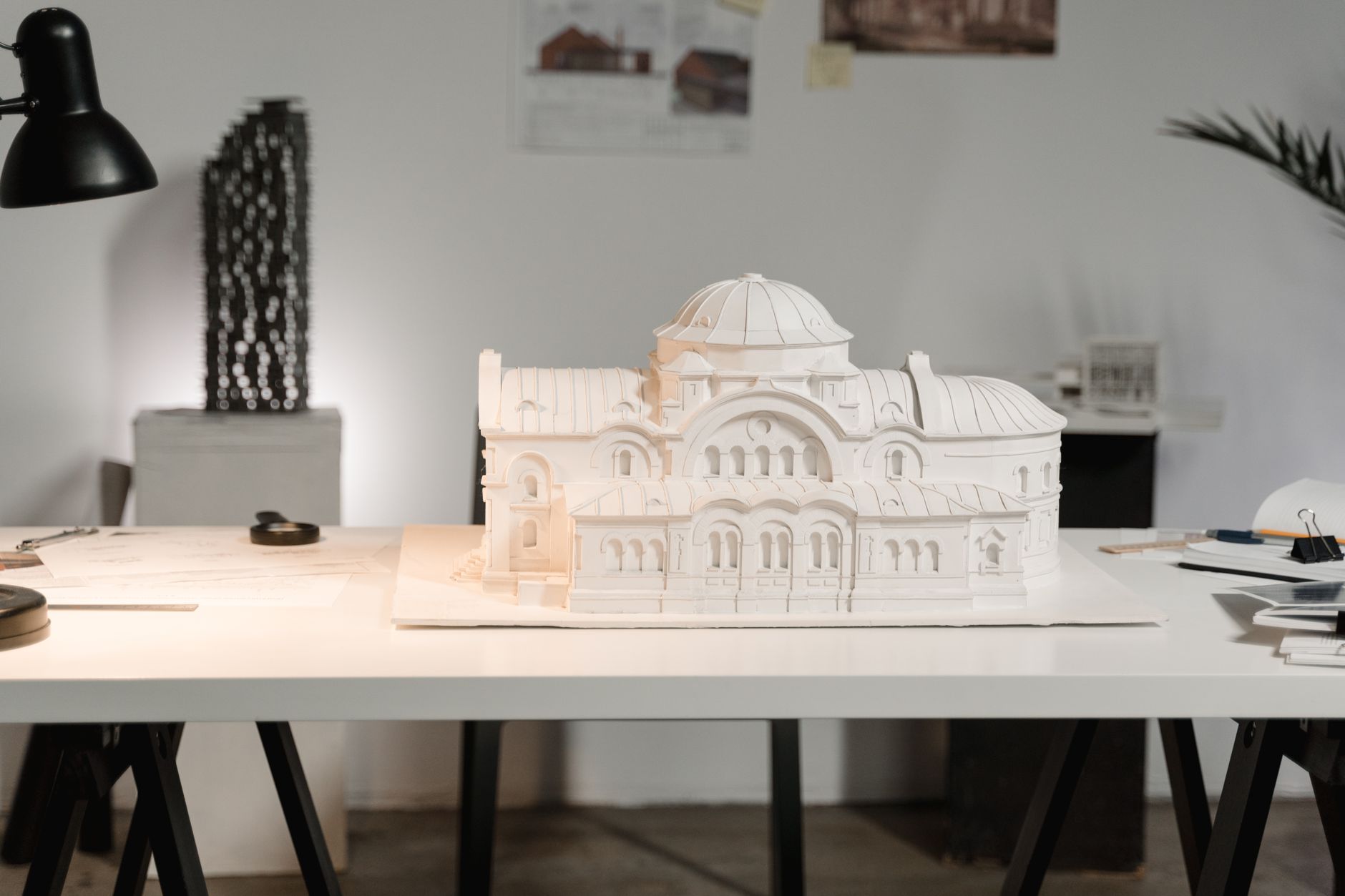
*Photo: Tima Miroshnichenko*
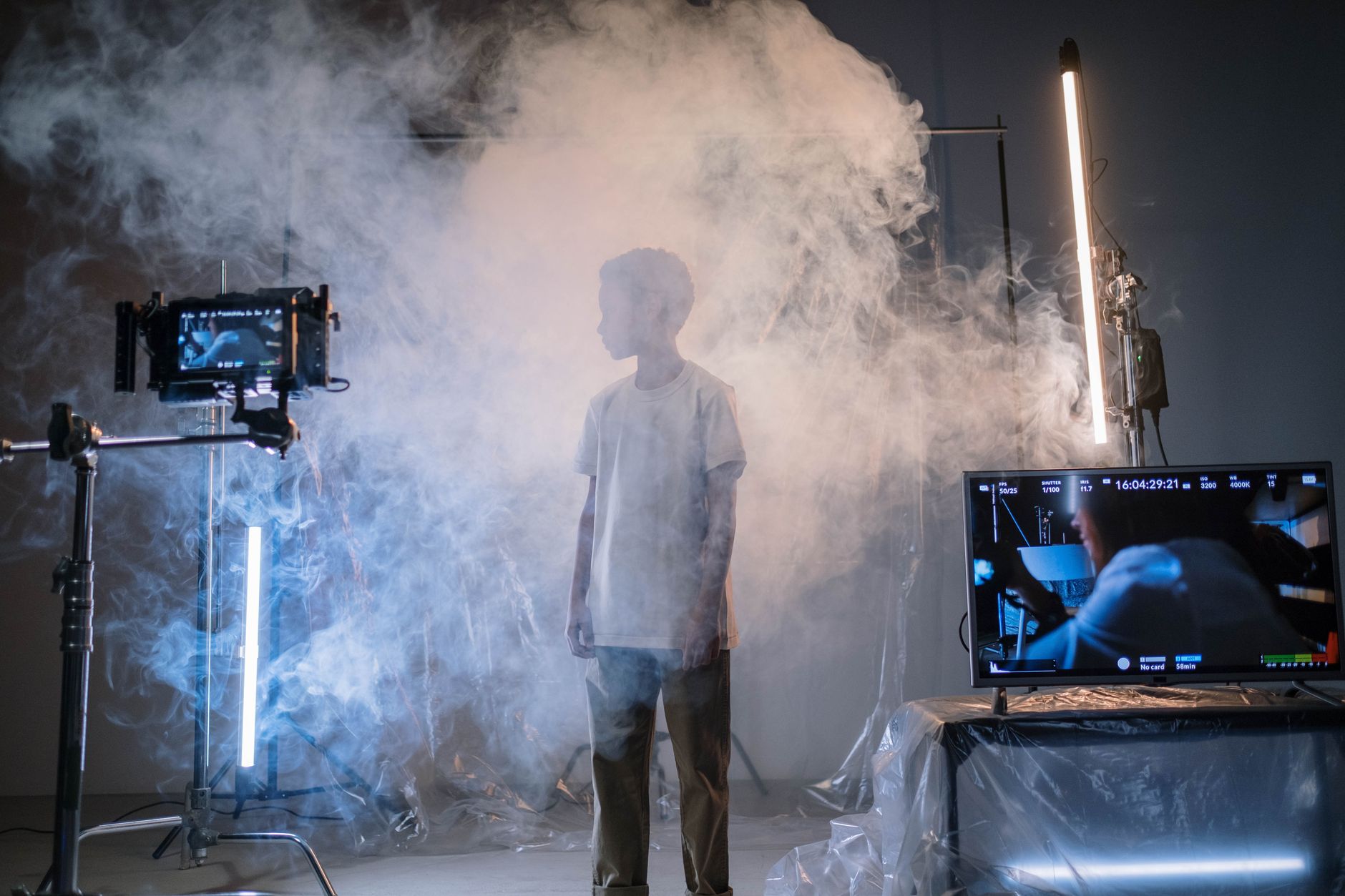
*Photo: cottonbro studio*
For many studios reading this, the review room is the relevant column. Architects, interior designers, product designers and set designers sell work the client cannot fully picture from drawings. That gap is where VR earns its fee, and it is also where you can put a number on it.
WORKED EXAMPLE
## Calculate what a VR client review costs against a standard review
Here is an illustrative cost comparison for a small interiors studio, setting a VR client review against a standard review with renders and a walkthrough video, so you can swap in your own rates and see when it breaks even.
Illustrative example: a 6-person interiors studio is designing a restaurant fit-out. It bills its time at 90 per hour. Its usual review process is renders plus a walkthrough video, which takes 8 hours to prepare, followed by 3 feedback rounds of about 10 hours each. The client signs off after roughly 24 days.
For the VR version, the studio buys a standalone headset for 500 and spends 14 hours preparing the scene from its existing 3D model. The client spends a 3-hour session in the headset with the lead designer. Because the client sees the space at full scale, many of the objections that usually take a round to surface come up in the session itself, so the project needs 2 feedback rounds instead of 3. Sign-off arrives after roughly 16 days.
These figures are assumptions, not measurements. Replace the hourly rate, the prep hours and the number of rounds with your own.
**Illustrative example: standard review against VR review**
Example figures for a fictional studio at 90 per hour.
| Line item | Standard review | VR review |
| --- | --- | --- |
| Headset | 0 | 500, once |
| Preparation | 8 hours, 720 | 14 hours, 1,260 |
| Review session | Included in rounds | 3 hours, 270 |
| Feedback rounds | 3 rounds, 2,700 | 2 rounds, 1,800 |
| Total, first project | 3,420 | 3,830 |
| Total, later projects | 3,420 | 3,330 |
| Days to sign-off | About 24 | About 16 |
In this example, the VR review costs 410 more on the first project because of the headset, then 90 less on every project after it. The bigger gain is time: about 8 days earlier to sign-off, which matters when the client is waiting to start construction. The comparison flips if scene preparation runs long or the client cannot make a session in person, so test both numbers on a real project before you change your process.
REALITY CHECK
## Decide whether VR is worth it for your studio
VR is worth it for a small studio or freelancer when the work is spatial, the client struggles to read drawings and a wrong decision is expensive to undo; for flat or screen-based work, a 3D web preview or a walkthrough video does the job for less.
**Weigh the barriers before you buy**
- **Hardware and setup**: A headset is the cheap part. The real cost is the hours it takes to turn a working model into a scene a client can walk through without getting lost.
- **Motion sickness**: Some clients feel queasy within minutes. Keep sessions short, avoid fast camera moves and always have a seated, screen-based fallback ready.
- **Integration**: If your tools do not export cleanly to a VR viewer, every review starts with file wrangling. Check the pipeline on a small project first.
- **Client access**: Many clients do not own a headset. Plan for an in-person session or ship a headset, and decide who pays for it in the scope.
The cheaper alternatives deserve a fair hearing. A 3D model the client can spin in a browser, a turntable render or a walkthrough video answers many of the same questions without any hardware. Retail has tested the same idea at a much larger audience, using 3D and phone-based product views to help buyers picture what they are getting.
In [Shopify's Gunner Kennels case study](https://www.shopify.com/case-studies/gunner-kennels), Shopify says the company reduced its return rate by 5%, eliminating plenty of significant shipping costs along with it.
Gunner Kennels makes dog kennels, not interiors, and it used 3D and phone-based product views rather than headsets. The point carries over anyway: when a buyer can see an object properly before committing, fewer decisions get reversed later.
[Snap research reported by Tubefilter](https://www.tubefilter.com/2022/06/16/snap-augmented-reality-stats/) showed that 66% of people who encounter AR tech in the buying process said they were less likely to return the product they bought once it arrived.
For a studio, the equivalent of a return is a late change of mind: the client who sees the built space and asks for the bar to move. Whether you use a headset or a browser preview, the goal is the same. Let the client see the work at the right scale while changes are still cheap.
SELLING IT
## Present VR-based work in a proposal clients can open anywhere
To show VR work to a client without a headset, lead with a walkthrough video and a few strong stills, scope the VR review as its own priced option, and send it all as a link the whole buying group can open on any device.
The proposal is where VR work often falls flat. A headset session is a great experience for the single person wearing it, and invisible to everyone else who signs off. The partner, the finance lead and the operator who joins late all see a static document with a sentence about virtual reality in it.
This is where Formlio fits. A Formlio proposal is a web document built from blocks, so you can embed the walkthrough video from the headset session, add a gallery of stills from inside the space, and lay out the timeline with the VR review as a clear milestone. In the pricing block, the VR review can sit as an optional add-on the client switches on and watches the total update, rather than a line buried in the fee.
Once it is sent, you see who opened it and how long they spent on the walkthrough and the pricing. A PDF goes into a black box. A Formlio document reports back: who opened it, what they read, when they signed. When the client is ready, they approve inside the document with Slide-to-Approve or an e-signature.
**Show spatial work without a headset**
- **Record the session**: Capture a short walkthrough video from the headset view and put it near the top, so every reader gets the experience in a minute.
- **Pick a few hero stills**: Choose the views that answer the client's biggest doubts, such as the entrance, the bar and the view from the best table.
- **Price the VR review separately**: List it as its own option with a clear description, so the client sees what it adds and can choose it.
- **Watch what gets read**: If the buying group keeps returning to the walkthrough but skips the pricing, follow up on value before you talk about money.

*Send the walkthrough to everyone who signs, not only the person in the headset.*
*Photo: Grove Brands*
## FAQ
### Is VR worth it for a small creative studio or freelancer?
It is worth it when your work is spatial, your clients struggle to read drawings and late changes are expensive. For flat or screen-based work, a 3D web preview or a walkthrough video usually does the job for less.
### Which VR tools do designers actually use?
Gravity Sketch is common for product and industrial design, Tilt Brush for painting and concept work in 3D space, and many studios export models from their usual 3D software into a VR viewer for client reviews.
### How much does a VR setup for a design studio cost?
A standalone headset is the smallest cost. The larger one is the time it takes to prepare scenes from your models, so price that preparation into the projects that use it.
### Will VR replace 2D design tools like Figma or Photoshop?
No. VR helps with spatial judgement and client review, while plenty of layout, interface and image work stays faster on a screen. Studios that use VR add it to specific stages rather than replacing their tools.
### How do you show a VR design to a client who has no headset?
Record a walkthrough video from the headset view, add a few strong stills and send them in a web proposal. With Formlio you can embed the video, price the VR review as an option and see who watched it.
## Send spatial work the whole buying group can see
Build a Formlio proposal with your walkthrough video, stills and a priced VR review option, then see who opened it after you hit send.
[Start free](https://formlio.com/templates)
## Sources
1. [Shopify's Gunner Kennels case study](https://www.shopify.com/case-studies/gunner-kennels)
2. [Snap research reported by Tubefilter](https://www.tubefilter.com/2022/06/16/snap-augmented-reality-stats/)
## Related
- [Interior design proposal: from moodboard to signed contract](https://formlio.com/blog/interior-design-proposal-guide)
- [Why your next proposal shouldn't be a PDF](https://formlio.com/blog/why-web-proposals-beat-pdfs)
- [Brand design proposal: what brand designers need to show to win new clients](https://formlio.com/blog/brand-designers-proposal-win-new-clients)
- [Web design proposal mistakes: the 7 mistakes that cost you clients](https://formlio.com/blog/web-design-proposal-mistakes)
- [Formlio: the modern way to create and share proposals](https://formlio.com/blog/formlio-modern-proposals)
- [How AI is truly changing creative agencies: hours, pricing and value](https://formlio.com/blog/ai-transforming-creative-agencies)
---
---
title: "How to quickly create proposals that feel high-end, with a reusable block library"
description: "Create high-end proposals quickly: define what quality means to a creative client, build a reusable block library and follow up on what the client actually read."
canonical: "https://formlio.com/blog/quickly-create-premium-proposals"
locale: "en"
type: "post"
date: "2025-08-18"
category: "How-To-Guides"
alternates:
fr: "https://formlio.com/fr/blog/creer-belles-propositions-commerciales-facilement-rapidement.md"
---
# How to quickly create proposals that feel high-end, with a reusable block library

Speed and quality in proposals are not a trade-off. Build a system once, spend your time on the client-specific thinking and let the rest assemble itself.
DEFINE QUALITY
## Decide what makes a proposal feel high-end before you speed it up.
The C's of proposal writing are clear, concise and compelling, and they define quality better than length or decoration. A proposal feels high-end when the client sees care in every choice: their problem stated precisely, nothing padded and a reason to say yes on the page.
Ask a creative director what makes a proposal feel expensive and you rarely hear "more pages". You hear restraint. A proposal feels high-end when it reads as though someone thought hard about this particular client and then cut everything that did not serve them. Decoration does not create that feeling. Neither does a thick appendix of credentials.
That matters doubly in the creative industry, because your client reads the proposal as a sample of your work. A design studio that sends a cramped, inconsistent document is telling the client something about how it will treat their brand. A studio that sends a calm, well-set, clearly argued proposal is showing the client the standard they will get.
So before you try to go faster, define the target. For a design-literate client, quality usually means a handful of things: their problem described in their language, a clear approach, relevant proof, a price they can understand and a simple way to say yes. Everything else is optional.
**A pre-send check built on clear, concise and compelling**
1. **Clear: could the client explain it to their boss?**: Read the problem statement and the approach aloud. If a stakeholder who missed the meeting could not repeat the plan in their own words, rewrite it.
2. **Concise: does every section earn its place?**: Cut anything the client did not ask about and does not need to decide. Length should follow the size and risk of the brief, not your stock of content.
3. **Compelling: is there a reason to choose you now?**: Point to the insight, the relevant case study or the option that fits their goal. If nothing in the proposal could only have come from you, add it.
### Where proposal time actually goes
When studios say proposals take too long, the writing is rarely the problem. The time disappears into copying sections from old documents, fixing the layout after every paste, rewriting the same team bio again, exporting, checking and re-exporting. Then it disappears again after sending, into wondering whether the client has opened it and chasing them when they have gone quiet.
None of that work makes the proposal better. It only makes it later. The fix is to separate the parts of a proposal that should be the same every time from the parts that should never be the same, and to stop rebuilding the first kind by hand.
The chasing is where time leaks, and busy teams drop things.
[Gong reports](https://www.gong.io/blog/data-shows-these-3-seller-mistakes-are-costing-you-time-and-money) that 45% of sellers recently said they have "one or more critical action item" fall through the cracks each week.
A system that saves you an afternoon of formatting but leaves the follow-up to memory has fixed the wrong half of the problem.
BUILD THE SYSTEM
## Build a block library so every proposal starts already assembled.
Write your reusable sections once, at their best, and save them as blocks: intro, approach, case studies, scope, timeline, pricing options and terms. Each new proposal then becomes assembly plus a short stretch of fresh thinking about this client's problem, which is the only part the client really reads closely.
A block library is a set of finished, designed sections you trust. Not a folder of old proposals to raid, and not a long template you trim down every time. Each block does a single job and stands on its own, so you can drop it into any proposal and know it will look right.
The trick is deciding what to standardise. Some sections barely change between clients: how you work, your terms, the shape of your timeline, your team. Others change completely: your reading of the client's problem, the approach you recommend, the case studies you pick. Standardise the first group hard. Leave room for the second group to be written fresh, every time, because that is where the client decides whether you understood them.
**What to reuse and what to write fresh**
| Block | Reuse or write fresh | What to keep in the library |
| --- | --- | --- |
| Intro and cover | Adapt | Layout, tone and a short line about who you are; swap the client name and headline |
| Understanding of the brief | Write fresh | Only the structure: the problem, the stakes, what success looks like |
| Approach | Adapt | Your phases and how decisions get made; rewrite the emphasis per client |
| Case studies | Reuse, chosen per client | Finished case study blocks, each with challenge, approach and result |
| Scope and timeline | Adapt | Standard deliverable descriptions and a timeline layout you can retime |
| Pricing options | Adapt | A good, better, best structure with optional add-ons ready to toggle |
| Terms | Reuse | Payment schedule, revision rounds, usage rights, written once in plain language |
### Offer options, not a single number
Pricing is the block that saves you the longest email threads when it is built well. Present good, better and best options and mark the one you recommend. Add optional items the client can switch on, such as extra concepts, a launch kit or a faster timeline. The client shapes the proposal themselves instead of emailing you to ask what it would cost without the animation, and you avoid a round of revisions on the quote.
### Keep length proportional to the brief
A library makes it tempting to include everything. Resist. A small brief deserves a short proposal: the problem, the approach, a couple of relevant projects, the options and the next step. A large, high-stakes brief can carry more process detail and more proof. Clients skim, and every unnecessary section makes the important ones harder to find.
### Pick a tool that keeps the layout for you
Design software is the wrong tool for proposals, even for designers. Layout tools make every edit a layout problem, and word processors make every proposal look like a word processor. Free options such as shared documents and slide decks work for a while, but they do not keep a library of designed blocks, show you whether the client opened the proposal or let the client approve it in place. Purpose-built proposal software does those things, and the time it saves is in the steps around the writing.
**Rules for a library that stays useful**
- **Save a block only when it is finished**: If you would edit it before sending, it is not ready for the library. Half-done blocks get copied with their flaws.
- **Name blocks by job, not by client**: Call it "Case study: hospitality rebrand", not "The Larkin project", so you can find the right proof under pressure.
- **Review the library on a regular rhythm**: Replace weaker case studies with newer ones, update the terms and retire anything that no longer matches the work you want.
- **Keep the brand in the blocks**: Fonts, colours and spacing live in the blocks themselves, so assembling a proposal never means fixing the layout afterwards.
WORKED EXAMPLE
## Assemble a branding proposal in under an hour.
Here is an illustrative build of a rebrand proposal from a block library, with a time budget for every block. Reused and adapted blocks take minutes. The writing time goes to the client's problem, the recommended approach and the choice of options, which is where a proposal is won.
This is an illustrative example. The studio, the client and every figure are invented to show the method.
A small branding studio receives a rebrand brief from Fieldhouse, an independent climbing gym opening its 3rd location. The founders want an identity that feels less like a hobby and more like a destination, in time for a launch in 10 weeks. The studio had a 30-minute call with the founders yesterday and has notes from it.
The studio opens its block library and gives itself a budget of 50 minutes. The bulk of the document assembles from saved blocks. The time goes into the parts no library can supply: the problem statement, the approach and the pricing options.
**Example time budget per block**
Illustrative minutes for the example proposal above.
| Block | Reused, adapted or fresh | Example minutes | What happens |
| --- | --- | --- | --- |
| Cover and intro | Adapted | 3 | Swap in the client name and a headline drawn from the call notes |
| Understanding of the brief | Fresh | 15 | Write the problem in the founders' words: hobby to destination, before the launch |
| Approach | Adapted | 8 | Keep the phases, rewrite the emphasis toward signage and the opening |
| Case studies | Reused | 4 | Pick a fitness studio rebrand and a hospitality launch from the library |
| Scope and timeline | Adapted | 6 | Retime the standard plan to the 10-week launch window |
| Pricing options | Adapted | 8 | Set Essentials at $6,000, Core at $11,000 and Launch at $16,000, Core marked as recommended |
| Terms and next step | Reused | 2 | Add a decision date tied to the launch |
| Pre-send check | Fresh | 4 | Read it against clear, concise and compelling, then cut what fails |

*The library handles the layout. The studio handles the thinking.*
*Photo: Helena Lopes*
Look at where the minutes land. The single largest block of time goes to understanding the brief, because that is the section the founders will read word by word. The approach and the pricing options come next, because they turn that understanding into a decision. Everything else is close to free, since it was written well once and never needs to be written again.
Notice too what the studio did not do. It did not open a layout tool, fix spacing after pasting, export a file or rename versions. It did not write a new team bio. The proposal still reads as though it was made for Fieldhouse alone, because the parts the client cares about were.
That is the whole idea in practice: speed comes from the library, quality comes from where you spend the time you saved.
SEND AND FOLLOW UP
## Use AI, tracking and e-signature to close faster without losing polish.
Yes, you can use ChatGPT to write parts of a proposal: first drafts of scope and terms, tightening long sentences, checking clarity. Do not use it to write the client insight or your pitch voice. Then send a trackable proposal, follow up on what the client read and let them sign in place.
AI tools can help with the parts of a proposal that are mostly structure. They are poor at the parts that are mostly judgment, and results vary widely across teams.
In a [Gartner survey](https://www.gartner.com/en/newsroom/press-releases/2026-05-19-gartner-survey-finds-ai-saves-sellers-nearly-five-hours-per-week-yet-seventy-two-percent-of-sales-organizations-fail-to-reinvest-time-in-high-value-activities), 25% of sales organizations report a 50% or higher return on AI investments, while 20% report a 50% or higher negative return.
Treat that spread as a reason to be deliberate about where you use it.
**What to delegate and what to write by hand**
- **Delegate: first drafts of scope and terms**: Deliverable descriptions, revision policies and payment wording are structured text. Let a tool draft them, then edit for your voice.
- **Delegate: tightening and checking**: Ask for shorter sentences, flagged jargon or a check that every deliverable appears in both the scope and the price.
- **Write by hand: the client insight**: Your reading of the client's problem is the reason they hire you. A generic version of it is exactly what makes a proposal feel cheap.
- **Write by hand: the recommendation**: Which option you recommend and why is a judgment call. Clients can tell when a proposal hedges, and it costs you their trust.
Once the proposal is out, the fastest way to lose the time you saved is to wait. Follow-up slips even for full-time sellers.
[Gong's data](https://www.gong.io/blog/data-shows-these-3-seller-mistakes-are-costing-you-time-and-money) shows that 32% of the time, reps don't follow up within 24 hours.
Put the follow-up in your calendar when you hit send, not when you remember.
- **32%** of the time, reps don't follow up within 24 hours ([Gong: 3 Costly Seller Mistakes to Avoid](https://www.gong.io/blog/data-shows-these-3-seller-mistakes-are-costing-you-time-and-money))
- **44%** of sales reps follow up with a prospect only once before giving up ([HubSpot: The Art of the Sales Follow-Up](https://blog.hubspot.com/sales/sales-follow-up-infographic))
Giving up early is a mistake because replies often arrive later than the first message.
[HubSpot advises](https://blog.hubspot.com/sales/sales-email-templates-to-get-and-keep-buyers-attention) that a follow-up should add something new, such as a case study, a relevant resource or a direct question, rather than restating the original pitch.
For a creative studio, that might be a project close to the client's sector or a question about the option they lingered on.
> When traveling to meet a client, we've found it works great to request a follow-up meeting within 24 hours of the first one (schedule both at the same time upfront)
>
> — [Chopra-McGowan, General Assembly](https://review.firstround.com/the-most-surefire-way-ive-found-to-win-enterprise-deals)
This is where Formlio fits the system. You build proposals from blocks, save your best sections to a library and reuse them across documents, and your team can edit the same proposal at the same time. Fonts, colours and layouts stay on-brand without a layout tool. The pricing block lets the client compare your options and toggle add-ons while the total updates.
After you hit send, you get a notification when the client opens the proposal, and section-level analytics show how long they spent on each part. A PDF goes into a black box. A Formlio document reports back: who opened it, what they read, when they signed. When the client is ready, they approve with Slide-to-Approve or sign with an e-signature inside the document, so the last step takes seconds instead of a scan-and-send round trip.
## FAQ
### Can I use ChatGPT to write a proposal?
Yes, for structured parts such as scope descriptions, terms and tightening copy. Write the client insight and your recommendation yourself, because those are the parts that show judgment and make the proposal feel made for the client.
### How do I write a proposal quickly without it looking rushed?
Build a library of finished blocks for the sections that rarely change, such as approach, case studies, terms and pricing structure. Then spend your time on the problem statement and the recommendation, and run a quick check for clarity before sending.
### What does clear, concise and compelling mean in proposal writing?
Clear means a stakeholder who missed the meeting could repeat the plan. Concise means every section helps the client decide. Compelling means the proposal gives a reason to choose you that could only come from you, such as a sharp insight or a relevant project.
### What is the best free software for creating proposals?
Shared documents and slide tools work when you send proposals rarely, but they do not keep designed blocks, track opens or collect approvals. Formlio has a free plan, so you can build proposals from blocks and share them by link before paying for anything.
### How long should a creative agency proposal be?
As long as the brief needs and no longer. A small project needs the problem, the approach, a few relevant projects, the options and the next step. Larger, riskier projects can carry more process detail and proof.
### Should I send a proposal as a file or a web link?
A web link lets the client read on any device, lets you update it after sending and can tell you when it was opened and which sections were read. A Formlio proposal also lets the client approve or sign without printing anything.
## Build your block library once
Make proposals from reusable blocks, share them as a link, see what the client reads and close the deal inside the document.
[Start free](https://formlio.com/templates)
## Sources
1. [Gong reports](https://www.gong.io/blog/data-shows-these-3-seller-mistakes-are-costing-you-time-and-money)
2. [Gartner survey](https://www.gartner.com/en/newsroom/press-releases/2026-05-19-gartner-survey-finds-ai-saves-sellers-nearly-five-hours-per-week-yet-seventy-two-percent-of-sales-organizations-fail-to-reinvest-time-in-high-value-activities)
3. [HubSpot: The Art of the Sales Follow-Up](https://blog.hubspot.com/sales/sales-follow-up-infographic)
4. [HubSpot advises](https://blog.hubspot.com/sales/sales-email-templates-to-get-and-keep-buyers-attention)
5. [Chopra-McGowan](https://review.firstround.com/the-most-surefire-way-ive-found-to-win-enterprise-deals)
## Related
- [Why your next proposal shouldn't be a PDF](https://formlio.com/blog/why-web-proposals-beat-pdfs)
- [Ten essential tips for creating engaging proposals that convert](https://formlio.com/blog/tips-creating-engaging-proposals-convert)
- [5 ways to present a proposal that builds client confidence](https://formlio.com/blog/present-proposal-client-confidence)
- [Formlio: the modern way to create and share proposals](https://formlio.com/blog/formlio-modern-proposals)
- [Four actionable strategies for proposals that win clients](https://formlio.com/blog/actionable-proposal-strategies-win-clients)
- [Brand design proposal: what brand designers need to show to win new clients](https://formlio.com/blog/brand-designers-proposal-win-new-clients)
---
---
title: "How to address pricing pushback without lowering your rates"
description: "Handle pricing pushback on creative work without discounting: find the real comparison, cut scope instead of rate, and hold your price. Worked example inside."
canonical: "https://formlio.com/blog/pricing-pushback-keep-rates"
locale: "en"
type: "post"
date: "2025-04-21"
category: "Strategy & Growth"
alternates:
fr: "https://formlio.com/fr/blog/gerer-objection-prix-sans-baisser-tarifs.md"
---
# How to address pricing pushback without lowering your rates

Pricing pushback is rarely a refusal. It usually means the client is comparing your fee with something cheaper, or cannot yet see what the money buys. Find that comparison first, answer it with scope and options instead of a lower rate, and build those answers into the proposal before the number appears.
DIAGNOSE
## Find out what the client is comparing your price to
When a client says your price is too high, they are measuring it against something: a template, an in-house designer, a cheaper freelancer or a bigger agency. Ask which before you defend a single line, because the right answer depends entirely on the comparison and guessing usually gets it wrong.
The reply usually lands soon after you hit send: "This looks great, but it's more than we expected." Studios often hear that sentence as a verdict on their work. It rarely is. A client who thought the work was worthless would not have read the proposal closely enough to object. What they are telling you is that your number sits next to some other number in their head, and yours looks bigger.
That other number is the thing to find. In creative work it tends to be a handful of anchors. The client could do it themselves with a template or a design tool. They have an in-house designer who could take it on. They found a freelancer who quoted far less. Or they are weighing you against a larger agency and wondering whether you are the safer or the riskier bet. Each anchor needs a different answer, and a discount answers none of them well.
Creative people also carry a particular weakness into these conversations.
The thesis [Tactics in B2B Negotiations in SMEs](https://opinvisindi.is/bitstreams/5946688e-7824-406e-b6aa-57a3f0d3845a/download) found that negotiators in creative sectors use tactics aimed at prioritising their ability to create rather than securing economic gain.
Knowing that tendency is a large part of the defence against it. So resist the reflex to justify the fee line by line. Defending the number before you know the comparison makes you sound nervous, and it frames the whole exchange as a haggle over cost. Ask first. A few calm questions turn a standoff into a working session, and they tell you which anchor you are really up against.
[Simon-Kucher's Global Pricing Study](https://www.simon-kucher.com/en/who-we-are/newsroom/global-pricing-study-2016-every-second-company-involved-price-war) found that for 50 percent of the interviewees, the most suitable option is to improve the value communication of products.
The same instinct works for a studio. Before you touch the number, change how clearly the proposal shows what the number buys.
**Common comparison anchors in creative work**
What the client says is the headline. The anchor behind it decides your reply.
| What the client says | What they are comparing against | What to ask next |
| --- | --- | --- |
| We could probably do this ourselves | A template, a DIY design tool, or doing nothing yet | What happens if this is still unsolved by next season? |
| Our in-house designer could handle it | Salaried time that already feels paid for | Who would own this alongside their current workload, and by when? |
| We got a much cheaper quote | A freelancer or marketplace rate | Could you walk me through what that quote includes? |
| The bigger agency felt safer | Perceived risk, not price | What would make you confident we can deliver on time? |
| It's more than our budget | A fixed internal figure | Is the budget fixed, or is the timing of payments the issue? |
**Questions to ask before you respond**
1. **Ask what they expected**: "Could you tell me what you had in mind? It helps me see where the gap is." This surfaces their reference point without sounding defensive.
2. **Ask what they compared**: "Is that compared with other quotes, or with the budget you set aside?" The answer tells you whether you face a competitor or a cap.
3. **Separate budget from cash flow**: "Is the total the issue, or when it's due?" A split payment schedule solves a cash-flow problem without touching your rate.
4. **Find the part they can't drop**: "Which outcome matters more than anything here?" You need this before you remove any scope, so you cut the right things.
5. **Ask who else decides**: "Who else will weigh in on this?" Pushback often comes from a finance lead who never saw the discovery call.
REFRAME
## Answer the comparison with value, not a lower number
Once you know the comparison, answer it directly. Show the outcome the work buys and what waiting costs, offer proof that lowers the client's risk, and explain how your scope differs from the cheaper option without attacking it. A lower number is the weakest reply, because it confirms the client's doubt.
Value has to arrive before the price, and it has to be about the client. A brand identity is not "logo, palette, guidelines". It is the rebrand that lets a client raise their own prices, pitch a new market or stop apologising for a website they are embarrassed by. Put that outcome in their words, taken from the discovery call, and the fee starts to read as the cost of getting there.
Then name the cost of doing nothing. If the client's anchor is the DIY route, the real comparison is with another season of the problem they came to you to solve: a launch that slips, a sales team pitching with mismatched decks, a hire who will not join because the brand looks small. You do not need a spreadsheet. A plain sentence about what waiting costs is usually enough to reset the frame.
Cheaper freelancers need a different answer. Marketplace rates are real and often low, as a developer in an Ask HN thread on freelance sites describes below. Do not argue with figures like that or disparage the people behind them. Explain what your scope includes that a lower quote tends to leave out (strategy, research, revision rounds, rollout support) and let the client decide whether they need those things.
> With them, I'm getting at least $35/hr full time for the period of the project.
>
> — [A freelancer on Hacker News, Hacker News](https://news.ycombinator.com/item?id=2619423)
Proof does the rest. Case studies with the same kind of client, a clear view of your process, and the names of the people who will do the work all lower the risk the client is pricing in. If you are up against a bigger agency, a guarantee can work harder than a discount: a promise to rework a concept at no charge if it misses the agreed brief costs you little when your process is sound, and it answers the fear behind the objection.
Discounts look cheap and are not. Every euro you take off a fixed fee comes straight out of your margin, because the hours, the software and the team cost exactly the same. To earn back the profit a price cut gives away, you need noticeably more work at the new rate, and the client you discounted now expects the lower figure next time. A discount also teaches the client that your first number was negotiable, which makes every later conversation harder. The table below maps each comparison to an answer you can put in the proposal instead.
**Illustrative decision table: match the comparison to the answer**
An illustrative guide to which proposal content answers which comparison.
| Comparison | What the client fears | What to put in the proposal |
| --- | --- | --- |
| DIY or a template | Spending money on something they could fake | The outcome in their words and a short cost-of-delay paragraph |
| In-house designer | Paying twice for capacity they have | A timeline that shows workload, deadlines and who owns each stage |
| Cheaper freelancer | Paying more for the same thing | A scoped lower option and a clear list of what each price includes |
| Bigger agency | Betting on a smaller studio | Process proof, team bios, a relevant case study and a rework guarantee |
| Fixed budget | Going over a number they cannot move | Tiered options that fit the budget by removing scope |
WORKED EXAMPLE
## Restructure scope to reach the client's budget without cutting your rate
When the budget is truly fixed, lower the price by removing scope, never by lowering the rate. Cut concepts or revision rounds, or phase the rollout, then show the client exactly what each version includes and let them choose. Your effective hourly rate stays intact and the client knows what they gave up.
Here is an illustrative example, with made-up numbers. A studio quotes 12,000 EUR for a brand identity: three logo concepts, three revision rounds, a full guidelines document and a rollout across stationery, social templates and a pitch deck. The studio estimates 120 hours of work, so its effective rate is 100 EUR an hour. The client replies: "Can you do it for 9,000?"
The fast answer is a straight discount. Take 3,000 EUR off, keep the same scope, and the studio still works 120 hours, now at 75 EUR an hour. Nothing about the project got easier. Only the studio got poorer, and the next quote to this client starts from the lower figure.
The better answer pulls three scope levers. Fewer concepts: two directions instead of three saves about 10 hours of exploration. Fewer revision rounds: two rounds instead of three saves about 8 hours. A phased delivery: the stationery, templates and deck move to a second phase, quoted separately at 1,200 EUR, which takes another 12 hours out of this project. Together that brings the work to 90 hours, and at the studio's usual rate that is exactly 9,000 EUR.
**Illustrative example: discount versus scope at a 9,000 EUR budget**
Sample numbers for illustration only.
| Version | Scope | Hours | Price | Effective rate |
| --- | --- | --- | --- | --- |
| Original quote (Complete) | 3 concepts, 3 revision rounds, guidelines, rollout | 120 | 12,000 EUR | 100 EUR/h |
| Straight discount | Same scope as the original | 120 | 9,000 EUR | 75 EUR/h |
| Standard option | 3 concepts, 2 revision rounds, guidelines, rollout later | 100 | 10,000 EUR | 100 EUR/h |
| Essential option | 2 concepts, 2 revision rounds, guidelines, rollout later | 90 | 9,000 EUR | 100 EUR/h |
| Rollout phase (later) | Stationery, social templates, pitch deck | 12 | 1,200 EUR | 100 EUR/h |
Illustrative example, continued: in the proposal, this becomes three options rather than a single grudging counter-offer. For example, Complete at 12,000 EUR is the original scope. Standard at 10,000 EUR keeps three concepts and the full guidelines but drops one revision round and moves the rollout to later. Essential at 9,000 EUR is the client's number, with two concepts and two rounds. The rollout becomes its own phase at 1,200 EUR whenever the client is ready for it.
Look at what happened to the rate. In every option the studio earns 100 EUR an hour, the same as in the original quote. The straight discount was the only path that cut it. The client, meanwhile, gets a real choice at their budget and a visible reason to stretch to the middle option if the extra concept matters to them. Nobody had to win an argument. The scope simply moved to meet the money.
Write the trade-offs down. A client who chooses fewer rounds and later asks for more is not being difficult if the limit was never stated. Spell out what each option leaves out, and get a yes on that list before work starts.
**Trade-offs the client accepts in writing**
- **A narrower set of directions**: With fewer concepts on the table, the brief and the moodboard stage have to be sharper, so agree on them before design starts.
- **Less room to change course**: Fewer revision rounds means feedback must be consolidated. Define what counts as a round so nobody argues about it later.
- **A later rollout**: Stationery, templates and the deck wait for the next phase, at a price fixed now so it does not drift upward.
- **A change-order clause**: Anything added after sign-off is quoted as new scope at the same rate, never squeezed into the agreed hours.
HOLD THE LINE
## Say your price is firm and raise rates without losing clients
To say a price is not negotiable, state it calmly, explain once what it covers, and offer scope options instead of a discount. To raise rates without losing clients, start with new clients, then give existing ones notice, a reason tied to results and a scoped way to stay within budget.
A firm price does not need a firm tone. Something like this works: "Our rate is the same for every client, so I can't lower it. What I can do is adjust the scope so the project fits your budget. Here are the options." It is short, it is warm, and it moves the conversation straight to the choices you prepared. Say it once. Repeating the justification sounds like you are waiting to be talked down.
Decide in advance who can approve a concession. In a small studio that may be the founder; in a larger team it should still be a single named person, not whoever happens to be on the call. Log every exception with the client and the reason, and review the log every few months. Untracked discounts are how margins leak without anyone ever deciding to cut them.
In [ANA/4A's Cost of the Pitch research](https://ana.net/miccontent/show/id/rr-2023-07-ana-4as-cost-of-the-pitch), the figure is $408,500 for an agency pitch without participation from the incumbent.
Winning work is expensive on both sides of the table. Every proposal you write already carries hours you will not bill, and a client who switches studios to save on the fee pays to run the search again. A discount quietly throws that investment away. Holding the rate, and moving scope instead, protects the time you already spent winning the client.
> Negotiators in creative sectors use negotiation tactics whose underlying aim is to prioritize negotiators' ability to create rather than securing economic gain.
>
> — [Tactics in B2B Negotiations in SMEs, Thesis on B2B negotiation in creative-sector firms](https://opinvisindi.is/bitstreams/5946688e-7824-406e-b6aa-57a3f0d3845a/download)
[The Payoneer Freelancer Insights Report](https://www.payoneer.com/resources/business/the-payoneer-2023-freelancer-insights-report/) found that 38% of freelancers reported an increase in hourly rates over the past year, while only 15% saw rates decrease.
Raising rates is normal work, not a risk reserved for the bold.
[Payoneer's report](https://www.payoneer.com/resources/business/the-payoneer-2023-freelancer-insights-report/) also found that, in response to the rising cost of living, 41% of freelancers raised their rates.
Rate increases follow the same logic. Raise your rate for new clients first, where there is no history to defend and the new figure is simply the price. Then bring existing clients along with notice, a short note on what the work has delivered for them, and a retainer or scoped package that keeps them inside their budget if they need it. Some clients will leave, and that is part of the point.
Pay attention to the pattern. If the same objection keeps coming back from the same kind of client, the problem is usually your positioning or the channel you find work through, not your price. At that point walking away from a deal is a decision, not a failure, and it frees time for clients who already see what the work is worth.
**Raise your rates in stages**
1. **Start with new clients**: Quote every new enquiry at the new rate. There is no old number to compare against, so the conversation stays about scope.
2. **Give existing clients notice**: Tell them in writing well before the change takes effect, with the date and the new rate, so nothing lands as a surprise.
3. **Tie it to results**: Remind them what the work has delivered: the launch, the pitch it helped win, the hours their team no longer spends fixing assets.
4. **Offer a scoped path**: For clients with a fixed budget, propose a retainer with a smaller monthly scope at the new rate rather than holding the old rate.
5. **Review the objection log**: Every few months, look at who pushed back and why. Repeated objections from a single type of client point to a positioning problem.
PROPOSAL DESIGN
## Build the pushback answers into the proposal itself
The best time to handle pushback is before it happens, inside the proposal. Put outcomes, proof and options ahead of the price, let clients choose a scope that fits their budget, and watch which sections they read so your reply answers the doubt they actually have.
Much of this playbook can live in the document instead of in a tense follow-up email. Order the proposal so value comes first: the client's goal in their own words, the cost of waiting, a relevant case study and the team who will do the work. Price comes after the reader already understands what it buys. Then present the scope options from the worked example as choices, not as a counter-offer you were forced into.
This is where Formlio fits. Proposals are web documents built from blocks, and the interactive quoting block lets a client toggle optional add-ons and compare tiered packages while the total updates in real time. The client picks their own price level, so the essential, standard and complete versions do the negotiating for you. A rollout phase can sit there as an optional add-on rather than a line you had to cut.
Tracking closes the loop. A PDF goes into a black box. A Formlio document reports back: who opened it, what they read, when they signed. Section-level analytics show how long a client spent on each section, so if they skipped the case study and lingered on pricing, your reply can lead with proof instead of a defence. Version history keeps a record of every revised scope, which is a better trail than a quick discount buried in an email thread. When the client is ready, they approve inside the document with Slide-to-Approve or an e-signature.

*Put value, proof and options ahead of the price.*
*Photo: Vitaly Gariev*
**Proposal checklist before you hit send**
- **Lead with the outcome**: Open with the client's goal in their own words, taken from the discovery call, before any deliverables or fees.
- **Show proof before price**: Place a relevant case study, your process and the team ahead of the pricing section so risk is answered first.
- **Offer scoped options**: Give tiered packages that differ by scope, not by rate, so the client can choose a level that fits their budget.
- **Make extras optional**: Present rollout work, extra concepts or additional rounds as add-ons the client can switch on, not as hidden cuts.
- **Read the reading pattern**: Check which sections the client spent time on before you reply to pushback, and answer the doubt they showed.
- **Keep the revision trail**: Save each revised scope as a version so every concession is visible, dated and tied to a change in what you deliver.
## FAQ
### What should I say when a client says your price is too high?
Thank them, then ask what they are comparing it with: another quote, an in-house option or a set budget. Once you know the comparison, answer it with outcomes, proof or scoped options. Avoid defending the number line by line or offering a discount before you understand the objection.
### How do you say price is not negotiable?
Keep it calm and short: "Our rate is the same for every client, so I can't lower it. I can adjust the scope to fit your budget, and here are the options." Say it once, then move straight to the choices. In Formlio you can present those choices as tiered packages inside the proposal.
### How do I raise my rates with existing clients without losing them?
Raise rates for new clients first. Then give existing clients written notice well ahead of the change, remind them what the work has delivered, and offer a scoped retainer at the new rate for anyone with a fixed budget. Expect a few to leave, and treat that as a fit signal rather than a failure.
### Is it ever okay to give a discount?
Occasionally, if it buys something real: a longer commitment, faster payment, a portfolio piece or a case study. Decide in advance who can approve it, record it with the reason, and review exceptions every few months. A discount given only to make pushback go away costs margin and resets the client's expectations.
### How do I justify my fee when a client compares me with a cheaper freelancer?
Do not argue with the lower rate or criticise the freelancer. Ask what the other quote includes, then show what your scope covers that it may leave out: strategy, research, revision rounds and rollout support. If the client only needs the narrower scope, offer a smaller option at your normal rate.
### How many revision rounds should a fixed-price creative project include?
Include as many as you can deliver profitably within the quoted hours, write that number into the scope, and define what counts as a round, such as consolidated feedback from a single contact. Offer extra rounds as a priced add-on so the client can buy more flexibility without you absorbing it.
### How do I respond when a client asks for a breakdown of my hourly rate?
Share the scope and the phases rather than an hourly breakdown, since a fixed fee prices the outcome, not your time. If they insist, show hours per phase so they can see where the effort goes, and use that view to discuss which scope to remove if the total is too high.
## Send your next quote as options
Build a proposal with tiered packages and optional add-ons, then see which sections your client reads before they reply.
[Start free](https://formlio.com/templates)
## Sources
1. [Tactics in B2B Negotiations in SMEs](https://opinvisindi.is/bitstreams/5946688e-7824-406e-b6aa-57a3f0d3845a/download)
2. [Simon-Kucher's Global Pricing Study](https://www.simon-kucher.com/en/who-we-are/newsroom/global-pricing-study-2016-every-second-company-involved-price-war)
3. [A freelancer on Hacker News](https://news.ycombinator.com/item?id=2619423)
4. [ANA/4A's Cost of the Pitch research](https://ana.net/miccontent/show/id/rr-2023-07-ana-4as-cost-of-the-pitch)
5. [The Payoneer Freelancer Insights Report](https://www.payoneer.com/resources/business/the-payoneer-2023-freelancer-insights-report/)
## Related
- [How to present pricing to clients in a proposal: layout, order and wording](https://formlio.com/blog/how-to-present-pricing-to-clients)
- [Four actionable strategies for proposals that win clients](https://formlio.com/blog/actionable-proposal-strategies-win-clients)
- [Innovative pricing models for creative services: a value-based method](https://formlio.com/blog/value-based-pricing-creative-services)
- [How to spot problematic clients before you write a proposal](https://formlio.com/blog/spot-problematic-clients-before-proposal)
- [The art of upselling in proposals without losing trust](https://formlio.com/blog/upselling-proposals-without-losing-trust)
- [5 ways to present a proposal that builds client confidence](https://formlio.com/blog/present-proposal-client-confidence)
---
---
title: "The art of upselling in proposals without losing trust"
description: "Upsell in proposals without losing trust: a complete core scope, a short price ladder and clearly priced add-ons the client controls."
canonical: "https://formlio.com/blog/upselling-proposals-without-losing-trust"
locale: "en"
type: "post"
date: "2026-03-23"
category: "Strategy & Growth"
alternates:
fr: "https://formlio.com/fr/blog/upselling-propositions-commerciales-interactives.md"
---
# The art of upselling in proposals without losing trust

Upselling in a proposal happens before the client has any reason to trust you. The fix is structure, not persuasion: a complete core scope, a short ladder of options and add-ons the client can switch off without losing the deal.
THE RULE
## Treat the upsell as a choice the client controls, not a push
The main rule of upselling in a proposal is simple: every extra must answer something the client wrote in their brief, and the client must be able to decline it without the core deal changing.
Advice on upselling usually comes from customer success or retail. A quarterly review, a checkout prompt, a script for the support line. All of it assumes a relationship that already exists: the customer has used the product, seen results and given you some credit. A proposal has none of that. The client has read your portfolio, maybe had a call, and is now deciding whether you are worth the money at all.
That changes what an upsell can do. Late in a relationship, an extra offer reads as attention. In a proposal, the same offer can read as a studio padding the invoice before the work has even started. The client cannot yet tell the difference between a thoughtful recommendation and a sales move, so they judge the structure instead of your intent.
So the rule has a relevance side and a control side. Relevance: an option earns its place only if you can point to the line in the brief it answers. Control: the client must be able to say yes to the core scope alone and feel they bought something complete. Break either side and the extras start to tax the trust the core proposal was building.
**Know which kind of extra you are offering**
- **Upsell: more of the same work**: A deeper version of what the client asked for. More concepts, a fuller guidelines document, extra rounds of refinement on the same deliverable.
- **Cross-sell: an adjacent service**: Something next to the request. A branding studio offering photography art direction, or a web studio offering copywriting for the pages it builds.
- **Phase: the same goal, later**: Work that only makes sense after the core project lands, such as a launch campaign once the identity exists. It belongs in the proposal as a clear next step, not a price today.
Sales folklore is full of rules of thumb with numbers in their names, about how many calls to make or how much the buyer should talk. They are fine for a sales floor. They say nothing about the proposal itself, where nobody is talking and the document has to make the case alone. For a creative studio, the useful question is narrower: does each option on the page make the client's decision easier or harder?
Cross-sells carry a specific risk. A client who hired you for identity work may read a long list of adjacent services as a studio that does everything and so nothing in particular. Keep cross-sells few, close to the brief and clearly separate from the core scope.
STRUCTURE
## Build options into the proposal as a short price ladder
Give the client a complete core scope, then a short ladder of tiers or a few priced add-ons, and stop there: three options at most keeps the choice easy to make.
Choice overload is real in proposals. Every extra option asks the client to compare, and every comparison is a moment where they can stall. A client who cannot decide between several packages often decides on nothing, or asks for a call that pushes the decision back by a week. A short ladder avoids that. The client sees a floor, a middle and a ceiling, and the middle carries the scope you would actually recommend.
There are three ways to build that ladder. Pick one per proposal and resist mixing all of them.
**Pick the structure that fits the project**
| Structure | How it works | Best for | Trust risk |
| --- | --- | --- | --- |
| Core plus add-ons | A complete core scope with separately priced extras the client can switch on | Projects with a clear brief and a few natural extensions | Vague add-ons that look like padding |
| Tiers | Good, better and best versions of the same project, each complete | Clients unsure how far they want to go | A low tier stripped down to push the middle |
| Phases | The core project now, later stages described and priced separately | Larger goals with an uncertain budget | Later phases that feel like a commitment |
In an [Ask HN thread about freelance sites](https://news.ycombinator.com/item?id=2619423), a freelancer wrote that work through those sites paid them at least $35/hr full time for the period of the project.
On a marketplace, the frame comes from the marketplace. The client compares your rate with a list of other rates, and the cheapest credible line tends to win. A proposal is the opposite setting. You choose the anchor, you decide what the core scope includes, and you decide which extras sit next to it.
Use that control with restraint. Keep the step between the core fee and each add-on modest, so an extra reads as a small, sensible addition rather than a second project. Order tiers from the scope you recommend outward, so the client meets the right answer early. And make every tier complete on its own: a client who picks the lowest tier should still get finished work.
Pricing research points the same way. When clients push on price, explaining the value of each option usually beats cutting the number.
- **50%** of interviewees said the most suitable option is to improve the value communication of products ([Simon-Kucher Global Pricing Study](https://www.simon-kucher.com/en/who-we-are/newsroom/global-pricing-study-2016-every-second-company-involved-price-war))
WORKED EXAMPLE
## Price a branding proposal with add-ons that earn their place
Here is an illustrative identity proposal for a fictional client, with a core scope, a short ladder of tiers and a pair of add-ons, each tied to a line in the brief.
Illustrative example: a small branding studio pitches Harbour Coffee, a fictional roaster opening its own cafe. The brief asks for a new identity, mentions packaging for the retail bags, and says the owners want to post more on social media after launch.
The studio sets the core identity at 9,000. That covers the logo, palette, type system and a short guidelines document. It is complete: if Harbour Coffee signs for 9,000 and ticks nothing else, they open with a finished identity.
The middle tier adds a packaging system for 3,500 more, for a total of 12,500. The top tier adds a launch toolkit (signage, menu boards, a cup design) for 15,000 in total. Next to the tiers sit a pair of add-ons: a social template kit at 1,200 and a photography art direction day at 1,800. The highest possible total is 18,000, and the client can see every line that gets them there.
**Illustrative example: Harbour Coffee identity proposal**
| Line | Price | Brief line it answers | Why it keeps trust |
| --- | --- | --- | --- |
| Core identity | 9,000 | We need a new identity for the cafe | Complete on its own, priced first and in plain sight |
| Tier: identity plus packaging | 12,500 | Our retail bags look generic | Answers a problem the client named |
| Tier: identity, packaging and launch | 15,000 | We open in the spring | Ties the ceiling to a real date, not a wish list |
| Add-on: social template kit | 1,200 | We want to post more after launch | Small, optional and in the client's own words |
| Add-on: photography art direction day | 1,800 | Our current photos feel off-brand | Separate price, easy to skip |
**Write each option so the client can judge it**
1. **Quote the brief back**: Open each add-on rationale with the client's own phrase, so they recognise the problem before they see the price.
2. **Name the outcome, not the deliverable**: A social template kit becomes posts that look like the cafe from the opening week, which is what the owners asked for.
3. **Show what skipping means**: State plainly what the client still gets without the option. That sentence does more for trust than any discount.
4. **Keep the core price up front**: Never make the client hunt for the base fee. A buried core price makes every extra look like a trap.

*Tie each option to something the client already asked for.*
*Photo: https://kaboompics.com/*
TRUST CHECK
## Spot the moves that cost you trust, then read the signals after sending
Trust usually breaks on a handful of avoidable moves, and the proposal itself can show you whether an option helped or hurt once the client starts reading.
**Avoid these upselling mistakes**
- **Surprise fees**: Costs that appear only in the small print or the contract. If it will be billed, it belongs on the pricing page.
- **Vague add-ons**: Lines like strategic support with no scope. The client cannot judge them, so they assume the worst.
- **Pressure deadlines**: An add-on that is only available if they sign this week. It turns a choice into a test of nerve.
- **A crippled low tier**: A floor option that is obviously unusable. Clients see the trick, and it colours how they read every other price.
- **Too many options**: A long menu of extras makes the core scope look incomplete and delays the decision.
[Payoneer's Freelancer Insights Report](https://www.payoneer.com/resources/business/the-payoneer-2023-freelancer-insights-report/) says that, in response to the rising cost of living, 41% of freelancers raised their rates.
Rate rises are easier to hold when the client can see what each price buys. A clear core scope with visible options gives a higher number something to stand on, and it keeps the conversation on value rather than on the total.
The same [Payoneer report](https://www.payoneer.com/resources/business/the-payoneer-2023-freelancer-insights-report/) says 38% of freelancers reported an increase in hourly rates over the past year, while only 15% saw rates decrease.
Timing matters as much as structure. Introduce options in the conversation before the proposal goes out, so nothing on the pricing page is a surprise. A line like 'we can also cover packaging, and I will price it separately so you can decide later' does the work. When the proposal arrives, the option is already familiar and the client reads it as something you discussed, not something you slipped in.
When a client declines an add-on, do not repeat the offer. Ask what held them back. The answer is usually budget, timing or doubt about the value, and each needs a different reply. Budget points to a later phase. Timing points to a natural moment, such as the end of the project when the client has seen your work. Doubt about value means the rationale in the proposal did not connect, and that is useful to know for the next proposal.
This is where Formlio fits. A Formlio proposal carries an interactive quote: the client switches add-ons on and off and watches the total update, so the upsell becomes a choice they make on the page rather than a conversation you push. Section-level analytics show how long they spent on the pricing block, heatmaps show which options they hovered over, and you get a notification when they open the proposal or approve it with Slide-to-Approve or an e-signature.
Those signals answer a question a static file never can. A PDF goes into a black box. A Formlio document reports back: who opened it, what they read, when they signed. If a client keeps returning to the options but signs the core scope alone, the price of the extras is the issue, not the interest. If they skip the options entirely, the rationale needs work.
## FAQ
### What is the main rule of upselling?
Offer only what solves a problem the client has already named, and let them decline it without the core deal changing. In a proposal, that means a complete core scope with clearly priced, optional extras.
### What are the most effective upselling techniques for proposals?
Tie every option to a line in the brief, describe the outcome rather than the deliverable, keep the core price visible and offer a short ladder of tiers or a few add-ons the client can switch on themselves.
### How many options should a proposal include?
Keep it to three options at most. A floor, a recommended middle and a ceiling give the client a real choice without turning the pricing page into a menu they have to study.
### Should add-ons be priced separately or bundled in tiers?
Price add-ons separately when they are true extras the client might skip. Use tiers when the options are deeper versions of the same project. Mixing both on the same page usually adds confusion rather than value.
### Is it better to upsell in the proposal or after the project starts?
Put relevant options in the proposal so nothing surprises the client later. Save bigger expansions for the end of the project, when the client has seen your work and trusts your judgement.
### How do I follow up when a client ignores the optional items?
Ask what held them back: budget, timing or doubt about the value. With Formlio you can see whether they read the options at all, which tells you whether the rationale or the price needs work.
## Build a proposal clients can shape
Make a Formlio proposal with a clear core scope and add-ons clients switch on themselves, then see which options they read after you hit send.
[Start free](https://formlio.com/templates)
## Sources
1. [Ask HN thread about freelance sites](https://news.ycombinator.com/item?id=2619423)
2. [Simon-Kucher Global Pricing Study](https://www.simon-kucher.com/en/who-we-are/newsroom/global-pricing-study-2016-every-second-company-involved-price-war)
3. [Payoneer's Freelancer Insights Report](https://www.payoneer.com/resources/business/the-payoneer-2023-freelancer-insights-report/)
## Related
- [Four actionable strategies for proposals that win clients](https://formlio.com/blog/actionable-proposal-strategies-win-clients)
- [How to present pricing to clients in a proposal: layout, order and wording](https://formlio.com/blog/how-to-present-pricing-to-clients)
- [How to write an engaging proposal that builds client trust](https://formlio.com/blog/how-to-write-proposal-guide)
- [5 ways to present a proposal that builds client confidence](https://formlio.com/blog/present-proposal-client-confidence)
- [Ten essential tips for creating engaging proposals that convert](https://formlio.com/blog/tips-creating-engaging-proposals-convert)
- [How to address pricing pushback without lowering your rates](https://formlio.com/blog/pricing-pushback-keep-rates)
---
---
title: "The psychology of persuasion: 6 principles to make your proposals irresistible"
description: "Cialdini's six principles of persuasion mapped to the sections of a proposal, with a before/after example and a clear line between persuasion and pressure."
canonical: "https://formlio.com/blog/proposal-persuasion-principles"
locale: "en"
type: "post"
date: "2025-10-20"
category: "Strategy & Growth"
alternates:
fr: "https://formlio.com/fr/blog/6-principes-persuasion-proposition-commerciale.md"
---
# The psychology of persuasion: 6 principles to make your proposals irresistible

Cialdini's principles of persuasion usually get explained with restaurant mints and hotel towels. This guide places each principle inside a real proposal, section by section, with a rebuilt example for a creative studio and a clear line where persuasion turns into pressure.
THE BASICS
## Understand the six principles and why they work on proposals
The principles are reciprocity, scarcity, authority, commitment and consistency, liking, and social proof. Each is a mental shortcut people use when a decision is too heavy to reason through from scratch, which is exactly the position a client is in when several proposals land in the same week.
Robert Cialdini's work starts from a simple observation: people are busy, and busy people decide with rules of thumb. Nobody rereads every line of every proposal. They look for signals that tell them which option is safe, fair and worth the money, then they reason backwards to justify the pick. The principles describe the signals that move people reliably.
That matters more for proposals than for almost any other document you write. A client rarely reads yours alone. They compare it against others on the shortlist, often late in the day, and they rarely decide alone either. Your proposal gets forwarded, skimmed on a phone and discussed in a meeting you are not in. Shortcuts are how a group of tired people reaches a yes.
So the job is not to trick anyone. It is to make the honest signals easy to find: you gave first, you are the right fit, people like them already trust you, and the next step is small and clear. The table below gives each principle, the study it is known for, and the place it belongs in a proposal.
**The six principles at a glance**
| Principle | Short definition | Classic study | Where it lives in a proposal |
| --- | --- | --- | --- |
| Reciprocity | People return what they receive first | Waiters who added a personal gesture to the after-dinner mint earned bigger tips | The opening: a short audit or insight before any pitch |
| Scarcity | People want more of what they could lose | Concorde seats sold faster once the airline announced the end of flights | Start dates, studio capacity and quote validity |
| Authority | People follow credible experts | Patients followed advice more often when diplomas hung on the wall | Team bios, process and named past work |
| Commitment and consistency | People act in line with what they already said or did | Residents who signed a small postcard pledge later agreed to a large lawn sign | The recap of agreed goals and a small first phase |
| Liking | People say yes to people they like and resemble | Negotiators who swapped personal details first reached agreement more often | Tone, references to the client's own words, the people behind the work |
| Social proof | Uncertain people copy what others like them do | Hotel cards saying other guests reused their towels got more reuse than eco messages | Case studies from similar clients, with outcomes |
You will also see longer lists. Cialdini later added **unity**: we say yes more easily to people we see as part of our own group, the "we" rather than the "them". It differs from liking. Liking is about warmth and similarity. Unity is about shared identity, like founders who both left agency life to start small studios, or people from the same design school. Older articles stop at the original book's list. Newer ones add unity. Both describe the same body of work.
For proposals, unity is usually the hardest to fake and the easiest to spoil. You either share an identity with the client or you do not. Where you genuinely do, say it plainly and only once. The bigger point for this guide is who you are persuading: rarely a single person.
- **93%** of B2B buyers participated in a buying group rather than buying alone ([Forrester, Buyers' Journey Survey (2023)](https://www.forrester.com/blogs/saying-goodbye-to-mqls-whats-the-big-deal-about-getting-rid-of-mqls))
Groups change what persuasion has to do. The person you met on the call has to carry your proposal into rooms you will never see, and every principle has to work on readers who missed the conversation.
[Forrester reports](https://www.forrester.com/press-newsroom/forrester-the-state-of-business-buying-2024) that, on average, 13 people within an organization are involved in the buying decision.
[McKinsey's research](https://www.mckinsey.com/capabilities/growth-marketing-and-sales/our-insights/do-you-really-understand-how-your-business-customers-buy) shows that almost 65 percent of B2B customers come away from the decision journey frustrated by inconsistent experiences.
TRUST FIRST
## Open with reciprocity, liking and authority to earn attention
Open by giving something useful, showing you understood the client in their own words, and proving you can do the work with evidence rather than adjectives. These persuasive techniques decide whether the rest of the proposal gets read closely or skimmed for the price.
The first screen of a proposal does more work than the pricing page. It is the moment a client decides whether to read closely or skim. If it reads like a template, they file you under "also ran" and move on.
Reciprocity is the strongest opener because it changes the relationship before you ask for anything. The mint study worked because the gift felt personal and unexpected, not automatic. A proposal gift works the same way. A generic "about us" page is automatic. A short teardown of the client's current homepage, or a sharp observation about a gap in their brief, is personal. It also doubles as a work sample: the client sees how you think before they see what you charge.
Liking comes next, and it is easy to overdo. Design-literate clients spot flattery instantly. Real similarity is specific: you quote the phrase they used on the call, you mention the constraint they worried about, you name the competitor they admire. Authority follows, shown rather than claimed. A short process with named stages, the people who will actually do the work, and a couple of past projects close to theirs say more than any line about being award-winning.
**Five ways to open a proposal**
1. **Give a small, real piece of work**: Add a short audit, a teardown of their brief or a few quick observations about their current brand. Keep it short enough that it reads as a gift, not free consulting.
2. **Restate the brief in their words**: Summarise goals and constraints using phrases from the discovery call. It shows you listened and sets up the commitment principle later on.
3. **Introduce the people, not the company**: Show the people who will do the work, with a line each on what they bring to this project.
4. **Show process as evidence**: Name your stages and what the client receives at each stage. A clear method reads as expertise without a single boast.
5. **Pick past work by similarity**: Choose case studies that match the client's size, sector or problem rather than your best-known logo. Relevance beats prestige.
A word of caution on the classic studies. They come from restaurants, hotels, clinics and neighbourhoods, where a single person makes a quick choice. A creative engagement is slower, costs more and involves several people, so expect the effects to be smaller and the principles to stack rather than act alone. Treat the studies as direction, not as a promise of the same lift.
What does transfer well is speed and usefulness. A team at General Assembly books the follow-up meeting at the same time as the first, then comes back with a rough draft proposal to get feedback early. That is reciprocity and commitment in a single move. The client receives something fast, and their feedback makes the final version partly theirs.
> When traveling to meet a client, we've found it works great to request a follow-up meeting within 24 hours of the first one (schedule both at the same time upfront)
>
> — [Anand Chopra-McGowan, General Assembly](https://review.firstround.com/the-most-surefire-way-ive-found-to-win-enterprise-deals)
PLACEMENT
## Place each principle where the client decides in your proposal
Order the principles the way a client reads: liking and reciprocity in the opening, authority and social proof in the middle where they judge whether you can deliver, then honest scarcity and a small commitment at the decision point. Each principle does the most work where the matching question is on the client's mind.
A lot of advice lists the principles as if you could sprinkle them anywhere. A proposal has a reading order, and each section answers a different question in the client's head. The opening asks "do they get us?" The case studies ask "can they actually do it?" The scope and price ask "is this worth it?" The last screen asks "what happens if I say yes?" Put the principle that answers the current question in that section and it lands. Put it in the wrong place and it reads as a sales tactic.
That gives you a sequence you can reuse on every proposal.
**The persuasion order of a proposal**
1. **Opening: liking and reciprocity**: Restate their goals in their words and give the small piece of work. The client should feel understood before they feel sold to.
2. **Approach: authority**: Explain the process, the team and why this method fits this problem. Keep it concrete and tied to their brief.
3. **Proof: social proof**: Show a few projects from similar clients, each with the problem, what you did and what changed. Outcomes beat logo walls.
4. **Scope and price: scarcity, honestly**: Give packages, a real start date and a quote validity period. Name what the client gains with each option rather than only what it costs.
5. **Next step: commitment**: Ask for a single small, clear yes, such as approving a paid discovery phase, rather than the full engagement in a single leap.
Social proof deserves a closer look, because it is where studios often waste space. A grid of logos tells the client you have worked with famous names. It does not tell them you have solved a problem like theirs. A short case study does: "A small architecture practice needed a site that sold the work, not the firm. We rebuilt it around projects, and enquiries started naming specific buildings." If you are a new studio with few projects, use what you have honestly: a relevant personal project, a testimonial from a collaborator, or the process itself shown step by step.
Scarcity and commitment carry the most weight at the end, because that is where deals stall.
**Where B2B buying goes wrong**
- **86%** of B2B purchases stall during the buying process ([Forrester, The State Of Business Buying (2024)](https://www.forrester.com/press-newsroom/forrester-the-state-of-business-buying-2024))
- **81%** of buyers express dissatisfaction with their chosen providers ([Forrester, The State Of Business Buying (2024)](https://www.forrester.com/press-newsroom/forrester-the-state-of-business-buying-2024))
Both figures point at the same thing. Buyers get stuck, and when they finally choose, they are often unhappy with the pick. A real deadline and a small first step help with the first problem. Honest claims help with the second.
There is a further placement question: how do you know which section did the persuading? With an emailed attachment, you don't. With a proposal sent as a web link, view tracking shows when it was opened and which sections held attention, so you can see whether the client lingered on the case studies or jumped straight to the price. That changes the follow-up, which is its own act of persuasion.
[Gong's data](https://www.gong.io/blog/data-shows-these-3-seller-mistakes-are-costing-you-time-and-money) shows a follow-up sweet spot with the highest average win rate of 49%, yet 32% of the time, reps don't follow up within 24 hours. In the same Gong data, when sellers sent an additional email to prospects who hadn't responded, win rates more than doubled compared to not sending anything further.
**The decision points, on paper**
**The opening**

*Photo: RDNE Stock project*
**The proof**

*Photo: alleksana*
**The decision**

*Photo: Pixabay*
WORKED EXAMPLE
## Rebuild a generic proposal using all six principles
Here is an illustrative before and after for a fictional brand-identity studio, Northfold. The scope, team and price stay the same. Only the structure and wording change, and every change maps to a principle, so you can copy the pattern section by section into your own next proposal.
Illustrative example, not a real client: Northfold is a four-person studio pitching a rebrand to a regional coffee roaster. Their original proposal was a familiar shape: a cover, an "about us" page, a list of services, a single price and "Let us know if you have any questions." Nothing in it was wrong. Nothing in it gave the roaster a reason to choose Northfold over the other two studios on the shortlist.
The rebuild keeps every fact and adds no claims the studio cannot back. The prices below are illustrative.
**Illustrative example: Northfold's proposal, before and after**
| Section | Before | After | Principle |
| --- | --- | --- | --- |
| Opening | "Northfold is a full-service branding studio founded in 2015." | "You told us customers love the coffee but can't remember the name. Here are three places the current packaging loses them." | Reciprocity, liking |
| About us | Company history and a list of awards | The three people on the project, a line each, plus the four-stage process with what the roaster receives at each stage | Authority |
| Past work | Grid of twelve logos | Two short project write-ups from food and drink brands, each with problem, approach and what changed | Social proof |
| Scope and price | A single package, example price 18,000 | Three packages (example prices 9,000, 18,000 and 26,000) and a note that the studio can start a single new identity project in March | Scarcity |
| Deadline | None | "This quote holds until 28 February, when we confirm the March slot." | Scarcity |
| Sign-off | "Let us know if you have any questions." | "Approve the two-week discovery phase to hold March. The full scope follows once you have seen what discovery turns up." | Commitment |
| Tone | Third person, formal | First person, the roaster's own phrases quoted back, a line on why the team cares about independent food brands | Liking, unity |
Look at what did not change. The team is the same size. The scope is the same. The middle package costs what the single package cost before. Northfold did not invent a waiting list, inflate its client count or promise a sales lift it has never measured. The scarcity is real because the studio really can take only a single identity project that month. The deadline is real because the slot really goes to someone else after it.
That restraint is what keeps the rebuild credible. A design-literate client reads proposals the way they read a layout: they notice the element that is off. A single fake countdown or a testimonial that sounds written by the studio, and every honest signal around it gets discounted too. The packages also do quiet work. Offering options lets the client choose between Northfold's offers rather than between Northfold and a competitor, and the middle option usually reads as the sensible one.
*Same scope, same team, same price. Different order and wording.*
*Photo: Walls.io*
LIMITS
## Keep persuasion honest so it doesn't backfire
Persuasion becomes manipulation when a claim is false, a deadline is invented, or the client would be worse off for saying yes. Pass three checks: the claim is true, the constraint is real, and the client is still better off if they decline. Anything that fails them costs more trust than it wins.
The line between persuasion and manipulation is not about technique. The same deadline is honest when the slot really goes away and manipulative when it doesn't. The same testimonial is honest when a real client said it and corrosive when the studio polished it into something nobody would say. Clients in the creative industry work with brands every day. They know what a fake "only a few spots left" banner looks like, because they have been asked to design one.
Pressure also tends to cost more than it earns, and it rarely fixes the real reason proposals go quiet. Buyers who stall usually lack a clear way to decide, not a reason to hurry. Clarity solves that. Urgency doesn't.
[Research on how buyers and sellers negotiate](https://opinvisindi.is/bitstreams/5946688e-7824-406e-b6aa-57a3f0d3845a/download) found that variable pay influences the negotiation behavior of both sides and is associated with competitive negotiation strategies, including distributive tactics, which could jeopardize firms' long-term business relationships.
For a studio that lives on repeat work and referrals, that trade is a bad one.
When the reader is a procurement team rather than a founder, adjust the weight of each principle. Liking and unity matter less to someone scoring you against a checklist. Authority and social proof matter more, as long as they are specific: method, team, comparable projects, clear terms. Scarcity should be stated as a plain fact about capacity and start dates, never as a nudge. Commitment still works, but the small first step has to fit their process, such as a short paid discovery phase with its own sign-off.
The same honesty applies after you send. A follow-up earns its place when it adds something.
[A HubSpot author](https://blog.hubspot.com/sales/follow-up-email-after-meeting-networking) sends a follow-up within 24 to 48 hours of a call, when there are genuine insights left to share.
That is reciprocity again, the principle the proposal opened with.
This is also where the medium helps. Formlio builds proposals from blocks and shares them as a link, so the persuasion order above maps straight onto the document: an opening block, case studies in a portfolio block, packages in an interactive pricing block where clients toggle optional add-ons and watch the total update, and a Slide-to-Approve button or e-signature for the small first yes. A PDF goes into a black box. A Formlio document reports back: who opened it, what they read, when they signed. Section-level analytics show which part held attention, so your follow-up speaks to what the client actually read.
**Pre-send checklist for the six principles**
- **Reciprocity**: The opening gives the client something useful about their own business before it asks for anything.
- **Liking**: The brief is restated in the client's words, and the tone sounds like the people who will do the work.
- **Authority**: Process, team and method are shown with specifics. No adjective is doing the job of evidence.
- **Social proof**: Every case study and testimonial is real, attributed with permission and relevant to this client's problem.
- **Scarcity**: Every deadline and capacity limit is true, and you would honour it if the client asked about it.
- **Commitment**: The next step is a small, clear action the client can take today, and it still leaves them better off if they stop there.
## FAQ
### What are the basic principles of persuasion?
Robert Cialdini's principles are reciprocity (people return what they receive), scarcity (people want what they could lose), authority (people follow credible experts), commitment and consistency (people act in line with what they already said), liking (people say yes to people they like) and social proof (people copy others like them).
### What are the 7 principles of persuasion?
They are the original principles plus unity, which Cialdini added later. Unity is shared identity: people say yes more easily to someone they see as part of their own group. Lists differ only because older sources stop at the original book.
### In what order should persuasion principles appear in a proposal?
Follow the reading order. Open with liking and reciprocity, show authority in your approach, use social proof in case studies, place honest scarcity in scope and pricing, and end with a small commitment as the next step.
### How do you use scarcity in a proposal without being manipulative?
Only state limits that are true: real studio capacity, a real start date, a quote validity period you will honour. Explain what the client gains by acting rather than inventing a countdown. If you would not defend the deadline when asked, remove it.
### Does social proof work if you are a new studio with few case studies?
Yes, if it stays honest. Use a relevant project in depth, a testimonial from a collaborator or former employer, or a personal project close to the client's problem. Relevance matters more than volume, and a clear process can carry much of the weight.
### How can you tell which part of a proposal persuades a client?
Send the proposal as a trackable web link instead of an attachment. View and section analytics show when it was opened and which sections held attention. Formlio adds section-level analytics and instant view notifications, so you can tailor the follow-up to what the client read.
### What is the difference between persuasion and manipulation in sales?
Persuasion makes true information easy to act on. Manipulation relies on false claims, invented deadlines or pressure that leaves the buyer worse off. A simple test: the claim is true, the constraint is real, and the client is still better off if they say no.
## Build your next proposal block by block
Put each principle where the client decides, then see which sections they actually read after you hit send. Start free and make your first Formlio proposal today.
[Start free](https://formlio.com/templates)
## Sources
1. [Forrester, Buyers' Journey Survey](https://www.forrester.com/blogs/saying-goodbye-to-mqls-whats-the-big-deal-about-getting-rid-of-mqls)
2. [Forrester reports](https://www.forrester.com/press-newsroom/forrester-the-state-of-business-buying-2024)
3. [McKinsey's research](https://www.mckinsey.com/capabilities/growth-marketing-and-sales/our-insights/do-you-really-understand-how-your-business-customers-buy)
4. [Anand Chopra-McGowan](https://review.firstround.com/the-most-surefire-way-ive-found-to-win-enterprise-deals)
5. [Gong's data](https://www.gong.io/blog/data-shows-these-3-seller-mistakes-are-costing-you-time-and-money)
6. [Research on how buyers and sellers negotiate](https://opinvisindi.is/bitstreams/5946688e-7824-406e-b6aa-57a3f0d3845a/download)
7. [A HubSpot author](https://blog.hubspot.com/sales/follow-up-email-after-meeting-networking)
## Related
- [How to write an engaging proposal that builds client trust](https://formlio.com/blog/how-to-write-proposal-guide)
- [Ten essential tips for creating engaging proposals that convert](https://formlio.com/blog/tips-creating-engaging-proposals-convert)
- [5 ways to present a proposal that builds client confidence](https://formlio.com/blog/present-proposal-client-confidence)
- [Brand design proposal: what brand designers need to show to win new clients](https://formlio.com/blog/brand-designers-proposal-win-new-clients)
- [What makes a winning marketing proposal: build it around the client's decision](https://formlio.com/blog/winning-marketing-proposal-key-elements)
- [Why sales proposals fail and what top closers do differently](https://formlio.com/blog/why-sales-proposals-fail)
---
---
title: "How to present pricing to clients in a proposal: layout, order and wording"
description: "How to present pricing to clients in a proposal: where the price goes, when to use a total, line items or tiers, and what to write next to it."
canonical: "https://formlio.com/blog/how-to-present-pricing-to-clients"
locale: "en"
type: "post"
date: "2026-01-12"
category: "How-To-Guides"
alternates:
fr: "https://formlio.com/fr/blog/comment-presenter-tarifs-proposition.md"
---
# How to present pricing to clients in a proposal: layout, order and wording

The price block is a design decision, not an afterthought. Here is where it sits, which layout fits which project, and what to put next to the number so clients choose instead of haggle.
TIMING
## Show the price after the client has seen the scope and the value
Present pricing to clients after the brief recap, your approach and the scope, so the number arrives as the answer to a problem they already agreed on, and talk through a budget range on the call so nothing in the written proposal comes as a shock.
Price-first proposals fail because the client reads the number with nothing to weigh it against. Price-last proposals fail in a different way: the client scrolls past everything to find the fee, then reads the rest looking for reasons to say no. The fix is not to hide the price. It is to put it where it makes sense in the story.
That story has a fixed order. Recap the brief in the client's own words. Explain your approach and why it fits. Define the scope, including what is out. Then show the price, followed by the terms and the next step. By the time the client reaches the number, they have already nodded through the problem and the plan, and the price reads as the cost of something they want.
- **62%** increase in time spent on pricing conversations and negotiations ([Top 5 Sales Insights from 2023: Essential Strategies and Trends | Gong](https://www.gong.io/blog/here-are-the-5-best-sales-insights-of-2023))
- **50%** of interviewees said the most suitable option is to improve the value communication of products ([Global Pricing Study 2016: Every second company involved in a price war | Simon-Kucher (2016)](https://www.simon-kucher.com/en/who-we-are/newsroom/global-pricing-study-2016-every-second-company-involved-price-war))
### Talk about budget before you write
Pricing now gets more attention and more pushback than it used to, and the answer is better framing rather than lower fees. Framing starts before the document exists. On the discovery call, ask what the client has set aside, or offer a range for projects like theirs and watch the reaction. A client who flinches at the range tells you to scope smaller. A client who nods gives you room for a recommended option above the minimum.
Then send the proposal in writing, even if you also present it live. A written proposal can be forwarded to the person who signs off, read twice, and compared calmly. If you send it as a trackable web document rather than an attachment, you also learn how it was read: whether the client went straight to the price, how long they stayed there, and whether they came back to it the next day. Those reading patterns tell you more about the decision than a polite reply does.
**The section order that sets up the price**
1. **Brief recap**: Restate the goal, the audience and the constraint in the client's words, so they feel understood before anything else.
2. **Approach**: Explain how you will tackle it and why this way, with a short reference to similar work you have done.
3. **Scope**: List deliverables, rounds of revisions and what is not included, so the price has clear edges.
4. **Price**: Show the total, the line items or the options, with each deliverable tied to the result it produces.
5. **Terms**: Put the deposit, milestones and invoice timing right next to the price, not in a separate appendix.
6. **Next step**: End with a single clear action: approve, choose an option, or book a call, plus a date the offer holds until.
LAYOUT
## Choose a single total, line items or tiers based on how certain the scope is
How to display pricing in a proposal depends on scope certainty: show a single total when the scope is fixed, phased line items when it is still fuzzy, and three options when the budget is flexible and you want the client to choose the level.
A lot of pricing advice jumps to psychology. Start with a simpler question: how sure are you about the work? Your layout should be as certain as your scope, no more and no less.
When the deliverables are clear, a single total is the most honest layout. It says you have done the thinking and you stand behind the number. Breaking a fixed-scope project into dozens of priced lines invites the client to cross things out, and every crossed-out line becomes a negotiation.
When the scope is fuzzy, a single total is a gamble for you and a leap of faith for the client. Split the work into phases instead. Price the discovery phase firmly, and give a range for the build that you confirm once discovery is done. Line items work here because they show where the uncertainty sits.
When the budget is flexible, offer options. Good, better, best gives the client a decision to make between versions of yes, rather than between yes and no.
The pricing model follows from the same question. A fixed fee suits defined work and keeps the conversation on the result. A milestone structure suits work that unfolds in stages, because each payment follows an approval. A retainer suits ongoing work after launch, as long as it states what the monthly fee includes. Hourly billing suits small, unpredictable requests, but on a full project it moves the client's attention from the outcome to the clock, which is rarely where you want it.
**Which price layout fits which project**
| Situation | Layout | Pricing model | Watch out for |
| --- | --- | --- | --- |
| Deliverables are clear and unlikely to change | A single total with a short list of what is included | Fixed fee | Scope creep: list exclusions next to the total |
| Scope depends on what discovery finds | Phased line items, firm for phase one, a range after | Milestone | Clients reading the low end of the range as the price |
| Budget is flexible, appetite is unclear | Three options with a recommended middle | Fixed fee per option | Options that differ only in quantity, not in outcome |
| Ongoing work after launch | A monthly fee with included hours or deliverables | Retainer | Unused hours rolling over without limit |
| Small, unpredictable requests | A day or hourly rate with an estimate | Hourly | Clients watching the clock instead of the result |
### Order options with care, skip the gimmicks
If you use options, the order matters. Listing the largest option first sets a high reference point, which makes the recommended middle option feel reasonable. Mark the recommended option clearly, explain in a sentence why you recommend it, and make the extended option genuinely useful rather than a decoy padded with filler. Clients in the creative industry spot fake anchors quickly.
Use round numbers. Charm prices that end in nines belong on retail shelves; on a proposal for creative work they read like a sales trick. A round fee signals that you priced the work, not the client's psychology.
Finally, show what is excluded. A short line such as "not included: copywriting, photography, printing" next to each option prevents the unpaid extras that eat a project's margin later. It also helps the client compare options honestly.
WORKED EXAMPLE
## Build a tiered branding price block, annotated line by line
Here is an illustrative pricing section for a brand identity project, with Core, Recommended and Extended options, each deliverable tied to an outcome, and the deposit and payment terms placed right next to the price.
**Illustrative price block: brand identity for a bakery chain**
Illustrative example: a fictional studio prices a brand identity for a regional bakery chain with 6 shops that wants to launch a wholesale line.
| Option | What the client gets | Outcome it supports | Fee |
| --- | --- | --- | --- |
| Extended | Everything in Recommended, plus wholesale packaging for the new range and a launch kit | Ready to pitch stockists in the spring | $28,000 |
| Recommended | Strategy workshop, logo system, colour and type, shop signage, 2 rounds of revisions | A brand the shops and the wholesale line can share | $18,000 |
| Core | Logo system, colour and type, a short brand guide | A consistent look across the existing shops | $11,000 |
### Why each choice was made
Read the table from the top. Extended comes first so the client meets the largest option before the others, and the recommended option sits in the middle with a visible label. Each row names an outcome, not just a list of files, so the client compares what each option does for the business.
The terms sit directly under the table, in the same block the client is already looking at: a deposit to book the start date, a milestone payment when the identity is approved, and the balance on delivery of final files. Invoice timing and the late-payment rule are written in plain words. Nothing about money is left for an appendix.
Under the terms, a short exclusions line lists what no option covers. Then comes a single next-step button with an expiry date, which gives the client a reason to decide now rather than later.

*Photo: George Milton*
**What to track after sending this block**
- **Time on the price block**: A long stay usually means the client is comparing options; a quick skim can mean they are waiting to discuss it with someone else.
- **Which option they looked at closely**: If attention lands on Core, prepare a phased version; if it lands on Extended, ask about the wholesale timeline.
- **Return visits**: A client who comes back to the pricing section the next day is close to a decision, so that is the moment to follow up.
- **Forwarding**: New viewers on the document often mean the proposal reached the person who signs, so offer them a short call.
AFTER SENDING
## Handle objections, follow-ups and later price increases without discounting
After you send the proposal, read what the client opened and ignored, answer a price objection with less scope or a different payment schedule rather than a discount, and announce any later price increase in writing with notice and the old and new rates side by side.
A client who says the price is too high is rarely asking you to work for less. They are telling you the value is not yet clear, or the timing of the spend is hard. Both have answers that keep your rate intact.
If the value is unclear, go back to the outcome column and walk through it on a call. If the budget is the problem, change the shape of the project instead of the price: drop a deliverable, split the work into phases, or spread the payments across milestones. A discount tells the client your first number was padded. A smaller scope tells them your number was honest.
For follow-ups, let the reading behaviour set the timing. Follow up soon after the client opens the proposal, and again when they return to the pricing section. If they go quiet after a call, pick up the phone rather than sending another email.
**Alternatives to a discount**
- **Reduce scope**: Move to the Core option or remove a deliverable, and say clearly what changes for the client.
- **Phase the work**: Start with strategy and identity now, and price packaging as a later phase with its own approval.
- **Change the payment schedule**: Keep the fee but spread payments across milestones so the spend fits the client's budget cycle.
- **Trade for something real**: Agree a lower fee only in exchange for a longer commitment, a case study or a referral, and write it down.
- **41%** of freelancers raised their rates in response to the rising cost of living ([The Payoneer 2023 Freelancer Insights Report | Payoneer (2023)](https://www.payoneer.com/resources/business/the-payoneer-2023-freelancer-insights-report/))
- **38%** reported an increase in hourly rates over the past year ([The Payoneer 2023 Freelancer Insights Report | Payoneer (2023)](https://www.payoneer.com/resources/business/the-payoneer-2023-freelancer-insights-report/))
### Announce a price increase to existing clients
Raising rates is normal, and clients expect it more than you think. What they do not expect is a surprise on an invoice. Announce the change in writing, give at least a full billing cycle of notice, and name the date it starts. Keep the message short: thank them for the work so far, state the new rate, explain in a sentence what drives it, and confirm what stays the same.
For retainer clients, put the change into the renewal proposal itself, with the current rate and the new rate side by side and the included work listed under each. If the new rate is a stretch, offer a smaller retainer at the new rate rather than the old scope at the old rate.
This is where Formlio helps. You build the proposal from blocks, and the interactive quote block lets clients compare tiered options and toggle add-ons while the total updates. Section-level analytics show how long the client spent on the pricing block and whether they came back to it, so your follow-up lands at the right moment. A PDF goes into a black box. A Formlio document reports back: who opened it, what they read, when they signed. For more on the delivery itself, read [ways to present a proposal that builds client confidence](https://formlio.com/blog/present-proposal-client-confidence), and for the rest of the document, our [tips for creating engaging proposals that convert](https://formlio.com/blog/tips-creating-engaging-proposals-convert).
## FAQ
### What should be included in a pricing proposal?
A recap of the brief, your approach, the scope with exclusions, the price or options, payment terms, an expiry date and a single clear next step.
### How do I present pricing to a client who says my price is too high?
Ask what feels too high, then offer a smaller scope, a phased plan or a different payment schedule instead of a discount.
### Should I show hourly rates or a project fee in a creative proposal?
Use a project fee for defined work, because it keeps attention on the result. Keep hourly or day rates for small, unpredictable requests.
### How many pricing options should a proposal include?
Three options work well when the budget is flexible. Use a single total when the scope is fixed, because extra options only add doubt.
### Should I put the price on the first page of a proposal?
No. Put it after the brief recap, approach and scope, so the client reads the price as the cost of a plan they already agree with.
### What payment terms should a creative studio put in a proposal?
A deposit to book the start date, milestone payments tied to approvals, invoice timing, and what happens when a payment is late. With Formlio, clients can approve the proposal and its terms inside the document.
## Put a price block clients can choose from
Build an on-brand proposal with an interactive quote, share it as a link and see when the client reads the price.
[Start free](https://formlio.com/templates)
## Sources
1. [Top 5 Sales Insights from 2023: Essential Strategies and Trends | Gong](https://www.gong.io/blog/here-are-the-5-best-sales-insights-of-2023)
2. [Global Pricing Study 2016: Every second company involved in a price war | Simon-Kucher](https://www.simon-kucher.com/en/who-we-are/newsroom/global-pricing-study-2016-every-second-company-involved-price-war)
3. [The Payoneer 2023 Freelancer Insights Report | Payoneer](https://www.payoneer.com/resources/business/the-payoneer-2023-freelancer-insights-report/)
## Related
- [Four actionable strategies for proposals that win clients](https://formlio.com/blog/actionable-proposal-strategies-win-clients)
- [How to address pricing pushback without lowering your rates](https://formlio.com/blog/pricing-pushback-keep-rates)
- [5 ways to present a proposal that builds client confidence](https://formlio.com/blog/present-proposal-client-confidence)
- [Formlio: the modern way to create and share proposals](https://formlio.com/blog/formlio-modern-proposals)
- [Innovative pricing models for creative services: a value-based method](https://formlio.com/blog/value-based-pricing-creative-services)
- [Ten essential tips for creating engaging proposals that convert](https://formlio.com/blog/tips-creating-engaging-proposals-convert)
---
---
title: "How to write an engaging proposal that builds client trust"
description: "How to write a proposal that builds client trust: what to say at the first screen, the price, the scope and the next step, with a before-and-after rewrite."
canonical: "https://formlio.com/blog/how-to-write-proposal-guide"
locale: "en"
type: "post"
date: "2025-06-02"
category: "How-To-Guides"
alternates:
fr: "https://formlio.com/fr/blog/rediger-propositions-commerciales-engageantes.md"
---
# How to write an engaging proposal that builds client trust

Clients decide whether to trust a proposal at a handful of specific moments: the first screen, the price, the scope boundaries and the next step. This guide gives you the wording for each moment, a rewritten branding proposal, and a way to see after sending where trust drops so you can fix it.
TRUST MOMENTS
## Earn trust at the moments clients decide
What can you say to make a client trust you? Say their problem back in their own words, say what is not included, and give a firm date. Those lines carry the C's of proposal writing: clarity, credibility and commitment, delivered where the client decides whether to trust you.
Trust in a proposal is not a section you add at the end. It builds or leaks at specific moments while the client reads. The first screen tells them whether you listened. The price tells them whether you are hiding anything. The scope tells them whether the project will spiral. The next step tells them whether saying yes is safe.
Buyers arrive at those moments already wary.
Forrester's research on business buying found that [86% of B2B purchases stall during the buying process and 81% of buyers express dissatisfaction with their chosen providers](https://www.forrester.com/press-newsroom/forrester-the-state-of-business-buying-2024).
Many of your clients have hired a studio before and regretted it. Your proposal is read against that memory.
Creative clients add a twist. They judge your proposal as a sample of your work. A cluttered layout, a generic opening or a vague price reads as a preview of how you will handle their brand. That is why the C's of proposal writing matter more here than elsewhere: **clarity** in what you will do, **credibility** in the proof you show, and **commitment** in the dates and terms you put in writing.
**Sentences that build trust**
1. **Name their constraint in their words**: "You said the launch can't move because the trade show is booked. Everything below is planned backwards from that date."
2. **State what is not included**: "Photography and copywriting are not in this scope. If you need them, we will quote them separately before any work starts."
3. **Give a firm date**: "You will see first concepts on a fixed date, set in the timeline below, and we hold that slot for you once you sign."
4. **Admit the trade-off**: "The faster option means fewer concept routes. We recommend the standard timeline unless the date is fixed."
5. **Make the next step small**: "Approve the discovery phase to start. The rest of the scope is confirmed once you have seen the research."
Notice what these sentences have in common. None of them claim you are trustworthy. They show it by being specific, by naming limits and by making the client's decision smaller. Adjectives like "passionate" and "dedicated" do the opposite: they ask the reader to take your word for it.
The best way to build trust with clients is the same in every part of the proposal. Say a concrete thing that could be checked, then let the client check it.
> Currently, 86% of B2B purchases stall during the buying process and 81% of buyers express dissatisfaction with their chosen providers.
>
> — [Forrester, The State Of Business Buying, 2024](https://www.forrester.com/press-newsroom/forrester-the-state-of-business-buying-2024)
OPEN STRONG
## Open with the client's problem, not your credentials
Open with the client's problem and the outcome they want, written so a busy stakeholder understands it without the discovery call. Put your credentials later, where they prove you can deliver that outcome. The first screen decides whether the rest gets read closely or skimmed for the price.
Your contact read your last email. Their colleagues did not.
Forrester's survey data shows that [93% of B2B buyers participated in a buying group](https://www.forrester.com/blogs/saying-goodbye-to-mqls-whats-the-big-deal-about-getting-rid-of-mqls), and Forrester reports that [on average 13 people are involved in the buying decision](https://www.forrester.com/press-newsroom/forrester-the-state-of-business-buying-2024).
The finance lead, the founder and the head of marketing will each open the proposal cold. The first screen has to brief them.
So write the executive summary as the client's story, not yours. Start with the situation: what is changing in their business and why it matters now. Then the outcome: what will be different when the work is done, in terms they would use in their own meeting. Then the shape of your answer, in a short sentence. Your studio history can wait.
Research is what makes this possible. Quote their brief back. Name their audience the way they named it. Mention the constraint they worried about on the call. A line like "You want the new identity to work on a phone screen first, because many of your bookings come through the app" proves you listened in a way no credential can, and it gives the colleagues who missed the call the context they need.
Layout carries trust too. A clean cover, generous spacing and a clear reading order signal craft before a word is read. But polish should never hide content. If the client has to scroll past full-bleed mood images to find out what you are proposing, the design is working against you. Lead with the substance, then let the visuals support it.

*The first screen briefs people who were not on the call.*
*Photo: George Milton*
PROOF
## Show proof that matches the client's risk
Choose proof by how close it is to the client's problem, not by how good it looks. A case study from a similar business, a testimonial that names a result, and a short view of your process each answer a specific fear. Pretty work from an unrelated sector answers none of them.
Clients rarely ask "is this studio talented?" They ask "has this studio solved my kind of problem, and what happens if it goes wrong?" Your proof should answer the second question.
[McKinsey's research on how business customers buy](https://www.mckinsey.com/capabilities/growth-marketing-and-sales/our-insights/do-you-really-understand-how-your-business-customers-buy) shows that almost 65 percent of B2B customers come away from the decision journey frustrated by inconsistent experiences.
Proof that matches what the client heard on the call keeps the experience consistent.
Pick case studies by similarity of problem: same stage of business, similar audience, comparable constraints. A modest rebrand for a company like theirs beats an award-winning campaign for a global brand they cannot relate to. Write each case study in a few lines: the situation, what you did, what changed for the client.
Testimonials work when they are specific. A name, a role and a result ("we launched on time and the sales team finally used the deck") carries weight. "Great to work with!" does not. If a client is new to you, show references they can contact, a short work sample, or the people who will actually do the job.
Forrester's State Of Business Buying report says that [81% of buyers express dissatisfaction with their chosen providers](https://www.forrester.com/press-newsroom/forrester-the-state-of-business-buying-2024).
That is the fear your proof has to answer. Each piece should speak to a specific worry the client brings from past projects.
**Match the proof to the fear**
- **Fear: you have not done this before**: Show a case study from a similar business or problem, with the situation and the result in plain words.
- **Fear: the project will drift**: Show your process with named stages, what the client receives at each stage, and how you handle changes.
- **Fear: you will be hard to work with**: Show a testimonial about the collaboration itself, and introduce the people who will be on the project.
- **Fear: the result will not fit the brand**: Show work in the client's medium, such as packaging for a packaging brief, and explain the decisions behind it.
**Proof that travels**
**Relevant case studies**

*Photo: Kawê Rodrigues*
**Visible process**
*Photo: Michael Burrows*
**Work in the client's medium**

*Photo: Thirdman*
WORKED EXAMPLE
## Rewrite a vague proposal into a trustworthy one
Here is an illustrative branding proposal rewritten section by section. The vague version hides its price and leaves scope open. The rewrite itemises the fee, names what is excluded, caps revisions, dates every stage and ends with a single clear call to action the client can sign.
**Illustrative example, not a real client.** A small studio is pitching a brand identity to a 12-person architecture practice. The first draft opened with "We are a multidisciplinary studio passionate about design", quoted a single total of €16,000 with no breakdown, and ended with "Let us know your thoughts."
The rewrite keeps the same work and the same total. It changes how the client meets it.
**The price, itemised (illustrative example)**
| Line item | Includes | Excludes | Example fee |
| --- | --- | --- | --- |
| Discovery and strategy | Stakeholder interviews, competitor review, positioning summary | Customer research beyond interviews | €3,000 |
| Identity design | Logo, colour, type, 2 rounds of revisions | Further rounds, billed at the day rate | €7,500 |
| Guidelines | Brand guidelines document and source files | Printed copies | €3,000 |
| Launch templates | Presentation, letterhead, social templates | Website design | €2,500 |
| Total | Quote valid until 30 November | Photography and copywriting | €16,000 |
The other changes follow the same logic. The opening now restates the practice's problem: their work had outgrown a brand designed when they were a much smaller firm. The timeline names a date for each stage and says what happens after sign-off: a kickoff call, then interviews, then concepts. The ending replaces "let us know" with a single action: sign to approve the discovery phase and pay the first invoice.
That last change matters more than it looks.
[Forrester's State Of Business Buying report](https://www.forrester.com/press-newsroom/forrester-the-state-of-business-buying-2024) says that 86% of B2B purchases stall during the buying process.
A clear price, a clear boundary and a clear next step remove the reasons to stall.
Research on negotiation points the same way. The thesis [Tactics in B2B Negotiations in SMEs](https://opinvisindi.is/bitstreams/5946688e-7824-406e-b6aa-57a3f0d3845a/download) reports survey-based findings that integrative negotiation tactics are positively related to market performance, and that this relationship is strengthened when combined with distributive negotiation tactics.
In proposal terms, the rewrite does both: it invites the client to shape the scope by dropping line items, and it holds firm on the fee, the revision cap and the dates.
**What each change does**
- **Itemised price**: The client sees where the money goes and can drop a line item instead of rejecting the whole proposal.
- **Exclusions next to inclusions**: Scope limits read as honesty, not small print, when they sit beside what is included.
- **Revision cap and expiry date**: A stated limit and a validity date protect both sides and stop the proposal sitting open for months.
- **Dated stages and a kickoff plan**: The client can picture the first weeks after signing, which makes the decision feel less risky.
- **A single call to action**: Signing and paying the first invoice in the same place turns agreement into a start date.
MEASURE
## Read tracking signals to fix trust gaps after sending
How do you know if your proposal is losing the client's trust? Read the tracking signals: long time on pricing, a drop-off at a specific block, forwarded views and repeat opens. Each signal points to a gap you can fix in the document or answer in a follow-up that adds information.
Trust does not stop building when you hit send. The way a client moves through the proposal tells you where it is holding and where it is leaking.
McKinsey says its experience with upward of 100 B2B sales organizations suggests that while the change required is significant, so are the benefits: [an up to 20 percent increase in customer leads, 10 percent growth in first-time customers, and a speedup of as much as 20 percent in the time between qualifying a lead and closing a deal](https://www.mckinsey.com/capabilities/growth-marketing-and-sales/our-insights/do-you-really-understand-how-your-business-customers-buy).
Following what the client actually does with your proposal is a small, practical way to act on how buyers really decide.
**Benefits McKinsey reports**
Benefits McKinsey reports from its experience with B2B sales organizations.
| | Reported gain (%) |
| --- | --- |
| Customer leads | 20 |
| First-time customers | 10 |
| Speed from qualified lead to close | 20 |
Source: [McKinsey](https://www.mckinsey.com/capabilities/growth-marketing-and-sales/our-insights/do-you-really-understand-how-your-business-customers-buy)
**Signals and what to do about them**
| Signal | What it usually means | What to change or say |
| --- | --- | --- |
| Long time on pricing | The client is weighing cost or unsure what is included | Follow up with a breakdown or an option that drops a line item |
| Drop-off at a specific block | That section lost them or did not answer their question | Shorten it, move it, or answer the question it raised in your follow-up |
| Views from new people | The proposal was forwarded to colleagues | Offer a short call for the wider group and check the summary works cold |
| Repeat opens, no reply | Interest with an unresolved doubt | Ask about the doubt directly and add the missing detail |
| Opened once, briefly | The first screen did not hold attention | Rewrite the opening around their problem before the next send |
Timing and tone matter as much as the signal.
Gong's analysis of seller mistakes describes a sweet spot for follow-up timing that comes with [the highest average win rate of 49%](https://www.gong.io/blog/data-shows-these-3-seller-mistakes-are-costing-you-time-and-money).
HubSpot notes that patience is normal: [leads need as many as 28 touchpoints before making a purchase](https://blog.hubspot.com/sales/follow-up-sales-email-templates-instead-checking-in).
The way to follow up without sounding pushy is to add information every time. "I noticed questions often come up around the revision rounds, so here is how we handle extra changes" helps. "Just checking in" does not.
This is where the format of the proposal decides what you can know. A PDF goes into a black box. A Formlio document reports back: who opened it, what they read, when they signed. Formlio shows who viewed the proposal, how many times, how long they spent on each section and whether it was shared with other stakeholders, and it sends a notification the moment it is opened or approved. Because the proposal is a live link built from blocks, you can fix a section that loses people and the client sees the update at the same address. Interactive pricing lets clients toggle optional add-ons, and they can approve or e-sign inside the document, so the clear next step from the worked example is a single action on the page.
## FAQ
### What are the C's of proposal writing?
Clarity, credibility and commitment. Clarity means the client understands what you will do and what it costs. Credibility means proof that matches their problem. Commitment means firm dates, terms and a clear next step written into the proposal.
### What can I say to make my client trust me?
Say specific things they can check. Restate their problem in their own words, state what is not included, give firm dates and make the next step small. Specific limits build more trust than any claim about being reliable.
### What are 5 things all proposals should include?
A summary of the client's problem and desired outcome, your approach and scope with exclusions, proof that matches their situation, an itemised price with a validity date, and a clear call to action with the next step after sign-off.
### Should I show my price upfront or at the end of the proposal?
Put the price after the problem, approach and proof, so the client understands the value before the number, but never hide it. A clear pricing section the client can find quickly builds more trust than a price buried in the terms.
### How do I follow up on a proposal without sounding pushy?
Add information each time. Answer a question the client is likely to have, share a relevant example, or offer a call for colleagues who joined late. If the proposal is trackable, time the follow-up to when they are reading it.
### Is a web proposal better than a PDF for winning clients?
A web proposal can be updated after sending, reads well on a phone and can report how it was read. With Formlio you see who opened it and which sections held attention, and clients can approve or sign inside the document.
### How do I handle scope and revision limits in a proposal without scaring the client?
Put exclusions right next to inclusions, explain how extra requests are quoted, and state the revision rounds as part of the process. Framed that way, limits read as care for the project rather than defensiveness.
## Build a proposal clients can trust
Make your next proposal with blocks, share it as a link, and see which sections hold attention after you hit send. Start free and make your first Formlio proposal today.
[Start free](https://formlio.com/templates)
## Sources
1. [86% of B2B purchases stall during the buying process and 81% of buyers express dissatisfaction with their chosen providers](https://www.forrester.com/press-newsroom/forrester-the-state-of-business-buying-2024)
2. [93% of B2B buyers participated in a buying group](https://www.forrester.com/blogs/saying-goodbye-to-mqls-whats-the-big-deal-about-getting-rid-of-mqls)
3. [McKinsey's research on how business customers buy](https://www.mckinsey.com/capabilities/growth-marketing-and-sales/our-insights/do-you-really-understand-how-your-business-customers-buy)
4. [Tactics in B2B Negotiations in SMEs](https://opinvisindi.is/bitstreams/5946688e-7824-406e-b6aa-57a3f0d3845a/download)
5. [the highest average win rate of 49%](https://www.gong.io/blog/data-shows-these-3-seller-mistakes-are-costing-you-time-and-money)
6. [leads need as many as 28 touchpoints before making a purchase](https://blog.hubspot.com/sales/follow-up-sales-email-templates-instead-checking-in)
## Related
- [5 ways to present a proposal that builds client confidence](https://formlio.com/blog/present-proposal-client-confidence)
- [Ten essential tips for creating engaging proposals that convert](https://formlio.com/blog/tips-creating-engaging-proposals-convert)
- [How to spot problematic clients before you write a proposal](https://formlio.com/blog/spot-problematic-clients-before-proposal)
- [Four actionable strategies for proposals that win clients](https://formlio.com/blog/actionable-proposal-strategies-win-clients)
- [Brand design proposal: what brand designers need to show to win new clients](https://formlio.com/blog/brand-designers-proposal-win-new-clients)
- [Why your next proposal shouldn't be a PDF](https://formlio.com/blog/why-web-proposals-beat-pdfs)
---
---
title: "A creative industry's guide to the RFP process"
description: "Learn the complete RFP process for agencies. Our step-by-step guide explains everything from the \"go/no-go\" decision to proposal writing and the final pitch."
canonical: "https://formlio.com/blog/creative-industry-guide-rfp-process"
locale: "en"
type: "post"
date: "2025-05-26"
category: "How-To-Guides"
alternates:
fr: "https://formlio.com/fr/blog/guide-processus-appel-offres-rfp.md"
---
# A creative industry's guide to the RFP process

The email arrives with a subject line that sparks a mix of opportunity and dread: “Request for Proposal: \[Project Name\]”. For any creative agency, studio, or advertising sector, the RFP is a familiar gateway to potentially significant new business. But it's also the start of a demanding, often opaque process that consumes immense time and resources before you’ve earned any money.
Navigating this process effectively is a critical skill. It requires more than just great creative ideas; it demands a strategic understanding of each phase, from the moment you receive the document to the day you deliver the final pitch. This guide is written specifically for creative agencies. It’s a clear breakdown of the entire RFP lifecycle, designed to help you take decisions, protect your value, and increase your chances of winning the work.
## Decoding the request: what an RFP means for your agency
At its core, a Request for Proposal (RFP) is a formal document a prospective client uses to solicit and compare proposals from various agencies for a specific project. It’s the official starting point of a competitive agency selection process. When an RFP lands in your inbox, it signals that a client has an approved budget and a defined need, moving the opportunity from a vague "what if" to a concrete project.
While you may also encounter an RFI (Request for Information), which is used to gather general information about agency capabilities, or an RFQ (Request for Quotation), which focuses on comparing prices for a standardized service, the RFP is the most comprehensive. It asks for your agency’s detailed strategy, process, team, and pricing for a custom scope of work.
## The RFP lifecycle: a step-by-step breakdown for agencies
Understanding the typical timeline of the RFP process is essential for managing your team's resources and deciding where to invest your energy. While every client is different, the process generally follows a predictable sequence of events.
### Step 1: The "go or no-go" decision
Before you write a single word, the first and most critical step is a strategic evaluation. Not every RFP is an opportunity worth pursuing. Your agency must decide if the project is a good fit. This is your first filter. Gather your leadership team and ask the hard questions:
- Does this project align with our core expertise and strategic goals?
- Is the project budget realistic for the requested scope of work?
- Do we have a pre-existing relationship or a unique advantage that gives us a realistic chance to win?
- Is this a client whose values and work we admire?
A disciplined "no" to a poor-fit RFP frees up your best people to pursue better opportunities.
### Step 2: The clarification phase (reading between the lines)
Once you decide to proceed, the next phase involves deep analysis and clarification. Most RFP processes include a formal Q&A period where agencies can submit written questions. This is your chance to get the critical information that a proper creative brief might contain. Use this opportunity to probe the client's true business objectives, understand their definition of success, and clarify any ambiguous requirements. Smart, insightful questions not only help you craft a better proposal but also signal your expertise to the potential client.
### Step 3: Proposal creation and development
This is where the heavy lifting begins. The proposal creation process is a project in itself, requiring a dedicated team and clear direction. It involves brainstorming a unique and compelling strategy that solves the client's problem, writing persuasive copy, and detailing a clear scope of work (SOW) with timelines and deliverables. Remember, a great proposal is a direct and thoughtful response to the evaluation criteria laid out in the RFP. Finally, the proposal design should be visually impactful and reflect the quality of your agency's brand.
While many formal RFPs lock you into a rigid PDF format, there are times you have the flexibility to impress. For these opportunities, you can gain a powerful advantage with tools like Formlio. It allows you to create a premium interactive proposal that is memorable, improves the client experience, and sets you apart from the competition.
### Step 4: Submitting the proposal (and waiting)
After countless hours of unpaid work, you submit the proposal, typically through a procurement portal or via email, before the strict deadline. This is followed by the often-anxious waiting period. During this time, the client is reviewing all submitted proposals, scoring them against their internal criteria, and determining which agencies will advance to the next round.
### Step 5: The shortlist and the chemistry meeting
If your proposal scores well, you’ll be notified that you’ve made the shortlist. This is a huge accomplishment. Often, this stage includes a chemistry meeting. This is a crucial, sometimes informal, meeting designed to see if the two teams have a good rapport and cultural fit. It's a gut check to see if a strong and collaborative client relationship is possible.
### Step 6: The pitch vs. the proposal
It is vital to understand the difference and sequence between these two milestones, as they serve very different purposes. In a formal RFP process, the proposal comes first, and the pitch comes second, but only if your proposal is strong enough to get you on the shortlist.
#### The proposal: Your detailed written case
Think of the proposal as the comprehensive architectural blueprint for a building. Its primary purpose is to be the detailed, logical, and written response to every question asked in the RFP. It meticulously outlines your understanding of the problem, your proposed strategy, the precise scope of work, timelines, and budget. It is a document designed to prove your agency is qualified, competent, and has a solid plan. The main goal of the proposal is to be so thorough, compelling and engaging that it earns you a spot on the shortlist.
#### The pitch: Your persuasive live performance
If the proposal is the blueprint, the pitch is the immersive, guided tour of the finished building. Once you are shortlisted, the client will invite you to present your ideas, this presentation is the pitch. Its purpose is not to read the proposal aloud, but to bring its most powerful ideas to life. Using a polished pitch deck, you tell a compelling story, introduce your team's personality, and convey the passion behind your strategy. This is your chance to build human chemistry, answer questions dynamically, and establish trust. The main goal of the pitch is to connect with the stakeholders on an emotional level and persuade them that your team is the right partner for them to work with.
### Step 7: The final selection and contract negotiation
After the final pitch presentations, the client will make their decision. If you are selected, you’ll move into the final stage: contract negotiation. This is where you will work with the client to finalize the SOW, budget, payment terms, and timelines. Once the contract is signed, the real work begins.
## Beyond the document: understanding the unspoken rules
The formal process is only half the story. Experienced agencies know how to read the subtext and navigate the unwritten rules of the RFP world.
### The hidden challenge of spec work
Occasionally, an RFP will ask for speculative creative work, or "spec work," as part of the proposal. This might be a request for sample ad creative, a logo concept, or a campaign tagline. This is a controversial practice and often a red flag. It asks your agency to provide valuable creative work for free, with no guarantee of payment. A confident agency will politely and professionally push back on requests for spec work, explaining that their best strategic and creative work comes from a deep, collaborative partnership, something that can only happen after the selection process is complete.
## Making the process work for you
The RFP process, for all its flaws, remains a common fixture in the industry. While it can be demanding, a disciplined and strategic approach allows your agency to participate effectively. However, before dedicating a single hour of your team's time, it is crucial to enter the process with a clear understanding of the costs.
Acknowledge that you may not win. Every RFP response is a significant investment of unbillable time that could otherwise be spent on innovation or billable projects. You must weigh the potential reward against the very real possibility that this investment will yield no financial gain.
Most importantly, ensure that the time used for a speculative proposal is never to the detriment of your existing, paying clients. The ultimate measure of a successful agency is the quality of service and results delivered to its current partners. By being ruthlessly selective, understanding the true costs of participation, and always prioritizing the clients who already trust you, you transform the process. It ceases to be a reactive chore and becomes a conscious strategic decision, one that allows you to pursue growth while protecting your agency's most valuable assets: your team, your time, and your reputation.
## Related
- [How to spot problematic clients before you write a proposal](https://formlio.com/blog/spot-problematic-clients-before-proposal)
- [What makes a winning marketing proposal: build it around the client's decision](https://formlio.com/blog/winning-marketing-proposal-key-elements)
- [How to follow up on a proposal: a guide for creative professionals](https://formlio.com/blog/how-to-follow-up-on-proposal)
- [How to use proposal analytics to increase your win rate](https://formlio.com/blog/proposal-analytics-increase-win-rate)
- [Digital agency pitch: how to build a pitch that answers every buyer doubt](https://formlio.com/blog/digital-agency-pitch-deck-essentials)
- [Four actionable strategies for proposals that win clients](https://formlio.com/blog/actionable-proposal-strategies-win-clients)
---
---
title: "A creative freelancer's guide to mastering productivity"
description: "Productivity guide for designer & motion design freelancers. Manage distractions, streamline client communication, and build a focus system for success."
canonical: "https://formlio.com/blog/creative-freelancer-productivity-guide"
locale: "en"
type: "post"
date: "2025-06-16"
category: "How-To-Guides"
alternates:
fr: "https://formlio.com/fr/blog/guide-freelance-creatif-productivite.md"
---
# A creative freelancer's guide to mastering productivity

So, you did it. You traded the security of a monthly paycheck for the freedom and adventure of a freelance career. The dream is finally real: you are your own boss, in control of your time and your creative destiny.
But as you settle in, you realize you're not just the creative anymore. You're also the project manager, accountant, and marketing director, all rolled into one. You've joined a massive global movement. In the United States, for example, freelancers contribute over a trillion dollars to the economy annually. In this exciting but demanding new role, your most valuable asset isn’t your software or even your skills; it’s your ability to focus.
This guide provides a strategic system to manage your multiple roles, protect your creative energy, and build a more thriving and profitable freelance business.
## Identifying your freelance productivity killers
Before you can build focus, you must identify your distractions. For freelancers, these productivity killers are often built into the work itself.
- **The juggler's dilemma:** The biggest challenge is context switching. One hour you are deep in creative flow, the next you are sending an invoice or building a new proposal. Juggling these different roles isn't easy, and this is where specialized tools can be a lifesaver. For example, a tool like **Formlio** helps you create premium, interactive proposals that look like mini private websites. Using a system of pre-made templates designed for creatives, you can build a stunning proposal in minutes, not hours. This saves valuable time, helps you stand out to clients, and lets you get back to the deep creative work that drives your business forward.
- **The 'always-on' client:** The fear of being seen as unresponsive can lead to a reactive workflow. Answering emails and messages at all hours not only wrecks your focus but also sets an unsustainable precedent for your clients.
- **The freedom paradox:** The very freedom we crave can be our undoing. Without the structure of an office, the lines between work and life blur. The call of social media or household chores can easily consume your most productive hours.
## Actionable strategies for freelance focus
You don’t need more willpower; you need a better system. Here are three powerful strategies you can implement today to reclaim your focus.
### Strategy 1: Master your time with thematic days
Stop trying to do everything, every day. Instead, assign a theme to each workday to reduce context switching and allow your brain to settle into a single mode of operation.
**How to do it:**
- **Deep work Mondays & Tuesdays:** Dedicate these days exclusively to your most demanding creative work. No client calls, no administrative tasks.
- **Meeting & communication Wednesdays:** Batch all your client calls and check-ins into a single day.
- **Admin & marketing Thursdays:** Use this day for invoicing, prospecting, and updating your portfolio.
- **Flex & overflow Fridays:** Use this day to wrap up weekly tasks, plan the week ahead, or invest in professional development.
### Strategy 2: Manage your digital distractions
Your devices are powerful tools, but their default settings are designed for distraction. It’s time to take control.
**How to do it:**
- **Perform a notification audit:** Pay attention to every ping and buzz, then ruthlessly disable all non-essential notifications.
- **Embrace 'do not disturb':** Use your phone's focus modes as a primary tool, not an emergency setting. Schedule a "Deep Work" mode to turn on automatically during your focus blocks.
- **Install a website blocker:** If you can't resist the allure of certain sites, outsource your discipline. Use apps like Freedom, Cold Turkey, or LeechBlock to block them during work hours.
### Strategy 3: Streamline your client communication
Great client relationships are built on clear communication and managed expectations, not instant replies.
**How to do it:**
- **Set boundaries in your contract:** Your contract should explicitly state your office hours and preferred communication channels.
- **Use the 'batch and respond' method for email:** Pick two specific times a day to check and respond to email. Keep your email client closed the rest of the day.
## Your next step to freelance success
Protecting your focus is the most impactful business decision you can make. These strategies are the building blocks of a more productive and less stressful freelance career.
But don't try to implement everything at once. Pick just one tactic this week, perhaps batching your emails or scheduling your first "Deep work Monday." Master that habit, feel the benefit, and then build on it.
## Related
- [How to find clients as a freelance designer: a pipeline you can measure](https://formlio.com/blog/freelance-designer-find-clients)
- [Agency productivity techniques that protect margin, starting with the proposal](https://formlio.com/blog/agency-productivity-techniques)
- [8 ways to make your design studio stand out](https://formlio.com/blog/design-studio-stand-out)
- [How to follow up on a proposal: a guide for creative professionals](https://formlio.com/blog/how-to-follow-up-on-proposal)
- [Managing client relationships in creative projects, from proposal to close](https://formlio.com/blog/manage-difficult-clients-creative-industry)
---
---
title: "8 ways to make your design studio stand out"
description: "Feeling like just another design studio? This guide provides 8 strategies, from niching down to developing a proprietary process, to help you stand out."
canonical: "https://formlio.com/blog/design-studio-stand-out"
locale: "en"
type: "post"
date: "2025-06-30"
category: "Strategy & Growth"
alternates:
fr: "https://formlio.com/fr/blog/votre-studio-de-design-est-il-unique-le-guide-pour-vous-differencier-de-la-concurrence.md"
---
# 8 ways to make your design studio stand out

In a world overflowing with talent, it's easy for a design studio to feel like a commodity. You see the same services, similar portfolios, and comparable pricing everywhere you look. It can create a nagging anxiety for any studio owner: are we just another option in a long list? You know your team is exceptional and your work is unique, but proving that in a crowded market is a constant challenge.
A great portfolio is no longer enough to be memorable. True differentiation comes from a series of deliberate, strategic choices that shape every aspect of your business. This isn't a list of quick tricks; it's a strategic guide to building a truly differentiated brand that attracts the high-value clients you deserve.
## Start with strategy: defining your studio's position
Before jumping into tactics, it's crucial to understand that true differentiation isn't about adding superficial features; it’s about making clear choices based on your strengths. This is the essence of strategic positioning. Before you decide how to stand out, you must first decide what you want to be known for. Take a moment to assess your studio’s current strengths, your team's passions, and the unique value you already bring to your best clients. This self-awareness is the foundation upon which a powerful brand is built.
## The 8 strategies for differentiation
The following seven strategies are strategic pillars that can be combined to create a unique and defensible position in the market. They are designed to move your studio from being a generalist vendor to a sought-after specialist.
### 1\. Specialize by niching down
Being the "go-to" expert for a specific industry (e.g., FMCG brands) or a particular service (e.g., motion design) is the fastest way to make the competition irrelevant. When a client has a complex problem, they don’t look for a generalist; they look for a specialist. Specialization allows you to build deep expertise, tailor your marketing, and command higher fees. It’s the classic strategy of becoming a big fish in a small pond.
### 2\. Develop a proprietary process
A proprietary process is about giving a unique, branded name to your specific way of working. Instead of telling a client you'll just "make an animated video," you present your service as a unique, proven system that only you have. This transforms your service from a commodity into a special product.
For example, imagin**e your studio specializes in motion design.** Your generic process is scriptwriting, storyboarding, illustration, animation, and sound design. To stand out, you brand this workflow as **"The StoryFlow Method."** Now, you walk clients through your unique system:
- **Phase 1: The clarity script:** A signature scripting process to ensure the message is perfectly clear.
- **Phase 2: The visual blueprint:** A detailed visual plan for the story's flow before animation begins.
- **Phase 3: The brand canvas:** Custom illustrations that are 100% aligned with the client's brand.
- **Phase 4: The motion weave:** Where animators bring the story to life with seamless, engaging motion.
- **Phase 5: The sonic signature:** Custom sound design and music to give the video a unique audio identity.
Your studio is no longer selling a generic video service; you are the only studio in the world that can sell "The StoryFlow Method." This allows you to stand out and justify a premium price.
### 3\. Cultivate a unique brand personality
In a market where many studios have similar skills and portfolios, your brand's personality is what creates an emotional connection. It’s often the deciding factor that makes a client feel your studio just "gets them." This personality should be intentionally crafted and consistently reflected in every touchpoint, from your website’s copy to your team's presentations. A strong, authentic brand voice makes you memorable because it shifts the client's decision from a logical comparison of services to an emotional preference for a partner they trust and admire.
### 4\. Create an unforgettable client experience
In the creative industry, the experience of working with your studio can be a more powerful differentiator than the final deliverables themselves. A truly exceptional client experience is built on intentional design. Consider every step of the client journey: a flawless and welcoming onboarding process, radical transparency through a shared project management portal, or proactive communication that anticipates their needs. When clients love working with you, they become your most powerful advocates.
### 5\. Share your expertise and build your network
Sharing your expertise is the ultimate way to prove your value, and it goes beyond just posting online.
- **Show your process:** On platforms like **Dribbble** and **Behance**, create detailed case studies with process shots and strategic explanations.
- **Teach and inform:** Use **Instagram** carousels or **LinkedIn** articles to teach mini-lessons on design principles or analyze industry trends.
- **Network and collaborate:** Actively attend industry events, not just to collect business cards, but to build genuine relationships. Talk about your design studio's unique approach. Collaborate with non-competing studios or freelancers on projects; this expands your network and demonstrates your ability to work well with others, a key differentiator for clients.
### 6\. Leverage technology for a premium experience
The tools you use can be a tangible differentiator in how you sell and manage your work. For example, unlike traditional PDFs, interactive proposal tools like **Formlio** empower studios to create memorable, private mini-websites for their proposals, shared via a secure link. This level of professionalism and originality provides a major advantage, creating a premium experience for clients that reflects your creativity, whether responding to RFPs or pitching new clients.
### 7\. Adopt a value-based pricing model
Moving away from hourly billing is a powerful positioning statement. A value-based model, where you charge based on the value your work delivers, shifts your role from a hired set of hands to a strategic partner. For example, instead of charging 100 hours for a website redesign, you first identify the financial impact. If the redesign is projected to increase a client’s monthly revenue by $25,000, pricing the project at $30,000 represents a clear and compelling return on investment for them.
This approach is made even more powerful with modern tools. An interactive pricing quote, like those built in **Formlio**, allows you to present this value clearly. You can give clients options to add or remove services, with the price updating in real-time. This transparency empowers the client and transforms the sales conversation from a negotiation about your costs to a collaborative session about their investment.
### 8\. Leverage AI as a strategic partner
Clients are increasingly aware of AI, and studios that use it strategically gain a significant competitive advantage. This isn't about replacing designers; it's about augmenting their talent to deliver more value.
- **For efficiency:** Use AI tools to automate repetitive tasks like creating mood boards from a prompt or summarizing user research. This frees up your senior talent to focus on high-level strategy and creative direction, which is what clients truly pay a premium for.
- **For deeper insights:** Leverage AI to analyze market trends or competitor branding at a scale impossible for a human team. Presenting these data-driven insights during a pitch shows a level of strategic rigor that sets you apart.
- **For enhanced creativity:** Use generative AI for rapid ideation, exploring hundreds of initial concepts in minutes to ensure every possible creative avenue has been considered.
## Positioning your design studio for success
Differentiation is not a one-time task; it is a continuous process of making deliberate choices that reinforce who you are and who you serve. You don’t need to implement all of these strategies at once. Start by choosing one or two that align with your studio’s strengths and passions. Building a unique identity is the most effective way to protect your business from the pressures of commoditization and the key to achieving long-term profitability and brand recognition in a crowded creative industry.
## Related
- [How AI is truly changing creative agencies: hours, pricing and value](https://formlio.com/blog/ai-transforming-creative-agencies)
- [Innovative pricing models for creative services: a value-based method](https://formlio.com/blog/value-based-pricing-creative-services)
- [How to find clients as a freelance designer: a pipeline you can measure](https://formlio.com/blog/freelance-designer-find-clients)
- [How to start a creative agency the smart way](https://formlio.com/blog/start-creative-agency-smart-way)
---
---
title: "Why authenticity, personality and human touch are the keys to agency success"
description: "Treat authenticity, personality and human touch as three checkable decisions, place each where agency buyers decide, and measure it in wins, not warmth."
canonical: "https://formlio.com/blog/agency-success-2025-authenticity-personality-human-touch"
locale: "en"
type: "post"
date: "2025-03-24"
category: "Strategy & Growth"
alternates:
fr: "https://formlio.com/fr/blog/se-demarquer-industrie-creative-authenticite-touche-humaine.md"
---
# Why authenticity, personality and human touch are the keys to agency success

Authenticity, personality and human touch help an agency win work only when they are treated as separate, checkable decisions and placed where buyers actually decide. Here is how to tell them apart, where each belongs in the sales path, and how to know whether it is working.
DEFINITION
## Separate authenticity, personality and human touch into three decisions
Brand authenticity means your agency says true, specific things and behaves the same way everywhere. The signs someone is authentic are concrete claims, named people, admitted limits and consistent behaviour, and that consistency, more than polish, is why it is important to maintain a positive image at every touchpoint.
Agencies tend to use these three words as if they meant the same thing: be more human. They don't, and mixing them up is how studios end up with a jokey website, a stiff proposal and a founder who sounds like a different person on every call.
**Authenticity** is about truth. Do your claims hold up? Is the case study you lead with representative of the work a new client will get? **Personality** is about voice. Would a reader recognise your writing with the logo removed? **Human touch** is about attention. Does the buyer see named people who listened to them, or a faceless "we"?
Each one is a decision you can check. You can audit a page for unsupported claims, read a paragraph aloud to hear whether it sounds like you, and count how many real names and specifics a prospect meets before they see a price. That makes the topic far less fuzzy than the usual advice to "show your true self".
**Signs an agency is authentic**
- **Specific claims**: Results are described with the client, the problem and what changed, not with adjectives like passionate, innovative or award-winning.
- **Named people**: The buyer knows who will run the project, who will design it and who to call, with faces and a line on each person.
- **Admitted limits**: The agency says what it does not do, or where a brief carries risk, before the client discovers it on their own.
- **A stated point of view**: There is an opinion on the brief, even a mild disagreement, rather than a mirror of whatever the client wrote.
- **Consistent behaviour**: The tone of the website, the first email, the proposal and the kickoff call all sound like the same team.
- **Promises that match delivery**: What the proposal says about process and timing is what the client actually experiences once the work starts.
[McKinsey's research](https://www.mckinsey.com/capabilities/growth-marketing-and-sales/our-insights/do-you-really-understand-how-your-business-customers-buy) shows that almost 65 percent of B2B customers come away from the decision journey frustrated by inconsistent experiences across the interaction channels they regularly use.
That is the practical case for consistency. A positive image is not built by the polish of any single asset. It is built when every touchpoint tells the same true story in the same voice, so the buyer never has to wonder which version of the agency they are hiring.
[Forrester's State of Business Buying report](https://www.forrester.com/press-newsroom/forrester-the-state-of-business-buying-2024) says that 81% of buyers express dissatisfaction with their chosen providers.
Read that from the buyer's chair. Many people hiring an agency have been let down before, and they arrive sceptical. Generic lines like "we're a passionate, collaborative team" don't calm that scepticism. They confirm it, because every disappointing provider said the same thing. Specifics, names and honest limits are what separate you from the last one.
EVIDENCE
## Weigh the evidence before you trade professionalism for personality
Personality is not automatically a win: in a well-known ad test the professional look beat the casual one on clicks, so treat authenticity as a choice you test by audience and funnel stage, and remember that agency buyers rarely decide alone.
The ranking advice on this topic comes with a useful warning. In a published ad experiment, a founder filmed in a suit was tested against the same founder in casual clothes, and the professional version won on click-through with both a returning audience and a fresh one. The lesson is not that personality fails. It is that authenticity lands differently depending on how well the audience already knows you, and that the result of a single test should inform a decision, not make it for you.
For agencies, that caution matters most at the very start of the relationship. A cold prospect who has never heard of you is judging competence first. A warm referral already trusts you a little and is looking for fit. The same joke, the same candid founder video or the same informal tone can help in the second case and hurt in the first.
**Agency buyers decide in groups**
- **93%** of B2B buyers participated in a buying group ([Forrester](https://www.forrester.com/blogs/saying-goodbye-to-mqls-whats-the-big-deal-about-getting-rid-of-mqls))
- **89%** of B2B purchases involve multiple departments ([Forrester](https://www.forrester.com/press-newsroom/forrester-the-state-of-business-buying-2024))
This changes the authenticity question. The person who loved your founder on the discovery call is rarely the only reader of your proposal. A finance lead, an operations manager or a managing director may open it cold, without the warmth of that first conversation. Your personality has to survive being forwarded. Write so that someone who never met you still sees named people, specific thinking and a clear plan.
According to [Forrester's State of Business Buying report](https://www.forrester.com/press-newsroom/forrester-the-state-of-business-buying-2024), 86% of B2B purchases currently stall during the buying process.
Stalls are where human touch earns its keep. A deal rarely dies because a buyer decided your agency was wrong. It goes quiet because nobody inside the client could explain the decision to everyone else. A proposal that carries your thinking in plain language, with a named contact who follows up personally, gives your champion something to forward and defend.
METHOD
## Place personality where buyers actually decide
The most useful ways to improve your personal brand as an agency founder, and your studio's brand with it, sit where buyers decide: put named people, a point of view and honest risks in the proposal and follow-up, and keep pricing, terms and timelines plainly formal.
Think of the agency sales path as a sequence of touchpoints, each with its own job. The first email has to earn a reply. The discovery call has to prove you listened. The proposal has to make the decision easy. The pitch deck has to make the idea memorable. The case study has to make the result believable. The kickoff has to prove the proposal was honest.
Personality belongs in each of these, but in different doses. At each touchpoint, decide which human element to add and which professional guardrail to keep. The table below is a starting map, not a rulebook.
**A touchpoint map for the agency sales path**
| Touchpoint | Human element to add | Guardrail to keep |
| --- | --- | --- |
| First email | A specific observation about their work, signed by a real person | Short, no jokes, no attachments |
| Discovery call | Questions that show you read their brief and their site | An agenda and a clear next step |
| Proposal | Named team, a point of view on the brief, honest risks | Plain scope, formal pricing and terms |
| Pitch deck | The founder's voice in the opening and the idea | Evidence behind every claim |
| Case study | What went wrong and how the team fixed it | Only results the client will confirm |
| Kickoff | The same people the proposal introduced | The timeline exactly as proposed |
[Forrester's State of Business Buying report](https://www.forrester.com/press-newsroom/forrester-the-state-of-business-buying-2024) notes that, on average, 13 people within an organization are involved in the buying decision.
That is why the proposal is the touchpoint to get right. It is the single document every person in that group may read, and the only place where your personality has to work without you in the room. To show personality in an agency proposal without looking unprofessional, keep the voice in the parts that are about thinking and people, and keep the parts that are about money and commitments formal.
**Show personality in a proposal without looking unprofessional**
1. **Introduce the real team**: Show the people who will actually do the work, with a photo, a role and a line in their own words about the project.
2. **Take a position on the brief**: Say what you would change about the brief and why. A respectful opinion reads as expertise, not arrogance.
3. **Name the risks honestly**: List the parts of the project that could slip and what you will do about them. Candour builds trust faster than confidence.
4. **Write the scope in plain language**: Describe deliverables the way you would explain them to a friend, then keep the wording precise enough to hold up later.
5. **Keep pricing, terms and timelines formal**: These sections are commitments. Clear tables and exact dates signal that the warmth elsewhere is backed by discipline.
[McKinsey](https://www.mckinsey.com/capabilities/growth-marketing-and-sales/our-insights/do-you-really-understand-how-your-business-customers-buy) says its experience with upward of 100 B2B sales organizations suggests journey-based selling brings an up to 20 percent increase in customer leads, 10 percent growth in first-time customers, and a speedup of as much as 20 percent in the time between qualifying a lead and closing a deal.
WORKED EXAMPLE
## Rewrite a generic proposal intro in your studio's own voice
Here is an illustrative before-and-after of a proposal opening for a fictional brand-identity studio, with each edit tagged as authenticity, personality or human touch, and the formal sections left exactly as they were.
Illustrative example: a fictional brand-identity studio, Fieldnote, is writing a proposal for a regional bakery chain that wants a new identity before opening more shops.
**Before.** "Thank you for the opportunity to submit this proposal. We are a passionate, collaborative team of creatives dedicated to delivering innovative brand solutions that exceed expectations. We look forward to partnering with you on this exciting journey."
**After.** "Your bakeries already have a brand: it's the smell when the door opens and the handwritten chalkboard by the till. The risk with a new identity is that it looks like every other chain. I'm Ana, and I'll lead this project with Tom, who designed our last packaging system. We'd keep the chalkboard voice, build a type system around it, and test it on a real shopfront before anything goes to print. One thing we'd push back on: the brief asks for a mascot. We think it would date quickly, and we explain why in the direction section."

*The rewrite changes the opening, not the commitments.*
*Photo: Pavel Danilyuk*
**What each edit does**
- **Authenticity: specific observation**: The chalkboard and the smell at the door are details only someone who visited could write. They prove attention.
- **Human touch: named people**: Ana and Tom replace "our team". The buyer now knows who is responsible and why that person fits the job.
- **Personality: a stated opinion**: Pushing back on the mascot shows judgement. It also gives the client a reason to keep reading the direction section.
- **Authenticity: a real constraint**: Testing on a shopfront before print admits the identity could fail and shows how the studio reduces that risk.
- **Untouched: scope, price and terms**: The deliverables table, the fee and the payment terms stay formal and exact. The voice changes, the commitments do not.
Before you send a rewrite like this, run a quick check. Is every sentence still true? Could the named people actually deliver what the intro promises? Would the client's finance lead, reading it cold, still see a competent studio? If the answer to any of these is no, pull the line back. Personality that oversells is worse than no personality at all, because it breaks the very trust it was meant to build.
MEASUREMENT
## Measure whether personality is winning you pitches
Measure the effect of a more personal proposal the way you would test any change: set a baseline for win rate and engagement, compare the new version against your old template over a decent run of proposals, and listen for what prospects quote back to you.
Brand warmth is hard to measure. Wins are not. Before you rewrite your proposal template, write down where you stand today: how many proposals turn into signed projects, how long a proposal sits before it is opened, which sections people actually spend time on, and how many people at the client open it at all.
Then change one thing at a time. If you rewrite the intro, add a team page and change the pricing layout in the same week, a better result will tell you nothing about which change mattered. Run the human-led version against your old template over a reasonable stretch of proposals, and resist calling it early on the strength of a single big win.
**Baseline metrics to track**
- **Proposal-to-win rate**: Signed projects divided by proposals sent, tracked by month so a single large win does not distort the picture.
- **Time from sent to opened**: A long gap usually means the proposal did not arrive at a good moment, or the email around it was easy to ignore.
- **Time spent per section**: Shows whether readers stop at the team page, skim the direction or jump straight to the price.
- **Stakeholders who open it**: More readers often means your champion is forwarding it, which is a good sign the voice survives without you.
- **What prospects quote back**: Phrases a client repeats on a call are the clearest qualitative sign that the personal parts landed.
For a sense of how low the outreach baseline sits, [HubSpot](https://blog.hubspot.com/sales/follow-up-sales-email-templates-instead-checking-in) puts the average cold email reply rate at 5.6%, and the average reply rate after a follow-up email at 6.9%.
Small samples lie in both directions. A handful of wins after a rewrite can be luck, and a handful of losses can be a slow season for your clients. Look for a pattern that holds across several months, and pair the numbers with what you hear on calls before you change your whole sales path.
This is where Formlio fits. A PDF goes into a black box. A Formlio document reports back: who opened it, what they read, when they signed. You see the time spent on each section, whether the team page held attention and how many people at the client opened the link, so you can tell whether the human-led version is actually being read.
Formlio proposals are built from blocks, so adding the human parts is quick: embed a short video intro from the founder, add a team section with real faces, and keep pricing in a clean interactive quote with an approval right inside the document. Duplicate your old template and your new one, send both, and let the engagement data and your win rate tell you which voice your buyers prefer.
## FAQ
### What does brand authenticity mean?
For an agency, brand authenticity means saying true, specific things about your work and behaving the same way at every touchpoint, from the first email to the kickoff. It is about truth and consistency, not about being casual.
### Why is it important to maintain a positive image?
Buyers judge an agency across many touchpoints and many people. A positive image comes from those touchpoints agreeing with each other, so no reader meets a version of the agency that contradicts what someone else saw.
### What are the signs that someone is authentic?
Look for specific claims instead of adjectives, named people, admitted limits, a stated point of view, consistent behaviour across channels, and promises that match what actually happens once the work starts.
### How do you show personality in an agency proposal without looking unprofessional?
Put the voice in the parts about thinking and people: the intro, the team, your view on the brief and the risks. Keep scope, pricing, terms and timelines formal. In Formlio you can add a team section and a video intro while the quote stays clean and exact.
### What is the risk of overdoing personality in agency marketing?
Personality that oversells or jokes in the wrong place can read as a lack of seriousness, especially to a cold prospect or a senior stakeholder who never met you. Test it by audience and keep commitments formal.
### Which agency touchpoints should stay formal?
Pricing, contract terms, timelines and anything the client will later hold you to. These are commitments, and clear, exact language there is what lets the warmth elsewhere feel trustworthy.
### How do you measure whether a more personal proposal improves win rate?
Set a baseline for win rate, time to open, time per section and the number of stakeholders who open it. Change one element at a time, compare against your old template over several months, and treat single wins with caution.
## Make proposals that sound like your studio
Build a proposal with your real team, your voice and a clean, formal quote, then see who reads which section after you hit send.
[Start free](https://formlio.com/templates)
## Sources
1. [McKinsey's research](https://www.mckinsey.com/capabilities/growth-marketing-and-sales/our-insights/do-you-really-understand-how-your-business-customers-buy)
2. [Forrester's State of Business Buying report](https://www.forrester.com/press-newsroom/forrester-the-state-of-business-buying-2024)
3. [Forrester](https://www.forrester.com/blogs/saying-goodbye-to-mqls-whats-the-big-deal-about-getting-rid-of-mqls)
4. [HubSpot](https://blog.hubspot.com/sales/follow-up-sales-email-templates-instead-checking-in)
## Related
- [How to write an engaging proposal that builds client trust](https://formlio.com/blog/how-to-write-proposal-guide)
- [Why sales proposals fail and what top closers do differently](https://formlio.com/blog/why-sales-proposals-fail)
- [Brand design proposal: what brand designers need to show to win new clients](https://formlio.com/blog/brand-designers-proposal-win-new-clients)
- [The psychology of persuasion: 6 principles to make your proposals irresistible](https://formlio.com/blog/proposal-persuasion-principles)
- [5 ways to present a proposal that builds client confidence](https://formlio.com/blog/present-proposal-client-confidence)
- [Four actionable strategies for proposals that win clients](https://formlio.com/blog/actionable-proposal-strategies-win-clients)
---
---
title: "How AI is truly changing creative agencies: hours, pricing and value"
description: "Where AI changes a creative agency's economics: the hours behind each deliverable, how work is scoped and priced, and what clients now value."
canonical: "https://formlio.com/blog/ai-transforming-creative-agencies"
locale: "en"
type: "post"
date: "2025-06-09"
category: "Trends & Insights"
alternates:
fr: "https://formlio.com/fr/blog/ia-transforme-agences-creatives.md"
---
# How AI is truly changing creative agencies: hours, pricing and value

Tool lists miss the real story. AI changes how many hours sit behind a deliverable, and that changes how a studio should scope, price and present its work.
REALITY CHECK
## Look past adoption to what the saved hours buy
AI is already in daily use across agencies, but using it is not the same as changing how the work is done or paid for.
AI in creative agencies today sits mostly at the surface. Teams use it to brainstorm, draft copy, write first versions of briefs and resize assets. That saves real time. The bigger change is economic: when a deliverable takes fewer hours, the way you scope, price and defend that deliverable has to change too, or the savings leak away.
Walk into almost any brand, design or content studio and you will find the same pattern. A strategist asks a chat assistant for a long list of angles on a positioning problem. A copywriter gets a rough headline set before lunch. A designer generates moodboard directions instead of pulling references by hand. A producer has meeting notes summarized and sent before the call has ended. None of this is controversial anymore, and none of it is a strategy on its own.
The question worth asking is what happens to the hours. Hard data on creative studios is still thin, so the clearest signal comes from sales teams, who have been measured more closely.
**What sales teams report about AI time savings**
- **4\.8 hours** saved per seller per week by AI tools, on average — Gartner's survey of sales organizations. ([Gartner (2026)](https://www.gartner.com/en/newsroom/press-releases/2026-05-19-gartner-survey-finds-ai-saves-sellers-nearly-five-hours-per-week-yet-seventy-two-percent-of-sales-organizations-fail-to-reinvest-time-in-high-value-activities))
- **72%** of sales organizations report low reinvestment of those time savings into high-value sales activities — Gartner calls this the reinvestment gap. ([Gartner (2026)](https://www.gartner.com/en/newsroom/press-releases/2026-05-19-gartner-survey-finds-ai-saves-sellers-nearly-five-hours-per-week-yet-seventy-two-percent-of-sales-organizations-fail-to-reinvest-time-in-high-value-activities))
Sellers are not designers, but the lesson carries over. Saving time and using it well are different achievements. When a team finishes a task faster and nobody decides where the freed hours go, they get absorbed by more revisions, more options shown to the client and more internal review. The studio feels busier, not more profitable.
There is a creative cost too. When every studio asks the same tools the same questions, the first answers start to look alike. The moodboards share a palette, the taglines share a rhythm, the concepts share a reference pool. Clients who see several pitches a month notice the sameness quickly. Surface use makes you faster at producing the average, and the average is exactly what a client can now get without you.
The payoff is uneven as well. In the same Gartner survey, [25% of sales organizations report a 50% or higher return on AI investments, while 20% report a 50% or higher negative return](https://www.gartner.com/en/newsroom/press-releases/2026-05-19-gartner-survey-finds-ai-saves-sellers-nearly-five-hours-per-week-yet-seventy-two-percent-of-sales-organizations-fail-to-reinvest-time-in-high-value-activities).
**Signs your studio is still at the surface**
- **Nobody tracks where saved time goes**: Hours drop on drafting and resizing, but no one decides whether they move to strategy, new business or simply more rounds of revisions.
- **Prices have not moved**: You quote the same day rates and the same scopes as before, so every hour the tools save becomes a smaller invoice.
- **The output looks like everyone else's**: First drafts from the same tools reach the client with light edits, and the work starts to resemble competing pitches.
- **Rules live in people's heads**: There is no written policy on which tools touch client files, who checks rights on generated images, or what you tell the client.
WHERE IT LANDS
## Sort agency work into automate, assist and protect
Every task in a studio falls into a bucket: let the tool do it, let the tool help, or keep it human because that is what the client pays for.
Use a simple test on every recurring task. Ask whether the client would care if a tool did it, and whether a mistake would damage the brand. If the client would not care and a mistake is cheap to catch, automate it. If the tool can speed up the thinking but a person must choose, let it assist. If the task is the reason the client hired you, protect it.
**Automate** covers the repetitive production layer: resizing a key visual into every social format, generating versions of a banner for each market, running spelling and consistency checks on a guidelines document, compiling the monthly campaign recap, transcribing and summarizing meetings, and moving files and approvals between tools with an automation service such as Zapier. These tasks used to fill junior schedules. They are now a cost to reduce, not a skill to bill.
**Assist** covers work where the tool widens the field and a person narrows it: desk research before a workshop, competitor scans, moodboard directions, a first pass of copy in ChatGPT or Jasper, concept sketches from an image generator, search keyword research and content outlines, and pattern spotting in campaign data to suggest personalized variants per audience. The tool proposes. The strategist, art director or writer decides.
**Protect** covers what clients actually buy: the strategy, the creative leap, art direction, taste, the story that makes a brand feel like itself, and the relationship with the people who sign off. These are slow on purpose. Speeding them up is where creative sameness creeps in.
**The automate, assist, protect test**
| Bucket | Typical tasks | Example tools | Who signs off |
| --- | --- | --- | --- |
| Automate | Resizing, versioning, file handoffs, QA checks, recaps, meeting notes | Zapier, Notion AI, built-in tools in design software | Producer or project lead spot-checks |
| Assist | Research, moodboards, first-pass copy, concept exploration, keyword research, audience variants | ChatGPT, Jasper, image generators | Strategist, writer or art director chooses and edits |
| Protect | Strategy, creative direction, brand judgment, storytelling, client relationships | None in the lead role | Creative director and account lead own it |
Brand safety sits across every bucket. Generated images can echo existing work, and the rules on who owns AI-assisted output are still unsettled and differ from country to country. In many places, copyright protection depends on human authorship, which means a purely generated asset may be hard to protect for your client. Read each tool's terms on commercial use and on what happens to the files you upload, and never feed a client's confidential material into a tool whose terms let it train on your inputs.
Write these rules down once and share them with the team. A short policy beats a long debate in the middle of a deadline.
**A brand-safety checklist before anything ships**
- **Check the rights**: Confirm the tool's terms allow commercial use of its output, and keep a record of which assets were generated or assisted.
- **Search for lookalikes**: Run a reverse image search on generated visuals and compare key art against well-known campaigns before it reaches the client.
- **Protect client data**: Keep briefs, unreleased products and customer data out of tools that may train on what you upload.
- **Edit for voice**: Rewrite generated copy against the brand's tone of voice document, so the final words sound like the client and not like the tool.
- **Name a human owner**: Every deliverable has a person who approves it and can explain each choice to the client in plain words.
WORKED EXAMPLE
## Follow a brand project through an assisted workflow
An illustrative identity project, with assumed hours and an example fee, shows where time drops, where it must not, and what that does to the rate you earn.
Numbers make the economics concrete, so here is a made-up project that behaves like a real one. A mid-size studio pitches a brand identity to a regional food company: discovery, moodboards, concepts, refinement, production of the core toolkit, versioning for every format, and regular status updates. The client signs a fixed fee. The studio then brings assisted tools into the parts of the workflow where the test above says they belong.
The table compares assumed hours by phase before and after. Read it as a model, not a benchmark: your own timesheets are the only data that matter for your pricing.
**Example: assumed hours by phase on a six-week identity project**
Illustrative figures for a fictional project, not real data.
| Phase | Hours before (example) | Hours after (example) | What changed |
| --- | --- | --- | --- |
| Research and discovery | 30 | 22 | Desk research and competitor scans drafted faster; interviews unchanged |
| Moodboards | 20 | 10 | Directions generated, then curated by the art director |
| Concept development | 50 | 46 | Kept almost whole on purpose: this is the creative leap |
| Refinement and production | 60 | 48 | Cleanup and mockups faster; typography and craft unchanged |
| Versioning and resizing | 40 | 12 | Formats produced by templates and tools, then checked |
| Status updates and wrap-up | 20 | 10 | Notes and recaps drafted for the producer to edit |
| Client presentations | 20 | 20 | Untouched: the relationship is the job |
| Total | 240 | 168 | Hours fall, judgment hours stay |
Now put money on it. Suppose the studio quotes a fixed fee of $36,000 for the project. Before the change, the work takes 240 hours, so the studio earns an effective $150 per hour. After the change, the same fee covers 168 hours, and the effective rate climbs to about $214 per hour. The client gets the same scope and the same quality, and the studio keeps the difference.
Now run the same project on hourly billing at $150 per hour. The invoice falls from $36,000 to $25,200. The studio has done the same thinking, delivered the same identity and lost $10,800 for being efficient. That gap is the whole argument of this article in one sum.
Look again at where the hours did not fall. Concept development, typography, craft and client presentations barely moved, and that is deliberate. Those phases are where taste shows, where the brand finds its voice, and where trust gets built in the room. Cutting them would make the project cheaper to deliver and less worth buying.
The hours that disappeared were the ones a client never valued in the first place: resizing a logo lockup into dozens of formats, drafting a weekly status email, pulling references by hand. Removing them is pure gain, as long as your price is not tied to them.
BUSINESS MODEL
## Reprice and reposition your work as delivery gets faster
If AI cuts your delivery hours, stop selling hours: price the outcome and the judgment, and show clearly in the proposal where human thinking shapes the work.
Hourly billing assumes that time is a fair proxy for value. It was always a weak proxy, and now it points the wrong way: the better your tools and process get, the less you earn. Day rates and timesheet-based retainers have the same flaw. Any model that multiplies hours by a rate turns your efficiency into the client's discount.
The alternatives are not new, but the case for them is stronger now. Each of them ties the price to something the client cares about rather than to the effort behind it.
**Pricing models that survive faster delivery**
1. **Fixed fee per scope**: Price a defined deliverable, such as a brand identity or a campaign toolkit, with clear inclusions and a change process. Efficiency gains stay with the studio.
2. **Tiered packages**: Offer a small set of packages with rising scope, so the client chooses the level of ambition instead of haggling over a single number.
3. **Value-based pricing**: Anchor the fee on what the work is worth to the client: a rebrand ahead of a funding round, a launch with a revenue target, a product entering a new market.
4. **Outcome-linked fees**: Add a bonus tied to an agreed result, such as launch dates hit or conversion on a new site, on top of a base fee that covers your costs.
5. **Productized services**: Package the automated layer, such as monthly asset versioning, as a subscription with a set price, so the cheap work stays cheap and predictable.
Clients are arriving with expectations shaped by the same tools you use. They have tried a chat assistant on their own brief, they know a banner can be resized in seconds, and some will ask why the price has not dropped. Buyers are also bringing AI into how they choose suppliers in the first place.
> Almost 95% of buyers anticipate using genAI to support their decision and purchase process in the next 12 months.
>
> — [Forrester](https://www.forrester.com/press-newsroom/forrester-the-state-of-business-buying-2024)
That raises the bar for how you explain your work. A buyer who can generate a passable logo or a page of copy needs to see what you add beyond it. Answer the question before it is asked: be open that you use assisted tools for research, versioning and production, and be specific about where people make the calls. Name the strategist who runs discovery, the art director who chooses the direction, the writer who owns the voice.
The skills that grow in value follow from this. Creative direction matters more, because someone has to choose between many plausible options. Editing matters more, because generated drafts need a sharp eye to become finished work. AI literacy matters too: knowing which tool fits which task, how to brief it and where it fails. The strongest people combine that literacy with brand judgment, and studios should hire and promote for the pair.
The proposal is where all of this becomes visible to the client. Formlio helps here in a practical way. Its pricing block presents tiered packages with optional add-ons and a live total, so the client picks the level of scope rather than auditing your hours. Timeline and text blocks lay out the process and show which phases are led by people. After you hit send, section-level analytics show whether the client read the process section or jumped straight to the price, which tells you what to stress in the follow-up. Clients can then approve or sign inside the same document.
**What to show in a proposal when your process uses AI**
- **The thinking, by name**: Name the people who lead strategy, direction and writing, and what each of them decides on the project.
- **The process, phase by phase**: Lay out the phases on a timeline and mark where tools speed things up and where people take the time.
- **The scope, not the hours**: Describe outcomes and deliverables per package, so the price reads as the cost of a result rather than a timesheet.
- **The rules you follow**: Summarize your policy on client data, image rights and originality checks, so the client can see the risk is managed.
## FAQ
### Will AI replace graphic designers and creative directors?
It replaces tasks, not the role. Resizing, versioning and first drafts are moving to tools. Choosing a direction, judging what fits a brand and defending that choice with a client remain human work, and they become a larger share of the job.
### How should an agency price projects when AI speeds up delivery?
Move away from hourly billing toward fixed fees per scope, tiered packages or value-based pricing. Price the outcome and the judgment, so the hours your tools save raise your margin instead of shrinking the invoice. In Formlio, tiered packages and optional add-ons let the client choose the scope inside the proposal.
### Do clients care if an agency uses AI?
They care about quality, originality, data safety and price. Many will not mind assisted production, but they will mind sameness, rights problems or confidential files sent to the wrong tool. Be open about your process and clear about where people make the decisions.
### How do you protect brand voice and originality when using AI?
Keep strategy and creative direction human, use tools for options rather than answers, edit every generated draft against the brand's voice guidelines, and run lookalike checks on generated visuals before anything reaches the client.
### Who owns the copyright of AI-assisted creative work?
It is unsettled and depends on the country and the tool. In many places, protection depends on human authorship, so purely generated material may be hard to protect. Check each tool's commercial terms, document what was generated, and seek legal advice for high-stakes brand assets.
### How do you tell clients you use AI in your process?
Say it plainly in the proposal and the kickoff: which tasks use assisted tools, which people own each decision, and how you handle data and rights. A short written policy reassures more than a vague promise.
## Price the judgment, not the hours
Build your next proposal in Formlio with tiered packages, optional add-ons and a clear process timeline, then see which sections your client reads after you hit send.
[Start free](https://formlio.com/templates)
## Sources
1. [Gartner](https://www.gartner.com/en/newsroom/press-releases/2026-05-19-gartner-survey-finds-ai-saves-sellers-nearly-five-hours-per-week-yet-seventy-two-percent-of-sales-organizations-fail-to-reinvest-time-in-high-value-activities)
2. [Forrester](https://www.forrester.com/press-newsroom/forrester-the-state-of-business-buying-2024)
## Related
- [Brand design proposal: what brand designers need to show to win new clients](https://formlio.com/blog/brand-designers-proposal-win-new-clients)
- [Innovative pricing models for creative services: a value-based method](https://formlio.com/blog/value-based-pricing-creative-services)
- [Agency productivity techniques that protect margin, starting with the proposal](https://formlio.com/blog/agency-productivity-techniques)
- [Four actionable strategies for proposals that win clients](https://formlio.com/blog/actionable-proposal-strategies-win-clients)
- [How to address pricing pushback without lowering your rates](https://formlio.com/blog/pricing-pushback-keep-rates)
- [How to present pricing to clients in a proposal: layout, order and wording](https://formlio.com/blog/how-to-present-pricing-to-clients)
---
---
title: "Interior design proposal: from moodboard to signed contract"
description: "Write an interior design proposal in the order clients decide: visual direction, scope in counts, fees apart from furniture, then a single acceptance step."
canonical: "https://formlio.com/blog/interior-design-proposal-guide"
locale: "en"
type: "post"
date: "2026-01-05"
category: "How-To-Guides"
alternates:
fr: "https://formlio.com/fr/blog/proposition-commerciale-design-interieur.md"
---
# Interior design proposal: from moodboard to signed contract

An interior design proposal works best when it follows the order your client makes decisions in: the look first, then the scope, the fee and a single place to say yes. Here is how to build one, with a fully annotated example for a small apartment.
STRUCTURE
## Build the proposal in the order your client decides
What should a design proposal look like? It should look like the client's own decision path: their goal, the visual direction, the scope, the timeline, the fee and a single acceptance step, short enough to read in a single sitting and specific enough that nothing important waits for a follow-up call.
Clients rarely read a proposal from top to bottom the way you wrote it. They hunt for answers to the questions already in their head. Does this designer understand what I want? Will it look the way I imagine? What exactly am I paying for, and when do I have to decide? A proposal that answers those questions in that order feels easy to sign. One that opens with your studio history and buries the look on the last page feels like homework.
So sequence the document as a decision journey. Open with a short project summary in the client's own words: the room, the goal, the brief you heard in the consultation. Then show the visual direction before any number appears. The moodboard is where the client starts to picture living in the space, and that feeling is what carries them through the scope and the fee.
If you want the long-form version of each section, read our guide on how to write an interior design proposal. This article focuses on the order and on the details that stop a good proposal from stalling.
**The six sections, in decision order**
1. **Project summary**: The client goal, the rooms in scope and the brief, written back in their words so they recognise their own project straight away.
2. **Visual direction**: The moodboard, material palette and any renders, with every image labelled as a reference or as your proposed concept.
3. **Scope and deliverables**: Rooms, concepts, views and revision rounds stated as counts, plus a short list of what is excluded from the engagement.
4. **Timeline and client inputs**: Phases in sequence, with the decisions and materials the client must supply before each phase can start.
5. **Fees and payment schedule**: Your design fee by phase, kept visibly apart from the furniture and procurement budget the client will spend.
6. **Terms and acceptance**: Validity date, revision policy, cancellation terms and a single, obvious place to approve or sign the proposal.
**Label every image.** The fastest way to lose trust in the visual section is to let a client fall in love with an inspiration photo you never intended to recreate. Mark each image as reference (the mood you are drawing from) or proposed concept (what you will actually design). Do the same for products: say which pieces are confirmed selections and which are placeholders for the sourcing phase.
**Match the brief, not your portfolio.** Pick references that echo what the client told you about how they live: the kids who need a durable sofa, the partner who works from the dining table. A proposal that quotes their own concerns back to them reads as listening. Your studio background belongs near the end, short and relevant, with a couple of projects close in scale and style to this one.
SCOPE
## Define scope in counts, phases and client inputs
Scope disputes start where a proposal uses adjectives instead of counts, so state the rooms, concepts, views and revision rounds as numbers, split the work into phases, and name what the client has to supply before each phase can move.
"Full design of the living area" means something different to every client. A line that names the living room and dining nook, then states how many concepts, rendered views and revision rounds are included, means a single thing. Counts protect you from the slow creep of extra options, and they protect the client from paying for a design they assumed would include more.
The cleanest structure for residential work runs in three phases. Each phase ends with a client decision, and each depends on something the client has to give you. Put those inputs in the proposal next to the phase they block, so a late measurement or a slow approval reads as a shift in the timeline rather than a broken promise.
**A phased scope with client inputs**
| Phase | What you deliver | What the client supplies | Ends when |
| --- | --- | --- | --- |
| Concept and space plan | Moodboard, space plan, design concepts, rendered views | Measurements, photos, budget range, feedback on concepts | Client approves a single concept |
| Sourcing and procurement | Sourcing list, trade quotes, orders, delivery schedule | Approval of each selection, procurement budget | All key pieces are ordered |
| Install and reveal | Delivery coordination, placement, styling, reveal | Site access, a clear room, a reveal date | Final walkthrough is signed off |
**Write the exclusions down**
- **Structural and architectural work**: Moving walls, new openings or anything that needs an engineer or architect sits outside your design fee.
- **Permits and approvals**: Building permits and landlord or co-op approvals are the client's responsibility unless you quote them separately.
- **Contractor fees**: Painters, electricians and joiners are billed by them, not by you, even when you coordinate their work on site.
- **Extra concepts and rounds**: Anything beyond the stated concepts and revision rounds is quoted as a change before you start on it.
Keep the timeline honest about lead times. Furniture delivery is the part of an interior project you control least, so show the procurement phase as dependent on supplier dates and say so plainly. Clients accept waiting for a sofa. They do not accept discovering the wait after they have signed.
FEES
## Price the work and show the pass-through costs separately
The percentage rule in interior design is not a fixed standard: it usually refers to the markup or handling fee a designer adds to furniture bought at trade prices, and the honest move is to name that markup in the proposal, on its own line, apart from your design fee.
There are three common ways to charge for interior design, and each one answers a different client worry. A fixed fee answers "what will this cost me?" and suits projects with a clear scope. Hourly billing answers "what if the project changes?" and suits uncertain or evolving briefs, ideally with a not-to-exceed cap. A percentage of the project or furniture spend ties your fee to the size of the job, which works when procurement is a large share of your effort.
Whichever you pick, the client sees a pair of very different kinds of money in an interior proposal. One is your fee for design thinking and project management. The other is the budget they will spend on furniture, lighting, fabric and accessories, which mostly passes through you to suppliers. Mixing them in a single total is the fastest way to make your fee look larger than it is.
**Choose a fee model by the client's worry**
| Model | Best when | Show in the proposal |
| --- | --- | --- |
| Fixed fee by phase | Scope is well defined and the client wants certainty | A fee per phase and what each phase delivers |
| Hourly with a cap | Scope may change or the brief is still forming | Hourly rate, estimated hours and the cap |
| Percentage of spend | Procurement is a large part of your work | The percentage and the budget it applies to |
| Hybrid | Full-service residential projects | Fixed design fee plus a stated procurement markup |
**Be transparent about markup.** Many designers buy at trade prices and add a handling fee or markup on procurement. There is nothing to hide in that. You are ordering, checking, chasing late deliveries and handling returns. Write the markup on its own line, say what it covers, and say whether the client sees trade prices or retail prices. A number the client discovers later feels like a trick. The same number shown upfront feels like a service.
**Tie payments to milestones.** Split the design fee into payments that match the phases: one on signature, one when sourcing starts, one when installation is complete. The first payment works as a retainer, so you are not designing on credit. Then close the fee section with a validity date and the acceptance step: an e-signature or approval right below the total, so the decision and the action sit together.
WORKED EXAMPLE
## See a full proposal for a small apartment, annotated
Here is a complete illustrative proposal for a fictional apartment refresh, with every line annotated so you can see which client objection it answers before the client raises it.
Illustrative example: a fictional client wants to refresh a three-room apartment (living room, bedroom and home office) for a calmer, warmer feel. They work from home, have a dog, and want the office to disappear behind closed doors in the evening.
The proposal opens with a summary of that brief in four sentences, then a visual direction board: 6 reference images labelled as reference, and 2 proposed concept boards labelled as concept. Scope is stated as 3 rooms, 2 concepts per room, 1 revised concept, 4 rendered views and 2 revision rounds. The timeline runs over 12 weeks, from weeks 1 to 4 for concept, weeks 5 to 9 for sourcing and weeks 10 to 12 for install and reveal.
**Illustrative example: fee table for the apartment refresh**
| Line | Amount | Why it exists |
| --- | --- | --- |
| Concept and space plan | $3,200 | Answers "what am I paying for first?" with a fixed phase fee |
| Sourcing and procurement | $2,800 | Covers ordering, chasing and checking every delivery |
| Install and reveal | $2,000 | Shows the finish is part of the job, not an extra |
| Design fee total | $8,000 | The only number that is your fee |
| Furniture and decor budget (pass-through) | $25,000 | Kept apart so the fee is not mistaken for the full spend |
| Procurement handling fee | $2,500 | Named upfront so the markup is never a surprise |
**Illustrative example: payment schedule and acceptance**
| Milestone | Payment | Objection it answers |
| --- | --- | --- |
| On signature | $2,400 | Reserves the studio's time and starts the concept phase |
| Sourcing starts | $3,200 | Paid only once the client has approved a concept |
| Install complete | $2,400 | Holds back the last payment until the room is finished |
| Proposal valid until | 30 days from the cover date | Gives a reason to decide without pressure |
*A direction board labels references and proposed concepts separately.*
*Photo: Yuliya Duzhaya*
**What the annotations teach**
- **The summary earns the read**: Writing the brief back in the client's words proves you listened before you ask them to trust your taste.
- **Labels prevent false promises**: Separating reference images from proposed concepts stops a client from expecting a room you never meant to design.
- **Counts end the scope argument**: Rooms, concepts, views and rounds stated as numbers leave no room for a quiet extra option later.
- **Two kinds of money, two lines**: The design fee and the furniture budget never share a total, so the fee reads at its real size.
- **The last payment waits for the reveal**: Holding back the final milestone tells the client you are confident about finishing well.
SEND
## Send it as a trackable web proposal and follow up with evidence
Send the proposal as a link you can track, follow up while the conversation is still warm, and run a short pre-send check so the client never finds a mistake before you do.
The time between sending and hearing back is where good proposals go quiet. The client opens it on a phone, shares it with a partner, means to come back to it, and the week fills up. You cannot control their calendar, but you can control how quickly the next conversation is booked.
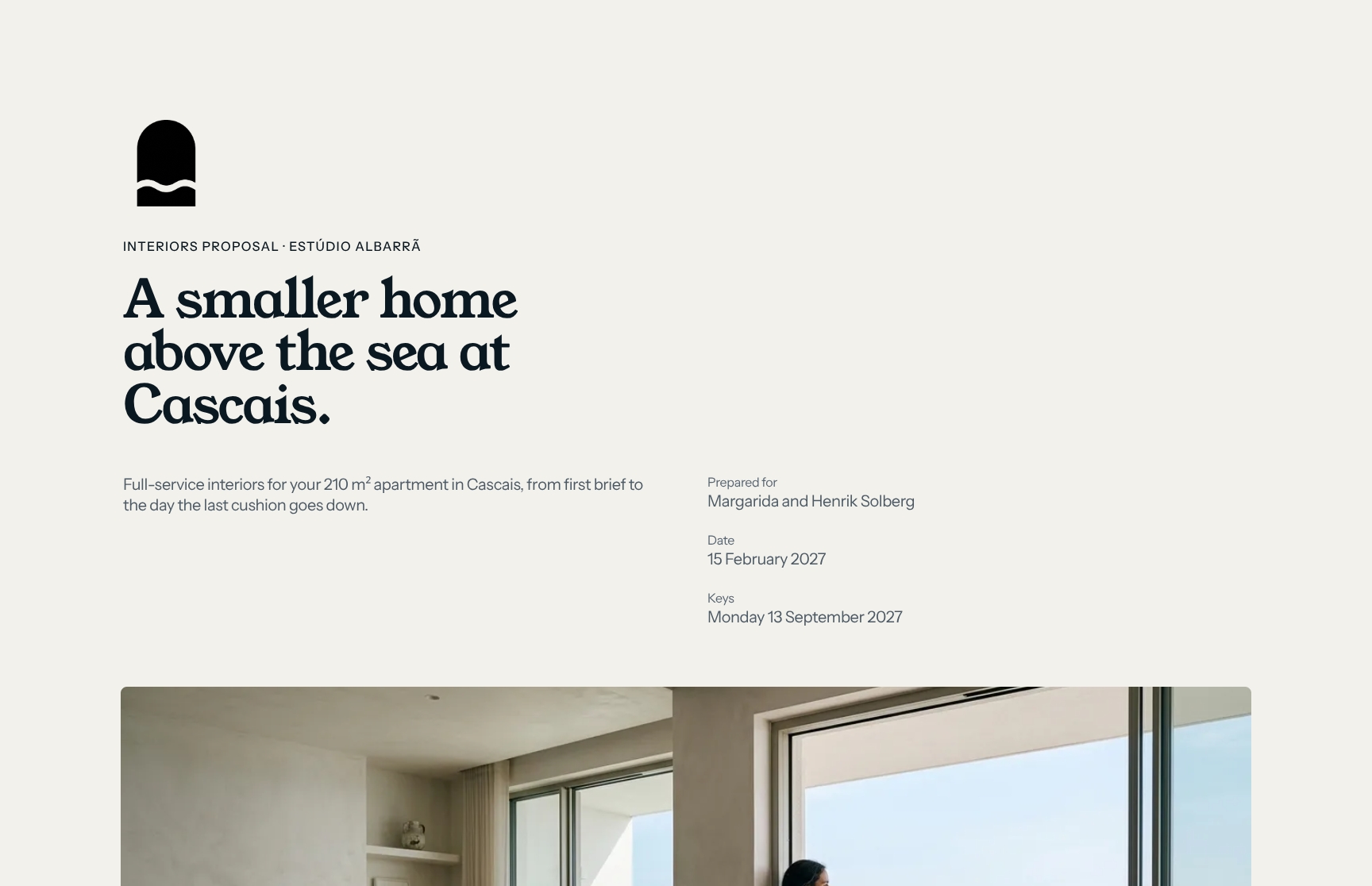
*Lisbon*
*Formlio template*
In [The Most Surefire Way I've Found to Win Enterprise Deals](https://review.firstround.com/the-most-surefire-way-ive-found-to-win-enterprise-deals), Chopra-McGowan told First Round Review that when traveling to meet a client, it works well to request a follow-up meeting within 24 hours of the first one, scheduling both at the same time upfront, sometimes even the same day.
Borrow the habit for interior work. Book the proposal walkthrough at the end of the consultation, before you leave the client's home, and send the proposal ahead of that meeting. The walkthrough becomes the follow-up, and the client arrives with questions instead of silence.
> When traveling to meet a client, we've found it works great to request a follow-up meeting within 24 hours of the first one (schedule both at the same time upfront), sometimes even the same day.
>
> — [Chopra-McGowan](https://review.firstround.com/the-most-surefire-way-ive-found-to-win-enterprise-deals)
This is where Formlio fits. A PDF goes into a black box. A Formlio document reports back: who opened it, what they read, when they signed. For an interior studio that means seeing whether the client lingered on the direction board, skipped the fee table, or came back to the payment schedule twice before the walkthrough. You follow up on what they actually read, not on a guess.
The proposal itself is built from blocks: a gallery for the moodboard, a timeline for the phases, an interactive pricing block for the fee, and an agreement block with slide-to-approve or e-signature right under the total. Once a proposal like this works, duplicate it for the next client and change only what is theirs. Shared through an open link, the same document doubles as a portfolio piece that shows prospects how you work.
**Pre-send checklist**
- **The summary uses their words**: Reread the brief from your consultation notes and check the summary quotes the goals the client actually named.
- **Every image is labelled**: Each picture on the direction board says reference or proposed concept, and products say confirmed or placeholder.
- **Scope is counted**: Rooms, concepts, views and revision rounds are numbers, and the exclusions list is written down.
- **Fees and pass-through are apart**: The design fee, the furniture budget and any procurement markup each sit on their own clearly named line.
- **Acceptance is one step**: A validity date and a single approve or sign action sit directly below the total, with nothing to print.
- **The follow-up is booked**: The walkthrough meeting is already in both calendars before the proposal link leaves your outbox.
## FAQ
### What should a design proposal look like?
It should follow the client's decision order: a short project summary, the visual direction, scope stated in counts, a timeline with client inputs, fees kept apart from furniture costs, and a single clear acceptance step. In Formlio you can build that order from blocks and add an approval right under the fee.
### What is the percentage rule in interior design?
There is no single official rule. The phrase usually refers to the markup or handling fee a designer adds when buying furniture at trade prices. Whatever rate you charge, name it on its own line in the proposal and say what it covers.
### Should an interior design proposal include a retainer or deposit?
Yes. Tie the first payment to signature so it works as a retainer, then link later payments to phases such as the start of sourcing and the end of installation. It keeps you from designing on credit.
### How long should an interior design proposal be?
Long enough to answer the client's questions in order and short enough to read in a single sitting. Cut anything that does not help them decide: the moodboard and the fee table matter far more than a long studio history.
### What is the difference between an interior design proposal and a contract?
A proposal sells the approach: the look, the scope, the timeline and the fee. A contract fixes the legal terms. Many studios combine them by adding terms and an e-signature to the proposal, which Formlio supports with its agreement block.
### Can ChatGPT help write an interior design proposal?
A general chatbot can help you tidy wording or draft a checklist, but it cannot know your client's brief, your fees or your sourcing. The parts that win the job, the direction board and the counted scope, still come from you.
### How do you follow up after sending a design proposal?
Book the walkthrough before you send, so the follow-up is already in the calendar. If you share the proposal as a Formlio link, you can see which sections the client read and open the conversation there.
## Build your next interior proposal with blocks
Start from a moodboard, add a counted scope and a clear fee table, and let the client approve right inside the document. Then see what they read after you hit send.
[Start free](https://formlio.com/templates/lisbon-interior-design-proposal)
## Sources
1. [The Most Surefire Way I've Found to Win Enterprise Deals](https://review.firstround.com/the-most-surefire-way-ive-found-to-win-enterprise-deals)
## Related
- [The architect's proposal framework: five pillars that make a fee feel worth it](https://formlio.com/blog/architecture-proposal-framework)
- [Brand design proposal: what brand designers need to show to win new clients](https://formlio.com/blog/brand-designers-proposal-win-new-clients)
- [Web design proposal mistakes: the 7 mistakes that cost you clients](https://formlio.com/blog/web-design-proposal-mistakes)
- [5 ways to present a proposal that builds client confidence](https://formlio.com/blog/present-proposal-client-confidence)
- [Formlio: the modern way to create and share proposals](https://formlio.com/blog/formlio-modern-proposals)
- [Four actionable strategies for proposals that win clients](https://formlio.com/blog/actionable-proposal-strategies-win-clients)
---
---
title: "The complete guide to pitch decks for creative agencies"
description: "A pitch deck guide for creative agencies: the structure, takeaway headlines, a worked slide-by-slide example, design rules and when to send a web proposal."
canonical: "https://formlio.com/blog/pitch-deck-creative-agencies-guide"
locale: "en"
type: "post"
date: "2025-01-26"
category: "How-To-Guides"
alternates:
fr: "https://formlio.com/fr/blog/pitch-deck-agences-creatives-guide.md"
---
# The complete guide to pitch decks for creative agencies

Pitch deck advice is usually written for founders raising money. A creative agency deck has a different job: win client work from people who may never see you present it.
FOUNDATIONS
## Define what your agency pitch deck has to do
A creative agency pitch deck is the story you tell a prospective client about their problem and how your studio will solve it. Unlike an investor deck, it has to work in the room, survive being forwarded to people you never met, and hand over cleanly to the proposal the client signs.
Search for pitch deck advice and you mostly find guides for startups raising a round: problem, fix, market size, traction, the ask. Some of it transfers. Plenty of it does not. An investor deck sells a company's future. An agency deck sells a team's judgement on someone else's problem, and the buyer is a marketing lead, a founder or a brand director with a deadline, not a venture partner.
The bigger difference is what happens after the meeting. The client asks you to "send the deck", and from that moment your slides have to do the selling without you. They get forwarded, skimmed on a phone, pasted into an internal email, and discussed in a meeting you are not invited to. A deck built only as a backdrop for your voice falls apart in that setting.
Forrester reports that, on average, [13 people within an organization are involved in the buying decision](https://www.forrester.com/press-newsroom/forrester-the-state-of-business-buying-2024).
- **13** people within an organization are involved in the buying decision, on average ([Forrester: The State Of Business Buying, 2024 (2024)](https://www.forrester.com/press-newsroom/forrester-the-state-of-business-buying-2024))
- **93%** of B2B buyers participated in a buying group ([Forrester: What's the big deal about getting rid of MQLs? (2023)](https://www.forrester.com/blogs/saying-goodbye-to-mqls-whats-the-big-deal-about-getting-rid-of-mqls))
So treat the pitch as three tasks with different readers. The live pitch is for the people in the room: it can be sparse, visual and paced by your voice. The leave-behind is for everyone else: it needs full-sentence headlines and enough context to make sense on its own. The proposal is for whoever signs: it carries scope, timeline, price and terms. Many agencies try to make a single file do all of this, and it ends up too wordy to present and too thin to sign.
**The three tasks a creative pitch has to do**
| Task | Main reader | What it needs | Depth |
| --- | --- | --- | --- |
| Live pitch | The people in the room | Big ideas, strong visuals, your voice doing the explaining | Light on text |
| Leave-behind | Colleagues who were not there | Takeaway headlines, context, proof that reads without you | Self-explanatory |
| Proposal | The person who signs | Scope, timeline, pricing options, terms and a way to approve | Complete |
STRUCTURE
## Structure your deck around the client's decision
The pitch deck rule on slide count, minutes and font size is a heuristic for investor pitches. For agencies, keep its spirit: a short core and readable type. The best structure for a pitch deck follows the client's decision: context, insight, idea, proof, process, team, investment, next step, with detail moved to an appendix.
For example, Guy Kawasaki's 10/20/30 rule asks for 10 slides, 20 minutes and no font smaller than 30 points. The 10-slide core and the large type suit agency pitches well: they force you to cut and they keep the deck readable on a phone. The 20 minutes rarely fits. Agency pitches usually run longer because the client wants to discuss the idea, and that conversation is where the work is often won. Keep the core short, leave room to talk, and park the rest in an appendix.
**A slide order that follows the client's decision**
1. **Context**: Show the client's situation back to them, more sharply than the brief put it. They should feel understood before they see a single idea.
2. **Insight**: State the thing you noticed that changes how the problem should be approached. This is the slide colleagues will repeat in the meeting you are not in.
3. **Idea**: Present the creative direction or strategy that follows from the insight, with just enough visual material to make it tangible.
4. **Proof**: Pick case studies that match the client's industry, problem or scale, each told as challenge, approach and outcome.
5. **Process**: Name the phases, what each produces and where the client is involved. A clear process makes creative work feel less risky.
6. **Team**: Introduce the people who will actually do the work, not the whole agency.
7. **Investment**: Frame the price against the scope, ideally as options, so the conversation moves forward inside the client's company.
8. **Next step**: End with a specific action and a date, not a thank-you slide.
Write every headline as the takeaway, not the label. "Problem" tells the reader nothing. "Your customers cannot tell your product lines apart" tells them what the slide proves. If a colleague reads only the headlines, they should still get the argument. That is the single most useful edit for a deck that will be forwarded.
Then tailor the emphasis to who decides. A founder usually wants the idea and the team. A marketing director wants proof that it will perform. A finance lead wants the investment slide to be unambiguous. You do not need separate decks for each; you need the right slides to carry their weight, and an appendix where the detail for each reader lives.
Gong Labs found that engaging executive buyers with a company-specific topic [tripled prospecting email reply rates](https://www.gong.io/blog/here-are-the-5-best-sales-insights-of-2023).
A deck is not a prospecting email, but the lesson carries over. The more a slide is about this client's company, the more likely a senior reader is to engage with it. Generic capability slides are the first thing a busy director skips.
WORKED EXAMPLE
## Build a pitch deck slide by slide with a worked example
Can ChatGPT create a pitch deck? It can draft an outline, suggest headline options and tidy your wording. It cannot supply the client insight, the right proof or your positioning, and those decide the pitch. Use AI for the first draft of structure, then let people who know the client write the argument.
Before any design, do the research. Read the client's site, their last few campaigns, their competitors and any interviews with their leadership. Ask in the briefing call what success looks like and who else will review the deck. Write the headlines in a plain document first. Only when the headlines tell the story on their own should anyone open a design tool.
The example below shows that order in practice for an invented project.
**Illustrative example: a 12-slide pitch for a fictional brand identity**
| Slide | Takeaway headline | Proof or content | Why it sits here |
| --- | --- | --- | --- |
| 1 | A brand identity for Fieldhouse Coffee's move into grocery | Client logo, project name, date | Sets the frame |
| 2 | Fieldhouse is loved in its cafes and invisible on a shelf | Photos of current packaging next to competitors | Shows you understood the problem |
| 3 | Shoppers choose coffee by origin story, not logo | Notes from shelf visits and customer interviews | The insight colleagues will repeat |
| 4 | Put the farm on the front of the bag | Moodboard and early direction | The idea follows the insight |
| 5 | The system works from bag to cafe menu | Rough applications | Makes the idea tangible |
| 6 | We did this for a tea brand entering retail | Case study: challenge, approach, outcome | Relevant proof |
| 7 | And for a bakery that grew into a chain | Second case study | Proof at a similar scale |
| 8 | Four phases, with you at every decision | Process diagram | Lowers perceived risk |
| 9 | Ready for the trade fair in 14 weeks | Timeline with milestones | Ties the plan to their deadline |
| 10 | The people who will do the work | Small team bios | Names, not an org chart |
| 11 | Three ways to start | Pricing options (see below) | Moves the decision forward |
| 12 | Decide by 14 March to make the fair | Next step and contact | A specific action and date |
**Illustrative example: the pricing slide**
| Option | Includes | Example price |
| --- | --- | --- |
| Essentials | Strategy, logo, colour and type system, packaging for 1 range | $18,000 |
| Recommended | Essentials plus guidelines and packaging for 3 ranges | $26,000 |
| Launch | Recommended plus cafe menus, signage and trade fair stand graphics | $34,000 |
April Dunford's write-up of the JOLT research notes that in no-decision deals, the company [did not stick with the status quo because they decided it was better than other options](https://www.lennysnewsletter.com/p/how-to-build-a-killer-sales-pitch).
That is the reason for options on the pricing slide. Clients rarely stall because they prefer doing nothing. They stall because the choice feels risky or unclear. A recommended middle option, a smaller way in and a fuller version give the reader something concrete to compare, and a clear line between them makes it easier to say yes.
**Draft the story before the design**

*Photo: Amina Filkins*
*Photo: Connor Scott McManus*

*Photo: Mediamodifier*
DESIGN
## Design the deck so it shows your craft without hiding the message
Design the deck the way you would design for a client: a tight type system, a restrained palette, a consistent grid and plenty of whitespace. Let the case studies and results carry the visual weight, keep every slide to a single point, and choose the tool by how much custom work the pitch really needs.
A creative agency deck is judged on what it says and on how it looks. Clients assume the deck is a sample of your work, so a cluttered layout costs you before the argument starts. The fix is not more decoration. It is restraint applied consistently.
Show results as simply as the data allows. A single before and after number with a plain label beats a busy dashboard. Use a chart only when the shape of the data matters, such as growth over time or a comparison between options, and label it so it reads without narration.
On tools, choose by the job. Google Slides is fast for drafting and easy for clients to comment on. Canva has ready-made layouts and suits quick, lightweight decks. Figma gives designers full control and works well for visual pitches that need custom layouts. Fully custom design is worth the time for a major pitch where the deck itself is part of the creative proof.
**Design rules for an agency pitch deck**
- **Keep the type system small**: Limit yourself to a pair of typefaces, a clear hierarchy, and body text large enough to read on a phone.
- **Restrain the palette**: Pick a few colours, use them with intent, and keep the client's brand colours for the slides about them.
- **Stick to a grid**: Align images, headlines and captions to the same grid on every slide so the deck reads as a single piece of work.
- **Give each slide a single point**: If a slide needs a paragraph to explain, split it or move the detail to the appendix.
- **Avoid the template look**: Templates save time, but stock layouts and default icons read as generic. Adapt them until they look like your studio.
- **Cut vague claims**: Replace words like innovative or award-winning with the specific result, the client name or the work itself.
McKinsey's research found that [almost 65 percent of B2B customers come away frustrated by inconsistent experiences](https://www.mckinsey.com/capabilities/growth-marketing-and-sales/our-insights/do-you-really-understand-how-your-business-customers-buy) during the decision journey.
Consistency is a design problem as much as a service problem. When the pitch, the leave-behind and the proposal look like they came from different studios, the client notices. Keep the same type, colour and voice from the first slide to the signature line.

*Restraint applied consistently reads as craft.*
*Photo: Ann H*
DELIVERY
## Decide when a static deck should become a trackable web proposal
Send a pitch deck as a link rather than a file when it has to travel: when several people will review it, when pricing needs a decision, or when you need to know whether it was read. A trackable web proposal shows who opened it and what they read, so your follow-up lands at the right moment.
A slide file is fine in the room. After the meeting it has real limits. You cannot see whether it was opened, who it was forwarded to, or which slides got attention. Versions multiply as you send updated copies, and the client ends up discussing an outdated copy. Pricing sits on a static slide, so any change needs a new file and another email. And when the client is ready to agree, they have to leave the deck for an email reply or a separate contract.

*Creative pitch template*
*Formlio template*
Forrester's research found that [86% of B2B purchases stall during the buying process](https://www.forrester.com/press-newsroom/forrester-the-state-of-business-buying-2024).
- **86%** of B2B purchases stall during the buying process ([Forrester: The State Of Business Buying, 2024 (2024)](https://www.forrester.com/press-newsroom/forrester-the-state-of-business-buying-2024))
Gong's analysis found that when sellers sent an additional email to prospects who had not responded, [win rates more than doubled compared to not sending anything further](https://www.gong.io/blog/data-shows-these-3-seller-mistakes-are-costing-you-time-and-money).
Stalls are normal, and following up through them pays. The hard part is knowing when, and what to say. That is where a web proposal earns its place. A PDF goes into a black box. A Formlio document reports back: who opened it, what they read, when they signed. You get a notification when the client opens or approves it, see how long they spent on each section, and whether it was shared with other stakeholders. If the investment section keeps getting attention, your follow-up can be about the options, without ever mentioning that you saw.
Formlio builds the deck from blocks, so the pitch story, case studies with embedded video and the pricing can live in a single branded, responsive document. The interactive quote lets the client toggle optional add-ons and compare tiered packages with the total updating as they go, and they can approve with Slide-to-Approve or sign with an e-signature inside the document.
**Test the finished deck before you send it**
- **Read only the headlines**: If the argument does not come through from the headlines alone, rewrite them before touching the design.
- **Open it on a phone**: Check that text is readable and images still make sense on a small screen, because forwarded decks are often read there.
- **Find the client in every section**: Each section should mention the client's situation, not only your agency. Cut slides that could go to anyone.
- **Check the investment slide**: Make sure the options, what each includes and the next step are unambiguous to someone who missed the meeting.
- **Plan the follow-up**: Decide before sending when you will follow up and what new material you will bring, such as a relevant case study.
## FAQ
### What is the pitch deck rule on slides, minutes and font size?
It is Guy Kawasaki's guideline for investor pitches: a short slide count, a short talk and large type. For agency pitches, keep the short core and the large type, and allow more time for discussion.
### Can ChatGPT create a pitch deck?
It can draft an outline, suggest headlines and polish wording. It cannot supply the client insight, the relevant proof or your positioning, so treat its output as a starting draft that your team rewrites.
### What is the best structure for a pitch deck?
For client work: context, insight, idea, proof, process, team, investment and next step, with takeaway headlines on every slide and the detail moved to an appendix.
### Should I send a pitch deck as a file or a link?
A link works better when the deck will be forwarded or needs a pricing decision, because it stays current and can show you whether it was read. With Formlio, the link also carries the interactive quote and approval.
### How do I present pricing in an agency pitch deck?
Show a small set of options tied to scope, mark your recommended option, and state what each includes. Keep the full line items in the proposal or appendix so the slide stays readable.
### What is the difference between a pitch deck and a proposal?
The pitch deck makes the case for your idea and your team. The proposal turns that case into scope, timeline, price and terms the client can approve. Many agencies send the deck first and the proposal after the pitch.
### How do I pitch a client who asked for a free spec pitch?
Offer a paid discovery phase or a strategy presentation of your thinking and past work instead of free creative. Clients who value the work usually accept; those who refuse are telling you how the project will go.
## Turn your next pitch into a document that reports back
Build your pitch and proposal with blocks, share it as a link, and see who reads it before you follow up.
[Start free](https://formlio.com/templates/creative-pitch-template)
## Sources
1. [13 people within an organization are involved in the buying decision](https://www.forrester.com/press-newsroom/forrester-the-state-of-business-buying-2024)
2. [Forrester: What's the big deal about getting rid of MQLs?](https://www.forrester.com/blogs/saying-goodbye-to-mqls-whats-the-big-deal-about-getting-rid-of-mqls)
3. [tripled prospecting email reply rates](https://www.gong.io/blog/here-are-the-5-best-sales-insights-of-2023)
4. [did not stick with the status quo because they decided it was better than other options](https://www.lennysnewsletter.com/p/how-to-build-a-killer-sales-pitch)
5. [almost 65 percent of B2B customers come away frustrated by inconsistent experiences](https://www.mckinsey.com/capabilities/growth-marketing-and-sales/our-insights/do-you-really-understand-how-your-business-customers-buy)
6. [win rates more than doubled compared to not sending anything further](https://www.gong.io/blog/data-shows-these-3-seller-mistakes-are-costing-you-time-and-money)
## Related
- [Digital agency pitch: how to build a pitch that answers every buyer doubt](https://formlio.com/blog/digital-agency-pitch-deck-essentials)
- [5 ways to present a proposal that builds client confidence](https://formlio.com/blog/present-proposal-client-confidence)
- [What makes a winning marketing proposal: build it around the client's decision](https://formlio.com/blog/winning-marketing-proposal-key-elements)
- [Brand design proposal: what brand designers need to show to win new clients](https://formlio.com/blog/brand-designers-proposal-win-new-clients)
- [Why your next proposal shouldn't be a PDF](https://formlio.com/blog/why-web-proposals-beat-pdfs)
- [How to quickly create proposals that feel high-end, with a reusable block library](https://formlio.com/blog/quickly-create-premium-proposals)
---
---
title: "Four actionable strategies for proposals that win clients"
description: "Four proposal strategies for creative studios and freelancers: qualify the brief, lead with the problem, price in options and time your follow-up."
canonical: "https://formlio.com/blog/actionable-proposal-strategies-win-clients"
locale: "en"
type: "post"
date: "2025-03-31"
category: "How-To-Guides"
alternates:
fr: "https://formlio.com/fr/blog/4-strategies-propositions-commerciales-conversion.md"
---
# Four actionable strategies for proposals that win clients

Creative proposals rarely lose on craft. They lose on decisions made before and after the writing: which briefs to chase, how the opening reads, how the price is framed and when you follow up.
QUALIFY
## Qualify the brief before you write a word
To get customers for your business without burning weeks on dead pitches, decide whether to bid before you write: check fit, budget signals and access to the person who signs.
Every studio knows the feeling. A brief lands on Friday afternoon, the deadline is Tuesday, and the team spends the weekend building a pitch for a client who was never going to choose them. The proposal was good. The decision to write it was not.
Qualifying is the cheapest strategy in this guide because it happens before any design work. It asks a blunt question: is this a project we can win, and do we want it? A studio that answers honestly sends fewer proposals and gives each one more attention. That trade is almost always worth it.
For creative work, a formal brief is often the end of the buying process, not the start. If a client sends you a request for proposal and you have never spoken to them, someone else has probably shaped the brief already. A solicited proposal answers a request the client wrote. An unsolicited proposal is one you send after a conversation that surfaced a problem. The unsolicited kind is harder to start and easier to win, because you helped define the problem it solves.
Competition belongs in that early conversation too. Ask who else they are talking to and what they liked about previous partners. It feels awkward, and it pays off.
- **32%** higher odds of winning an enterprise deal when the competition is mentioned early, compared with not discussing it ([Gong, Top 5 sales insights from 2023](https://www.gong.io/blog/here-are-the-5-best-sales-insights-of-2023))
**Questions to ask before you agree to write**
- **What happens if you do nothing?**: The answer tells you whether the problem is urgent or a nice-to-have. Nice-to-haves stall in approval.
- **Who signs off, and will they read it?**: If you cannot reach the decision-maker before sending, your proposal will be summarised by someone else, badly.
- **What budget range have you set aside?**: Clients rarely give a number, but a range or a past project cost is enough to know whether you are in the same world.
- **Who else are you talking to?**: Knowing the alternatives lets you position against them instead of guessing what the client is comparing.
- **Why now?**: A launch date, a rebrand or a funding round gives the project a deadline. No reason usually means no decision.
PROBLEM FIRST
## Lead with the client's problem, not your portfolio
Open your proposal with the client's problem in their own words, then show a single relevant case study as proof. A gallery of past work can wait for the appendix.
Creative studios love to open with themselves. The founder's story, the award shelf, the client logos. It feels like credibility. To the reader it feels like a delay, because the first page is the one they actually read, and it says nothing about them.
A problem-first executive summary flips that. It restates what the client told you, names the cost of leaving it unsolved and previews the outcome you propose. If the client nods at the first paragraph, they keep reading. The rewrite below shows the same opening for a fictional client, before and after.
**Illustrative example: the same opening, rewritten**
For example, a fictional coffee roaster, North Fold, asks a studio for a new brand identity before opening its second cafe.
| Generic opening | Problem-first opening | What changed |
| --- | --- | --- |
| We are an award-winning studio founded in 2012 with a passion for bold brands. | North Fold's packaging no longer matches the cafe experience, and the second location opens in March. | The subject is the client, not the studio. |
| Our team has worked with over 40 food and drink brands. | Wholesale buyers mistake your bags for a supermarket label, which caps your shelf price. | It names the business cost of the problem. |
| We would love to help you refresh your brand. | We propose a 6-week identity project that gives the new cafe and the bags a single, recognisable system. | It previews a scoped outcome with a deadline. |
Notice what the rewrite keeps out. No list of services, no adjectives about the studio. Proof still matters, but it works harder when it is specific. Pick the single case study closest to this client's situation and place it right after the problem, so it reads as evidence rather than decoration.
Personalise the cover the same way. Use the client's name, their colours if they have them and language lifted from the discovery call. Clients notice when a proposal sounds like them.
In The Most Surefire Way I've Found to Win Enterprise Deals on [First Round Review](https://review.firstround.com/the-most-surefire-way-ive-found-to-win-enterprise-deals), Chopra-McGowan says that when traveling to meet a client, it works well to request a follow-up meeting within 24 hours of the first one, sometimes even the same day, and to schedule both upfront.
> When traveling to meet a client, we've found it works great to request a follow-up meeting within 24 hours of the first one (schedule both at the same time upfront), sometimes even the same day.
>
> — [Chopra-McGowan, General Assembly](https://review.firstround.com/the-most-surefire-way-ive-found-to-win-enterprise-deals)
The idea travels well to studio work. Bring a rough draft of the problem statement to a quick second conversation and let the client correct it. Their edits become your opening, and the finished proposal arrives already agreed in spirit.

*Photo: cottonbro studio*
PRICE OPTIONS
## Price in three options so the client chooses how, not whether
Give the client three options with clear scope, so the decision becomes which version of the project to buy rather than whether to buy at all.
A single price invites a yes or no. Three options invite a comparison, and a comparison keeps the client inside your proposal instead of opening a competitor's. The middle option is the one you recommend. The smaller option protects the relationship when budget is tight. The larger option anchors the range and often sells more than you expect.
Each option needs its own scope, deliverables and timeline, plus a short line on what it excludes. Exclusions prevent the scope creep that eats a studio's margin, and they make the larger option easier to justify.
**Illustrative example: brand identity options for North Fold**
For example, here is how the fictional roaster's proposal could price the same project three ways.
| Option | Scope | Timeline | Price |
| --- | --- | --- | --- |
| Essential | Logo refresh, colour palette, type pairing, a short guidelines sheet | 3 weeks | $6,500 |
| Recommended | Essential plus packaging system for 4 bag sizes and cafe signage | 6 weeks | $12,000 |
| Full | Recommended plus menu design, website art direction and a launch photo day | 9 weeks | $19,500 |
Illustrative example notes: the Recommended option is listed second and marked as the studio's pick, because it covers the cafe opening in March. The Essential option at $6,500 keeps a smaller yes on the table. The Full option at $19,500 makes $12,000 feel measured. The proposal states that prices hold for 30 days and that copywriting and printing are excluded from every option.
**What every priced option should state**
- **Deliverables**: Name each file or artefact the client receives, so nobody argues later about what was included.
- **Timeline and milestones**: Show when the client reviews work and when feedback is due, so delays on their side are visible.
- **Exclusions**: List what the option does not cover, such as printing, copywriting or extra revision rounds.
- **Expiry date**: Give the prices a validity window. It creates a natural reason to follow up and protects you from stale quotes.
- **Next step**: End with one clear action: pick an option and approve, or book a call to adjust the scope.
[Payoneer's Freelancer Insights Report](https://www.payoneer.com/resources/business/the-payoneer-2023-freelancer-insights-report/) found that, in response to the rising cost of living, 41% of freelancers raised their rates.
Raising a rate is easier when the client chooses between options than when they judge a single number. Options are how you defend the price, and when a client pushes back you can move them to a smaller option instead of cutting your rate.
[Simon-Kucher's global pricing study](https://www.simon-kucher.com/en/who-we-are/newsroom/global-pricing-study-2016-every-second-company-involved-price-war) found that for 50 percent of the interviewees, the most suitable option is to improve the value communication of products.
For a studio, value communication lives next to the price. Each option should say what the client gets and why it matters to their project, so the number reads as the cost of an outcome.
FOLLOW UP
## Track engagement and follow up while the proposal is open
Follow up after sending a proposal while the client is still thinking about it, ideally the same working day they read it, and bring something new each time.
The proposal is out. Now the hardest part starts: silence. Studios tend to wait politely for a week, then send a nervous note. By then the client has moved on, or a competitor has called. Timing is the strategy here, and timing depends on knowing when the client is actually reading.
[Gong's analysis of seller mistakes](https://www.gong.io/blog/data-shows-these-3-seller-mistakes-are-costing-you-time-and-money) describes a sweet spot for follow-up timing that comes with the highest average win rate of 49%.
The same [Gong research](https://www.gong.io/blog/data-shows-these-3-seller-mistakes-are-costing-you-time-and-money) shows that 32% of the time, reps don't follow up within 24 hours.
- **44%** of sales reps follow up with a prospect only once before giving up ([HubSpot, The art of the sales follow-up](https://blog.hubspot.com/sales/sales-follow-up-infographic))
- **94%** of salespeople have given up after four follow-ups ([HubSpot, The art of the sales follow-up](https://blog.hubspot.com/sales/sales-follow-up-infographic))
So the bar is low. A studio that follows up promptly and keeps going without being a nuisance already stands out. The words matter as well, because a follow-up that only asks for a status update gives the client nothing to respond to.
**Before and after you hit send**
1. **Proofread with fresh eyes**: Have someone outside the project read the proposal for the client's name, prices and dates. Typos in a design pitch cost more than anywhere else.
2. **Watch for the first open**: The first read tells you the proposal reached the right inbox. Plan your follow-up for the same working day.
3. **Note where the client lingers**: Time spent on pricing or scope points to the question they will ask. Answer it before they do.
4. **Look for forwards**: New readers mean the proposal is being shared with a decision-maker. Offer a short walkthrough call.
5. **Add something new each time**: A relevant case study, a timeline tweak or a direct question gives the client a reason to reply.
Those signals only exist if the proposal can report them. Formlio proposals are web documents built from blocks, shared as a link. A PDF goes into a black box. A Formlio document reports back: who opened it, what they read, when they signed. You get a notification when the client opens it, section-level time shows whether they reached the pricing, and the client can pick an option in the interactive quote and approve inside the document. Your follow-up stops being a guess.
**Follow up with context**

*Photo: Vitaly Gariev*

*Photo: Angela Roma*
## FAQ
### How to write a proposal?
Start by qualifying the brief and confirming who signs off. Open with the client's problem in their own words, follow it with a single relevant case study, then set out scope, deliverables, timeline and priced options. Close with a clear next step and an expiry date, and proofread before you send.
### How many pricing options should a proposal include?
Three options work well for creative projects: a smaller version, the version you recommend and a larger one. Each needs its own scope and exclusions so the client compares real differences, not just prices.
### When should I follow up after sending a proposal?
Follow up soon after the client first opens the proposal, ideally the same working day, and keep going a few times with something new each time. With Formlio you get a notification when the proposal is opened, so you know when that moment arrives.
### How do I handle a client who says my price is too high?
Point them to a smaller option instead of discounting. Ask which deliverables matter to them and rebuild the scope around those. Your rate stays intact, and the client still gets a project that fits the budget.
### How do I write a proposal when the client hasn't given a brief?
Write the brief yourself. Summarise the problem from your conversation, list your assumptions and send it as a short draft for the client to correct. Their corrections become the opening of the full proposal.
## Send your next proposal as a Formlio document
Build it from blocks, price it in options with the interactive quote and know the moment your client opens it.
[Start free](https://formlio.com/templates)
## Sources
1. [Gong, Top 5 sales insights from 2023](https://www.gong.io/blog/here-are-the-5-best-sales-insights-of-2023)
2. [First Round Review](https://review.firstround.com/the-most-surefire-way-ive-found-to-win-enterprise-deals)
3. [Payoneer's Freelancer Insights Report](https://www.payoneer.com/resources/business/the-payoneer-2023-freelancer-insights-report/)
4. [Simon-Kucher's global pricing study](https://www.simon-kucher.com/en/who-we-are/newsroom/global-pricing-study-2016-every-second-company-involved-price-war)
5. [Gong's analysis of seller mistakes](https://www.gong.io/blog/data-shows-these-3-seller-mistakes-are-costing-you-time-and-money)
6. [HubSpot, The art of the sales follow-up](https://blog.hubspot.com/sales/sales-follow-up-infographic)
## Related
- [How to present pricing to clients in a proposal: layout, order and wording](https://formlio.com/blog/how-to-present-pricing-to-clients)
- [Ten essential tips for creating engaging proposals that convert](https://formlio.com/blog/tips-creating-engaging-proposals-convert)
- [5 ways to present a proposal that builds client confidence](https://formlio.com/blog/present-proposal-client-confidence)
- [Brand design proposal: what brand designers need to show to win new clients](https://formlio.com/blog/brand-designers-proposal-win-new-clients)
- [What makes a winning marketing proposal: build it around the client's decision](https://formlio.com/blog/winning-marketing-proposal-key-elements)
- [Why sales proposals fail and what top closers do differently](https://formlio.com/blog/why-sales-proposals-fail)
---
---
title: "Managing client relationships in creative projects, from proposal to close"
description: "Manage client relationships in creative projects: pick the right relationship model, diagnose difficult clients, and decide when to repair or end the work."
canonical: "https://formlio.com/blog/manage-difficult-clients-creative-industry"
locale: "en"
type: "post"
date: "2025-08-25"
category: "How-To-Guides"
alternates:
fr: "https://formlio.com/fr/blog/gerer-clients-difficiles-industrie-creative.md"
---
# Managing client relationships in creative projects, from proposal to close

A difficult client is usually a design problem, not a personality problem. Treat the relationship as something you shape at the proposal, the kickoff, every feedback round and the close, and you can fix far more of it than you think.
FOUNDATIONS
## Choose the relationship model before you start the project
There are four types of customer relationships worth naming in creative work (transactional, advisory, collaborative and partnership), and choosing the right type of relationship before kickoff tells you how to scope, price and talk to the client.
Relationship management sounds like a soft skill. In a studio it is mostly structure: who decides, how often you talk, what the fee covers and what happens when the brief moves. Clients arrive with their own picture of how this will go, shaped by past agencies, design apps and whatever they have seen on television. If you never state your version, theirs wins by default.
The proposal is where you state it. It is the first document the client reads closely, and it sets the tone for everything after. A proposal that names the decision-maker, the budget range, the rounds of feedback and the roles on both sides has already prevented many of the arguments you would otherwise have mid-project. A proposal that only shows the work leaves those questions open, and open questions turn into friction.
**Match the relationship type to the way you run the project**
| Relationship type | What the client wants | How to scope it | How to talk |
| --- | --- | --- | --- |
| Transactional | A defined deliverable, fast and at a known price | Fixed scope, fixed fee, tight revision limit | Short updates at set milestones |
| Advisory | Your judgement on a problem they cannot frame alone | Discovery phase priced separately from delivery | Explain the reasoning behind every recommendation |
| Collaborative | To shape the work with you, often with an in-house team | Named decision-maker and approval checkpoints | Regular working sessions with a shared record |
| Partnership | An ongoing creative lead across several projects | Retainer with a scope review every few months | Planning calls ahead of the work, not after it |
Getting the type wrong is the quiet cause of many strained projects. A client who wanted a transactional job gets frustrated by long strategy workshops. A client who wanted an advisor feels shortchanged by a studio that simply executes the brief. Neither side is difficult. They signed up for different relationships.
Scope creep often starts here too. When the relationship type is unclear, every new request looks reasonable to the client, because nobody agreed on what the fee was for. Each small extra costs you hours you did not price, and the resentment builds on both sides until somebody says something sharp in a feedback call.
DIAGNOSIS
## Diagnose why a client feels difficult before you react
Before you decide a client is difficult, check whether they are badly briefed: friction usually comes from unclear scope, an unclear decision-maker or a genuinely poor fit, and each cause needs a different response.
**Sort the behaviour by its cause**
1. **Unclear scope**: The client keeps asking for things you think are extras and they think are included. Fix it by pointing to the written scope and pricing the change, not by arguing about intent.
2. **Unclear decision-maker**: Feedback contradicts itself, or approval stalls after a round you thought was final. Someone else is deciding. Ask who signs off and get them into the next review.
3. **Poor fit**: Disagreement about price, process or taste that no document resolves. This shows up early, often in the first meeting, and it rarely improves with more effort.
The warning signs tend to appear before the contract. A client who pushes hard on price in the first conversation, who cannot say who else will review the work, or who describes their last agency with real anger is telling you something. None of these is a reason to walk away on its own. Together, they are a reason to write the scope and the approval process more tightly than usual.
Once the project is running, keep a record. Note every decision, every change request and every approval, with the date and who made it. This is not about building a legal case. It turns a vague argument (you never told us) into a short, calm reply that points to the note. Clients respect a studio that knows what was agreed, and the record protects you if the relationship does end.
Match the response to the cause. Scope problems need a change request with a price and a timeline. Decision-maker problems need a meeting with the person who actually signs. Fit problems need an honest conversation about whether to continue. Treating a scope problem as a personality clash, or a fit problem as a scope issue, wastes weeks and leaves everyone more tired than before.
WORKED EXAMPLE
## Walk through a brand identity project and fix each strain point
Here is an illustrative identity project for a fictional client, mapped week by week to the moments where relationships usually strain and the reply that keeps each one on track.
Illustrative example: a small studio takes on a brand identity for Fernhill, a fictional bakery chain, over 10 weeks. The proposal names the owner as the decision-maker, includes 2 rounds of revisions and splits the fee into 3 payments: at signing, at the concept presentation and at delivery.
In week 5, after the 1st revision round, the owner asks for a new sub-brand for a catering line. In week 7, the owner's business partner appears at the presentation and questions the whole direction. In week 10, the final payment arrives 3 weeks late. Each moment is predictable, and each has a reply that keeps the relationship intact.
**Illustrative example: Fernhill identity project, week by week**
| Week | What happens | Warning sign | What to say or do |
| --- | --- | --- | --- |
| Week 1 | Kickoff and brief review | Owner mentions a partner who might have opinions | Ask now whether the partner signs off, and add them to the review list |
| Week 3 | Concepts presented, round 1 feedback | Feedback arrives from several people in separate emails | Request a single consolidated list from the owner |
| Week 5 | Round 2 and a request for a catering sub-brand | Extra work framed as a small tweak | Great idea. It sits outside this scope, so I will send a separate quote and timeline by Friday. |
| Week 7 | Partner questions the direction at the presentation | A decision-maker nobody named | Walk the partner through the approved brief, then agree on one person who approves |
| Week 10 | Final files delivered, last payment late | Silence after delivery | Send a friendly reminder citing the payment stage in the signed proposal |
**Wording that pushes back without a fight**
- **For extra revisions**: We have used the rounds included in the fee. I am happy to keep going, and here is what another round costs.
- **For a changing brief**: This changes what we agreed at kickoff. Let me show you what it affects in scope, time and budget before we decide.
- **For a surprise stakeholder**: Thanks for joining. Can I walk you through the brief we approved, so we judge the work against the same goals?
CLOSING OUT
## Decide whether to repair the relationship or end it
Repair the relationship when the problem is scope or an unclear decision-maker and the client still respects your process; end it when the fit is wrong, when respect has gone, or when the project costs more than it earns.
**Repair or end: the questions to ask**
- **Is the cause fixable?**: Scope and decision-maker problems usually are. A clash of values or taste usually is not.
- **Does the client still respect your time?**: Late feedback once is normal. Constant out-of-hours demands and ignored agreements are a pattern.
- **Is the project still worth doing?**: Count the unpaid hours and the effect on your team. A project that drains both rarely recovers.
- **Would you take this client again?**: If the honest answer is no, plan an orderly ending rather than hoping the next phase improves.
If you end it, let the contract do the hard part. An early termination clause should say how much notice either side gives, what work gets paid for and who owns what at the point of exit. A kill fee covers the time you reserved for the project and cannot fill at short notice. With those terms in place, ending a project becomes a matter of following the agreement, not a negotiation under stress.
Write the notice calmly and without blame. Hand over completed work and files on time, close the open invoices and keep the tone professional. The creative industry is small, and a client you part with well may still refer you later.
According to [HubSpot's 2025 State of Sales Report](https://blog.hubspot.com/sales/sales-email-templates-to-get-and-keep-buyers-attention), 15% of sales professionals identify customer referrals as the best source for high-quality leads.
The good projects are where referrals come from, so close them as carefully as you opened them. Send a short wrap-up with what you delivered, ask what worked for the client, and tell them plainly that you welcome introductions.
This is also where Formlio helps. A Formlio proposal sets the whole relationship out together: scope, revision rounds, payment stages and an agreement the client approves with Slide-to-Approve or an e-signature. After you hit send, you see who opened it and which sections they read, so a partner who reads the pricing twice is no surprise at the presentation. A PDF goes into a black box. A Formlio document reports back: who opened it, what they read, when they signed.

*Close good projects as carefully as you opened them.*
*Photo: Kampus Production*
## FAQ
### What are the four types of customer relationships?
In creative work they are transactional, advisory, collaborative and partnership. Each needs a different scope, fee structure and rhythm of communication, so name the type in the proposal.
### How many revision rounds should a creative contract include?
Include a fixed number of rounds that fits the project, often two rounds for identity work, and state the price of any extra round. The point is that the limit is written down before work starts.
### How do you say no to a client who keeps changing the brief?
Acknowledge the idea, show what it changes in scope, time and budget, and offer a separate quote. You are not refusing the work, only refusing to do it for free.
### What should a creative client contract say about termination and kill fees?
It should set the notice period, what completed work gets paid for, who owns the files at exit and a kill fee for reserved time. Clear terms make an ending procedural instead of personal.
### How do you handle a client with several decision-makers who disagree?
Ask who has final sign-off, get that person into the next review and request consolidated feedback. With Formlio you can see which stakeholders opened the proposal before the meeting.
### How do you fire a client without damaging your reputation?
Follow the termination clause, give notice in writing without blame, hand over completed work on time and settle open invoices. A calm, orderly exit protects how people talk about you.
## Set the relationship out in the proposal
Build a Formlio proposal with scope, revision rounds and payment stages together, then see who read it after you hit send.
[Start free](https://formlio.com/templates)
## Sources
1. [HubSpot's 2025 State of Sales Report](https://blog.hubspot.com/sales/sales-email-templates-to-get-and-keep-buyers-attention)
## Related
- [How to spot problematic clients before you write a proposal](https://formlio.com/blog/spot-problematic-clients-before-proposal)
- [Four actionable strategies for proposals that win clients](https://formlio.com/blog/actionable-proposal-strategies-win-clients)
- [Agency productivity techniques that protect margin, starting with the proposal](https://formlio.com/blog/agency-productivity-techniques)
- [How to address pricing pushback without lowering your rates](https://formlio.com/blog/pricing-pushback-keep-rates)
- [How to present pricing to clients in a proposal: layout, order and wording](https://formlio.com/blog/how-to-present-pricing-to-clients)
- [Brand design proposal: what brand designers need to show to win new clients](https://formlio.com/blog/brand-designers-proposal-win-new-clients)
---
---
title: "How to structure a successful photography proposal"
description: "Our guide breaks down how to structure a successful photography proposal, with specific tips for wedding, commercial, and product photographers."
canonical: "https://formlio.com/blog/structure-photography-proposal"
locale: "en"
type: "post"
date: "2025-09-15"
category: "How-To-Guides"
alternates:
fr: "https://formlio.com/fr/blog/photographe-structurer-proposition-commerciale.md"
---
# How to structure a successful photography proposal

As a photographer, your talent shines through your lens, capturing moments, products, or events with breathtaking artistry. Your portfolio is a testament to your skill.
A successful photography proposal isn't merely a price list; it's the crucial first step in a thriving client partnership. It’s your opportunity to prove that your professionalism matches your artistic vision, laying the groundwork for trust, clear communication, and a seamless working relationship.
## The foundation: what every great photography proposal needs
Before diving into niche-specific details, every successful photography proposal must establish a universal framework that builds confidence and clarity.
### Start with the client's vision
The proposal process doesn't begin when you open your template; it begins during the initial consultation. This is your chance to listen intently to your client's needs, their aspirations, and their pain points.
Reflect their own language and goals back to them in your proposal. When a client reads their own words and sees their vision articulated by you, it immediately signals that you've truly understood their requirements, building trust and rapport from the very first page.
### Clearly define the scope and deliverables
Ambiguity is the enemy of a successful project. Your proposal must provide a practical, detailed breakdown of exactly what the client will receive. This includes a clear description of the project, the number of shooting hours, the specific number of professionally edited photos, estimated turnaround times, and any physical products such as prints, albums, or canvases.
Setting clear expectations upfront prevents misunderstandings and ensures both parties are aligned on the outcome.
### Showcase your relevant work
While your full portfolio might be extensive, your proposal is not the place for a generic dump of images.
Curate a mini-portfolio within the proposal itself, featuring past work that is directly relevant to the new client's style, industry, or desired aesthetic.
If they're a fashion brand, show your fashion photography.
If it's a family portrait, show your best family sessions.
This targeted showcase proves your capability for their specific project, making your expertise feel tailored and immediately applicable.
## Tailoring the details for your photography niche
While core principles remain universal, the nuances of a successful proposal change dramatically based on your photography specialization.
### For commercial and brand photographers
For commercial and brand clients, your proposal must speak the language of business.
Focus on critical details such as clear definitions of licensing and usage rights, outlining exactly how and where the client can use your images (e.g., web-only, print, advertising, duration).
Explain how your photographic style and approach will align with the client's brand guidelines and marketing objectives.
Crucially, frame the project in terms of return on investment (ROI), how will these images help them sell more, build their brand, or achieve their business goals?
### For wedding and event photographers
Wedding and event photography proposals are about capturing emotion and telling a story.
Rather than just listing hours, describe the experience you provide and the narrative you'll preserve. Present clear, tiered packages (e.g., "Silver," "Gold," "Platinum") that outline varying levels of coverage, album options, and second shooter availability.
Detail popular add-ons like engagement shoots, prints, or additional hours. The goal is to build an emotional connection while clearly articulating what they receive.
### For portrait and family photographers
Proposals for portrait and family sessions should be warm, personal, and straightforward.
Focus on transparent pricing for session length, the number of final retouched images included, and options for wardrobe changes or location scouting.
Clearly suggest product add-ons like high-quality prints, custom canvases, or family albums directly within the proposal. A friendly, reassuring tone helps build rapport and trust, guiding clients through their choices.
## The Formlio advantage: from static propsals to interactive experiences
In an industry that sells creativity and visual excellence, your proposal should be an extension of your artistic brand. This is where Formlio transforms your approach, elevating your proposals to match the quality of your photography.
### Build professionals proposals quickly
- Time is money, especially for busy photographers. Formlio streamlines your workflow, allowing you to create stunning proposals in a fraction of the time. Use pre-designed, reusable templates and content blocks to quickly assemble your proposals.
- Collaborate in real-time with your team on the same proposal.
- Plus, you can save your custom templates and blocks to your personal library, ensuring brand consistency and speed for every future proposal.
### Create a premium, visually engaging proposal
- Formlio empowers you to differentiate yourself by creating interactive, responsive proposals that look like high-end, custom-built private websites, no coding required.
- Go beyond static images by easily incorporating rich media like videos and animations to truly showcase your work and bring your vision to life.
- Customize every element with your logo, brand colors, and fonts to ensure your proposal is a seamless extension of your professional brand, leaving a lasting impression that static PDFs simply can't match.
### Maximize revenue and close deals faster
Formlio isn't just about pretty presentations; it's a powerful tool for driving business growth.
- Utilize interactive estimates that allow clients to explore different packages and add-ons themselves, driving effortless upselling and increasing the value of each deal.
- Receive real-time notifications the moment your client opens the proposal and leverage detailed analytics (including heatmaps that show what they focused on) to follow up intelligently and at the perfect moment.
- Finally, empower clients to approve quotes directly within the proposal, streamlining the final step and accelerating your sales cycle.
## Your proposal is the start of the partnership
A truly successful photography proposal transcends a simple cost breakdown. It's a strategic document that reflects your professionalism, showcases your understanding of the client's needs, and communicates the value of your art.
By investing in how you present your work, moving towards interactive, visually rich proposals, you're not just securing a booking; you're initiating a professional and trusting relationship, setting the stage for a thriving partnership and a successful project.
\---
En tant que photographe, votre talent brille à travers votre objectif, capturant des moments, des produits ou des événements avec un talent artistique époustouflant. Votre portfolio est un témoignage de votre compétence.
Une proposition commerciale de photographe réussie n'est pas une simple liste de prix ; c'est la première étape cruciale d'un partenariat client fructueux. C'est votre opportunité de prouver que votre professionnalisme est à la hauteur de votre vision artistique, en posant les bases de la confiance, d'une communication claire et d'une relation de travail fluide.
#### **Les fondations : ce que toute bonne proposition de photographe doit contenir**
Avant de plonger dans les détails spécifiques à votre niche, toute proposition commerciale réussie doit établir un cadre universel qui inspire confiance et clarté.
**Commencez par la vision du client** Le processus de proposition ne commence pas lorsque vous ouvrez votre modèle ; il commence lors de la première consultation. C'est votre chance d'écouter attentivement les besoins de votre client, ses aspirations et ses problématiques. Reprenez son propre langage et ses objectifs dans votre proposition. Quand un client lit ses propres mots et voit sa vision formulée par vous, cela lui signale immédiatement que vous avez vraiment compris ses exigences, créant ainsi un lien de confiance dès la première page.
**Définissez clairement la mission et les livrables** L'ambiguïté est l'ennemie d'un projet réussi. Votre proposition doit fournir une description pratique et détaillée de ce que le client recevra exactement. Cela inclut une description claire du projet, le nombre d'heures de prise de vue, le nombre spécifique de photos retouchées professionnellement, les délais de livraison estimés et tout produit physique comme des tirages, des albums ou des toiles. Fixer des attentes claires dès le départ prévient les malentendus et garantit que les deux parties sont alignées sur le résultat.
**Mettez en avant votre travail pertinent** Même si votre portfolio complet est peut-être vaste, votre proposition n'est pas l'endroit pour un simple pêle-mêle d'images génériques. Constituez un mini-portfolio au sein même de la proposition, en présentant des travaux passés qui sont directement pertinents par rapport au style, au secteur ou à l'esthétique souhaitée par le nouveau client. S'il s'agit d'une marque de mode, montrez vos photos de mode. S'il s'agit d'un portrait de famille, montrez vos meilleures séances de famille. Cette vitrine ciblée prouve votre capacité à réaliser leur projet spécifique, rendant votre expertise sur mesure et immédiatement pertinente.
#### **Adapter les détails à votre spécialisation en photographie**
Bien que les principes de base restent universels, les nuances d'une proposition réussie changent radicalement en fonction de votre spécialisation.
**Pour les photographes commerciaux et de marque** Pour les clients commerciaux et les marques, votre proposition doit parler le langage des affaires. Concentrez-vous sur des détails cruciaux comme la définition claire des licences et des droits d'utilisation, en précisant exactement comment et où le client peut utiliser vos images (par ex., web uniquement, impression, publicité, durée). Expliquez comment votre style photographique et votre approche s'aligneront sur la charte graphique et les objectifs marketing du client. Enfin, et c'est essentiel, présentez le projet en termes de retour sur investissement (ROI) : comment ces images les aideront-elles à vendre plus, à construire leur marque ou à atteindre leurs objectifs commerciaux ?
**Pour les photographes de mariage et d'événements** Les propositions pour la photographie de mariage et d'événements visent à capturer l'émotion et à raconter une histoire. Plutôt que de simplement lister des heures, décrivez l'expérience que vous offrez et le récit que vous allez préserver. Présentez des forfaits clairs et à plusieurs niveaux (par ex., "Argent", "Or", "Platine") qui décrivent différents niveaux de couverture, des options d'albums et la disponibilité d'un second photographe. Détaillez les options supplémentaires populaires comme les séances de fiançailles, les tirages ou les heures additionnelles. L'objectif est de créer un lien émotionnel tout en articulant clairement ce qu'ils reçoivent.
**Pour les photographes de portrait et de famille** Les propositions pour les séances de portrait et de famille doivent être chaleureuses, personnelles et directes. Mettez l'accent sur une tarification transparente pour la durée de la séance, le nombre d'images finales retouchées incluses, et les options pour les changements de tenue ou le repérage des lieux. Suggérez clairement des produits additionnels comme des tirages de haute qualité, des toiles personnalisées ou des albums de famille directement dans la proposition. Un ton amical et rassurant aide à construire une relation de confiance et guide les clients dans leurs choix.
#### **L'avantage Formlio : des propositions statiques aux expériences interactives**
Dans un secteur qui vend la créativité et l'excellence visuelle, votre proposition commerciale doit être un prolongement de votre marque artistique. C'est là que Formlio transforme votre approche, en élevant vos propositions pour qu'elles correspondent à la qualité de votre photographie.
**Créez des propositions professionnelles rapidement** Le temps, c'est de l'argent, surtout pour les photographes très occupés. Formlio optimise votre flux de travail, vous permettant de créer des propositions percutantes en une fraction du temps. Utilisez des modèles réutilisables et des blocs de contenu prédéfinis pour assembler rapidement vos propositions. Collaborez en temps réel avec votre équipe sur la même proposition. De plus, vous pouvez enregistrer vos modèles et blocs personnalisés dans votre bibliothèque personnelle, garantissant la cohérence de votre marque et la rapidité pour chaque future proposition.
**Créez une proposition premium et visuellement engageante** Formlio vous donne les moyens de vous différencier en créant des propositions interactives et responsives qui ressemblent à des sites web privés, haut de gamme et sur mesure, sans nécessiter de code. Allez au-delà des images statiques en intégrant facilement des contenus riches comme des vidéos et des animations pour vraiment mettre en valeur votre travail et donner vie à votre vision. Personnalisez chaque élément avec votre logo, les couleurs de votre marque et vos polices pour vous assurer que votre proposition soit une extension parfaite de votre marque professionnelle, laissant une impression durable que les PDF statiques ne peuvent tout simplement pas égaler.
**Maximisez vos revenus et concluez des contrats plus rapidement** Formlio n'est pas seulement un outil pour faire de belles présentations ; c'est un outil puissant pour stimuler la croissance de votre activité.
- Utilisez des devis interactifs qui permettent aux clients d'explorer eux-mêmes différents forfaits et options, favorisant la vente additionnelle sans effort et augmentant la valeur de chaque contrat.
- Recevez des notifications en temps réel dès que votre client ouvre la proposition et tirez parti d'analyses détaillées (y compris des heatmaps qui montrent ce sur quoi il s'est concentré) pour relancer intelligemment et au moment parfait.
- Enfin, donnez aux clients la possibilité d'approuver les devis directement dans la proposition, optimisant l'étape finale et accélérant votre cycle de vente.
#### **Votre proposition est le début du partenariat**
Une proposition de photographe vraiment réussie va au-delà d'une simple ventilation des coûts. C'est un document stratégique qui reflète votre professionnalisme, met en valeur votre compréhension des besoins du client et communique la valeur de votre art. En investissant dans la manière dont vous présentez votre travail, en vous orientant vers des propositions interactives et visuellement riches, vous ne faites pas que décrocher une réservation ; vous initiez une relation professionnelle et de confiance, préparant le terrain pour un partenariat fructueux et un projet réussi.
## Related
- [5 ways to present a proposal that builds client confidence](https://formlio.com/blog/present-proposal-client-confidence)
- [Formlio: the modern way to create and share proposals](https://formlio.com/blog/formlio-modern-proposals)
- [Four actionable strategies for proposals that win clients](https://formlio.com/blog/actionable-proposal-strategies-win-clients)
- [What makes a winning marketing proposal: build it around the client's decision](https://formlio.com/blog/winning-marketing-proposal-key-elements)
- [Ten essential tips for creating engaging proposals that convert](https://formlio.com/blog/tips-creating-engaging-proposals-convert)
- [Interior design proposal: from moodboard to signed contract](https://formlio.com/blog/interior-design-proposal-guide)
---
---
title: "Innovative pricing models for creative services: a value-based method"
description: "Innovative pricing models for creative services: match hourly, fixed, retainer and value-based fees to the work, with a worked brand identity price breakdown."
canonical: "https://formlio.com/blog/value-based-pricing-creative-services"
locale: "en"
type: "post"
date: "2025-02-09"
category: "Strategy & Growth"
alternates:
fr: "https://formlio.com/fr/blog/tarification-valeur-services-creatifs.md"
---
# Innovative pricing models for creative services: a value-based method

Creative studios rarely lose money on the rate. They lose it on the model. This guide maps each pricing model to the work it fits, then prices a single brand identity project on value, step by step.
THE MODELS
## Choose a pricing model by what you sell, not what is common
What creative agencies charge depends less on the rate card than on the pricing model. Hourly fees track time, fixed fees track scope, retainers track capacity and value-based fees track the client's gain, so pick the model that fits the work before you pick the number.
Ask a room of designers what they charge and you get a spread of day rates. Ask what they earn and the answers spread even wider, because the rate is only half of it. The other half is what the fee is tied to.
Hourly billing ties income to time. It feels fair and transparent, and it caps you. Every hour you save through experience is an hour you no longer bill, so the better you get, the less a project pays. Fixed fees, retainers and value-based pricing each break that link in a different way.
The four types of pricing that come up in any economics course map neatly onto creative work. Cost-plus starts from your hours and overhead. Competitive pricing starts from what other studios quote. Value-based pricing starts from what the work is worth to the client. Hybrid pricing mixes them, for example a fixed base fee with a bonus tied to results.
Rates are moving, at least for freelancers. [Payoneer's Freelancer Insights Report](https://www.payoneer.com/resources/business/the-payoneer-2023-freelancer-insights-report/) found that, in response to the rising cost of living, 41% of freelancers raised their rates.
A higher rate helps, but it keeps the same ceiling. The bigger lever is selling the work as a defined result rather than a block of time.
Clients already buy plenty of creative work that way. [CGTrader's research](https://by.cgtrader.com/research) puts the average cost by city of 30 product photos at $11,076.
Nobody buying a product shoot asks for a timesheet. They buy a set of finished images at a known price, and that is the shift worth making in every model you offer.
**Pricing models and the work they fit**
| Model | The fee is tied to | Fits best | Main risk |
| --- | --- | --- | --- |
| Hourly | Time spent | Open-ended fixes and ad-hoc requests | Caps income and rewards slowness |
| Fixed fee | A defined scope | Identity, websites, campaigns with a clear brief | Scope creep eats the margin |
| Retainer | Reserved capacity | Ongoing design support and content | Unused hours make the client doubt the value |
| Productized | A standard package | Repeatable work such as logo refreshes or audits | Clients who need something custom |
| Value-based | The client's expected gain | Work with a measurable business result | Hard to price when results are vague |
BEYOND HOURLY
## Match hourly, project, retainer and productized models to the work
The different pricing models for consulting and creative services are hourly, fixed fee, retainer, productized, performance-based and hybrid. Each suits a different kind of work, and studios often combine them: a fixed fee for the project, a retainer for what follows.
Fixed fees are the natural step up from hourly, and they live or die on scope. Write the deliverables by name, cap the revision rounds and list what is excluded, then price changes as their own line. A fixed fee without those limits is just an hourly job with the risk moved to you.
Retainers sell capacity: a reserved slice of your team each month. They give a studio steady income, but clients judge them on outcomes, not hours. A retainer that only reacts to requests starts to look like a cost.
Performance-based pricing ties part of the fee to a result, such as leads or sales. It works when you control the result and can measure it, which is rare in brand work. That is why hybrid structures are common: a base fee that covers your cost, plus a success fee or a bonus when the agreed result arrives.
**Which model fits who**
- **Freelancers**: Productized packages and fixed fees keep admin low and make the price easy to compare with an agency quote.
- **Small studios**: Fixed fees for projects, then a retainer for the ongoing work a launch creates, such as campaigns and new assets.
- **Growing agencies**: Value-based fees for strategy-led work, with hybrid success fees where the result is measurable and shared.
- **Everyone**: Keep an hourly rate for small, undefined requests so they never leak into a fixed scope for free.
Retainers are where proactivity gets tested. [RSW/US](https://www.rswus.com/news-stories/new-agency-business-expected-to-rise/), in research published on rswus.com, reports that when marketers were asked why they decided to review new agencies to work with, 45% cited lack of proactivity by their current agencies, up from 30% the previous year.
Price retainers around what you will bring to the client, not only what you will answer. A monthly plan with a few named initiatives reads as value. A bucket of hours reads as a cost to cut.
Buyers are also getting more formal. [The PRCA research report](https://www.mynewsdesk.com/uk/prca/pressreleases/prca-research-report-confirms-financial-strain-and-ethical-pitfalls-in-pitch-process-3350965) shows that 43% of agencies believe procurement-led pitches have increased.
Procurement teams like to compare day rates, because rates are easy to line up. Give them a structure to compare instead: scope, outcomes and tiers. It moves the conversation away from the hourly number that value-based pricing is trying to leave behind.
WORKED EXAMPLE
## Price a single brand identity project on value, step by step
To calculate the value of a design project for a client, start from your cost floor, estimate the client's gain in their own numbers, set the fee as a defensible share of that gain and offer it as tiers. The example below walks through each step.
Illustrative example: a fictional two-person studio prices a new brand identity for a regional bakery that wants to sell to cafés and hotels.
Step 1 sets the floor. The studio expects the work to take 80 hours at an internal rate of €90, which is €7,200. Adding overhead and margin brings the floor to €8,600. No version of the fee goes below that line.
Step 2 estimates the gain. The owner hopes the new identity will help win 8 wholesale accounts, each worth about €12,000 a year. That is €96,000 in the first year if it works.
Step 3 sets the fee. The studio prices the middle tier at €9,500, about a tenth of that first-year gain. The owner can see why the fee is fair, and the studio clears its floor.
Step 4 builds tiers. Essentials at €6,800 covers the logo, palette and type with a smaller scope. Core at €9,500 adds packaging and shop signage. Full at €14,500 adds a wholesale sales kit and 3 months of design support. Photography is an optional add-on at €1,400.
**Illustrative example: the same project priced three ways**
| Version | How the fee is set | Fee | Left above cost |
| --- | --- | --- | --- |
| Hourly | 80 hours at €90 | €7,200 | Nothing above the rate |
| Fixed fee | Cost floor with overhead and margin | €8,600 | €1,400 |
| Value-based, Core tier | About a tenth of first-year gain | €9,500 | €2,300 |
### Use the C's of pricing as a checklist
The C's of pricing feed each of those steps. They give you a checklist for the conversation that comes before the number.
**The C's of pricing, step by step**
1. **Costs**: Set the floor from your hours, overhead and margin, so a value-based fee never undercuts what the work costs you.
2. **Customers**: Ask the client how they will judge success and what a good result is worth to them, in their own numbers.
3. **Competitors**: Know what other studios would quote, so your tiers sit in a range the client recognises.
4. **Channels**: Consider how the work will be used, such as packaging, shop signage or a website, because reach drives value.
5. **Company goals**: Decide whether this project is about margin, a portfolio piece or a long relationship, and price to match.
### Price work when results are hard to measure
When the client cannot measure results, price on the risk you remove instead. Ask what happens if the launch slips or the brand looks amateur next to rivals. Their answer is still a value, even without a sales figure, and it gives the tiers a reason to exist.
To move an existing client from hourly to value-based pricing, start with the next new project rather than the current one. Present it as a defined result with tiers, and keep your hourly rate for small extras.
PRESENTING
## Present value-based fees so clients can say yes
To present value-based pricing so it doesn't look like a guess, show the client's goal and your rationale next to the price, offer tiers with a recommended option, and use optional add-ons instead of discounts. The client then chooses a level of value rather than judging a single number.
The way a price is shown changes which model a client accepts. A single number invites a yes or no and a request for a discount. A set of tiers invites a comparison, and the middle tier, marked as recommended, usually feels like the sensible choice. The top tier anchors the range even when few clients pick it.
Put the rationale beside the price. A short line that links each tier to the client's goal turns the fee into the cost of an outcome. Optional add-ons do the work that discounts usually do: they let the client adjust the total without you cutting your rate.
Value communication is a recognised lever. [Simon-Kucher's global pricing study](https://www.simon-kucher.com/en/who-we-are/newsroom/global-pricing-study-2016-every-second-company-involved-price-war) found that for 50 percent of the interviewees, the most suitable option is to improve the value communication of products.
For a studio, that communication lives in the proposal. It also means not giving the thinking away before the client has agreed to pay for it.
Unpaid pitching is common. TrinityP3's State of the Pitch, [an inaugural piece of TrinityP3 research](https://mediaweek.com.au/agencies/89-of-agencies-not-paid-pitch-fees-trinityp3s-inaugural-state-of-the-pitch-report), found that 89% of agencies unsuccessful in pitches were not paid a fee by the client.
### Handle the hourly rate question
If a client asks for your hourly rate, answer with the tiers. Explain that the fee covers a defined result, and offer the hourly rate for small extras outside the scope. Usually the question is a request for reassurance, not a demand for a timesheet.
**Price presentation that holds up**
**Walk through the tiers**

*Photo: Vitaly Gariev*
**Show the result being priced**

*Photo: Monstera Production*
### Let the client choose inside the proposal
This is where Formlio fits. A PDF goes into a black box. A Formlio document reports back: who opened it, what they read, when they signed. The interactive quote shows your tiers side by side, clients toggle optional add-ons and watch the total update, and section-level time shows which tier they keep returning to before you follow up.
When the client is ready, they approve with a slide or an e-signature inside the document, so the price, the rationale and the yes sit in the same place.
## FAQ
### What are the C's of pricing?
Costs, customers, competitors, channels and company goals. For creative work they become a checklist: set your cost floor, learn what the result is worth to the client, know the market range, consider how the work will be used and decide what the project is for.
### What are the four types of pricing?
Cost-plus, competitive, value-based and hybrid. Creative studios usually start with cost-plus, move to fixed fees, and use value-based pricing for strategy-led work where the client's gain can be estimated.
### How much do creative agencies charge?
It depends on the model more than the rate. Hourly rates vary widely by city and seniority, while fixed and value-based fees track the scope and the result. Set a cost floor first, then price the result above it.
### Should freelancers use a different pricing model than agencies?
Often, yes. Productized packages and fixed fees suit freelancers because they keep admin low. Agencies with strategy teams can carry value-based and hybrid fees, which need more discovery and measurement.
### How do you stop scope creep on a fixed-fee creative project?
Name every deliverable, cap revision rounds, list exclusions and price changes as separate lines. In Formlio, optional add-ons in the interactive quote let clients add extras at a visible price instead of asking for them free.
## Price your next project in tiers
Build the proposal from blocks, add an interactive quote with tiers and add-ons, and see which option the client reads before you follow up.
[Start free](https://formlio.com/templates)
## Sources
1. [Payoneer's Freelancer Insights Report](https://www.payoneer.com/resources/business/the-payoneer-2023-freelancer-insights-report/)
2. [CGTrader's research](https://by.cgtrader.com/research)
3. [RSW/US](https://www.rswus.com/news-stories/new-agency-business-expected-to-rise/)
4. [The PRCA research report](https://www.mynewsdesk.com/uk/prca/pressreleases/prca-research-report-confirms-financial-strain-and-ethical-pitfalls-in-pitch-process-3350965)
5. [Simon-Kucher's global pricing study](https://www.simon-kucher.com/en/who-we-are/newsroom/global-pricing-study-2016-every-second-company-involved-price-war)
6. [an inaugural piece of TrinityP3 research](https://mediaweek.com.au/agencies/89-of-agencies-not-paid-pitch-fees-trinityp3s-inaugural-state-of-the-pitch-report)
## Related
- [How to present pricing to clients in a proposal: layout, order and wording](https://formlio.com/blog/how-to-present-pricing-to-clients)
- [How to address pricing pushback without lowering your rates](https://formlio.com/blog/pricing-pushback-keep-rates)
- [Four actionable strategies for proposals that win clients](https://formlio.com/blog/actionable-proposal-strategies-win-clients)
- [Agency productivity techniques that protect margin, starting with the proposal](https://formlio.com/blog/agency-productivity-techniques)
- [How to write a quote clients approve faster](https://formlio.com/blog/write-quote-faster-approval)
- [How AI is truly changing creative agencies: hours, pricing and value](https://formlio.com/blog/ai-transforming-creative-agencies)
---
---
title: "Why sales proposals fail and what top closers do differently"
description: "Why sales proposals fail, from the opening line to the next-step ask, and what top closers in creative studios change in the document itself."
canonical: "https://formlio.com/blog/why-sales-proposals-fail"
locale: "en"
type: "post"
date: "2025-02-16"
category: "Trends & Insights"
alternates:
fr: "https://formlio.com/fr/blog/propositions-commerciales-echouent.md"
---
# Why sales proposals fail and what top closers do differently

A lost proposal usually gets blamed on price or on the person who sent it. Look at the document instead: it tends to lose the buyer in a few predictable places, and each one can be fixed.
THE DIAGNOSIS
## Spot why your proposal loses before the buyer reads past the first page
A proposal fails when its opening talks about the studio instead of the buyer's problem, so the reader decides it is not about them before the scope or price ever comes up.
Picture the client on the other side. They open your proposal between meetings, on a phone, with a colleague asking for something else. The first screen has your logo, a paragraph about the studio's philosophy and a list of awards. They scroll, find the price, and close the tab. Nothing in the document was wrong. It just never got to the point while they were still paying attention.
That is the real failure pattern. Proposals lose on the opening, on structure and on the ask, long before mindset or charisma enter the picture.
Web readers decide fast whether a page deserves their time, and a proposal opened as a link gets judged the same way. The opening screen has to earn the next one.
- **10 seconds** to communicate a clear value proposition if a page wants several minutes of attention ([Nielsen Norman Group, How Long Do Users Stay on Web Pages? (2011)](https://www.nngroup.com/articles/how-long-do-users-stay-on-web-pages/))
A proposal read in a browser behaves like any other page. The opening has to tell the buyer that you understood their problem, or the rest goes unread. Use the autopsy below on a proposal you already sent. Score it honestly. Each failed test points to a part of this guide.
**Proposal autopsy: five checks for a sent proposal**
| Failure point | Pass test |
| --- | --- |
| Opening focus | The first sentence names the client and their problem, not the studio. |
| Problem clarity | The client would describe the problem in the same words you used. |
| Outcome over price | The outcome is stated before any price or process appears. |
| Length | The core argument fits on a few screens, with detail moved to an appendix. |
| Next-step ask | The document ends with a single, small, dated action the client can take. |
THE ROOT CAUSES
## Fix the three mistakes that get blamed on mindset
Unqualified buyers, price-first framing and slow follow-up sink proposals that read well. Each looks like a sales skills problem and is really a process decision you can change.
Start with qualification. A client who asks for a proposal is not always a client who can buy. Budget may not exist yet, the person asking may not sign, or the stated need may sit on top of a different problem. A studio that writes before it finds out is writing for the wrong reader.
Every qualified prospect deserves a real conversation before you write a word. Qualifying is not a delay. It is how you make sure the proposal lands with someone who can say yes.
**The mistakes, and the fix for each**
1. **Writing for an unqualified buyer**: Confirm the budget range, the decision-maker and the deadline before you write. If any of them is missing, ask again instead of guessing.
2. **Leading with price and process**: Open with the outcome the client wants, then show the phases that get them there. Price comes after value, never before it.
3. **Following up late, or not at all**: Decide the follow-up date before you send. A proposal with no planned follow-up is a proposal you have already half abandoned.
[Gong's data](https://www.gong.io/blog/data-shows-these-3-seller-mistakes-are-costing-you-time-and-money) shows that 32% of the time, reps don't follow up within 24 hours.
- **44%** of sales reps follow up with a prospect only once before giving up ([HubSpot, The art of the sales follow-up](https://blog.hubspot.com/sales/sales-follow-up-infographic))
- **94%** of salespeople have given up after four follow-ups ([HubSpot, The art of the sales follow-up](https://blog.hubspot.com/sales/sales-follow-up-infographic))
The last root cause is the format itself. A static attachment gives you no signal. You do not know whether the client opened it, forwarded it or stopped at the cover. So you follow up blind, or you wait, and waiting feels polite while the deal goes cold.
TOP CLOSERS
## Copy what top closers do differently in the proposal itself
Top closers write short, buyer-first proposals that move from the client's current state to a future state, keep technical detail in an appendix and end with the smallest committed next step.
The habits below are document habits. None of them needs a natural closer. They need a writer who keeps asking whose problem each paragraph is about.
**Habits worth stealing**
- **Open with the buyer's problem**: Restate the problem in the client's words and name the cost of leaving it alone. Your studio story can wait.
- **Show the move from now to next**: Describe where the client is today, the transition you run and where they land. Clients buy the path, not the deliverables list.
- **Keep the core short**: Put methodology, technical specs and long case studies in an appendix, so the main proposal reads in a sitting.
- **Bring the senior people in**: Ask who signs off and get them into a meeting before the proposal goes out, not after.
- **End with a small, specific ask**: Ask for a single concrete action, such as approving the first phase or booking a review call on a named date.
[Gong](https://www.gong.io/blog/here-are-the-5-best-sales-insights-of-2023) reports that since 2020, it has seen a 55% increase in the number of won deals where VP+ personas participated in one or more sales meetings.
> They're the ones who notice a prospect went quiet after the demo and pick up the phone instead of sending a follow-up email
>
> — [First Round Review, First Round](https://www.firstround.com/sales-craft)
That instinct matters for studios too. When a client goes quiet, a call that offers to walk them through the scope does more than a polite nudge by email.
WORKED EXAMPLE
## Rewrite a weak design-studio proposal, step by step
Here is a weak proposal opening and ask from a fictional branding studio, rewritten so the client sees their own problem, the outcome and a single clear next step.
The client in this example is invented. The structure is the part to copy. Read the left column as the proposal that lost, and the right column as the version a top closer would send.
**Illustrative example: a proposal autopsy for Halden Studio**
For example, Halden Studio pitches a rebrand to a fictional 40-person architecture practice that is entering the hospitality market.
| Section | Before | After |
| --- | --- | --- |
| Opening | We are pleased to present our proposal. Halden has 12 years of brand experience. | Your portfolio wins residential work, but hotel groups do not see you as a hospitality firm yet. |
| Headline | Brand identity scope of work | Be shortlisted for hotel projects within 6 months |
| Structure | Deliverables list, then price of $28,000 on page one | Phase 1 audit, phase 2 identity, phase 3 launch, with price after the outcome |
| Ask | Let us know if you have any questions. | Approve phase 1 by Friday 14 March so the audit starts the following Monday. |
Illustrative example notes: the after version opens with the client's market, not Halden's 12 years. The headline promises a result with a 6-month horizon instead of naming a document type. The $28,000 fee moves below the phases, so the client meets the result first. The ask shrinks from an open question to approving phase 1, a commitment small enough to say yes to this week.

*Photo: RDNE Stock project*
AFTER THE NO
## Turn a lost proposal into the next opportunity
To stay motivated after rejections and turn a prospect's no into an opportunity for future business, treat each lost proposal as data: ask for a debrief, log the objection behind it and plan a later check-in.
A no hurts less when it teaches you something. Ask the client a single debrief question within a week: what made the other option feel safer? The answer is usually an objection you can handle better next time, such as budget timing, risk or a missing proof point.
**A post-loss sequence**
1. **Send the debrief question**: Keep it short and easy to answer. You want the real reason, not a polite one.
2. **Log the objection**: Track whether you lost on price, timing, scope or trust. Patterns show up after a handful of losses.
3. **Share something useful**: Send a relevant case study or idea with no ask attached, so the relationship stays warm.
4. **Book a check-in**: Put a date in the calendar a few months out. Priorities change, and the winning studio does not always deliver.
[Gong](https://www.gong.io/blog/data-shows-these-3-seller-mistakes-are-costing-you-time-and-money) found that communication that is not a direct response to a buyer's communication has the highest potential to increase win rates.
A debrief works better when you already know where the client stopped reading. A PDF goes into a black box. A Formlio document reports back: who opened it, what they read, when they signed. Section-level time shows whether the client reached the pricing, view notifications tell you when to call, and the next proposal starts from what you learned instead of a guess.
## FAQ
### How long should a sales proposal be?
Long enough to state the problem, the outcome, the plan, the price and the next step, and no longer. Keep technical detail in an appendix so the core reads in a single sitting.
### What should the first page of a proposal say?
The client's problem in their own words and the outcome you propose. Leave the studio history, awards and team bios for later sections.
### Should pricing go at the start or end of a proposal?
After the outcome and the plan. When the client sees the price before the value, they judge the number on its own instead of against what it buys.
### How do you know if a client has read your proposal?
With a static attachment you cannot. A proposal sent as a Formlio link notifies you when it is opened and shows time spent on each section, so you can follow up on what the client actually read.
### What are some common objections and responses in sales?
Price, timing and risk come up again and again. Answer price with a smaller option, timing with a phased start and risk with a relevant case study or a short first phase.
## Send a proposal that reports back
Build your next proposal in Formlio and see when the client opens it, what they read and when they approve.
[Start free](https://formlio.com/templates)
## Sources
1. [Nielsen Norman Group, How Long Do Users Stay on Web Pages?](https://www.nngroup.com/articles/how-long-do-users-stay-on-web-pages/)
2. [Gong's data](https://www.gong.io/blog/data-shows-these-3-seller-mistakes-are-costing-you-time-and-money)
3. [HubSpot, The art of the sales follow-up](https://blog.hubspot.com/sales/sales-follow-up-infographic)
4. [Gong](https://www.gong.io/blog/here-are-the-5-best-sales-insights-of-2023)
5. [First Round Review](https://www.firstround.com/sales-craft)
## Related
- [Your proposal is being ignored. Here's how to fix that](https://formlio.com/blog/how-to-fix-ignored-proposal)
- [Ten essential tips for creating engaging proposals that convert](https://formlio.com/blog/tips-creating-engaging-proposals-convert)
- [Four actionable strategies for proposals that win clients](https://formlio.com/blog/actionable-proposal-strategies-win-clients)
- [Proposal follow-up email: how to get a reply from a client who went quiet](https://formlio.com/blog/proposal-follow-up-email)
- [5 ways to present a proposal that builds client confidence](https://formlio.com/blog/present-proposal-client-confidence)
- [How to spot problematic clients before you write a proposal](https://formlio.com/blog/spot-problematic-clients-before-proposal)
---
---
title: "Brand design proposal: what brand designers need to show to win new clients"
description: "What a brand design proposal must prove to win the client: problem understanding, process, relevant work, price logic and a clear next step, with an annotated example."
canonical: "https://formlio.com/blog/brand-designers-proposal-win-new-clients"
locale: "en"
type: "post"
date: "2025-01-19"
category: "Strategy & Growth"
alternates:
fr: "https://formlio.com/fr/blog/proposition-commerciale-branding-convaincre-clients.md"
---
# Brand design proposal: what brand designers need to show to win new clients

A client buying a brand identity is buying an outcome they cannot preview. Your proposal wins when it proves your thinking, not when it lists the deliverables.
THE BUYER'S VIEW
## Understand what a client is really judging in your proposal.
To convince a client your design direction is right, prove the thinking behind it before they see a single mark. The client is judging whether you understood their problem, whether your process is sound, whether you have done similar work, whether your price makes sense and whether the next step is clear.
A client hiring a brand designer is taking a strange kind of risk. They are paying for something they cannot see yet. A logo, a type system, a tone of voice: none of it exists when they sign. So they cannot judge the work itself. They judge the evidence that you will get it right.
That is why a proposal that reads like a menu of deliverables loses so often. "Logo, colour palette, brand guidelines, social templates" tells the client what arrives at the end. It says nothing about whether you understood the business, how you will reach the answer or why your answer will be better than the next studio's.
There is a second layer that brand designers in particular cannot escape. Your proposal is the first piece of brand work the client sees from you. They read the typography, the spacing, the way the argument unfolds. If it feels generic, they assume the identity will too. If it feels considered, they start to trust you before they reach the price.
**The five questions behind every yes**
1. **Did they understand our problem?**: The client wants to see their situation described back to them more clearly than they described it themselves, in their own words where possible.
2. **Do they have a process I can trust?**: Phases, decision points and what happens at each stage show that the route from brief to identity is planned, not improvised.
3. **Have they done work like this before?**: Relevant case studies, chosen for a similar sector or a similar problem, lower the perceived risk far more than a full portfolio dump.
4. **Does the price make sense?**: Price reads as fair when it is tied to scope and outcomes, and when the client can see what changes if they spend less or more.
5. **What do I do next?**: A clear decision path, with a date and a simple way to say yes, keeps a good proposal from stalling in someone's inbox.
[Forrester's State of Business Buying research](https://www.forrester.com/press-newsroom/forrester-the-state-of-business-buying-2024) reports that almost 95% of buyers anticipate using genAI to support their decision and purchase process in the next 12 months.
Expect your proposal to be compared with help from a model. Plan for a client who may paste your proposal next to others and ask for a comparison. Lists of deliverables compare easily and look alike. Your reasoning about their specific problem is much harder to flatten, so put it on the page.
- **Almost 95%** of buyers anticipate using genAI to support their decision and purchase process in the next 12 months ([Forrester: The State Of Business Buying](https://www.forrester.com/press-newsroom/forrester-the-state-of-business-buying-2024))
THE PROOF
## Show the thinking behind the work, not only the deliverables.
AI is not replacing designers who sell judgment. Generated output can produce options, but it cannot decide which option fits a client's market, history and ambition. Make your proposal prove that judgment: frame the problem, connect each deliverable to an outcome and name honestly where AI tools sit in your process.
Open with the client, not with your studio. Skip the founding story and the list of awards. Start with what you heard in the discovery call: the problem, the stakes, the goals, ideally in the phrases the client used. Then go a step further and diagnose it. If they said "we need a rebrand", explain why. Perhaps the identity was built for a local business that now sells nationally. Perhaps the product moved upmarket and the visual language did not follow. When you name the problem better than they did, you stop sounding like a supplier and start sounding like the person who should solve it.
Next, tie every deliverable to an outcome. Instead of "Brand guidelines", write "Brand guidelines, so your in-house team can produce on-brand campaigns without coming back to us for every asset." The deliverable is the same. The reason to pay for it is now visible.
Choose case studies the way a lawyer chooses precedents. Pick work that shares a sector, a problem or a stage of growth with this client, and cut the rest. For each case, give the challenge, your approach and what changed afterwards, in a few sentences. A tight, relevant selection beats a gallery of everything you have made.
Finally, show the process as phases with decisions in them. Discovery, strategy, identity concepts, refinement, handover. Mark where the client's input is needed and where the big choices get made. A client who can see the decision points can picture working with you.
**Let the thinking show**
**Research made visible**
*Photo: Leeloo The First*
**Exploration before polish**

*Photo: Sedanur Kunuk*
**Decisions written down**
*Photo: Walls.io*
Be honest about tools. If you use AI for research summaries, early mood exploration or production chores, say so, and say what you do with the time it frees.
[A Gartner survey of sales organizations](https://www.gartner.com/en/newsroom/press-releases/2026-05-19-gartner-survey-finds-ai-saves-sellers-nearly-five-hours-per-week-yet-seventy-two-percent-of-sales-organizations-fail-to-reinvest-time-in-high-value-activities) found that 72% of sales organizations report low reinvestment of AI time savings back into high-value sales activities.
Treat that as a warning for your own studio. Tell the client where your hours go instead: interviews, positioning, the hard edit between concepts. That is the part they cannot get from a prompt.
[The same Gartner survey](https://www.gartner.com/en/newsroom/press-releases/2026-05-19-gartner-survey-finds-ai-saves-sellers-nearly-five-hours-per-week-yet-seventy-two-percent-of-sales-organizations-fail-to-reinvest-time-in-high-value-activities) found that 25% of sales organizations report a 50% or higher return on AI investments, while 20% report a 50% or higher negative return.
THE PRICE
## Present price as a choice between scopes, not a single number.
A logo price is too much only when the client cannot see what it buys. Price the outcome and the scope around the mark, not the file. Offer a pared-down, a core and an expanded option, explain what each includes and state payments, revisions and extra fees plainly.
A single number invites a single question: is that too much? Options change the question to which scope fits. When a client can compare a lean version against a fuller one, they stop weighing your price against an imaginary cheaper designer and start weighing it against their own goals.
Three options usually work well. The first covers the essentials: strategy-light, a mark and a basic system. The second is the scope you would recommend, and it should say so. The third adds the pieces a growing brand often needs later, such as a full guidelines book, campaign templates or a launch kit. Each option should name its deliverables, the outcome it supports and what it leaves out.
The question of whether a logo alone is too expensive mostly disappears here. A logo is never only a file. It is the research behind it, the reasoning that rejects the alternatives and the system that makes it usable. If the client only needs the file, the pared-down option exists for them. If they need the brand to carry a business, the price of the core option is easy to explain.
State the terms in the same section. Spell out the payment schedule (a deposit before discovery, a stage payment at concept approval, the balance at handover), the number of revision rounds included, what counts as an extra round and how additional work is billed. Add who owns the final files and usage rights once payment clears. Clear terms read as confidence.
**Example: three scope options for a brand identity**
Illustrative prices for a fictional client, to show the structure. Set your own from your costs and market.
| Option | What it includes | Example price | Example timeline |
| --- | --- | --- | --- |
| Essentials | Short discovery call, logo, colour palette, type pairing, basic usage sheet | $3,500 | 4 weeks |
| Core (recommended) | Discovery workshop, positioning summary, logo suite, full palette and type system, brand guidelines | $7,500 | 8 weeks |
| Expanded | Everything in Core, plus campaign templates, packaging or signage concepts and a launch kit | $12,000 | 12 weeks |
WORKED EXAMPLE
## Walk through an annotated brand identity proposal.
Here is how the pieces fit in a real-feeling proposal for a fictional client. Each section answers one of the client's questions, and the annotations explain why it is there, what was cut and how the format itself helps the client decide.
This is an illustrative example. The client, the studio and every figure are invented to show the structure.
The client is Hearth & Grain, a family bakery that has grown to 6 shops and now wants to sell packaged bread through regional grocers. Its current identity is a hand-drawn logo made when it had 1 shop. The founders asked for "a new logo". After a 45-minute discovery call, the studio believes the real problem is shelf presence: the brand has to work at a distance, next to national labels, without losing the warmth that regulars love.
The proposal opens with that diagnosis in a short paragraph, using the founders' own words: "we look homemade in the wrong way". It follows with 2 past projects, a coffee roaster that moved into supermarkets and a farm shop that rebranded for wholesale. The price section offers the three options from the table above, with Core marked as recommended at $7,500 over 8 weeks.
*The proposal is the first brand work the client judges.*
*Photo: Mikael Blomkvist*
**Annotations: why each section is there**
1. **The diagnosis comes first**: Reframing "a new logo" as a shelf-presence problem proves the studio listened and earns the right to propose a bigger scope.
2. **Case studies match the move**: Both examples show a small brand entering retail. The studio cut its strongest restaurant project because it answered a different question.
3. **Deliverables carry reasons**: Packaging concepts sit in the core option with a line on why they matter: the grocer buyer will judge the brand on the shelf, not on a website.
4. **The process shows decision points**: Each phase names what the founders decide and when, so they can see their own role and plan time for it.
5. **Terms are short and plain**: Payments, revision rounds and usage rights fit on a single screen. Nothing reads like small print, which keeps the tone warm.
6. **The close has a date**: The proposal ends with a decision date, the kickoff slot it protects and a way to approve in place, rather than a request to get in touch.
Notice what is missing. There is no studio history, no long list of software skills and no full portfolio. Every section either answers a client question or it goes.
The format matters as well. Sent as a static attachment, this proposal disappears the moment it leaves your outbox. Sent as an interactive web document, it can show the case studies at full size, let the founders compare the options side by side and tell you which sections they read and when they came back to the price. That signal tells you whether the founders are still thinking, already convinced or stuck on cost, and it shapes what you say next.
CLOSING
## Make the next step obvious and easy to take.
End the proposal with a single clear action, a decision date and the kickoff it opens. Then follow up quickly and specifically, using what the client actually opened, so the decision happens while the proposal is still fresh in their mind.
"Let me know what you think" is the weakest line in any proposal. It hands the client a task with no deadline, and busy people put deadline-free tasks at the bottom of the pile. Replace it with a concrete step: approve the core option by a named date to hold the kickoff slot. Make that step possible on the page itself, so saying yes takes less effort than saying nothing.
Follow up, and do it on purpose.
[Gong's data](https://www.gong.io/blog/data-shows-these-3-seller-mistakes-are-costing-you-time-and-money) shows that 32% of the time, reps don't follow up within 24 hours.
Designers are not sales reps, but the lesson carries: a polite, specific nudge is part of the service, not an imposition. Timing it well matters as much as sending it.
- **49%** highest average win rate, for follow-up timed in the sweet spot Gong identifies ([Gong: 3 Costly Seller Mistakes to Avoid](https://www.gong.io/blog/data-shows-these-3-seller-mistakes-are-costing-you-time-and-money))
- **32%** of the time, reps don't follow up within 24 hours ([Gong: 3 Costly Seller Mistakes to Avoid](https://www.gong.io/blog/data-shows-these-3-seller-mistakes-are-costing-you-time-and-money))
[A HubSpot sales writer](https://blog.hubspot.com/sales/follow-up-email-after-meeting-networking) sends a follow-up within 24 to 48 hours of a call when there are genuine insights left to share.
Make the follow-up worth reading. For a brand designer, that insight might be a competitor's packaging you noticed on a shelf, a question about a phase the client lingered on or a note on the option they seemed to favour.
> When traveling to meet a client, we've found it works great to request a follow-up meeting within 24 hours of the first one (schedule both at the same time upfront)
>
> — [Chopra-McGowan, General Assembly](https://review.firstround.com/the-most-surefire-way-ive-found-to-win-enterprise-deals)
**Close the proposal with these in place**
- **A decision date**: Tie it to something real, such as the kickoff slot you are holding or the client's own launch, so the date has a reason.
- **Shared responsibilities**: List what the client provides and when: access to stakeholders, existing assets, feedback windows. Delays then have an owner.
- **Usage rights in plain words**: Say who owns the final files and what the client may do with them once paid, and what stays with you, such as rejected concepts.
- **A way to say yes in place**: An approval or signature inside the proposal turns agreement into action before the client closes the tab.
This is where the format of the proposal does real work. With Formlio, a brand designer builds the proposal from blocks: portfolio and gallery blocks for relevant case studies, a timeline block for the phases and a pricing block where the client toggles between your options and watches the total update. The client approves with Slide-to-Approve or signs with an e-signature without leaving the page.
After you hit send, you get a notification when the client opens it, and section-level analytics show how long they spent on the case studies or the price. A PDF goes into a black box. A Formlio document reports back: who opened it, what they read, when they signed. That is the context a good follow-up needs.
## FAQ
### How do I convince a client that my design direction is right?
Show the reasoning before the result. Describe their problem in their own words, explain the process that leads to the answer, point to relevant work that solved a similar problem and connect each deliverable to an outcome they care about.
### Is a logo price too much if it is higher than a freelancer marketplace quote?
Not if the proposal shows what the price buys. A logo priced on its own looks expensive. A logo priced as part of research, positioning and a usable system is easy to justify. Offer a pared-down option for clients who only need the file.
### Is AI replacing brand designers?
AI tools can generate options quickly, but clients still need someone to decide which direction fits their market and ambition. Proposals that show strategic judgment and name honestly where tools are used make that value visible.
### Should I include pricing in the first proposal or after a discovery call?
Send the proposal after a discovery call, with pricing included. The call gives you the problem framing the proposal needs, and options with prices let the client decide without another round of emails.
### How many case studies should a design proposal include?
A small, relevant selection beats a full portfolio. Pick work that shares a sector, problem or stage of growth with the client, and give each case its challenge, approach and result in a few sentences.
### How do I follow up after sending a design proposal?
Follow up quickly with something useful: an insight, a question about a section or a note on an option. In Formlio you can see when the client opened the proposal and which sections held their attention, so the follow-up can be specific.
## Build a brand proposal that shows your thinking
Make it with blocks, share it as a link, see what the client reads and let them approve inside the document.
[Start free](https://formlio.com/templates)
## Sources
1. [Forrester's State of Business Buying research](https://www.forrester.com/press-newsroom/forrester-the-state-of-business-buying-2024)
2. [A Gartner survey of sales organizations](https://www.gartner.com/en/newsroom/press-releases/2026-05-19-gartner-survey-finds-ai-saves-sellers-nearly-five-hours-per-week-yet-seventy-two-percent-of-sales-organizations-fail-to-reinvest-time-in-high-value-activities)
3. [Gong's data](https://www.gong.io/blog/data-shows-these-3-seller-mistakes-are-costing-you-time-and-money)
4. [A HubSpot sales writer](https://blog.hubspot.com/sales/follow-up-email-after-meeting-networking)
5. [Chopra-McGowan](https://review.firstround.com/the-most-surefire-way-ive-found-to-win-enterprise-deals)
## Related
- [5 ways to present a proposal that builds client confidence](https://formlio.com/blog/present-proposal-client-confidence)
- [Ten essential tips for creating engaging proposals that convert](https://formlio.com/blog/tips-creating-engaging-proposals-convert)
- [Four actionable strategies for proposals that win clients](https://formlio.com/blog/actionable-proposal-strategies-win-clients)
- [What makes a winning marketing proposal: build it around the client's decision](https://formlio.com/blog/winning-marketing-proposal-key-elements)
- [Web design proposal mistakes: the 7 mistakes that cost you clients](https://formlio.com/blog/web-design-proposal-mistakes)
- [How to write an engaging proposal that builds client trust](https://formlio.com/blog/how-to-write-proposal-guide)
---
---
title: "How to spot problematic clients before you write a proposal"
description: "Spot problematic clients before you write a proposal: run a short intake, score the red flags, and decide to decline, reprice, restructure or proceed."
canonical: "https://formlio.com/blog/spot-problematic-clients-before-proposal"
locale: "en"
type: "post"
date: "2025-09-22"
category: "How-To-Guides"
alternates:
fr: "https://formlio.com/fr/blog/reperer-clients-problematiques-avant-proposition-commerciale.md"
---
# How to spot problematic clients before you write a proposal

Gut feel is a poor filter when the pipeline is thin and every brief looks like rent. A short intake, a simple score and a planned response catch the costly clients before you spend a weekend on their proposal.
THE SHORT ANSWER
## Screen every brief with a short scored intake before you quote
Vet the client before you write a word of the proposal. Run a short intake call, score what you hear across budget, decision makers, goals, respect for your process and payment terms, then pick a response: decline, reprice, restructure or proceed. A score keeps you honest when you badly want the work.
Many studios vet clients after the fact. The project slips, the feedback turns into a committee, the final invoice sits unpaid, and only then does someone say the signs were there from the first call. They usually were. The problem is that nobody wrote them down, and nobody decided in advance what they would do about them.
A proposal is expensive to write well. It takes research, a scope, a timeline, pricing and often a few hours of design. Spending that effort on a client who was never going to sign, or who will cost you more than they pay, is the most avoidable loss in a creative business. Vetting belongs before the proposal, because that is the last moment when walking away costs you nothing.
The method here has three steps. Start by running a short intake conversation built to surface specific signals. Then score what you heard against a simple rubric instead of trusting your mood that day. Finally, choose a response that matches the score. A middling score is rarely a reason to say no; it is usually a reason to write a different proposal.
[Forrester's State of Business Buying research](https://www.forrester.com/press-newsroom/forrester-the-state-of-business-buying-2024) found that 86% of B2B purchases stall during the buying process.
Even good clients are slow to buy, so a stall on its own is normal. A stall with no budget, no named approver and no clear goal is a pattern worth scoring.
**The signal areas to check on every intake**
- **Budget**: Is there a real range, and does the way they talk about money hold together from the start of the call to the end?
- **Decision makers**: Do you know who approves the work, who influences it, and whether you will ever speak to the person who signs?
- **Goals**: Can the client say what success looks like in their own words, beyond wanting something that looks better?
- **Respect for your process**: Do they accept your intake, your discovery step and your way of presenting work, or push to skip straight to a price and a mock-up?
- **Payment terms**: Are they comfortable with a deposit and staged payments, or do they resist paying anything before they see finished work?
**Why the approver question matters**
- **13** people are involved in the average B2B buying decision — Your contact is rarely the only person who decides. ([Forrester: The State Of Business Buying, 2024 (2024)](https://www.forrester.com/press-newsroom/forrester-the-state-of-business-buying-2024))
- **93%** of B2B buyers took part in a buying group rather than deciding alone — Forrester Buyers' Journey Survey. ([Forrester: What's the big deal about getting rid of MQLs? (2023)](https://www.forrester.com/blogs/saying-goodbye-to-mqls-whats-the-big-deal-about-getting-rid-of-mqls))
SPOT THE SIGNALS
## Ask these questions in the first conversation
The questions to ask a potential client before sending a proposal make each signal visible: what budget range they have set aside, who signs off and who else will review, what a good result looks like, why the deadline is fixed, and whether they have worked with a designer on this before. Score each answer as you go.
A red flag only helps if you can ask for it. Bad clients rarely announce themselves; they answer ordinary questions in revealing ways. The trick is to ask questions that leave room for the revealing answer, then write it down before you have time to talk yourself out of it.
The table below pairs each signal with the question that surfaces it and a weight. Weight matters because signals are not equal. A request for free spec work tells you far more about the relationship ahead than a tight deadline does. Score each signal from nothing (no concern) up to a heavy weight (a clear problem), and add the totals at the end of the call.
**The intake rubric: signal, question, weight**
| Signal | Question that surfaces it | Weight |
| --- | --- | --- |
| No budget | What range have you set aside for this, even roughly? | Heavy |
| Unnamed decision maker | Who signs off on the final design, and who else will review it? | Heavy |
| Spec or free-work request | How do you usually choose between studios? | Heavy |
| Unclear goals | After launch, what tells you this worked? | Medium |
| Past designers burned | Have you worked with anyone on this before? What happened? | Medium |
| Resistance to process | Here is how we run projects. Does that work on your side? | Medium |
| Rush with no reason | What is driving the date? | Light |
[Forrester's State of Business Buying research](https://www.forrester.com/press-newsroom/forrester-the-state-of-business-buying-2024) reports that, on average, 13 people within an organization are involved in the buying decision, with 89% of purchases involving more than a single department.
That is why the decision maker question deserves the extra weight. If your contact cannot name who signs, you are writing for an audience you have not met.
### Signals that look bad but are not
Some items on popular red-flag lists are noise. An NDA before the first call can simply mean the client needs to show you confidential files. A formal RFP often comes from a well-run organisation with a procurement rule, not from a bad client, even if it means more paperwork for you. A first-time buyer of design needs more guidance, which is a pricing question rather than a warning. An urgent deadline tied to a real launch or event is a constraint, not disrespect.
Score these at zero unless they come with something else: an NDA plus a refusal to share a budget, or an RFP with a scoring sheet that only weighs price. On their own, they describe the client's situation. The heavy signals describe how the client will treat you.
WORKED EXAMPLE
## Score a pair of briefs side by side to see the method in action
Take a pair of fictional brand identity briefs and run them through the same rubric. The intake notes look similar at first glance, yet the scores split clearly, and each score points to a different proposal: a standard proposal for the low scorer, and a restructured, protected proposal or a polite decline for the high scorer.
Illustrative example with fictional clients: both briefs ask for a brand identity for a small consumer brand. Each signal scores 0 (no concern) to 3 (clear problem). Heavy signals carry extra weight and can add up to 6 points each.
**Brief A, a coffee roaster.** On a 15-minute call, the founder gives a budget range, says she and her co-founder sign off together, and describes success as getting stocked by independent grocers. The launch date is tied to a trade fair. She worked with a freelancer before, who moved abroad. She accepts the deposit and the discovery step without fuss.
**Brief B, a skincare start-up.** The marketing manager will not share a budget ("just tell us what it costs"), says the board will review "at some point", and asks for initial concepts before signing anything so they can compare studios. Success is described as "something high-end". The previous agency "didn't get it". The deadline is in three weeks, with no reason given.
**Illustrative example: the briefs scored**
| Signal | Brief A score | Brief B score | Note on Brief B |
| --- | --- | --- | --- |
| No budget (heavy) | 0 | 6 | Refused any range |
| Unnamed decision maker (heavy) | 0 | 4 | Board reviews, timing unknown |
| Spec or free work (heavy) | 0 | 6 | Wants concepts before signing |
| Unclear goals | 0 | 2 | Goal is a feeling, not an outcome |
| Past designers burned | 0 | 2 | Blames the last agency |
| Resistance to process | 0 | 2 | Wants to skip discovery |
| Rush with no reason | 0 | 2 | Tight date, no driver |
| Total | 0 | 24 | Decline or restructure |
Illustrative score bands for this example: 0 to 5 means proceed with your standard proposal. 6 to 11 means proceed with protections. 12 to 17 means reprice or restructure, for example by selling a paid discovery phase first. 18 and above means decline politely.
Brief A gets a normal proposal. Brief B scores well into the decline band. If the studio wants to keep the door open, the honest offer is a paid discovery phase with a named approver from the board, no free concepts, and a full deposit before any work starts. If the client refuses that, the score was right.
For Brief B, the vague approval chain should worry you more than the budget. A client who cannot say who decides is a client who may never decide.
April Dunford makes the point in [her guide to building a sales pitch](https://www.lennysnewsletter.com/p/how-to-build-a-killer-sales-pitch): companies that stuck with the status quo usually did not decide it was better than the other options.
RESPOND
## Match your response to the score instead of just saying yes or no
When vetting says proceed with caution, a proposal can prevent scope creep and other risks by turning each into a written protection: a named approver for an unclear decision chain, a revision cap for vague goals, a deposit for payment worries, and a change-order rate for scope that keeps growing. Decline only when the protections themselves would be refused.
A score is only useful if it changes what you send. The response options are simple, and you should decide which applies before you open your proposal template.
**Decline** when the heavy signals stack up and the client has already pushed back on a paid first step. Keep it short and kind. Thank them, say the project is not the right fit for how you work, and if you can, suggest another studio or freelancer who might suit them. Turning work down well protects your reputation; clients talk.
**Reprice** when the brief is fine but the budget is not. Offer tiered scope: a core option that fits the money they have, a recommended option, and a fuller option. That turns a budget fight into a choice the client controls.
**Restructure** when the goals are unclear. Sell a paid discovery phase first, with its own short proposal, and quote the main project when you both know what it is.
**Proceed with protections** when the client is good but a few signals worry you. The list below maps each worry to a line in the proposal.
**Turn each risk signal into a proposal protection**
- **Unclear decision maker: name the approver**: Write the approver's name and role into the proposal, and state that feedback reaches you through them. It stops surprise opinions from people you never met.
- **Vague goals: cap the revisions**: State how many rounds of revisions each phase includes and what counts as a new round. Vague goals produce endless rounds unless the cap is on the page.
- **Payment worries: take a deposit**: Ask for a deposit before work starts and tie later payments to milestones. A client who will not pay a deposit is telling you how the final invoice will go.
- **Growing scope: set a change-order rate**: List what is out of scope and the rate for extra work, so a new request becomes a quote rather than a favour.
- **Shaky relationship: add a termination clause**: Let either side end the project with reasonable notice, with payment due for work completed. It gives you a clean exit if the warning signs prove right.
Data from [IPSE's Freelancer Confidence Index survey](https://www.ipse.co.uk/articles/heres-how-clients-get-away-with-paying-freelancers-later), covering Q1 2024, found that 32% of freelancers had experienced a delay in payment from a client in the preceding 12 months.
Put these protections where the client will actually read them: next to the scope and the price, not buried in terms at the end. A deposit and milestone payments are far easier to agree before work starts than to chase once an invoice is late.
[McKinsey's research on how business customers buy](https://www.mckinsey.com/capabilities/growth-marketing-and-sales/our-insights/do-you-really-understand-how-your-business-customers-buy) shows that, throughout the decision journey, almost 65 percent of B2B customers will come away from it frustrated by inconsistent experiences.
Vetting also continues after you send. A proposal that lives as a link rather than an attachment can tell you who opened it, whether it was forwarded, and where the reader spent time. Treat that behaviour as late intake data. A proposal that is never opened after a warm call says the urgency was not real. A forward to people you have never heard of says the approval chain is bigger than the client admitted. Long, repeated reads of the pricing section followed by silence usually mean a budget conversation is coming, and you can open it first.

*Score the intake notes before you open the proposal template.*
*Photo: Vitaly Gariev*
ALREADY IN TROUBLE
## Handle a problem client you have already accepted
To deal with problematic clients you have already accepted, name the exact problem first: scope creep, indecision, poor communication or crossed boundaries. Then fix it in writing, with a change order for new scope or a reset of the approval process. If nothing improves, exit professionally with notice, a handover and a refund of unearned fees.
Sometimes the warning signs slip through, or a good client changes after the work starts. You are not alone in a relationship that soured.
[Forrester's State of Business Buying research](https://www.forrester.com/press-newsroom/forrester-the-state-of-business-buying-2024) found that 81% of buyers express dissatisfaction with their chosen providers.
Unhappiness on the client side is common, which is why it pays to name the problem precisely rather than tolerate it.
**Reset or exit a difficult project**
1. **Name the specific problem**: Write down whether it is scope creep, indecision, slow communication or boundary issues. A named problem has a fix; a general bad feeling does not.
2. **Meet and reset in writing**: Talk it through on a call or in person, then confirm the agreed fix by email: who approves, how feedback arrives and how fast you each reply.
3. **Price new scope with a change order**: Any request outside the original scope gets a short written change order with its cost and timing, approved before you start the extra work.
4. **Exit if nothing improves**: Give notice under your termination clause, hand over files and documentation for the work paid so far, and refund any fees you have not yet earned.
5. **Update your rubric**: Look back at the intake notes. If a signal was there and you scored it low, raise its weight so the next brief like this gets caught.
The cleanest reset starts with a document the client can read and approve. If you send proposals as Formlio documents, a change order can be its own short Formlio proposal with the new scope, the price in an interactive quote and an agreement block, so the client approves with Slide-to-Approve or signs with an e-signature before work restarts. You get a notification when it is opened and when it is approved, and version history keeps a record of what changed and when. The same applies at the start: the scope, the named approver, the deposit and the revision cap sit in blocks the client reads, not in an attachment they skim.
## FAQ
### How do you deal with problematic clients?
Name the specific problem, fix it in writing with a reset of approvals or a change order, and exit professionally under your termination clause if nothing improves. Better still, score clients at intake so fewer problems get through.
### What questions should I ask a potential client before sending a proposal?
Ask what budget range they have set aside, who signs off and who else reviews, what success looks like after launch, what is driving the deadline, and whether they have worked with a designer on this before.
### Is a client who asks for an NDA or sends an RFP always a red flag?
No. NDAs often protect confidential files, and RFPs often come from organisations with procurement rules. Treat them as neutral unless they come with heavier signals, such as no budget or a request for free concepts.
### How do I politely turn down a client who is a bad fit?
Reply promptly, thank them for the conversation, say the project is not the right fit for how you work, and suggest another studio if you can. Keep it short and avoid listing their faults.
### How do I qualify a lead when I don't know their budget?
Offer ranges and watch the reaction, or propose a paid discovery phase that defines scope before the main quote. A client who refuses both a range and a paid first step is unlikely to accept your final price.
### What should a proposal include to prevent scope creep?
A clear deliverables list, explicit exclusions, a revision cap per phase, a change-order rate for extra work and a named approver. With Formlio, these sit in blocks next to an interactive quote the client approves inside the document.
### How do you prepare a proposal for a client?
Vet the client first, then write the proposal around their goals: the problem in their words, your approach, scope and exclusions, timeline, pricing options and terms, ending with a clear way to approve.
## Put scope, approvals and terms on the page
Build proposals with blocks for scope, pricing and approval, then see who opens and forwards them before you follow up.
[Start free](https://formlio.com/templates)
## Sources
1. [Forrester's State of Business Buying research](https://www.forrester.com/press-newsroom/forrester-the-state-of-business-buying-2024)
2. [Forrester: What's the big deal about getting rid of MQLs?](https://www.forrester.com/blogs/saying-goodbye-to-mqls-whats-the-big-deal-about-getting-rid-of-mqls)
3. [her guide to building a sales pitch](https://www.lennysnewsletter.com/p/how-to-build-a-killer-sales-pitch)
4. [IPSE's Freelancer Confidence Index survey](https://www.ipse.co.uk/articles/heres-how-clients-get-away-with-paying-freelancers-later)
5. [McKinsey's research on how business customers buy](https://www.mckinsey.com/capabilities/growth-marketing-and-sales/our-insights/do-you-really-understand-how-your-business-customers-buy)
## Related
- [How to write an engaging proposal that builds client trust](https://formlio.com/blog/how-to-write-proposal-guide)
- [Four actionable strategies for proposals that win clients](https://formlio.com/blog/actionable-proposal-strategies-win-clients)
- [Why sales proposals fail and what top closers do differently](https://formlio.com/blog/why-sales-proposals-fail)
- [Managing client relationships in creative projects, from proposal to close](https://formlio.com/blog/manage-difficult-clients-creative-industry)
- [5 ways to present a proposal that builds client confidence](https://formlio.com/blog/present-proposal-client-confidence)
- [Your proposal is being ignored. Here's how to fix that](https://formlio.com/blog/how-to-fix-ignored-proposal)
---
---
title: "How to start a creative agency the smart way"
description: "Starting a creative agency? This guide provides a real-world playbook, from starting as a freelancer to niching down and hiring your first team."
canonical: "https://formlio.com/blog/start-creative-agency-smart-way"
locale: "en"
type: "post"
date: "2025-09-01"
category: "Strategy & Growth"
alternates:
fr: "https://formlio.com/fr/blog/strategie-lancer-agence-creative.md"
---
# How to start a creative agency the smart way

Many of today's most successful agencies don't follow a traditional path. They are often started by passionate founders who, frustrated with corporate life, decide to build something new from the ground up with little more than a laptop and a clear vision. While there are a thousand articles that will give you generic business advice, this is a real-world guide. It's for new agency owners who want to build something solid, based on the hard-won lessons from those who have paved the way.
## Before you launch: build the foundation
The most critical mistakes are made before you even have a business card. The work done here is what separates successful agencies from those that struggle.
### Start as a freelancer, not an agency
This is the most powerful and unique piece of advice for starting a new agency. Many new owners launch with a new name and website, then wonder why they can't find clients. Founders who learn this the hard way often spend months struggling to land their first contract. The smart way is to start as a freelance consultant. Build a solid base of repeat clients who trust you and value your work. Once you have that foundation, you can announce your "official" agency launch to them. This ensures you start with revenue and momentum from day one.
### Define your niche (and stick to it)
It's a common pitfall for new agency owners: in an attempt to capture every lead, they become confused about their core service offerings. The old saying holds true: if you try to be everything to everyone, you will be nothing to anyone. You must be clear and specific. If you want to offer Performance Marketing for the Real Estate industry, then position your agency exactly like that. Build your entire strategy around it, become the go-to expert in that single area, and only then should you think about spreading your wings.
## Building the machine: your operational playbook
A successful agency isn’t just about creative work; it’s about having a disciplined operational machine running in the background.
### Create your standard packages and pricing
Create a clear document that contains all the information about your services, with detailed deliverables and your base or package pricing. While every client project is different, this document establishes your baseline. It's the standard you will not go below, and it ensures you aren't just inventing prices on the spot.
### Develop your core SOPs (and why you can't skip this)
Many new agencies ignore creating Standard Operating Procedures (SOPs), but this is a critical mistake. SOPs ensure your agency works in a disciplined, consistent way. It’s not just about doing the work; it’s about doing the work in a specific, repeatable manner that guarantees quality. Start by defining your SOPs for Client Acquisition, Client Onboarding, and Operations.
### Prepare your sales assets in advance
It is crucial to create your agency deck, portfolio, and proposal templates and keep them handy. Never waste time creating a proposal from scratch every time you get a new lead. Have a standard, beautifully branded proposal template ready to go so you can respond quickly and professionally.
## Finding your first clients (without breaking the bank)
You don't need a huge marketing budget to find your first clients. You just need a smart, focused strategy.
### Use your website and social media strategically
Your website and social media are important, but you must be clear about how you use them. For example, an agency's website should give a complete picture of its brand personality and process. Instagram can be used to showcase company culture and work in progress, while LinkedIn should be used purely for client acquisition. Decide on a purpose for each channel and create content that aligns with that goal. Also, be sure to add your agency to B2B and agency listing directories for better reach.
### Why you should avoid paid ads (at first)
It might be surprising, but running paid ads is often not the best strategy during the initial stages of an agency’s growth. Use that budget to purchase a specialized tool, access valuable market research reports, or improve your client delivery process. Run ads only when you have a strong portfolio and are ready to expand your services or target new regions.
### The art of smart lead generation
During the initial stages, the best sources for leads are simple and cost-effective. Focus on referrals from your existing clients, proactive outreach on LinkedIn (you can find great leads with the right keyword searches without needing Sales Navigator), and partnering with other non-competing agencies to refer clients to each other. Never rely on a single source for leads; build multiple streams.
## Growing up: from solo act to a true agency
Knowing when and how to grow is what determines your long-term success.
### When (and how) to hire your first team members
The excitement of hiring a first employee is understandable, but the smart approach is to reduce your fixed costs as much as possible at the beginning. Outsource to trusted freelancers first. When you find a freelancer who delivers high-quality results, treat them well and don't abandon them for a cheaper option; quality and reliability are everything. Hire full-time employees wisely and only for critical roles that bring in revenue.
### The truth about scaling your agency
You should only scale your agency when you have strong, consistent revenue coming in from multiple sources. Pay attention to the market and the demand for your services. And most importantly, believe in your gut feeling. If you are not comfortable with scaling, don't do it.
## A final piece of advice
Starting an agency is a journey. It begins with you as a solo entrepreneur, and what matters most at the start is your ability to deliver the results you promise. Be honest, be focused, and build a solid foundation before you grow. The smart way isn't always the fastest way, but it's the one that leads to a profitable and sustainable business you can be proud of.
## Related
- [Boutique agency vs. big agency: A guide to choosing the right partner](https://formlio.com/blog/boutique-agency-vs-big-agency-how-to-choose)
- [8 ways to make your design studio stand out](https://formlio.com/blog/design-studio-stand-out)
- [A creative industry's guide to the RFP process](https://formlio.com/blog/creative-industry-guide-rfp-process)
- [How to find clients as a freelance designer: a pipeline you can measure](https://formlio.com/blog/freelance-designer-find-clients)
---
---
title: "Video production portfolio: how to build one that attracts the right clients"
description: "Build a video production portfolio that filters for the right clients: pick a niche, cut a tight reel, frame projects as case studies and link them to a proposal."
canonical: "https://formlio.com/blog/video-production-portfolio-right-clients"
locale: "en"
type: "post"
date: "2025-02-23"
category: "How-To-Guides"
alternates:
fr: "https://formlio.com/fr/blog/portfolio-production-video-attirer-clients.md"
---
# Video production portfolio: how to build one that attracts the right clients

A video production portfolio attracts the right clients when it works as a filter, not a gallery. Choose the client you want, show only work that proves you solve their problem, frame each project as a case study, and give a qualified viewer a direct path from that case study to a proposal.
STRATEGY
## Decide which clients your portfolio should attract
The best way to create a video portfolio that attracts the right clients is to build it for a single client type and the problem they hire video to solve. Pick that client first, then show only work that proves you solve their problem, and cut everything that invites enquiries you would rather turn down.
Plenty of producers build a portfolio the way they would hang a group show: every good piece goes on the wall. A wedding film sits next to a product launch, a music video, a real estate walkthrough and a conference recap. The logic feels sound. More range should mean more work.
In practice, range tells a buyer very little. A marketing lead at a software company does not want to know that you can shoot anything. They want to know that you have solved their problem before, for a team like theirs, at a budget like theirs. When the page answers a different question, they either leave or send the message every producer dreads: "What do you charge?"
So change the job of the portfolio. Stop thinking of it as a gallery of your best work and start thinking of it as a filter. A gallery tries to impress everyone who lands on it. A filter is designed so that the right person leans in and the wrong person quietly moves on. Both outcomes are wins. The wrong client who never writes saves you a discovery call, a quote and a polite refusal.
### Read the signals in your current enquiries
Before you rebuild anything, gather your recent enquiries, as many as you can find. They are the frankest review your portfolio will ever get, because each one is a reaction to what you chose to show. Patterns in those messages point straight at specific causes on the page.
Budgets vary widely across video buyers. [Wistia's State of Video Report](https://wistia.com/state-of-video) found that almost 40% of companies spent under $5,000 producing videos last year.
That is why client type matters before craft. A portfolio built for buyers with small video budgets attracts small briefs, however good the work. Decide whose budget you want to meet, then show the work that fits it.
**Wrong-client signals and what usually causes them**
- **Enquiries that ask only for a price**: The portfolio shows clips but no thinking. With nothing to judge beyond the footage, the buyer compares you on the only thing left: the rate. Case studies with a brief, an approach and a result fix this.
- **Budgets well below your rate**: The work on display looks like a different tier of project. If your homepage leads with low-stakes event recaps, buyers price you against event recaps, even if your best work is brand film.
- **Briefs outside your niche**: Your categories are organised by format (weddings, corporate, music) rather than by client. Every format you list is an open invitation, so off-niche work keeps arriving in proportion to how much of it you show.
- **Buyers who want you to copy someone else**: Your visual signature is hard to read. When every project uses a different look, the client cannot tell what you bring, so they send a reference reel and ask you to match it.
- **Long silences after a first call**: The portfolio got the call but nothing in it helps the contact sell you internally. Decision-makers who were not on the call never see a story they can forward to their team.
### Choose a single client type and a single problem
Now make the decision the old portfolio avoided. Name the client type you want more of over the coming years, and write down the problem they hire video to solve. Be concrete. "Corporate" is not a client type. "Marketing teams at B2B software companies who need launch films and customer stories" is. So is "independent hotels that need a brand film before reopening" or "architecture studios that want their buildings filmed for awards submissions".
The problem matters as much as the client. A software marketing team buys video to explain a product that is hard to see. A hotel buys it to make a place feel worth the trip. An architecture studio buys it to prove the quality of a space to a jury. Each problem rewards different projects, different pacing and a different kind of proof.
### Treat your look as positioning
A niche tells buyers who you work for. A visual signature tells them why you, out of everyone else in that niche. The signature lives in specific choices: how you light faces, how you grade skin and product, which focal lengths you reach for, how fast you cut, whether you favour locked-off frames or a moving camera. Pick the choices that show up in your strongest work and let them repeat across the portfolio. Repetition is what makes a style recognisable. A viewer who sees the same considered look across several projects reads it as intent. A viewer who sees a different look in each reads it as whatever the client asked for.
SHOWREEL
## Build a showreel that earns the next click in its opening seconds
To create an attractive portfolio, start with the showreel: open on your strongest moment, keep it short, and cut it for a single niche rather than for everyone. Its job is not to close the deal. Its job is to earn the click into a full piece and a case study.
The showreel is the first thing buyers usually press play on, and often the last if it opens badly. Agency producers and in-house brand teams watch reels between meetings, usually with a shortlist open in other tabs. They are not looking for reasons to stay. They are looking for a reason to move on to the next name.
That changes how you cut. Title cards, slow fades from black, a logo animation and a long musical build all spend the precious opening seconds of the reel on nothing. Open on the frame that makes another filmmaker stop scrolling: your best shot, your boldest move, the moment a viewer would describe to a colleague. Think of the opening seconds as the whole reel for anyone who leaves early, and the rest as a reward for the people who stay.
Length follows the same logic. A long reel starts to repeat itself, and repetition reads as padding. Strong reels tend to be short. Shorter is fine when every shot earns its place. If you find yourself adding a shot because you like it rather than because it proves something to your target client, it belongs in a different cut.
[Vidyard's Video in Business Benchmark Report](https://www.vidyard.com/business-video-benchmarks/) found that if a video is under 1 minute long, 65% of viewers stay engaged all the way to the end.
Short holds attention. A reel is a business video like any other, and buyers watch it with the same impatience.
[Wistia](https://wistia.com/blog/optimal-video-length) reports that videos under a minute average a 52% engagement rate.
Treat length as a craft decision, not a limit. Every second the reel runs has to earn the next one.
**Rules for a reel that filters**
1. **Lead with your strongest opening**: No title card, no fade in, no logo sting. Open on the shot that best shows your signature, then hold the pace through the first section.
2. **Cut a separate reel per niche**: A software launch reel and a hotel reel should share almost no footage. Make a separate reel for each client type you actively pursue and drop the generic catch-all cut.
3. **Show story, not only shots**: Include a few sequences that run long enough to show a beginning and an end. Buyers hire storytelling, and a montage of isolated beauty shots hides it.
4. **Pair the reel with a complete piece**: Place a full short film or campaign spot right under the reel. It proves you can sustain a narrative and gives a serious buyer something to forward.
5. **End with a clear next step**: Close the reel page with links into a few case studies for the same niche, so interest turns into reading rather than into a closed tab.

*Cut the reel for the client you want, then cut it again shorter.*
*Photo: Jakub Zerdzicki*
A final habit pays off here: watch your reel on a phone, with the sound off, before you publish it. Plenty of buyers see it exactly that way the first time. If the opening still lands as a small, silent rectangle, the reel is ready. If it only works on a calibrated monitor with headphones, rework the first section until it does not depend on either.
SELECTION
## Choose and frame projects as case studies, not clips
What makes a good video editor portfolio is selection: projects that pass three checks (the client fits the type you want, the craft shows your signature, and there is evidence of what the work achieved), each framed as a short case study with the brief, your role, the constraint, your approach and the result.
The reel gets attention. Case studies get you hired. A clip on its own shows what you made. A case study shows how you think, which is what a buyer is really paying for when the brief is vague, the budget is fixed and the deadline is close.
Start with selection, because portfolios often fail here before a single word is written. Lay out every project you would consider showing and run each project through the same three questions. Would the client in this project recognise themselves in your target client? Does the work carry the look you want to be known for? Can you say what happened after it went out, even in a single plain sentence? A project that fails the first test goes, however good it looks. A project that passes every check goes near the top.
How many should survive? For a single niche, a small set is usually enough: enough projects to show depth, few enough that nothing dilutes it. A handful of case studies told well beat a long wall of clips with captions. If you are short on client work in your new niche, a well-made spec piece for an imagined client in that niche is more useful than another real project in the wrong niche, as long as you label it as spec.
[NN/G](https://www.nngroup.com/articles/ux-design-portfolios/) surveyed 204 UX professionals in charge of hiring about what they look for in a portfolio.
Hiring managers in other fields read portfolios the same way video buyers do: they look for how you think, not just what you made. That is the job of a case study.
**A case study structure buyers can skim**
| Section | What to write | What it proves |
| --- | --- | --- |
| The brief | Who the client was and what they needed video to do, in a couple of sentences | You understand the business problem, not only the shoot |
| Your role | Exactly what you did: direction, cinematography, edit, grade, or the full production | Honesty about credits, which buyers check |
| The constraint | The budget, timeline, location or access limit that shaped the work | You deliver under real conditions |
| The approach | The key creative decisions and why you made them | Your judgement, which is what they hire |
| The result | What happened after release, using only results the client shared or approved | The work did a job beyond looking good |
| Proof | A short client quote, the client logo with permission, and any festival or industry award | Someone else vouches for you |
### Use proof you can stand behind
Testimonials, client logos and awards all carry weight, but only when they are real and specific. A single-line quote from the marketing lead who commissioned the film is worth more than a paragraph of generic praise. Ask for it within a few days of delivery, while the project is still fresh, and ask a direct question: what changed for them after the video went out? Their answer often gives you the result line for the case study too.
For work under NDA, describe the client by type ("a European fintech scaling into the US") and keep the case study focused on the brief and your approach, without footage. For work you only partly produced, state your exact role. Buyers who hire for direction will ask who directed, and a clear credit line protects you in that conversation.
### Show the process, not only the polish
Behind-the-scenes material earns trust in a way finished footage cannot. A few stills of the lighting setup, the storyboard frame next to the final shot, or a short clip of the crew working through a tight location tells a buyer what it will feel like to have you on set. Keep it tight: a small gallery per case study is plenty.
**Behind the scenes, in a few frames**
**The setup**
*Photo: Ron Lach*
**The plan**

*Photo: Thijs van der Weide*
**The frame**
*Photo: cottonbro studio*
WORKED EXAMPLE
## Rebuild a mixed portfolio for a single client type
Here is an illustrative rebuild. A freelancer with a large, mixed portfolio across several genres and a long generic reel narrows it to a small set of projects, a short reel and a few case studies, all aimed at marketing teams at software companies.
This example is invented to show the method. The producer, projects and counts are illustrative, not a real client.
Meet a freelance director-editor with eight years of work behind them. The portfolio site has four tabs: Weddings, Corporate, Music videos and Real estate. There are 24 projects in total. The homepage reel runs three minutes and opens on a slow aerial over a vineyard wedding. Enquiries come in steadily, but they are for weddings and property tours at rates the producer no longer wants to work at.
The producer decides the next two years should be about one client type: marketing teams at B2B software firms who need launch films, product explainers and customer stories. That decision becomes the test for every cut below.
**Before and after (illustrative example)**
| Element | Before | After |
| --- | --- | --- |
| Projects shown | 24 across four genres | 6, all relevant to software marketing teams |
| Navigation | By format: Weddings, Corporate, Music, Real estate | By goal: Launch films, Customer stories, Product explainers |
| Reel | 3 minutes, opens on a wedding aerial | 75 seconds, opens on a product launch hero shot |
| Write-ups | None, clips with one-line captions | 3 full write-ups with brief, role, approach and result |
| Proof | A row of mixed logos | Two client quotes from marketing leads, logos with permission |
| Next step | A generic contact form | A short enquiry form asking about the launch, the audience and the timing |
**Why each cut was made**
1. **Removed all wedding and real estate work**: Off-niche. Strong craft, but every wedding film on the page invited another wedding enquiry. Kept privately for referrals from past couples.
2. **Kept a single music video, for the reel only**: Its grade and pacing show the visual signature the producer wants software clients to see, but it has no outcome story, so it does not get a case study.
3. **Promoted a customer story for a logistics software client**: Right-client signal. The brief, the constraint (a short shoot on site, several interviewees) and the client's comment on the result make it the lead case study.
4. **Cut the corporate event recaps**: Weak outcome evidence. They are competent but read as a lower tier of project and would anchor buyers to event budgets.
5. **Wrote a spec explainer for an imagined software product**: Filled the gap for product explainers. Labelled clearly as spec on the page, with the creative reasoning written up like a real case study.
6. **Recut the reel into a much shorter cut**: Dropped every shot that did not prove something to a software marketing lead and opened on the launch film rather than the vineyard.
What should the producer expect next? Not a flood of new enquiries, and that is the point. In an example like this, the realistic change is in the quality of the messages rather than their number: fewer price-only requests, fewer briefs outside the niche, and more first emails that mention a specific case study. Those are the enquiries worth a discovery call. Treat this as an example of the direction to look for, not a promise of a result, and judge your own rebuild by reading the next twenty enquiries the same way you read the last twenty.
DELIVERY
## Host, organise and connect your portfolio to a proposal
A videography portfolio should look like a guided path, not an archive: hosted where you control the experience, organised by the client's goal rather than by format, quick to play on a phone, and with every case study linking straight into a proposal so a qualified viewer can act while interest is high.
A portfolio can do everything above and still lose the client in the last step. The usual failure is not the work. It is the path: slow pages, a video player buried under a cookie banner, categories that make sense to you but not to a buyer, and a contact form that leads nowhere in particular.
Start with where the work lives. Social feeds are good for being found and bad for being judged, because the algorithm decides what sits next to your film. Video hosts are good for playback. Your own site or a dedicated portfolio document is where you decide the order, the framing and the next step.
[Vidyard's benchmark report](https://www.vidyard.com/business-video-benchmarks/) found that if a video is over 20 minutes long, only 20% of viewers remain engaged through to the end.
Long films still belong in a portfolio, but not on the first screen. Put the short cut up front and let the full film sit one click deeper for the buyer who wants it.
**Where to host a video portfolio**
| Option | Best for | Watch out for |
| --- | --- | --- |
| Your own website | Full control over order, framing and enquiries | Slow embeds and dated templates that undercut the work |
| Vimeo | Clean, professional playback and embeds for your site | Little help turning a viewer into an enquiry on its own |
| YouTube | Being found in search and long-form pieces | Suggested videos from other creators beside yours |
| Behance or Adobe Portfolio | Reaching other creatives and showing stills with video | An audience of peers more than buyers |
| Social media alone | Behind-the-scenes clips and staying visible | No case studies, no structure, no control over context |
Producers often end up with a mix: videos hosted on a player built for playback, embedded into a portfolio they control, with social channels pointing back to it. Whatever the mix, organise the portfolio by the client's goal. A software marketing lead looks for "launch films" or "customer stories", not "corporate". Then open every page on a phone over a mobile connection. If a case study takes long enough to load that you notice, a buyer between meetings will notice too.
### What happens after someone likes your portfolio
This is the part no portfolio guide covers. A buyer watches the reel, reads a case study and decides you are worth talking to. What they receive next decides whether that interest survives. Too often it is a quote in an email attachment that looks nothing like the work they just admired, with no link back to the projects that sold them.
Keep the thread unbroken. Your proposal should reference the same case studies by name, use the same visual language, and include the full piece that matches their brief. With Formlio, you build the portfolio and the proposal from the same blocks: portfolio and gallery blocks for the case studies, embedded video for the reel, and a pricing block where the client picks the options that fit their budget. Share the portfolio on an Open Link so search engines can index it, and send the proposal on a Private Link so you can see who opened it and which sections they spent time on. You get a notification when they view it and when they approve it, which tells you when to follow up and what to talk about.
**Keep the portfolio current**
- **Review it every quarter**: Remove any project that no longer fits your target client or your current standard, even if it was once a favourite.
- **Add a case study after every strong project**: Write it within a week of delivery, while you still remember the constraint and the client is happy to give you a quote.
- **Recut the reel once a year**: Replace the opening shots first. If your newest work does not beat them, wait until it does.
- **Re-read your enquiries**: Every few months, check the last batch of messages against the wrong-client signals and fix the page that caused them.
## FAQ
### What is the best way to create a video portfolio?
Decide which client type you want to attract, then select a small set of projects that fit that client, cut a short reel for that niche, and write each project up as a case study with the brief, your role, your approach and the result. Host it where you control the order and the next step.
### How long should a video showreel be?
Keep it short and open on your strongest moment, with no title card or slow fade. Shorter works when every shot earns its place. Pair the reel with a complete short piece so buyers can judge your storytelling, and cut a separate reel for each niche you pursue.
### How many projects should a video production portfolio include?
For a single niche, a small, focused set of projects usually shows depth without diluting your positioning. A few well-told case studies do more work than a long wall of clips with captions. Cut anything that would invite enquiries you do not want.
### Should I show spec work if I have no client work in my niche?
Yes, as long as you label it clearly as spec. A well-made spec piece for an imagined client in your target niche, written up with the same creative reasoning as a real case study, is more useful than real work in the wrong niche.
### Is Vimeo or my own website better for hosting a video portfolio?
Use both. Host the videos on a player built for clean playback, such as Vimeo, and embed them in a portfolio you control, whether that is your own site or a portfolio document such as a document built in Formlio. That way you decide the order, the framing and the path to an enquiry.
### How do I present work under NDA or work I only partly produced?
For NDA work, describe the client by type and write up the brief and your approach without showing footage. For shared work, state your exact role, such as cinematography or edit, so the credit is clear when a buyer asks.
### How do I turn portfolio views into proposal requests?
End every case study with a clear next step, and send a proposal that references the same projects and matches the look of the portfolio. In Formlio, a proposal shared on a Private Link shows you who opened it and which sections held their attention, so you know when to follow up.
## Build your portfolio and proposal from the same blocks
Make a video portfolio with portfolio, gallery and video blocks, share it as a link, then send a matching proposal and see when the client opens it.
[Start free](https://formlio.com/templates)
## Sources
1. [Wistia's State of Video Report](https://wistia.com/state-of-video)
2. [Vidyard's Video in Business Benchmark Report](https://www.vidyard.com/business-video-benchmarks/)
3. [Wistia](https://wistia.com/blog/optimal-video-length)
4. [NN/G](https://www.nngroup.com/articles/ux-design-portfolios/)
## Related
- [Client portfolio: what clients look for before they hire a studio](https://formlio.com/blog/design-portfolio-what-clients-want)
- [Why your next proposal shouldn't be a PDF](https://formlio.com/blog/why-web-proposals-beat-pdfs)
- [Digital agency pitch: how to build a pitch that answers every buyer doubt](https://formlio.com/blog/digital-agency-pitch-deck-essentials)
- [Brand design proposal: what brand designers need to show to win new clients](https://formlio.com/blog/brand-designers-proposal-win-new-clients)
- [Web design proposal mistakes: the 7 mistakes that cost you clients](https://formlio.com/blog/web-design-proposal-mistakes)
- [5 ways to present a proposal that builds client confidence](https://formlio.com/blog/present-proposal-client-confidence)
---
---
title: "Client portfolio: what clients look for before they hire a studio"
description: "A client portfolio for creatives, read from the buyer's side: what clients scan for, how to show proof, and how to pick and order projects."
canonical: "https://formlio.com/blog/design-portfolio-what-clients-want"
locale: "en"
type: "post"
date: "2026-03-09"
category: "Strategy & Growth"
alternates:
fr: "https://formlio.com/fr/blog/portfolio-design-attentes-clients.md"
---
# Client portfolio: what clients look for before they hire a studio

Search for client portfolio and you get finance careers and sales lists. This guide covers the other meaning: the portfolio a client reviews before hiring a designer or studio, and what makes them reach out.
THE BUYER'S VIEW
## Understand what clients actually look for in a design portfolio
A client portfolio, for a creative, is the body of work a client reviews before hiring you, and clients read it for fit: have you solved a problem like theirs, can they trust you, and what will working with you cost them.
The phrase means three different things. In finance, a client portfolio is the set of investments a manager runs for a client. In sales, it is the list of accounts a rep looks after. For a designer, photographer, architect or studio, it is the work a prospective client looks at before deciding whether to get in touch. This article is about that third meaning.
That portfolio is not judged the way you judge it. You see craft, range and the projects you are proudest of. A client sees a stranger asking for budget and trust. They scan for something close to their own problem, then for proof that the work did something, then for signs that you will be easy to work with. Aesthetics get you past the door. Fit gets you the call.
- **50 ms** Impressions of web pages were made in the first 50 milliseconds of viewing ([Web users judge sites in the blink of an eye: Nature News (2006)](https://www.nature.com/news/2006/060109/full/news060109-13.html))
- **10 seconds** To gain several minutes of user attention, communicate your value proposition within 10 seconds ([How Long Do Users Stay on Web Pages? - NN/G (2011)](https://www.nngroup.com/articles/how-long-do-users-stay-on-web-pages/))
The practical reading: the top of your portfolio decides whether the rest gets read. The opening screen has to say who you help and what changed for them, before anyone clicks into a project. Use the scorecard below to read your own portfolio the way a client will.
**The client-side scorecard**
- **Relevance**: Does a project near the top look like my problem, my sector or my size of business?
- **Proof of results**: Does each case study say what the client wanted and what changed after launch, in plain terms?
- **Clarity of role**: Can I tell what this person or studio did, as opposed to the agency, the developer or the in-house team?
- **Process**: Do I understand how they work, how decisions get made and where I come in as the client?
- **Tone**: Does the writing sound like someone I would enjoy a long project with, or like a sales page?
PROOF
## Show process and results, not just finished visuals
Clients care about process and results as much as the final visuals, because a case study shows how you think and what the work achieved, while a gallery only shows how it looks.
A gallery of finished images answers a single question: can this person make nice things? A case study answers the questions a client actually has. What was the brief? What was hard about it? What did you decide, and why? What happened afterwards?
You do not need a data team to report results. Pick the measure your client already cared about and state it simply: more enquiries, a faster sign-up, a launch that hit its date, a team that stopped rebuilding slides by hand. Qualitative results count too, as long as they are specific. "The founder now uses the brand book in every investor meeting" says more than "the client loved it".
Be precise about your role. If you were the designer inside a larger agency team, say so and name what you owned. Clients find out eventually, and a clear credit line builds more trust than a vague "we". For work under NDA, describe the sector, the problem and the result without the name, blur or recreate sensitive screens, and offer a private walkthrough on a call.
**Gallery versus case study**
| What the client wants to know | Image gallery | Case study |
| --- | --- | --- |
| Have you solved a problem like mine? | Only if the visuals happen to match | Yes, the brief and constraints are stated |
| Did the work achieve anything? | No evidence | A clear result or KPI after launch |
| What did you personally do? | Unclear | A credit line naming your role |
| How will working together feel? | Unknown | Process steps and decisions shown |
WORKED EXAMPLE
## Break down a strong case study, block by block
Here is a fictional case study for a small branding studio, annotated so you can see which client question each block answers and why the order matters.
Illustrative example: Northfold, a fictional branding studio, rebranded a regional coffee roaster that wanted to sell to cafés, not only at farmers' markets.
The write-up opens with the outcome: wholesale enquiries went from 4 to 15 a month within 6 months of launch. Then comes the brief in 2 sentences, then a credit line (Northfold led strategy and identity, a partner studio built the shop). Process follows in 3 steps: café owner interviews, a packaging system built for 12 blends, and a trade sample box. It closes with a line from the roaster's owner about what changed for them.

*Photo: https://kaboompics.com/*
**What each block tells the client**
1. **Headline outcome**: Answers whether the work did anything. Lead with it so a fast reader still gets the point.
2. **The brief**: Answers whether the problem looks like mine. Keep it short and in the client's words.
3. **Your role**: Answers what you actually did. A credit line removes doubt before the client has to ask.
4. **Process**: Answers how working with you will feel, and where the client gets a say.
5. **Client quote**: Answers whether someone like me was happy. A quote about the result beats a quote about being nice.
**Weak versus strong opening**
| Weak opening | Strong opening |
| --- | --- |
| A new visual identity for a coffee brand. | A rebrand that got a market-stall roaster into cafés. |
| Logo, colours, packaging. | Strategy and identity by us, shop build by a partner studio. |
| We loved working on this one. | The owner now pitches cafés with the trade sample box. |
CURATION
## Choose and order projects by the type of client you want
How many projects should a design portfolio show when a client is comparing studios? Show only the handful that match the client type you want, and put the most relevant project at the top instead of the newest.
There is no magic count. A short, tight set of strong case studies reads better than a long scroll, because every weak project makes the strong ones look like luck. The better rule is about selection: each project should earn its place for a specific kind of client.
Segment your work the way clients segment themselves. A startup wants speed and a team that can work with rough ideas. A retailer wants proof that packaging or a shop sells. An institution wants evidence of process, accessibility and sign-off across many stakeholders. If you can, keep a few curated versions and send the one that fits.
Then remove work that attracts the wrong clients. If you no longer want logo-only jobs, stop leading with logos.
- **57%** of page-viewing time was spent above the fold ([Scrolling and Attention - NN/G (2018)](https://www.nngroup.com/articles/scrolling-and-attention/))
- **19%** of respondents cited lack of organization, the second most common blunder ([Portfolio Pitfalls; The Creative Group Survey Reveals Most Common Portfolio Mistakes Among Interactive, Design and Marketing Professionals (2011)](https://press.roberthalf.com/2011-10-04-portfolio-pitfalls))
Attention sits at the top, and messy structure costs you. Lead with the project that matches the client you are writing to, group the rest by client type, and cut anything that needs an apology.
**Which project to lead with**
| Client type | What they need to see | Lead with |
| --- | --- | --- |
| Startup | Speed, clarity, a brand that can grow | A launch you shipped fast, with what happened after |
| Retail or consumer brand | Shelf and shop results | Packaging or e-commerce work with sales or enquiry results |
| Institution or nonprofit | Process, accessibility, stakeholder sign-off | A project with a clear process and many approvers |

*Photo: Tima Miroshnichenko*
*Photo: Cup of Couple*

*Photo: cottonbro studio*
FROM PORTFOLIO TO PROPOSAL
## Carry your portfolio proof into the proposal
The proof that earned the call should travel with the proposal, so the client sees the same relevant projects, results and quotes when they decide.
A client who liked your portfolio will meet your proposal next, often weeks later and alongside competitors. Do not make them go back and look for the evidence. Pick a few projects that match this client, keep the same results and quotes you used in the portfolio, and place them next to the scope they support.
This is where Formlio fits. You build the proposal from blocks, including portfolio and gallery blocks, so the case studies sit inside the document instead of in a separate attachment. A PDF goes into a black box. A Formlio document reports back: who opened it, what they read, when they signed. If the client spends time on a particular case study, that is your opening for the follow-up call. For the rest of that relationship, see [managing client relationships in creative projects, from proposal to close](https://formlio.com/blog/manage-difficult-clients-creative-industry).
**Before you send**
1. **Match the proof**: Choose the few projects closest to this client's sector and problem, not your favourites.
2. **Keep results consistent**: Use the same outcomes and client quotes as your portfolio, so nothing looks inflated.
3. **Send a trackable link**: Share the proposal as a web document so you can see which case studies the client opened.
4. **Follow up on what they viewed**: Open the conversation with the project they lingered on and ask how it compares to their brief.
## FAQ
### What is a portfolio client?
In finance, a portfolio client is someone whose investments a portfolio manager runs. For creatives, the client portfolio is the work a prospective client reviews before hiring you.
### How many projects should a design portfolio include?
Show a small set of strong case studies that match the client type you want, and lead with the most relevant project rather than the newest.
### Should a portfolio be a website or a PDF when pitching a client?
A website or web document is easier to read on any device and can be updated. With Formlio you can also see when a client opens it and which projects they viewed.
### How do you show work covered by an NDA in a portfolio?
Describe the sector, the problem and the result without naming the client, recreate or blur sensitive screens, and offer a private walkthrough.
### Should you put prices or rates in your portfolio?
Usually not. Price depends on scope, so keep rates for the proposal, where you can present packages and options for that client.
### How do you build a portfolio when you have no client work yet?
Use self-initiated briefs, pro bono work for local organisations or redesign concepts, and write them up as case studies with a clear problem and process.
## Put your best work inside the proposal
Build an on-brand proposal with portfolio blocks, share it as a link and see which projects your client reads.
[Start free](https://formlio.com/templates)
## Sources
1. [Web users judge sites in the blink of an eye: Nature News](https://www.nature.com/news/2006/060109/full/news060109-13.html)
2. [How Long Do Users Stay on Web Pages? - NN/G](https://www.nngroup.com/articles/how-long-do-users-stay-on-web-pages/)
3. [Scrolling and Attention - NN/G](https://www.nngroup.com/articles/scrolling-and-attention/)
4. [Portfolio Pitfalls; The Creative Group Survey Reveals Most Common Portfolio Mistakes Among Interactive, Design and Marketing Professionals](https://press.roberthalf.com/2011-10-04-portfolio-pitfalls)
## Related
- [Video production portfolio: how to build one that attracts the right clients](https://formlio.com/blog/video-production-portfolio-right-clients)
- [Brand design proposal: what brand designers need to show to win new clients](https://formlio.com/blog/brand-designers-proposal-win-new-clients)
- [Four actionable strategies for proposals that win clients](https://formlio.com/blog/actionable-proposal-strategies-win-clients)
- [Web design proposal mistakes: the 7 mistakes that cost you clients](https://formlio.com/blog/web-design-proposal-mistakes)
- [Ten essential tips for creating engaging proposals that convert](https://formlio.com/blog/tips-creating-engaging-proposals-convert)
- [Why your next proposal shouldn't be a PDF](https://formlio.com/blog/why-web-proposals-beat-pdfs)
---
---
title: "5 ways to present a proposal that builds client confidence"
description: "Client confidence comes from evidence in the proposal. Lead with their problem, show proof, make the price legible, present live, close on a date."
canonical: "https://formlio.com/blog/present-proposal-client-confidence"
locale: "en"
type: "post"
date: "2026-03-02"
category: "How-To-Guides"
alternates:
fr: "https://formlio.com/fr/blog/presenter-proposition-confiance-client.md"
---
# 5 ways to present a proposal that builds client confidence

Client confidence rarely comes from how calm you look in the room. It comes from evidence in the proposal: proof you understood the problem, a process they can follow, a price they can read and a next step they can take.
UNDERSTANDING
## Lead with the client's problem, not your portfolio
Open the proposal and the meeting with the client's problem in their own words, then show what is at stake, before a single slide about your studio.
The fastest way to build confidence is to prove you listened. Start by restating the brief in the client's own words: what they want to change, why now, and what happens if nothing changes. A client who hears their problem described better than they described it stops wondering whether you understand them and starts wondering how you would solve it.
Many proposals do the opposite. They open with the agency: the founding story, the client logos, the awards, the philosophy. That feels like confidence from the inside. From the client's chair it reads as a studio talking about itself, and the opening minute, when attention is highest, is spent on the wrong subject. Put your story later, where it serves as proof. Open with theirs.
**Why a proposal has more readers than you think**
- **13 people** within an organization are involved in the buying decision, on average ([Forrester, The State Of Business Buying (2024)](https://www.forrester.com/press-newsroom/forrester-the-state-of-business-buying-2024))
- **81%** of buyers express dissatisfaction with their chosen providers ([Forrester, The State Of Business Buying (2024)](https://www.forrester.com/press-newsroom/forrester-the-state-of-business-buying-2024))
### Map who will read the proposal
Forrester's research shows how crowded the decision is: [on average, 13 people within an organization are involved in the buying decision, and 89% of purchases involve more than a single department](https://www.forrester.com/press-newsroom/forrester-the-state-of-business-buying-2024). Its Buyers' Journey Survey adds that [93% of B2B buyers participated in a buying group](https://www.forrester.com/blogs/saying-goodbye-to-mqls-whats-the-big-deal-about-getting-rid-of-mqls) rather than deciding alone.
A studio client is usually a smaller organization, but the roles are the same. Someone holds the budget and asks whether the investment is worth it. Someone owns the project day to day and asks whether you will be easy to work with. Someone guards the brand or the technology and asks whether you will get the details right. Each of them reads your proposal looking for an answer to a different worry.
Write for all of them. Give each main worry its own block, so a reader can find the answer without reading everything else.
**Who reads a creative proposal, and what they need to see**
- **The economic buyer**: Usually a founder, CEO or finance lead. Needs the outcome, the total investment and the risk, stated plainly near the top.
- **The day-to-day owner**: Often the marketing or brand manager who briefed you. Needs the process, the timeline and how much of their time the project takes.
- **The brand or technical lead**: A design lead, head of product or developer. Needs proof that you handle their constraints: systems, platforms, accessibility, rollout.
- **The quiet influencer**: Someone who never joins the calls but whose opinion counts. Needs a summary short enough to read between meetings.
### Name the cost of standing still
Studios rarely lose deals only to a competitor. They often lose them to indecision.
April Dunford makes the point in [her guide to building a sales pitch](https://www.lennysnewsletter.com/p/how-to-build-a-killer-sales-pitch): companies that stuck with the status quo usually did not decide it was better than the other options.
That is why the opening of your proposal should make the status quo visible. Describe what it costs the client to keep the old identity, the slow website or the inconsistent campaign: in missed opportunities, internal friction, the launch that will look dated. You are not inventing urgency. You are helping the client see the decision clearly enough to make it.
PROOF
## Show your process and proof before you show your price
Show matching case studies, the named team and a clear process before the investment section, so the price arrives as the cost of a result the client already believes in.
Confidence is a judgment about risk. The client is asking a simple question: will this studio deliver what it promises, on time, without drama? Your proof should answer that question, not show off. Pick case studies that match the client's situation (their sector, their size, their kind of problem), even if they are not your showiest work. A modest project that solved the same problem beats a showpiece from a different world.
For each case study, show the before, the decision you made and what changed afterwards. Keep it visual and brief: a strong image, a line on the problem, a line on what you did, a line on the outcome the client saw.
**Let the work carry the proof**
**Identity in use**

*Photo: Monstera Production*
**Process on the wall**

*Photo: Michael Burrows*
**Finished craft**

*Photo: Cup of Couple*
### Show the process as a timeline
A process the client can see is a process they can trust. Lay it out as phases with milestones: discovery, concepts, refinement, delivery. Mark the moments where the client is involved, such as workshops, presentations and approvals, so they can plan their own time. Say what happens at each review and how decisions get made. A clear process also answers a question clients rarely ask out loud: what will working with you feel like?
### Introduce the people who will do the work
Clients buy people, not logos. Name the team members who will actually work on the project, with a photo, their role and a line on relevant experience. If the founder pitches but a junior designer delivers, say so and introduce the designer. Nothing erodes confidence faster than meeting a new team after the contract is signed.
**Ways to lower the perceived risk**
- **Offer references**: Name a past client in a similar situation who has agreed to take a call, and say what they can speak to.
- **State outcomes plainly**: Describe what changed for past clients in concrete terms, without inflating results or claiming credit for things you did not control.
- **Explain how scope changes work**: Say what happens if the brief grows: how you flag it, how it is priced and who approves it before work starts.
- **Show your review points**: Point to the moments where the client can steer the work, so they never feel locked into a direction they have not seen.
INVESTMENT
## Make the price legible with a line-by-line breakdown
Present the investment as a few options with clear scope boundaries, annotate each line with what the client gets, and state assumptions, revisions, payment terms and exclusions up front.
A price the client cannot read is a price they cannot defend internally. The marketing manager who loves your proposal still has to explain the number to someone who never met you. Make that easy. Break the investment into lines, say what each line delivers, and state the assumptions behind it. A legible price shows you have thought through the work, and that is a form of proof in itself.
Options help more than discounts. When the client can choose between tiers with clear scope boundaries, the conversation moves from whether to work with you to how much of the project to start with.
Treat the investment section as a joint decision, not an opening bid. Write each option as something you would be glad to deliver, say who it suits, and leave the client room to choose without feeling steered.
### Annotate every line
Here is an illustrative example: a brand identity proposal from a fictional studio, with three tiers and example prices. Each line carries a note on the doubt it settles. The client reads the scope, sees the boundaries and can pick a level of ambition without a call.
**Example: brand identity investment, three tiers**
Illustrative tiers and example prices for a fictional client, not real data.
| Line | Essentials | Signature | Complete | Doubt it settles |
| --- | --- | --- | --- | --- |
| Discovery workshop and brand audit | Included | Included | Included | Will they understand our business? |
| Logo, colour and type system | Included | Included | Included | What exactly do we get? |
| Concept routes presented | 2 | 3 | 3 | Will we have a real choice? |
| Revision rounds per stage | 2 | 3 | 3 | What if we don't like it? |
| Brand guidelines | Starter guide | Full guidelines | Full guidelines | Can our team use it without you? |
| Website design and launch assets | Not included | Not included | Included | Is the rollout covered? |
| Example price | $12,000 | $24,000 | $38,000 | Is the price tied to scope? |
### State assumptions, payment and exclusions
In this example, the studio adds a short terms block under the table. For the Signature tier, payment is split into a deposit of $9,600 on signing, $9,600 at concept approval and $4,800 on handover. The assumptions are written out: the client provides existing brand files and a single point of contact, feedback arrives within five working days of each presentation, and the project runs for eight weeks from kickoff. The exclusions are explicit too: photography, copywriting beyond taglines and print production costs are quoted separately.
None of this is fine print. It is the information a finance lead needs to say yes, written where they will find it.
**Frame value without inventing returns**
- **Tie the price to their goal**: Connect each tier to the outcome the client named, such as a launch, a funding round or new stores, in their words.
- **Describe what changes**: Say what the client will be able to do after the project that they cannot do now, without promising a revenue figure you cannot back.
- **Show the cost of delay**: Remind the client what waiting costs, such as a launch with a dated brand or another season of inconsistent campaigns.
- **Keep the total visible**: Show the total for each option clearly, so nobody has to add up lines or guess at extras.
DELIVERY
## Walk the client through the proposal in a timed, interactive meeting
Should you send a proposal before or after presenting it? Present it live first, then send the link right after the meeting, and use view tracking to time your follow-up.
Sending the proposal first invites the client to jump to the price without the context that makes it make sense. Walking them through it live lets you tell the story in order: their problem, your approach, your proof, the investment, the next step. Send the link straight after the meeting so they can share it with the people who were not in the room, and watch who opens it and where they spend their time.
Keep the meeting short and structured, and leave real time for questions. A proposal presentation is a conversation with a document in the middle, not a performance.
### Use a timed agenda mapped to the proposal
Here is an example agenda for a proposal meeting of 45 minutes, mapped to the blocks of the proposal. The timings are illustrative; adjust them to the client and the size of the project.
**Example: a 45-minute proposal walkthrough**
| Minutes | Segment | Proposal block | What the client should leave with |
| --- | --- | --- | --- |
| 0 to 5 | Hook and problem recap | Opening summary | They feel understood |
| 5 to 15 | Approach and process | Approach and timeline | They can picture the project |
| 15 to 25 | Proof and team | Case studies and team | They believe you can deliver |
| 25 to 32 | Investment | Pricing tiers and terms | They understand the options |
| 32 to 37 | Next step and date | Approval block | They know what happens next |
| 37 to 45 | Questions | Any block | Their doubts are answered or noted |
### Keep live and async consistent
The proposal the client reads afterwards should tell the same story you told in the room, in the same order and with the same numbers. Inconsistency between what was said and what was sent is where doubt creeps in.
McKinsey's research shows that [almost 65 percent of B2B customers come away from the decision journey frustrated by inconsistent experiences](https://www.mckinsey.com/capabilities/growth-marketing-and-sales/our-insights/do-you-really-understand-how-your-business-customers-buy) across the channels they use.

*Present the story in order, then send the same story as a link.*
*Photo: Jakub Zerdzicki*
### Handle questions and objections in the room
Listen to the whole question before you answer, and pause before you speak. Answer directly, then stop. If you do not know, say so and promise a written answer by a set time, then keep the promise. Objections follow a simple pattern: acknowledge the concern, show the evidence that addresses it, reframe it if needed, and offer a way to reduce the risk, such as a smaller first phase or a review point.
Rehearse with a colleague who plays the sceptical finance lead. You are not practising composure; you are testing whether the proposal answers the hard questions. Every question your colleague asks that the document cannot answer is a block to add.
**Common objections and how to answer them**
- **The price is too high**: Ask what they are comparing it to, then show which lines drive the cost and offer a smaller tier or a phased start.
- **The timeline is too long**: Show where the time goes, point to the client review points, and say what could move faster if feedback is quick.
- **We need to think about it**: Ask what would help them decide and who else needs to see the proposal, then agree a date to talk again.
- **We have worked with an agency that let us down**: Acknowledge it, ask what went wrong, and show the parts of your process that prevent that specific problem.
CLOSE
## Close with a dated next step the client can say yes to
End every proposal and every meeting with a specific ask, a decision date and a next step that takes the client a minute, not a week.
A presentation that ends with "let us know what you think" hands the momentum back to a busy client. End instead with a concrete ask: approve the Signature tier by a named date so the project can start before the spring launch, or book the kickoff workshop. Make it specific enough to say yes to, and easy enough to do without another meeting.
Specific asks work better. Gong's analysis notes that [specific CTAs outperform every other type of CTA](https://www.gong.io/resources/templates/sales-follow-up-email-template), and its post-meeting template uses [a CTA style that's 2x more effective than just asking for a meeting](https://www.gong.io/resources/templates/sales-follow-up-email-template).
### Follow up while the meeting is fresh
Send answers to the open questions soon after the meeting, along with the proposal link and a short recap of what was agreed. Keep the next meeting on the calendar before you leave the room if you can.
> When traveling to meet a client, we've found it works great to request a follow-up meeting within 24 hours of the first one (schedule both at the same time upfront)
>
> — [Chopra-McGowan, General Assembly](https://review.firstround.com/the-most-surefire-way-ive-found-to-win-enterprise-deals)
### Make acceptance happen inside the proposal
The last step should take the client a minute. This is where Formlio fits. Proposals in Formlio are web documents built from blocks, so the client can compare your tiers in an interactive pricing block, toggle optional add-ons and watch the total update, then approve with a slide-to-approve button or sign with an e-signature on the same page. After you hit send, instant notifications and section-level analytics show who opened the proposal and which sections they read, so your follow-up can address the investment section the finance lead lingered on, or the case study the CEO skipped.
A PDF goes into a black box. A Formlio document reports back: who opened it, what they read, when they signed.
**A closing checklist**
- **A specific ask**: Name the tier or the first step you recommend and say why it fits their goal.
- **A decision date**: Tie the date to something real on the client's side, such as a launch, a board meeting or a season.
- **A low-friction next step**: Let the client approve or book the kickoff inside the proposal, without printing, scanning or another call.
- **A follow-up plan**: Say when you will send answers to open questions and when you will check in, then do it.
## FAQ
### Should you send a proposal before or after presenting it?
Present it live first, then send the link straight after the meeting. Presenting first lets you tell the story in order, and sending after lets the client share it with people who were not in the room.
### How long should a creative proposal presentation be?
Keep it under an hour, with a clear agenda and real time for questions. Spend the opening on the client's problem, the middle on approach and proof, and the end on the investment and a dated next step.
### How many case studies should a proposal include?
A small number that match the client's sector, size and problem. Relevance beats volume: each case study should show the problem, what you did and what changed for that client.
### How do you handle a client who says your price is too high?
Ask what they are comparing it to, show which lines drive the cost, and offer a smaller tier or a phased start rather than a discount. A legible breakdown makes the conversation about scope, not about trust.
### How do you follow up after sending a proposal without being pushy?
Bring something useful each time, such as answers to open questions, a relevant case study or a smaller first phase. With Formlio, section-level analytics show which sections the client read, so each follow-up can address what they actually looked at.
### Can you present a proposal remotely and still build confidence?
Yes. Share your screen and walk through the proposal in the same order you would in person, keep cameras on for the key moments, pause for questions, and send the link right after so the client can revisit it.
## Present proposals clients can say yes to
Build your next proposal in Formlio with tiered pricing, a clear process and approval on the page, then see what your client reads after you hit send.
[Start free](https://formlio.com/templates)
## Sources
1. [Forrester, The State Of Business Buying](https://www.forrester.com/press-newsroom/forrester-the-state-of-business-buying-2024)
2. [93% of B2B buyers participated in a buying group](https://www.forrester.com/blogs/saying-goodbye-to-mqls-whats-the-big-deal-about-getting-rid-of-mqls)
3. [her guide to building a sales pitch](https://www.lennysnewsletter.com/p/how-to-build-a-killer-sales-pitch)
4. [almost 65 percent of B2B customers come away from the decision journey frustrated by inconsistent experiences](https://www.mckinsey.com/capabilities/growth-marketing-and-sales/our-insights/do-you-really-understand-how-your-business-customers-buy)
5. [specific CTAs outperform every other type of CTA](https://www.gong.io/resources/templates/sales-follow-up-email-template)
6. [Chopra-McGowan](https://review.firstround.com/the-most-surefire-way-ive-found-to-win-enterprise-deals)
## Related
- [Ten essential tips for creating engaging proposals that convert](https://formlio.com/blog/tips-creating-engaging-proposals-convert)
- [How to write an engaging proposal that builds client trust](https://formlio.com/blog/how-to-write-proposal-guide)
- [Brand design proposal: what brand designers need to show to win new clients](https://formlio.com/blog/brand-designers-proposal-win-new-clients)
- [Four actionable strategies for proposals that win clients](https://formlio.com/blog/actionable-proposal-strategies-win-clients)
- [Why your next proposal shouldn't be a PDF](https://formlio.com/blog/why-web-proposals-beat-pdfs)
- [What makes a winning marketing proposal: build it around the client's decision](https://formlio.com/blog/winning-marketing-proposal-key-elements)
---
---
title: "Why your next proposal shouldn't be a PDF"
description: "Why your next proposal shouldn't be a PDF: what a flat file hides, the format that helps clients decide, and when a PDF still earns its place."
canonical: "https://formlio.com/blog/why-web-proposals-beat-pdfs"
locale: "en"
type: "post"
date: "2025-04-14"
category: "Trends & Insights"
alternates:
fr: "https://formlio.com/fr/blog/pourquoi-propositions-commerciale-web-battent-pdf.md"
---
# Why your next proposal shouldn't be a PDF

Your proposal is the first sample of your craft a client holds, and a flat file hides how they read it. Here is the case against the PDF proposal, a side-by-side example, and a simple rule for when a PDF is still fine.
THE COST
## See what a PDF proposal costs you before the client replies
You can only track whether a client has opened a proposal when it lives on the web. A PDF attachment reports nothing back: no open, no reading time, no forward, and it is the first sample of your design work the client sees.
A creative proposal does a double job. It explains the project, and it proves you can make things people want to look at. The PDF works against the second job before the client reads a word. They have to download it, find it again, and pinch and zoom through a page layout built for a laptop while they stand in a queue with a phone.
Then the file goes quiet. You hit send and wait. You don't know if it was opened, which page held their attention, or whether it was passed to the person who signs off the budget. Every revision adds another attachment, and soon the client and your team are reading different versions of the same offer.
[Forrester's Buyers' Journey Survey](https://www.forrester.com/blogs/saying-goodbye-to-mqls-whats-the-big-deal-about-getting-rid-of-mqls) shows that 93% of B2B buyers participated in a buying group.
That changes what a proposal is. It is not a letter to your contact. It is a document that travels through a company, read by people you never met, on devices you didn't design for. A PDF gets forwarded as a copy, so the trail ends at your inbox.
- **13** people within an organization are involved in the buying decision, on average ([Forrester, The State Of Business Buying](https://www.forrester.com/press-newsroom/forrester-the-state-of-business-buying-2024))
When a group decides, the useful question after sending is no longer whether your contact liked it. It is who else saw it, what they skipped, and which section started the conversation you are not part of. A flat file can't answer any of that.
**What a PDF hides from you**
- **The open**: You can't tell if the file was opened today, last week or never, so every follow-up is a guess.
- **The reading pattern**: You can't see which pages the client lingered on, reread or skipped on the way to the price.
- **The forward**: A forwarded attachment is a new copy. You never learn that the finance lead or the founder joined the decision.
- **The current version**: Each edit means a new file. Old copies keep circulating with old prices and old scope.
THE FORMAT
## Choose a structure that makes the proposal easy to decide on
The proper format for a proposal is an ordered sequence of sections, not a file type: the client problem, your approach, scope and deliverables, timeline, price options, terms and acceptance, in the order a client actually decides.
Plenty of proposal advice argues about pages and templates. The better question is order. A client reads to answer a short run of questions: do they understand us, can they do it, what exactly do we get, when, for how much, and how do we say yes. Each section should answer exactly one of those, and the last should make yes easy.
Once you think in sections instead of pages, the file type stops being neutral. A page layout freezes the order and the content for every reader. A web proposal built from blocks lets you drop the case study a client won't care about, move the timeline up for a client in a hurry, and keep the price where the argument has earned it.
[McKinsey's research on how business customers buy](https://www.mckinsey.com/capabilities/growth-marketing-and-sales/our-insights/do-you-really-understand-how-your-business-customers-buy) shows that almost 65 percent of B2B customers come away from the decision journey frustrated by inconsistent experiences.
A proposal is often the moment those channels meet: the call, the email thread, the deck, the site. If the proposal looks and reads like the rest of your work, it holds the story together. If it is a cramped attachment, it breaks it.
**The sections a client decides with**
| Section | Question it answers | What a web proposal adds |
| --- | --- | --- |
| Client problem | Do they understand us? | Their brand, their words, their images up front |
| Approach and past work | Can they do it? | Embedded video and galleries instead of screenshots |
| Scope and deliverables | What exactly do we get? | Clear lists the client can scan on a phone |
| Timeline | When will it happen? | A milestone block that stays current after edits |
| Price options | How much, and what are the choices? | Tiers and optional add-ons the client can toggle |
| Terms and acceptance | How do we say yes? | Sign or approve inside the document |
[Forrester's State of Business Buying research](https://www.forrester.com/press-newsroom/forrester-the-state-of-business-buying-2024) reports that 86% of B2B purchases currently stall during the buying process.
Stalls rarely come from a bad idea. They come from a missing answer: a scope line nobody can confirm, a price option that needs a call, a signature that needs a printer. Build the acceptance step into the proposal itself and you remove at least a single reason to wait.

*Photo: Tima Miroshnichenko*
WORKED EXAMPLE
## Compare a single studio proposal as a PDF and as a web proposal
Every proposal should include five things: the client problem, scope and deliverables, a timeline, pricing and a way to accept. This example puts the same five things in a PDF and in a web proposal, and shows the signals each format gives back.
For example, picture a small branding studio pitching a rebrand to a regional coffee roaster. The PDF version is a 12-page file of about 9 MB: intro, three spreads of past projects, scope, a timeline graphic, a fee page with a single price of 24,000 and a signature page to print, sign and scan.
The web version has the same content as blocks: an intro with the roaster's own photography, a project gallery with a short film of a past launch, scope as a scannable list, a timeline, three price options from 18,000 to 31,000 with an optional packaging add-on, and a sign-off block at the end.
**Illustrative example: what the studio can see after sending**
Illustrative example with invented figures, not client data.
| Signal | PDF version | Web version |
| --- | --- | --- |
| Opened | Unknown until a reply | Opened on day 1, on a phone |
| Time spent | Unknown | About 7 minutes, mostly on past projects |
| Reread sections | Unknown | Price options viewed 3 times on day 2 |
| Forwarded | Unknown | A second viewer opened it on day 2 |
| Option chosen | Reply email after 9 days | Middle tier plus packaging, approved on day 4 |
The difference is not the design alone, though the web version looks like the studio's own work instead of a print file squeezed onto a phone. The difference is what the studio does next. With the PDF it waits and then sends a polite nudge. With the web version it sees a second reader land on pricing and calls with an answer to the question that reader is likely asking.
**The same proposal, rebuilt as blocks**

*Photo: Angela Roma*
*Photo: cottonbro studio*
*Photo: picjumbo.com*
[Gong's analysis of seller mistakes](https://www.gong.io/blog/data-shows-these-3-seller-mistakes-are-costing-you-time-and-money) says its data shows that 32% of the time, reps don't follow up within 24 hours.
A signal makes the timing obvious. Knowing that the client just read the price page is a better reason to pick up the phone than a reminder in your calendar.
> When traveling to meet a client, we've found it works great to request a follow-up meeting within 24 hours of the first one.
>
> — [Chopra-McGowan, General Assembly](https://review.firstround.com/the-most-surefire-way-ive-found-to-win-enterprise-deals)
PITFALLS
## Avoid the proposal mistakes that sink creative pitches
What not to do when proposing: don't lead with the fee, don't send a heavy unsearchable file, don't version by file name, don't bury the decision under decoration, and don't end without a clear next step.
- **Leading with price**: A fee on the first screen gets judged before the client has seen why the work is worth it. Earn the number first.
- **Sending a bloated file**: Heavy exported spreads are slow to open on mobile data, and the text inside is often an image nobody can search or copy.
- **Versioning by file name**: proposal\_final\_FINAL\_revised.pdf tells everyone that nobody is sure which copy is current, including you.
- **Overbuilding the web proposal**: Motion and video should support the decision, not delay it. If the price and the sign-off are hard to find, cut something.
- **Ending without a next step**: Close with a single clear action: choose an option, approve, or book a call. A thank-you page is not a next step.
[HubSpot](https://blog.hubspot.com/sales/follow-up-sales-email-templates-instead-checking-in) gives the average cold email reply rate as 5.6%.
Silence is normal, which is why the chase matters. The trap is chasing blind: the same nudge to everyone, at whatever moment your calendar suggests.
[HubSpot](https://blog.hubspot.com/sales/follow-up-sales-email-templates-instead-checking-in) gives the average reply rate after a follow-up email as 6.9%.
A follow-up helps, but only a little on its own. What you say, and when, carries the rest.
[Forrester's State of Business Buying research](https://www.forrester.com/press-newsroom/forrester-the-state-of-business-buying-2024) reports that 81% of buyers express dissatisfaction with their chosen providers.
Winning the work is only the start, and a pushy chase sets the wrong tone for the project. Engagement signals help you follow up with a reason, not more often. Treat them as context. A client who reread the timeline may be worried about a launch date. A client who opened the proposal at midnight does not want a call about it first thing the next morning. Read the signal, then write the follow-up a thoughtful person would send.
WHEN PDF IS FINE
## Decide when a PDF still earns its place
Should you send a press release as a PDF? Often yes, because a press release is a static text meant to be copied and filed. A proposal is a decision document, so a PDF only earns its place for formal tenders, strict procurement rules and archive copies.
The rule is simple. Use a fixed file when the document needs to be stored, printed or submitted unchanged. Use a web proposal when the document needs to persuade, adapt and collect a decision. Some public tenders and procurement portals demand an upload, and there the file wins by default. Some clients want a copy for their records after they sign, and keeping it is good practice.
The hybrid works for many studios: share the web proposal first, then keep a fixed copy of the agreed version for the file.
**Fixed file or web proposal**
| Document | Fixed file fits when | Web proposal fits when |
| --- | --- | --- |
| Press release | Journalists need text to copy and file | Rarely needed |
| Formal tender | The portal requires an upload | The buyer allows a link alongside it |
| Signed agreement | You need an archive copy | The client signs inside the document first |
| Creative proposal | Almost never the best first send | You want to show the work and see how it is read |
**A quick checklist for the switch**
1. **Rebuild your best proposal**: Start from the proposal that won you the most work and rebuild it as sections, not pages, keeping your own type and colours.
2. **Cut to the decision**: Move the price options and the acceptance step to where the argument has earned them, and drop sections no client reads.
3. **Set how it is shared**: Decide who can open the link, and use invited access for clients with strict security rules.
4. **Agree on how you read signals**: Decide as a team what an open, a reread or a forward means before the first signal arrives.
This is the job Formlio is built for. A PDF goes into a black box. A Formlio document reports back: who opened it, what they read, when they signed. You build the proposal from blocks with your own fonts and colours, embed the film and the project gallery, and share it as a link that reads well on a phone.
After you hit send, you get a notification when it is opened, time spent on each section, heatmaps and session replay. Clients can toggle optional add-ons in an interactive quote, then slide to approve or e-sign inside the document. Edits happen in a single place with version history, so nobody reads an old price, and a private link with a passcode sent by email keeps the proposal to invited readers.
## FAQ
### What is the proper format for a proposal?
An ordered set of sections: the client problem, your approach, scope and deliverables, timeline, price options, terms and acceptance. The file type matters less than the order, but a web proposal lets you adapt that order per client and collect the decision in the same place.
### How do you track whether a client has opened a proposal?
Send it as a web proposal instead of an attachment. A link-based document can notify you when it is opened and show time spent per section. Formlio adds heatmaps and session replay on top of open notifications.
### Can clients still sign a web proposal legally?
Electronic signatures are a common way to accept commercial terms. Formlio supports typed, drawn or uploaded e-signatures and a lighter slide-to-approve. Check the rules for your contract type and country if the agreement is unusual.
### Is a web proposal safe to send to clients with strict security rules?
Use invited access. With a Formlio private link, only the email addresses you add can open the document, and each reader confirms with a passcode sent to their email first.
### Should I still send a PDF copy for the client's records?
If the client asks for it or your contract process needs an archive, yes. Keep the web proposal as the place where the client reads and decides, and treat the fixed copy as the record.
### How long should a creative agency proposal be?
As long as it takes to answer the client's questions and no longer. Cut any section that does not help them decide, and keep past projects to those closest to their brief.
### How do you move from Canva or InDesign proposals to a web proposal?
Rebuild your strongest proposal section by section rather than importing pages. Carry over your fonts, colours and best past projects, then save the result as a template for the next pitch.
## Send your next proposal as a link
Build it from blocks, share it as a link, and see who reads what after you hit send.
[Start free](https://formlio.com/templates)
## Sources
1. [Forrester's Buyers' Journey Survey](https://www.forrester.com/blogs/saying-goodbye-to-mqls-whats-the-big-deal-about-getting-rid-of-mqls)
2. [Forrester, The State Of Business Buying](https://www.forrester.com/press-newsroom/forrester-the-state-of-business-buying-2024)
3. [McKinsey's research on how business customers buy](https://www.mckinsey.com/capabilities/growth-marketing-and-sales/our-insights/do-you-really-understand-how-your-business-customers-buy)
4. [Gong's analysis of seller mistakes](https://www.gong.io/blog/data-shows-these-3-seller-mistakes-are-costing-you-time-and-money)
5. [Chopra-McGowan](https://review.firstround.com/the-most-surefire-way-ive-found-to-win-enterprise-deals)
6. [HubSpot](https://blog.hubspot.com/sales/follow-up-sales-email-templates-instead-checking-in)
## Related
- [Ten essential tips for creating engaging proposals that convert](https://formlio.com/blog/tips-creating-engaging-proposals-convert)
- [Web design proposal mistakes: the 7 mistakes that cost you clients](https://formlio.com/blog/web-design-proposal-mistakes)
- [5 ways to present a proposal that builds client confidence](https://formlio.com/blog/present-proposal-client-confidence)
- [How to quickly create proposals that feel high-end, with a reusable block library](https://formlio.com/blog/quickly-create-premium-proposals)
- [Formlio: the modern way to create and share proposals](https://formlio.com/blog/formlio-modern-proposals)
- [Four actionable strategies for proposals that win clients](https://formlio.com/blog/actionable-proposal-strategies-win-clients)
---
---
title: "What event sponsors actually want to see in a proposal"
description: "Write the sponsorship proposal a sponsor's marketing lead can defend internally: the questions they ask, in order, plus an annotated example for a design conference."
canonical: "https://formlio.com/blog/event-sponsorship-proposal-sponsors-want"
locale: "en"
type: "post"
date: "2026-03-30"
category: "Strategy & Growth"
alternates:
fr: "https://formlio.com/fr/blog/proposition-commerciale-sponsoring-attentes-sponsors.md"
---
# What event sponsors actually want to see in a proposal

A sponsorship proposal is read by a marketing lead who has to defend the spend to someone more sceptical than they are. Write it to survive that meeting, in the order they ask their questions, and it stops reading like a request for money.
THE SPONSOR'S VIEW
## Understand what a sponsor is really asking before they read
A sponsor reads your proposal looking for answers to a short run of questions: who is in the room, what do we get, how will we prove it worked, what does it cost and what happens next. Answer them in that order, and check brand fit first, because a poor fit ends the read early.
Event organisers tend to write sponsorship proposals as if the sponsor were a fan. They open with the vision, the lineup and the venue, then ask for money at the end. The person actually reading is rarely a fan. It is usually a brand or partnerships manager with a budget, a set of campaign goals for the year and a finance colleague who will ask why this event, and why now.
That changes what the proposal is for. It is not a pitch for the event. It is a briefing pack the marketing lead can forward with a single line: "I think we should do this, here is why." If the document cannot carry that argument on its own, without you in the room, it will stall the moment it leaves the first inbox.
Sponsors buy outcomes for their business, not prestige for yours. A design tool wants trial sign-ups from studio leads. A paper merchant wants specifiers to touch its stock. A bank wants to look credible to founders. Every page you write should connect to an outcome like that, in words the sponsor would use in their own planning documents.
**The questions a sponsor asks, in the order they ask them**
Structure the proposal so each question is answered before the next comes up.
1. **Does this fit our brand?**: The first filter. Values, tone, the other sponsors on the list and whether a direct competitor already owns the category.
2. **Who is actually there?**: Not a headcount, but roles, seniority, industries, locations and how engaged the audience is with the programme.
3. **What do we get?**: Each perk described as an outcome: visibility, conversations, leads, content, or a moment with the audience they cannot buy elsewhere.
4. **How will we prove it worked?**: The metrics you will track, how you will capture them and what the sponsor receives after the event.
5. **What does it cost, and what happens next?**: A clear price per package, payment terms, a decision date and the name of the person to talk to.
Brand fit deserves to come first because it is where a sponsor says no fastest. If your lineup includes a brand they compete with, say how category exclusivity works before they have to ask. If your audience skews towards freelancers and the sponsor sells to agency procurement teams, be honest about the overlap and show where it exists.
The order matters for a practical reason too. A busy reader skims the opening, jumps to the price and only reads the middle if the opening earned it. Put fit and audience up front, and the price lands on a reader who already understands what it buys.
THE CONTENT
## Include the five sections sponsors use to decide
Whichever of the 6 types of sponsorships you sell, the most common being cash, in-kind, media, venue, naming rights and activation, the proposal needs five sections: a sponsor-specific hook, audience data beyond headcount, packages tied to outcomes, proof from past sponsors, and clear terms with a next step.
Start with a hook written for this sponsor. Not a paragraph about your event, but a paragraph about their goal and how your event moves it. "You are launching a collaboration feature for studios this spring. Our audience is the studio leads who will choose whether their team adopts it." That opening tells the reader you did your homework, and it gives them the sentence they will copy into their internal email.
Then give audience data that a marketing lead can use. Headcount alone says nothing. Break the audience down by job title and seniority, by industry, by city or region, and by how they engage: who attends workshops, who stays for the evening programme, who opens your newsletter. If you have run the event before, use your own registration and feedback data. If you have not, describe the community you are drawing from and how you know who is in it.
Packages come next, and this is where generic tiers fail. Gold, silver and bronze tell a sponsor how much they are paying, not what they are buying. Name each package after what it does, and describe every perk as an outcome.
**Turn perks into outcomes**
The same items, described the way a sponsor's marketing lead thinks about them.
| Perk as usually written | Outcome the sponsor cares about | How you prove it |
| --- | --- | --- |
| Logo on stage screens and signage | Brand visibility with a defined audience | Photos of placements and session attendance |
| Exhibition booth | Lead capture and product conversations | Scanned contacts and booked demos |
| Sponsored talk | Thought leadership in front of buyers | Attendance, questions asked and talk recording views |
| Newsletter mention | Reach before and after the event | Opens and clicks on the sponsor's link |
| Hosted workshop | Hands-on time with the product | Sign-ups, trial accounts and follow-up meetings |
Proof is the section that gets a proposal past finance. Testimonials from past sponsors help, especially when they mention a result rather than a feeling. Renewal is the strongest signal you have: if sponsors came back, say so and say who. Lead counts, meetings booked and sign-ups attributed to the event are worth more than impressions, because they connect to the sponsor's own pipeline.
If this is your first edition, you have no past sponsors to quote. Use what you do have: the size and engagement of your community, the speakers who have confirmed, partners who supported earlier formats such as meetups or online talks, and a concrete plan for what you will measure.
Finish with terms and use of funds. Sponsors want to know what their money pays for, when payment falls due, what happens if the event moves or goes online, and whether the deal is a single edition or the start of a longer partnership. Keep it short and plain. A sponsor who has to hunt for the terms assumes there is a reason they are buried.
WORKED EXAMPLE
## Build a sponsor-specific proposal, section by section
Some examples of sponsored events in the creative industry are design conferences, studio-run festivals and portfolio reviews. Below is an illustrative proposal for an invented design conference pitching an invented software company, with each section annotated by the sponsor question it answers.
Illustrative example: Northlight is an invented 800-person design conference for studio founders and creative directors. Its organisers are pitching Tessera, an invented software company launching a feedback tool for design teams.
**Hook (answers "does this fit us?")**: "Tessera wants studio leads to try its feedback tool before their next big client project. Northlight gathers those leads in a single room for a full day, and the programme is built around client work."
**Audience summary (answers "who is there?")**: founders and creative directors from independent studios, with a smaller group of in-house design leads; mostly from the UK and northern Europe; strong attendance at the afternoon workshops.
**Illustrative example: the Tessera package, line by line**
Example figures only, for an invented event and sponsor.
| Line | Deliverable | Success metric | Example price |
| --- | --- | --- | --- |
| Hosted workshop | A 90-minute session: run a client critique using Tessera | Workshop sign-ups and trial accounts opened | £6,000 |
| Demo lounge | Branded space beside the main stage during breaks | Demos given and meetings booked | £4,000 |
| Pre-event email | A feature in the attendee briefing email | Clicks to the Tessera trial page | £1,500 |
| Post-event recap | A results pack within two weeks of the event | Delivered on time with every metric above | Included |
**Why each section is there**
- **The hook uses the sponsor's own goal**: It quotes the launch the sponsor is already planning, so the reader sees the event as part of their campaign.
- **The audience summary is short**: Roles, seniority, region and engagement fit in a few lines a manager can paste into an internal email.
- **The workshop is a custom activation**: It puts the product in attendees' hands during real client work, which a logo on a screen cannot do.
- **Every line has a metric**: The sponsor knows in advance how success will be judged, which makes the spend easier to defend.
- **The recap is part of the price**: Committing to results before signing tells the sponsor you plan to earn a renewal.
**Illustrative example: rewriting a weak package description**
| Element | Before | After |
| --- | --- | --- |
| Name | Gold sponsor | Workshop partner |
| Description | Logo on all materials, booth, talk slot | Run a hands-on client critique with your product in front of studio leads |
| Proof | Exposure to our audience | Sign-ups, trial accounts and meetings, sent in a recap after the event |
| Next step | Contact us for details | Confirm by a set date to hold the afternoon workshop slot |
*Describe the room the sponsor is buying, not just the logo they get.*
*Photo: Tahir Xəlfəquliyev*
SENDING AND CLOSING
## Present the proposal so the next step is obvious and trackable
End with a single dated call to action, then watch how the sponsor's team reads the proposal so you can follow up at the right moment. Leave room for custom asks: some cool sponsorship ideas for events, like a hosted workshop or a sponsored portfolio review, come from the sponsor's own team.
The call to action should be a single, specific step with a date. "Book a call before the end of the month to hold the workshop slot" works. "Let us know if you are interested" does not. Name the person the sponsor should contact, and say what happens after they say yes: contract, invoice, a kickoff call to plan the activation.
Then think about how the proposal travels. Your contact will forward it to a manager, a finance colleague, perhaps a product team. An attachment loses its formatting, gets saved to someone's desktop and goes quiet. You have no idea whether it reached the person who decides.
This is where Formlio fits. You build the sponsorship proposal from blocks, share it as a link that works on any device, and keep your event's own fonts and colours. Pricing blocks let a sponsor toggle optional add-ons, like the pre-event email, and watch the total update. An agreement block lets them approve with Slide-to-Approve or sign with an e-signature inside the document.
A PDF goes into a black box. A Formlio document reports back: who opened it, what they read, when they signed. You get a notification when the proposal is opened, and you can see how long each section held attention. If the sponsor's team keeps returning to the packages, they are comparing options: offer a call to shape a custom version. If they read the audience section and stop, fit is in doubt: send the attendee breakdown they would need to convince their manager. If nobody has opened it, the problem is the email, not the proposal.
**Mistakes that stall sponsorship proposals**
- **Opening with the event, not the sponsor**: Pages of mission and lineup before the reader learns what is in it for them.
- **Inflated or vague attendance**: Round headcounts with no breakdown read as guesses and fail the first question from finance.
- **Buried pricing**: A sponsor who cannot find the price quickly assumes it is bad news and stops reading.
- **Perks with no outcomes**: A list of logos, banners and mentions with nothing that connects to the sponsor's goals.
- **No measurement plan**: Promising exposure without saying what you will track or send back after the event.
- **A rigid menu**: Fixed tiers with no room for a custom activation built around the sponsor's own campaign.
Flexibility is the last thing to signal. Standard packages give structure, but the sponsors worth having often want something built for them: a workshop, a sponsored award, an installation, a portfolio review hosted by their design team. Say plainly that packages can be adapted. Then decide whether you are selling a single edition or a longer partnership, and price it accordingly. A sponsor who renews is cheaper to keep than a new sponsor is to find, and the recap you promised in the proposal is how you earn the renewal.
## FAQ
### What should a sponsorship proposal include?
A hook written for the specific sponsor, audience data beyond headcount, packages that tie each perk to an outcome, proof from past sponsors or your community, plain terms and use of funds, and a single dated next step.
### How much should I ask a sponsor to pay for an event sponsorship?
Price from the value of what the sponsor gets, not from your budget gap. Look at what each deliverable would cost them to buy elsewhere, such as a targeted ad campaign or a private event, and price each package line by line.
### How do I pitch a sponsor with no past sponsors to reference?
Lead with your audience and community: who they are, how engaged they are, the speakers confirmed and any earlier formats you ran. Add a clear measurement plan so the sponsor knows how results will be shown.
### What is the difference between cash and in-kind sponsorship in a proposal?
Cash sponsors pay a fee for a package. In-kind sponsors supply products or services, such as print, drinks or software, in exchange for benefits. List in-kind contributions with their agreed value and what the sponsor receives in return.
### How do I report results to a sponsor after the event?
Send a short recap within a couple of weeks: the metrics you promised in the proposal, photos of their placements and activations, attendee feedback and a suggestion for next year.
### How long should an event sponsorship proposal be?
As short as it can be while answering the sponsor's questions in order. A focused document a manager can forward beats a long prospectus. With Formlio, you can also see which sections a sponsor actually reads and trim the rest.
## Send a sponsorship proposal sponsors can approve
Build packages from blocks, let sponsors pick add-ons and sign inside the document, and see which sections their team reads.
[Start free](https://formlio.com/templates)
## Related
- [What makes a winning marketing proposal: build it around the client's decision](https://formlio.com/blog/winning-marketing-proposal-key-elements)
- [5 ways to present a proposal that builds client confidence](https://formlio.com/blog/present-proposal-client-confidence)
- [Formlio: the modern way to create and share proposals](https://formlio.com/blog/formlio-modern-proposals)
- [Ten essential tips for creating engaging proposals that convert](https://formlio.com/blog/tips-creating-engaging-proposals-convert)
- [Brand design proposal: what brand designers need to show to win new clients](https://formlio.com/blog/brand-designers-proposal-win-new-clients)
- [Why your next proposal shouldn't be a PDF](https://formlio.com/blog/why-web-proposals-beat-pdfs)
---
---
title: "How to write a quote clients approve faster"
description: "How to write a quote for creative work: put scope before price, include the essentials, set a validity date and follow up while the client is still deciding."
canonical: "https://formlio.com/blog/write-quote-faster-approval"
locale: "en"
type: "post"
date: "2025-08-04"
category: "How-To-Guides"
alternates:
fr: "https://formlio.com/fr/blog/rediger-devis-efficace-validation-rapide.md"
---
# How to write a quote clients approve faster

This guide is about price quotes, not quotations in writing. It shows a creative studio how to write a quote as a decision document, so the client can say yes without a round of emails first.
STRUCTURE
## Write the quote around the decision your client has to make
Put the scope first and the price second, and open with a good sentence starter for a quote that restates the client's goal, such as "You asked us to give your shops a brand that also works for wholesale", so the price reads as the answer to their brief.
A quote is a fixed-price offer for a defined piece of work, and it usually becomes binding once the client accepts it. An estimate is a rough figure that can move as the work becomes clearer. If you are not ready to commit to a price, send an estimate, and say so. Everything below is about the quote.
The person reading your quote has a short list of questions. What exactly do I get? How much does it cost? When will it be done? What do I do next? A quote that answers those questions in that order gets approved. A quote that opens with a total, buries the scope in a spreadsheet tab and ends without a next step gets forwarded, questioned and parked.
- **50%** of interviewees said the most suitable option is to improve the value communication of products ([Global Pricing Study 2016: Every second company involved in a price war | Simon-Kucher (2016)](https://www.simon-kucher.com/en/who-we-are/newsroom/global-pricing-study-2016-every-second-company-involved-price-war))
Value has to be communicated before the price can land. That is why scope comes first: it is where the client sees the value they are paying for. Static attachments and spreadsheets work against this, because they push the reader to the total and make every line look like something to negotiate.
**The order that gets a yes**
1. **Goal**: Restate what the client asked for, in their words, in a single opening sentence.
2. **Scope**: List the deliverables, the revision rounds and what is out of scope.
3. **Price**: Show the options or the total, with each line tied to a deliverable.
4. **Timeline**: Give the start date, the key milestones and the delivery date.
5. **Next step**: End with a single action and the date the quote expires.
CONTENTS
## Include the seven elements every creative quote needs
Every creative quote needs client and studio details, itemised deliverables with quantity and unit price, totals with taxes and discounts, a quote number, a validity date, payment and cancellation terms, and revision limits.
Many of these elements are administrative, and that is the point. When they are missing, the client has to ask, and every question adds a day. A quote number lets both sides refer to the same version. A validity date tells the client the price will not hold forever. Clear payment terms prevent the awkward invoice conversation later.
Revision limits deserve special care in creative work. Say how many rounds of changes are included, what counts as a round, and what happens after that. Name what is out of scope too: copywriting, photography, printing, extra formats. A line about exclusions is the cheapest protection you have against unpaid extra work.
Use a clean, branded template so every quote looks like it came from the same studio. Consistency signals that the process behind the quote is just as organised.
**What goes in a creative quote**
| Element | What to include | Why it speeds approval |
| --- | --- | --- |
| Client and studio details | Names, company, billing address, contact person | Finance can process it without asking |
| Itemised deliverables | Each deliverable with quantity and unit price | The client sees what each line buys |
| Totals, taxes, discounts | Subtotal, tax, any discount, final total | No surprise on the invoice |
| Quote number | A unique reference for this version | Everyone discusses the same document |
| Validity date | A named expiry date, not a vague period | Gives the client a reason to decide |
| Payment and cancellation terms | Deposit, instalments, invoice timing, late fees, cancellation | Removes the money questions up front |
| Revision limits and exclusions | Rounds included, what counts as extra | Prevents scope creep later |
WORKED EXAMPLE
## Walk through a brand identity quote line by line
Here is an illustrative quote for a brand identity project with Core, Standard and Extended options, a payment schedule and a named validity date, with notes on what each element does to approval speed.
**Illustrative quote: brand identity for a bakery**
Illustrative example: a fictional studio quotes a 6-week brand identity project for a regional bakery.
| Option | Deliverables | Hours | Price |
| --- | --- | --- | --- |
| Core | Logo system, colour and type, short brand guide | 60 hours at $120 | $7,200 |
| Standard | Core plus shop signage and packaging labels, 2 revision rounds | 95 hours at $120 | $11,400 |
| Extended | Standard plus wholesale packaging and a launch kit | 130 hours at $120 | $15,600 |
For example, if the client picks Standard at $11,400, the payment schedule reads: $5,700 on signing, $3,420 when the concepts are approved and $2,280 on delivery of final files. The quote is numbered Q-118, it is valid for 14 days, and the expiry date is written out in full under the total. A single button at the bottom says "Approve Standard".
### What each element does
The options give the client a choice between versions of yes, so the conversation moves from whether to which. Showing hours and a rate on each option explains the jump between them without line-by-line haggling. The payment schedule ties money to milestones the client can see. The named expiry date creates a deadline without pressure. The single button removes the last question: what do I do now?

*Photo: George Milton*
SENDING
## Send the quote and follow up on a schedule
Follow up on a quote soon after the client opens it, again midway through the validity window and once more shortly before it expires, and say something new each time instead of just checking in.
Speed matters more after sending than many studios think. Clients rarely say no to a quote outright; they let it go quiet. Your follow-ups decide whether it gets approved or forgotten.
Each follow-up should add something: an answer to a question the client is likely to have, a relevant project, a note on how the timeline would work if they start next week. If the client wants changes, treat it as a good sign. Adjust the scope, not the rate, and send a new version with a new quote number.
- **49%** highest average win rate, for follow-up timed in the sweet spot ([3 Costly Seller Mistakes to Avoid: Time & Money Saving Tips | Gong](https://www.gong.io/blog/data-shows-these-3-seller-mistakes-are-costing-you-time-and-money))
- **45%** of marketers who decided to review new agencies cited lack of proactivity by their current agencies ([Agency Growth & Key Takeaways from RSW/US eport (2024)](https://www.rswus.com/news-stories/new-agency-business-expected-to-rise/))
### Send a quote you can track
Prompt, proactive follow-up wins work and keeps it. To time it well, you need to know what the client did with the quote. That is where Formlio fits. You build the quote inside a proposal, with an interactive quote block where clients compare tiered options and toggle add-ons while the total updates. You get a notification when the client opens it, see how long they spent on the pricing section and whether they shared it with a colleague, and the client can approve it inside the document. A PDF goes into a black box. A Formlio document reports back: who opened it, what they read, when they signed.
**A follow-up cadence inside the validity window**
1. **After the first open**: Send a short note offering to walk through the options on a call, and answer the question they are most likely to have.
2. **Midway through the window**: Share a relevant project or a detail about the timeline, and ask which option fits best.
3. **Shortly before expiry**: Remind them of the expiry date and offer to hold the start date if they confirm this week.
4. **When they ask for changes**: Change the scope or the option, not the rate, and resend with a new quote number.
## FAQ
### What is the difference between a quote, an estimate and a proposal?
A quote is a fixed price for defined work. An estimate is an approximate figure that can change. A proposal adds the approach, the proof and the terms around the price.
### How long should a quote be valid?
Long enough for the client to get sign-off, short enough to create a decision point. Write the expiry date out in full rather than a vague period.
### Should I show my hourly rate in a quote?
Show it when it explains the difference between options. For a fixed-price project, the deliverables and the total matter more than the hours.
### How do I quote a project when the scope is unclear?
Quote a paid discovery phase first, then send a full quote once the scope is clear, or send an estimate and label it as one.
### Is a quote legally binding once the client accepts?
A quote usually becomes binding once accepted, so state the scope, price, terms and validity clearly. Check local rules or a lawyer for large projects.
### How do I handle a client who negotiates the price after receiving a quote?
Offer a smaller option or a different payment schedule instead of a discount. With Formlio, tiered options and add-ons let the client adjust scope themselves.
## Send a quote clients can approve on the spot
Build an on-brand proposal with an interactive quote, see when the client opens it and let them approve inside the document.
[Start free](https://formlio.com/templates)
## Sources
1. [Global Pricing Study 2016: Every second company involved in a price war | Simon-Kucher](https://www.simon-kucher.com/en/who-we-are/newsroom/global-pricing-study-2016-every-second-company-involved-price-war)
2. [3 Costly Seller Mistakes to Avoid: Time & Money Saving Tips | Gong](https://www.gong.io/blog/data-shows-these-3-seller-mistakes-are-costing-you-time-and-money)
3. [Agency Growth & Key Takeaways from RSW/US eport](https://www.rswus.com/news-stories/new-agency-business-expected-to-rise/)
## Related
- [How to present pricing to clients in a proposal: layout, order and wording](https://formlio.com/blog/how-to-present-pricing-to-clients)
- [Four actionable strategies for proposals that win clients](https://formlio.com/blog/actionable-proposal-strategies-win-clients)
- [How to address pricing pushback without lowering your rates](https://formlio.com/blog/pricing-pushback-keep-rates)
- [Innovative pricing models for creative services: a value-based method](https://formlio.com/blog/value-based-pricing-creative-services)
- [Agency productivity techniques that protect margin, starting with the proposal](https://formlio.com/blog/agency-productivity-techniques)
- [Formlio: the modern way to create and share proposals](https://formlio.com/blog/formlio-modern-proposals)
---
---
title: "The architect's proposal framework: five pillars that make a fee feel worth it"
description: "A proposal framework for architects: frame the brief, show your thinking, phase the scope, price with clear exclusions and make acceptance easy. With a worked example."
canonical: "https://formlio.com/blog/architecture-proposal-framework"
locale: "en"
type: "post"
date: "2025-10-27"
category: "How-To-Guides"
alternates:
fr: "https://formlio.com/fr/blog/structure-proposition-commerciale-architectes.md"
---
# The architect's proposal framework: five pillars that make a fee feel worth it

Clients rarely choose an architect on the fee letter alone; they choose the practice whose proposal shows it already understands the project. This framework gives your proposal a reading order that sells judgement first and deliverables second.
THE FRAMEWORK
## Structure your proposal around five pillars, not a list of services
The core pillars that an architect must consider in their design are function, structure and context. The pillars of a proposal that sells that design are different: frame the brief, show your design thinking, phase the scope, price each phase with clear exclusions, and make acceptance easy.
Search for an architectural proposal and you find the same thing again and again: a list of phases, a payment schedule and a page of exclusions. Those parts matter. Without them you are exposed on scope, on fees and on liability. But they describe a contract, not a choice. A homeowner or developer comparing practices reads that page last, after they have already decided who they trust.
The proposals that feel considered do something else first. They show the client their own project, understood better than they could put it themselves. Then they show how the practice thinks. Only after that do they lay out what gets delivered, when and for what fee. The order is the argument: judgement first, deliverables second, paperwork last.
**The five pillars, in reading order**
Each section supports a specific decision the client is making as they read.
1. **Frame the brief**: An executive summary that restates the project in the client's own terms, including what they care about but did not say.
2. **Show the design thinking**: Site reading, constraints and an early point of view, plus the past projects and people relevant to this job.
3. **Phase the scope**: Schematic design, design development, construction documents, bidding and construction administration, each with its deliverables.
4. **Price each phase, with exclusions**: A fee tied to every phase, payment milestones, and a plain-language list of what is not included and how extras are charged.
5. **Make acceptance easy**: Short terms, a clear next step and a way to approve or sign without printing, scanning and emailing a document back.
This is also the practical answer to how to structure a proposal for a project. The brief comes first because it earns attention. Thinking comes second because it earns trust. Scope and price come next, when the client is ready to judge value rather than cost. Acceptance closes the document, so the decision and the action sit on the same page.
Compare that with a standard fee letter, which opens with the practice's services and closes with a signature block. It answers the question "what do you do?" when the client is asking "do you understand what I need?"
BRIEF AND THINKING
## Open with the client's brief and your design reasoning
Restate the brief in the client's own words, then add what you noticed that they did not: a site constraint, a planning risk, an opportunity in the budget. Follow it with only the past projects and team members that match this job, so the client sees proof, not a brochure.
The executive summary is the page clients read in full, so give it real work to do. Open with their goal in their own vocabulary. If they said "more light in the kitchen and somewhere for the kids to do homework", say that, not "enhanced daylighting and flexible living space". Then add the thing they did not mention: the north-facing garden that makes a rear extension darker than they expect, or the conservation area that shapes what the roof can do. That paragraph is where the client decides you are worth the fee.
Next, show a point of view before any fees appear. A site analysis sketch, a massing diagram or a pair of precedent images can carry more weight than a page of text. Use visuals to show thinking, not to decorate. Every image should answer a question: why this orientation, why this height, why keep that wall.
The firm profile belongs here too, but cut it down. Pick the past projects closest to this brief in type, scale and constraint, and name the people who will actually run the job. A long list of awards and sectors reads as a brochure. A short, relevant selection reads as evidence.
**Show your thinking before your fees**
**Site reading**

*Photo: Czapp Árpád*
**Massing**

*Photo: https://kaboompics.com/*
**Materials**

*Photo: cottonbro studio*
**What the brief and thinking sections should prove**
- **You heard the brief**: The summary restates the client's goals in their own words, without architectural jargon.
- **You saw something they did not**: At least a single constraint or opportunity the client had not raised, explained in plain language.
- **You have done this before**: A short selection of past projects that match the type and scale, with what each taught you.
- **They know who they will work with**: Names and roles of the people running the project, not a full staff list.
SCOPE AND PRICE
## Phase the scope and tie every fee to a deliverable
Split the work into the standard phases, list what the client receives at the end of each, and attach a fee and a payment milestone to every phase. Then write the exclusions and additional services in plain language, with a contingency note on time and cost, so nothing surprises the client later.
Phases give a client something they rarely get from professional services: a map. Use the names they will hear from builders and planners, and explain each in a sentence. Schematic design settles the big moves. Design development fixes materials, structure and services. Construction documents produce the drawings a contractor prices and builds from. Bidding helps the client compare tenders. Construction administration covers site visits, queries and sign-off while the build happens.
Tie a fee to each phase and a payment to the end of each, so the client pays for things they can see. Whether you charge a fixed fee per phase or a percentage of construction cost, show how the total breaks down. Clients accept a higher number more easily when they can see what each part buys.
Construction administration deserves its own line. Many practices price it separately, as a time-based fee, because nobody knows yet how long the build or the contractor will take. Saying so up front avoids an awkward conversation halfway through the job.
**Phases, deliverables and what usually sits outside the fee**
| Phase | Deliverables | Often excluded or extra |
| --- | --- | --- |
| Schematic design | Concept plans, elevations, sections and perspective sketches | Extra design options beyond those agreed |
| Design development | Developed drawings, outline specification, planning application | Planning fees, surveys, specialist consultants |
| Construction documents | Signed construction drawings and details | Revisions after sign-off, detailed cost estimates |
| Bidding | Tender package, contractor shortlist, tender comparison | Negotiating more contractors than agreed |
| Construction administration | Site visits, contractor queries, completion sign-off | Visits beyond the agreed schedule, travel costs |
Write exclusions as sentences, not legal fragments. "Planning application fees are paid by you directly to the council" is clearer than "Statutory fees excluded". Name the additional services a client is likely to need, such as a structural engineer, a party wall surveyor or a cost consultant, and say how you charge if they ask you to arrange them. Then add a short contingency note: a margin on time and cost for things nobody controls, like weather, material prices and planning decisions.
WORKED EXAMPLE
## Build a proposal step by step: a house extension example
Here is an illustrative house extension proposal built with the framework, from the brief reframe to the fee table and exclusions. The practice, client and figures are invented to show the method; replace them with your own fee history and local costs before you send anything.
Illustrative example: a couple want a 180 m² family home extended at the rear, with a larger kitchen and a ground-floor home office. The fictional practice writes the brief reframe like this.
**Brief reframe:** "You want a kitchen the whole family can use at once, and a quiet room for working from home. Your garden faces north, so we will bring light in from above rather than from the back wall, and keep the home office at the front where it is calmest."
Notice what that paragraph does. It uses the client's words, adds a site insight and previews a design move without drawing anything yet.
**Illustrative example: fee by phase for a rear extension**
Example figures only, for a fictional practice and project.
| Phase | Deliverables | Example fee | Paid when |
| --- | --- | --- | --- |
| Schematic design | Concept plans and sketches, client review meeting | £3,000 | Concept approved |
| Design development | Developed drawings, planning application | £4,500 | Application submitted |
| Construction documents | Construction drawings and details | £5,000 | Drawings issued |
| Bidding | Tender package and comparison | £1,500 | Contractor appointed |
| Construction administration | Site visits and sign-off | Charged by the hour | Monthly in arrears |
**Exclusions in the example, and why each is there**
- **Planning and building control fees**: Paid by the client to the authority, so the practice never carries a cost it cannot control.
- **Structural engineer and surveys**: Appointed by the client on the practice's recommendation, which keeps liability with the specialist.
- **Extra design options**: Charged by the hour once the agreed options are explored, so revisions stay a choice, not a habit.
- **Contingency on time and cost**: A plain note that weather, material prices and planning decisions can move dates and budgets.
**Illustrative example: the same scope, before and after**
| Section | Flat fee letter | Framework version |
| --- | --- | --- |
| Opening | Practice history and services | The client's brief, reframed with a site insight |
| Thinking | None | Sketches and relevant past projects |
| Fee | A single total | A fee per phase with deliverables and payment points |
| Exclusions | A legal list in small print | Plain sentences with the reason for each |
| Close | Sign and return | A clear next step and an online approval |
ACCEPTANCE
## Make acceptance easy with clear terms and a web proposal
Keep terms short and readable, then let the client approve in the document itself. ChatGPT cannot draw architectural plans you could build from, but it can help tidy proposal text; your site reading, design judgement and fees still have to come from the practice.
Terms protect you, so keep them, but write them for a client to read. Cover client responsibilities such as information, access and timely decisions. Cover delays outside your control, rising material prices, insurance on site and what happens if the project pauses. A page of short paragraphs beats a dense legal schedule, and you can link to full terms for anyone who wants them.
Then remove every step between "yes" and a signed agreement. This is where Formlio fits. You build the proposal from blocks: the brief, a gallery of sketches, a timeline of phases, a pricing block with the fee by phase, and an agreement block where the client signs with an e-signature or a Slide-to-Approve button. It opens as a web page on any device, in your own fonts and colours.
A PDF goes into a black box. A Formlio document reports back: who opened it, what they read, when they signed. You get a notification when the client opens the proposal and can see which sections they spent time on. If they lingered on the fee table, call about the fee. If they went straight to the sketches, talk about the design. Follow up when they are reading, not a week later.
As for AI, treat it as an editor. It can help you turn rough notes into clean paragraphs or suggest a clearer order for your terms. It cannot read a site, weigh a planning risk or decide what your time is worth.

*Let the client move from reading to approving in the same document.*
*Photo: Kampus Production*
**Before you send it**
- **The brief reads like the client wrote it**: Their goals, their words, plus the insight that shows you looked closely.
- **Every fee has a deliverable**: Each phase lists what the client receives and when the payment falls due.
- **Exclusions are plain sentences**: Each item says who pays and how extra services are charged.
- **The next step is obvious**: The client can approve or sign at the end of the document without printing anything.
## FAQ
### Can ChatGPT draw architectural plans?
Not plans you could submit or build from. It can describe layouts and help with text, but measured drawings, structural logic and planning judgement still need an architect and proper drawing software.
### What is included in architectural services?
Typically schematic design, design development, construction documents, help with bidding, and construction administration. Surveys, specialist consultants, statutory fees and extra revisions are usually excluded or charged separately.
### Should an architect proposal include a fixed fee or a percentage of construction cost?
Either can work. A fixed fee per phase is easier for homeowners to understand; a percentage suits projects where the budget is still moving. Whichever you choose, show how the fee splits across phases.
### What should an architect exclude from a proposal?
Planning and building control fees, surveys, structural and other specialist consultants, detailed cost estimates, revisions after sign-off and site visits beyond an agreed schedule, each written as a plain sentence.
### How long should an architect proposal be?
Long enough to cover the brief, your thinking, the phased scope, the fee and the terms, and no longer. Cut generic firm history and keep only past projects that match the job.
### How do you follow up on an architect proposal without pushing?
Follow up when the client is actually reading it, and talk about the section they spent time on. With Formlio you get a notification when the proposal is opened and can see which sections held their attention.
## Send a proposal clients can approve
Build your brief, phases and fees from blocks, share them as a link, and let the client sign inside the document.
[Start free](https://formlio.com/templates)
## Related
- [Interior design proposal: from moodboard to signed contract](https://formlio.com/blog/interior-design-proposal-guide)
- [Web design proposal mistakes: the 7 mistakes that cost you clients](https://formlio.com/blog/web-design-proposal-mistakes)
- [Why your next proposal shouldn't be a PDF](https://formlio.com/blog/why-web-proposals-beat-pdfs)
- [Formlio: the modern way to create and share proposals](https://formlio.com/blog/formlio-modern-proposals)
- [How to quickly create proposals that feel high-end, with a reusable block library](https://formlio.com/blog/quickly-create-premium-proposals)
- [5 ways to present a proposal that builds client confidence](https://formlio.com/blog/present-proposal-client-confidence)
---
---
title: "Formlio: the modern way to create and share proposals"
description: "How a creative studio builds a block-based web proposal, prices it with packages, shares it as a link and reads what the client did before following up."
canonical: "https://formlio.com/blog/formlio-modern-proposals"
locale: "en"
type: "post"
date: "2025-10-06"
category: "Product Tips"
alternates:
fr: "https://formlio.com/fr/blog/formlio-propositions-commerciales-modernes.md"
---
# Formlio: the modern way to create and share proposals

A modern proposal is a link, not an attachment. You build it from pre-designed blocks, let the client pick a package and sign on the page, and see which sections they read before you follow up. This guide walks a creative studio through that workflow with an illustrative branding proposal, block by block.
THE PROBLEM
## Replace the static file with a proposal clients can explore
Creative studios lose deals with static proposal files because the file goes quiet after sending. You can't see whether it was read, copies drift between versions, prices are frozen in a table, and the work you sell sits small on a fixed page. A web proposal fixes each of those.
A Formlio proposal is a responsive web page built from blocks. Each block is a pre-designed section: a hero, a text section, a gallery, a portfolio, a timeline, a pricing table, an agreement. You fill them in, reorder them and share the result as a link. The client opens it on a laptop or a phone and it reads well on both.
That matters because a proposal costs real hours before anyone says yes. Pitching is expensive work, and agencies know the number.
- **62** hours spent on average per pitch by the average agency ([PRCA](https://prca-uk.prezly.com/average-pr-agency-spends-ps11k-on-pitching-every-year-new-research-3188969))
Time spent on a proposal is only worth it if the proposal does its job after it leaves your outbox. A static file can't. It looks the same on a phone as on your studio monitor, so the client pinches and zooms through your best images. Any change in scope means a new export, a new attachment and a client who now has two versions in their inbox. And once it's sent, you're guessing: did they open it, did it reach the person who signs, did they stop at the price?
There is a second cost in the creative industry. Clients hire you for taste. A brand lead comparing studios reads each proposal as a preview of how that studio works: the type, the spacing, the way the images sit, whether the pricing makes sense on first read. A cramped file argues against you before anyone reaches the budget.
Block-based proposals also differ from design-tool templates. A design tool gives you a canvas and a download button. You get layout freedom, then a flat file. A block-based proposal keeps the structure live: pricing that recalculates, a signature step on the page and tracking after you hit send. It fits agencies, design studios and freelancers who sell project work and want the proposal to look like their portfolio, not like an invoice.
**Compare the three ways studios send proposals**
| Question | Static file | Design-tool template | Block-based web proposal |
| --- | --- | --- | --- |
| Reads well on a phone | Rarely, fixed page size | Depends on the export | Yes, responsive by default |
| Client can choose a package | No | No | Yes, with a live total |
| Sign or approve on the page | Needs a separate tool | Needs a separate tool | Yes |
| Shows what the client read | No | No | Yes, by section |
| Stays a single version | No, copies multiply | No, each download is a copy | Yes, the link is the version |
WORKED EXAMPLE
## Build a creative proposal block by block
Build the proposal in the order the client asks their questions: what you understood, what you will make, proof you can do it, when, how much, and how to say yes. Each block answers a single question from that list. The example below is illustrative.
Start from a template, not a blank page. A template gives you the block order; your saved blocks give you your house style. Once your studio has a case study block that reads well, with the right image ratio and a tight result line, save it to the library. Do the same with the team section, the process timeline and your terms. After a handful of proposals, building a new proposal means choosing and adapting rather than designing.
Work on it together. A branding proposal usually needs a strategist for the approach, a designer for the visuals and a founder for the price. In Formlio everyone edits the same document at the same time, with live cursors, so drafts stop bouncing between inboxes. Version history lets you compare and restore an earlier draft if a late pricing change goes wrong. Brand colours and fonts are set once for the workspace, so every proposal your team sends looks like it came from the same studio.
**Example: a brand identity proposal for a fictional studio**
Illustrative example: a fictional studio pitching a fictional coffee roaster on a 6-week brand identity project. Prices are examples, not real data.
| Block | Client question it answers | Example content |
| --- | --- | --- |
| Hero and intro | Did they understand us? | The roaster's goal in their own words: a brand that works on bags, a cafe sign and a website |
| Scope | What exactly do we get? | Logo suite, palette, type pairing, packaging for 3 products, brand guidelines |
| Portfolio and testimonials | Can they do it? | 2 food and drink projects, 1 client quote |
| Timeline | When is it done? | Discovery in week 1, concepts in week 3, refinement in weeks 4 and 5, handover in week 6 |
| Tiered pricing | How much, and what are the options? | Essentials $4,500, Signature $9,800 (recommended), Full identity $18,500 |
| Terms | What happens if things change? | 2 revision rounds per stage, 50/50 payment split, extra rounds billed at $600 |
| E-signature | How do we say yes? | Signature block directly under the total |
Follow the client through it. For example, the roaster's founder opens the link on a phone between meetings, reads the intro and spends a while on the case studies. Later, on a laptop, she opens the pricing block, picks Signature at $9,800 and switches on a photography art direction day at $1,200. The total moves to $11,000 while she watches. No call, no revised file. The signature block sits right below the total, so she can agree while the number is in front of her.
The order did the work. Proof came before price, so the budget read as the cost of a result she had already seen. The middle package was marked as recommended, so she compared scope rather than judging a single figure. The add-on was her choice, so it never felt like an upsell.
**Why each block sits where it does**
1. **Intro first**: The opening screen is about the client's situation, not your studio's history.
2. **Scope before proof**: The client needs to know what they're buying before your case studies mean anything.
3. **Proof before price**: Relevant work makes the budget read as the cost of an outcome.
4. **Timeline before pricing**: Dates make the scope concrete, so the price has something to attach to.
5. **Signature last**: The decision sits next to the total, so agreeing takes a single step.

*Build once, save the block, reuse it in the next proposal.*
*Photo: Amina Filkins*
SHARE AND TRACK
## Share the proposal and read the signals before you follow up
You know a client has read your proposal when the document tells you. Tracking shows when the link was opened, which sections held attention and whether someone new viewed it. Follow up on what they read, and do it soon: slow follow-up is common.
Pick the link type first. A private link is for named people: each recipient verifies their email with a passcode before the document opens, and you see exactly who viewed what. A public link opens for anyone who has it, with anonymous tracking, which suits a proposal the client will pass around their team; anyone who signs or approves still has to verify their email at that point. Then add the agreement step: a slide-to-approve button for a light yes, or an e-signature (typed, drawn or uploaded) when the client needs a formal signature, with several signers if the deal needs them.
A PDF goes into a black box. A Formlio document reports back: who opened it, what they read, when they signed. You get a notification when the proposal is viewed or approved. Section-level analytics show the time spent on each block. Heatmaps show where the cursor rested, and session replay lets you watch the scroll.
- **32%** of the time, reps don't follow up within 24 hours ([Gong](https://www.gong.io/blog/data-shows-these-3-seller-mistakes-are-costing-you-time-and-money))
Sales teams miss the window often, and a studio without tracking has even less to go on. A proposal the client asked for deserves a prompt follow-up, and the tracking data tells you what to say in it.
Use a simple rule. Follow up within a day of the first open, and make the message about the section they spent the most time on. If there is no open after a couple of working days, resend with a new subject line that names their project. Never send a bare check-in: every follow-up should add something, such as a relevant case study, an answer to a question the pricing raises, or a time for a short call.
**Read the signal, pick the follow-up**
- **Long read on case studies, short visit to pricing**: They are still deciding whether you are the right studio. Send another relevant project and ask which part of the approach to talk through.
- **Pricing revisited**: The budget conversation has started on their side. Offer a short call to walk through the packages and the add-on that fits their brief.
- **A new viewer appears**: The proposal was forwarded, probably to whoever signs. Offer a short summary for the decision maker and ask who should join the next call.
- **No opens**: The email may have been missed. Resend with their project name in the subject and keep the message to a couple of lines.
- **Approved**: Reply the same day with the kickoff date, so the momentum carries straight into the project.
GETTING STARTED
## Move your next proposal into Formlio in an afternoon
Take the proposal you send most often and rebuild it once as blocks. Paste the text into text blocks, place your images in gallery and portfolio blocks, rebuild the price as packages, add the signature step, then save the result as a template.
Start with the proposal you reuse the most, not the most ambitious. Rebuild it section by section: the intro and approach become text blocks, case studies become portfolio blocks, your schedule becomes a timeline, and the price becomes an interactive pricing block with packages and optional add-ons. Set your brand colours and fonts, including any custom font you upload, so every block picks them up.
Then save the pieces you'll reuse as blocks in your library, and save the whole proposal as a template. The next proposal starts from that template, duplicated and adapted for the new client in a fraction of the time.
Over your first handful of proposals, watch a few things: how soon each is opened, which sections hold attention, whether pricing gets revisited, which add-ons clients switch on, and how long it takes from sending to a signature. Patterns show up quickly, and they tell you which block to rewrite next.
**Check before you send**
- **Client's words in the intro**: The opening restates their goal, not your studio's history.
- **Proof before price**: Case studies and testimonials sit above the pricing block.
- **Packages make sense alone**: Each tier says what is included without needing a call to explain it.
- **Signature step works**: The agreement block sits under the total, with the right signers added.
- **Right link type**: Use a private link for anything priced, so you know exactly who read it.
- **Checked on a phone**: Open the link on your own phone and scroll it once before the client does.
## FAQ
### How much does this kind of proposal tool cost, and is there a free plan?
Formlio has a free plan with every feature and unlimited documents; free publications carry a watermark and a monthly publishing limit. Paid plans remove the watermark, raise or remove the limit and are priced per user. Each workspace is billed on its own.
### Is an e-signature on a web proposal legally binding?
Electronic signatures are widely accepted for commercial agreements, but rules vary by country and contract type, so check with your own legal adviser for anything unusual. In Formlio, clients can type, draw or upload a signature, or use slide-to-approve when a formal signature isn't needed.
### Can I import an existing proposal file or design-tool proposal?
Formlio doesn't convert files into editable documents. Rebuild your most-used proposal once as blocks, which usually takes an afternoon, then save it as a template so every later proposal starts from it.
### How do web proposals compare with PandaDoc, Qwilr or Proposify?
Those tools are built for general sales teams and document workflows. Formlio is made for the creative industry: animated blocks, portfolio and gallery layouts, custom fonts, interactive pricing, approvals and tracking in a single document.
### Can clients choose between pricing packages inside the proposal?
Yes. An interactive pricing block shows tiered packages side by side and optional add-ons the client can switch on or off. The total updates as they choose, and the signature step can sit right below it.
### How do I keep proposal content consistent across a team?
Set brand colours and fonts once for the workspace, save approved sections as reusable blocks, and start every proposal from a shared template. Real-time editing and version history keep everyone on the same document.
## Build your next proposal from blocks
Start from a template, price it with packages and see what your client reads after you hit send. Every feature is included on the free plan.
[Start free](https://formlio.com/templates)
## Sources
1. [PRCA](https://prca-uk.prezly.com/average-pr-agency-spends-ps11k-on-pitching-every-year-new-research-3188969)
2. [Gong](https://www.gong.io/blog/data-shows-these-3-seller-mistakes-are-costing-you-time-and-money)
## Related
- [Why your next proposal shouldn't be a PDF](https://formlio.com/blog/why-web-proposals-beat-pdfs)
- [How to quickly create proposals that feel high-end, with a reusable block library](https://formlio.com/blog/quickly-create-premium-proposals)
- [How to present pricing to clients in a proposal: layout, order and wording](https://formlio.com/blog/how-to-present-pricing-to-clients)
- [5 ways to present a proposal that builds client confidence](https://formlio.com/blog/present-proposal-client-confidence)
- [Four actionable strategies for proposals that win clients](https://formlio.com/blog/actionable-proposal-strategies-win-clients)
- [Ten essential tips for creating engaging proposals that convert](https://formlio.com/blog/tips-creating-engaging-proposals-convert)
---
---
title: "How to use proposal analytics to increase your win rate"
description: "Use proposal analytics to increase your win rate: measure win rate by segment, pick the signals that predict a yes, and turn each into a timely follow-up."
canonical: "https://formlio.com/blog/proposal-analytics-increase-win-rate"
locale: "en"
type: "post"
date: "2025-08-11"
category: "Product Tips"
alternates:
fr: "https://formlio.com/fr/blog/comment-augmenter-votre-taux-de-conversion-grace-aux-analyses-de-propositions.md"
---
# How to use proposal analytics to increase your win rate

Win rate is usually treated as a score you check once the period is over. Read your proposals as live behaviour instead, and every open, reread and forward tells you what to do next.
BASELINE
## Measure your win rate by segment before you read any analytics
Win rate is the share of proposals you win out of the proposals you send. A high blended rate can hide weak pitches, because referrals and cold leads behave differently. Split your rate by lead source, project size and service before you trust it, or any analytics you add will tell you nothing useful.
Ask a studio owner for their win rate and you usually get a gut number. Ask them to split it by where the lead came from and the conversation changes. A warm introduction from a past client arrives with trust attached. A cold inbound request from a stranger comparing studios is a different sport. Blending them into a single figure tells you very little about either.
Sales teams already rank lead sources differently, and HubSpot's reporting below shows how. If referrals are your best leads, a strong blended win rate can simply mean you had a good run of referrals, while your cold pitches quietly lost.
So before you look at a single open or scroll, build a baseline you can trust. Record every proposal you send, not only the ones you win. Tag each with its lead source, its rough size and the service it covers. Then calculate the rate per segment and keep the blended figure as a footnote.
- **15%** of sales professionals identify customer referrals as the best source for high-quality leads ([HubSpot State of Sales Report](https://blog.hubspot.com/sales/sales-email-templates-to-get-and-keep-buyers-attention))
Illustrative example: the maths is simple. Divide proposals won by proposals sent. Say a studio sends 20 proposals in three months and wins 6 of them. Split that same stretch and the picture sharpens: 4 wins came from 6 referral proposals, and only 2 wins came from 14 cold proposals. The blended figure described neither group.
This is also the honest answer to whether a high win rate is good. For warm referrals a high rate can be ordinary. For cold, competitive pitches the same rate would be exceptional. Published averages for RFP teams and government contractors come from formal tenders with scoring sheets, so they are a poor yardstick for a brand studio pitching a founder over coffee.
[New research from the PRCA](https://prca-uk.prezly.com/average-pr-agency-spends-ps11k-on-pitching-every-year-new-research-3188969), a study of senior agency professionals, found that the average agency undertakes 27 pitches to win new contracts every year, with 62 hours spent on average per pitch.
**Log these fields for every proposal you send**
| Field | Why it matters |
| --- | --- |
| Lead source | Referral, inbound, outbound or repeat client: the biggest driver of win rate |
| Service and project size | Shows which work you win easily and which you chase |
| Decision makers | Who signs, who influences, and who you have actually met |
| Sent date and decision date | Reveals how long deals sit before a yes or a no |
| Engagement signals | First open, rereads, time on pricing, new viewers |
| Outcome and reason | Won, lost or ghosted, plus the reason in the client's own words |
SIGNALS
## Pick the proposal signals that predict a win
Track the signals that change what you do next: when the client first opens the proposal, whether they come back, how long they spend on scope and pricing, and whether new people from their side start reading. Ignore totals that only feel good. A signal earns its place if it triggers a specific follow-up.
Win/loss advice usually works backwards. You lose a pitch, hold a review, and promise to do better next time. Proposal analytics move that learning forward, into the days when the deal is still open. The proposal stops being a file you sent and becomes a record of what the client did with it.
The risk is drowning in data you never act on. Busy studios already drop things.
[Gong](https://www.gong.io/blog/data-shows-these-3-seller-mistakes-are-costing-you-time-and-money) says that 45% of sellers recently told it they have a critical action item or more fall through the cracks each week.
Adding a dashboard full of numbers to that week does not help. Picking a short list of signals, each tied to a rule, does.
The list below is the short version for creative work. Each signal answers a question you would otherwise guess at: did they see it, are they still interested, what are they stuck on, and who else is now involved?
**The signals worth tracking**
1. **First open time**: How soon after sending the client opens the proposal. A quick open means the project is live on their desk; a long silence means it slipped down their list.
2. **Repeat opens**: Clients reread proposals they are seriously weighing. Repeat visits, especially over several days, usually mean the proposal is being compared or discussed.
3. **Time on scope and pricing**: Long reads of the pricing section point to a budget question. Long reads of scope point to a fit question. Each needs a different follow-up.
4. **Time on case studies**: Attention on your past work means the client is still judging whether you are the right studio, not yet whether the price is right.
5. **New viewers**: When people you have never met start reading, your contact has forwarded it. The buying group is forming, and your follow-up should speak to them too.
Just as useful is knowing what to ignore. Total page views across all proposals, average session length across every client, and device splits rarely change a decision. They describe your pipeline; they do not tell you what to say to the person reading your pitch right now.
The signals matter because they let you speak first.
[Gong](https://www.gong.io/blog/data-shows-these-3-seller-mistakes-are-costing-you-time-and-money) found that communication that is not a direct response to a buyer's communication has the highest potential to increase win rates.
Waiting for the client to write back is the default. Reading the signals gives you a reason, and a topic, to reach out before they do.
ACTION
## Turn each signal into a follow-up you send within a day
When a client opens your proposal but does not reply, follow up within a day and make the message about the section they spent time on, without saying you watched. Unopened proposals get a short nudge, pricing rereads get options, and new viewers get a summary they can forward. Every follow-up adds something new.
Timing is where studios often lose ground.
[Gong's data](https://www.gong.io/blog/data-shows-these-3-seller-mistakes-are-costing-you-time-and-money) shows that 32% of the time, reps don't follow up within 24 hours.
[HubSpot](https://blog.hubspot.com/sales/sales-follow-up-infographic) notes that 44% of sales reps follow up with a prospect only once before giving up.
A creative studio does not need a sales team's cadence, but it does need to show up while the proposal is still open on the client's screen. A practical window comes from a sales writer's own habit.
Writing for [HubSpot](https://blog.hubspot.com/sales/follow-up-email-after-meeting-networking), the author says they send a follow-up within 24 to 48 hours of a call when they genuinely have insights they didn't get to share.
Use the table below to decide what that something to share is.
**Match the signal to the follow-up**
| Signal | What it suggests | Follow-up |
| --- | --- | --- |
| Not opened after a couple of days | It got buried, or went to the wrong person | Short note with the key outcome in the subject line; ask who else should see it |
| Opened, then silence | Interest, but no urgency yet | Share a relevant case study or a timeline question that moves the decision forward |
| Repeated pricing reads | A budget question they have not asked | Offer tiered options, a phased scope or different payment terms |
| Long time on scope | Unsure the scope fits their need | Offer a short call to walk through the scope blocks |
| New viewer joined | Your contact is selling you internally | Send a brief summary your contact can forward to the new reader |
| No engagement at all | The deal is not real yet | Qualify out politely and spend the time on live pitches |
Never lead with what you saw. "I noticed you spent a long time on pricing" makes a client feel watched. Let the signal decide the timing and the topic, then write a normal, helpful message that brings something new.
[HubSpot's guidance](https://blog.hubspot.com/sales/sales-email-templates-to-get-and-keep-buyers-attention) is to add something new in a follow-up, such as a case study, a relevant resource or a direct question, rather than restating the original pitch.
[HubSpot](https://blog.hubspot.com/sales/follow-up-sales-email-templates-instead-checking-in) says a thoughtful follow-up email boosts the chance of a reply by 49%.
Wording matters too, and some familiar openers work against you. The chart below shows how common phrases changed the number of meetings booked in follow-up emails.
**How follow-up phrases change meetings booked**
A friendly opener helped; guilt-tinged openers cost meetings.
| | Change in meetings booked (%) |
| --- | --- |
| Hope all is well | 24 |
| Following up | -5 |
| Never heard back | -14 |
Source: [Gong: Scientific tips for writing the perfect follow-up sales email](https://www.gong.io/blog/7-tips-for-writing-the-perfect-follow-up-sales-email-according-to-science)
The lesson for creative studios is about tone, not tricks. Phrases that hint the client owes you a reply ("never heard back") cost you the conversation. Warm, specific messages keep it going. When pricing is being read but not accepted, change the proposal, not only the email: split the scope into tiers, offer a phased start, or adjust payment terms so the first yes is easier.
WORKED EXAMPLE
## Follow a small studio as it lifts its win rate
Follow an illustrative brand studio over a few months. It logs its signals for every proposal, attaches a follow-up rule to each, and changes its pricing blocks when clients stall. Wins by signal group show where the extra wins came from, and a short win/loss review closes the loop for the next batch of pitches.
Illustrative example, not client data: a 6-person brand studio sends 20 proposals over three months and wins 6 of them, at an average fee of $25,000. It starts logging first open, repeat opens, time on pricing and new viewers for every proposal, and adopts the follow-up rules from the table above.
After three months, the log shows a clear split. Proposals that were reopened and read by a new viewer won far more often than proposals opened just a single time. Pricing that was read for over 2 minutes without a reply was the usual stall, so the studio rebuilt its pricing section into 3 tiers and added a phased start. Over the next three months it again sends 20 proposals and wins 8 of them. At the same average fee, those 2 extra wins add $50,000 in revenue.
**Illustrative example: next-period results by signal group**
| Signal group | Proposals | Won |
| --- | --- | --- |
| Reopened and new viewer joined | 6 | 4 |
| Reopened, single viewer | 5 | 2 |
| Pricing read over 2 minutes, then tiered follow-up | 4 | 2 |
| Opened a single time or never | 5 | 0 |
| Total | 20 | 8 |
The studio closes the period with a short win/loss review against the signal log. For each lost pitch, it asks what the signals said at the time and what it did about them. Often the answer is that the client went quiet and nobody called.
[First Round](https://www.firstround.com/sales-craft) writes about the sellers who notice a prospect went quiet after the demo and pick up the phone instead of sending a follow-up email.
The review also tells the studio when to stop chasing. Endless nudges rarely revive a pitch that has gone cold.
[HubSpot](https://blog.hubspot.com/sales/follow-up-sales-email-templates-instead-checking-in) says a second follow-up only increases reply rates by 3.2%.
The same [HubSpot guide](https://blog.hubspot.com/sales/follow-up-sales-email-templates-instead-checking-in) puts the average reply rate after a follow-up email at 6.9%.
So the studio's rule is simple: a single well-timed, useful follow-up per signal, then a phone call, then a polite close if nothing moves.
All of this depends on having the signals in the first place. A Formlio proposal is a web document, so it reports back: you get a notification when the client opens or approves it, see who viewed it and how many times, how long they spent on each section, and whether it was shared with other stakeholders. If pricing is the stall, Formlio's interactive quote lets clients compare tiered packages and toggle optional add-ons with the total updating as they go, then approve or sign inside the same document.

*Review the signal log against won and lost pitches after every batch.*
*Photo: George Milton*
## FAQ
### How do you calculate RFP win rate?
Divide the proposals you won by the proposals you submitted, then express it as a percentage. Count every submitted proposal, including the ones that went quiet, and calculate it per segment as well as overall.
### What is the average RFP win rate?
Published averages mostly come from RFP software vendors and government contracting, where deals follow formal scoring. They make a poor benchmark for creative studios. Your own rate, split by lead source and service, is the number to improve.
### Is a high win rate always good?
Not always. A very high rate can mean you only pitch safe referral work or price too low. Look at it per segment and alongside average fee and pipeline volume before deciding it is good news.
### What proposal analytics should a freelancer track?
Keep it short: when the client first opens the proposal, whether they come back, how long they spend on pricing and scope, and whether new people start reading. With Formlio, these appear for every proposal you send.
### How soon should I follow up after a client opens my proposal?
Within a day is a good rule, while the proposal is still fresh. Make the message useful, such as a relevant case study or a question about timing, and never mention that you saw them open it.
### Can proposal tracking be used without feeling intrusive to clients?
Yes. Use the data to decide when to reach out and what to talk about, not as content for the message. A well-timed, helpful note feels attentive; quoting their reading time back at them feels like surveillance.
### How do I run a win/loss review for lost creative pitches?
List each lost pitch with its signals and your follow-ups, then ask the client briefly why they chose otherwise. Look for patterns across lead sources and pricing sections, and change your proposal or follow-up rules accordingly.
## Know what happens after you hit send
Send proposals as web documents that report every open, reread and forward, so your next follow-up lands at the right moment.
[Start free](https://formlio.com/templates)
## Sources
1. [HubSpot State of Sales Report](https://blog.hubspot.com/sales/sales-email-templates-to-get-and-keep-buyers-attention)
2. [New research from the PRCA](https://prca-uk.prezly.com/average-pr-agency-spends-ps11k-on-pitching-every-year-new-research-3188969)
3. [Gong](https://www.gong.io/blog/data-shows-these-3-seller-mistakes-are-costing-you-time-and-money)
4. [HubSpot](https://blog.hubspot.com/sales/sales-follow-up-infographic)
5. [HubSpot](https://blog.hubspot.com/sales/follow-up-email-after-meeting-networking)
6. [HubSpot](https://blog.hubspot.com/sales/follow-up-sales-email-templates-instead-checking-in)
7. [Gong: Scientific tips for writing the perfect follow-up sales email](https://www.gong.io/blog/7-tips-for-writing-the-perfect-follow-up-sales-email-according-to-science)
8. [First Round](https://www.firstround.com/sales-craft)
## Related
- [Why sales proposals fail and what top closers do differently](https://formlio.com/blog/why-sales-proposals-fail)
- [Your proposal is being ignored. Here's how to fix that](https://formlio.com/blog/how-to-fix-ignored-proposal)
- [Proposal follow-up email: how to get a reply from a client who went quiet](https://formlio.com/blog/proposal-follow-up-email)
- [Ten essential tips for creating engaging proposals that convert](https://formlio.com/blog/tips-creating-engaging-proposals-convert)
- [Four actionable strategies for proposals that win clients](https://formlio.com/blog/actionable-proposal-strategies-win-clients)
- [How to spot problematic clients before you write a proposal](https://formlio.com/blog/spot-problematic-clients-before-proposal)
---
---
title: "Web design proposal mistakes: the 7 mistakes that cost you clients"
description: "The web design proposal mistakes that lose the pitch before the project starts, grouped by where clients lose interest, with a before and after audit you can copy."
canonical: "https://formlio.com/blog/web-design-proposal-mistakes"
locale: "en"
type: "post"
date: "2025-02-02"
category: "Strategy & Growth"
alternates:
fr: "https://formlio.com/fr/blog/7-erreurs-proposition-commerciale-web-design.md"
---
# Web design proposal mistakes: the 7 mistakes that cost you clients

Every guide to web design mistakes is about websites, yet plenty of studios lose the client earlier, in the proposal. The same failures apply there, and they cluster in the words, the format and the close.
SAY IT CLEARLY
## Open with the client's goal and outcome, not your process
The five golden rules of web designing (clarity, hierarchy, an obvious next step, mobile first and speed) apply to the proposal too. Open with the client's goal and the outcome in a sentence they can read at a glance, then make every section skimmable, and keep the whole document short enough to finish in a sitting.
### Mistake: opening with your credentials and process
Search for web design mistakes and you get pages about websites: confusing navigation, slow pages, weak calls to action. Useful, but they skip the moment you lose the project before it starts. The proposal makes the same mistakes, and a client judges it with the same impatience they bring to a slow homepage.
The first and costliest is the opening. Many proposals start with the studio: when it was founded, its philosophy, its process diagram. The client has a different question in mind. Do you understand what I need, and what will I get? If the first screen does not answer that, the rest of the document is read with suspicion, if it is read at all.
Write an outcome summary instead. It names the client, the audience they want to reach and the result the site should produce. "A new site for Harbour Physio that turns local search traffic into booked first appointments, live before the spring campaign." That sentence does more than a page of credentials, because it shows you heard the brief and turned it into a goal you can both measure.
### Mistake: walls of text with no hierarchy
The second mistake is the wall of text. Long paragraphs, no headings, scope buried in the middle of a sentence. On a website, a visitor leaves. In a proposal, the client skims, misses the scope and comes back with questions you already answered, or simply forwards it to a colleague with "thoughts?" and moves on.
Apply the same hierarchy you would give a landing page. A heading per section that says what the section decides. Short paragraphs. Scope as a list of deliverables. Price in a table. The client should be able to scroll the document once and tell you what is included, how long it takes and what it costs.
Cut generic phrases while you are there. "We will bring your vision to life" and "a modern, responsive website" could sit in any proposal from any studio. Replace them with specifics: the pages, the audience, the content you will write or migrate, the CMS and the training.
**A length guide for each section**
Enough to decide on, and no more.
| Section | What it does | Keep it to |
| --- | --- | --- |
| Outcome summary | States the goal, audience and result | A short paragraph |
| Scope | Lists deliverables and what is excluded | A list, grouped by phase |
| Timeline | Shows phases and the client's decision points | A simple timeline, not a Gantt chart |
| Proof | Shows a relevant past project and a client quote | A couple of case studies at most |
| Price | Breaks the fee into options and line items | A table |
| Next step | Asks for a specific action by a date | A sentence and a button |
SHOW IT WELL
## Make the proposal look like your work and open cleanly on a phone
Send the proposal in a format that opens instantly on any device and looks like the work you are selling. A heavy, desktop-only attachment with stock imagery tells a client the opposite of what a web designer wants to say, so use your own case studies and your own branding.
### Mistake: a heavy attachment that falls apart on a phone
Think about where your proposal lands: an inbox, usually, opened between other things, often on a phone. A large attachment has to download first. Then it opens at desktop width, so the client pinches and scrolls sideways through your scope. Someone who sells responsive websites has just sent a document that is not responsive.
- **86%** of the sales interactions Gong analyzed were emails ([Gong, 3 costly seller mistakes to avoid](https://www.gong.io/blog/data-shows-these-3-seller-mistakes-are-costing-you-time-and-money))
Your proposal competes in that inbox with everything else the client receives. A link to a web page avoids the download, opens at the right size on any screen and stays current: when you fix a typo or adjust the scope, the client sees the latest version instead of hunting through attachments named final, final-final and final-revised.
Speed matters for the same reason it matters on a website. Compress images, avoid autoplaying video and keep the first screen light, so the outcome summary appears before the client loses interest.
### Mistake: generic templates and visuals that do not match your portfolio
The fourth mistake is visual. A proposal built on a stock template, with stock photos of people shaking hands, looks like every other proposal the client has seen. For a web designer that is worse than neutral. The document is a sample of your taste, and the client reads it that way.
Use your own type, colour and layout. Show real screens from past projects that match the client's situation: a booking flow for a clinic, a product page for a shop, a menu and reservations page for a restaurant. A couple of relevant case studies, each with the problem, what you did and what changed, are proof of fit. A gallery of unrelated work is decoration.
**Show your own work, not stock imagery**
**Check it on a phone first**

*Photo: RDNE Stock project*
**Show how you think**

*Photo: picjumbo.com*
**Show finished screens**

*Photo: Firmbee.com*
CLOSE IT
## Price in options and end with a dated next step
Break the price into a few clear options with line items, put proof next to the price, and end with a single dated next step. Then follow up while the proposal is fresh, ideally when you can see the client is reading it, rather than waiting a week and hoping.
### Mistake: a single lump-sum price
A single total with no breakdown turns the decision into yes or no, and it hides what the money buys. The client cannot see where to trim if the budget is tight, or what they would gain by spending more. They compare your total with a cheaper quote and the cheaper quote looks like the same thing.
Show the fee as line items: strategy, design, build, CMS setup, content, training, support. Then offer options. A core version that solves the problem, a recommended version with the extras you would advise, and an extended version for clients who want more. Each option should differ in what it delivers, not just in the number of revisions.
There is a limit. Too many options create the decision paralysis a cluttered navigation creates on a website. A handful of clearly different choices helps the client decide; a long list of add-ons and variants does the opposite.
Clients who stall rarely do so because they prefer doing nothing. More often, the proposal has not given them an easy way to decide. A short set of clearly different options, with your recommendation named, gives them that way and turns a yes or no into a choice between good outcomes.
**Make the price easy to decide on**
- **Lead with the recommended option**: Say which option you would choose for this client and why, in a sentence above the table.
- **Tie every line to a deliverable**: Each line item names what the client receives, so the total reads as a list of outcomes.
- **Keep optional extras optional**: List add-ons such as copywriting or photography separately, so the client can include or drop them.
- **Put proof beside the price**: A short client quote or a relevant result next to the table answers the doubt the price creates.
### Mistakes: a weak close and no proof near the decision
The sixth mistake is the close. "Let me know if you have any questions" leaves the client to work out what happens next, and many simply do nothing. End with a specific action and a date: book a kickoff call this week, approve the recommended option by Friday to hold the start date. Name who they should talk to.
The seventh is missing proof at the moment of decision. Testimonials often sit on a separate page at the end, after the price. Move a short quote from a past client next to the price and the next step. It answers the question the price raises: is this studio worth it?
Then follow up while the proposal is still fresh in the client's mind. Some teams go further and book the follow-up before the proposal is even sent.
> When traveling to meet a client, we've found it works great to request a follow-up meeting within 24 hours of the first one (schedule both at the same time upfront), sometimes even the same day.
>
> — [Chopra-McGowan, General Assembly](https://review.firstround.com/the-most-surefire-way-ive-found-to-win-enterprise-deals)
The follow-up email itself deserves care, because it has to get opened before it can do anything. Write a subject line that names the client and the project, not "Following up". Ask a single question, such as which option they are leaning towards, and repeat the date in your next step.
WORKED EXAMPLE
## Audit a weak proposal and rewrite it with seven changes
Here is an illustrative audit of an invented studio's proposal for a small-business website. The before version makes every mistake above; the after version fixes each in turn, with an outcome summary, a priced set of options, proof beside the price and a dated next step.
Illustrative example: an invented studio, Fold, is pitching a 12-page website to Harbour Physio, an invented clinic with three practitioners. Fold's first draft opens with its own history, describes the scope in a paragraph, quotes a single total of £9,800 and ends with "Let us know what you think." It goes out as a heavy attachment built on a stock template.
The rewrite keeps the same work and the same studio, and changes how it is presented.
**Illustrative example: three priced options for the Harbour Physio site**
Example figures only, for an invented studio and client.
| Line item | Core | Recommended | Extended |
| --- | --- | --- | --- |
| Strategy and sitemap | £1,200 | £1,200 | £1,200 |
| Design | £2,800, 8 pages | £3,600, 12 pages | £4,400, 12 pages plus blog |
| Build and CMS | £2,600 | £3,200 | £3,900 |
| Online booking integration | Not included | £900 | £900 |
| Copywriting | Not included | £900 | £1,500 |
| Training and launch support | £400 | £600 | £800 |
| Total | £7,000 | £10,400 | £12,700 |
**Illustrative example: each change mapped to a mistake**
| Mistake | Before | After |
| --- | --- | --- |
| Opening with credentials | Studio history and process | Outcome summary: more booked first appointments from local search, live before the spring campaign |
| Walls of text | Scope in a long paragraph | Scope as a list of pages and deliverables, grouped by phase |
| Heavy, desktop-only format | Large attachment | A link that opens quickly on a phone |
| Generic visuals | Stock template and photos | Fold's own type and a booking flow from a past clinic project |
| Lump-sum price | A single total | Three options with line items, Recommended marked |
| Weak close | Let us know what you think | Approve an option by Friday to hold the start date |
| No proof near the decision | Testimonials at the very end | A past client's quote beside the price table |
Notice that none of the changes asks Fold to do more work on the project itself. The scope is the same. What changed is that the client can now see the goal, scan the scope, compare options and act, all without asking a question.
This is the kind of proposal Formlio is built for. You assemble it from blocks: an outcome summary, a gallery of past screens, a timeline of phases and an interactive quote where the client toggles optional extras like copywriting and watches the total update. It opens as a link on any device, in your own fonts and colours, and the client can approve with Slide-to-Approve or sign with an e-signature inside the document.
A PDF goes into a black box. A Formlio document reports back: who opened it, what they read, when they signed. You get a notification when the client opens it and can see which sections held their attention. If they keep returning to the price table, follow up about the options. If they have not opened it, the problem is the email, not the proposal.
**Audit your own proposal before you send it**
1. **Read the first screen only**: Does it name the client's goal and the outcome, or your studio's history?
2. **Skim it in under a minute**: Can you tell what is included, how long it takes and what it costs from the headings and tables alone?
3. **Open it on your phone**: Does it load quickly and read without zooming or scrolling sideways?
4. **Compare it with your portfolio**: Does it look like work you would put your name to, with real screens from relevant projects?
5. **Check the price and the close**: Are there clear options with line items, proof beside them and a dated next step?
## FAQ
### What should a web design proposal include?
An outcome summary, the scope as a list of deliverables and exclusions, a timeline with the client's decision points, a relevant case study, priced options with line items, short terms and a dated next step.
### How long should a web design proposal be?
Long enough to decide on and no longer. A short outcome summary, a scope list, a simple timeline, a couple of case studies at most, a price table and a sentence for the next step is usually enough.
### Should a web design proposal show prices up front?
Show them clearly, after the outcome summary and scope, so the client understands what the price buys. Hiding the price at the end or behind a call makes the client assume the worst.
### How do you follow up on a web design proposal with no reply?
Follow up soon, with a subject line naming the client and project and a single question, such as which option they prefer. With Formlio you can see whether the proposal was opened and which sections they read, and time the follow-up to match.
### Should a web design proposal be an attachment or a web page?
A web-based proposal suits web design well: it opens quickly on any device, always shows the latest version and demonstrates your design thinking in the format you sell.
### How do you write a web design proposal for a client who has no clear brief?
Run a short discovery call first and write the outcome summary from it. If the goal is still unclear, propose a paid discovery phase as the first option, with design and build priced after it.
## Send a web design proposal that reads like your work
Build it from blocks, let clients pick options in an interactive quote, and see when they open it and what they read.
[Start free](https://formlio.com/templates)
## Sources
1. [Gong, 3 costly seller mistakes to avoid](https://www.gong.io/blog/data-shows-these-3-seller-mistakes-are-costing-you-time-and-money)
2. [Chopra-McGowan](https://review.firstround.com/the-most-surefire-way-ive-found-to-win-enterprise-deals)
## Related
- [Why your next proposal shouldn't be a PDF](https://formlio.com/blog/why-web-proposals-beat-pdfs)
- [Ten essential tips for creating engaging proposals that convert](https://formlio.com/blog/tips-creating-engaging-proposals-convert)
- [Brand design proposal: what brand designers need to show to win new clients](https://formlio.com/blog/brand-designers-proposal-win-new-clients)
- [Four actionable strategies for proposals that win clients](https://formlio.com/blog/actionable-proposal-strategies-win-clients)
- [5 ways to present a proposal that builds client confidence](https://formlio.com/blog/present-proposal-client-confidence)
- [Interior design proposal: from moodboard to signed contract](https://formlio.com/blog/interior-design-proposal-guide)
---
---
title: "Agency productivity techniques that protect margin, starting with the proposal"
description: "Agency productivity techniques for creative studios: measure margin per hour, find where hours leak from pitch to invoice, and fix scope at the proposal."
canonical: "https://formlio.com/blog/agency-productivity-techniques"
locale: "en"
type: "post"
date: "2025-06-23"
category: "Strategy & Growth"
alternates:
fr: "https://formlio.com/fr/blog/productivite-agence-guide-arreter-perdre-temps-energie.md"
---
# Agency productivity techniques that protect margin, starting with the proposal

Agency productivity is not how busy the team looks. It is how much margin each project hour keeps, and many of the hours a studio loses are decided in the proposal, long before the work is scheduled.
DEFINE IT
## Measure agency productivity as margin per hour, not busyness
To raise productivity in a creative agency, stop counting busy hours and start measuring how much of each hour you sell, bill and keep, because personal focus rules help a designer's day but do not fix a studio's margin.
A full calendar feels productive. Every designer is booked, the project board is crowded and nobody has time for lunch. Then the month closes and the numbers are flat. The team worked hard, but a lot of that work was never billed, or was billed at a price set before anyone knew how long it would take.
That is why the useful definition of agency productivity is narrow: the margin each project hour keeps. Output per hour, not effort per week. A studio can raise it without anyone working longer, simply by losing fewer hours between the moment a project is sold and the moment it is invoiced.
Personal productivity rules still have a place. The so-called rule of threes for productivity asks you to spend a focused block on your most important project, then clear three short tasks and three maintenance tasks. It is a sensible way to plan a day. It does nothing about a fixed fee that was quoted too low or a revision round nobody charged for.
### Read utilization and realization together
A pair of measures does the heavy lifting. Utilization is the share of available hours your team spends on billable client work. Realization is how much of the value of those hours you actually bill and collect. Utilization tells you whether people are busy on the right things. Realization tells you whether that busyness turns into money.
A studio with high utilization and low realization is the classic overworked shop: everyone is on client work, but discounts, write-offs and unbilled revisions eat the value. A studio with low utilization and high realization is selling well but carrying too much internal time. Track both, and look at project margin on every engagement, not only at the end of the year.
**A weekly scorecard for a small studio**
| Measure | What it shows | Question to ask |
| --- | --- | --- |
| Utilization | Billable hours as a share of available hours | Are people on client work or stuck in admin? |
| Realization | Value billed against the value of time spent | Which projects are leaking unbilled hours? |
| Project margin | Fee minus delivery cost, per project | Which kind of work actually pays? |
| Pitch hours | Time spent on proposals and pitches | Are we pitching for work we can win? |
The last row is the row many studios skip, and it is often the largest unbilled cost in the business.
[New research](https://prca-uk.prezly.com/average-pr-agency-spends-ps11k-on-pitching-every-year-new-research-3188969) found that the average agency undertakes 27 pitches to win new contracts every year, with 62 hours spent on average per pitch.
- **62 hours** spent on average per pitch ([PRCA (2022)](https://prca-uk.prezly.com/average-pr-agency-spends-ps11k-on-pitching-every-year-new-research-3188969))
- **27** pitches the average agency undertakes every year to win new contracts ([PRCA (2022)](https://prca-uk.prezly.com/average-pr-agency-spends-ps11k-on-pitching-every-year-new-research-3188969))
None of those hours shows up on a timesheet as billable work, yet they decide which projects arrive and at what price. Treat pitching as part of production, and measure it like production.
FIND THE LEAKS
## Locate where hours leak between pitch and invoice
Hours leak at each handoff of a project, from sold to scoped, scheduled, delivered and billed, so follow a single project through that chain and mark every point where time was spent that nobody priced or charged.
Every project passes through the same chain. It is sold in a pitch or proposal, scoped into deliverables, scheduled against the team's capacity, delivered and finally billed. Each handoff is a place where hours can slip out unnoticed.
At the sale, the leak is the pitch itself: time spent on work you do not win. At scoping, it is vague deliverables that leave room for interpretation. At scheduling, it is a deadline promised before anyone checked who is free. During delivery, it is the extra revision round, the quick favour and the waiting time while a client approves. At billing, it is everything above that never makes it onto the invoice.
Based on responses from 412 agencies, [EACA](https://eaca.eu/eaca-cost-of-pitching-2025/) found that the average agency now spends 650.937 € annually on pitching to win new business.
- **50\.3%** pitch-win rate in 2021 ([Mediaweek (2022)](https://www.mediaweek.com.au/ouch-factor-survey-reveals-what-agencies-spent-on-pitches))
- **650\.937 €** spent annually on pitching by the average agency ([EACA (2025)](https://eaca.eu/eaca-cost-of-pitching-2025/))
Even a healthy win rate means a large share of pitch hours buys nothing. That makes the cost of pitching worth knowing in money, not only in hours.
Pitching is only the first leak. The rest tend to sit inside projects the studio has already won, and they are easier to fix because you control them.
**Leak checks for every project**
1. **Scope before you schedule**: Write the deliverables, revision rounds and exclusions down before the project enters the calendar, so the plan matches what was sold.
2. **Check capacity before the deadline**: Look at who is actually free in the weeks the client wants before you agree to a date, not after the proposal is signed.
3. **Count every revision round**: Log each round against the number included, so extra rounds become a change request instead of a favour.
4. **Time the approval wait**: Note how long work sits waiting for client sign-off. Waiting time stretches projects and fills calendars without producing anything.
5. **Track time on fixed fees too**: Fixed-fee and retainer work needs time tracking most, because it is the only way to see whether the price still covers the effort.
WORKED EXAMPLE
## Trace an illustrative branding project to see which technique saves which hours
This illustrative example follows a fictional brand identity project from estimate to final invoice, shows where the hours went at each handoff, and names the technique that would have recovered each lost block of time.
Illustrative example: a small studio, Field Office, wins a brand identity project for a fictional bakery chain at a fixed fee of $24,000. The studio estimates 112 hours and plans with a delivery cost of $90 per hour, so it expects to keep $13,920 after delivery costs.
The project ships on time and the client is happy. The timesheets tell a different story: the team logged 166 hours, and the studio kept $9,060. Nobody worked badly. The hours leaked at the handoffs.
**Illustrative example: estimated versus actual hours by phase**
| Phase | Estimated hours | Actual hours | Where the hours went | Technique that recovers them |
| --- | --- | --- | --- | --- |
| Proposal and scoping | 10 | 16 | Rebuilding the proposal from an old file | Reusable proposal blocks |
| Discovery | 20 | 22 | An extra workshop the client asked for | Optional add-on priced in the proposal |
| Concepts | 40 | 44 | An extra route explored without agreement | Deliverables named per phase |
| Revisions | 24 | 46 | Rounds 3 to 5 done as favours | Revision cap with a change rule |
| Approvals and admin | 6 | 18 | Chasing sign-off by email | Approval inside the document |
| Handover | 12 | 20 | File formats nobody listed | Handover files in the scope |
| Total | 112 | 166 | 54 unplanned hours | Fix the bulk of it at the proposal |
For example, run the same project again with the fixes in place. Reusable proposal blocks cut the proposal to 10 hours. The extra workshop turns into a priced add-on worth $1,800. Revisions stop at 2 rounds, with round 3 quoted as a change request, which brings revisions back to 26 hours. Approval inside the document cuts admin to 8 hours, and a handover list in the scope holds handover at 12 hours.
The rerun lands at 128 hours. At $90 per hour of delivery cost, Field Office keeps $12,480 on the base fee, plus the $1,800 add-on. The work, the team and the client are the same. The difference sits almost entirely in decisions made before the first concept was drawn.

*Many of the hours in this example were lost before the design work started.*
*Photo: Antoni Shkraba*
FIX AT THE SOURCE
## Prevent scope creep by building limits into the proposal
To stop scope creep in a design project, write the limits into the proposal before it is signed: itemized deliverables, a revision cap, priced add-ons and a change rule, plus an approval trail the whole team can see.
Scope creep rarely arrives as a big request. It arrives as a small one, in a friendly tone, a few weeks into the project. "Could you just try it in green?" If the proposal never said how many rounds were included, saying no feels petty, so the studio says yes and the hours disappear.
The fix is to make the limits part of what the client agreed to. When the proposal lists each deliverable, states the number of revision rounds and explains what happens beyond them, the conversation changes. Extra work becomes a quote, not a confrontation.
How many revision rounds should a proposal include? There is no universal number, but many studios settle on a small, fixed count per deliverable and price anything beyond it. What matters is that the number is written down and visible next to the price.
**Limits to build into every proposal**
- **Itemized deliverables**: Name each output the client receives, including file formats and handover materials, so nothing is left to interpretation.
- **A revision cap**: State how many rounds each deliverable includes and what counts as a new request rather than a revision.
- **Optional add-ons**: Price the extras clients often ask for, such as an extra workshop or a social kit, so they can choose them up front.
- **A change rule**: Explain that anything outside the agreed list gets a written quote before work starts, and keep that line close to the price.
- **An approval trail**: Keep the signed proposal, the chosen options and later approvals in a single place everyone can check.
The proposal is also where pitching hours can be cut. A studio that rebuilds every proposal from an old file spends hours on layout before it writes a word about the client. A library of finished, reusable sections, such as approach, case studies, terms and pricing structure, turns each new proposal into assembly plus a short stretch of fresh thinking. Pitches are often unpaid, so every hour saved on assembling a proposal is an hour returned to paid work.
MAKE IT STICK
## Standardize repeat work and review margin on a fixed rhythm
Make productivity stick by turning closed projects into an estimating library, standardizing the work that repeats, protecting focus time and reviewing margin at every project close, adapted to whether you are a freelancer, a boutique studio or a full-service agency.
Fixes only last if they become habits. The most valuable habit is the closeout review: when a project ends, compare estimated and actual hours by phase, note where the hours went and update your estimates. After a handful of projects, you have an estimating library built from your own work, which beats any rule of thumb when you price a project you have not done before.
Standardize what has become predictable. Proposal sections, onboarding emails, kickoff agendas, handover checklists and invoice reminders are the same every time, so template them and automate the sending where you can. Keep the variable work, the thinking and the design, for the people who are best at it.
Protect focus time as well. Client coverage matters, but a designer pulled into every call never finishes anything. Rotate who covers client messages, block shared focus hours and keep all project decisions in a single system of record so nobody has to ask twice.
**Adapt the system to your size**
- **Freelancers**: Track time on every fixed-fee project, keep a short estimating sheet and reuse your proposal sections. Your margin is your hourly rate in disguise.
- **Boutique studios**: Run a closeout review on every project, cap revisions in every proposal and check capacity before any deadline is promised.
- **Full-service agencies**: Review margin by service line, standardize handoffs between teams and keep a single system of record for scope and approvals.
This is where Formlio fits. Formlio proposals are built from blocks you save to a library and reuse, so a new proposal starts already assembled. Deliverables, revision rounds and exclusions sit in the document the client approves. The interactive quote lists optional add-ons the client can toggle on, so extras are priced before work starts rather than argued about later.
After you hit send, you get a notification when the client opens the proposal, and section-level analytics show how long they spent on scope and pricing, so follow-ups land at the right moment. A PDF goes into a black box. A Formlio document reports back: who opened it, what they read, when they signed. Clients approve with slide-to-approve or an e-signature inside the document, which gives the whole team the same approval trail.
## FAQ
### How do I raise productivity in a creative agency?
Measure margin per hour instead of busyness, find where hours leak between the pitch and the invoice, and fix scope, revision rounds and approvals in the proposal before work is scheduled.
### What is the rule of threes for productivity?
It suggests a focused block on your most important project, then three short tasks and three maintenance tasks each day. It helps individuals plan, but it does not fix a studio's margin on its own.
### Should freelancers track time on fixed-fee projects?
Yes. Time tracking on fixed-fee work is the only way to see whether the price still covers the effort, and it builds the estimating data you need for the next quote.
### How do you stop scope creep in a design project?
Write the limits into the proposal: itemized deliverables, a revision cap, priced add-ons and a change rule. With Formlio, those sit in the document the client approves, alongside optional add-ons they can choose up front.
### How do you estimate hours for a project you haven't done before?
Break it into phases, borrow actual hours from the closest past projects in your estimating library and add a buffer for the parts that are genuinely new. Review the estimate against actual hours when the project closes.
### What tools do small creative studios need to stay productive?
A time tracker, a project board, a shared calendar for capacity and a proposal tool that keeps scope and approvals in a single place. Formlio covers the proposal side, from reusable blocks to approval inside the document.
## Fix your margin at the proposal
Build proposals from reusable blocks, write the scope and revision limits into the document, and let clients choose add-ons and approve in a single place.
[Start free](https://formlio.com/templates)
## Sources
1. [New research](https://prca-uk.prezly.com/average-pr-agency-spends-ps11k-on-pitching-every-year-new-research-3188969)
2. [EACA](https://eaca.eu/eaca-cost-of-pitching-2025/)
3. [Mediaweek](https://www.mediaweek.com.au/ouch-factor-survey-reveals-what-agencies-spent-on-pitches)
## Related
- [Four actionable strategies for proposals that win clients](https://formlio.com/blog/actionable-proposal-strategies-win-clients)
- [How to address pricing pushback without lowering your rates](https://formlio.com/blog/pricing-pushback-keep-rates)
- [Innovative pricing models for creative services: a value-based method](https://formlio.com/blog/value-based-pricing-creative-services)
- [How to quickly create proposals that feel high-end, with a reusable block library](https://formlio.com/blog/quickly-create-premium-proposals)
- [How to present pricing to clients in a proposal: layout, order and wording](https://formlio.com/blog/how-to-present-pricing-to-clients)
- [Digital agency pitch: how to build a pitch that answers every buyer doubt](https://formlio.com/blog/digital-agency-pitch-deck-essentials)
---
---
title: "How to find clients as a freelance designer: a pipeline you can measure"
description: "Find clients as a freelance designer with a pipeline you can measure: pick a niche, compare channels, run a weekly outreach plan, turn replies into projects."
canonical: "https://formlio.com/blog/freelance-designer-find-clients"
locale: "en"
type: "post"
date: "2025-07-21"
category: "How-To-Guides"
alternates:
fr: "https://formlio.com/fr/blog/designer-graphiste-freelance-trouver-clients.md"
---
# How to find clients as a freelance designer: a pipeline you can measure

Finding design clients is less about discovering a secret channel and more about running a small pipeline every week. Pick a lane, choose the channels that fit it, write specific messages, and treat the proposal as the last step of the funnel, not an afterthought.
CHOOSE A LANE
## Pick a single niche and client type before you contact anyone
How do you find clients as a freelancer? Start by deciding who you are looking for: a niche, a client type and a project size, so every message, portfolio piece and channel points at the same buyer.
A freelance designer who can do anything for anyone is hard to hire. Clients look for someone who has solved their problem before. When you pick a lane, such as brand identity for early-stage software companies, packaging for independent food brands, or websites for architecture practices, several things get easier at once. Your portfolio tells a single story. Your outreach list writes itself. And your first message can mention a problem the client recognises, because you have seen it many times.
A niche is not a cage. It is the front door. You can still take other work that comes through referrals; you just stop marketing yourself as a generalist.
**Why the channel you pick matters**
- **15%** of sales professionals identify customer referrals as the best source for high-quality leads ([HubSpot State of Sales Report](https://blog.hubspot.com/sales/sales-email-templates-to-get-and-keep-buyers-attention))
- **5\.6%** average cold email reply rate ([HubSpot](https://blog.hubspot.com/sales/follow-up-sales-email-templates-instead-checking-in))
### Weigh referrals against cold outreach
[HubSpot's State of Sales Report](https://blog.hubspot.com/sales/sales-email-templates-to-get-and-keep-buyers-attention) says 15% of sales professionals identify customer referrals as the best source for high-quality leads.
[HubSpot](https://blog.hubspot.com/sales/follow-up-sales-email-templates-instead-checking-in) puts the average cold email reply rate at 5.6%.
Those are general sales numbers, not design figures, but the shape is familiar to any freelancer. Referrals and repeat clients arrive warm and close easily, yet you cannot switch them on when the calendar is empty. Cold outreach is slow and low-yield, yet it is the channel you control. A healthy pipeline uses both: outreach to fill the gaps now, and great work plus a light nudge to past clients to grow referrals over time.
Before you commit to a niche, check that it has paying clients. Look for companies that raise money, open new locations, launch products or hire marketing staff, because those are the moments they buy design.
**Test a niche before you commit**
- **Look for buying moments**: Find signs that companies in the niche spend on design: funding rounds, new stores, product launches, rebrands of competitors.
- **Check budgets**: Ask peers or past clients what similar projects cost, and drop niches where budgets cannot cover your rate.
- **Count reachable buyers**: Make sure you can list enough named companies and decision makers to fill a month of outreach.
- **Match your proof**: Pick a niche where you already have at least a relevant project, or can make a strong self-initiated piece quickly.
- **Like the work**: Choose clients whose problems you find interesting, because enthusiasm shows in every message and call.
CHANNEL MAP
## Compare the channels that bring in design clients
Every channel trades effort against speed and client quality: outreach and referrals bring better-fit clients, marketplaces bring quick work at lower rates, and content pays off slowly.
Freelance designers tend to spread themselves thin across every channel at once. Better to pick a small number and work them properly. Each channel has a cost in time, a delay before the first payment, and a typical kind of client. Knowing those trade-offs helps you choose what to do this month and what to build for next year.
**Channels compared by effort, speed and client quality**
| Channel | Effort | Time to first payment | Typical client quality |
| --- | --- | --- | --- |
| Direct outreach (email, LinkedIn) | High and steady | Weeks | Good, if the list is well chosen |
| Referrals and past clients | Low, but slow to build | Fast when they happen | High: trust is already there |
| Upwork and Fiverr | Medium: proposals for every job | Days to weeks | Mixed, with heavy price competition |
| Dribbble and Behance | Medium: consistent posting | Unpredictable | Good for visual niches, often other studios |
| Portfolio website with case studies | High upfront, low after | Slow: it supports other channels | High: clients arrive pre-sold |
| Communities (Reddit, Facebook, LinkedIn groups) | Medium: helpful participation | Slow | Variable, strong in niche groups |
| Partnerships (agencies, printers, developers) | Medium: relationship building | Weeks to months | High and often recurring |
### Use marketplaces as a ramp, not a home
Upwork and Fiverr can bring a first paid project quickly, which matters when you are starting out. They also put you next to hundreds of other designers on the same brief, which pushes prices down. Use them to build early reviews and portfolio pieces, write a tailored proposal for every job, and move repeat clients to a direct relationship as soon as the marketplace rules allow. Dribbble and Behance work differently: they are galleries more than marketplaces, and they work best when your posts show process and thinking, not only polished shots.
### Build the assets every channel needs
Whatever channels you choose, they all lead back to the same places: your portfolio site and your LinkedIn profile. Make the portfolio about case studies, not galleries. For each project, show the client's problem, the decisions you made, the finished work and what changed afterwards, with a testimonial if you have one. Make your LinkedIn headline say who you help and how, then post work in progress and short notes on projects regularly. Join a couple of communities where your niche clients actually talk, and contribute before you ever mention your services.
Partnerships are the quiet channel. Agencies need overflow help, printers get asked for design, developers need a designer for their client sites. Introduce yourself to a handful of these partners in your niche and make it easy for them to refer you.
**A portfolio case study that sells**
1. **The problem**: Describe the client's situation in a short paragraph, in terms a similar client would recognise.
2. **The decisions**: Show the options you explored and why you chose the direction you did, with sketches or early concepts.
3. **The result**: Present the finished work in context: on packaging, on a website, on a shop front, not only on a white background.
4. **The outcome**: Say what changed for the client, in their words if possible, without inflating results you did not measure.
5. **The next step**: End with a line inviting a similar client to get in touch, and a direct way to do it.
WORKED EXAMPLE
## Run a month-long outreach plan with real funnel math
An illustrative plan for a brand designer shows how a short list, a specific first message and patient follow-ups turn into calls and a signed project.
Outreach feels random until you count it. Once you track how many messages you send, how many people reply, how many calls you book and how many projects you sign, you can see which step is weak and fix it. Follow-ups are where much of the result comes from.
[HubSpot](https://blog.hubspot.com/sales/follow-up-sales-email-templates-instead-checking-in) says the average reply rate after a follow-up email is 6.9%.
The same [HubSpot guide](https://blog.hubspot.com/sales/follow-up-sales-email-templates-instead-checking-in) says the optimal waiting time for a follow-up email is 3 days.
[HubSpot](https://blog.hubspot.com/sales/follow-up-sales-email-templates-instead-checking-in) also says a thoughtful follow-up email boosts the chance of a reply by 49%.
### Plan the month
Illustrative example: Lena, a freelance brand designer, targets early-stage software startups that have just raised a seed round and still use a founder-made logo. She builds a list of 40 companies, with the founder or head of marketing for each, and sends 10 first messages a week. Every contact gets up to three follow-ups, spaced a few days apart. She blocks five hours a week for outreach and keeps the rest of her time for client work. The table shows assumed numbers for a plausible month, not measured data.
**Example: four weeks of outreach, assumed numbers**
| Week | First messages | Follow-ups | Replies | Calls booked | Projects signed |
| --- | --- | --- | --- | --- | --- |
| Week 1 | 10 | 0 | 1 | 0 | 0 |
| Week 2 | 10 | 10 | 2 | 1 | 0 |
| Week 3 | 10 | 20 | 2 | 1 | 0 |
| Week 4 | 10 | 30 | 3 | 2 | 1 |
| Total | 40 | 60 | 8 | 4 | 1 |
### Do the math on the result
In this example, 40 first messages and 60 follow-ups produce 8 replies, 4 calls and 1 signed project. If Lena's typical identity project is worth $8,000, the month of outreach at five hours a week, or about 20 hours in total, earns her a project worth $400 per hour of outreach. The numbers will differ for you. The point is to know them, so you can see whether to improve the list, the first message, the follow-ups or the call.
Notice where the replies come from: the biggest batch arrives in the last week, when the earliest contacts are on their second or third follow-up. Stopping after the first message would have thrown that away.
### Write a specific first message
In this example, Lena's first message names a single visible problem and offers a small, concrete next step.
*Subject: Your new pricing page and the old logo*
*Hi Sam, congratulations on the seed round. I noticed the new pricing page uses a much sharper type system than the logo in the header, so the brand now looks like it belongs to two companies. I help software startups at your stage align identity with product, and I recently did this for a fintech team in a similar spot. Would a short call next week be useful to look at the gap together?*
It is specific to the company, it shows she looked, it offers proof in a line, and it ends with a single question.
> longer emails perform 15X BETTER for cold outreach follow up
>
> — [Gong](https://www.gong.io/blog/sales-email-follow-up)
### Follow up with something new each time
Length is not the same as padding. A good follow-up earns its extra lines by adding something the first message did not have. Each follow-up should bring a new reason to reply rather than repeat the pitch.
**Follow-ups that add value**
1. **A relevant case study**: Share a short project from the same niche, with the problem and the result in a couple of lines.
2. **A quick observation**: Point out a specific improvement on their site, packaging or deck, with a rough sketch if it helps.
3. **A useful resource**: Send an article or checklist that helps them, such as what to prepare before a rebrand, with no ask attached.
4. **A polite close**: End the sequence with a short note that you will stop writing, and an easy way to reach you later.
AI AND POSITIONING
## Position yourself so AI tools do not undercut your pricing
Will AI replace graphic designers? It replaces some graphic design tasks: ChatGPT and image tools can do quick graphic design drafts, but a designer who sells strategy, judgment and outcomes stays hireable.
AI tools now produce passable logos, social graphics and layout variations in seconds. That changes the bottom of the market. The small, standalone jobs that used to bring new freelancers their first clients, such as a quick logo, a set of social templates or a flyer, are the jobs clients now try to do themselves. Competing there on price is a race you cannot win.
The work that stays human is the work clients find hard to judge on their own: understanding the business problem, choosing a direction among many plausible options, building a system that holds up across every touchpoint, and explaining why it is right. That is where your positioning should sit.
### Sell outcomes, not deliverables
Your clients are adopting these tools too, so they arrive knowing what a quick draft costs. A client who can generate a logo in a minute will not pay much for a logo. They will pay for a brand that helps them raise money, launch a product or look credible to bigger customers. Describe your services in those terms. Instead of "logo and brand guidelines", offer "an identity your sales team can use from day one". Instead of "website design", offer "a site that explains your product to investors in a single scroll". Price the outcome and the thinking, and let the deliverables follow.
Clients who can make a quick draft themselves still need someone to choose the right direction. Freelancers who sell that judgment can keep raising their rates; the drafts got cheaper, the thinking did not.

*Tools speed up the drafts. The judgment is what clients pay for.*
*Photo: Helena Lopes*
### Use AI for the prospecting work
The same tools can save you hours on the business side. Use them to research a company before you write, summarize a founder's interviews, draft a first version of your outreach list, or check a message for clarity. Keep the final words your own: a first message that sounds generated is the fastest way to be ignored by a design-literate founder.
**Where AI fits in a freelance design practice**
- **Hand it the research**: Company background, competitor scans and first lists of prospects in your niche, checked by you before use.
- **Let it draft, not decide**: Moodboard directions and rough variations to widen the options, with the choices made by you.
- **Keep the strategy human**: Positioning, concept direction and the story behind the work stay yours, because that is what you sell.
- **Protect the client**: Check the terms of any tool before you upload client files, and say plainly how you use these tools.
AFTER THE REPLY
## Turn a reply into a signed project with a proposal clients actually read
When a lead replies, qualify them on a short discovery call, send a proposal that lets them decide quickly, and time your follow-up to what they do with it.
A reply is the start of the sale, not the end. Many freelancers lose good leads here: the call wanders, the proposal arrives as a dense file a week later, and the follow-up is a vague "any thoughts?". Treat this stage with the same care as your design work.
**Discovery call questions that qualify the lead**
1. **What prompted this now?**: Find the trigger, such as a launch, a funding round or a new market, because it sets the deadline and the stakes.
2. **What does success look like?**: Ask how they will judge the project a few months from now, in their own words, and write it down.
3. **Who else decides?**: Learn who signs off and who influences the decision, so the proposal speaks to them too.
4. **What budget have you set aside?**: Ask directly, or offer ranges, so you can shape options that fit instead of guessing.
5. **What went wrong last time?**: Past bad experiences tell you which risks to address in the proposal.
### Structure the proposal so the client can decide fast
Open with the client's goal in their words, then your approach, then a couple of matching case studies, then the investment and a clear next step. Offer a few options with clear scope boundaries instead of a single number. State revision rounds and what happens when scope grows, so you never slide into unlimited revisions. Price the project on value and scope, not on the hours you guess it will take, and resist the temptation to underprice to win a first client: it sets the anchor for every project after.
**What a clear proposal shows**
**The goal and the approach**

*Photo: MART PRODUCTION*
**Matching proof**

*Photo: Suzy Hazelwood*
**A clear timeline**

*Photo: Ivan S*
### Follow up on what the client read
This is where Formlio helps a freelance designer. You build the proposal from pre-designed blocks and templates, add your case studies with galleries and video, and set your options in an interactive pricing block with tiered packages and optional add-ons. You share it as a link, and instant notifications and section-level analytics show when the client opened it and which sections they spent time on. If they keep returning to pricing, your follow-up can explain what drives the price or offer a smaller first phase. When they are ready, they approve with a slide-to-approve button or an e-signature on the same page.
A PDF goes into a black box. A Formlio document reports back: who opened it, what they read, when they signed.
Make the ask specific when you do follow up, and do follow up.
[Gong's follow-up email guide](https://www.gong.io/resources/templates/sales-follow-up-email-template) says response rates steadily decrease after the first interaction, and that specific CTAs outperform every other type of CTA.
[Gong](https://www.gong.io/blog/data-shows-these-3-seller-mistakes-are-costing-you-time-and-money) found that when sellers sent an additional email to prospects who hadn't responded, win rates more than doubled, compared to not sending anything further.
## FAQ
### How do I get my first freelance design client with no portfolio?
Create a few self-initiated projects for real companies in your chosen niche, such as a rebrand concept for a local business, and present them as case studies. Then reach out to similar companies, and consider a small paid starter project to build references.
### How much should a freelance designer charge a new client?
Price the project on scope and value rather than hours, and check what similar projects cost in your niche. Offer a few options with clear boundaries, and avoid deep discounts for new clients, since the first price becomes the anchor for future work.
### Which niche for freelance designers pays the best?
Niches where design ties directly to revenue or funding tend to pay well: software startups after a raise, consumer brands launching products, property developers and professional practices. The right niche is also one where you can reach buyers and show relevant proof.
### How long does it take to find steady freelance design clients?
Expect several months of consistent outreach, portfolio work and referrals before work feels steady. Track your pipeline weekly, so you can see which step needs work instead of guessing.
### Should freelance designers work for free or do spec work to get clients?
Avoid unpaid spec work for clients, since it signals that your thinking has no price. Self-initiated portfolio projects are different: you choose the brief and keep the rights, and they can open doors in a new niche.
### How do I write a cold email to a potential design client?
Name a single visible problem specific to their company, add a line of relevant proof, and end with a single clear question, such as a short call. Follow up a few times, each time with something new, like a case study or an observation.
## Turn your next reply into a signed project
Build your proposal in Formlio from designed blocks, share it as a link and see what your client reads after you hit send.
[Start free](https://formlio.com/templates)
## Sources
1. [HubSpot State of Sales Report](https://blog.hubspot.com/sales/sales-email-templates-to-get-and-keep-buyers-attention)
2. [HubSpot](https://blog.hubspot.com/sales/follow-up-sales-email-templates-instead-checking-in)
3. [Gong](https://www.gong.io/blog/sales-email-follow-up)
4. [Gong's follow-up email guide](https://www.gong.io/resources/templates/sales-follow-up-email-template)
5. [Gong](https://www.gong.io/blog/data-shows-these-3-seller-mistakes-are-costing-you-time-and-money)
## Related
- [Brand design proposal: what brand designers need to show to win new clients](https://formlio.com/blog/brand-designers-proposal-win-new-clients)
- [Four actionable strategies for proposals that win clients](https://formlio.com/blog/actionable-proposal-strategies-win-clients)
- [Client portfolio: what clients look for before they hire a studio](https://formlio.com/blog/design-portfolio-what-clients-want)
- [Web design proposal mistakes: the 7 mistakes that cost you clients](https://formlio.com/blog/web-design-proposal-mistakes)
- [How to spot problematic clients before you write a proposal](https://formlio.com/blog/spot-problematic-clients-before-proposal)
- [Proposal follow-up email: how to get a reply from a client who went quiet](https://formlio.com/blog/proposal-follow-up-email)
---
---
title: "How to follow up on a proposal: a guide for creative professionals"
description: "Follow up on a proposal based on what the client did with it: opens, forwards, time on pricing. Signals, channels, sample messages and when to stop."
canonical: "https://formlio.com/blog/how-to-follow-up-on-proposal"
locale: "en"
type: "post"
date: "2025-05-12"
category: "How-To-Guides"
alternates:
fr: "https://formlio.com/fr/blog/relance-proposition-commerciale.md"
---
# How to follow up on a proposal: a guide for creative professionals

The calendar is a poor guide to following up on a proposal. What the client did with it is a better one: who opened it, who it was forwarded to, where they lingered. This guide turns those signals into short messages that move a creative project forward.
THE SILENCE
## Understand why creative proposals go quiet before you follow up
Silence after you send a proposal rarely means no: it usually means a busy buyer, an internal approval that has not happened yet, or a proposal that never reached the person who decides.
A quiet inbox after you send a proposal is not a verdict. The person you briefed with is often juggling a launch, waiting for a budget meeting, or passing your document to someone senior who has not opened it yet. Treat silence as missing information, not as rejection, and write your follow-up to fill the gap.
Creative work adds its own reasons to stall. Taste is subjective, so the marketing lead who loved your moodboard still has to win over a founder with different instincts. Scope moves while people talk: a rebrand turns into a rebrand plus packaging, or shrinks to a logo refresh. And your proposal doubles as a preview of how you will work, so every message you send after it is judged as a sample of the project to come.
**Why buying decisions take time**
- **13 people** within an organization are involved in the buying decision, on average ([Forrester, The State Of Business Buying (2024)](https://www.forrester.com/press-newsroom/forrester-the-state-of-business-buying-2024))
- **86%** of B2B purchases stall during the buying process ([Forrester, The State Of Business Buying (2024)](https://www.forrester.com/press-newsroom/forrester-the-state-of-business-buying-2024))
### Expect readers you have never met
Forrester puts numbers on the committee problem. In its State of Business Buying research, [on average 13 people within an organization are involved in the buying decision, and 89% of purchases involve more than a single department](https://www.forrester.com/press-newsroom/forrester-the-state-of-business-buying-2024).
Those are broad B2B figures, and a studio client is usually smaller. The shape still holds. Your proposal will be read by a finance lead who cares about payment terms, a founder who cares about the big idea, and perhaps a head of product who wants to know how the brand will work in the app. None of them sat in your discovery call. A good follow-up is written for them too: it restates the goal in a line, points to the part that matters to each reader, and makes the next step obvious.
**Why creative proposals stall**
- **The buyer is busy**: Your contact wants the project but has a launch, an event or a year-end close in front of it. A short nudge helps; pressure does not.
- **An approval is pending**: The budget or the final call sits with someone else, and your contact is waiting for a meeting that keeps moving.
- **The right person has not seen it**: The proposal stopped at your contact's inbox or was forwarded without context, so the decision maker has no reason to open it.
- **Taste is still being negotiated**: People on the client side disagree about direction, and nobody wants to reply until they agree among themselves.
- **The scope has shifted**: The project the client now has in mind is bigger or smaller than the one you priced, and they are unsure how to say so.
### Stop sending follow-ups that add nothing
The classic follow-up fails for predictable reasons. It asks the buyer to do the work ("just checking in, any thoughts?"), it adds nothing new, and it sounds unsure. It also starts from a blind spot. If you sent a file as an attachment, you do not know whether it was opened, read in full or forwarded, so every message is a guess. A proposal sent as a trackable link removes that guess: you can see when it was opened, by whom, and which sections held attention.
The fix is to make each message worth reading. Reference the proposal by name, bring something the client did not have before, keep it short, and end with a single clear question.
Effort shows. HubSpot notes that [a thoughtful follow-up email raises the chance of a reply by 49%](https://blog.hubspot.com/sales/follow-up-sales-email-templates-instead-checking-in).
THE SIGNALS
## Time your follow-up to what the client did, not to the calendar
The best way to follow up on a proposal a client opened but did not answer is to reply to what they read: if they keep returning to pricing, address price; if a new viewer appears, write for that person.
Start with a simple baseline. If you agreed a decision date, write the day before it. If you did not, wait a few business days after sending, long enough for the client to read and short enough that the conversation is still warm. Fixed cadences found online disagree with each other on the exact days, which is a hint that the calendar is not the real variable. What the client does with your proposal is.
Speed still matters once there is a reason to write.
Gong's analysis of seller behaviour found that [32% of the time, reps don't follow up within 24 hours](https://www.gong.io/blog/data-shows-these-3-seller-mistakes-are-costing-you-time-and-money), and that [when sellers sent an additional email to prospects who hadn't responded, win rates more than doubled](https://www.gong.io/blog/data-shows-these-3-seller-mistakes-are-costing-you-time-and-money) compared with sending nothing further.
### Read the signal before you write
A web proposal tells you what happened after you hit send. Use that as the trigger for your next message, and match the message to the signal. The table below is a framework, not measured data: it maps the common signals to the follow-up that fits them.
**Match the follow-up to the signal**
| Signal | What it usually means | Next message | Channel and timing |
| --- | --- | --- | --- |
| Not opened | It is buried, filtered or waiting for a quiet moment | Resend with a subject line that names their project and a short reason to open it | Email, a few business days after sending |
| Opened once, briefly | A first skim, often on a phone | Point to the section that answers their main concern | Email, the next working day |
| Opened repeatedly | Real interest, plus a question they have not asked | Name the likely question and answer it, then offer a short call | Email or phone, the same day |
| Longest time on pricing | Budget is the open issue | Explain what drives the price and offer a smaller first phase | Email, within a day |
| Forwarded to a new viewer | Your contact is selling it internally | Send a short summary they can pass on, and offer to walk the new person through it | Email to your contact, within a day |
### Answer the repeated open, not the silence
When a client opens your proposal again and again without replying, they are telling you something. They are interested enough to return, and something stops them from saying yes. Guess the blocker from where they spent their time and address it directly. If they kept returning to the timeline, write about how you would handle their launch date. If they kept returning to pricing, explain what the price covers and offer a lighter first phase. Do not mention that you can see their visits. Simply write the message a perceptive person would write.
### Pick the channel the relationship started on
Email is the default for a reason: it is easy to forward and easy to find later. But if the relationship started in an Instagram DM, on LinkedIn or in a shared Slack channel, a short note there can feel more natural than a formal email. A phone call is right when the stakes are high or when a written thread has stalled. Whatever you choose, keep the story consistent across channels.
Consistency is not a nicety. McKinsey's research shows that [almost 65 percent of B2B customers come away from the decision journey frustrated by inconsistent experiences](https://www.mckinsey.com/capabilities/growth-marketing-and-sales/our-insights/do-you-really-understand-how-your-business-customers-buy) across the channels they use.
**Adjust the channel to the relationship**
- **New contact from a referral**: Stay on email and keep it formal, so the message is easy to forward to the person who introduced you.
- **Relationship that began on social media**: Reply in the same thread with a short, friendly note, then move the details to email once the client engages.
- **Existing client in a shared Slack**: Post a brief update in the project channel and link the proposal, without tagging a crowd of people.
- **Large project or stalled thread**: Ask for a short call. A conversation clears up concerns that a written thread keeps circling.
WORKED EXAMPLE
## Follow a rebrand proposal from first nudge to closing message
An illustrative sequence for a fictional studio shows how each follow-up responds to a signal, asks a single question and moves the project a step closer.
Illustrative example: Atelier North, a fictional studio of four, sends a proposal for a six-week rebrand to Dana, marketing director at a regional bakery chain. Dana briefed the studio. The CEO, who signs off on budgets, has not seen the proposal yet. The sequence below follows the proposal from the send email to a recovered deal, with a closing message for the version where it does not recover.
**Example: the follow-up sequence, day by day**
| Day | What the client did | Message sent | The single ask |
| --- | --- | --- | --- |
| Day 1 | Briefing call ends | Send email with the proposal link | Can we book a short review call on Thursday? |
| Day 3 | Dana opens pricing twice, no reply | Signal-based nudge on what the price covers | Would a phased start help? |
| Day 5 | A new viewer opens it: the CEO | Stakeholder note Dana can forward | Should I walk your CEO through it? |
| Day 10 | Quiet after a long visit to pricing | Scope-trim offer: identity first, packaging later | Is phase one the right place to start? |
| Day 12 | Dana replies: phase one approved | Thank-you and kickoff date | Does Monday work for kickoff? |
### The send email
In this example, Atelier North sends the proposal while the call is still fresh and books the next step before anyone gets busy.
*Subject: Bakery rebrand proposal, as discussed*
*Hi Dana, thanks for walking us through the new store concept today. Here is the proposal for the rebrand, with the approach, the timeline and three package options. The section on store signage answers your question about the new locations. Could we book a short review call on Thursday to go through it with you?*
**Why it works:** it references the conversation, points to the part Dana cared about, and asks for a call rather than a decision.
> When traveling to meet a client, we've found it works great to request a follow-up meeting within 24 hours of the first one (schedule both at the same time upfront)
>
> — [Chopra-McGowan, General Assembly](https://review.firstround.com/the-most-surefire-way-ive-found-to-win-enterprise-deals)
### The signal-based nudge
In this example, Dana has returned to the pricing section twice without replying. The studio writes about price without mentioning the visits.
*Subject: How the bakery rebrand budget breaks down*
*Hi Dana, a quick note on the investment section, since budgets often need a second look. The middle package carries the bulk of the signage work, which is why it sits above the first. If it helps your planning, we can split the project into an identity phase and a rollout phase. Would a phased start make the decision easier?*
**Why it works:** it answers the likely blocker and offers a way forward with a single question.
### The stakeholder note and the scope trim
In this example, a new viewer opens the proposal: the CEO. The studio writes a note Dana can forward as is.
*Hi Dana, in case it helps when you share the proposal: in short, we would give the bakery an identity that works across stores, packaging and the website, delivered in time for the spring openings. I would be glad to walk your CEO through it in a short call. Should I suggest a time?*
A few days later the thread goes quiet after a long visit to pricing. The studio offers a smaller start.
*Hi Dana, one option we have not discussed: we could begin with the core identity only, and pick up packaging once the new stores open. It keeps the first budget lighter and the timeline intact. Is that a better place to start?*
**Why it works:** the first note travels without Dana having to explain anything; the second removes friction instead of repeating the pitch.
### Why each message asks for a single thing
Every message in the sequence ends with a single question, and that is deliberate. A message with several asks gives the reader several reasons to postpone. A single ask that can be answered in a line gets answered. Keep each message short, put the project name in the subject line, open with a reference to the proposal, and let the question do the closing.
**What each message does**
1. **The send email confirms**: It ties the proposal to the conversation and books the next step while the client still remembers the call.
2. **The nudge adds context**: It answers the question the client has not asked yet, based on where they spent their time.
3. **The stakeholder note travels**: It gives your contact a summary they can forward to someone who never met you.
4. **The scope trim removes friction**: It offers a smaller first step, so the client can say yes to part of the project instead of no to all of it.
5. **The closing message closes the loop**: If nothing works, it ends the sequence politely and leaves a clear way back in.
THE EXIT
## Decide when to stop following up and how to keep the door open
Stop when several thoughtful touches over a few weeks have produced no reply and no new signal, then send a closing message that lets the client come back without losing face.
There is a point where another message costs more goodwill than it earns. You have reached it when you have sent several useful follow-ups over a few weeks, tried a second channel, and the proposal shows no new activity. At that point, silence is an answer. It may be about timing, budget or fit, and it is rarely personal.
Giving up too early is the more common mistake. HubSpot's follow-up infographic notes that [44% of sales reps follow up with a prospect only once before giving up](https://blog.hubspot.com/sales/sales-follow-up-infographic), and that [after four follow-ups, 94% of salespeople have given up](https://blog.hubspot.com/sales/sales-follow-up-infographic).
### Know the returns fall with every touch
Persistence has limits too. HubSpot reports that [the average reply rate after a follow-up email is 6.9%](https://blog.hubspot.com/sales/follow-up-sales-email-templates-instead-checking-in), that [a second follow-up only increases reply rates by 3.2%](https://blog.hubspot.com/sales/follow-up-sales-email-templates-instead-checking-in), and that [sending three follow-ups or more has a negative effect on reply rates](https://blog.hubspot.com/sales/follow-up-sales-email-templates-instead-checking-in).
Those figures come from general sales outreach, not creative proposals the client asked for, so your numbers will look better. The pattern still applies: each extra message has to earn its place by adding something new, and a sequence that repeats itself does more harm than good.
### Write a closing message that leaves the door open
A good closing message is short, warm and final. It names the proposal, says you will stop writing about it, and gives the client an easy way to return when the timing is right. If your proposal has a validity date, that is a legitimate reason to write: the price you quoted holds until a set day, and saying so is information, not pressure.
**What a graceful closing message includes**
- **A clear reference**: Name the project and the proposal, so the client knows exactly which conversation you are closing.
- **A permission to say no**: Make it easy to reply "not now" or "we went another way", which often gets you the reply you were missing.
- **The validity date**: Mention when the quoted price and timeline expire, as a fact the client can plan around.
- **A way back in**: Say you would be glad to pick it up later and that the proposal link stays available until then.
### Check in later with something useful
Once or twice a year, send a closed lead something worth reading: a case study from their sector, a short note on a project like theirs, an article that touches their market. Do not ask for a decision. You are staying on their radar for the day the budget opens. And notice how the buyer communicated during the sale. A client who never answers before signing rarely becomes more responsive after.
Following up well starts with knowing what happened after you hit send, and this is where Formlio helps. Proposals in Formlio are shared as links, with instant notifications when a client views or approves, section-level analytics that show where they spent their time, and heatmaps and session replay for the detail. On a private link, named viewers sign in with a one-time passcode, and anyone else has to request access, so a forwarded proposal shows up as a new person asking to read it. A PDF goes into a black box. A Formlio document reports back: who opened it, what they read, when they signed.
## FAQ
### How long should I wait before following up on a proposal?
If you agreed a decision date, write the day before it. If not, wait a few business days. When the client opens the proposal again, forwards it or spends time on pricing, follow up within a day, while the proposal is on their mind.
### How many times should I follow up on a proposal before giving up?
Send a handful of useful follow-ups over a few weeks, each adding something new, and try a second channel before you stop. Then send a short closing message that leaves the door open rather than going silent.
### Should I follow up by email, phone or LinkedIn?
Start with email, since it is easy to forward to other decision makers. Use the channel the relationship began on, such as LinkedIn, Instagram or Slack, for a lighter nudge, and pick up the phone for large projects or a thread that has stalled.
### What should I do if a client opened my proposal but didn't reply?
Treat repeated opens as interest with an unanswered question. Look at which sections they returned to and address that topic directly, without mentioning that you saw their visits. With Formlio, section-level analytics show where the client spent their time.
### How do I follow up without sounding pushy or desperate?
Bring something new each time, such as a relevant case study, an answer to a likely concern or a smaller first phase. Keep it short, reference the proposal, and end with a single question that is easy to answer.
### What if the client says they need to talk to their team?
Make that conversation easy. Send a short summary they can forward, offer to join the call to answer questions, and ask when they expect to decide so your next message has a natural date.
## Know what happens after you hit send
Share your next proposal as a Formlio link and see when it is opened, who reads it and which sections hold attention, so every follow-up answers a real question.
[Start free](https://formlio.com/templates)
## Sources
1. [Forrester, The State Of Business Buying](https://www.forrester.com/press-newsroom/forrester-the-state-of-business-buying-2024)
2. [a thoughtful follow-up email raises the chance of a reply by 49%](https://blog.hubspot.com/sales/follow-up-sales-email-templates-instead-checking-in)
3. [32% of the time, reps don't follow up within 24 hours](https://www.gong.io/blog/data-shows-these-3-seller-mistakes-are-costing-you-time-and-money)
4. [almost 65 percent of B2B customers come away from the decision journey frustrated by inconsistent experiences](https://www.mckinsey.com/capabilities/growth-marketing-and-sales/our-insights/do-you-really-understand-how-your-business-customers-buy)
5. [Chopra-McGowan](https://review.firstround.com/the-most-surefire-way-ive-found-to-win-enterprise-deals)
6. [44% of sales reps follow up with a prospect only once before giving up](https://blog.hubspot.com/sales/sales-follow-up-infographic)
## Related
- [Proposal follow-up email: how to get a reply from a client who went quiet](https://formlio.com/blog/proposal-follow-up-email)
- [How to use proposal analytics to increase your win rate](https://formlio.com/blog/proposal-analytics-increase-win-rate)
- [Your proposal is being ignored. Here's how to fix that](https://formlio.com/blog/how-to-fix-ignored-proposal)
- [Why sales proposals fail and what top closers do differently](https://formlio.com/blog/why-sales-proposals-fail)
- [Ten essential tips for creating engaging proposals that convert](https://formlio.com/blog/tips-creating-engaging-proposals-convert)
- [5 ways to present a proposal that builds client confidence](https://formlio.com/blog/present-proposal-client-confidence)
---
---
title: "Your proposal is being ignored. Here's how to fix that"
description: "Proposal ignored? Diagnose the silence (unopened, stalled or declined), rewrite around the client's goal, and follow up on a schedule that adds value."
canonical: "https://formlio.com/blog/how-to-fix-ignored-proposal"
locale: "en"
type: "post"
date: "2025-07-28"
category: "How-To-Guides"
alternates:
fr: "https://formlio.com/fr/blog/relancer-proposition-commerciale-ignoree.md"
---
# Your proposal is being ignored. Here's how to fix that

A silent client is not a single problem. A proposal that was never opened, a proposal that was read and stalled, and a proposal that was quietly declined each need a different fix, so read the signals first, then rewrite whichever part is actually failing: the document or the follow-up.
DIAGNOSE
## Work out why your proposal is being ignored before you change it
To know if a client has opened your proposal, send it as a tracked link rather than an attachment, then read the signals: opens, time per section, forwards and repeat visits. Those signals sort the silence into never opened, opened but stalled, or read and declined, and each needs its own fix.
Silence after you hit send feels like a verdict. Usually it is not. It hides three kinds of problem, and the fix for each is different. A proposal that was never opened has a delivery problem: wrong contact, a subject line that gave no reason to click, or an email buried under a week of other priorities. A proposal that was opened and then stalled has a content problem: the client started reading, hit something unclear or uncomfortable, and put it aside. A proposal that was read closely and then met with nothing has a decision problem: price, fit or an internal objection you never got to answer.
Without tracking, these look identical from your inbox. With it, the pattern shows itself. No opens points to delivery. A quick open with little time on scope or pricing points to content. Long reads, repeat visits and new viewers point to a client weighing it seriously, often with colleagues you have never met.
There is also a fourth explanation, and it sits on your side of the table: you stopped asking.
- **44%** of sales reps follow up with a prospect only once before giving up ([HubSpot, citing a Brevet study](https://blog.hubspot.com/sales/sales-follow-up-infographic))
- **94%** of salespeople have given up after four follow-ups ([HubSpot, citing a Brevet study](https://blog.hubspot.com/sales/sales-follow-up-infographic))
Those numbers come from sales teams, not studios, but the habit is familiar to anyone who has sent a pitch and then felt awkward chasing it. Busy weeks make it worse.
[Gong reports](https://www.gong.io/blog/data-shows-these-3-seller-mistakes-are-costing-you-time-and-money) that 45% of sellers recently said they have "one or more critical action item" fall through the cracks each week.
Before you rewrite a word, check which kind of silence you are facing. The table below maps each signal to its likely cause and the first thing to change.
**Read the silence before you fix it**
| Silence type | What the signals show | Likely cause | First fix |
| --- | --- | --- | --- |
| Never opened | No opens at all | Wrong contact, buried email, vague subject line | Resend to the right person with a short, specific reason to open |
| Opened but stalled | A quick open, little time on scope or pricing, no reply | Unclear scope, a lump-sum price, no next step | Add priced options, a start date and a clear next step |
| Read and declined quietly | Long reads, repeat visits, then nothing | Price or fit concerns raised internally | Ask directly, offer a smaller option or close gracefully |
| Forwarded and circulating | New viewers and repeat visits | Internal review with stakeholders | Offer a short call for the wider group |
FIX THE CONTENT
## Rewrite the proposal around the client's problem, not your credentials
Don't lower your price when a client goes quiet. Silence usually means the proposal made saying yes hard: it opened with your history, buried the client's goal and offered a lump sum with no alternatives. Rewrite it around their problem, with proof matched to the brief and priced options, before you touch the number.
Boilerplate is the quickest way to get ignored. A proposal that could have gone to any client tells this client you did not listen. Open with their goal in their own words, taken from the discovery call: launch the new range before the trade show, stop losing pitches to bigger studios, make the website feel like the product. Follow it with a summary that fits on a single screen: the goal, the scope, the timeline and the price. A busy reader who stops there should still know what you are proposing.
Then replace generic claims with research. Name the client's competitors, the audience they are trying to reach and the constraint they mentioned twice on the call. Match your portfolio to the brief instead of showing everything you have made. A short set of relevant projects beats a long reel of unrelated ones.
The relationship matters as much as the document, and often it is decided before the document arrives. Talk to the client before you write, share a relevant idea or case study early, and the proposal becomes the next step in a conversation instead of a cold document.
Keep the structure familiar. A proposal has five standard parts: summary, scope, timeline, pricing and terms. Move the summary and the client's goal to the top, keep studio history to a short section near the end, and cut anything the client will not read.
Price framing is where stalled proposals usually die. A single lump sum forces a yes or no, and no is easier. Priced options with different scope let the client choose a level instead of deciding whether to say yes at all. Avoid the lowest-bid trap: a cheap quote without a relationship reads as risk, not value.
**Rewrite checklist**
- **Lead with their goal**: Open with the outcome the client described, in their words, before any credentials or deliverables appear.
- **Summarise on a single screen**: Put the goal, scope, timeline and price in a short summary a busy reader can approve without scrolling further.
- **Match proof to the brief**: Show a small set of projects close to this brief rather than a full reel of everything the studio has made.
- **Offer priced options**: Give tiers that differ by scope so the client chooses a level instead of deciding between yes and no.
- **End with a next step**: Close on a specific action, such as choosing an option and booking a kickoff call, never on a vague invitation.
WORKED EXAMPLE
## See a stalled proposal rewritten, change by change
Here is an illustrative rewrite of a stalled brand identity proposal. The before version opens with studio history and ends on a lump-sum price. The after version opens with the client's goal, offers priced options, a start date and an expiry, and each change targets a specific kind of silence.
Illustrative example: a small studio sends a 9-page brand identity proposal to a regional coffee roaster. Pages 1 to 3 cover the studio's history and awards. The portfolio shows 12 unrelated projects. The last page carries a single price, 14,000 EUR, and the line "Let us know if you have any questions." The client opens it twice, spends under a minute on the price page, and goes quiet.
The rewrite keeps the same studio and the same work, but changes what the client meets first and what they are asked to do at the end. Here is each change and the silence it targets.
**Illustrative example: before and after**
Sample proposal, invented for illustration.
| Before | After | Silence it fixes |
| --- | --- | --- |
| Sent as an attachment, subject "Proposal" | Sent as a link, subject naming the packaging launch | Never opened |
| Opens with 3 pages of studio history | Opens with the client's goal: launch the new packaging line by spring | Opened but stalled |
| No summary | A summary on 1 screen: goal, scope, timeline, price | Opened but stalled |
| 12 unrelated portfolio projects | 3 packaging projects matched to the brief | Read and declined |
| Single price: 14,000 EUR | Options at 9,500, 14,000 and 18,500 EUR | Read and declined |
| No dates | Next start date 3 March, pricing valid for 14 days | Opened but stalled |
| Ends with "Let us know" | Ends with: choose an option and book a kickoff call | Opened but stalled |
Every edit lowers the effort it takes the client to say yes. The goal at the top proves you listened. The summary lets a busy reader decide without reading everything. Options replace a yes-or-no choice with a choice between levels. The start date and the expiry are honest scarcity: your calendar really does fill, and a price really should not stay open forever. The closing step tells the client exactly what to do next.
A rewrite only works if you send it with a reason to look again.
In Gong's analysis, [when sellers sent an additional email to prospects who hadn't responded, win rates more than doubled](https://www.gong.io/blog/data-shows-these-3-seller-mistakes-are-costing-you-time-and-money) compared to not sending anything further.

*Change what the client meets first, and what they are asked to do last.*
*Photo: Vitaly Gariev*
FOLLOW UP
## Follow up on a schedule that adds value each time
Don't wait more than a few days before following up on a proposal, then space later messages further apart. Each proposal follow-up email should add something new: an answer, a matched case study, a smaller option, and finally a graceful close. Never send a bare "just checking in".
For example, a studio might follow up on day 2, day 5, day 10 and day 21 after sending. Day 2 answers the question the client is most likely to have, often about scope or timing. Day 5 shares a project write-up close to their brief. Day 10 offers a smaller or phased option. Day 21 closes the thread politely and leaves the door open.
The exact days matter less than the rule behind them: every message gives the client something they did not have before.
**What each follow-up adds**
1. **Answer the open question**: Address the part of the proposal the client spent time on, or the question you suspect is blocking them.
2. **Share matched proof**: Send a case study or a short result from a project similar to theirs, with a sentence on why it is relevant.
3. **Offer another option**: Propose a smaller scope or a phased start so the client has a way forward if the budget is the issue.
4. **Close gracefully**: Say you will assume the timing is wrong, thank them, and invite them to come back when it suits them.
Speed matters, and sellers often lose it.
[Gong's data](https://www.gong.io/blog/data-shows-these-3-seller-mistakes-are-costing-you-time-and-money) shows that 32% of the time, reps don't follow up within 24 hours.
Each extra message also has to earn its place, because attention fades as the thread grows.
[Gong's research on follow-up emails](https://www.gong.io/blog/7-tips-for-writing-the-perfect-follow-up-sales-email-according-to-science) shows that response rates don't increase after the first interaction and decline steadily with every subsequent point of contact.
The tone lesson is simple: warm beats accusatory. Guilt-tripping a client for not replying might get a response, but it rarely gets a meeting. Write like a person who has something useful to add.
This is where Formlio fits. A PDF goes into a black box. A Formlio document reports back: who opened it, what they read, when they signed. You get a notification when the client opens the proposal, section-level analytics show how long they spent on each section, and a private link shows who else is reading. So your follow-up can name the section they lingered on instead of guessing. When they are ready, the interactive quote lets them pick an option and approve inside the document.
If the answer is no, make the close easy for both sides. Thank them, ask whether timing or fit was the issue, and keep the thread friendly. A polite close often brings a client back when the timing changes.
## FAQ
### How do I know if a client has even opened my proposal?
Send it as a tracked web link rather than an attachment. Tracking shows whether the client opened it, how long they spent on each section, and whether new viewers appeared. Formlio sends a notification when a proposal is opened and shows section-level time, so you know which kind of silence you face.
### How long should I wait before following up on a proposal?
Follow up within the first few days while the proposal is still fresh, then space later messages further apart. Stop with a graceful close rather than chasing indefinitely, and make sure every message adds something new instead of simply asking for an update.
### What should I say in a proposal follow-up email?
Add something the client did not have: an answer to a likely question, a case study close to their brief, or a smaller option. Keep the tone warm, avoid guilt phrases like never heard back, and end with a single clear next step.
### Should I lower my price when a client goes quiet?
No. Silence is more often about clarity than cost. Rewrite the proposal around the client's goal, add priced options with different scope, and set a start date and an expiry. If budget is the issue, remove scope rather than cutting your rate.
### What are the five main parts of a proposal?
A summary, the scope of work, a timeline, pricing and terms. For creative work, put the client's goal and the summary first, match portfolio proof to the brief, and keep studio history short and near the end.
### How do you decline a proposal politely?
Reply promptly, thank the sender for the work, give a short honest reason such as timing, budget or fit, and leave the door open if you would consider them later. If you are the sender and the client goes cold, close the thread the same way.
## Know what happens after you hit send
Send your next proposal as a tracked web document, see which sections the client reads, and follow up with something useful.
[Start free](https://formlio.com/templates)
## Sources
1. [HubSpot, citing a Brevet study](https://blog.hubspot.com/sales/sales-follow-up-infographic)
2. [Gong reports](https://www.gong.io/blog/data-shows-these-3-seller-mistakes-are-costing-you-time-and-money)
3. [Gong's research on follow-up emails](https://www.gong.io/blog/7-tips-for-writing-the-perfect-follow-up-sales-email-according-to-science)
## Related
- [Proposal follow-up email: how to get a reply from a client who went quiet](https://formlio.com/blog/proposal-follow-up-email)
- [Why sales proposals fail and what top closers do differently](https://formlio.com/blog/why-sales-proposals-fail)
- [Ten essential tips for creating engaging proposals that convert](https://formlio.com/blog/tips-creating-engaging-proposals-convert)
- [Four actionable strategies for proposals that win clients](https://formlio.com/blog/actionable-proposal-strategies-win-clients)
- [5 ways to present a proposal that builds client confidence](https://formlio.com/blog/present-proposal-client-confidence)
- [How to spot problematic clients before you write a proposal](https://formlio.com/blog/spot-problematic-clients-before-proposal)
---
---
title: "Trends & Insights"
description: "Stay ahead with the latest trends in AI, technology, and business. Insights and analysis to help you adapt, evolve, and stay competitive."
canonical: "https://formlio.com/blog/trends-and-insights"
locale: "en"
type: "postCategory"
alternates:
fr: "https://formlio.com/fr/blog/tendances-and-analyses.md"
---
# Trends & Insights
## Related
- [Proposal follow-up email: how to get a reply from a client who went quiet](https://formlio.com/blog/proposal-follow-up-email)
- [Retainer vs project proposal: which wins more clients](https://formlio.com/blog/retainer-vs-project-proposal)
- [The best fonts for pitch decks and creative proposals in 2025](https://formlio.com/blog/best-fonts-pitch-decks-creative-proposals-2025)
- [How virtual reality is changing the creative industry, and where it pays off for studios](https://formlio.com/blog/virtual-reality-transforming-creative-industry)
- [How AI is truly changing creative agencies: hours, pricing and value](https://formlio.com/blog/ai-transforming-creative-agencies)
- [Why sales proposals fail and what top closers do differently](https://formlio.com/blog/why-sales-proposals-fail)
- [Why your next proposal shouldn't be a PDF](https://formlio.com/blog/why-web-proposals-beat-pdfs)
---
---
title: "Product Tips"
description: "Get the most out of Formlio with tips, tutorials, and best practices for creating interactive proposals, quotes, and client documents."
canonical: "https://formlio.com/blog/product-tips"
locale: "en"
type: "postCategory"
alternates:
fr: "https://formlio.com/fr/blog/conseils-produit.md"
---
# Product Tips
## Related
- [Formlio: the modern way to create and share proposals](https://formlio.com/blog/formlio-modern-proposals)
- [How to use proposal analytics to increase your win rate](https://formlio.com/blog/proposal-analytics-increase-win-rate)
---
---
title: "How-To-Guides"
description: "Step-by-step guides on proposals, pricing, client management, productivity, and growing your business. Practical tutorials you can apply today."
canonical: "https://formlio.com/blog/how-to-guides"
locale: "en"
type: "postCategory"
alternates:
fr: "https://formlio.com/fr/blog/guides-pratiques.md"
---
# How-To-Guides
## Related
- [Digital agency pitch: how to build a pitch that answers every buyer doubt](https://formlio.com/blog/digital-agency-pitch-deck-essentials)
- [Ten essential tips for creating engaging proposals that convert](https://formlio.com/blog/tips-creating-engaging-proposals-convert)
- [How to quickly create proposals that feel high-end, with a reusable block library](https://formlio.com/blog/quickly-create-premium-proposals)
- [How to present pricing to clients in a proposal: layout, order and wording](https://formlio.com/blog/how-to-present-pricing-to-clients)
- [How to write an engaging proposal that builds client trust](https://formlio.com/blog/how-to-write-proposal-guide)
- [A creative industry's guide to the RFP process](https://formlio.com/blog/creative-industry-guide-rfp-process)
- [A creative freelancer's guide to mastering productivity](https://formlio.com/blog/creative-freelancer-productivity-guide)
- [Interior design proposal: from moodboard to signed contract](https://formlio.com/blog/interior-design-proposal-guide)
- [The complete guide to pitch decks for creative agencies](https://formlio.com/blog/pitch-deck-creative-agencies-guide)
- [Four actionable strategies for proposals that win clients](https://formlio.com/blog/actionable-proposal-strategies-win-clients)
- [Managing client relationships in creative projects, from proposal to close](https://formlio.com/blog/manage-difficult-clients-creative-industry)
- [How to structure a successful photography proposal](https://formlio.com/blog/structure-photography-proposal)
- [How to spot problematic clients before you write a proposal](https://formlio.com/blog/spot-problematic-clients-before-proposal)
- [Video production portfolio: how to build one that attracts the right clients](https://formlio.com/blog/video-production-portfolio-right-clients)
- [5 ways to present a proposal that builds client confidence](https://formlio.com/blog/present-proposal-client-confidence)
- [How to write a quote clients approve faster](https://formlio.com/blog/write-quote-faster-approval)
- [The architect's proposal framework: five pillars that make a fee feel worth it](https://formlio.com/blog/architecture-proposal-framework)
- [How to find clients as a freelance designer: a pipeline you can measure](https://formlio.com/blog/freelance-designer-find-clients)
- [How to follow up on a proposal: a guide for creative professionals](https://formlio.com/blog/how-to-follow-up-on-proposal)
- [Your proposal is being ignored. Here's how to fix that](https://formlio.com/blog/how-to-fix-ignored-proposal)
---
---
title: "Strategy & Growth"
description: "Business strategies, pricing advice, and growth tactics. Learn how to scale your business, stand out from competitors, and win more clients."
canonical: "https://formlio.com/blog/strategy-and-growth"
locale: "en"
type: "postCategory"
alternates:
fr: "https://formlio.com/fr/blog/strategie-et-developpement.md"
---
# Strategy & Growth
## Related
- [Boutique agency vs. big agency: A guide to choosing the right partner](https://formlio.com/blog/boutique-agency-vs-big-agency-how-to-choose)
- [What makes a winning marketing proposal: build it around the client's decision](https://formlio.com/blog/winning-marketing-proposal-key-elements)
- [How to address pricing pushback without lowering your rates](https://formlio.com/blog/pricing-pushback-keep-rates)
- [The art of upselling in proposals without losing trust](https://formlio.com/blog/upselling-proposals-without-losing-trust)
- [The psychology of persuasion: 6 principles to make your proposals irresistible](https://formlio.com/blog/proposal-persuasion-principles)
- [8 ways to make your design studio stand out](https://formlio.com/blog/design-studio-stand-out)
- [Why authenticity, personality and human touch are the keys to agency success](https://formlio.com/blog/agency-success-2025-authenticity-personality-human-touch)
- [Innovative pricing models for creative services: a value-based method](https://formlio.com/blog/value-based-pricing-creative-services)
- [Brand design proposal: what brand designers need to show to win new clients](https://formlio.com/blog/brand-designers-proposal-win-new-clients)
- [How to start a creative agency the smart way](https://formlio.com/blog/start-creative-agency-smart-way)
- [Client portfolio: what clients look for before they hire a studio](https://formlio.com/blog/design-portfolio-what-clients-want)
- [What event sponsors actually want to see in a proposal](https://formlio.com/blog/event-sponsorship-proposal-sponsors-want)
- [Web design proposal mistakes: the 7 mistakes that cost you clients](https://formlio.com/blog/web-design-proposal-mistakes)
- [Agency productivity techniques that protect margin, starting with the proposal](https://formlio.com/blog/agency-productivity-techniques)
---
---
title: "Templates"
description: "Beautiful, ready-to-use document templates for proposals, portfolios, brochures, and more."
canonical: "https://formlio.com/templates"
locale: "en"
type: "templates"
alternates:
fr: "https://formlio.com/fr/templates.md"
---
# Templates
## Related
- [Lyon](https://formlio.com/templates/lyon-hotel-website-proposal): Website proposal for multi-property hotel groups
- [Bordeaux](https://formlio.com/templates/bordeaux-launch-event-pitch): Hybrid launch event pitch for brands
- [Boston](https://formlio.com/templates/boston-event-retainer-proposal): Monthly event retainer proposal for brands
- [Cardiff](https://formlio.com/templates/cardiff-website-care-plan-proposal): Monthly care plan proposal for festival organisers
- [Cambridge](https://formlio.com/templates/cambridge-design-studio-portfolio): Web design studio portfolio for research clients
- [Portland](https://formlio.com/templates/portland-app-redesign-proposal): App redesign pitch for subscription startups
- [Copenhagen](https://formlio.com/templates/copenhagen-headless-ecommerce-proposal): Headless storefront proposal for ecommerce brands
- [Liverpool](https://formlio.com/templates/liverpool-live-events-portfolio): Event studio portfolio for launches and conferences
- [Berlin](https://formlio.com/templates/berlin-product-launch-event-proposal): Multi-city launch event proposal for hardware brands
- [Milan](https://formlio.com/templates/milan-headless-commerce-proposal): Headless ecommerce proposal for luxury brands
- [Brooklyn](https://formlio.com/templates/brooklyn-brand-film-proposal): Brand film proposal for hospitality clients
- [Miami](https://formlio.com/templates/miami-ffe-procurement-statement-of-work): FF&E procurement statement of work for designers
- [Amsterdam](https://formlio.com/templates/amsterdam-show-apartment-design-proposal): Show apartment design proposal for property developers
- [Chicago](https://formlio.com/templates/chicago-workplace-interior-design-proposal): Workplace interiors proposal for law firms
- [Lisbon](https://formlio.com/templates/lisbon-interior-design-proposal): Full-service interiors proposal for homeowners
- [Stockholm](https://formlio.com/templates/stockholm-restaurant-interior-proposal): Restaurant interior concept proposal for chefs
- [London](https://formlio.com/templates/london-interior-design-retainer-proposal): Monthly design retainer for hospitality clients
- [Melbourne](https://formlio.com/templates/melbourne-interior-design-portfolio): Capabilities portfolio for interior design studios
- [Sydney](https://formlio.com/templates/sydney-hotel-design-concept-proposal): Hotel concept response for hospitality investors
- [Seattle](https://formlio.com/templates/seattle-interior-design-statement-of-work): Commercial interior design SOW for office clients
- [Paris](https://formlio.com/templates/paris-retail-interior-design-estimate): Boutique interior design estimate for retail brands
- [Brighton](https://formlio.com/templates/brighton-architecture-statement-of-work): Architect statement of work for design stages
- [Porto](https://formlio.com/templates/porto-architecture-services-proposal): Architecture proposal for winery tasting rooms
- [Austin](https://formlio.com/templates/austin-architecture-shortlist-proposal): Architecture shortlist proposal for corporate clients
- [Denver](https://formlio.com/templates/denver-interior-design-ffe-proposal): Interior design and FF&E proposal for homeowners
- [Florence](https://formlio.com/templates/florence-hotel-interior-design-proposal): Interior design proposal for boutique hotels
- [Perth](https://formlio.com/templates/perth-interior-design-pitch): Interior design pitch for restaurant operators
- [Toronto](https://formlio.com/templates/toronto-brand-relaunch-proposal): Creative campaign proposal for consumer brands
- [Dublin](https://formlio.com/templates/dublin-launch-campaign-proposal): Integrated launch campaign proposal for consumer brands
- [Edinburgh](https://formlio.com/templates/edinburgh-temporary-venue-build-estimate): Temporary venue build estimate for festivals
- [Antwerp](https://formlio.com/templates/antwerp-photography-and-film-portfolio): Photo and film portfolio for creative studios
- [Oslo](https://formlio.com/templates/oslo-campaign-photography-estimate): Photography estimate with options for brands
- [Manchester](https://formlio.com/templates/manchester-marketing-statement-of-work): Paid media and lifecycle SOW for agencies
- [Bristol](https://formlio.com/templates/bristol-launch-film-proposal): Launch film proposal for product marketing teams
- [Vancouver](https://formlio.com/templates/vancouver-video-production-statement-of-work): Multi-market commercial shoot statement of work
- [Portfolio template](https://formlio.com/templates/portfolio-template): Showcase Your Best Work with Strategic Project Presentation
- [Creative pitch template](https://formlio.com/templates/creative-pitch-template): Brand Redefining Partnership Presentation
- [Detailed proposal template](https://formlio.com/templates/detailed-proposal-template): Complete Business Engagement Framework with Strategy & Execution
- [Simple Proposal Template](https://formlio.com/templates/simple-proposal-template): Streamlined Business Proposal Format for Client Projects
---
---
title: "Lyon"
description: "Win hotel group web projects with a proposal template comparing three options, costs and a recommendation to lift direct bookings and cut OTA commission."
canonical: "https://formlio.com/templates/lyon-hotel-website-proposal"
locale: "en"
type: "template"
lastModified: "2026-10-22"
category: "Digital & web design"
alternates:
fr: "https://formlio.com/fr/templates/lyon-proposition-de-site-web-hotel.md"
---
# Lyon
Hotel Group Website & Direct Booking Proposal Template
Win hotel group web projects with a proposal template comparing three options, costs and a clear recommendation to lift direct bookings and cut commissions.
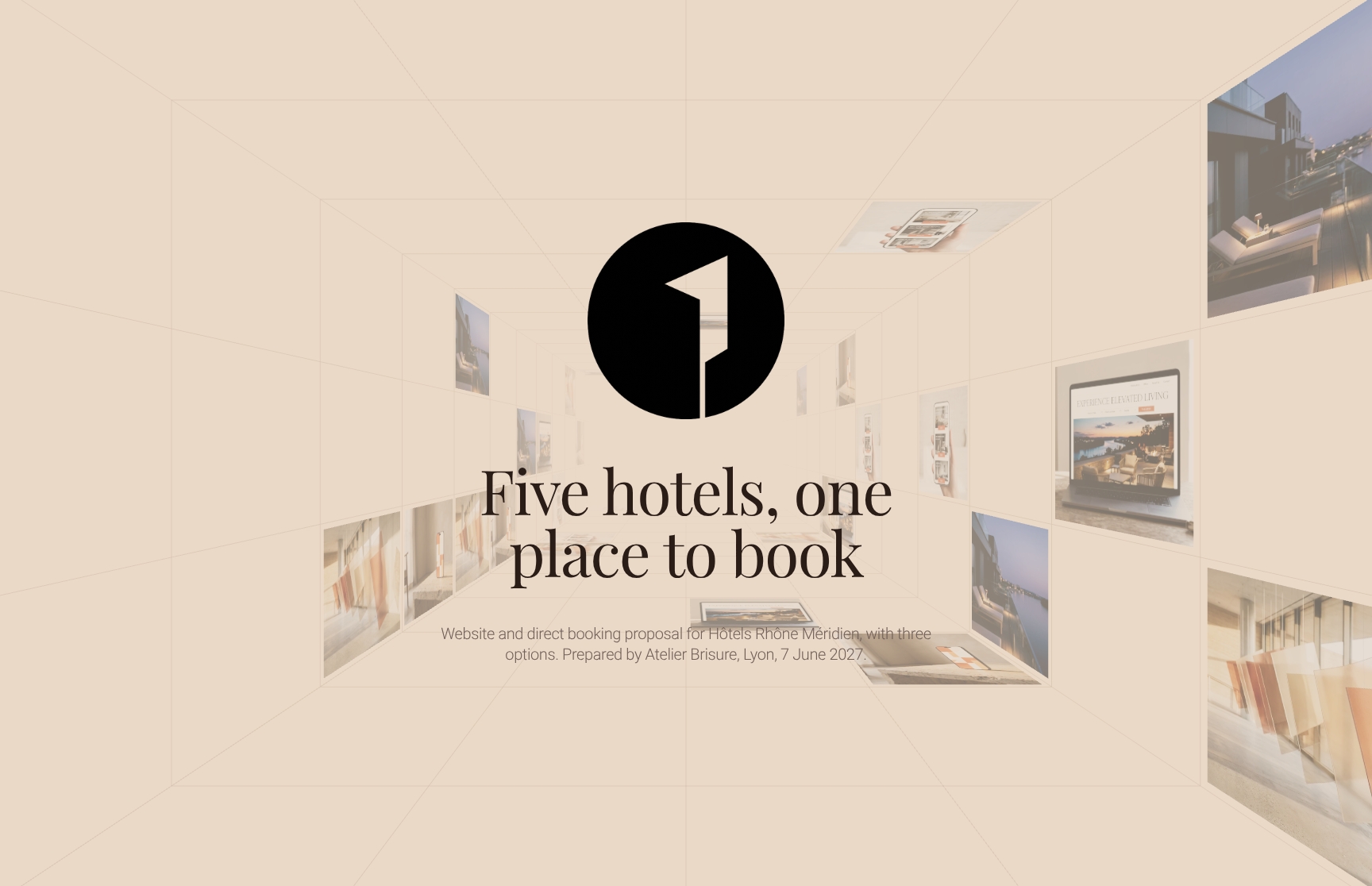
- [Use this template](https://formlio.com/workspaces/claim?template=lyon-hotel-website-proposal)
- [Live preview](https://formlio.com/documents/lyon-hotel-website-proposal)
- **Categories:** [Digital & web design](https://formlio.com/templates/digital-web-design), [Proposals](https://formlio.com/templates/proposals)
- **Document goal:** Win hotel group web projects with a proposal that compares three options and recommends the best route to more direct bookings.
- **Blocks:** Perspective grid, Single column, Grid 3x2 with icons, Scroll gradient, Split, Itemized quote, Gantt, Left-aligned, E-signature
- **Palette:** Warm Parchment Light (#F6F1EA), Soft Sand Accent Light (#EBD9C8), Terracotta Signature Accent (#B5532F), Espresso Depth Dark (#2A1D17), Midnight Roast Text (#17110E)
## Get more from every document
Win hotel group web projects with a proposal that makes the case for direct bookings over OTA commission. Comparison options, day-rate pricing, and a clear recommendation sit ready for you to tailor.
### Get the yes without leaving the proposal
Your client reads the pricing, then signs in the agreement section. No PDF, no printing, no chasing a scan.
### Build proposals from sections you trust
Drop in pricing, steps, and testimonial blocks, then save your best-performing versions and reuse them on the next pitch.
### Your hero images look right everywhere
Your client opens the proposal on a phone between meetings and the showcase, pricing, and steps still land cleanly.
### See which section sells your pitch
Heatmaps show who lingers on pricing, replays show how they read, and you follow up while interest is warm.
### Know the moment they open it
Get pinged when your client views the proposal, comments on a price, or signs, so your reply is never late.
### Write the pitch together, live
Your designer tweaks the showcase while you tighten the pricing, all in one proposal, no version files flying around.
## See how every part fits
The proposal opens with the client's problem and baseline numbers, builds through three options and proof, and closes on a recommendation with phased approval. Keep what fits, drop what doesn't, and reorder anything to suit the pitch.
### Hotel Group Website Proposal Cover with Hero Imagery
A striking opening for Hôtels Rhône Méridien that frames the pitch: five hotels, one place to book. It states the three options, the author (Atelier Brisure, Lyon) and the date, so the client knows the scope at a glance.
### Client Brief and Problem Statement
Restates the client's challenge: five websites on three platforms and only 18 percent direct bookings. Shows you have listened, and sets the context for every recommendation that follows.
### Current Performance Metrics and Baseline Data
Cards of baseline figures drawn from Mews reports and Google Analytics over the trailing twelve months. Gives the proposal a factual starting point and a benchmark for measuring results later.
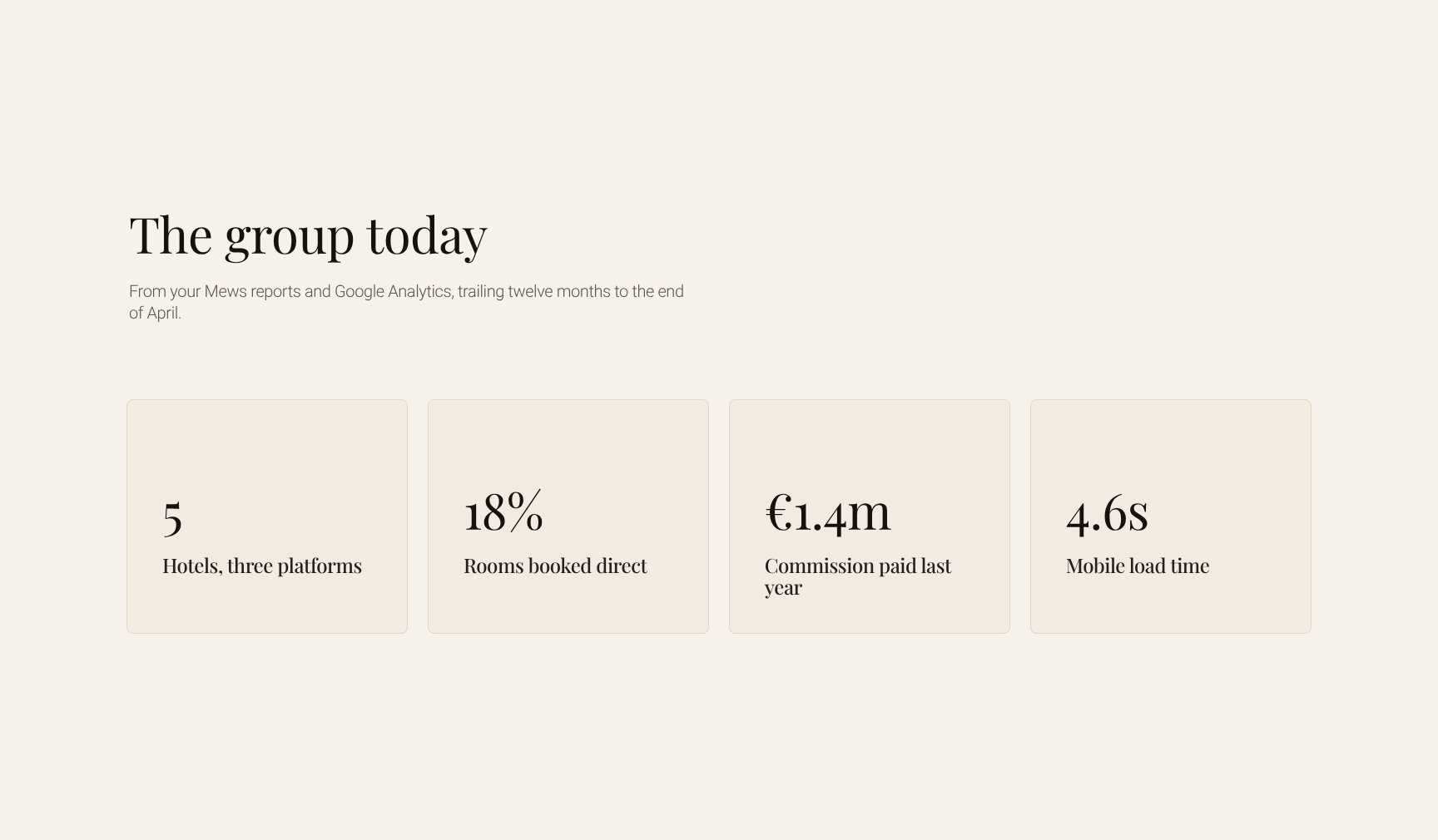
### Strategic Point of View on Direct Booking
An animated statement of the studio's core belief: every booking that starts on the site should end there. A memorable positioning moment that sets up the options and ties the work to revenue.
### Three Website Options Compared: Single Group Site vs Alternatives
Presents Options A, B and C side by side, covering effort, running cost and impact on direct bookings. Option A, one domain with five hotel sections, is flagged as the recommended path, which makes the decision easier.
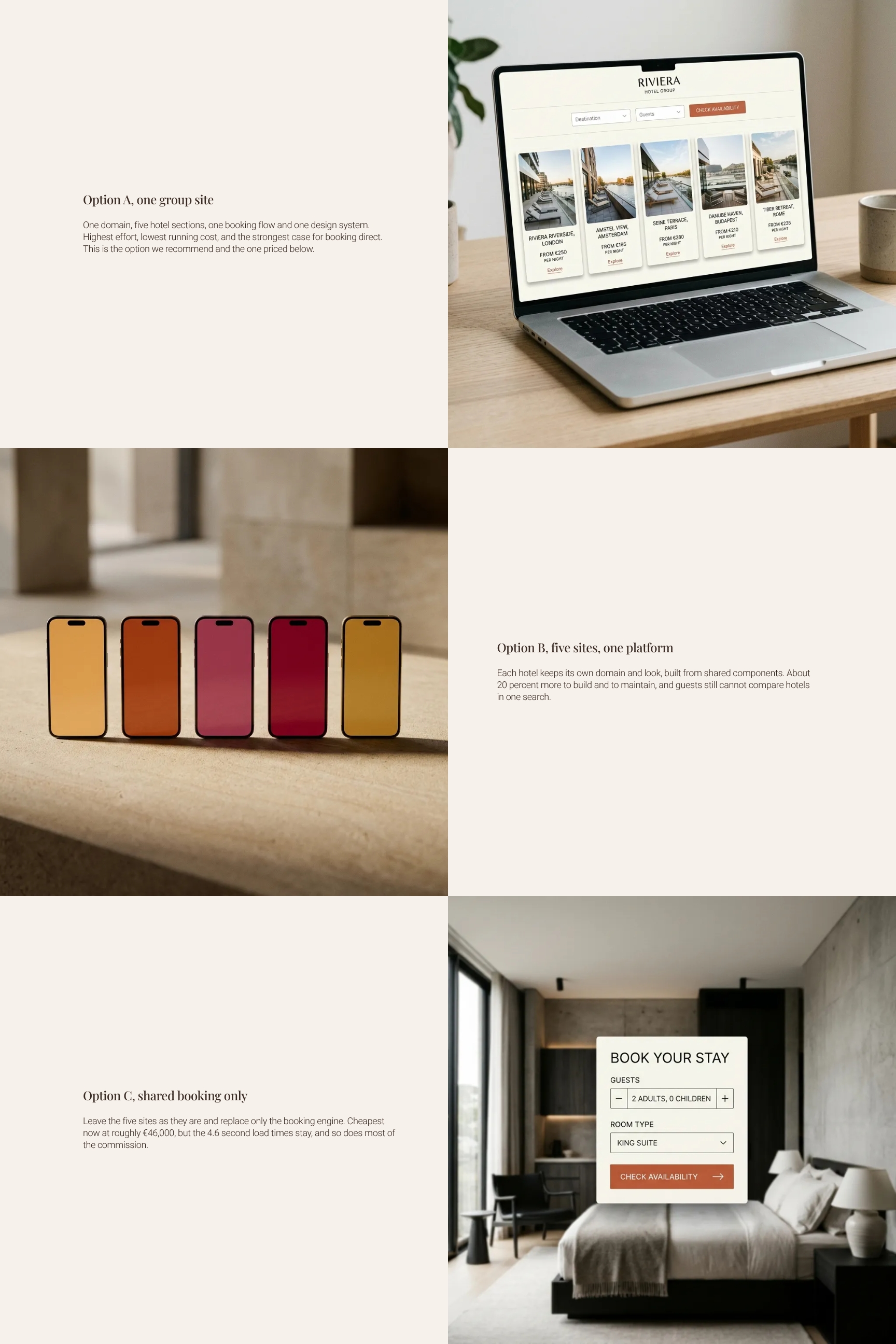
### Twenty-Week Delivery Process and Project Team
Walks through the project in stages, led by Léa Fontanel on design and Bastien Roche on build. Launch lands in mid-January, the quietest booking fortnight, so risk to revenue stays low.
### Hotelier Testimonials and Proven Direct Booking Results
Quotes from hoteliers who measured results after launch, including direct bookings rising from 21 to 34 percent. Social proof that builds trust and shows the approach delivers.
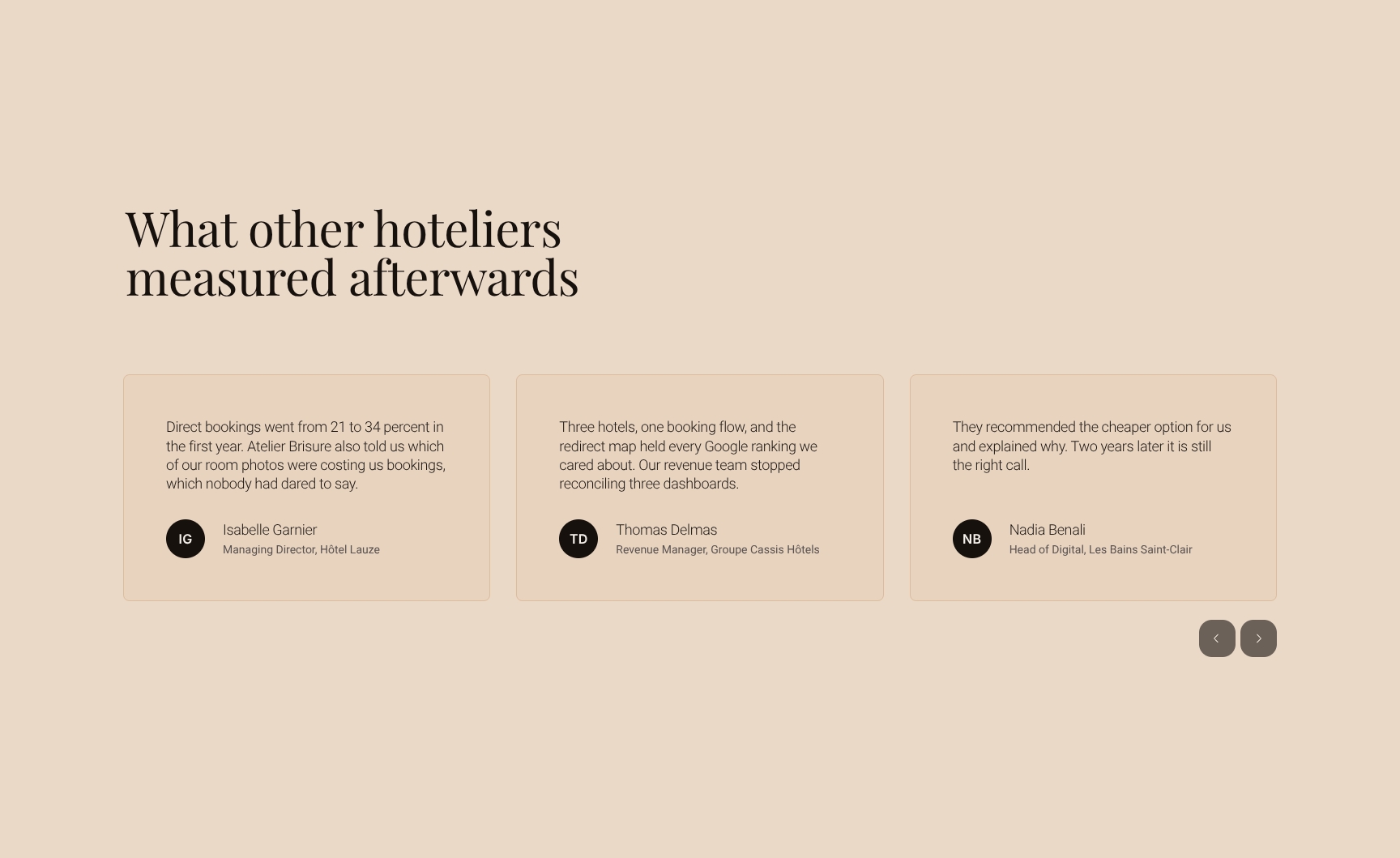
### Transparent Fees and Day-Rate Pricing for Option A
Itemised fees in EUR hors taxes, built from clear day rates for designer, developer and technical lead. Notes that Mews, Storyblok and Vercel are billed at cost, so there are no surprises on the invoice.
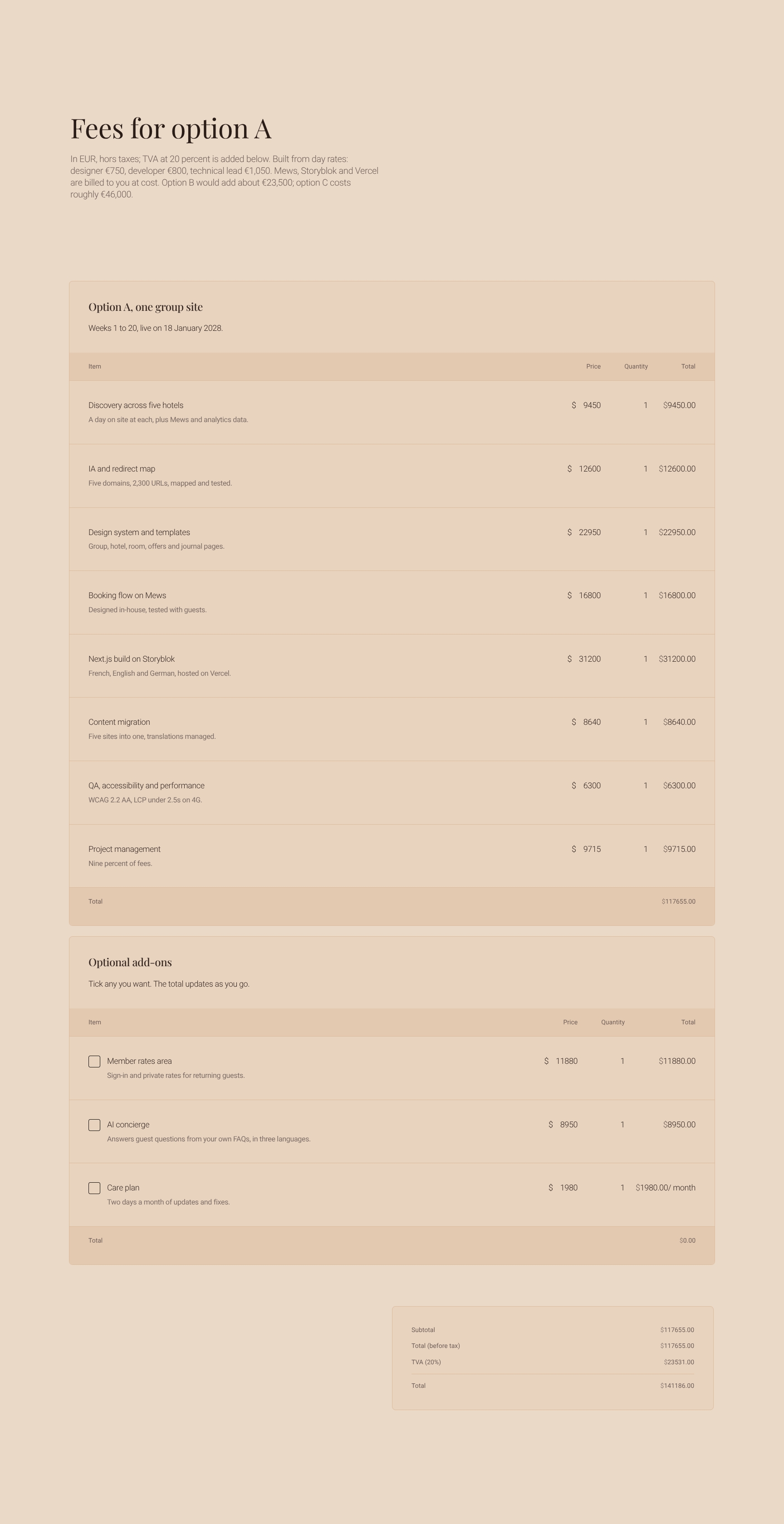
### Project Programme and Timeline with Key Dates
A dated schedule from the 6 September 2027 start to the 18 January 2028 go-live, with the holiday closure accounted for. Gives the client clear milestones and confidence that nothing ships in the dead fortnight.
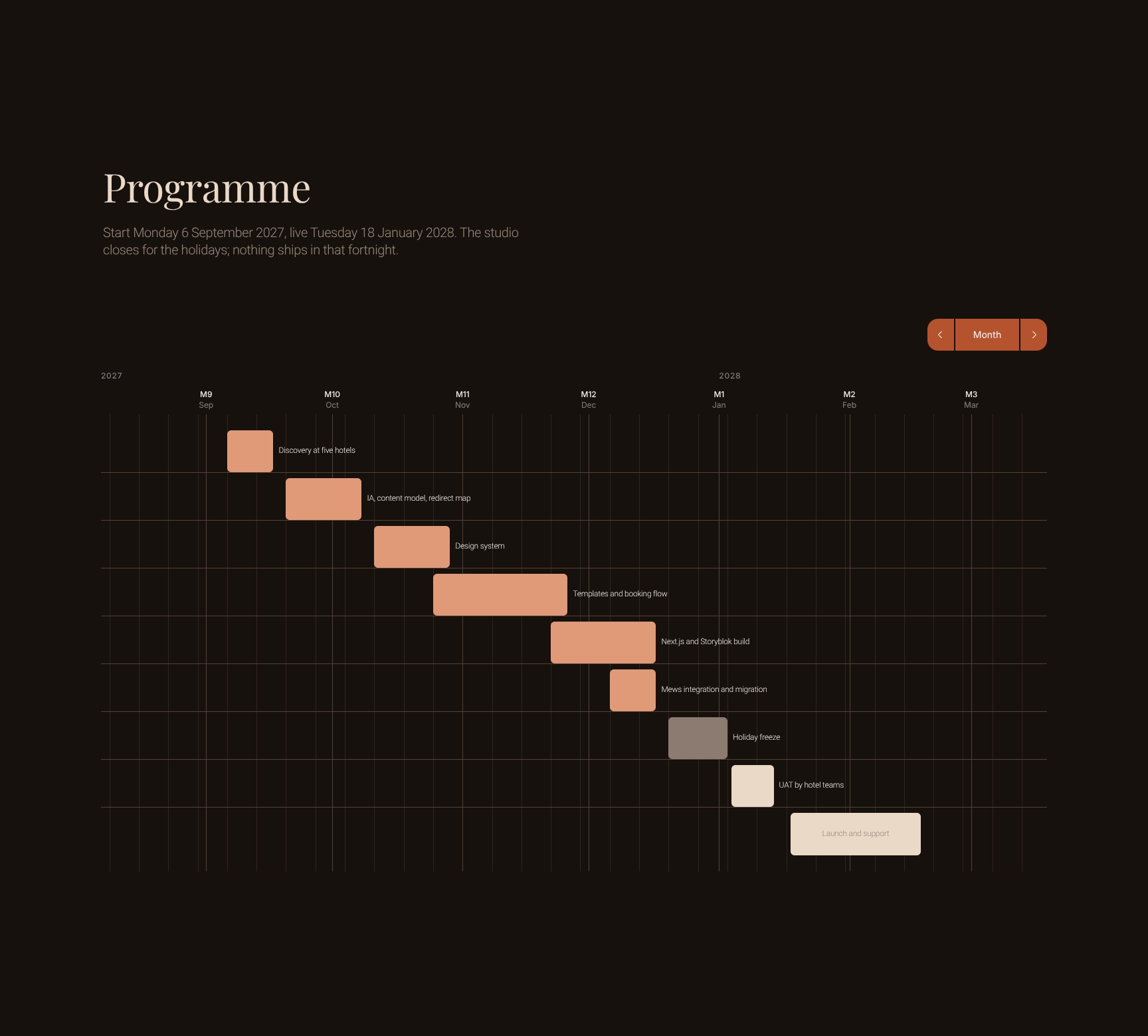
### Project Assumptions and Hotel Group FAQ
An expandable list answering the questions hotel groups ask most, such as who writes and translates content. Clarifies responsibilities up front and prevents scope disputes later.
### Recommendation, Phased Approval and Next Steps
Closes with a clear recommendation of Option A and a low-commitment alternative: approve the first stage alone for €9,450 HT. Work starts on 6 September either way, which makes saying yes simple.
## Find your answers
Answers to common questions about writing website and direct booking proposals for multi-property hotel groups.
### What should be included in a hotel proposal template?
A strong hotel proposal should include a client overview (such as Hôtels Rhône Méridien), a clear brief, supporting numbers, your expert view, pricing or strategy options, and a work plan. This template covers each of these in six ready-made sections: The brief, The numbers, Our view, Three options, and How we would work. Together they guide decision-makers from problem to recommended solution.
### How do I customize this proposal template for my own client?
Replace the Hôtels Rhône Méridien name and details with your client's information, then update The brief with their goals and challenges. Edit The numbers with your client's data, such as occupancy, revenue, or budget figures, and adjust Our view to reflect your recommendation. Finally, tailor the Three options and How we would work sections to your own services, timelines, and pricing.
### Why does a proposal offer three options instead of one?
Presenting three options gives clients a sense of choice and shifts the conversation from whether to buy to which option fits best. A typical structure is a core, a recommended, and a premium package, with your preferred option clearly highlighted. This approach often increases average deal value and speeds up decision-making.
### Is this proposal template suitable for industries other than hospitality?
Yes. Although the example is built around a hotel group, the structure of brief, numbers, point of view, options, and delivery plan works for consulting, marketing, agency, tourism, and B2B service proposals. Simply swap the industry-specific data and language while keeping the same persuasive flow.
### Can I export this proposal template to PDF or Word?
Yes, you can typically export the finished proposal to PDF for polished, secure client delivery, or to Word format for easier collaboration and edits. PDF is best for final submission because it preserves layout and fonts. Check that your fonts and any charts in The numbers section display correctly before sending.
## Related
- [Cardiff](https://formlio.com/templates/cardiff-website-care-plan-proposal): Monthly care plan proposal for festival organisers
- [Cambridge](https://formlio.com/templates/cambridge-design-studio-portfolio): Web design studio portfolio for research clients
- [Portland](https://formlio.com/templates/portland-app-redesign-proposal): App redesign pitch for subscription startups
- [Copenhagen](https://formlio.com/templates/copenhagen-headless-ecommerce-proposal): Headless storefront proposal for ecommerce brands
- [Milan](https://formlio.com/templates/milan-headless-commerce-proposal): Headless ecommerce proposal for luxury brands
- [Bordeaux](https://formlio.com/templates/bordeaux-launch-event-pitch): Hybrid launch event pitch for brands
---
---
title: "Bordeaux"
description: "Win more launch briefs with a product launch event pitch template: audience needs, planning numbers, venue options and fee, built for agencies and studios."
canonical: "https://formlio.com/templates/bordeaux-launch-event-pitch"
locale: "en"
type: "template"
lastModified: "2026-10-22"
category: "Events & experiential"
alternates:
fr: "https://formlio.com/fr/templates/bordeaux-pitch-devenement-de-lancement.md"
---
# Bordeaux
Product Launch Event Pitch Template
Win more launch briefs with a product launch event pitch template: audience needs, planning numbers, venue options and fee, built for agencies and studios.
- [Use this template](https://formlio.com/workspaces/claim?template=bordeaux-launch-event-pitch)
- [Live preview](https://formlio.com/documents/bordeaux-launch-event-pitch)
- **Categories:** [Events & experiential](https://formlio.com/templates/events-experiential), [Proposals](https://formlio.com/templates/proposals), [Pitch decks](https://formlio.com/templates/pitch-decks)
- **Document goal:** Win launch briefs by pitching a hybrid event with clear audience insights, planning numbers, venue options, and fees.
- **Blocks:** Highlight, Single column, Scroll gradient, Grid 3x2 with icons, Split, Itemized quote, E-signature
- **Palette:** Warm Linen Background (#F3F0EA), Sandstone Highlight (#E9DCC9), Coastal Teal Accent (#1F5C7A), Deep Harbor Navy (#12303F), Midnight Ink Text (#0D1418)
## Get more from every document
Win the launch brief by showing a client exactly how their event will run, what it will cost, and who will deliver it. Audience numbers, format comparisons, a production timeline, and fee tables are ready for your details.
### Get the yes without leaving
Your client reads the pricing, scrolls to the agreement, and signs on the spot. No PDF download, no printing, no waiting.
### Build proposals from proven sections
Drop in pricing tables, step timelines, and testimonials, then save your best-performing blocks to reuse in the next pitch.
### Your pitch looks right on any screen
The hero, charts, and pricing hold their shape when a client opens your proposal on a phone between meetings.
### See which section wins the deal
Heatmaps show if they lingered on pricing, and session replays let you follow up while the proposal is fresh in mind.
### Know the moment they open it
Get a ping when your client views the proposal, leaves a comment, or signs, so your reply lands on time.
### Write the proposal with your team
You tune the scope while a teammate fixes the pricing and another polishes the hero, all in the same live document.
## See how every part fits
The pitch opens with the venue and date, moves through the brief, concept, and numbers, and closes on booking terms and a clear next step. Keep what fits your pitch, drop what doesn't, and reorder anything.
### Event Launch Pitch Cover with Date and Venue
A bold opening that names the client, the T-Cargo reveal, the 212-dealer audience and the 18 November Bègles factory-floor date. It sets the tone and shows the pitch answers the brief.
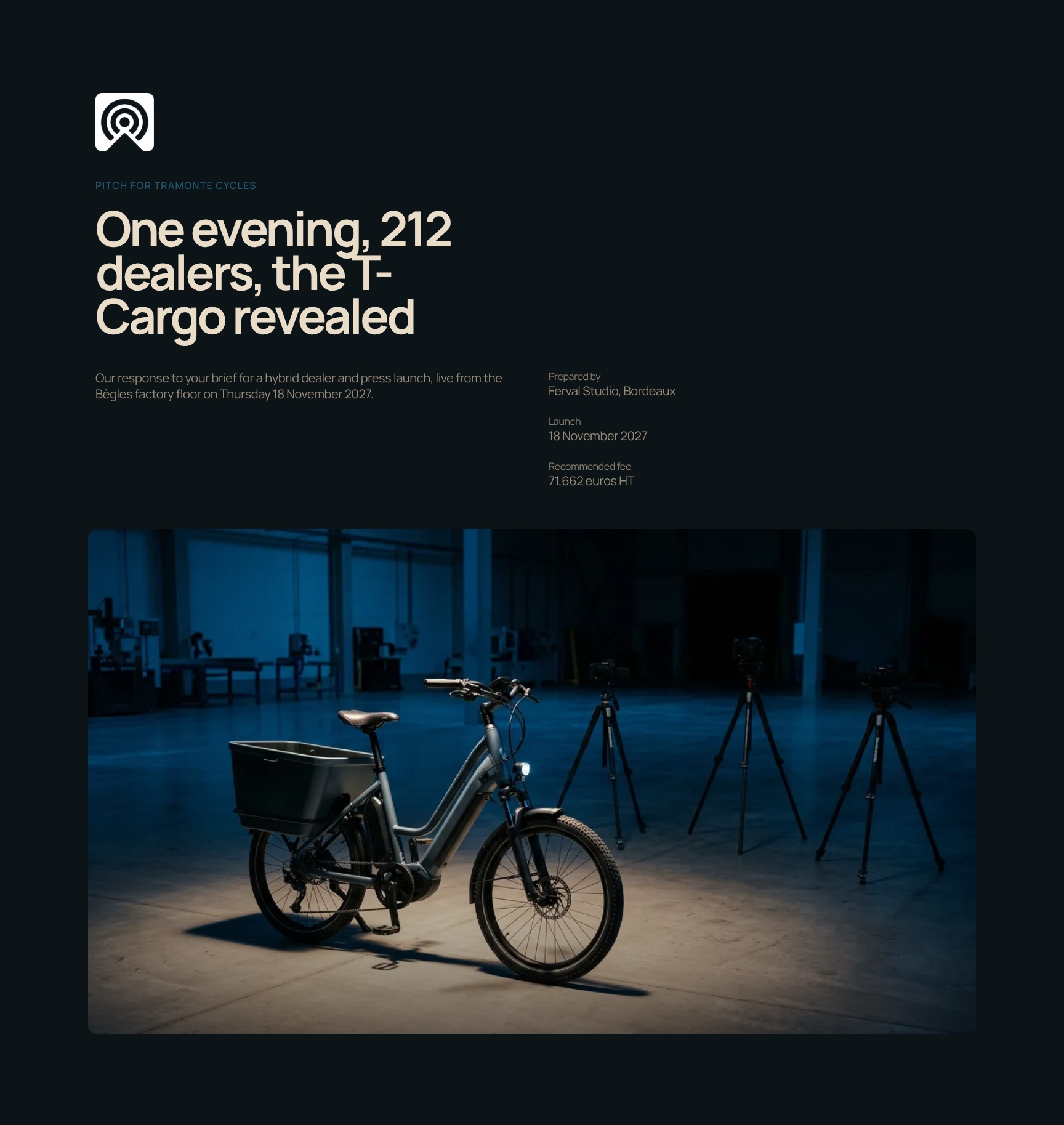
### Client Brief Summary and Project Objectives
Restates the client's brief: first cargo e-bike, first product sold outside France, and a dealer launch before the spring order window closes. Proves you listened and aligns both sides on goals.
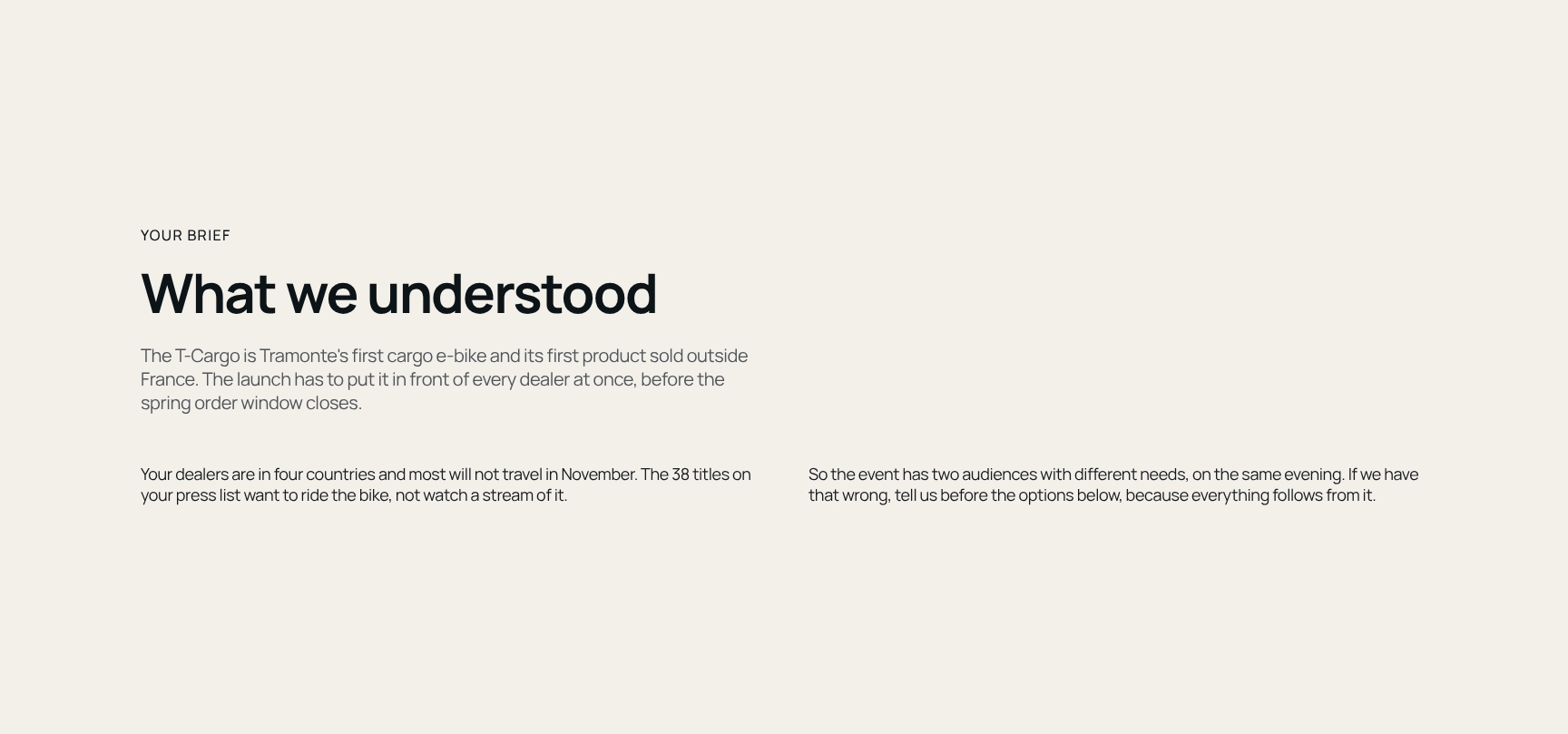
### Creative Concept: Hybrid Live Launch Idea
A short, animated statement of the core idea: press ride the bike in Bègles while dealers watch live from their own shops. It makes the concept memorable and easy to repeat internally.
### Key Audience Numbers and Planning Assumptions
Cards summarizing dealer and press figures from the client's portal and press list, with a clearly labeled target. Shows the plan rests on real data and separates facts from ambitions.
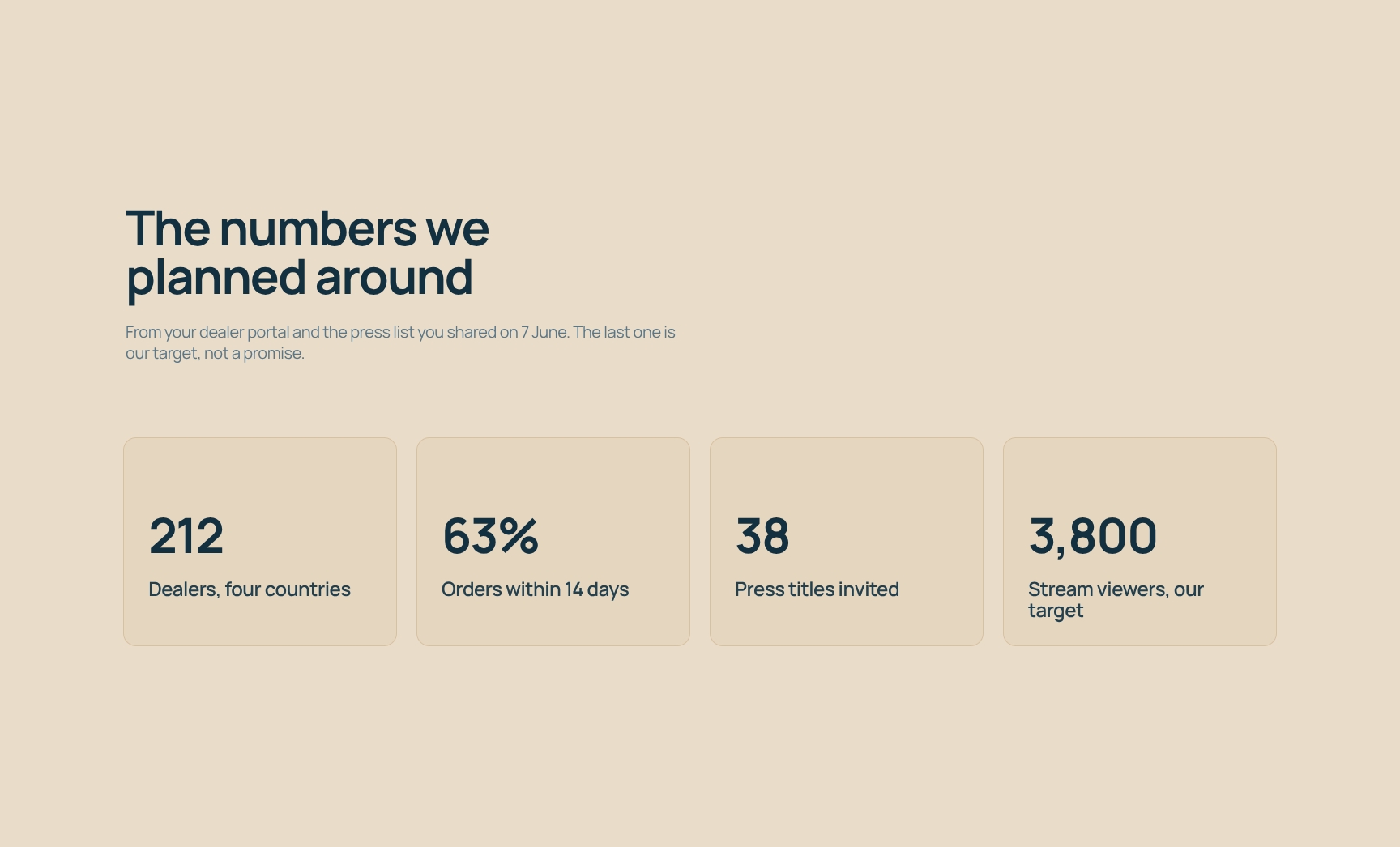
### Dealer Order Data Charts: The First Fortnight
Charts from the Tramonte dealer portal showing almost two thirds of first orders land within two weeks. This evidence justifies the launch timing and the focus on momentum on the day.
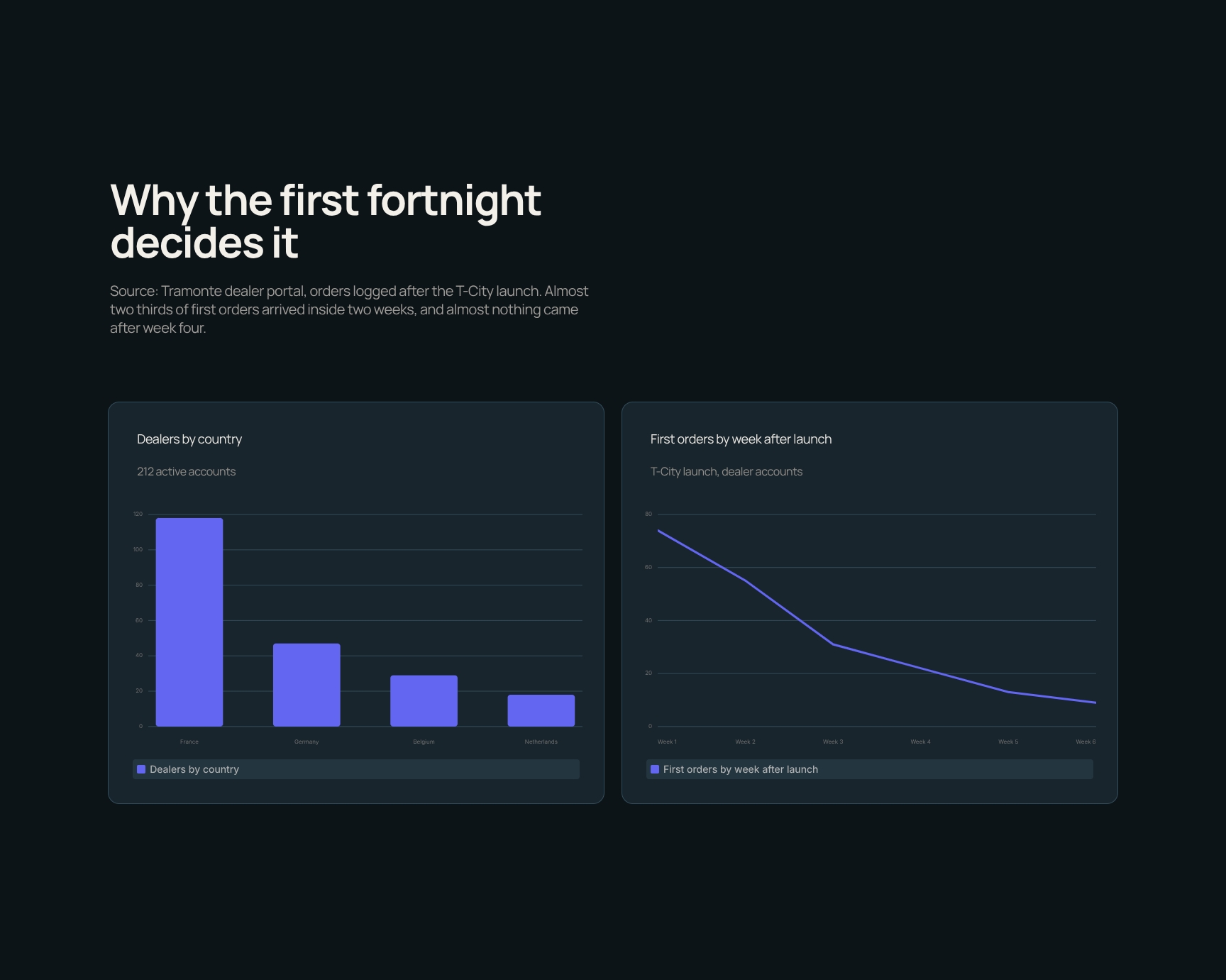
### Three Launch Format Options Compared
Showcases three formats, from one streamed venue to larger hybrid builds, with trade-offs on cost, reach and how remote dealers feel. Helps the client choose confidently.
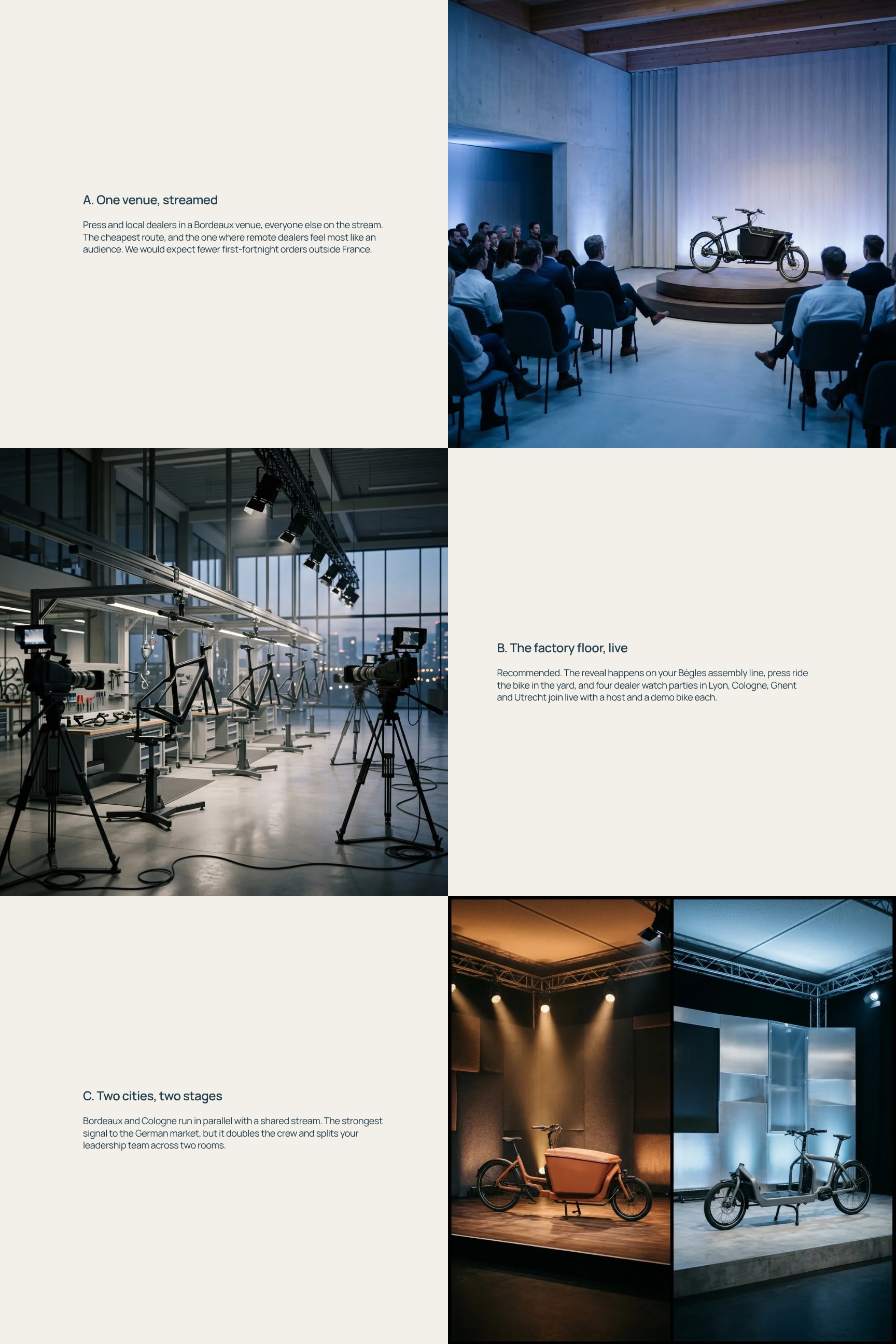
### 20-Week Production Timeline and Process Steps
A five-stage plan counted back from 18 November, covering format, run of show, build and crew. The same stages apply to every format, making delivery risk and workload clear.
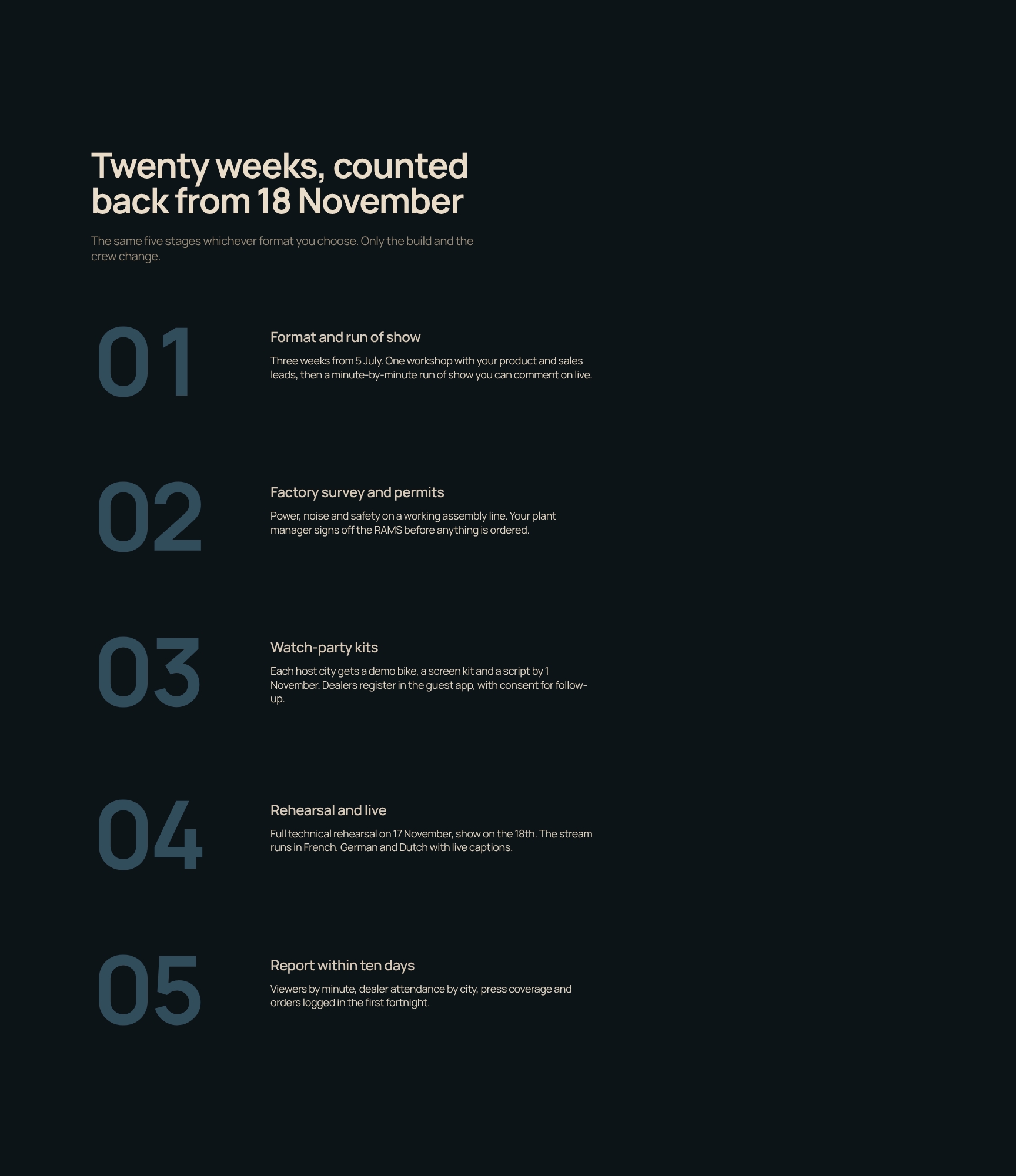
### Transparent Event Fees and Pricing by Format
Itemized euro (HT) fees for each format, with 10% project management, 6% contingency billed only if used, a payment schedule and a recommendation. Removes budget surprises and speeds approval.
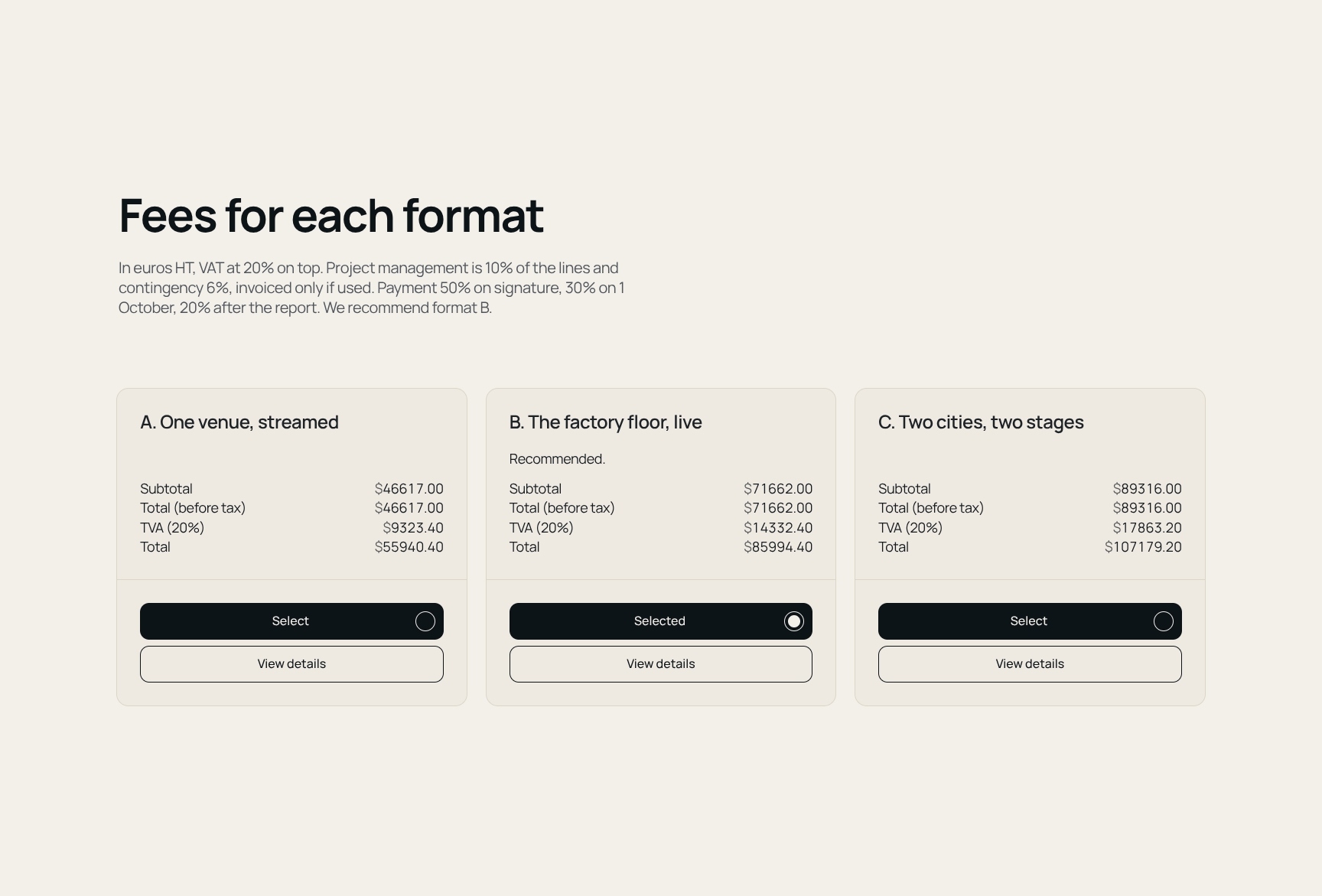
### Meet the Ferval Team Leading Your Launch
Introduces the nine-person Ferval studio, with Inès Lacombe leading the launch and Hugo Mercadier directing the stream. Builds trust by putting names and roles behind the proposal.
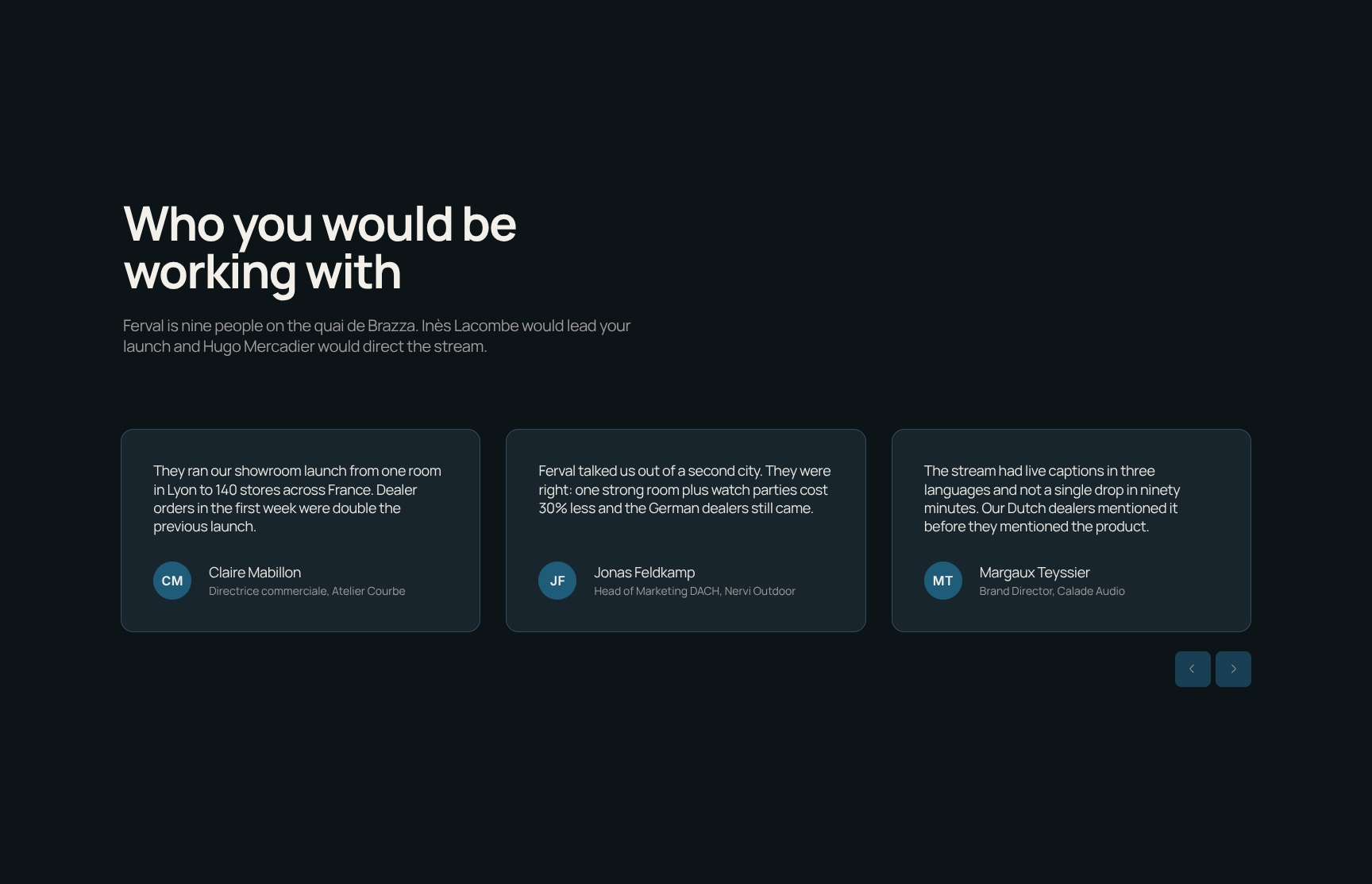
### Booking Terms, Cancellation Policy and Next Step
Confirms the crew and stream hold until 25 June 2027 and sets out cancellation terms. Gives a clear deadline and conditions so the client can sign with confidence.
## Find your answers
Answers to common questions about building a product launch event pitch for brand clients, from format options to fees and timelines.
### What should be included in a proposal template for a pitch?
A strong proposal should include a pitch summary, the client brief, your core idea, the numbers (pricing and projected results), supporting dealer data, and deliverable formats. This template covers all six sections in a logical order so you can move from understanding the problem to proving the return. Each section is built to be filled in quickly and edited to fit your offer.
### How do I customize this proposal template for my own client?
Start with The brief to reflect your client's goals, then rewrite The idea to match your solution. Update The numbers and Dealer data with your own pricing, forecasts, and figures, then adjust fonts, colors, and logos to match your brand. Delete any section you don't need so the proposal stays focused.
### What does the Three formats section do in this proposal template?
The Three formats section presents your idea in three deliverable options, so clients can compare them and choose the one that fits their budget and goals. Giving a choice of formats makes approval easier and often raises the average deal size. You can rename the formats and change their scope, pricing, and timelines.
### Is this proposal template suitable for automotive or dealership pitches?
Yes. The Dealer data section is designed for dealership and retail-network proposals, where you show performance metrics, inventory or sales figures, and local market insights. It also works for other sales-driven industries if you replace the dealer figures with your own customer or channel data. Using real numbers in The numbers section makes the pitch more credible.
### Can I export this proposal template to PDF or present it as slides?
Yes. You can export the finished proposal to PDF for sending to clients, or present it on screen as a slide deck. Check your software's export options to keep fonts and layouts intact. For best results, review the file after exporting to confirm that charts and tables in The numbers and Dealer data sections display correctly.
## Related
- [Boston](https://formlio.com/templates/boston-event-retainer-proposal): Monthly event retainer proposal for brands
- [Cardiff](https://formlio.com/templates/cardiff-website-care-plan-proposal): Monthly care plan proposal for festival organisers
- [Liverpool](https://formlio.com/templates/liverpool-live-events-portfolio): Event studio portfolio for launches and conferences
- [Berlin](https://formlio.com/templates/berlin-product-launch-event-proposal): Multi-city launch event proposal for hardware brands
- [Edinburgh](https://formlio.com/templates/edinburgh-temporary-venue-build-estimate): Temporary venue build estimate for festivals
- [Lyon](https://formlio.com/templates/lyon-hotel-website-proposal): Website proposal for multi-property hotel groups
---
---
title: "Boston"
description: "Win brand clients with an event marketing retainer proposal template covering run clubs, recovery pop-ups, content and data. Built for experiential agencies."
canonical: "https://formlio.com/templates/boston-event-retainer-proposal"
locale: "en"
type: "template"
lastModified: "2026-10-22"
category: "Events & experiential"
alternates:
fr: "https://formlio.com/fr/templates/boston-proposition-de-contrat-evenementiel.md"
---
# Boston
Event Marketing Retainer Proposal Template
Win brand clients with an event marketing retainer proposal template covering run clubs, recovery pop-ups, content and data. Built for experiential agencies.
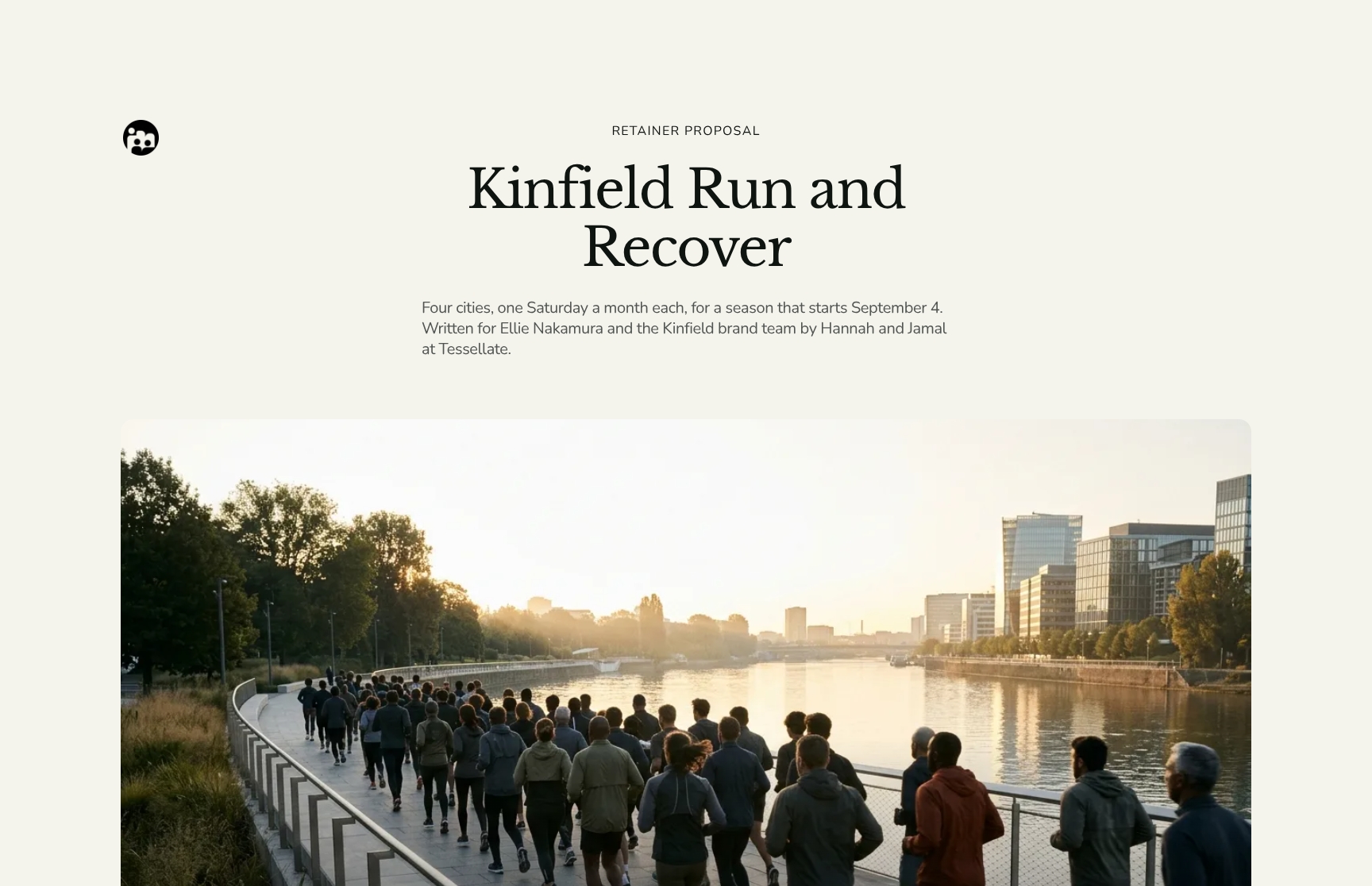
- [Use this template](https://formlio.com/workspaces/claim?template=boston-event-retainer-proposal)
- [Live preview](https://formlio.com/documents/boston-event-retainer-proposal)
- **Categories:** [Events & experiential](https://formlio.com/templates/events-experiential), [Marketing](https://formlio.com/templates/marketing), [Proposals](https://formlio.com/templates/proposals)
- **Document goal:** Win brand clients with a clear monthly retainer proposal for run clubs, recovery pop-ups, content and data.
- **Blocks:** Highlight, Single column, Grid 3x2 with icons, Split, Scroll gradient, Itemized quote, Gantt, Left-aligned, E-signature
- **Palette:** Soft Parchment Light (#F4F3EC), Fresh Sage Accent Light (#DCE8C8), Verdant Forest Accent (#3D7A4E), Deep Evergreen Shadow (#13201A), Midnight Moss Dark (#0E1410)
## Get more from every document
This template helps you turn a one-off event pitch into a monthly retainer a brand signs. Case studies, pricing, a season schedule, and sign-off tools sit ready below.
### Get the yes without the PDF
Your client reads the pricing, accepts the terms, and signs in the same scroll. No download, print, or scan.
### Build proposals from sections you trust
Drop in a pricing table, steps timeline, or testimonials block, then save your best versions to reuse on the next pitch.
### Your pitch looks sharp on any screen
Your hero, showcase, and pricing hold their shape when a client opens the proposal on a phone between meetings.
### See which section sells your proposal
Heatmaps show if they linger on pricing or skip your steps, and replays let you time your follow-up call.
### Know the moment they open it
Get a ping when a client views, comments, or signs, so you can reply while the proposal is still on their mind.
### Write the proposal together, live
Your designer tweaks the showcase while you rework pricing and tasks, with no merged files or version mix-ups.
## See how every part fits
The proposal opens with the brand and the case for a retainer, then moves through scope, proof, and pricing, and closes on a booking deadline. Keep what fits, drop what doesn't, and reorder anything.
### Retainer Proposal Cover with Brand and Season Start
A branded cover introducing the Kinfield Run and Recover retainer: four cities, one Saturday a month each, with the September 4 start date. Sets a confident, personal tone for the client team.
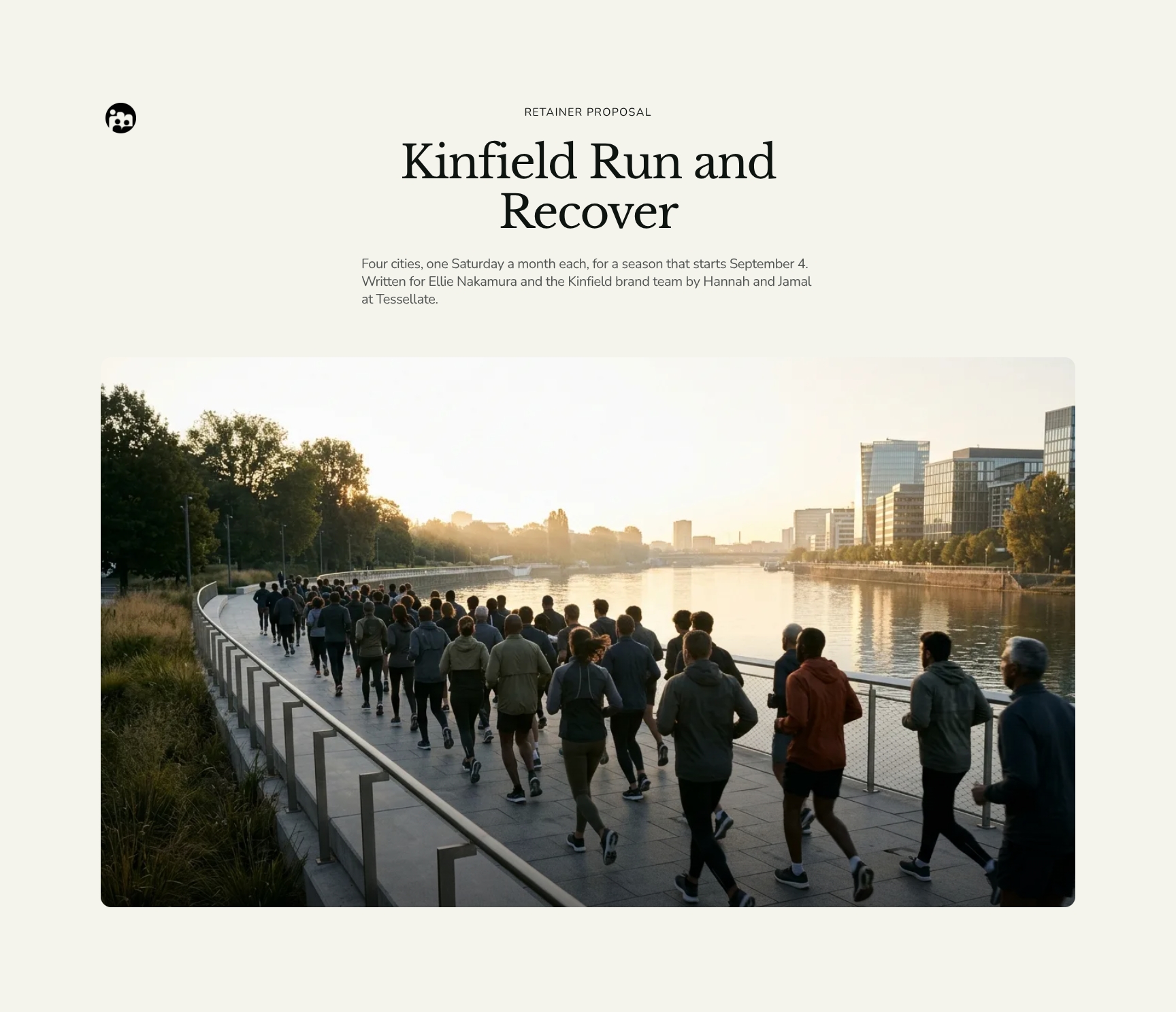
### Why a Retainer: Client Brief and Strategic Rationale
Restates the client's brief and store openings, then argues that a recurring Saturday crew builds loyalty a one-off event can't. Helps clients see why ongoing commitment beats single events.
### Monthly Deliverables and Scope of Services Per City
Cards listing the same four pieces delivered every Saturday in each city. Clear, repeatable scope lets runners and store teams know what to expect and prevents scope confusion.
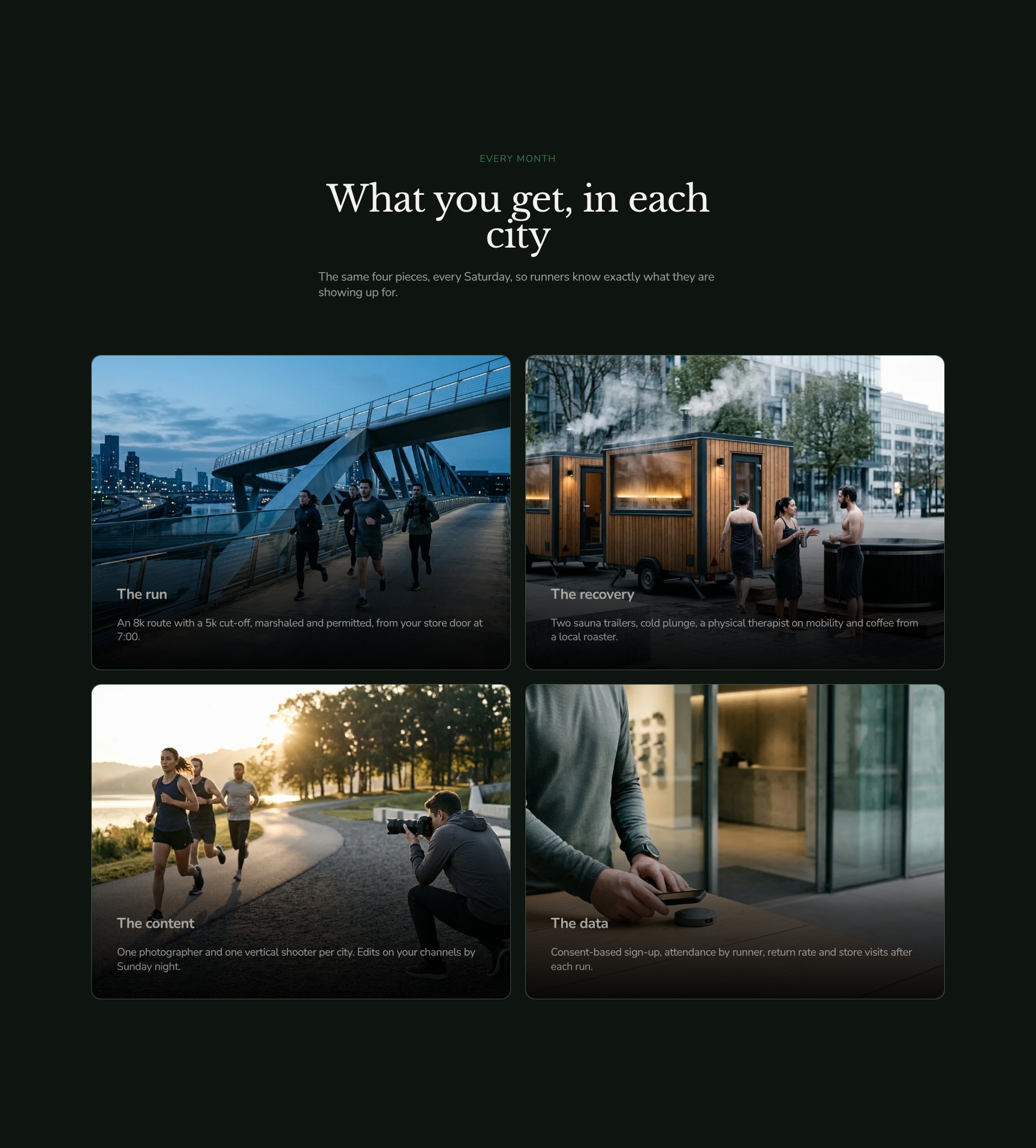
### Past Programs Showcase and Community Event Case Studies
Proof-of-work examples like the Lowtide Swim sunrise series, with attendance and repeat-participation numbers. Builds credibility by showing real results from comparable brand events.
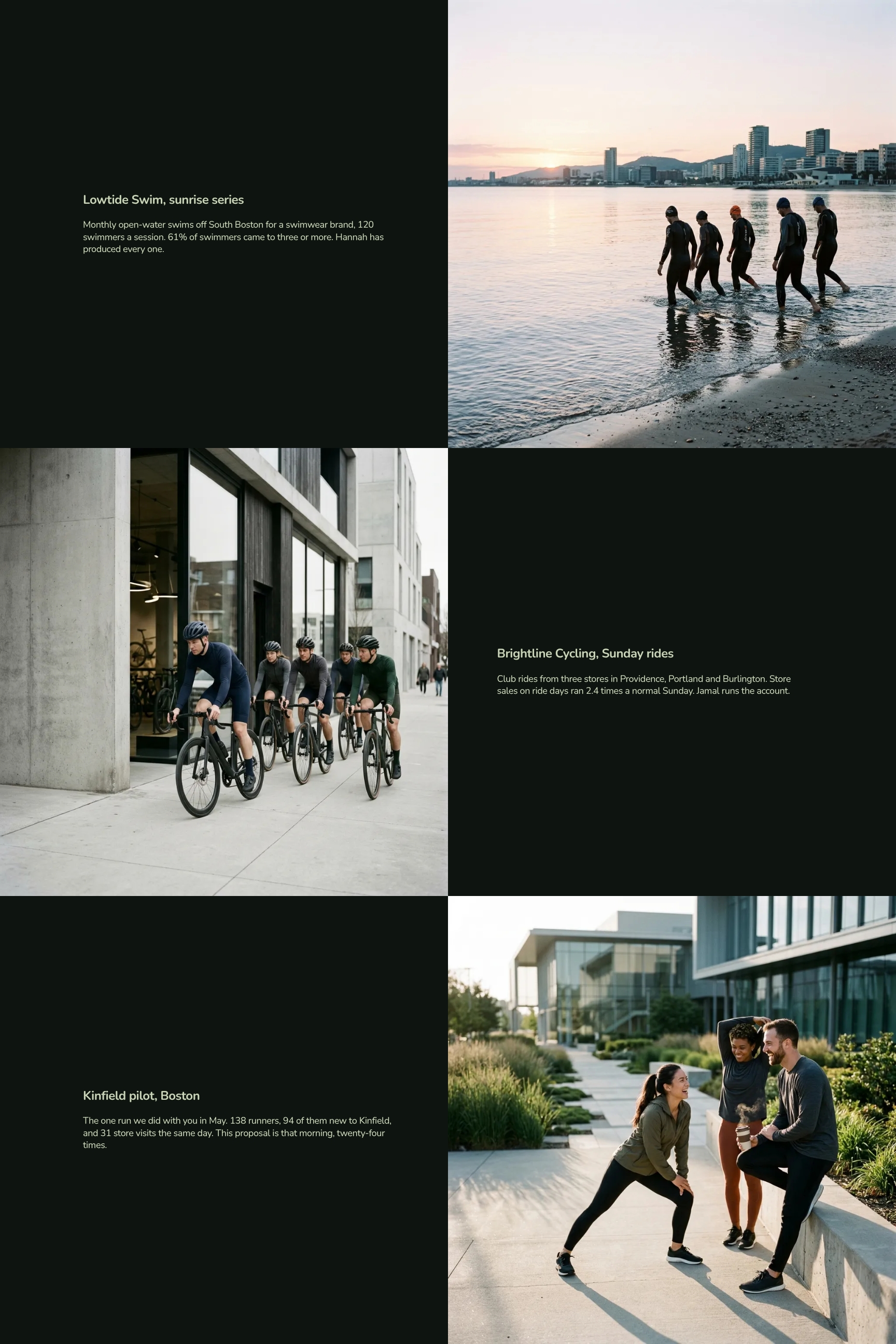
### Monthly Workflow and Event Rhythm Timeline
A step-by-step view of how each month runs, from city rotation to store-team responsibilities. Gives clients a predictable cadence and clarity on what is needed from them.
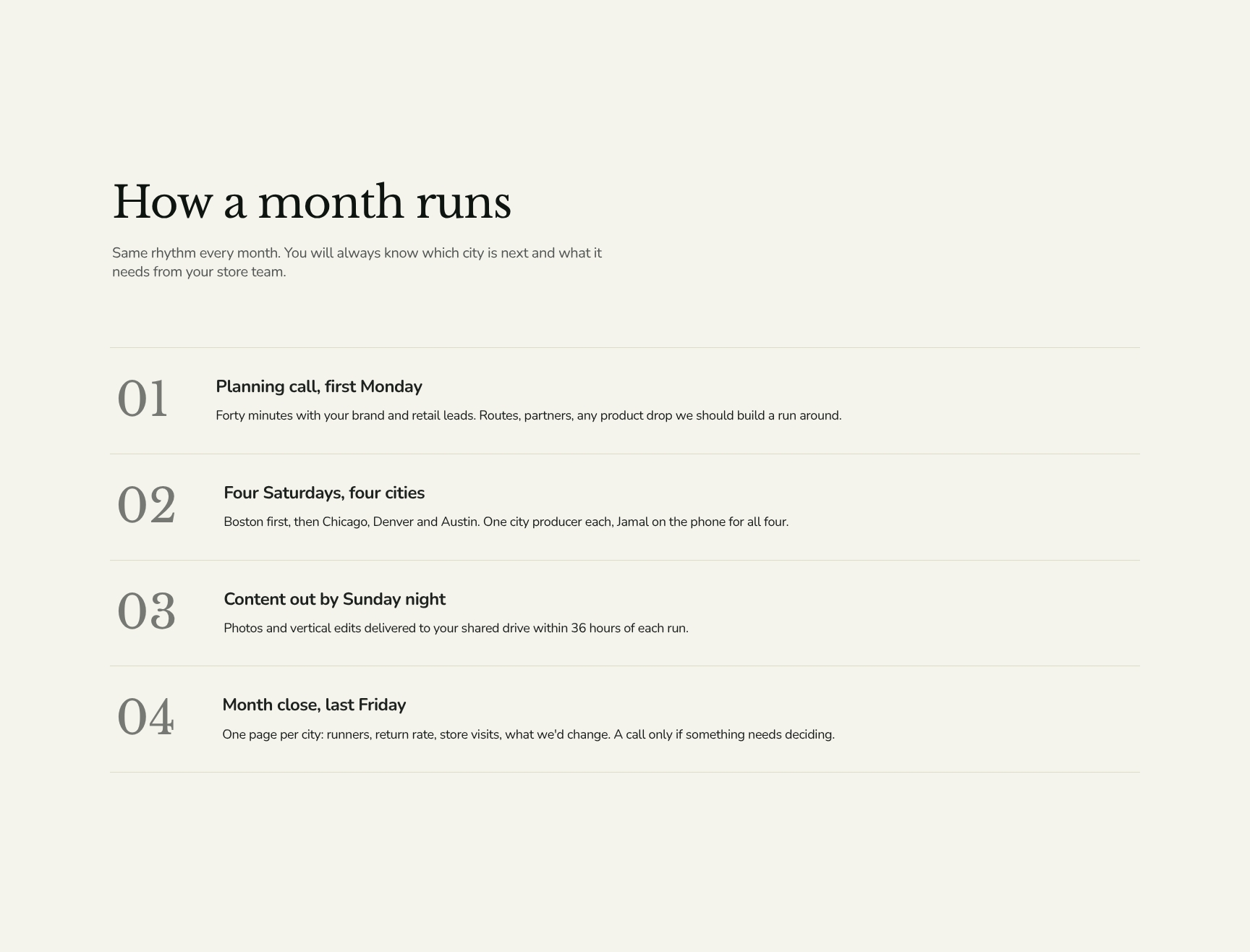
### Client Testimonials on Reliability and Event Execution
Quotes from past clients, including Lowtide Swim's founder, showing calm problem-solving under pressure. Reassures buyers that the team delivers on the day, whatever happens.
### Animated Brand Message: Community Over Event
A bold animated statement, "People come for the run. They come back for each other." Distills the proposal's core idea into one memorable line and gives the page a strong visual pause.
### Retainer Pricing, Monthly Fee and Payment Terms
Transparent USD monthly fee for four cities, one-off season setup, six-month minimum, 30 days' notice, and invoicing on the first. Spells out what Kinfield supplies so there are no billing surprises.
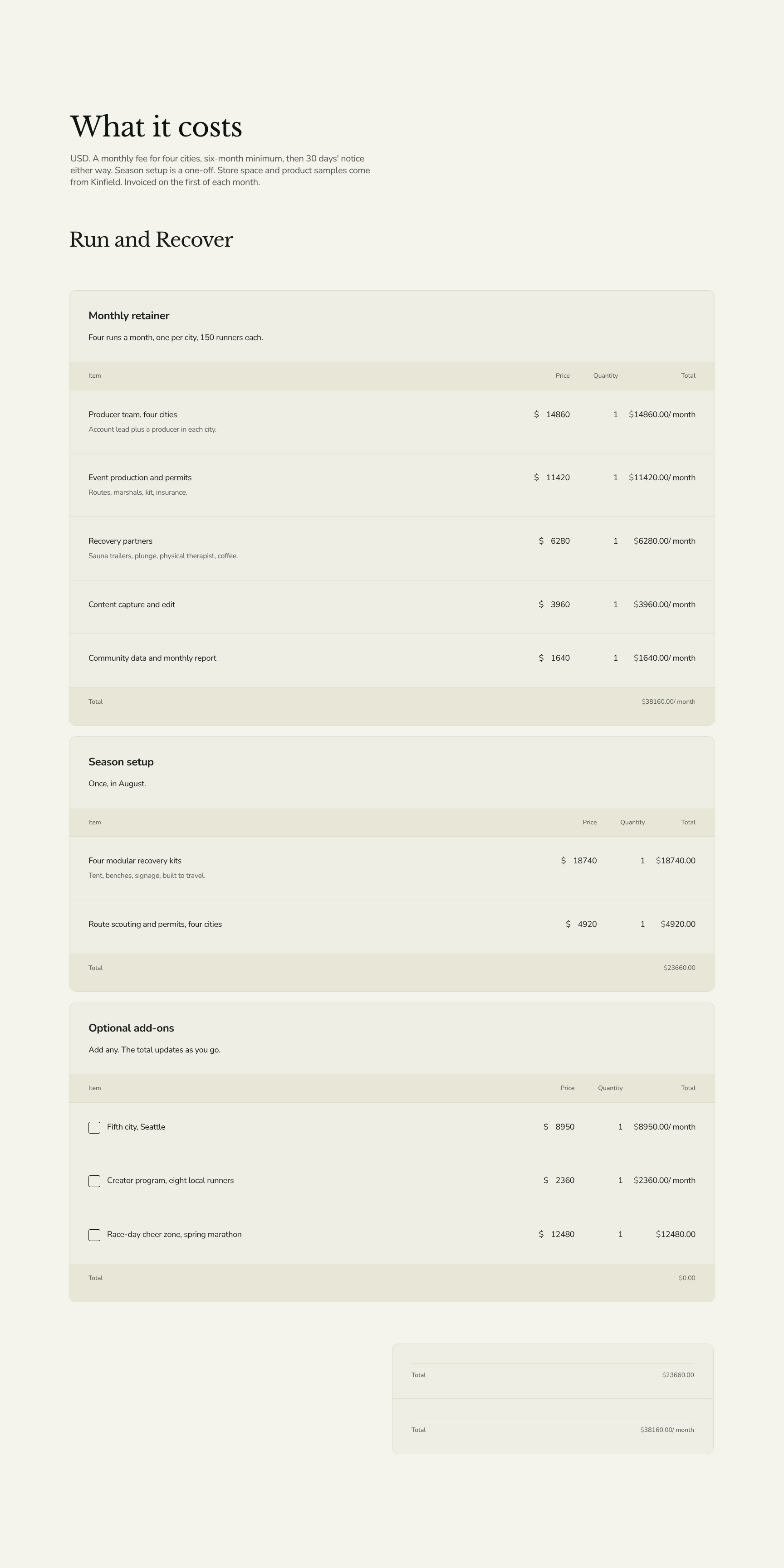
### First Season Plan: September to February Run Schedule
Outlines 24 runs from September to February, with August setup, a November winter switch, and a pre-renewal review. Shows the season roadmap and key milestones at a glance.
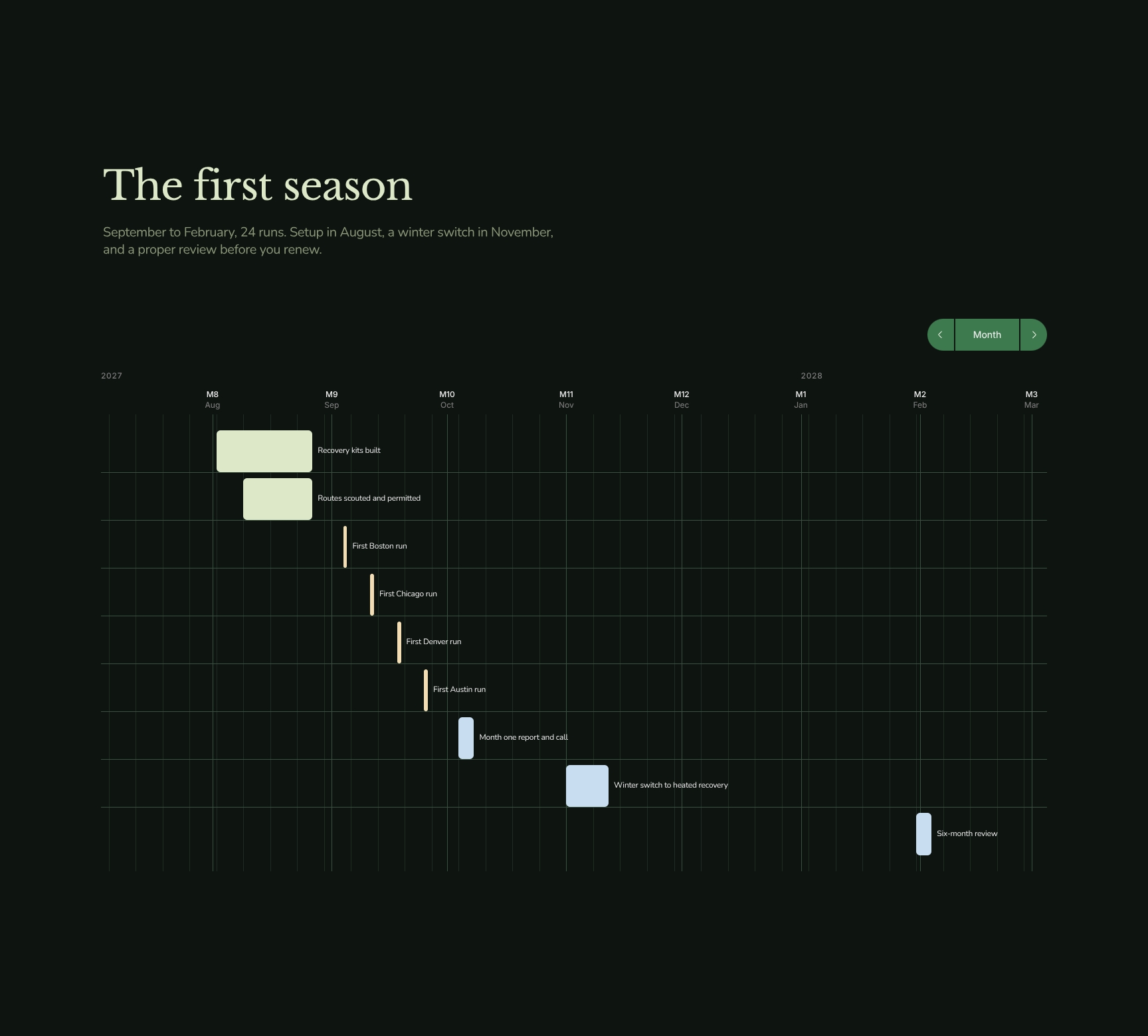
### FAQ and Terms: Weather, Safety and Policy Answers
An accordion answering the questions a client would ask, such as rain, snow, lightning and heat contingencies. Handles objections and risk up front while keeping the page tidy.
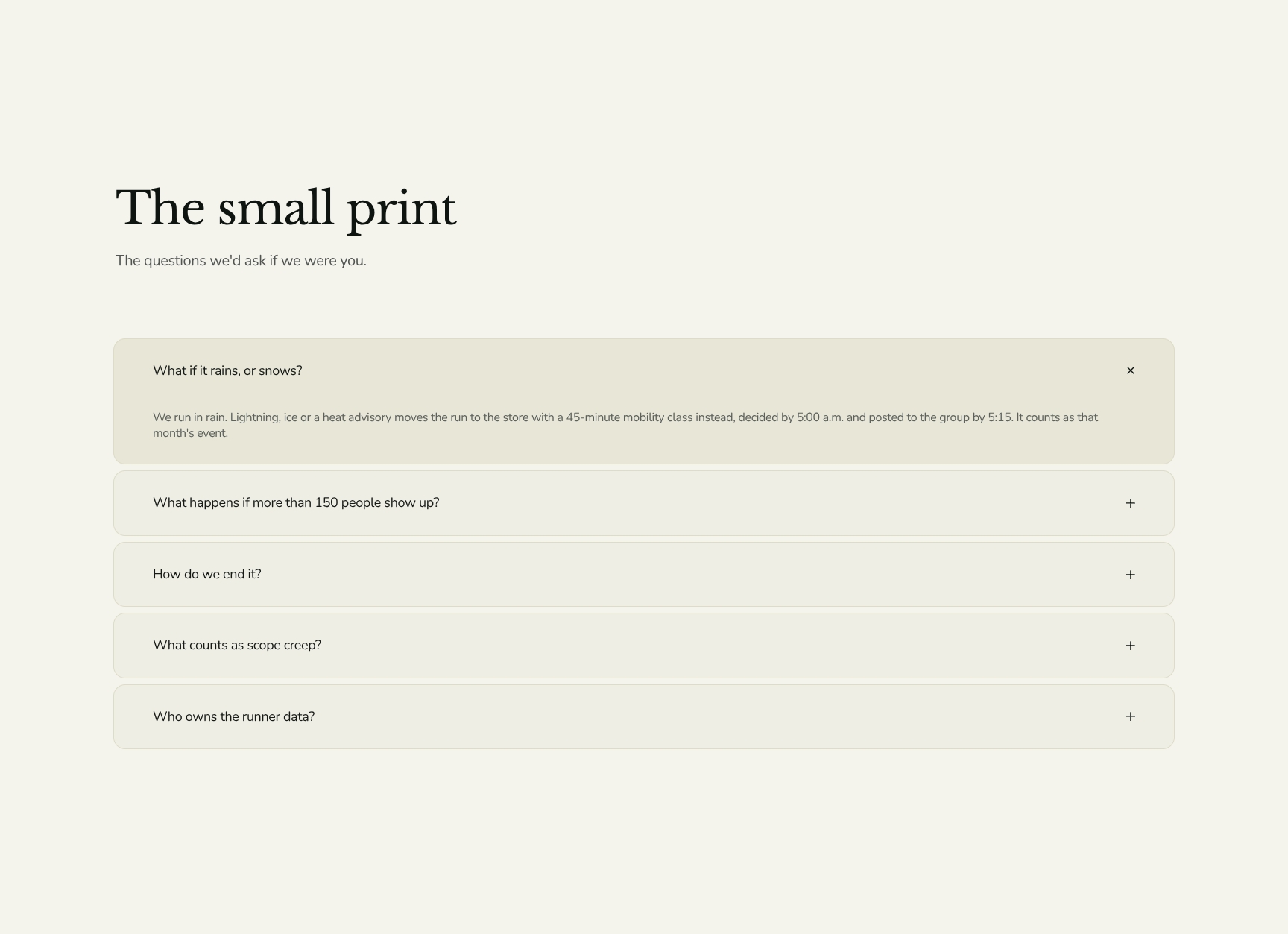
### Proposal Sign-Off and Booking Deadline Call to Action
A closing agreement section with a July 30 deadline to hold all eight sauna trailers and the Boston September 4 start. Creates urgency and makes saying yes simple.
## Find your answers
Answers to the questions brands ask before signing an event marketing retainer, from weather plans to safety and scope.
### What should be included in a retainer proposal template?
A strong retainer proposal includes a cover page, the rationale for choosing a retainer over one-off projects, a clear breakdown of what each month includes, the programs or services you run, a month-by-month workflow, and client testimonials. This template covers all six sections so prospects see the value, scope, and process in one document.
### How do I customize this retainer proposal template for my agency?
Replace the cover details with your logo, brand colors, and client name, then edit the 'What a month includes' and 'Programs we run' sections to match your services and deliverables. Update the 'How a month runs' timeline to reflect your real workflow, and swap in your own client quotes. Each section can be reordered, duplicated, or removed to fit your offer.
### Can I export this proposal template to PDF or other formats?
Yes, you can export the finished proposal to PDF to send to clients, which keeps layout and branding consistent on any device. Depending on your editor, you can also share it as a link or download an editable version for further revisions. PDF is recommended for final delivery and signing.
### Is this retainer proposal template suitable for my industry?
Yes. The structure works for marketing, design, consulting, development, PR, and other service businesses that deliver ongoing work each month. Because the programs and monthly deliverables sections are fully editable, you can tailor the language, metrics, and examples to your industry.
### How do I explain why a client should choose a retainer instead of project-based work?
Use the 'Why a retainer' section to highlight benefits like priority access, consistent momentum, predictable budgeting, and deeper strategic knowledge of the client's business. Back each point with a concrete outcome, such as faster turnaround or compounding results over time. Pair it with testimonials in the 'From clients' section to strengthen credibility.
## Related
- [Bordeaux](https://formlio.com/templates/bordeaux-launch-event-pitch): Hybrid launch event pitch for brands
- [Cardiff](https://formlio.com/templates/cardiff-website-care-plan-proposal): Monthly care plan proposal for festival organisers
- [Liverpool](https://formlio.com/templates/liverpool-live-events-portfolio): Event studio portfolio for launches and conferences
- [Berlin](https://formlio.com/templates/berlin-product-launch-event-proposal): Multi-city launch event proposal for hardware brands
- [Toronto](https://formlio.com/templates/toronto-brand-relaunch-proposal): Creative campaign proposal for consumer brands
- [Dublin](https://formlio.com/templates/dublin-launch-campaign-proposal): Integrated launch campaign proposal for consumer brands
---
---
title: "Cardiff"
description: "Win retainer work with a festival care plan proposal template covering site and app upkeep, ticketing support and on-call weekend cover for event organisers."
canonical: "https://formlio.com/templates/cardiff-website-care-plan-proposal"
locale: "en"
type: "template"
lastModified: "2026-10-21"
category: "Digital & web design"
alternates:
fr: "https://formlio.com/fr/templates/cardiff-proposition-de-maintenance-de-site-web.md"
---
# Cardiff
Festival Website & App Care Plan Proposal Template
Win retainer work with a festival care plan proposal template covering site and app upkeep, ticketing support and on-call weekend cover for event organisers.
- [Use this template](https://formlio.com/workspaces/claim?template=cardiff-website-care-plan-proposal)
- [Live preview](https://formlio.com/documents/cardiff-website-care-plan-proposal)
- **Categories:** [Digital & web design](https://formlio.com/templates/digital-web-design), [Events & experiential](https://formlio.com/templates/events-experiential), [Proposals](https://formlio.com/templates/proposals)
- **Document goal:** Win monthly retainer work by pitching festival organisers a clear care plan for their site, app, ticketing and weekend cover.
- **Blocks:** Highlight, Single column, Carousel, Split, Marquee, Itemized quote, Horizontal timeline, Left-aligned, E-signature
- **Palette:** Warm Linen Background (#FBF4EE), Blush Peach Highlight (#F9D3C4), Royal Plum Accent (#7B2D6B), Deep Aubergine Depth (#3A1233), Midnight Plum Text (#170B15)
## Get more from every document
Turn a one-off festival build into a monthly retainer the organiser says yes to. Tiered pricing, a festival-month calendar, and on-call weekend cover are already laid out for you.
### Get the yes without leaving the page
Your client reads the pricing, scrolls to the agreement, and signs right there. No PDF download, no printing, no chasing.
### Build proposals from sections you trust
Drop in a hero, pricing table, or steps timeline, then save your best version and reuse it on the next pitch.
### Your pitch looks sharp on any screen
Clients open your proposal on a phone between meetings and still see the showcase, pricing, and steps laid out cleanly.
### See which section sells your proposal
Heatmaps show if they lingered on pricing or skipped the showcase, so your follow-up call speaks to what they cared about.
### Know the moment they open it
Get a ping when your client views the proposal, leaves a comment, or signs, so you can reply while the deal is warm.
### Write the proposal together, live
Your designer tweaks the showcase while you rework the pricing, and both edits land in the same document as you type.
## See how every part fits
The proposal opens on the case for a care plan, moves through coverage, workflow and pricing, and closes on onboarding steps. Keep what fits your client, drop what doesn't, and reorder anything.
### Festival Care Plan Cover Page with Monthly Support Overview
A confident opening cover for the Glanmor Festival care plan. It frames ongoing site and app support from early-bird tickets to Sunday night's last set, so clients grasp the offer at a glance.
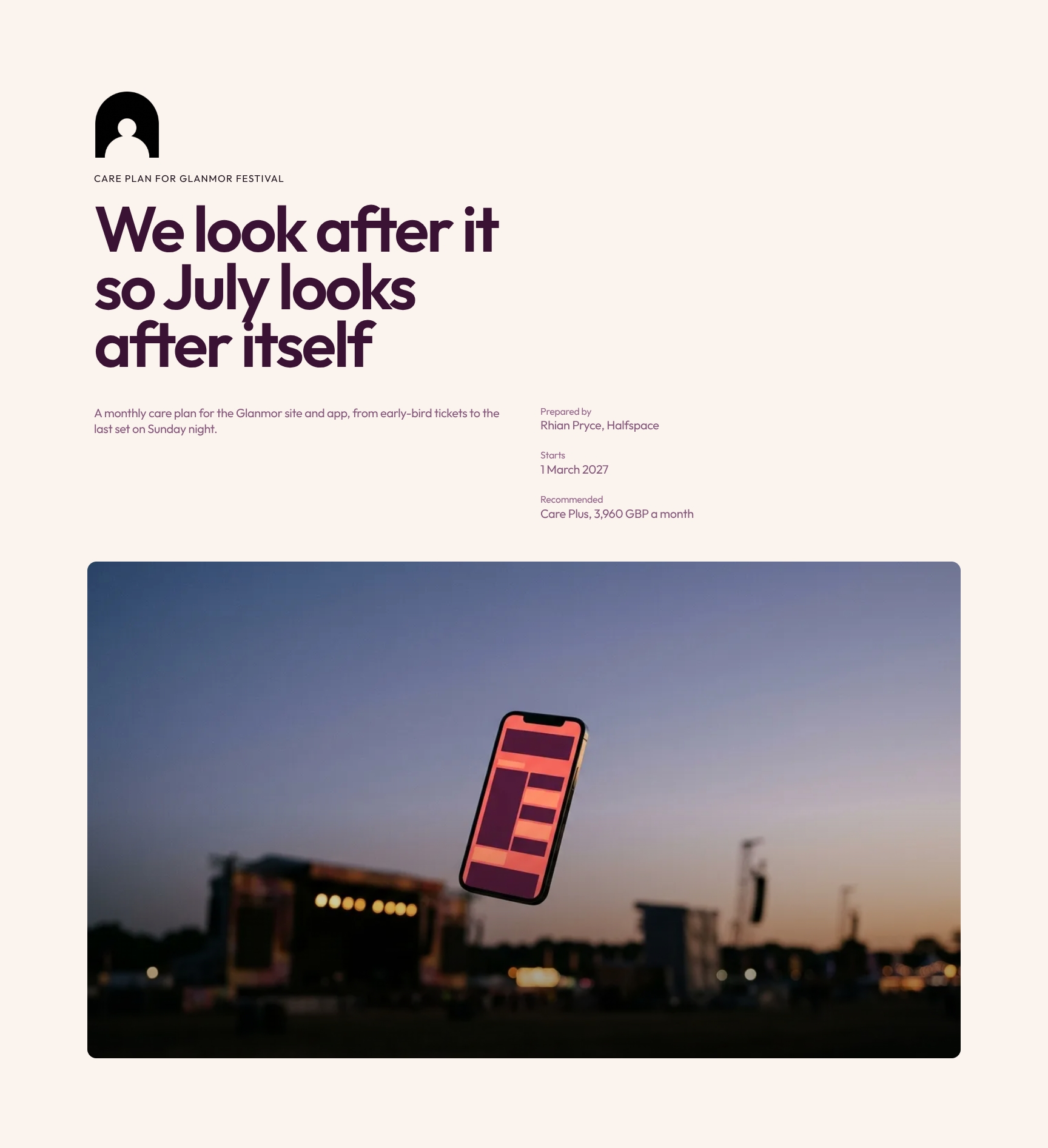
### Why a Care Plan Instead of a Rebuild: Project Brief and Context
Sets out the brief: Glanmor doubling to 30,000 attendees and a site that needs ongoing care, not a rebuild. It builds the case for continuous support and justifies the investment.
### Care Plan Coverage and Dedicated Team Roles
Breaks down the three areas covered each month and introduces the four-person team leading design, engineering and delivery. Clear ownership and named contacts build trust and accountability.
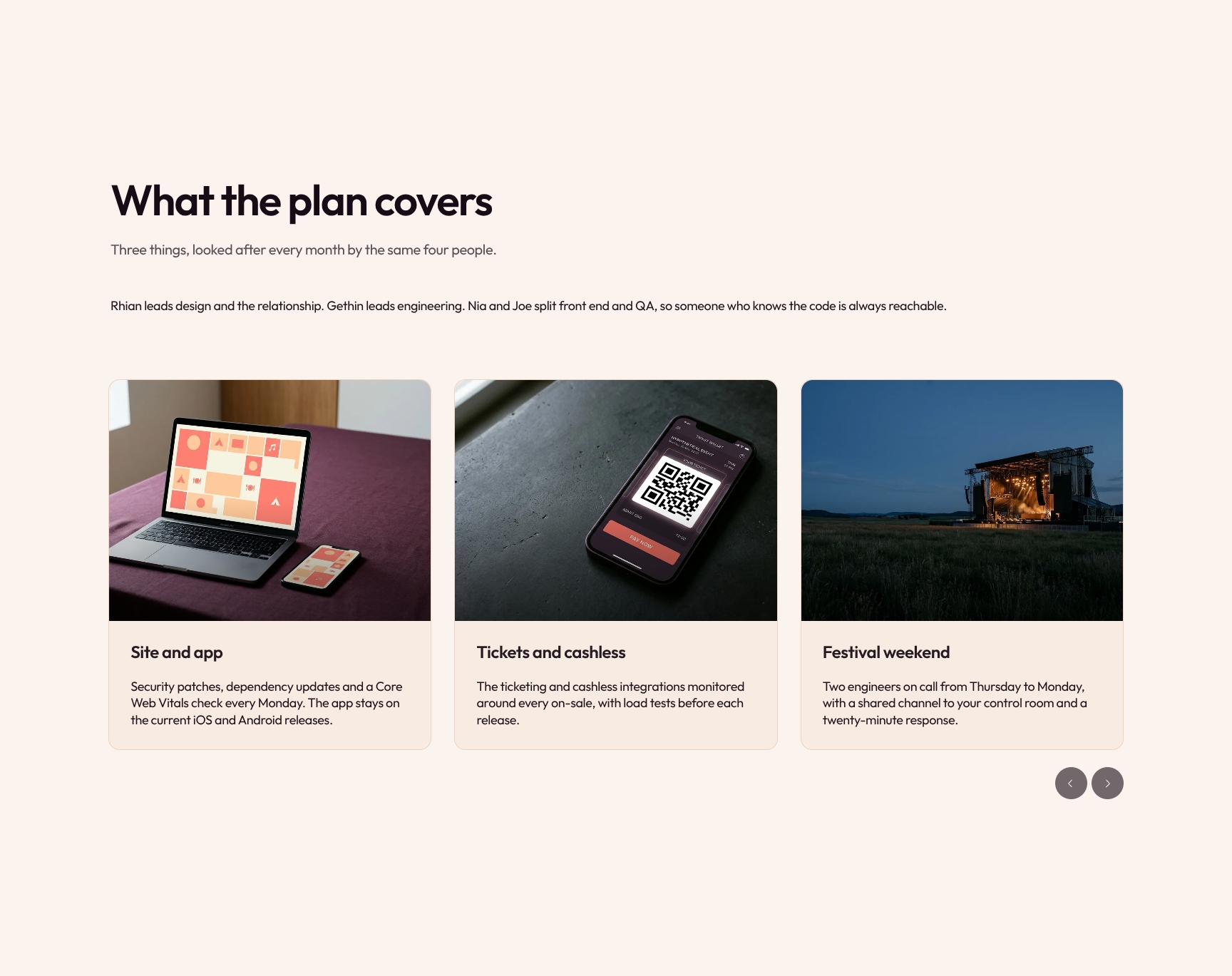
### Line-Up Drop Page Showcase with Edge-Served Performance
Showcases the high-traffic line-up drop page, rebuilt as a static page served from the edge so 40,000 refreshes add no cost. Set times and clash finder features show tangible, festival-specific value.
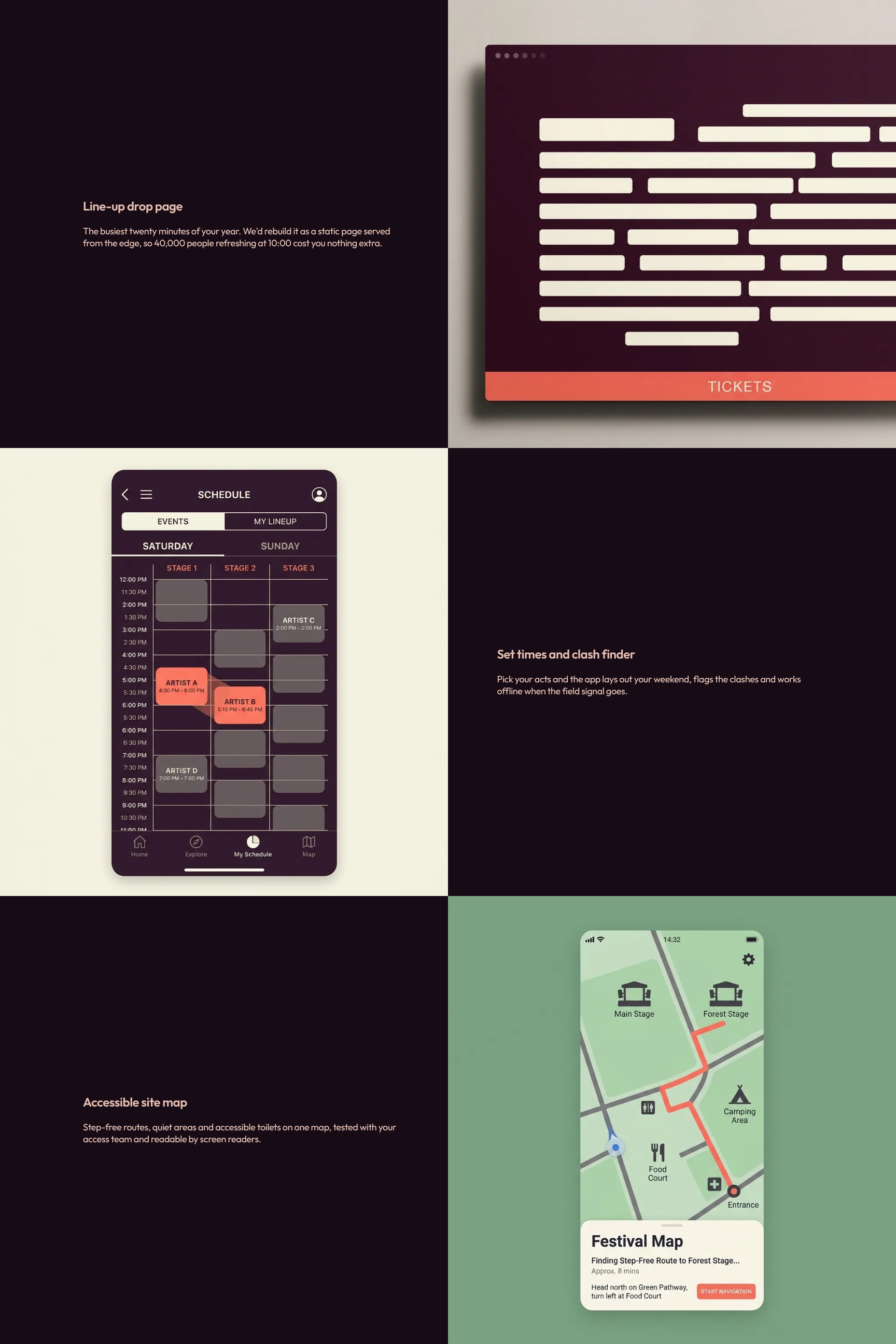
### Monthly Support Workflow and Festival Month Calendar
Explains the repeatable monthly rhythm so your team always knows where a request stands, plus a calendar showing how festival month runs differently. Predictable process, fewer surprises.
### Key Message Statement: Reliability When It Matters Most
An animated statement that distills the stakes: thirty thousand people, one weekend, no second chance to load. It reinforces why proactive care and performance planning matter.
### Care Plan Pricing Tiers with Recommended Option
Presents three monthly plans in GBP on a 12-month term, with Care Plus recommended for a festival this size. Totals update when a plan is selected, making the decision clear and transparent.
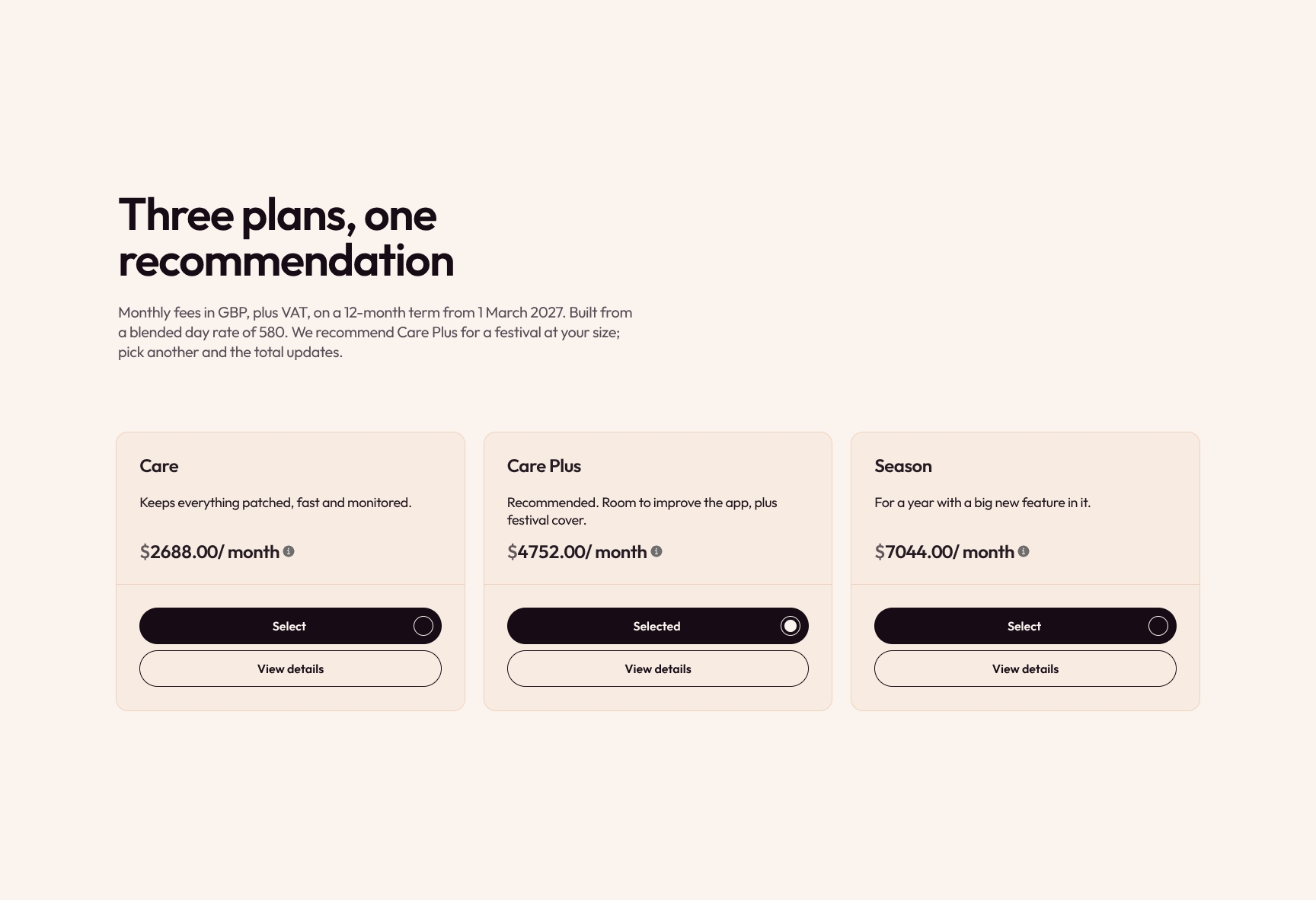
### Annual Festival Roadmap with On-Sale Dates and Code Freeze
A year-long task plan built around on-sales and the July weekend, including a code freeze ten days before gates open. It shows work scheduled around your busiest moments, reducing launch risk.
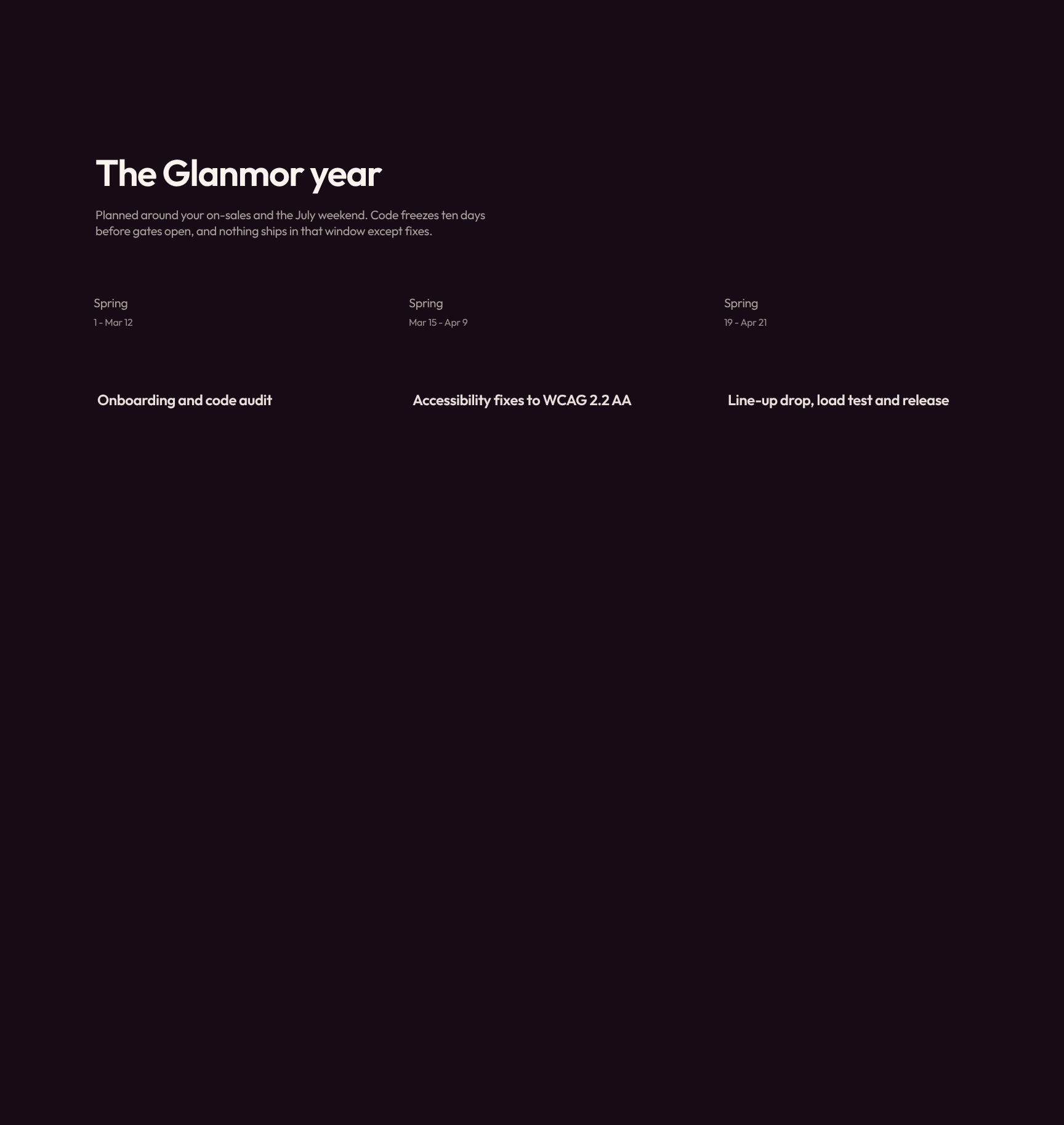
### Plain-English Terms and Care Plan FAQs
Expandable accordion covering the small print in plain words, such as how unused days carry over and what happens in festival month. It answers common questions up front and removes contract friction.
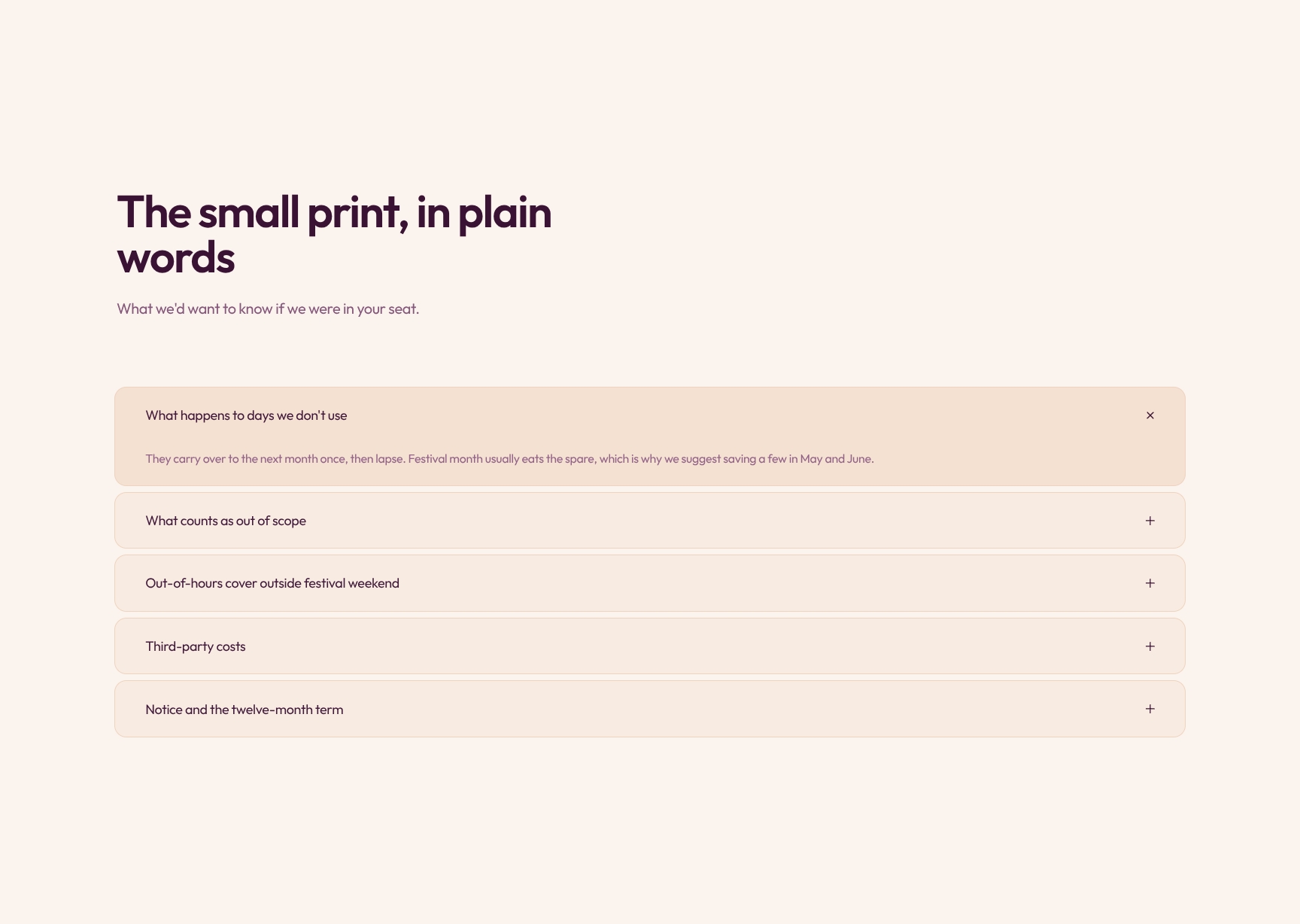
### Festival and Venue Client Testimonials with Proven Results
Quotes from venues and festivals already under care, including a ticketing lead who sold 18,000 tickets in nine minutes with no errors. Real results from similar clients build credibility and confidence.
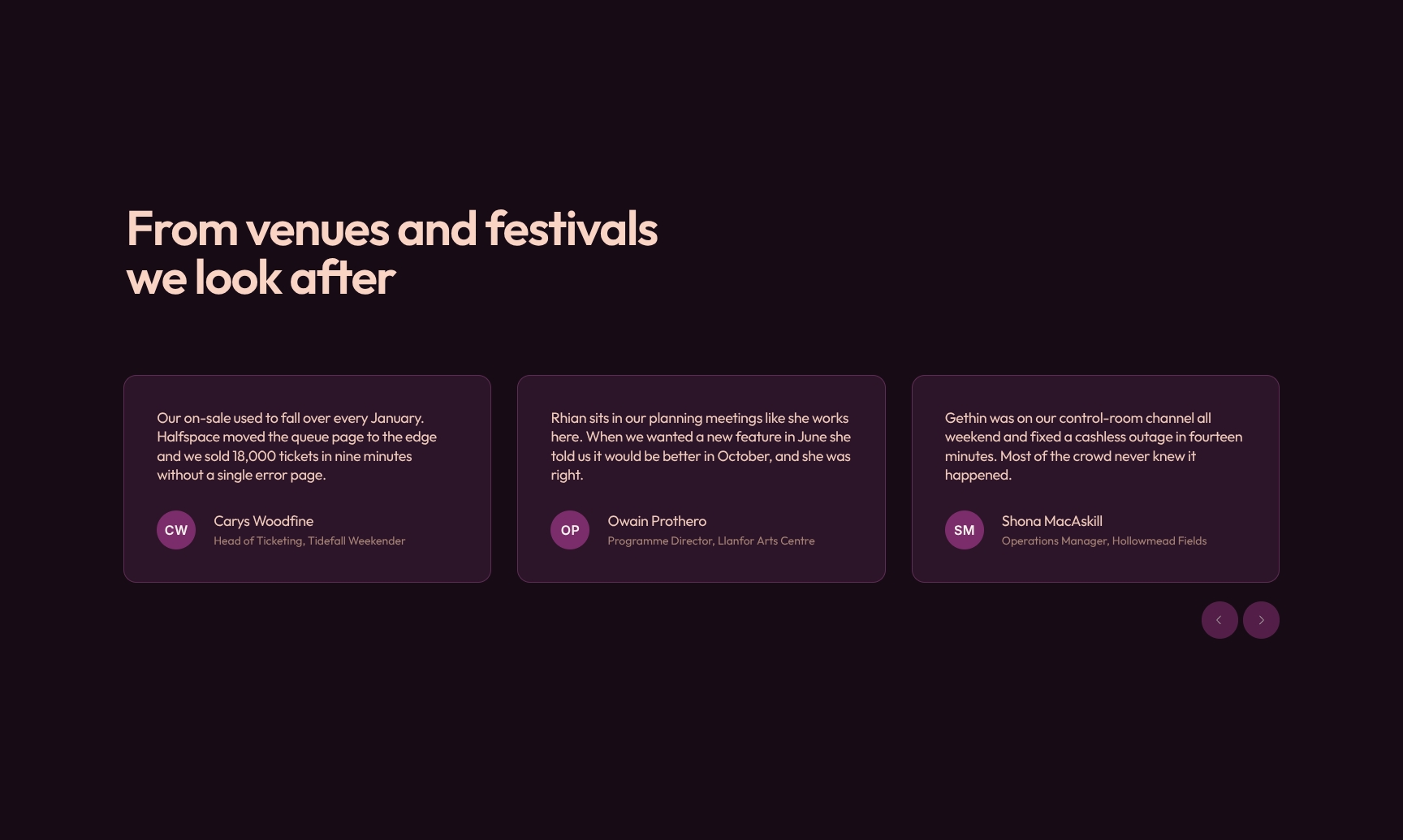
### Approval and Onboarding Audit Next Steps
A clear call to action: confirm by 19 February and the code audit begins 1 March, seven weeks before the line-up drop. It lists access requirements and makes sign-off simple.
## Find your answers
Answers to common questions about pricing and scoping care plans for festival websites, apps, ticketing and weekend support.
### What should be included in a care plan proposal?
A strong care plan proposal should include a cover page, the reasons a client needs ongoing care, a clear scope of what the plan covers, the deliverables or reports it produces, and a month-by-month workflow. It should close with a concise statement of the value or purpose. This template includes all of these sections so you can send it with minimal editing.
### How do I customize this care plan proposal template?
Replace the cover details with your business name, client name, and branding, then edit the 'What it covers' and 'What it produces' sections to match your services. Adjust 'How a month runs' to reflect your real schedule of tasks, check-ins, and reporting. Finish by rewriting 'The point' in your own words so it reflects your value to the client.
### Why do clients need a care plan instead of one-off support?
A care plan gives clients predictable, ongoing maintenance, faster issue resolution, and fewer surprise costs compared to paying for one-off fixes. It also protects their investment by keeping systems updated, secure, and performing well. The 'Why a care plan' section helps you make this case clearly and persuasively.
### Can I export this care plan proposal to PDF or other formats?
Yes, you can export the finished proposal to PDF for sending to clients, which preserves layout and formatting. You can also keep it in an editable format so you can reuse it and update it for future clients. Always review the exported file to confirm that fonts and spacing look correct before sending.
### Is this care plan proposal suitable for agencies, freelancers, and IT providers?
Yes, the template is flexible enough for web agencies, freelancers, IT support providers, and other service businesses that offer recurring maintenance or support. Because the coverage, deliverables, and monthly workflow sections are fully editable, you can adapt them to your industry. You can also use it commercially with your own clients.
## Related
- [Lyon](https://formlio.com/templates/lyon-hotel-website-proposal): Website proposal for multi-property hotel groups
- [Bordeaux](https://formlio.com/templates/bordeaux-launch-event-pitch): Hybrid launch event pitch for brands
- [Boston](https://formlio.com/templates/boston-event-retainer-proposal): Monthly event retainer proposal for brands
- [Cambridge](https://formlio.com/templates/cambridge-design-studio-portfolio): Web design studio portfolio for research clients
- [Portland](https://formlio.com/templates/portland-app-redesign-proposal): App redesign pitch for subscription startups
- [Copenhagen](https://formlio.com/templates/copenhagen-headless-ecommerce-proposal): Headless storefront proposal for ecommerce brands
---
---
title: "Cambridge"
description: "Showcase your web design studio with a portfolio template featuring positioning, studio stats, and case studies for research, culture and science clients."
canonical: "https://formlio.com/templates/cambridge-design-studio-portfolio"
locale: "en"
type: "template"
lastModified: "2026-10-21"
category: "Digital & web design"
alternates:
fr: "https://formlio.com/fr/templates/cambridge-portfolio-de-studio-de-design.md"
---
# Cambridge
Digital Design Studio Portfolio Template
Showcase your web design studio with a portfolio template featuring positioning, studio stats, and case studies for research, culture and science clients.
- [Use this template](https://formlio.com/workspaces/claim?template=cambridge-design-studio-portfolio)
- [Live preview](https://formlio.com/documents/cambridge-design-studio-portfolio)
- **Categories:** [Digital & web design](https://formlio.com/templates/digital-web-design), [Creative & design](https://formlio.com/templates/creative-design), [Portfolio](https://formlio.com/templates/portfolio)
- **Document goal:** Show research, culture and science clients your best web work with a portfolio built around studio stats and case studies.
- **Blocks:** Infinite grid, Scroll gradient, Grid 3x2 with icons, Single column, Split, Alternating column, Grid tile scroll
- **Palette:** Warm Parchment Background (#F4F1EA), Soft Sand Highlight (#EFDDBF), Burnished Amber Accent (#A8661F), Espresso Brown Depth (#3A2A14), Rich Charcoal Ink (#121110)
## Get more from every document
Show research, culture and science clients exactly what your studio builds and the results it delivers. Image-led covers, animated positioning, live charts and case studies keep the work front and center.
### Make your portfolio look like you
Swap colours, typefaces, and layouts so your hero images and case studies carry your own style, not a template's.
### Build your portfolio from reusable blocks
Drop in galleries, showcases, and testimonials, then save your best case study layout to reuse on the next pitch.
### Your work looks right on any screen
Full-bleed hero images and galleries hold up on a client's phone, an art director's tablet, or a studio monitor.
### See which projects hold their attention
Heatmaps show which case studies get lingered on, and session replays show when a client is ready for your follow-up.
### Know when your portfolio gets opened
Get a ping the moment a client views your work, leaves a comment, or signs off, so you reply while it's fresh.
### Build the portfolio with your team
Your designer tweaks the gallery while you rewrite case study copy, all in the same document, live.
## See how every part fits
The portfolio opens with a full-bleed cover and closes with client testimonials and a clear path to starting a project. Keep, drop, or reorder any section so the story fits your studio.
### Full-Bleed Studio Cover with Image-Led Hero
A confident opening that introduces Ridgeway & Cole, an eleven-person Cambridge studio building websites and digital products for research, culture and science. Imagery sets the tone and tells visitors who you serve in seconds.
### Animated Positioning Statement for Complex Ideas
A single animated line of text that states your niche: designing for organisations whose ideas are harder to explain than to have. It builds a memorable brand position and filters for the right clients.
### Studio Facts and Founders in Numbers
Card-based snapshot of the studio: founding year, founders Anna Ridgeway and Tobi Cole, and the promise that a founder designs every project. Quick, scannable proof of credibility and senior attention.
### Point of View Manifesto on Performance and Design
A short editorial statement, 'Fast is the floor, not the point', that sets out your design philosophy. It shows thought leadership and explains why hard ideas deserve more than a template with a logo on it.
### Featured Case Study Showcase with Measurable Results
A spotlight on flagship work such as the Calyx Genomics WebGL protein explorer, with load time and a rise in research applications. It pairs visuals with outcomes to prove your work delivers real results.
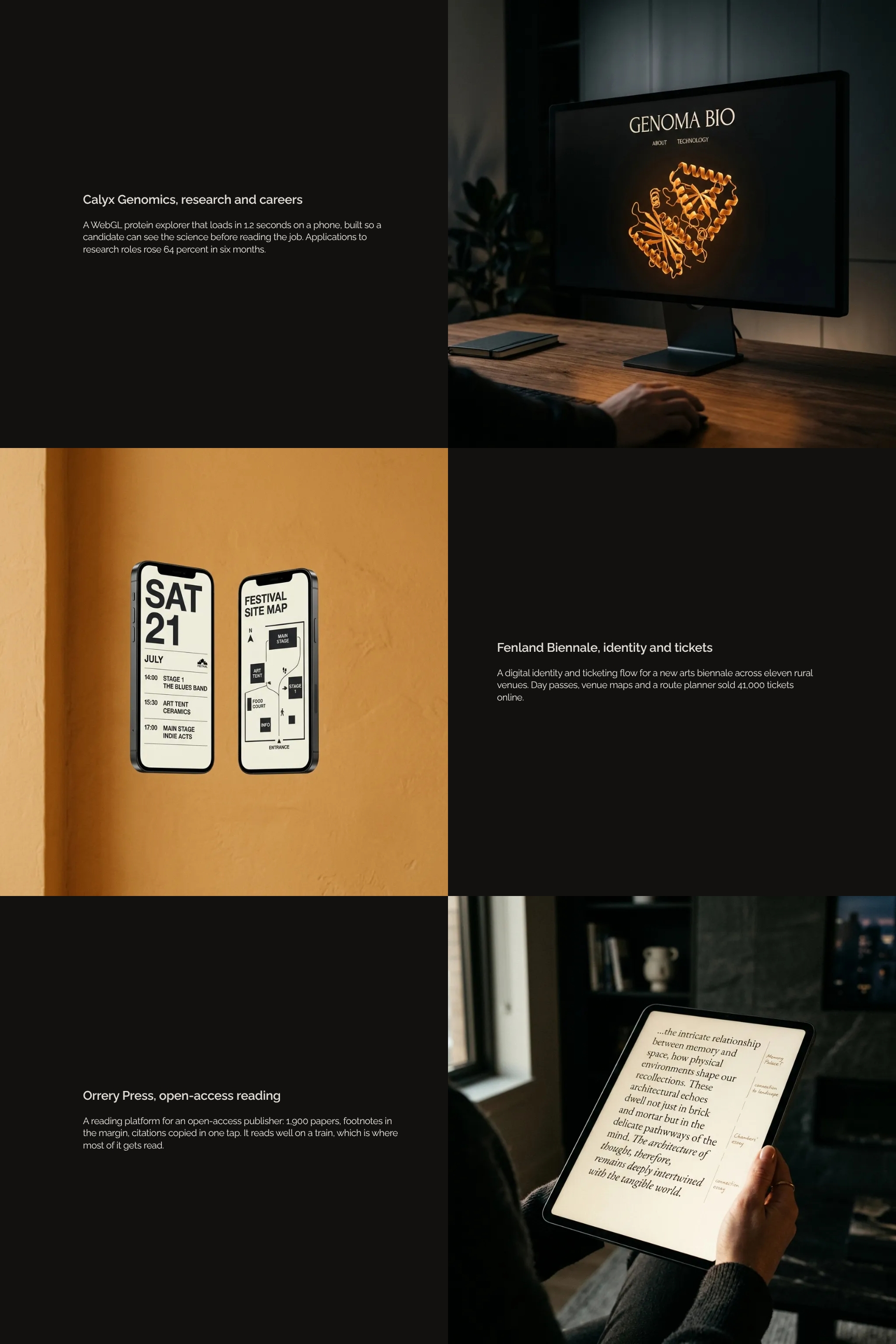
### Selected Project Index of Research and Culture Work
A curated list of six standout projects from forty-six, each chosen for a hard central idea and a measurable result. It lets visitors browse breadth of experience quickly and jump to the work most relevant to them.
### Behind-the-Scenes Gallery of Components and Prototypes
A visual gallery of components, prototypes and renders from recent launches. It reveals craft and process details that polished case studies hide, adding personality and showing technical depth.
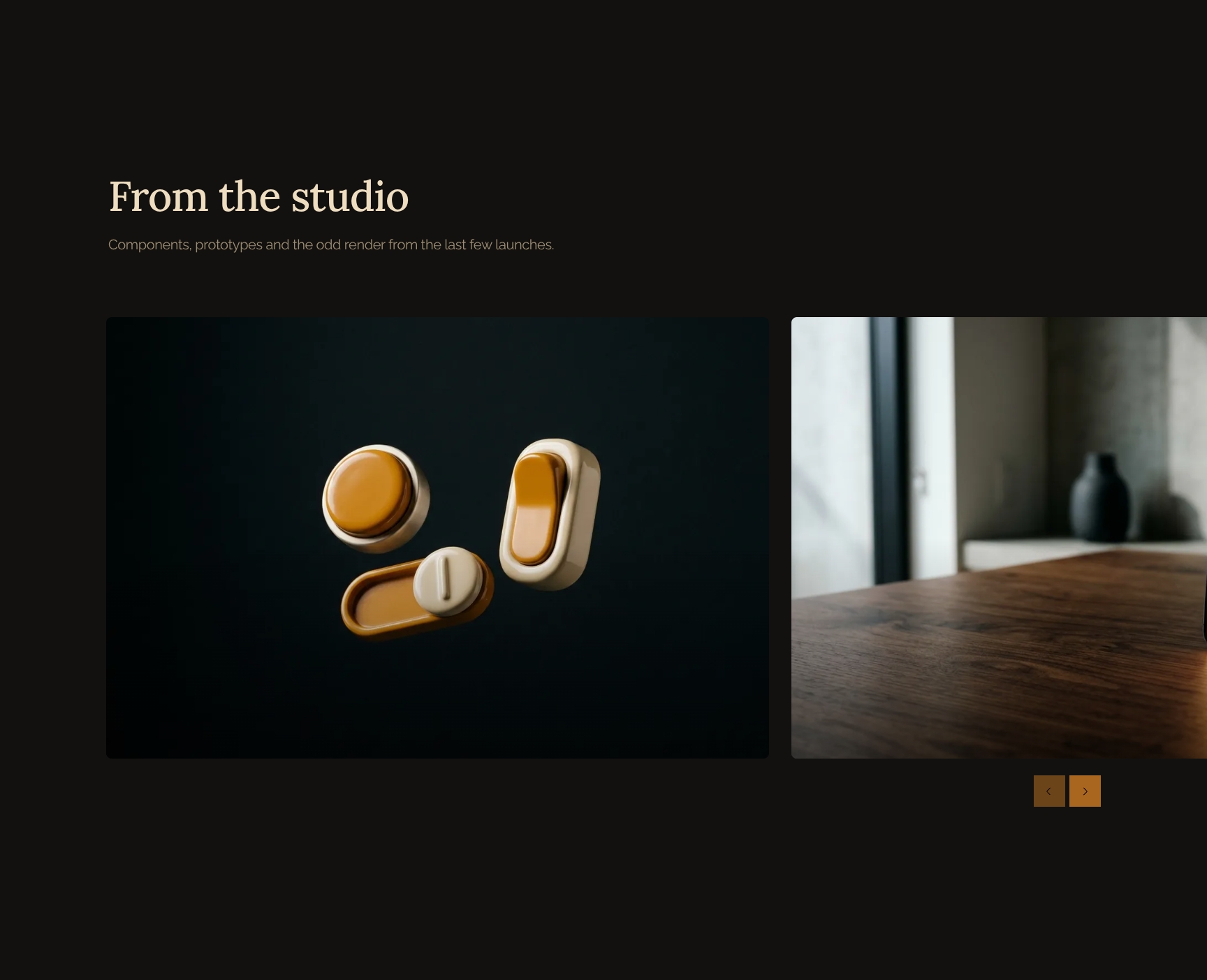
### Outcomes Dashboard with Client-Measured Performance Charts
Charts showing what the work achieved, using CrUX field data and client analytics ninety days after launch. Transparent, third-party-style evidence builds trust and supports data-driven buyers.
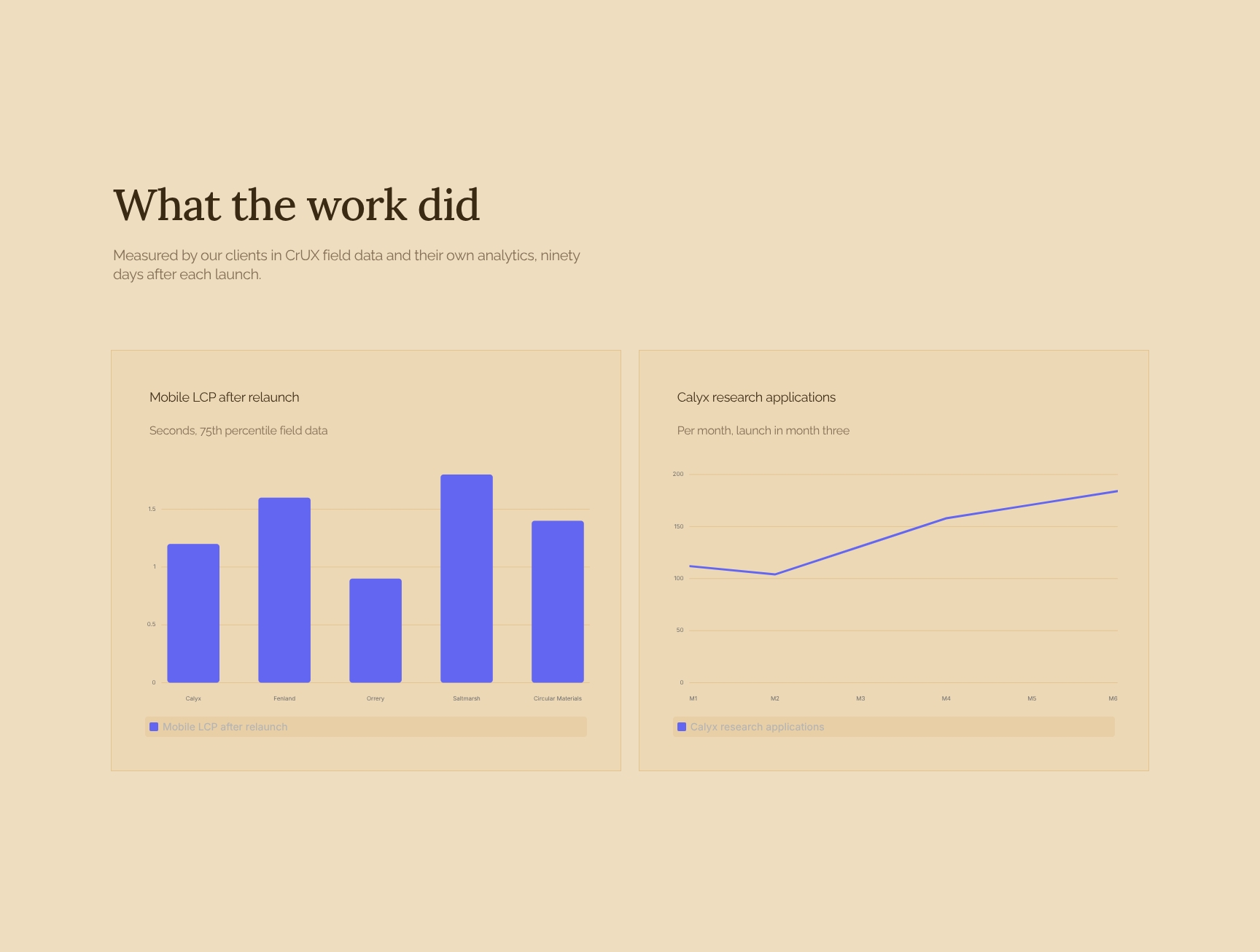
### Project Process Timeline: How a Project Runs
A step-by-step view of a typical ten to sixteen week engagement, explaining the consistent shape and what affects duration. It sets expectations, reduces uncertainty and helps prospects plan with confidence.
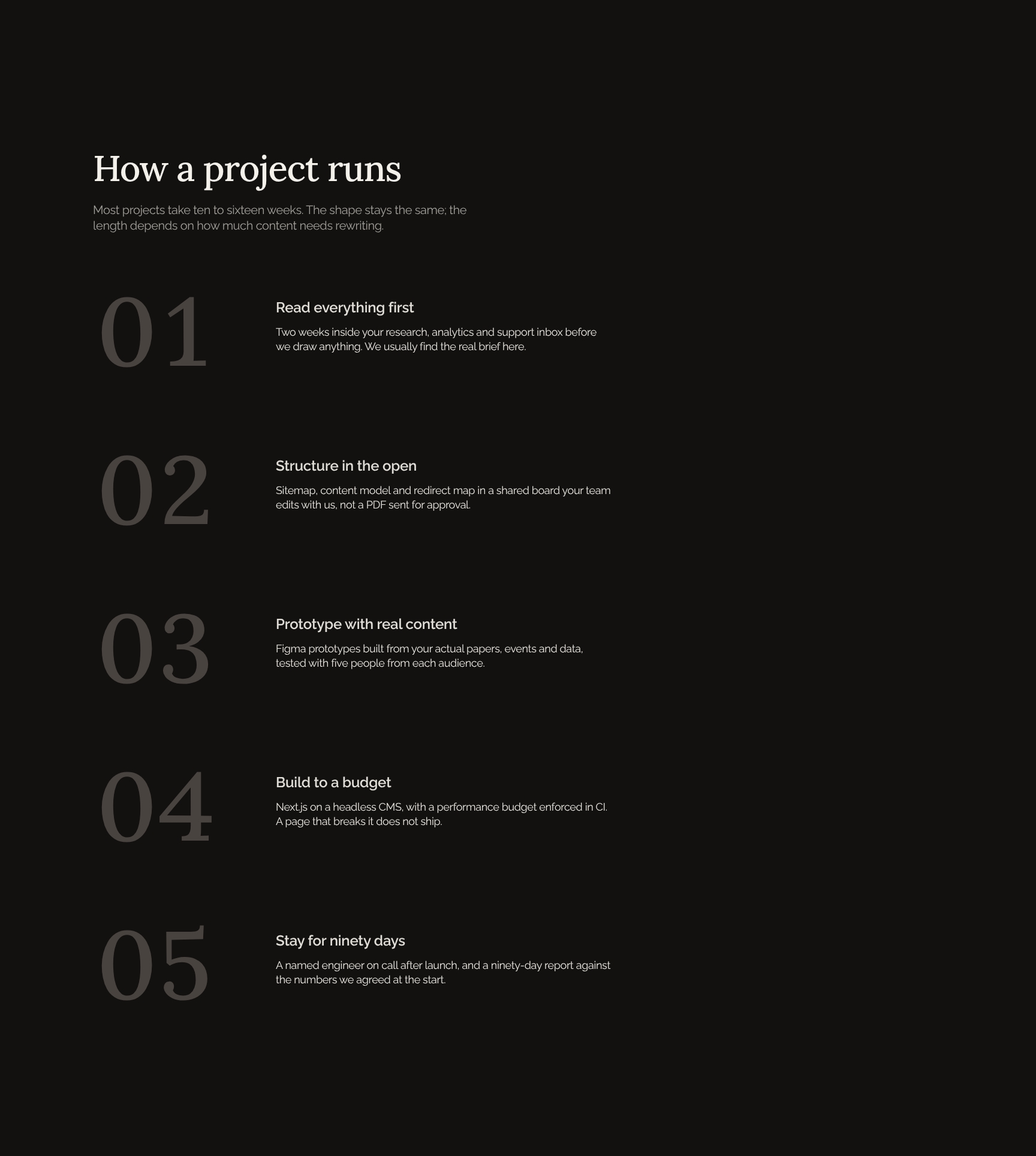
### Starting a Project: Capacity, Lead Times and Availability
Clear guidance on working together: six new projects a year, an eight to ten week lead time and spring 2027 openings. Scarcity and transparency encourage serious enquiries and qualify leads early.
### Client Testimonials from Research and Science Leaders
Quotes from clients such as Dr Meera Kulkarni, tying the studio's deep research approach to real outcomes. Named, credible endorsements give social proof that reassures prospective clients before they get in touch.
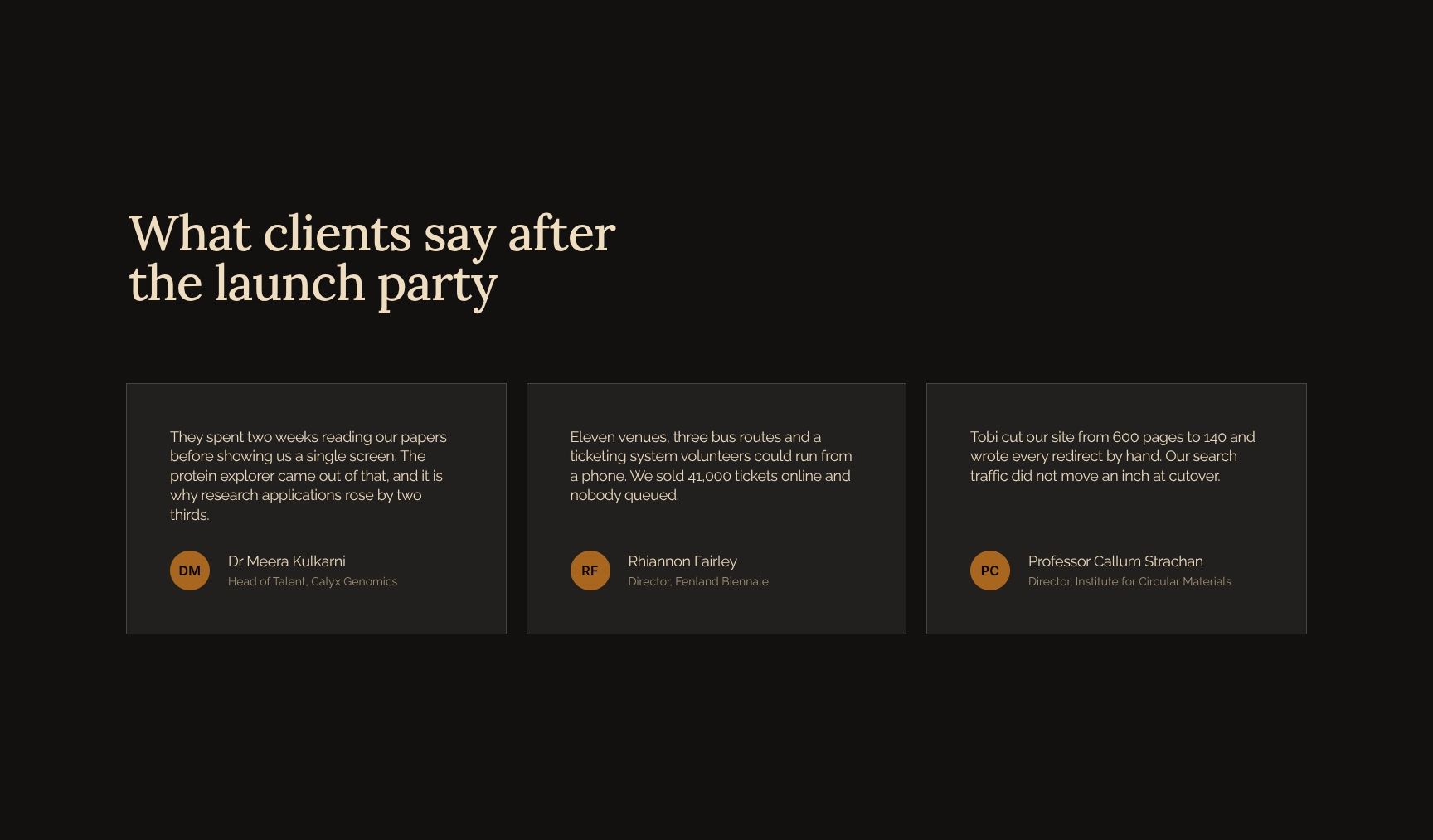
## Find your answers
Answers to common questions about building a web design studio portfolio for research, culture and science clients.
### What should be included in a design studio portfolio?
A strong studio portfolio opens with a cover and a clear positioning statement, then introduces the studio, its point of view, and a curated selection of featured work. This template also includes an index so clients can scan every project quickly. Together, these six sections show who you are, what you believe, and the results you deliver.
### How do I customize this portfolio template for my own studio?
Replace the placeholder text in each section (Cover, Positioning, The studio, Point of view, Featured work, and Index) with your own copy, images, and project details. Then adjust fonts, colors, and logo placement to match your brand. Each section is built to stand alone, so you can reorder, duplicate, or remove pages without breaking the layout.
### Can I export this portfolio template to PDF or share it online?
Yes. You can export the finished portfolio as a PDF for email attachments and client proposals, or share it as a link or web view where your tool supports it. For the best results, use high-resolution images and export at print quality if you plan to print it.
### Is this portfolio template suitable for designers, architects, and creative agencies?
Yes. The structure of positioning, studio story, point of view, and featured work suits any studio-based creative business, including graphic design, architecture, branding, photography, and interiors. You can adapt the Featured work and Index sections to match your industry's case study format or project categories.
### How many projects should I show in the Featured work section?
Aim for three to six of your strongest projects so the portfolio stays focused and easy to scan. Pick work that supports your positioning and shows the kind of clients you want to attract. List any additional projects in the Index so nothing gets left out.
## Related
- [Lyon](https://formlio.com/templates/lyon-hotel-website-proposal): Website proposal for multi-property hotel groups
- [Cardiff](https://formlio.com/templates/cardiff-website-care-plan-proposal): Monthly care plan proposal for festival organisers
- [Portland](https://formlio.com/templates/portland-app-redesign-proposal): App redesign pitch for subscription startups
- [Copenhagen](https://formlio.com/templates/copenhagen-headless-ecommerce-proposal): Headless storefront proposal for ecommerce brands
- [Milan](https://formlio.com/templates/milan-headless-commerce-proposal): Headless ecommerce proposal for luxury brands
- [Toronto](https://formlio.com/templates/toronto-brand-relaunch-proposal): Creative campaign proposal for consumer brands
---
---
title: "Portland"
description: "Win app redesign projects with a proposal template covering onboarding, churn analysis, design system scope and pricing routes for subscription mobility startups."
canonical: "https://formlio.com/templates/portland-app-redesign-proposal"
locale: "en"
type: "template"
lastModified: "2026-10-21"
category: "Digital & web design"
alternates:
fr: "https://formlio.com/fr/templates/portland-proposition-de-refonte-dapplication.md"
---
# Portland
Mobile App Redesign Proposal Template
Win app redesign projects with a proposal template covering churn analysis, onboarding fixes, design system scope and route options for funded mobility startups.
- [Use this template](https://formlio.com/workspaces/claim?template=portland-app-redesign-proposal)
- [Live preview](https://formlio.com/documents/portland-app-redesign-proposal)
- **Categories:** [Digital & web design](https://formlio.com/templates/digital-web-design), [Creative & design](https://formlio.com/templates/creative-design), [Proposals](https://formlio.com/templates/proposals), [Pitch decks](https://formlio.com/templates/pitch-decks)
- **Document goal:** Win app redesign projects by pitching onboarding fixes, churn insights, design system scope, and pricing to subscription startups.
- **Blocks:** Typewriter, Scroll gradient, Single column, Grid 3x2 with icons, Split, Alternating column, Itemized quote, E-signature
- **Palette:** Soft Meadow Light (#F2F5EF), Pale Lime Mist (#DDF3B8), Vibrant Lime Accent (#a8e63a), Deep Forest Green (#12241B), Midnight Evergreen (#0A140F)
## Get more from every document
Pitch a full app redesign and show a subscription startup exactly how you'll cut churn. Metrics snapshots, funnel charts, design routes, and fixed-fee pricing are already built into the layout.
### Get the yes without the PDF
Your client approves the scope and signs the agreement section right where they read your pricing. No printing, no re-uploading.
### Build proposals from sections you trust
Pull in a pricing table, steps timeline, or testimonials block, then save your tuned versions to reuse on the next pitch.
### Your pitch looks right on any screen
The hero, portfolio showcase, and pricing cards hold their shape when a client opens your proposal on a phone between meetings.
### See which section wins the deal
Heatmaps show whether they lingered on pricing or skipped your portfolio, and replays let you time your follow-up call.
### Know the moment they open it
Get pinged when a client views your proposal, leaves a comment on the scope, or signs the agreement.
### Write the proposal together, live
Your designer tweaks the showcase while you rework pricing and steps, all in one document with no version juggling.
## See how every part fits
The proposal opens with your big idea and the client's problem, then moves through data, design routes, proof, and price, and closes on a sign-off deadline. Keep what fits, drop what doesn't, and reorder anything.
### Proposal Cover with Project Pitch & Launch Deadline
Opens with a bold pitch headline for the Cascade Ride app redesign and ties it to the September Denver and Minneapolis launches, so the client sees the stakes and timeline immediately.
### Big Idea Statement: Core Design Vision
An animated one-line statement of the guiding idea: the best ride app is the one you forget you opened. It sets the creative direction and gives the whole proposal a memorable anchor.

### Client Brief & Problem Statement
Restates the client's situation: a $14M Series A, expansion from two cities to four, and a first-week app experience that leaks riders. Shows you understand the problem and its business impact.
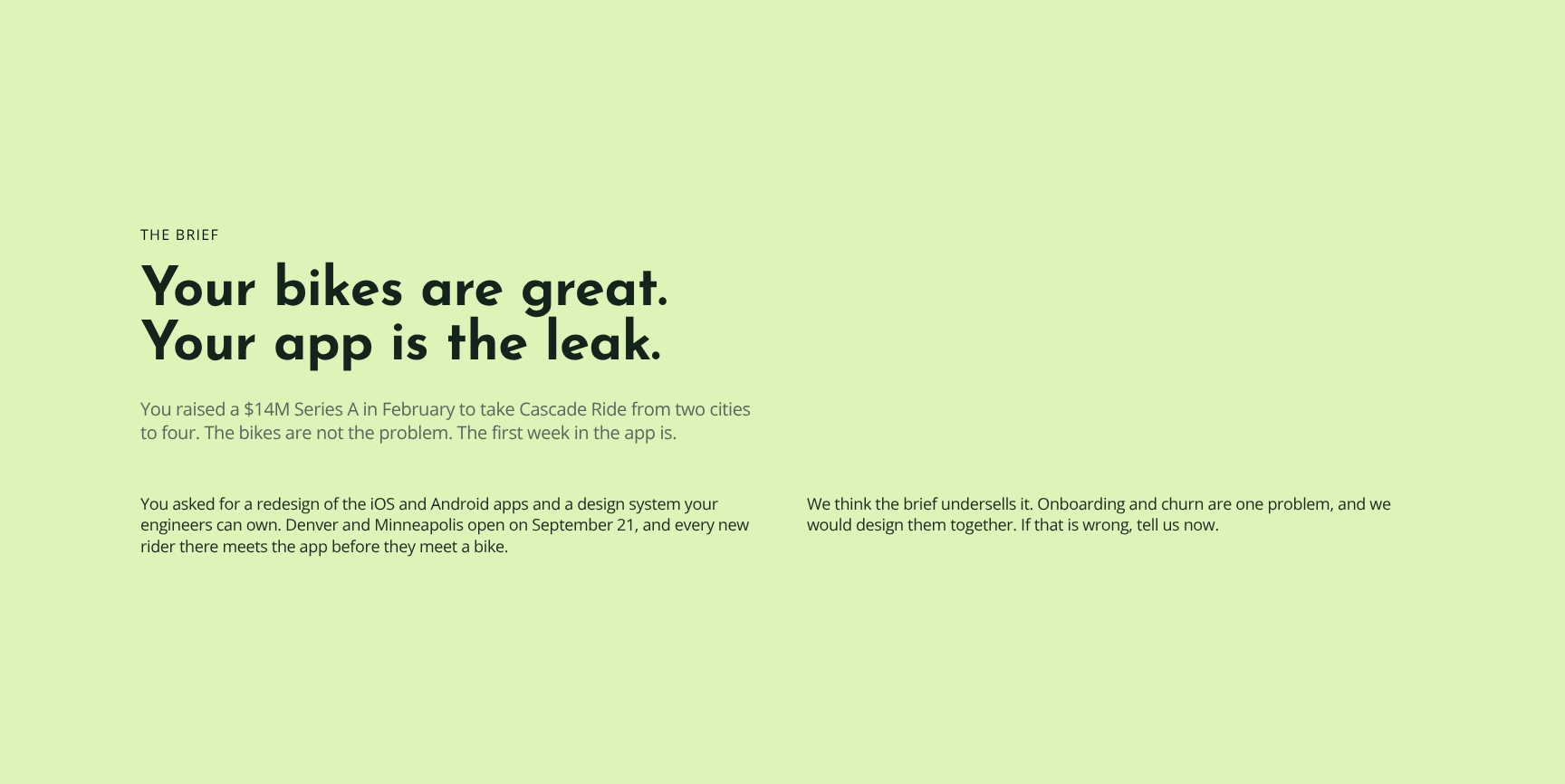
### Key Metrics Snapshot from Amplitude & Stripe
Summarizes where the business stands today, drawn from six months of Amplitude and Stripe exports. Grounds the proposal in the client's own numbers and builds credibility.
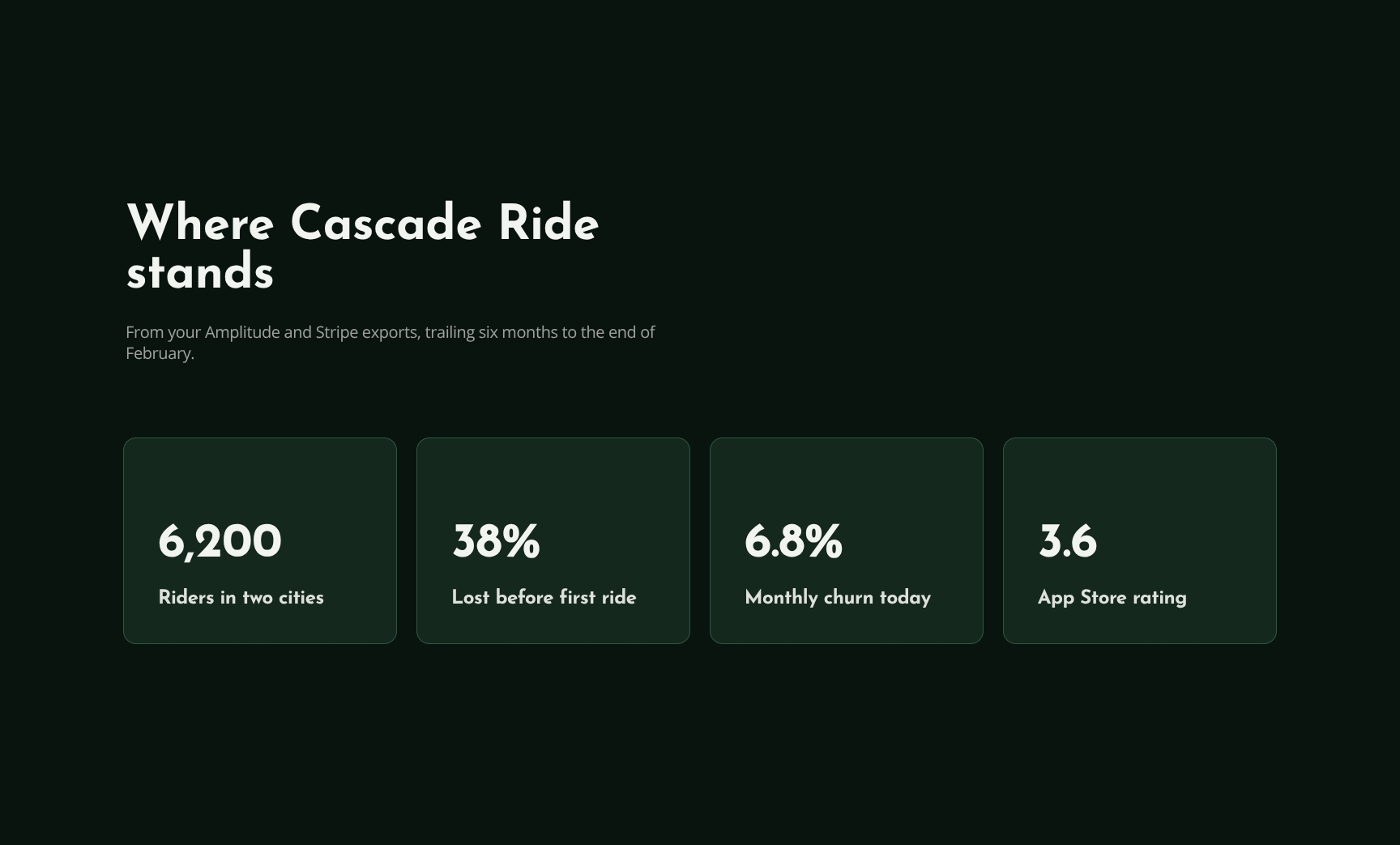
### Funnel Drop-Off Analysis with Data Charts
Charts show where riders leave, pinpointing the loss between plan selection and delivery booking. Reframes the issue as a scheduling-screen problem rather than a pricing one, so the fix is clear.
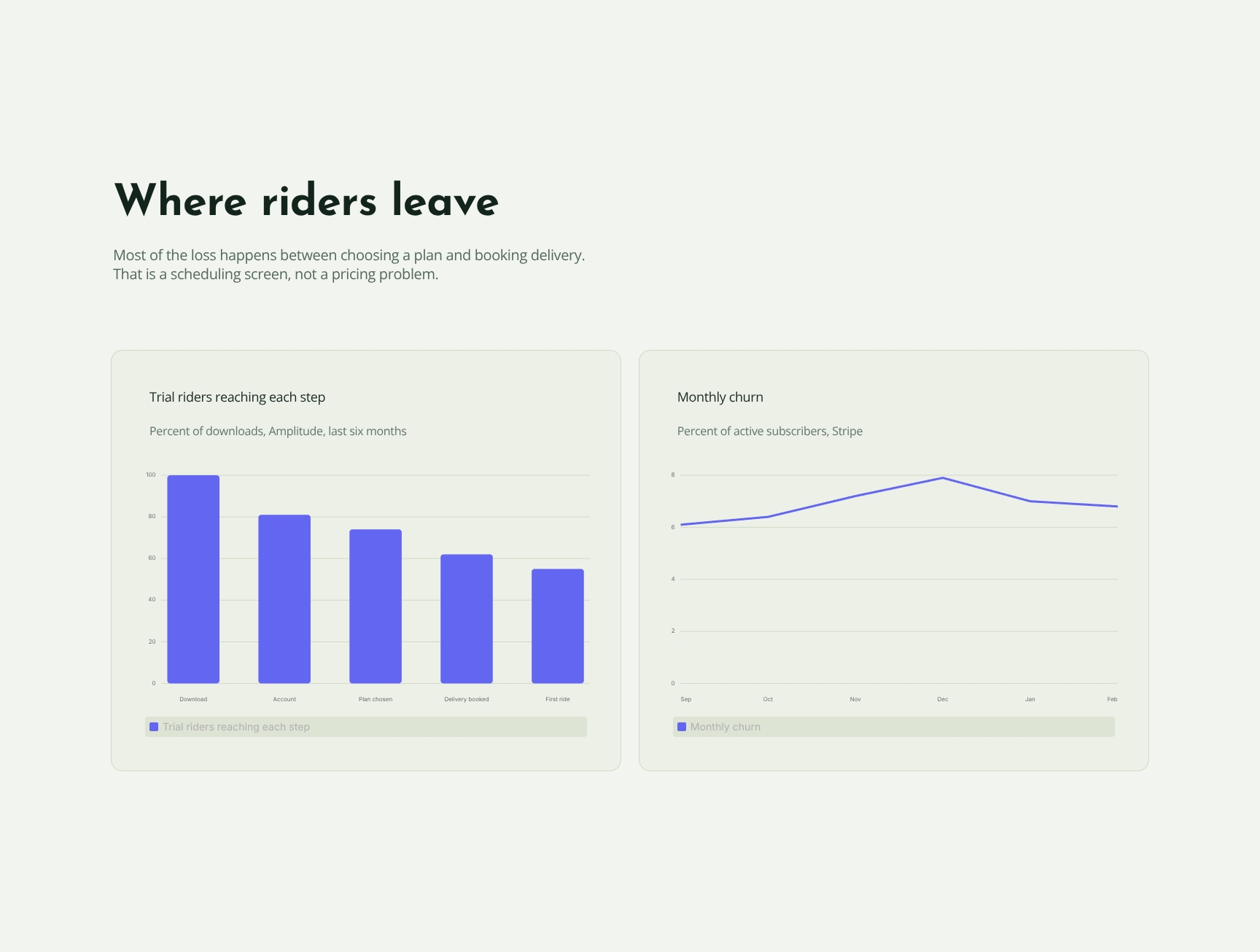
### Three Design Routes with Recommended Direction
Presents three app concepts, from a ride-first home screen to alternatives, each with a clear rationale. Route A is recommended, which helps the client decide quickly and with confidence.
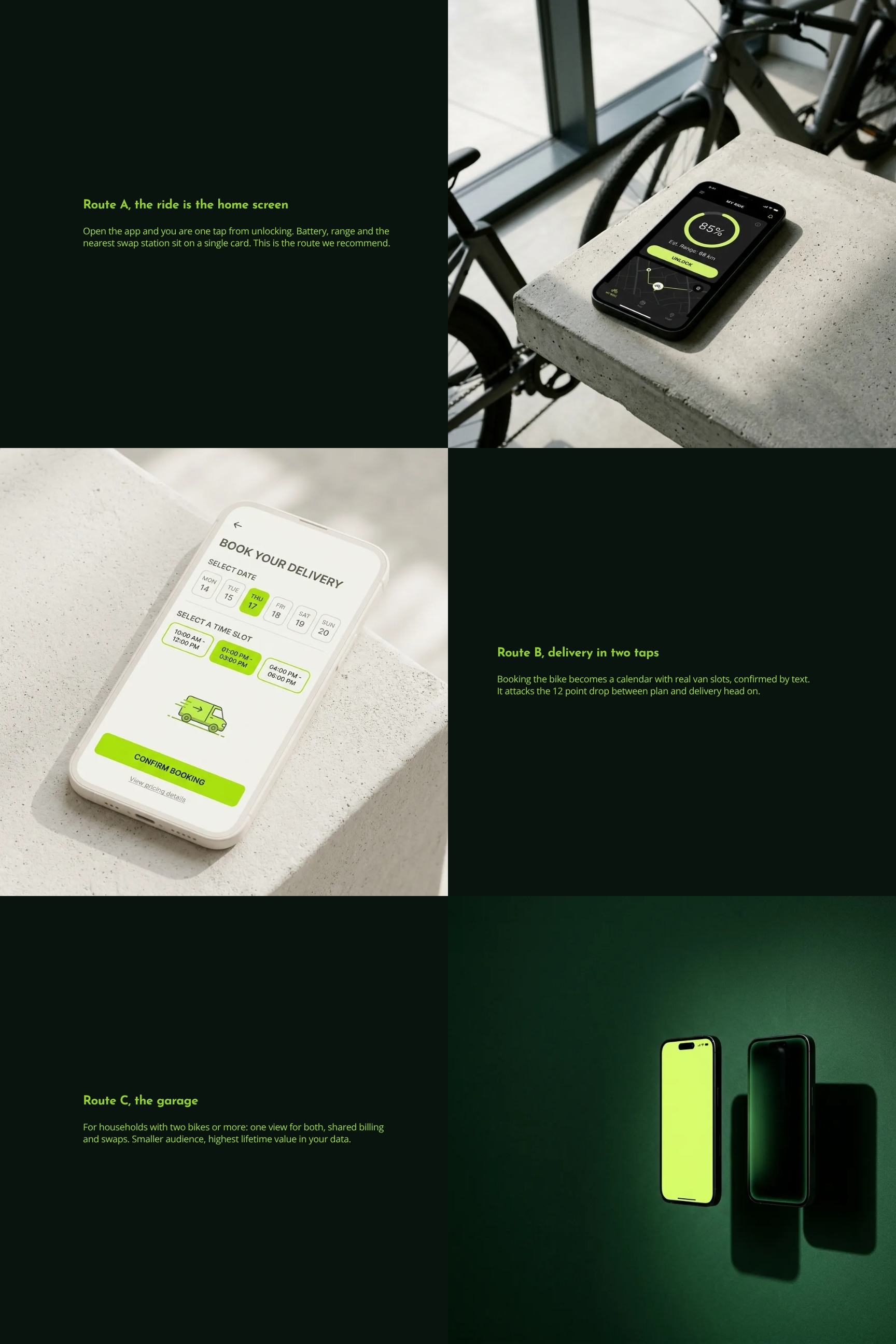
### Case Studies: Subscription App Portfolio & Results
Four subscription app projects where the first week decided the business, with results taken from clients' own dashboards. Proves you have fixed this exact problem before.
### 20-Week Project Timeline & Delivery Plan
A step-by-step plan from the May 3 kick-off to the September 7 store release, two weeks before Denver launches. Gives clear milestones and shows the schedule protects the launch.
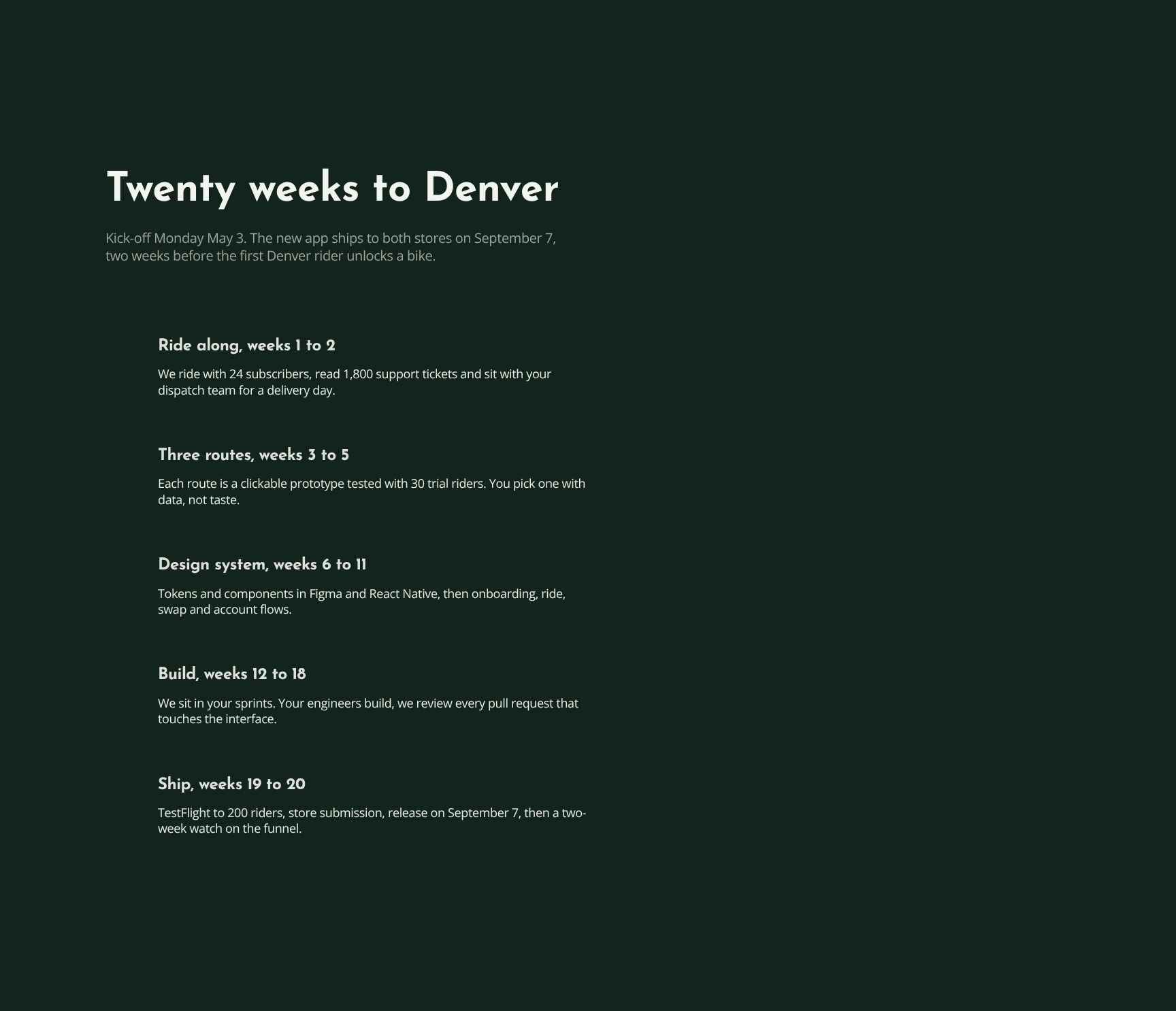
### Fixed-Fee Pricing with Transparent Day Rates
A fixed USD fee for the defined scope, built from published day rates for designer, design lead and researcher. Clients keep their App Store and TestFlight accounts. Clear, no-surprise budgeting.
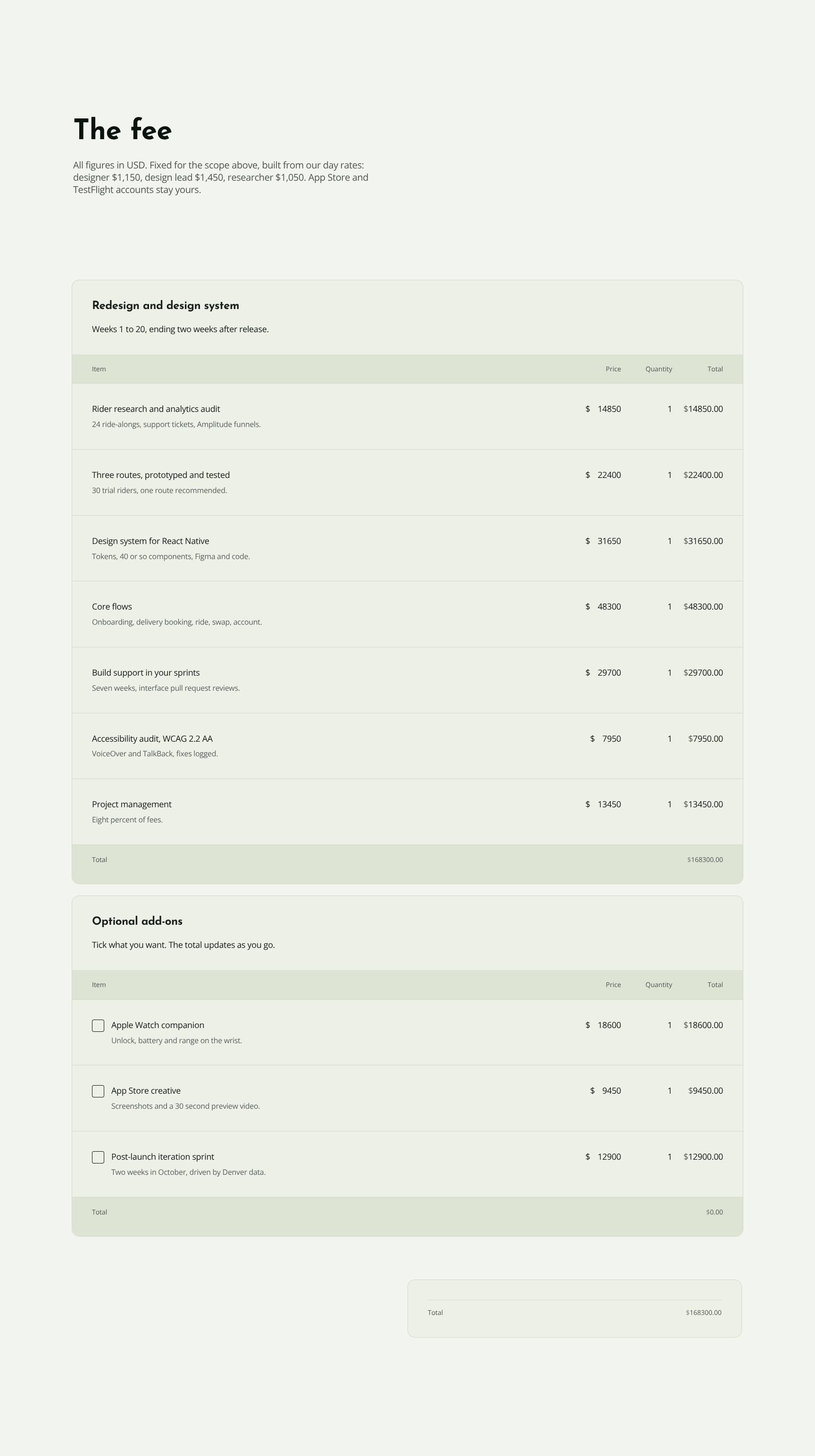
### Client Testimonials from Founders & Product Leads
Quotes from founders and product heads who hired you for the same problem, including onboarding activation lifting from 41 to 63 percent. Adds social proof and shows candid, honest advice.
### Agreement & Sign-Off with April 23 Deadline
A clear call to action: sign by April 23 to start May 3. Explains that a later signature pushes the release past the Denver launch, creating honest urgency and an easy path to approval.
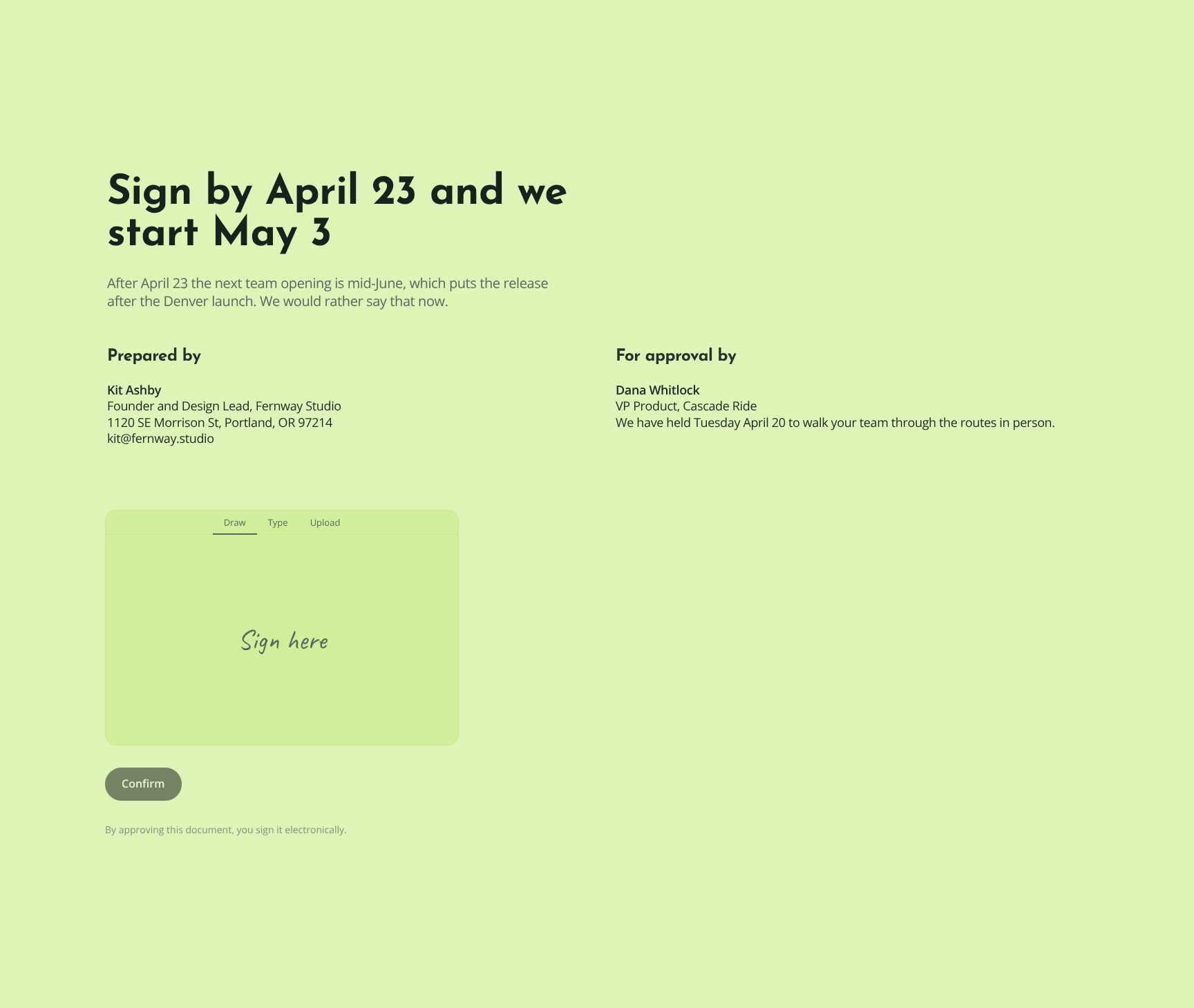
## Find your answers
Answers to common questions about writing and sending app redesign proposals to subscription startups.
### What should be included in a proposal like the Cascade Ride template?
This template covers six key sections: Cascade Ride (project overview), The idea (your core concept), The brief (goals and requirements), The numbers (budget and pricing), The data (supporting research), and Three routes (options for the client to choose from). Together they tell a clear story from concept to decision, making it easy for clients to approve.
### How do I customize this proposal template for my own project?
Replace the Cascade Ride title and details with your project name, then rewrite The idea and The brief to match your client's goals. Update The numbers and The data with your own pricing and research, and adjust Three routes to reflect your actual options. You can also change fonts, colors, and logos to match your brand.
### What is the purpose of the 'Three routes' section in a proposal?
The Three routes section presents three options, such as basic, recommended, and premium, so clients can compare choices instead of deciding yes or no. Offering tiered options gives clients a sense of control and often leads to faster approvals. Highlight the route you recommend and show how each one differs in scope, timeline, and cost.
### Can I export this proposal template to PDF or other formats?
Yes, you can export the finished proposal to PDF for sharing with clients, and most editors also let you download it as a PowerPoint or Word file for further editing. PDF is best for final delivery because it preserves layout, fonts, and images. Check your editor's export or download menu to choose the format you need.
### Is this proposal template suitable for agencies, freelancers, and consultants?
Yes, the structure works for any service business that needs to pitch an idea backed by numbers and data, including agencies, freelancers, consultants, and event or marketing teams. The idea-to-brief-to-options flow is flexible enough to adapt across industries. Simply swap in your own terminology, case data, and pricing to fit your field.
## Related
- [Lyon](https://formlio.com/templates/lyon-hotel-website-proposal): Website proposal for multi-property hotel groups
- [Cardiff](https://formlio.com/templates/cardiff-website-care-plan-proposal): Monthly care plan proposal for festival organisers
- [Cambridge](https://formlio.com/templates/cambridge-design-studio-portfolio): Web design studio portfolio for research clients
- [Copenhagen](https://formlio.com/templates/copenhagen-headless-ecommerce-proposal): Headless storefront proposal for ecommerce brands
- [Milan](https://formlio.com/templates/milan-headless-commerce-proposal): Headless ecommerce proposal for luxury brands
- [Toronto](https://formlio.com/templates/toronto-brand-relaunch-proposal): Creative campaign proposal for consumer brands
---
---
title: "Copenhagen"
description: "Win ecommerce redesign projects with a headless Shopify Plus proposal template: Next.js storefront, Sanity CMS, US checkout, sprint phases and KPI targets."
canonical: "https://formlio.com/templates/copenhagen-headless-ecommerce-proposal"
locale: "en"
type: "template"
lastModified: "2026-10-22"
category: "Digital & web design"
alternates:
fr: "https://formlio.com/fr/templates/copenhagen-proposition-e-commerce-headless.md"
---
# Copenhagen
Headless Shopify Plus Ecommerce Proposal Template
Win ecommerce redesign projects with a headless Shopify Plus proposal template: Next.js, Sanity, Shopify Markets, phased sprints and conversion targets.
- [Use this template](https://formlio.com/workspaces/claim?template=copenhagen-headless-ecommerce-proposal)
- [Live preview](https://formlio.com/documents/copenhagen-headless-ecommerce-proposal)
- **Categories:** [Digital & web design](https://formlio.com/templates/digital-web-design), [Proposals](https://formlio.com/templates/proposals)
- **Document goal:** Win ecommerce redesign projects with a clear headless Shopify Plus proposal covering scope, sprints, and KPI targets.
- **Blocks:** Image reveal, Single column, Scroll gradient, Spotlight, Fullscreen, Grid 3x2 with icons, Itemized quote, Gantt, Left-aligned, E-signature
- **Palette:** Warm Parchment Background (#F4F1EA), Soft Sand Accent Light (#EADFCB), Golden Amber Accent (#D98A2B), Espresso Depth Accent Dark (#1E1B17), Midnight Ink Text Dark (#0F0E0C)
## Get more from every document
Win headless Shopify Plus redesign projects with a proposal that shows clients exactly what you'll build and how. Pricing tables, sprint phases, and KPI targets sit ready to edit with your own brand and numbers.
### Get the yes without leaving
Clients approve your scope and sign the agreement right under the pricing, so the deal closes while they're still reading.
### Assemble proposals from your best sections
Drop in pricing, steps, and testimonials, then save your own winning blocks and reuse them on the next pitch.
### Your pitch looks right on every screen
Hero images, breakdowns, and pricing tables hold their shape when a client opens your proposal on a phone between meetings.
### See which section sells the job
Heatmaps show where clients linger on pricing or testimonials, and replays let you time your follow-up call.
### Know the moment they open it
Get a ping when a client views your proposal, leaves a comment, or signs, so you can reply while the deal is warm.
### Write the proposal together, live
Your designer tweaks the showcase while you fix the pricing, and nobody waits on a file to come back.
## See how every part fits
The proposal opens with a branded cover and the client's own goals, then moves through your approach, pricing, and timeline before closing on approval. Keep, drop, or reorder any section to match the pitch.
### Branded Cover Page for Headless Shopify Plus Proposal
A personalised opening page naming the client, the agency (Nordvig & Holt), the date and the project scope. It sets a polished, professional first impression and frames the proposal as built for this client.
### Client Brief and Project Goals Summary
Restates what the client asked for and exposes the real deadline behind it, such as US press timing ahead of the store opening. It proves you listened and aligns both sides on goals and urgency.
### Creative Concept and Design Vision Statement
A short, animated statement of the core idea: most customers will meet a Lysne lamp on a phone, after dark. It sets the design direction and shows strategic thinking before any technical detail.
### Interactive Headless Commerce Platform Breakdown
A click-through tour of the four platform components, each tied to one measurable target and ordered as a US customer meets them. It makes the technical architecture clear and links each part to a business outcome.
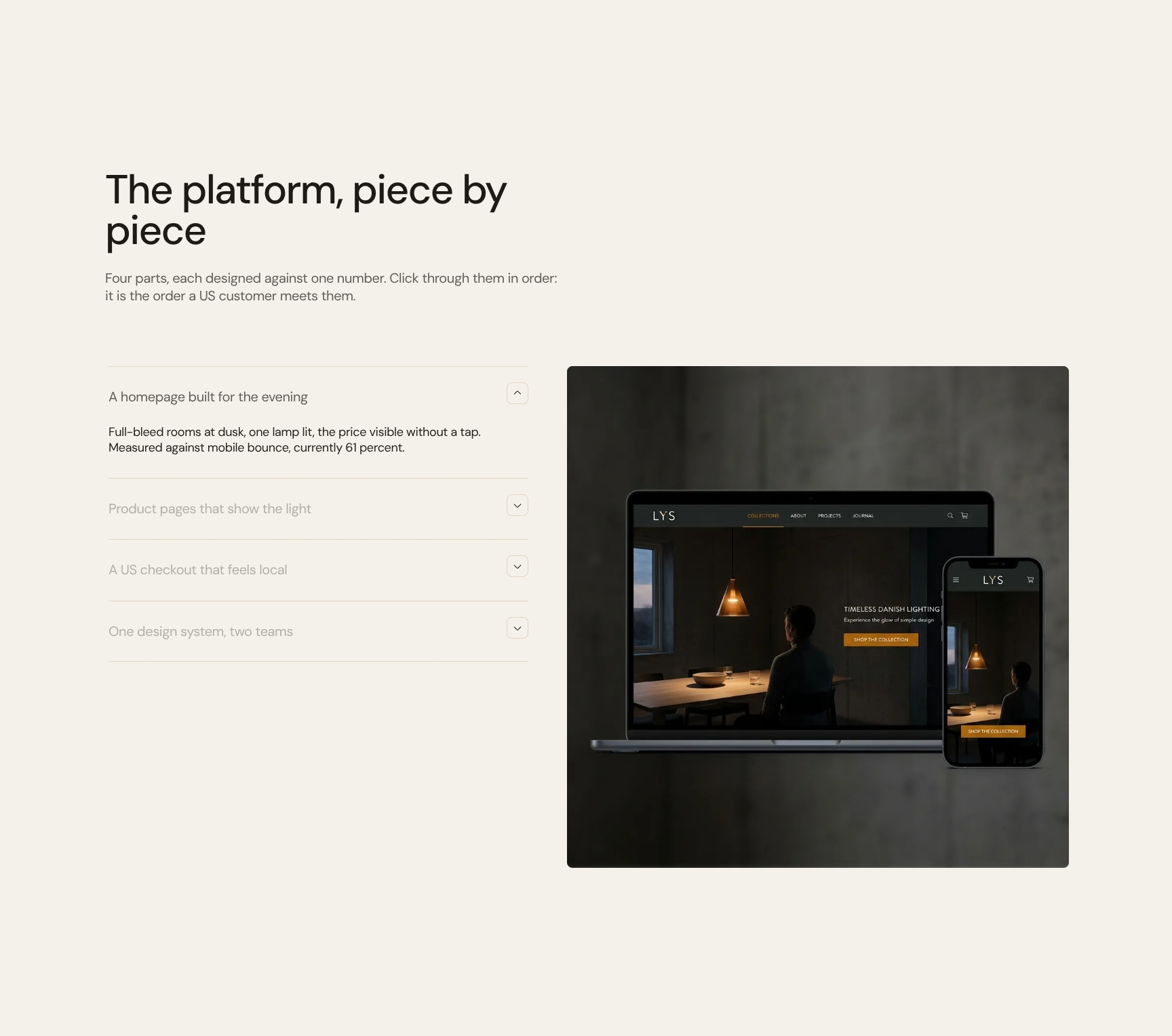
### Delivery Process: Five Phases and Two-Week Sprints
Explains the 22-week path from kick-off to launch plus 30 days of support. Working software is shown every second Friday, giving clients transparency, predictable rhythm and confidence in delivery.
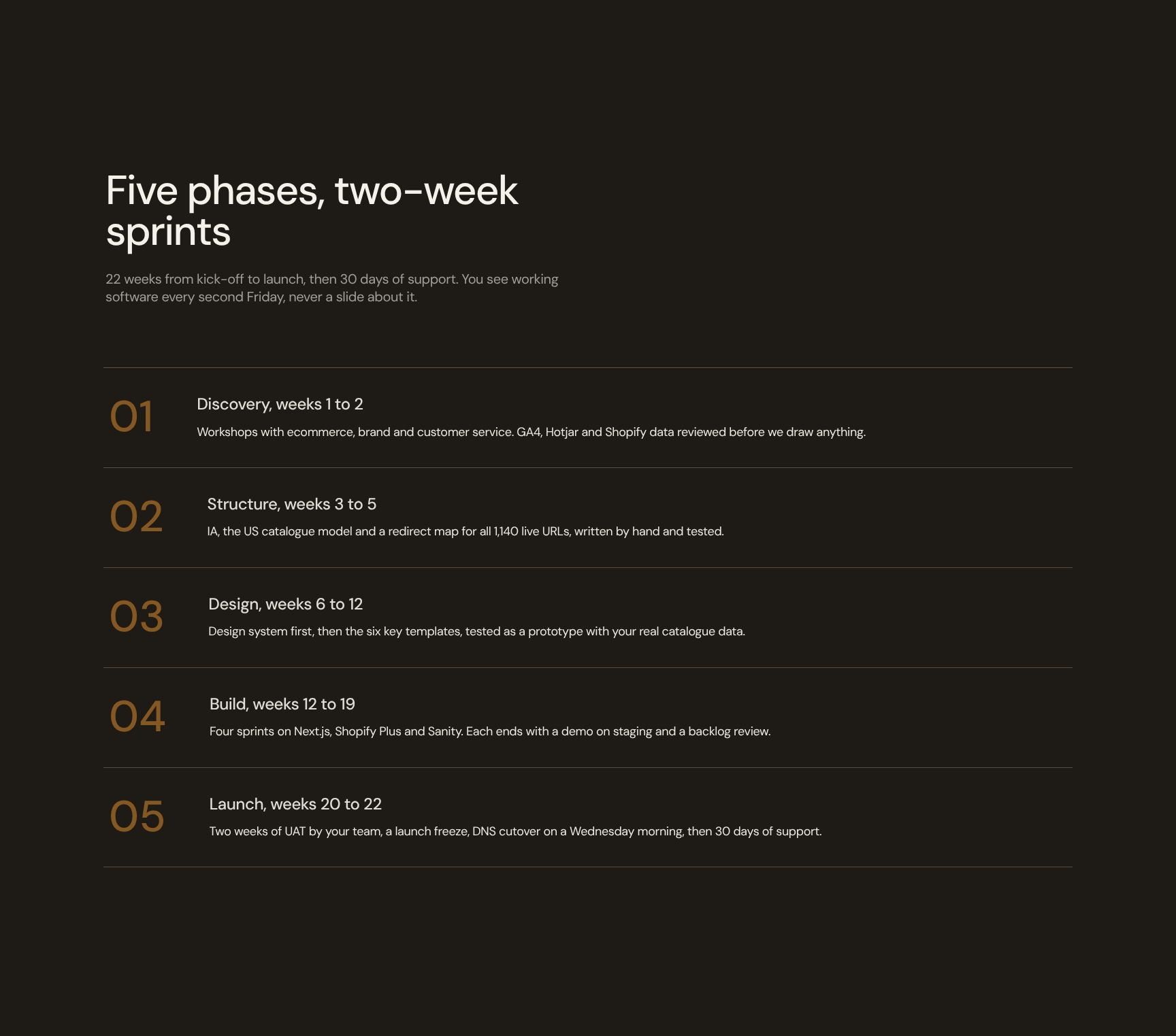
### Ecommerce Case Studies and Selected Work Portfolio
Showcases relevant projects, including a Shopify Plus headless store and a 3D configurator, with concrete results like a 19 percent mobile conversion lift. It builds credibility through proven, comparable outcomes.
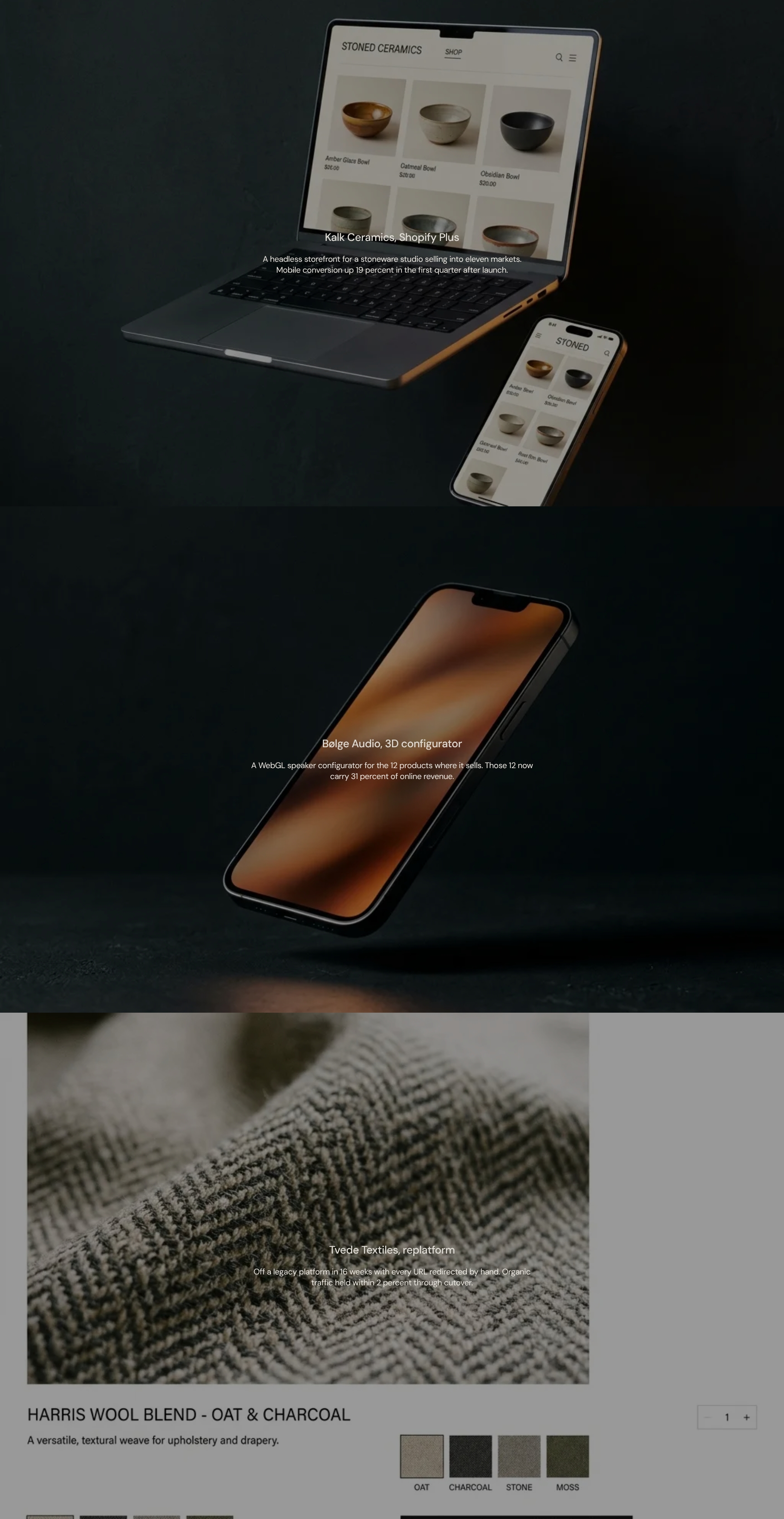
### Meet Your Dedicated Project Team
Introduces the three people who stay on the project from first workshop to last support ticket, along with the studio's background. It builds trust and shows continuity and accountability.
### Client Testimonials on Replatforming and SEO Success
Quotes from past clients praising work such as a hand-built 1,140-URL redirect map that protected organic traffic. It reduces migration fears with credible third-party proof.
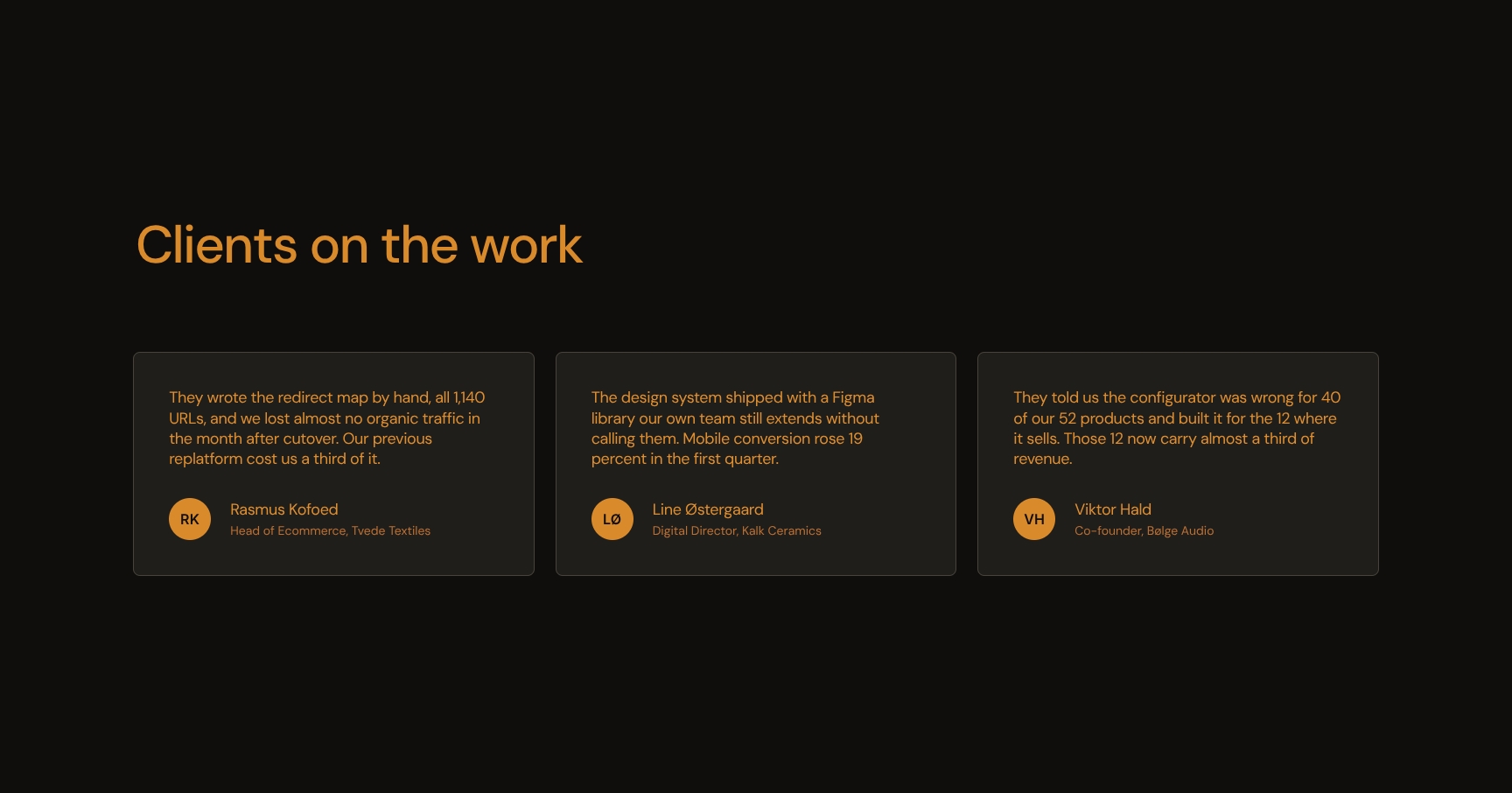
### Transparent Fixed-Fee Pricing and Day Rates
Fixed fees in DKK excluding moms, built from published day rates for designer, frontend developer and technical lead. Platform and licence costs are shown as pass-through, so there are no budget surprises.
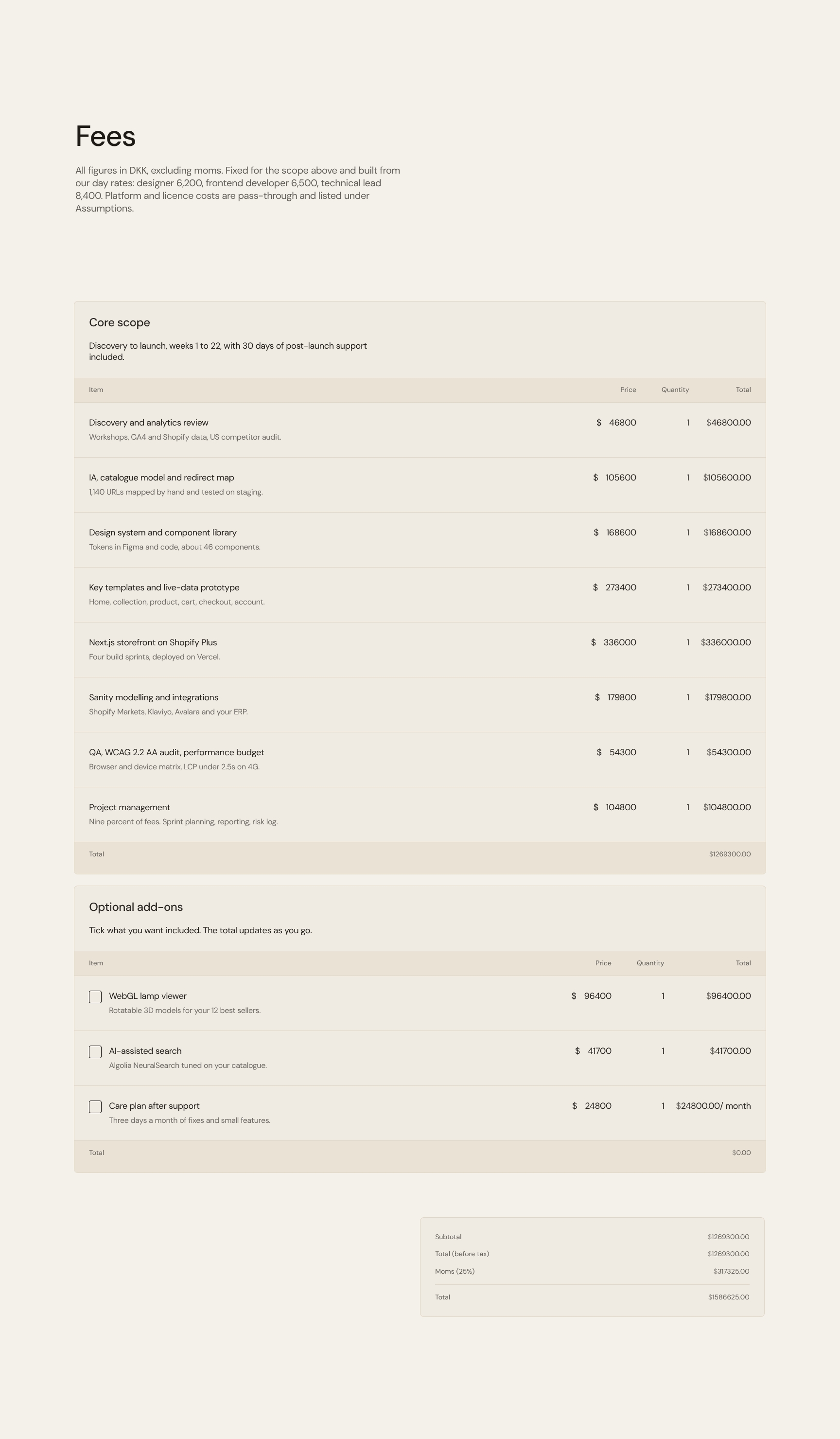
### Project Timeline and Launch Programme
A dated schedule from kick-off on 5 April to go-live on 1 September, five weeks before the store opens. It states the feedback turnaround assumption so the launch date is realistic and shared.
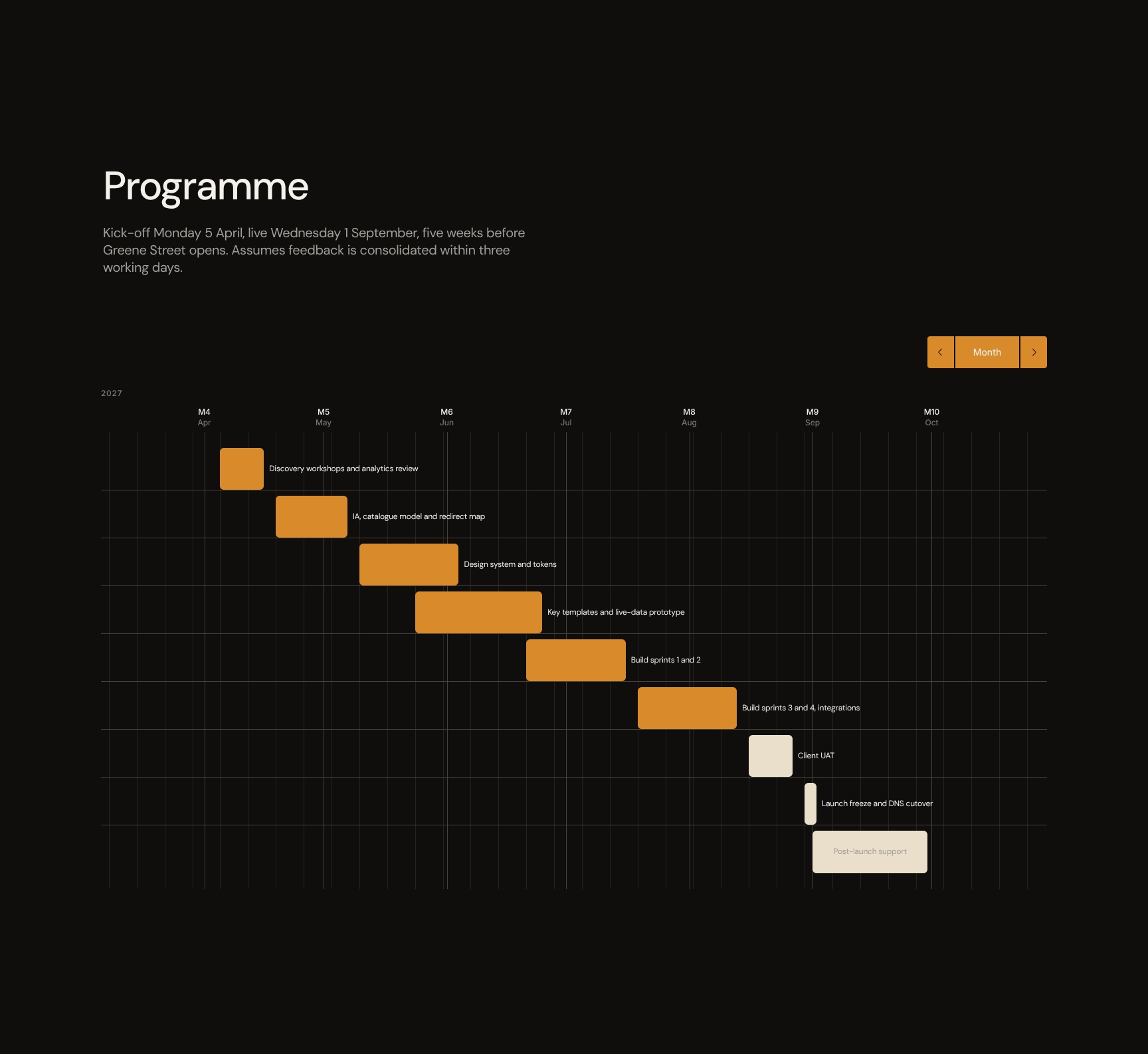
### Assumptions, Exclusions and Scope Clarifications
An expandable list covering the points every replatform disputes, such as content ownership, written down before signing. It prevents scope creep and protects both sides.
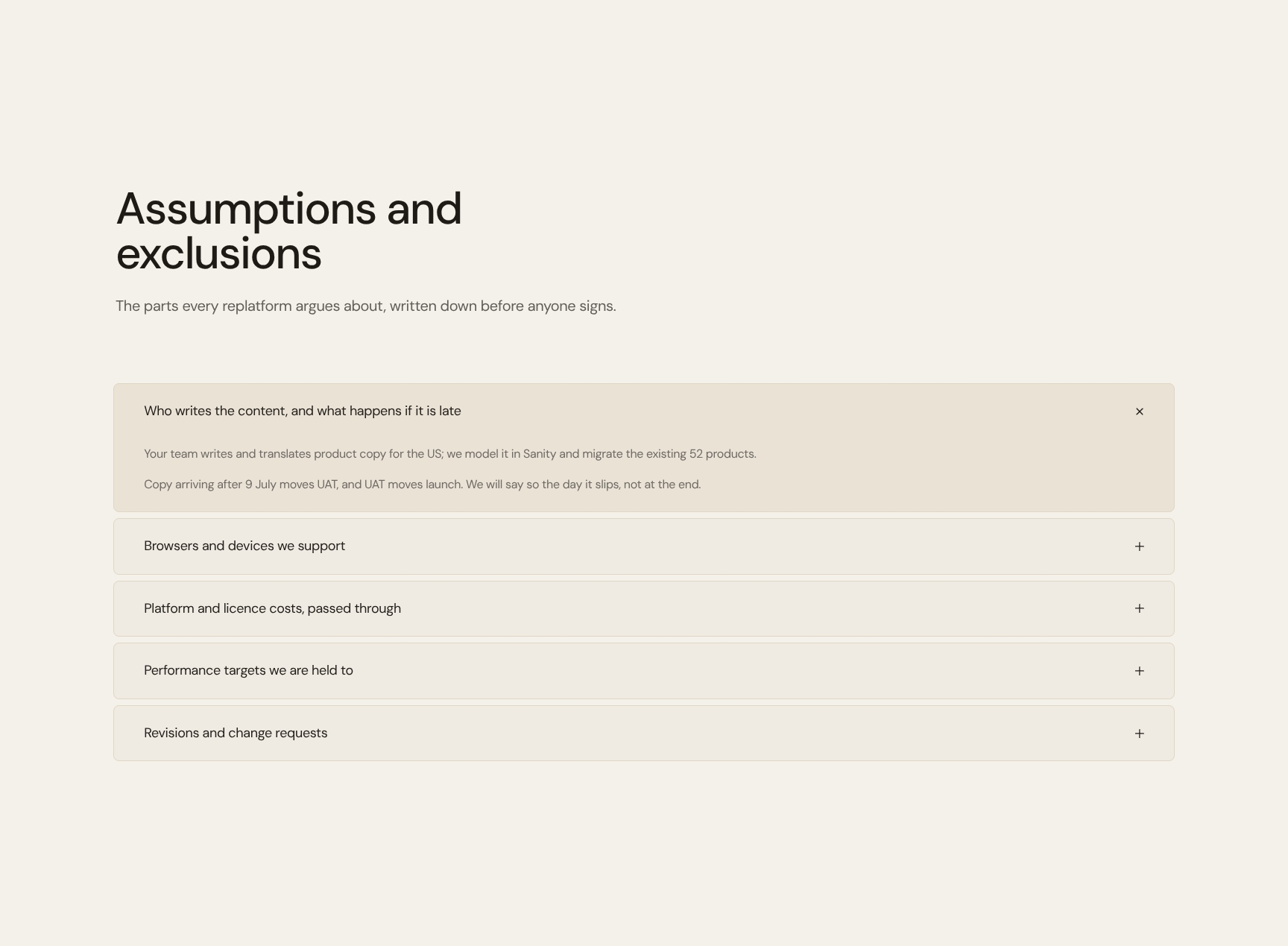
### Proposal Approval and Next Steps
A clear call to action with a validity date of 19 March 2027 and the reason for it, namely team availability for an April start. It creates healthy urgency and makes sign-off simple.
## Find your answers
Answers to common questions about writing headless Shopify Plus proposals for ecommerce redesign and replatforming clients.
### What should be included in a proposal template?
A strong proposal covers the client's challenge, your proposed solution, the approach, and proof of results. This template does that with six sections: Lysne (your intro), The brief, The idea, The platform, How we run it, and Selected work. Together they walk a client from understanding their needs to trusting your delivery.
### How do I customize this proposal template for my own business?
Start by replacing the Lysne section with your company name, story, and positioning. Then rewrite The brief to reflect your client's goals, adjust The idea and The platform to match your solution, and swap in your own projects under Selected work. Update fonts, colors, and logos so the proposal matches your brand.
### Can I export this proposal template to PDF or other formats?
Yes, you can export the finished proposal to PDF to send to clients and preserve layout and formatting. Depending on the tool you open it in, you can usually also export to formats like PowerPoint or Word, or share it as a link. Always check the exported file for spacing and image quality before sending.
### Is this proposal template suitable for agencies and creative services?
Yes, the structure suits agencies, studios, consultancies, and freelancers who pitch strategic or creative projects. The idea, platform, and process sections work well for branding, digital, marketing, and product work. Selected work lets you show relevant case studies for any industry.
### How long does it take to complete this proposal template?
Most people finish a tailored proposal in 1 to 3 hours if they already have case studies and company details ready. The brief and idea sections take the most time because they need client-specific input. Reusing your Lysne, How we run it, and Selected work content speeds up future proposals significantly.
## Related
- [Lyon](https://formlio.com/templates/lyon-hotel-website-proposal): Website proposal for multi-property hotel groups
- [Cardiff](https://formlio.com/templates/cardiff-website-care-plan-proposal): Monthly care plan proposal for festival organisers
- [Cambridge](https://formlio.com/templates/cambridge-design-studio-portfolio): Web design studio portfolio for research clients
- [Portland](https://formlio.com/templates/portland-app-redesign-proposal): App redesign pitch for subscription startups
- [Milan](https://formlio.com/templates/milan-headless-commerce-proposal): Headless ecommerce proposal for luxury brands
- [Bordeaux](https://formlio.com/templates/bordeaux-launch-event-pitch): Hybrid launch event pitch for brands
---
---
title: "Liverpool"
description: "Showcase launches, conferences and live events with this studio portfolio template. Features stats, case studies and a point of view for brand clients."
canonical: "https://formlio.com/templates/liverpool-live-events-portfolio"
locale: "en"
type: "template"
lastModified: "2026-10-21"
category: "Events & experiential"
alternates:
fr: "https://formlio.com/fr/templates/liverpool-portfolio-evenementiel-live.md"
---
# Liverpool
Live Events Studio Portfolio Template
Showcase launches, conferences and live events with this studio portfolio template. Features stats, case studies and a point of view for brand clients.
- [Use this template](https://formlio.com/workspaces/claim?template=liverpool-live-events-portfolio)
- [Live preview](https://formlio.com/documents/liverpool-live-events-portfolio)
- **Categories:** [Events & experiential](https://formlio.com/templates/events-experiential), [Portfolio](https://formlio.com/templates/portfolio)
- **Document goal:** Show brand clients your best launches and conferences with case studies, stats, and a clear point of view.
- **Blocks:** Image reveal, Scroll gradient, Grid 3x2 with icons, Split, Single column, Spotlight, Grid tile scroll
- **Palette:** Warm Linen Background (#F2F0EC), Soft Lavender Mist (#DCD6F5), Vivid Violet Accent (#5B3FD6), Midnight Indigo Depth (#231B45), Ink Black Typography (#0E0D12)
## Get more from every document
Show brand clients the launches and conferences you've built, with the proof to back each one up. Stats, a full case study, and a point of view sit alongside the imagery.
### Make your portfolio look like you
Swap colours, fonts, and layouts until your hero images and case studies match your own style, no design app open.
### Build case studies from saved blocks
Drop in a showcase, gallery, or breakdown section, then save your best versions and reuse them in every new portfolio.
### Your work looks sharp everywhere
Your hero images and galleries hold their shape on a client's phone, an art director's tablet, or a studio monitor.
### See which projects hold attention
Heatmaps show whether clients linger on your gallery or skip to testimonials, so you know when to follow up.
### Know when a client opens your work
Get a ping the moment a recruiter or client views your portfolio, comments on a project, or signs off.
### Polish the portfolio together, live
Your copywriter tightens the breakdown text while you reorder the gallery, both editing the same page at once.
## See how every part fits
The page opens with a full-bleed image and a clear positioning line, then moves through your work, your thinking and your process, and closes with a prompt to book the date. Keep, drop, or reorder any section to fit your studio.
### Live Event Studio Hero with Full-Bleed Imagery
An immersive opening for Halfmoon Live that sets out the studio's focus: launches, conferences and live events made in Liverpool's Baltic Triangle. Full-bleed visuals show the quality of the work and the 2027 portfolio framing.
### Animated Positioning Statement for Event Design
A bold animated text line, 'A launch is remembered for one minute', that states the studio's design philosophy. It sets a memorable tone and shows a clear creative stance within seconds.
### Studio in Numbers: Team, History and Founders
Key facts on the fourteen-person Jamaica Street studio and build shop, founded in 2016 by Niamh Doherty and Kwabena Mensah. Card-style stats build credibility and show clients who runs every show.
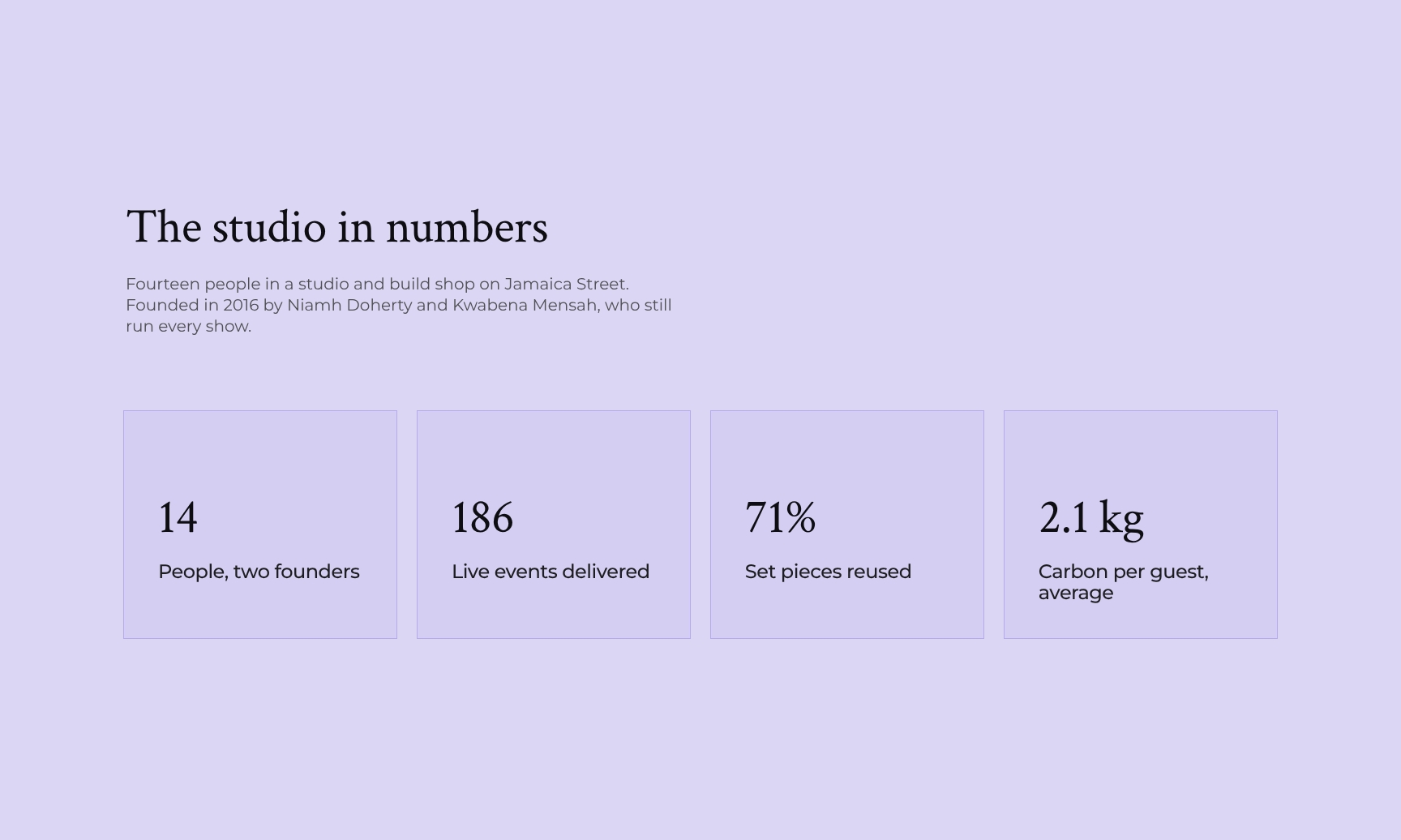
### Selected Work Showcase: Launches and Live Events
A curated project showcase including Seventh Wave for Sundew Swim and Signal Hall. Each project pairs a vivid event description with results, such as 600 guests and a first drop sold out in 41 minutes.
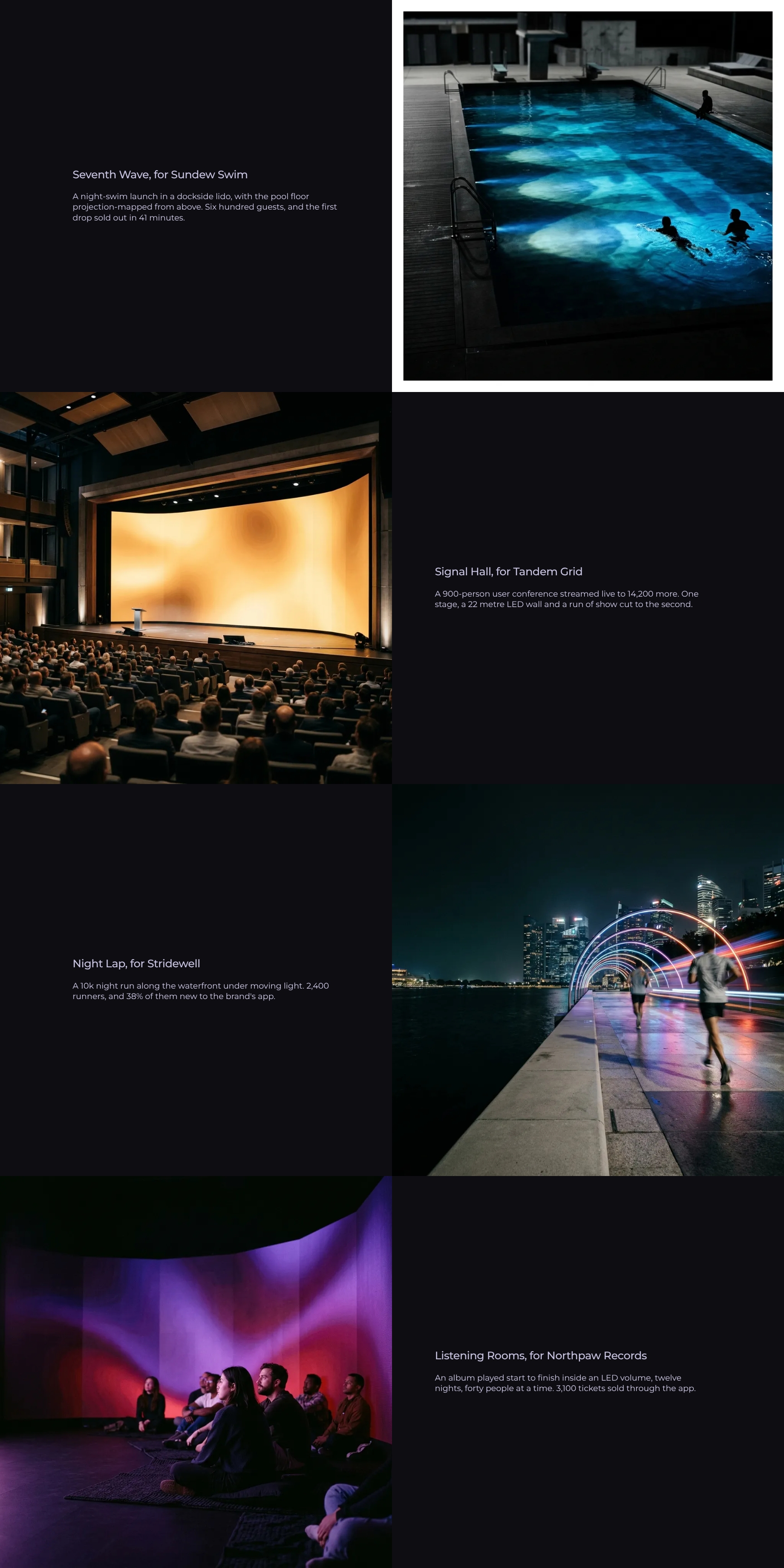
### Point of View: The Room Is the Medium
A thought-leadership section arguing that launches should be designed room-first, backed by data from the studio's last forty shows. It positions the studio as expert and gives prospects a reason to choose it.
### Signal Hall Case Study: Step-by-Step Breakdown
A detailed walkthrough of Tandem Grid's first user conference: 900 in the room and 14,200 online in one day. It shows how a show moves from studio to stage, proving process, scale and hybrid delivery.
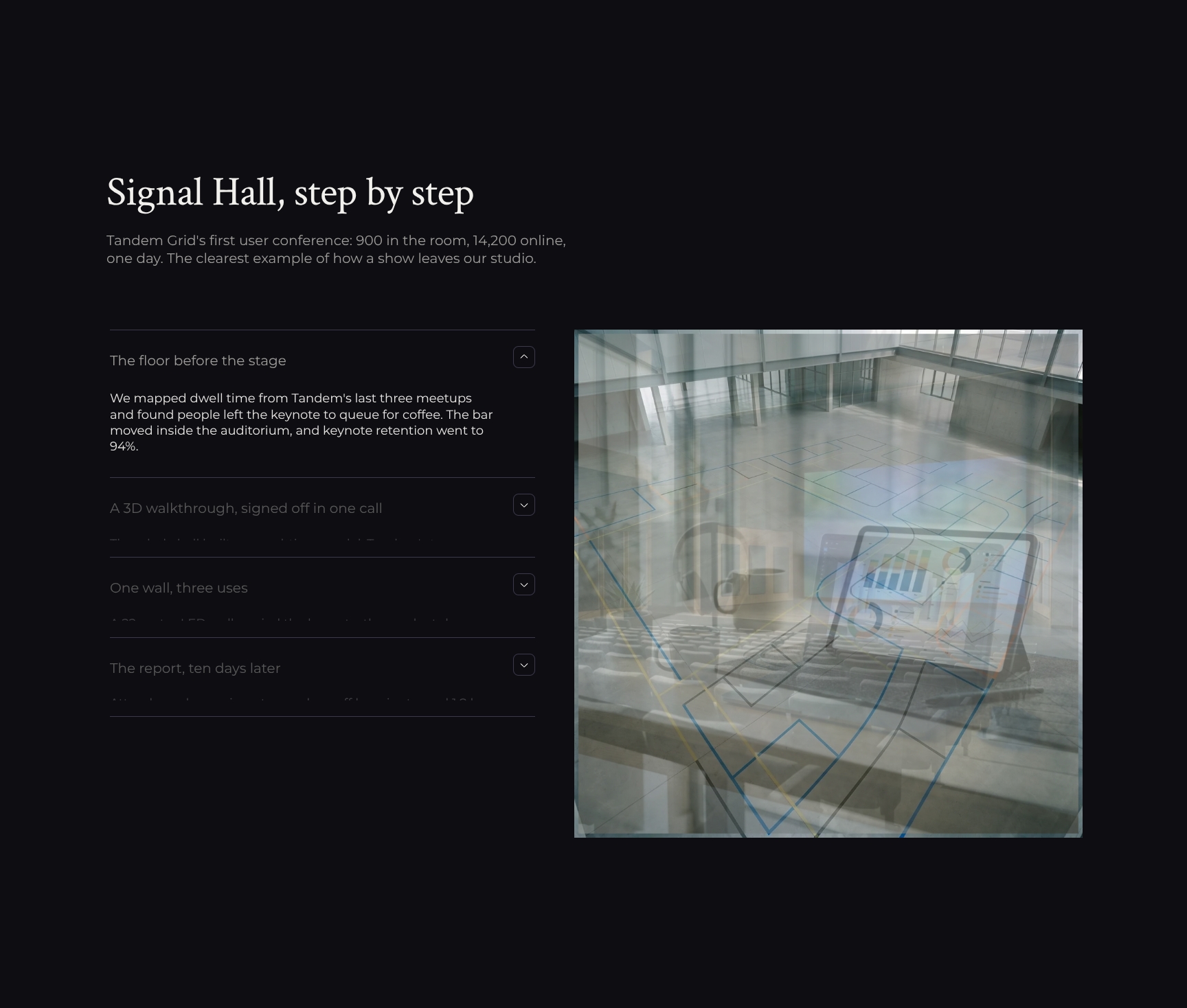
### Behind-the-Scenes Build Gallery
A visual gallery of the build hour before doors open, 'The hour before the room fills is ours.' It shows craft, fabrication and production readiness that polished final photos often hide.
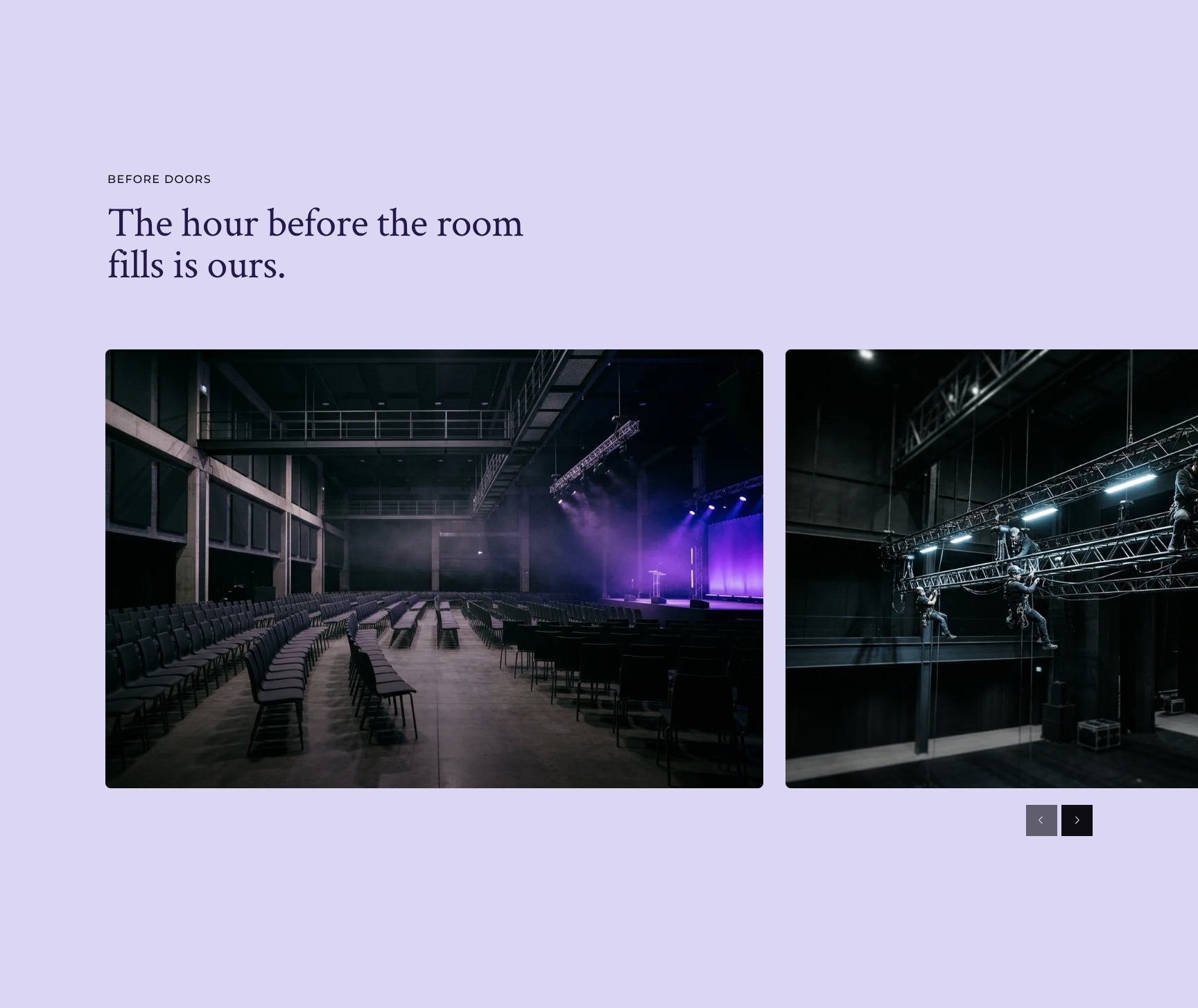
### Five-Stage Event Production Process
A clear, step-by-step view of how a show is made, with the same five stages for a forty-person dinner or a nine-hundred-person conference. It reassures clients with a repeatable process that scales.
### Client Testimonials from Launch and Conference Partners
Quotes from clients such as Ruth Okonedo-Blake, VP Marketing at Tandem Grid, on live problem-solving and calm delivery under pressure. They provide social proof that builds trust before booking.
### Contact Call to Action: Bring Us the Date
A direct enquiry section inviting visitors to share their date and the one thing guests should remember. It promises a reply within two working days with a floorplan and honest budget view, plus a direct email.
## Find your answers
Answers to common questions about building a live events studio portfolio for launches, conferences and brand clients.
### What should be included in a portfolio website template?
A strong portfolio should include a clear positioning statement, a studio or about section, selected work, a point of view, and in-depth case studies. This template covers each of these with dedicated sections: Halfmoon Live, Position, The studio, Selected work, Point of view, and Case study. Together they show who you are, what you do, and how you think.
### How do I customize this portfolio template for my own brand?
Replace the placeholder text in the Position and The studio sections with your own messaging, then swap the Selected work entries for your projects. Update the fonts, colors, and imagery to match your brand identity. You can duplicate or remove sections like Case study and Point of view to fit your content.
### How do I write a case study for my portfolio?
Use the Case study section to walk through the project in a clear sequence: the client challenge, your approach, the solution, and the measurable results. Add visuals such as screenshots, process shots, or final deliverables to support each step. Keep it focused on the outcome and your specific role.
### Is this portfolio template suitable for design studios and creative agencies?
Yes. The Halfmoon Live hero, The studio section, and Selected work grid are built for studios, agencies, and independent creatives. It also works well for designers, developers, photographers, and consultants who want to highlight their work and perspective. The Point of view section helps you stand out by showing your thinking, not just your output.
### Can I export or publish this portfolio template to a live website?
Yes, you can publish it as a live website or share it as a link with clients and employers. You can typically also export it to PDF for sending as a downloadable presentation. Check your editing tool's export options to confirm the supported formats and hosting settings.
## Related
- [Bordeaux](https://formlio.com/templates/bordeaux-launch-event-pitch): Hybrid launch event pitch for brands
- [Boston](https://formlio.com/templates/boston-event-retainer-proposal): Monthly event retainer proposal for brands
- [Cardiff](https://formlio.com/templates/cardiff-website-care-plan-proposal): Monthly care plan proposal for festival organisers
- [Berlin](https://formlio.com/templates/berlin-product-launch-event-proposal): Multi-city launch event proposal for hardware brands
- [Edinburgh](https://formlio.com/templates/edinburgh-temporary-venue-build-estimate): Temporary venue build estimate for festivals
- [Cambridge](https://formlio.com/templates/cambridge-design-studio-portfolio): Web design studio portfolio for research clients
---
---
title: "Berlin"
description: "Pitch a multi-city product launch event with this proposal template: brief, concept, listening room design and launch numbers for consumer audio brands."
canonical: "https://formlio.com/templates/berlin-product-launch-event-proposal"
locale: "en"
type: "template"
lastModified: "2026-10-21"
category: "Events & experiential"
alternates:
fr: "https://formlio.com/fr/templates/berlin-proposition-devenement-de-lancement-produit.md"
---
# Berlin
Product Launch Event Proposal Template
Pitch a multi-city product launch event with this proposal template. Cover the brief, concept, room flow and logistics for press, buyers and creators.
- [Use this template](https://formlio.com/workspaces/claim?template=berlin-product-launch-event-proposal)
- [Live preview](https://formlio.com/documents/berlin-product-launch-event-proposal)
- **Categories:** [Events & experiential](https://formlio.com/templates/events-experiential), [Proposals](https://formlio.com/templates/proposals)
- **Document goal:** Pitch a multi-city launch event to audio brands with a clear brief, concept, listening room design, and numbers.
- **Blocks:** Perspective grid, Single column, Rectangle reveal, Grid 3x2 with icons, Fullscreen, Spotlight, Itemized quote, Gantt, Left-aligned, E-signature
- **Palette:** Warm Linen Background (#F1F0EC), Soft Periwinkle Tint (#D3D8FF), Electric Indigo Accent (#3B4BFF), Midnight Indigo Depth (#151A4A), Ink Black Foundation (#0A0B0F)
## Get more from every document
Pitch a multi-city launch event to a hardware brand and win the room before the first listening session. Built-in key figures, a room-by-room walkthrough, a EUR budget, and a sign-off page keep the pitch concrete.
### Get the yes without leaving
Your client reads the pricing, accepts the terms, and signs in the same scroll. No PDF to download, print, or lose.
### Build proposals from proven sections
Drop in pricing tables, process steps, and testimonials, then save your best versions to reuse on the next pitch.
### Your pitch looks right everywhere
Your hero images, pricing, and showcase hold their shape when a client opens the proposal on a phone between meetings.
### See which section wins them over
Heatmaps show if they lingered on pricing, and replays let you watch them read, so your follow-up lands at the right moment.
### Know the moment they open it
A ping tells you when the client views, comments on, or signs your proposal, so you can reply while it's fresh.
### Write the proposal together, live
Your designer tweaks the showcase while you fix the pricing breakdown, both of you in the same document at once.
## See how every part fits
The proposal opens with the client's brief and your big idea, walks through the guest experience, then closes on budget, schedule, terms, and a signature. Keep what fits, drop what doesn't, and reorder anything to suit your pitch.
### Multi-City Product Launch Cover Page
A bold cover naming the event, client, three host cities (Berlin, Paris, Milan), dates and author. It sets the scene and gives the client instant clarity on what the proposal covers.
### Client Brief Summary: Three Nights, Three Cities
Restates the client's requirements: 240 guests a night and an audio-first reveal of the NF-1. Proves you listened and anchors the whole proposal in the client's goals.
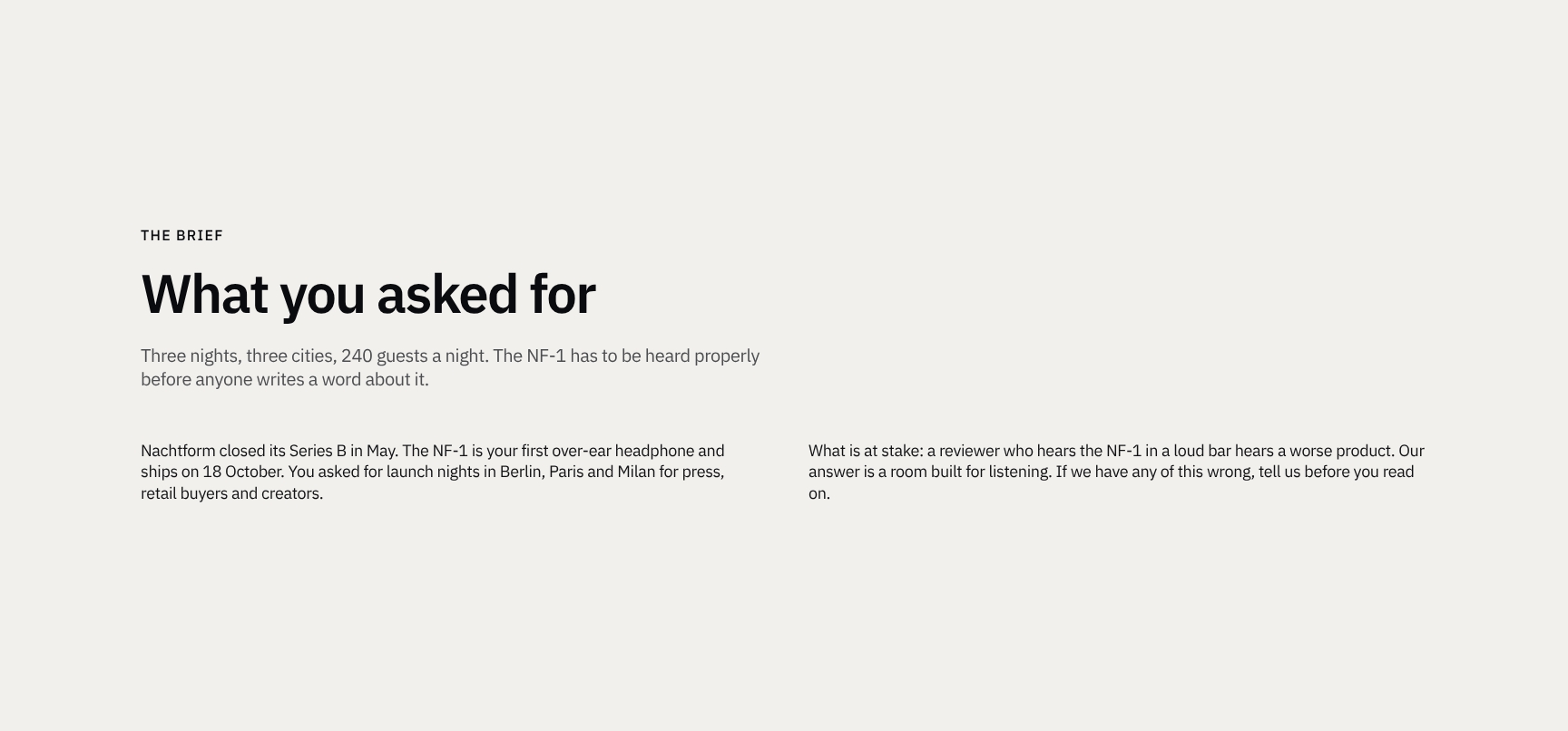
### Creative Launch Idea: Hear It Before You See It
A single, memorable creative hook that frames the event experience. It gives decision-makers a clear idea to rally behind before any detail on rooms, logistics or cost.

### Launch Key Figures and Touring Kit Highlights
Headline numbers presented as cards, including the two-kit leapfrog model that avoids building anything twice. Shows efficiency, scale and sustainability at a glance.
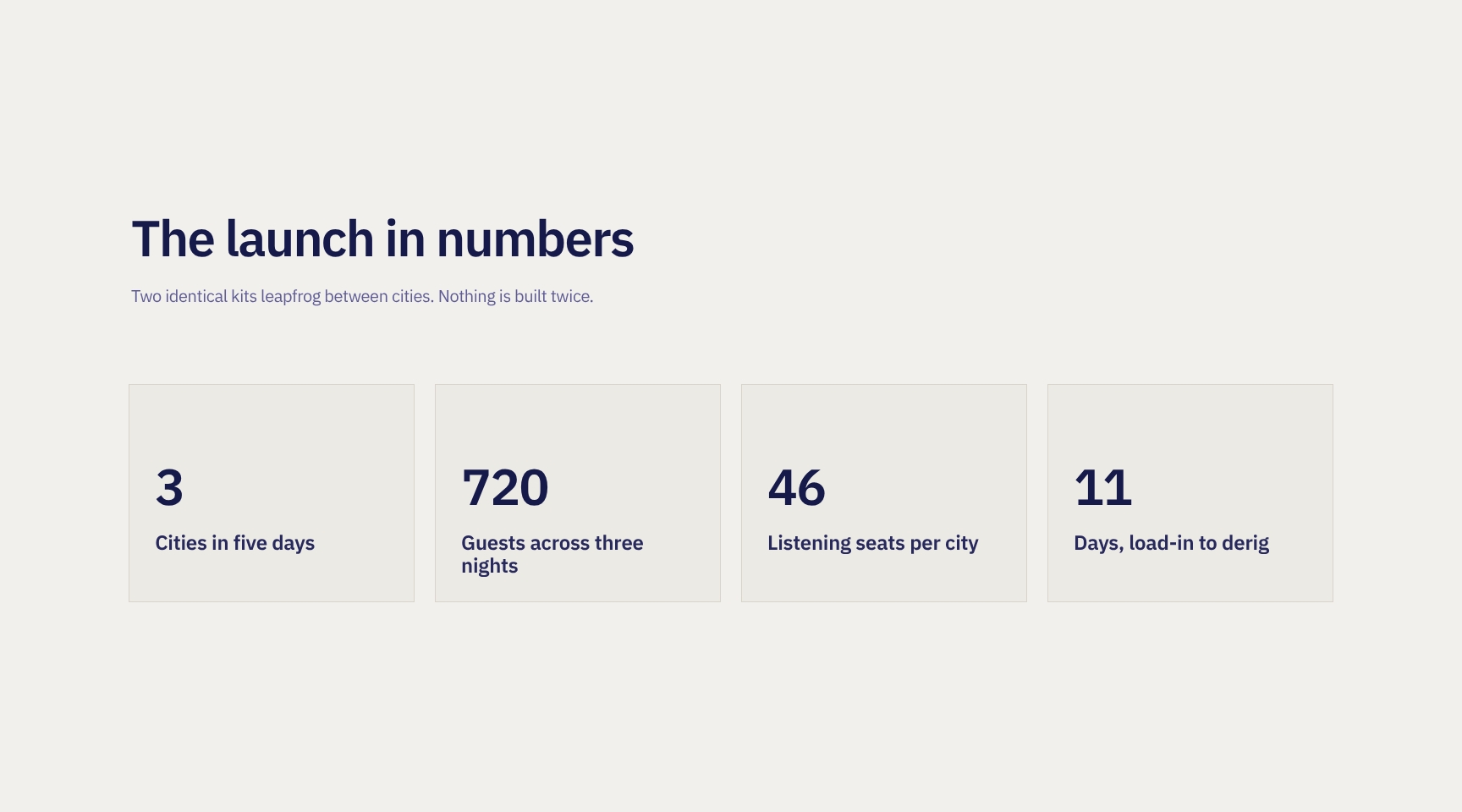
### Event Concept Walkthrough: Room-by-Room Guest Experience
A visual showcase of the guest journey, from the 22 metre felt corridor and sealed phone pouches to the listening room. Helps clients picture the experience and approve the concept with confidence.
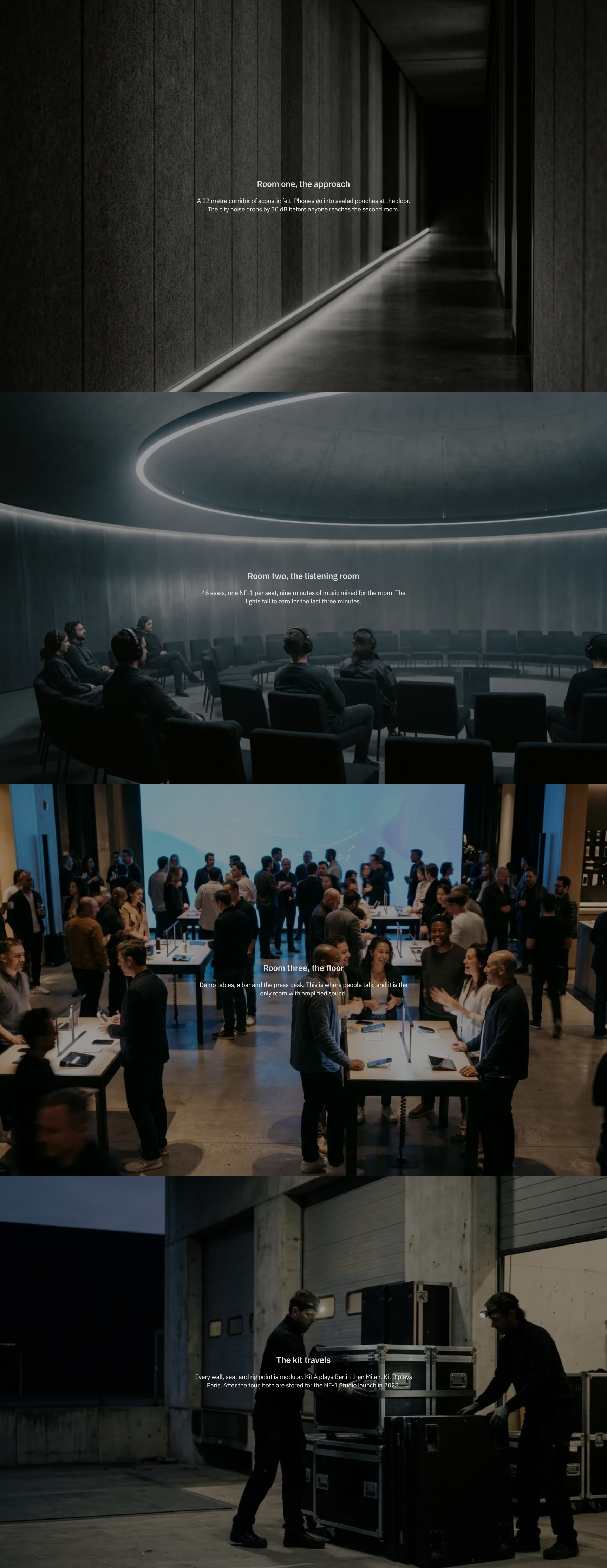
### Six-Stage Delivery Approach with Client Sign-Off Points
A step-by-step process from concept to launch night, each stage ending in a written client decision. Reduces risk, clarifies deliverables like the 3D walkthrough and keeps approvals on track.
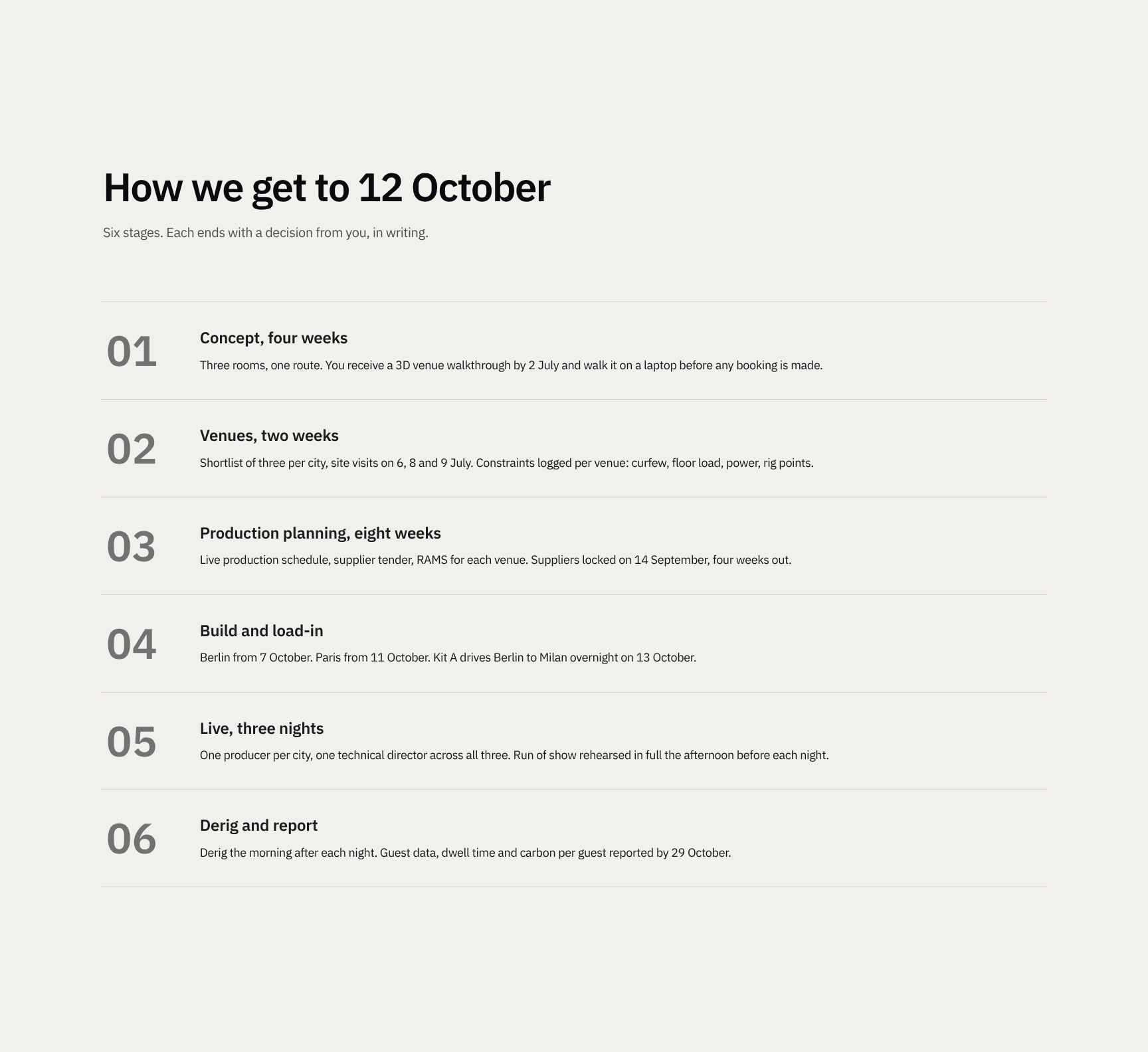
### Team Credentials and Past Launch Experience
Introduces Spannweite Live's Berlin-based team, with named leads for production, technical direction and Paris. Builds trust by showing who delivers the launch and their track record.
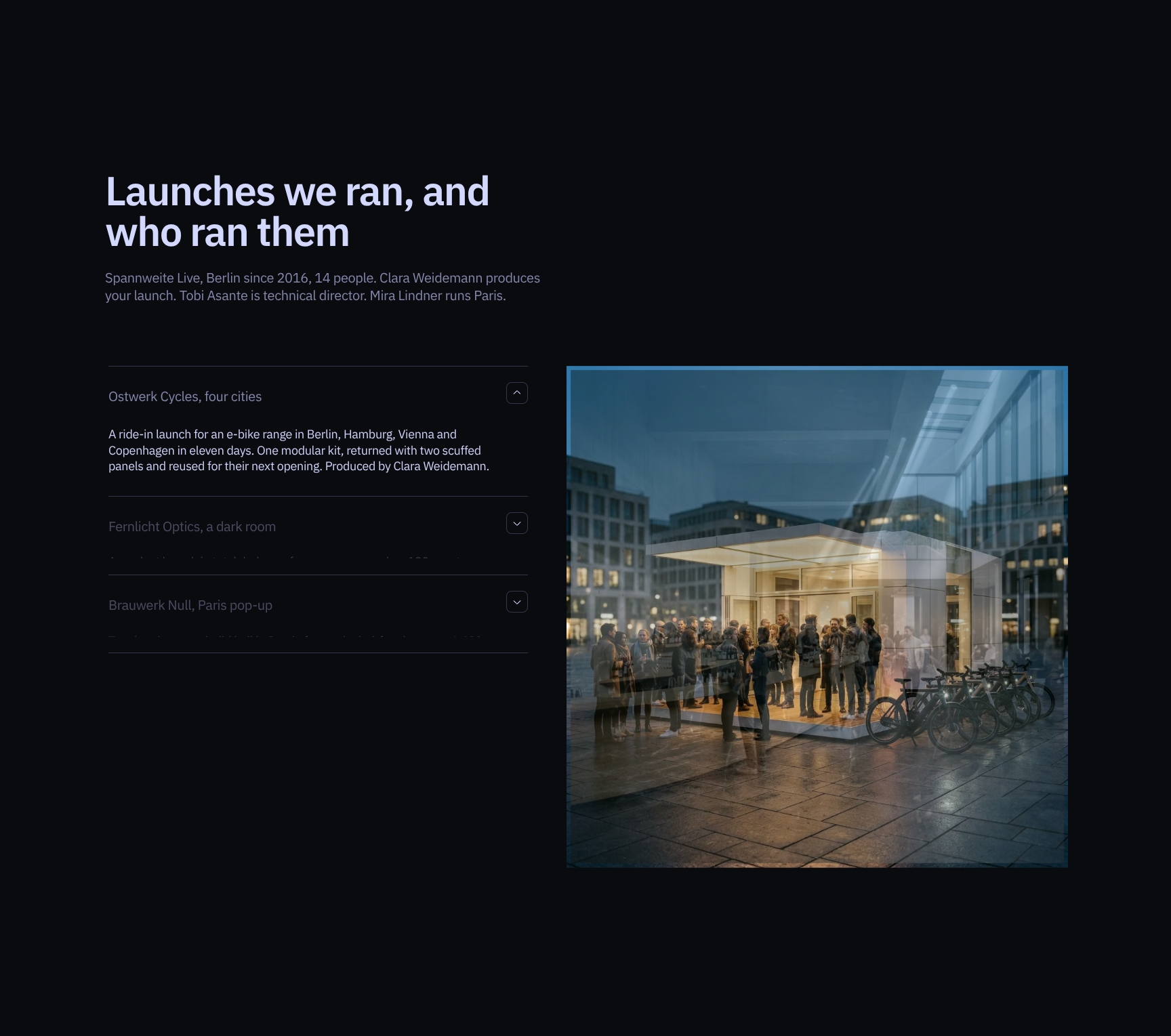
### Client Testimonials and Proof of Delivery
Quotes from past clients on touring reliability and reusable structures. Social proof that backs up the multi-city claims and reassures buyers weighing the proposal.
### Transparent Fee and Production Budget in EUR
A clear cost breakdown based on 240 guests a night, net of 19% MwSt, with exclusions noted and a staged payment plan (50/30/20). Makes budgeting and approval simple.
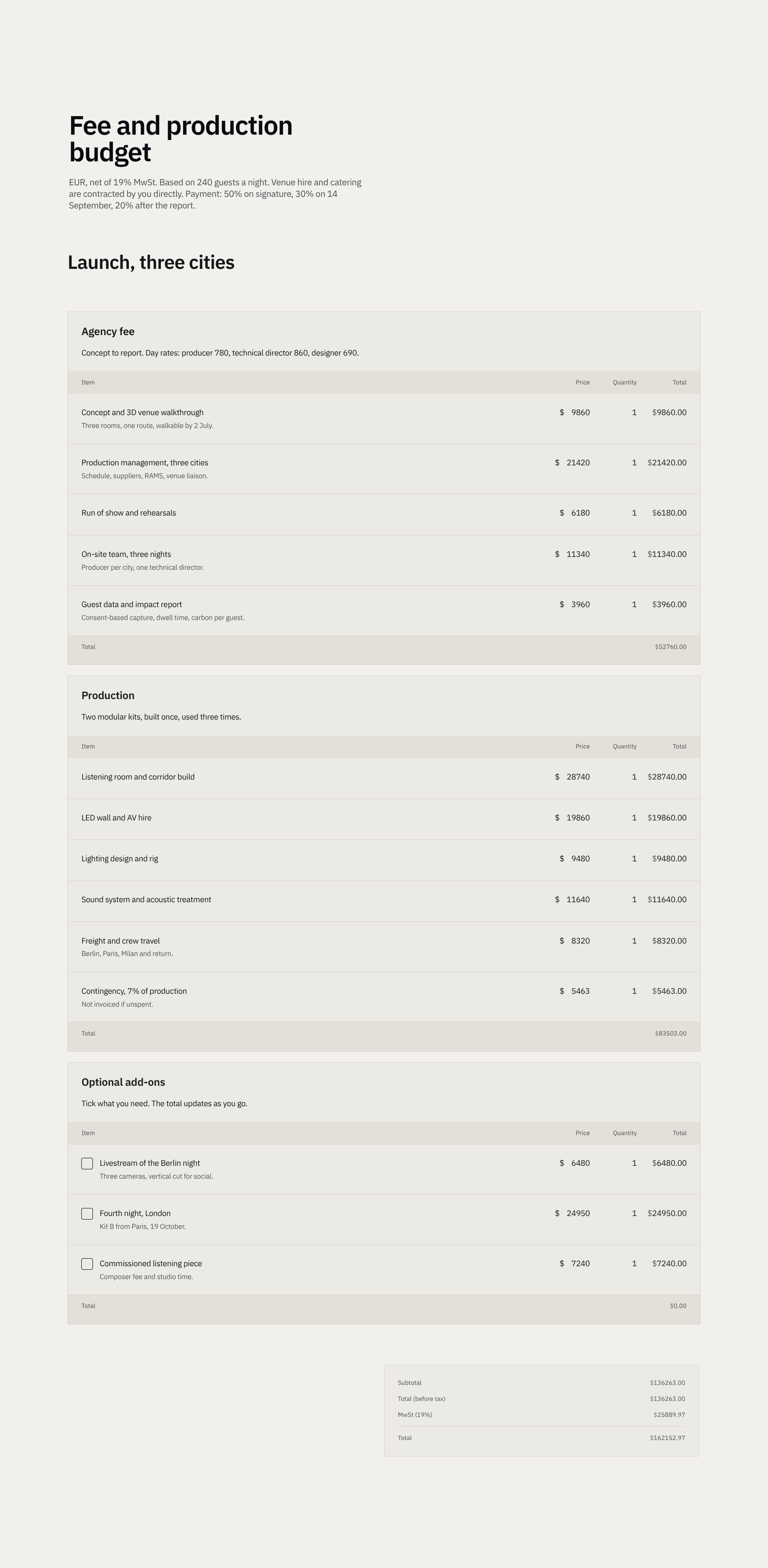
### Countdown Production Schedule to Launch Day
A timeline counted back from 12 October, with assumptions on feedback turnaround and the 28 September guest-number deadline. Keeps both sides accountable for milestones.
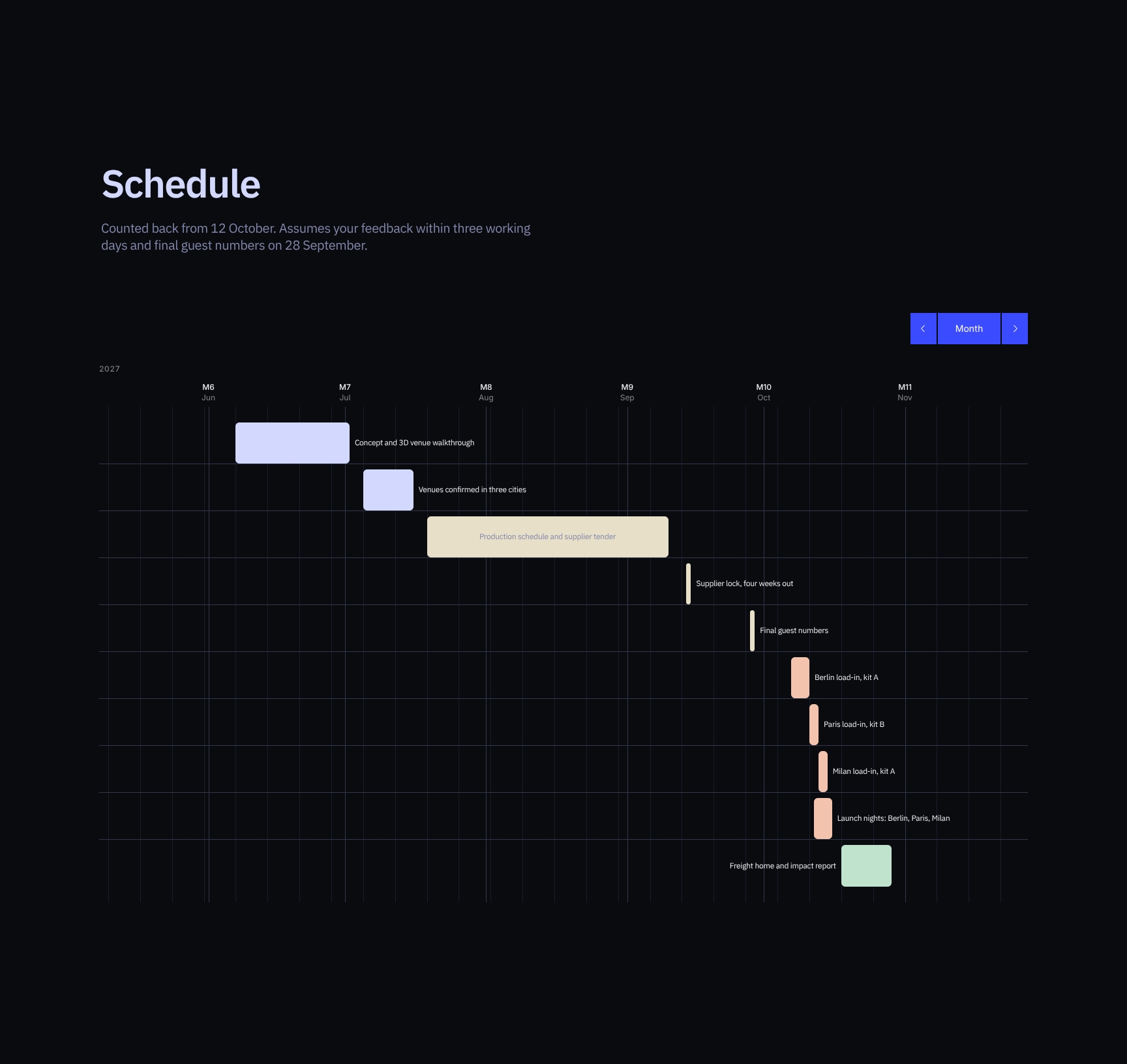
### Terms, Exclusions and Planning Assumptions
Expandable accordion covering what the budget excludes, such as venue hire, catering and talent, plus key assumptions. Prevents surprises and keeps launch week uneventful.
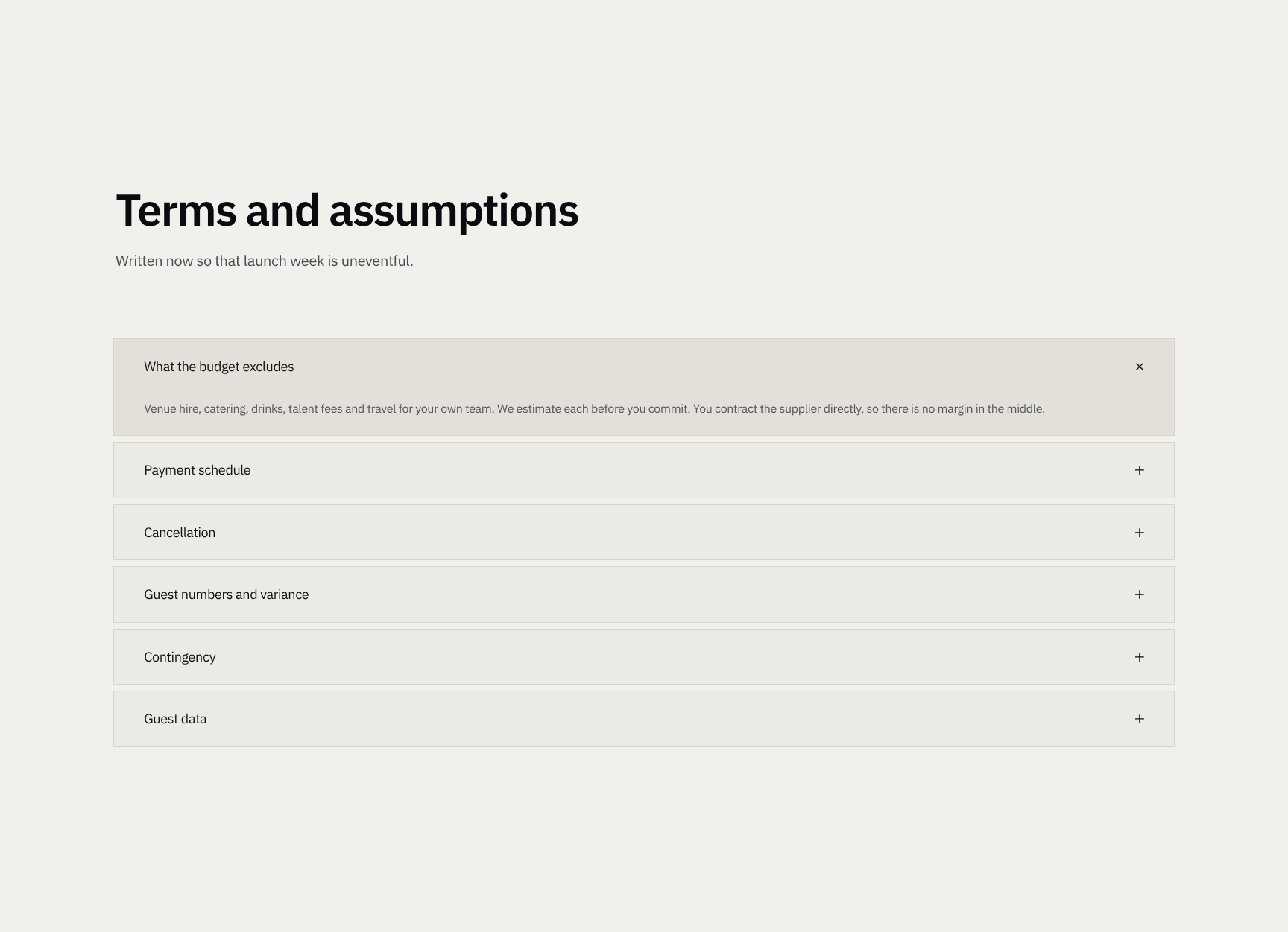
### Proposal Acceptance and Next Step Sign-Off
A clear call to action with the validity date of 31 May 2027 and the Paris venue-hold deadline. Creates urgency and lets clients sign digitally to lock in the plan.
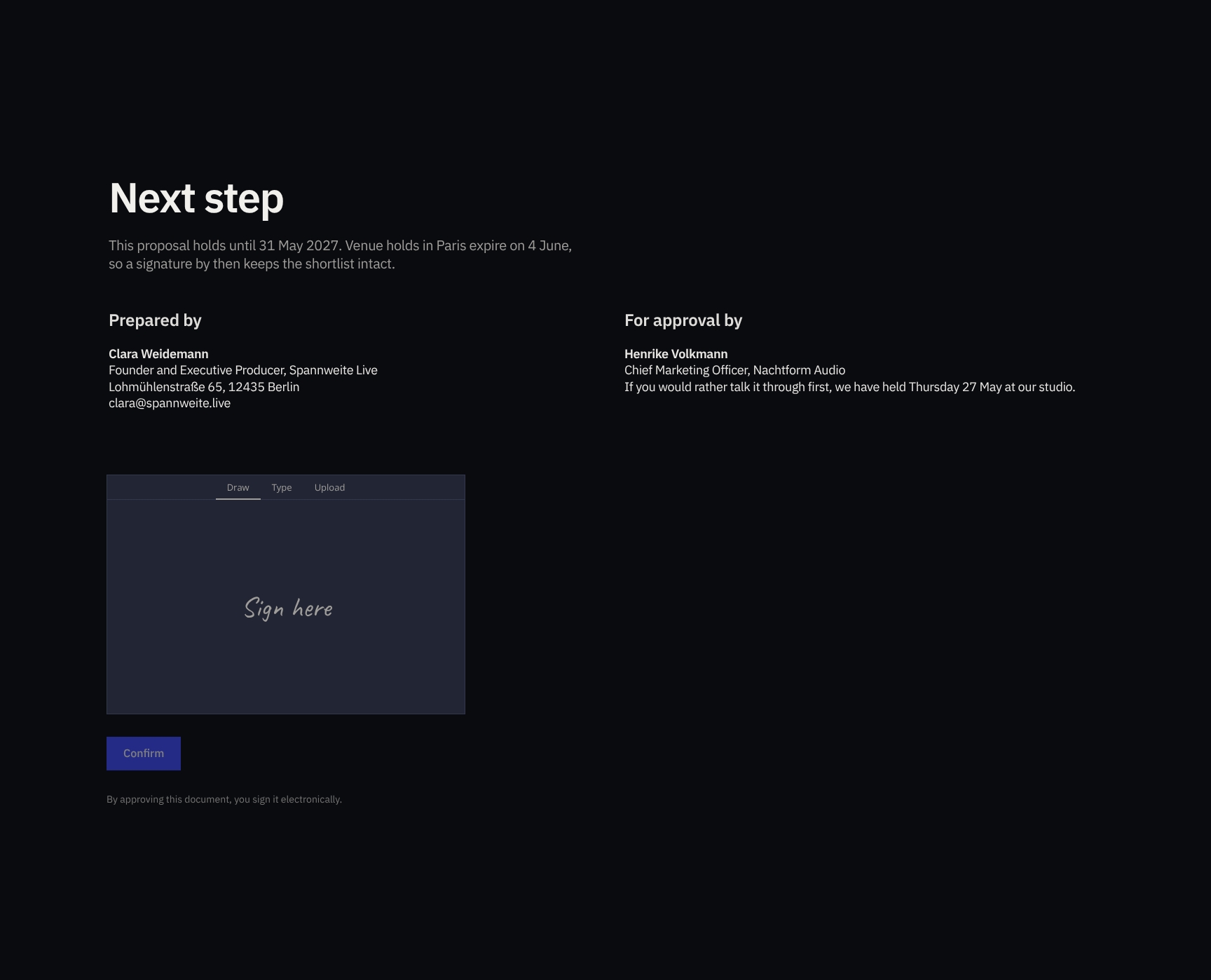
## Find your answers
Answers to common questions about writing and sending a multi-city launch event proposal to consumer audio and hardware clients.
### What should be included in a proposal template?
A strong proposal should include a cover, the client's brief, your core idea, supporting numbers, a detailed concept, and your approach. This template covers all six sections in a logical flow, moving from understanding the problem to showing how you will deliver. Together they help you win buy-in and make your value clear.
### How do I customize this proposal template for my client?
Start by replacing the cover with your client's name, project title, and branding. Then rewrite 'The brief' in your own words to show you understand their goals, and update 'The idea' and 'The concept' with your solution. Finish by adjusting 'In numbers' and 'Approach' to reflect your real figures, timeline, and process.
### What should I write in the 'In numbers' section of a proposal?
Use this section to present the figures that support your idea, such as budget, projected results, timelines, market data, or past performance. Keep it scannable with a few key metrics, charts, or short tables rather than dense paragraphs. Tie each number back to the client's goals so it proves the value of your proposal.
### Can I export this proposal template to PDF or other formats?
Yes, you can export the finished proposal to PDF for easy sharing and to preserve your layout and fonts. Most editors also let you download it as PowerPoint or share it as a link so clients can view it online. Use PDF for final submission and an editable format when you expect feedback or revisions.
### Is this proposal template suitable for creative agencies, consultants, and freelancers?
Yes, the structure of brief, idea, concept, and approach works well for creative agencies, consultants, freelancers, and marketing teams. It suits branding, campaigns, web design, and service-based projects. You can adapt the tone, visuals, and level of detail to match your industry and the size of the project.
## Related
- [Bordeaux](https://formlio.com/templates/bordeaux-launch-event-pitch): Hybrid launch event pitch for brands
- [Boston](https://formlio.com/templates/boston-event-retainer-proposal): Monthly event retainer proposal for brands
- [Cardiff](https://formlio.com/templates/cardiff-website-care-plan-proposal): Monthly care plan proposal for festival organisers
- [Liverpool](https://formlio.com/templates/liverpool-live-events-portfolio): Event studio portfolio for launches and conferences
- [Edinburgh](https://formlio.com/templates/edinburgh-temporary-venue-build-estimate): Temporary venue build estimate for festivals
- [Lyon](https://formlio.com/templates/lyon-hotel-website-proposal): Website proposal for multi-property hotel groups
---
---
title: "Milan"
description: "Win luxury ecommerce projects with a headless commerce proposal template featuring 3D product viewer, returns data and multi-market checkout for fashion brands."
canonical: "https://formlio.com/templates/milan-headless-commerce-proposal"
locale: "en"
type: "template"
lastModified: "2026-10-21"
category: "Digital & web design"
alternates:
fr: "https://formlio.com/fr/templates/milan-proposition-commerce-headless.md"
---
# Milan
Headless Commerce & 3D Product Proposal Template
Win luxury ecommerce projects with a headless commerce and 3D product viewer proposal template. Cut returns, show data and pitch multi-market storefronts.
- [Use this template](https://formlio.com/workspaces/claim?template=milan-headless-commerce-proposal)
- [Live preview](https://formlio.com/documents/milan-headless-commerce-proposal)
- **Categories:** [Digital & web design](https://formlio.com/templates/digital-web-design), [Creative & design](https://formlio.com/templates/creative-design), [Proposals](https://formlio.com/templates/proposals)
- **Document goal:** Win luxury ecommerce projects with a proposal that showcases 3D product viewing, returns data, and multi-market checkout.
- **Blocks:** Ring, Single column, Rectangle reveal, Grid 3x2 with icons, Split, Spotlight, Itemized quote, Gantt, Left-aligned, E-signature
- **Palette:** Warm Parchment Light (#F3EFE8), Soft Blush Accent (#F4C7B8), Bold Vermilion Accent (#C93A1C), Deep Ember Brown (#5A1A0E), Espresso Dark Text (#120E0C)
## Get more from every document
Win luxury ecommerce projects with a proposal that shows the storefront before a line of code exists. Inside you get a 3D product viewer, returns data cards, and pricing that recalculates as clients choose.
### Get the yes without leaving
Your client approves the scope and signs the agreement on the same page where they read your pricing.
### Build proposals from sections you trust
Drop in pricing, steps, and testimonials, then save your best-performing breakdown to reuse on the next pitch.
### Your pitch reads right on phones
Hero images, pricing tables, and step timelines reflow cleanly when a client opens your proposal between meetings.
### See which section sells the job
Heatmaps show if they lingered on pricing or skipped the showcase, so your follow-up lands at the right moment.
### Know the moment they open it
Get a ping when a client views your proposal, comments on a price, or signs the agreement.
### Write the proposal together, live
Your designer tweaks the showcase while you rework the pricing, with no version mix-ups before it goes out.
## See how every part fits
The proposal opens with a full-bleed product image, builds through brief, concept, data, and delivery plan, and closes on approval and a booked April start. Keep, drop, or reorder any section to fit your pitch.
### Immersive Hero Cover with Full-Bleed Product Imagery
A striking cover that opens the proposal with campaign-grade imagery and a confident headline. It sets the premium tone for a luxury ecommerce redesign and makes a memorable first impression on the client.

### Project Brief: Client Goals, Stakes and Reframed Objective
Restates the request (new site before the September New York and Seoul launch) and reframes the real goal as fewer returns. Shows the client you listened and understand what is truly at stake.
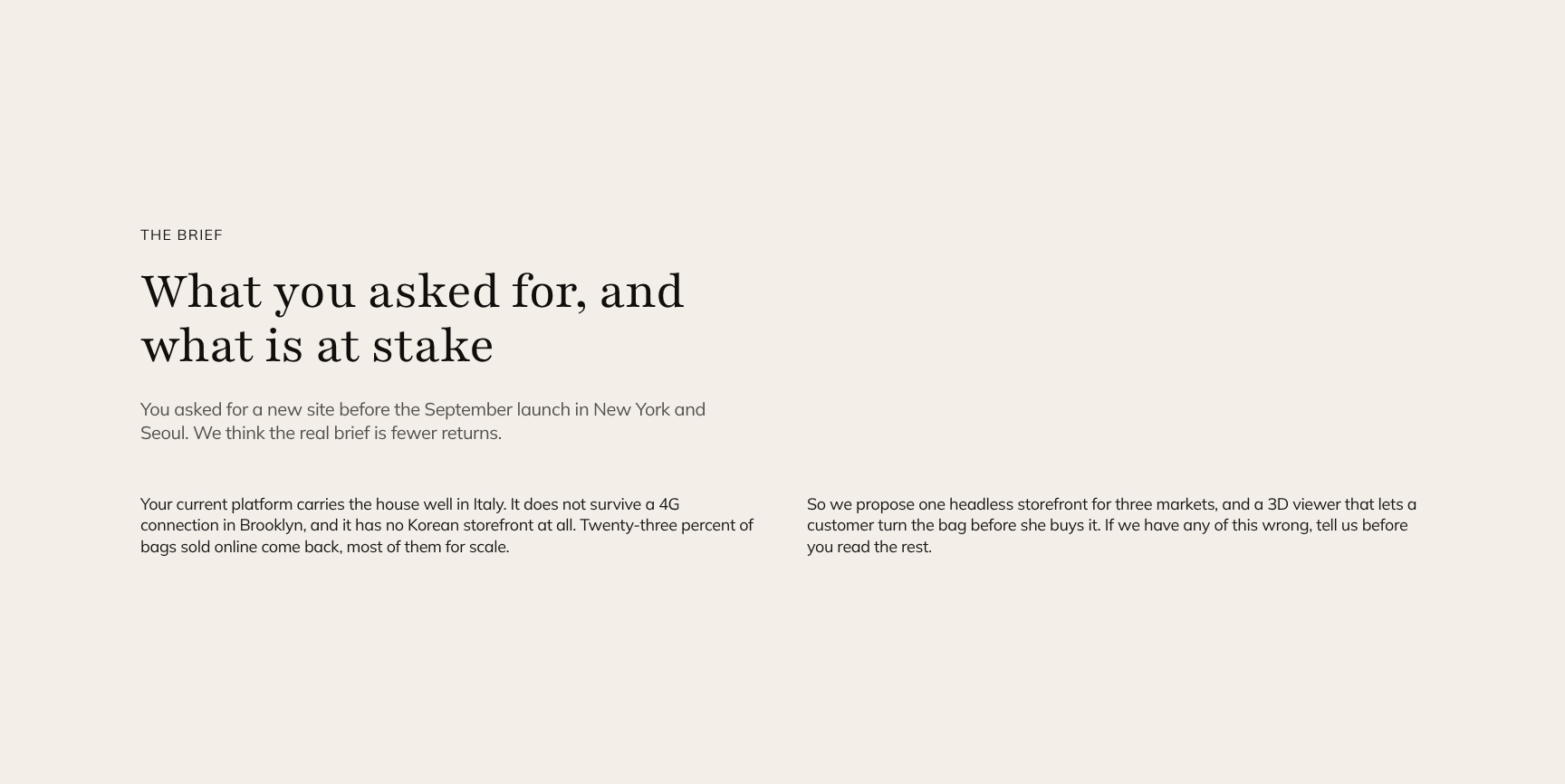
### Big Idea: Animated Concept Statement for the Storefront
An animated text moment that presents the core creative idea: let shoppers inspect products as if holding them. It makes the strategy memorable and ties 3D experience directly to fewer returns.
### Performance Baseline: GA4 and Returns Data Metrics Cards
Metric cards built from the client's own GA4 and returns data across the rolling twelve months. They set a measurable baseline so the new storefront can be judged against real figures.
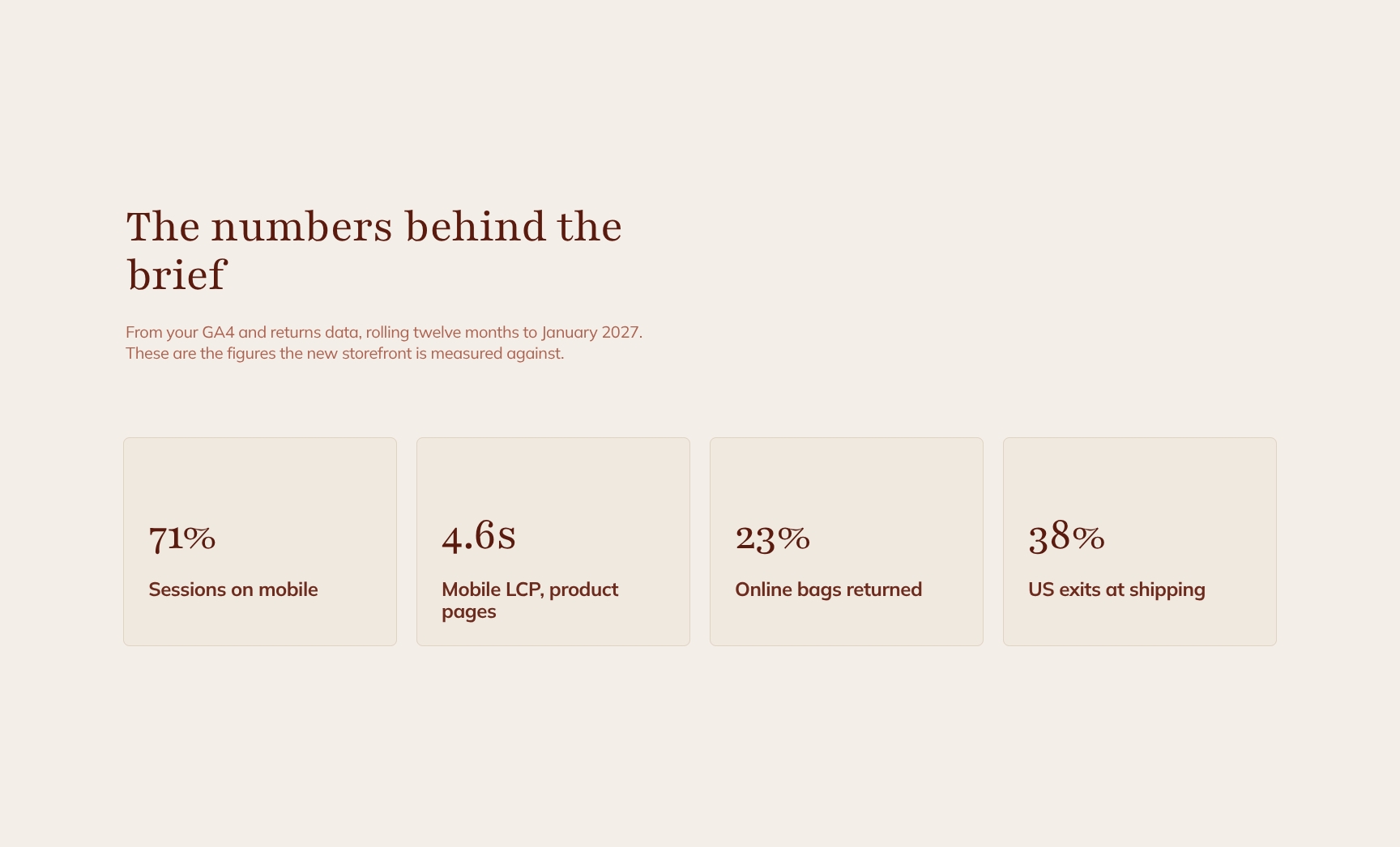
### Creative Direction Showcase: Homepage and Product Page Concepts
Visual walkthrough of the proposed design direction, from the autumn drop homepage to product pages. Includes concrete performance targets like sub-1.8-second loads on 4G so the vision feels buildable.
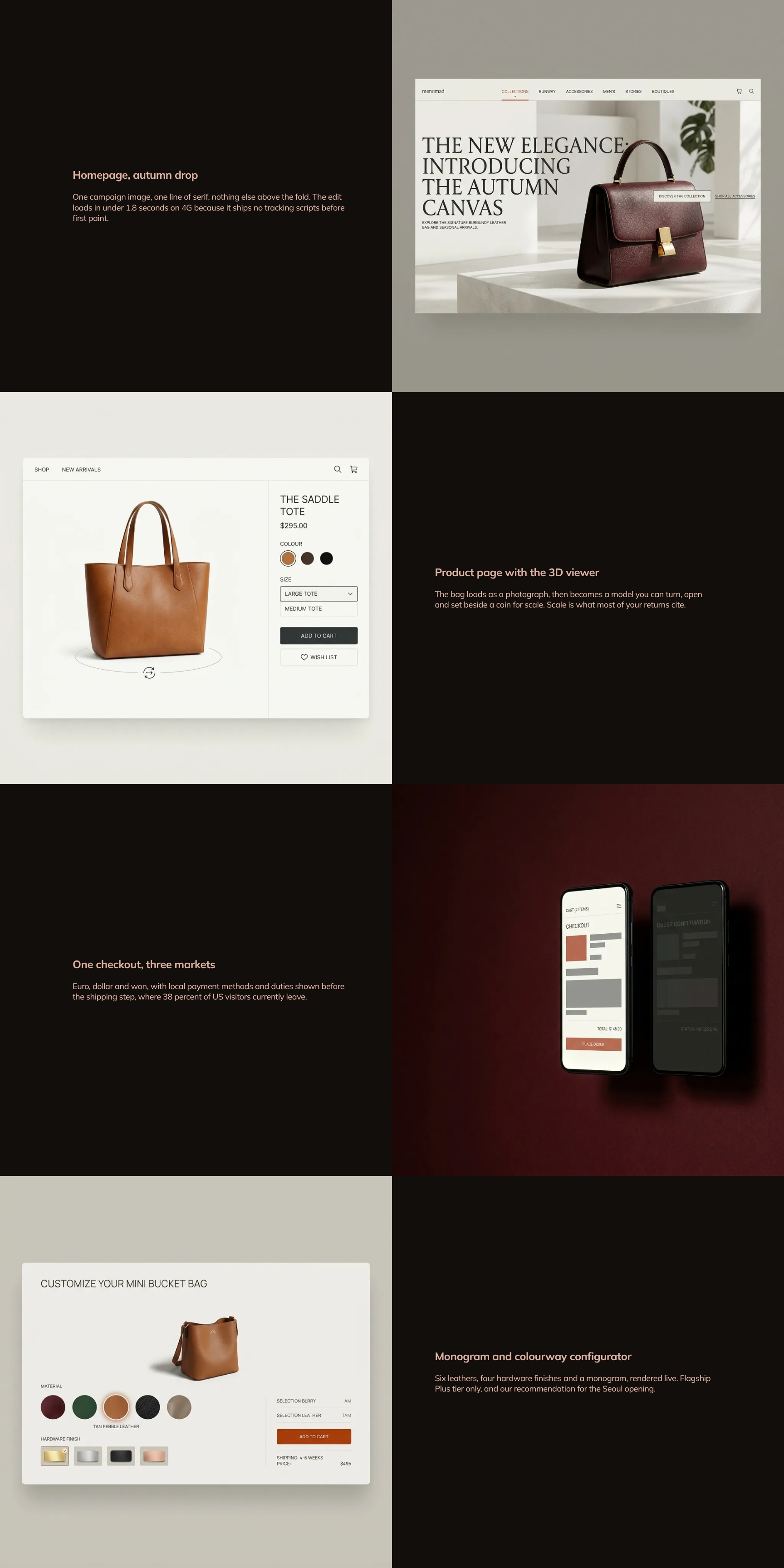
### Delivery Approach: Five-Phase, Twenty-Four-Week Roadmap
A phase-by-phase process built on two-week sprints and demos every second Friday. Working software appears from week twelve, giving the client transparency, control and early confidence.
### Selected Work and Team: Three Relevant Launch Case Studies
Highlights three comparable launches alongside the fourteen-person studio and its design, engineering and 3D leads. Proves relevant experience and shows who will work with the client from the first workshop.
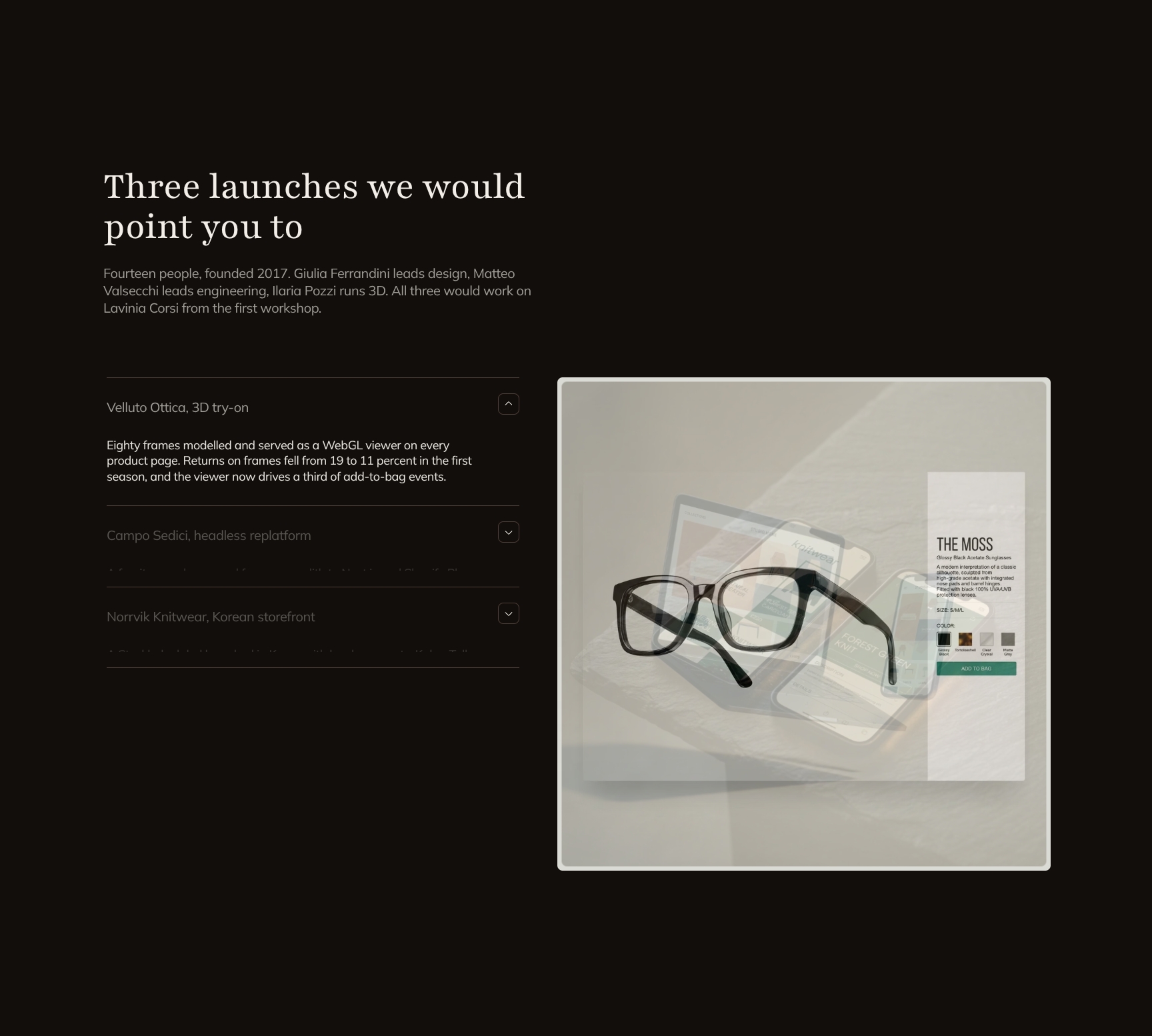
### Interactive Pricing: Three Launch Tiers in EUR with Live Totals
Three selectable packages with transparent day rates and a total that updates as you choose. The recommended Flagship tier guides the decision, and figures in EUR excluding IVA keep budgeting clear.
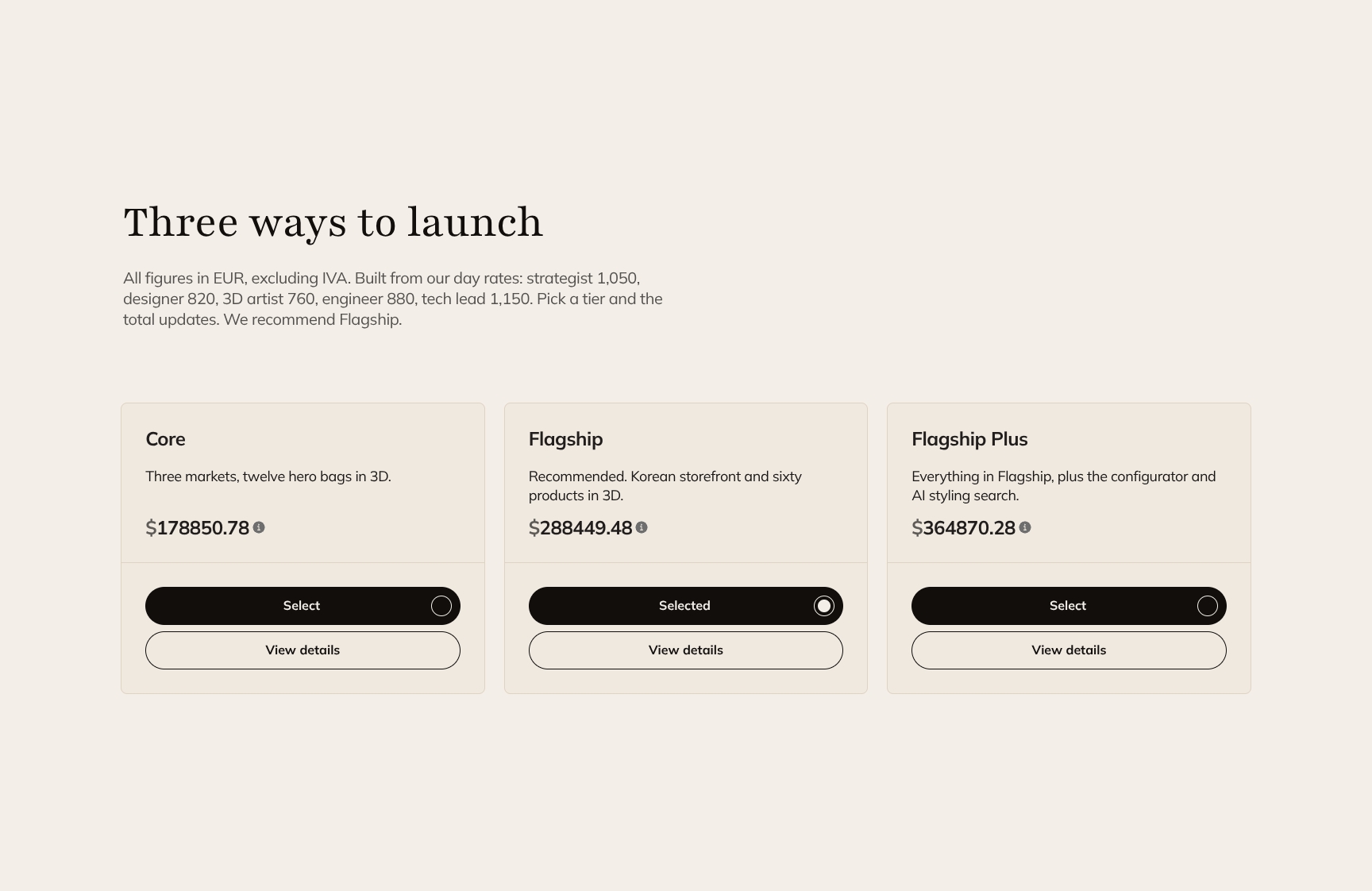
### Project Programme: Timeline and Task Schedule, April to October 2027
A dated task schedule from 12 April to 22 October 2027, with stated dependencies such as consolidated feedback and ERP sandbox access. Shows exactly what happens when and what keeps the launch on track.
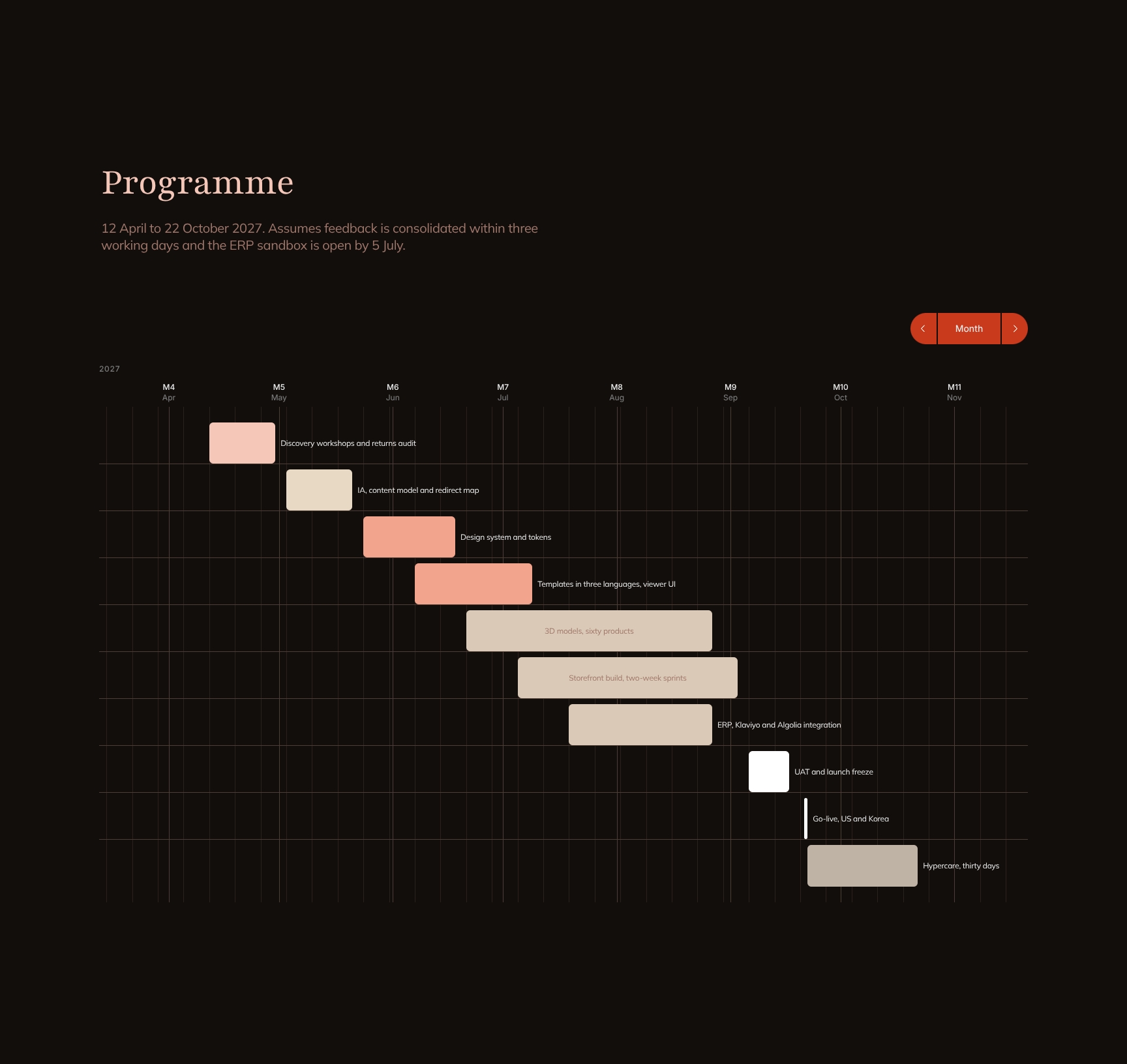
### Assumptions and Terms: Expandable Risk and Responsibility FAQ
Collapsible items covering content ownership, late-delivery consequences and other terms that decide whether September holds. Sets expectations early and prevents scope and schedule disputes.
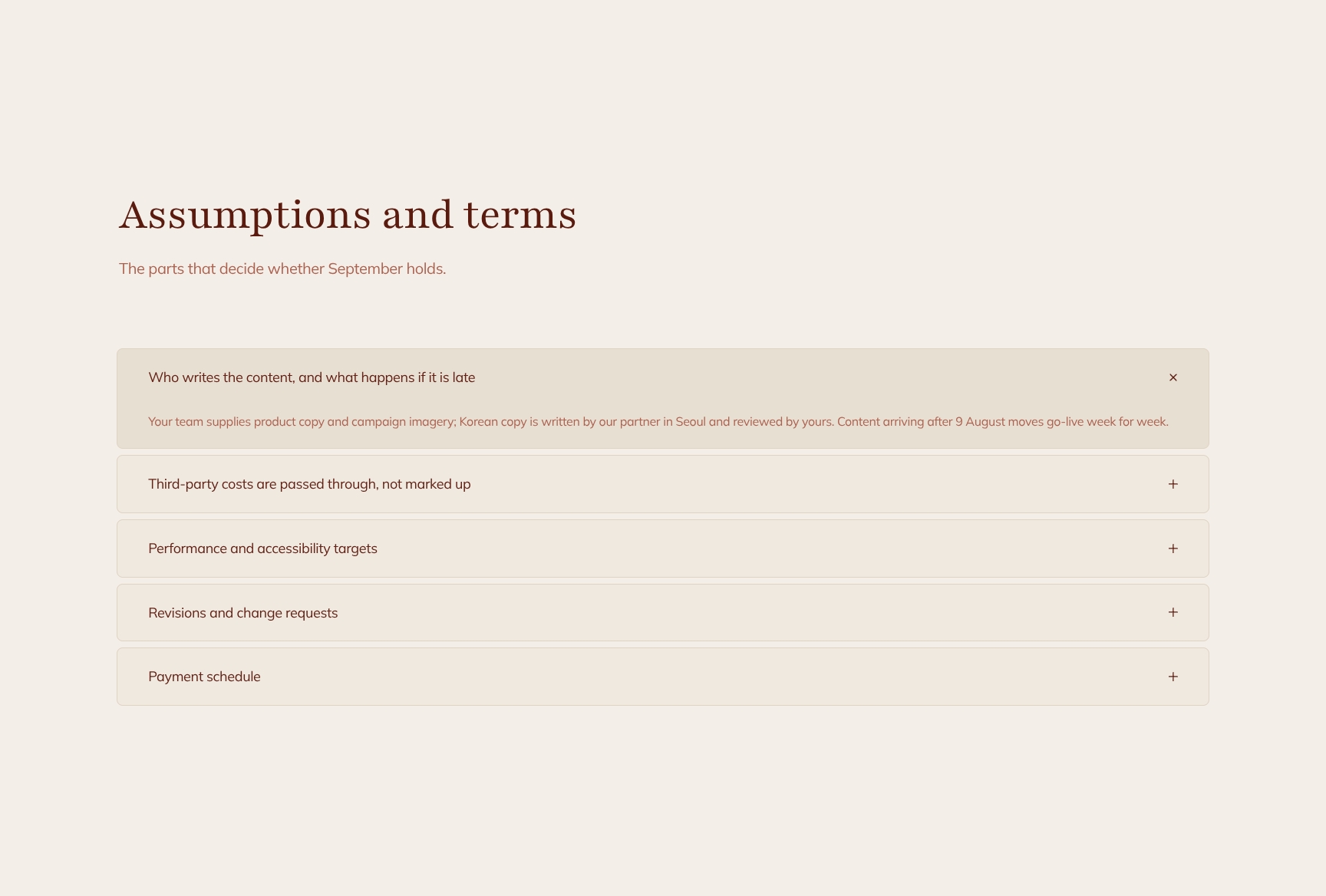
### Client Testimonials: Proven Results from Past Ecommerce Launches
Quotes from past clients with named roles and hard results, such as returns on frames falling from 19 to 11 percent. Social proof that builds trust and backs up the promise of fewer returns.
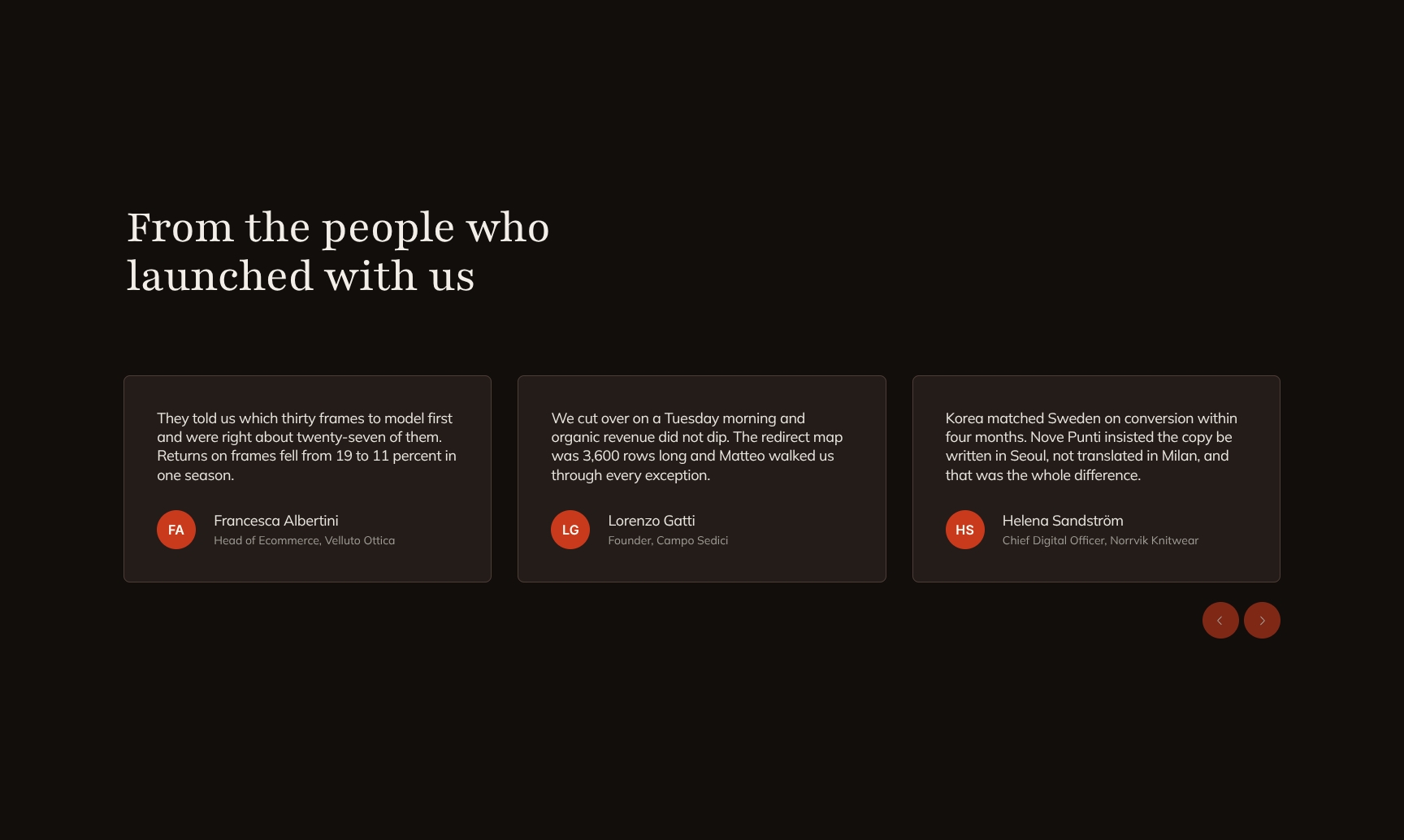
### Approval and Next Steps: Proposal Validity and April Start Booking
A clear call to action with a validity date of 26 March 2027 and a prompt to book a call to secure the 12 April slot. Creates urgency and a simple path to sign-off.
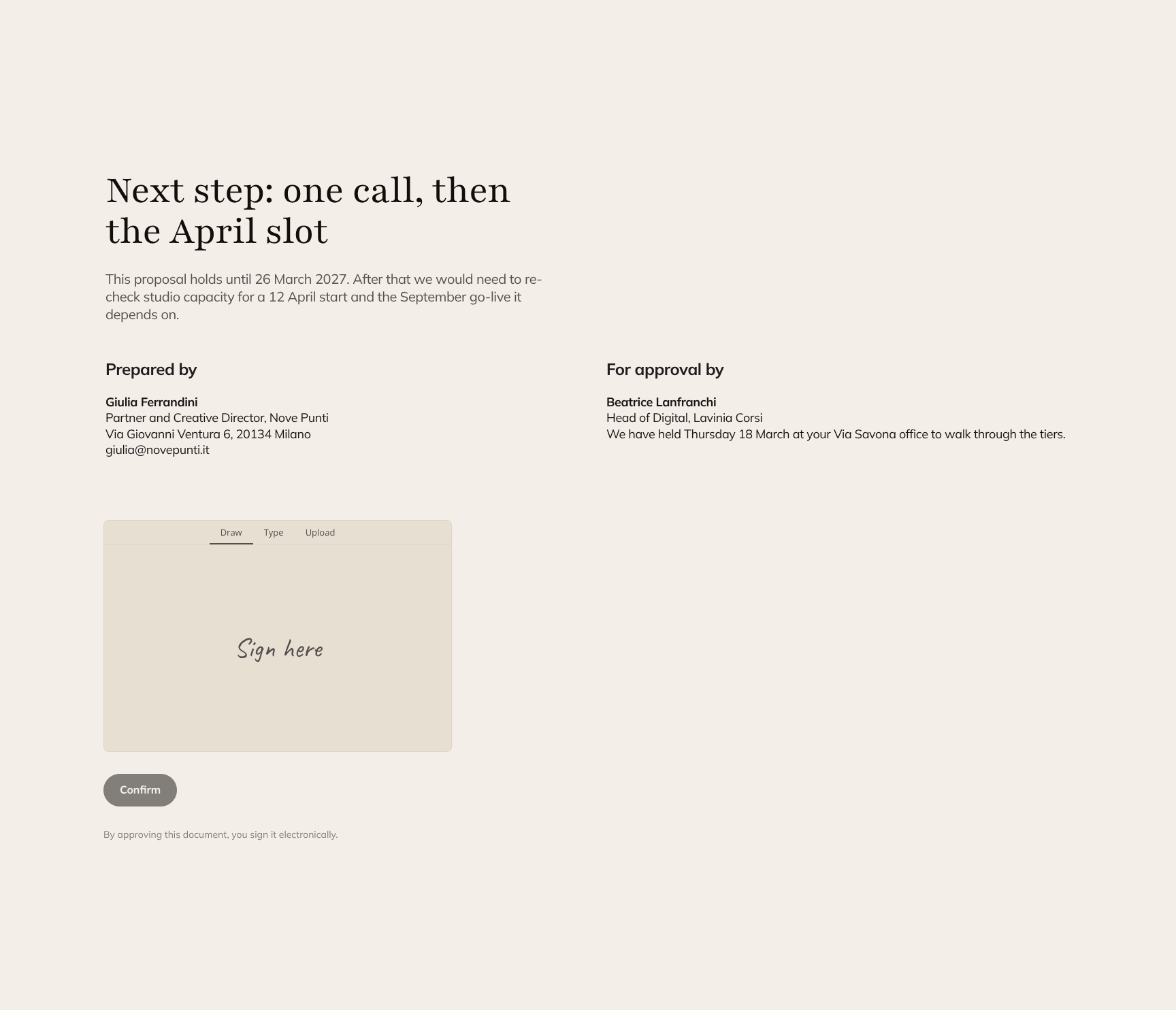
## Find your answers
Answers to common questions about writing and sending headless commerce proposals to luxury fashion clients.
### What should be included in a business proposal template?
A strong proposal includes a cover, a summary of the client's brief, your core idea or solution, pricing and projected numbers, the creative or strategic direction, and your approach to delivery. This template covers each of these in six dedicated sections: Cover, The brief, The idea, The numbers, The direction, and Approach. Together they walk the client from understanding their problem to knowing exactly how you'll solve it.
### How do I customize this proposal template for my own clients?
Start by replacing the cover details with your client's name, your branding, and the project title. Then rewrite The brief in your own words to confirm you understand their goals, and update The idea, The numbers, The direction, and Approach with your specific solution, pricing, and timeline. You can reorder, duplicate, or delete sections to fit each project.
### Can I export this proposal template to PDF or other formats?
Yes, you can export the finished proposal to PDF for sharing with clients, which preserves layout, fonts, and branding on any device. Depending on the tool you use, you can also export to formats like PowerPoint or Google Slides for further editing. Always review the exported file to confirm that pricing tables and images display correctly.
### Is this proposal template suitable for creative agencies, consultants, and freelancers?
Yes, the structure works for any service-based business, including creative agencies, marketing consultants, designers, developers, and freelancers. The Brief, Idea, and Direction sections suit creative and strategic pitches, while The Numbers and Approach sections suit consulting and project-based work. You can adjust the tone and level of detail to match your industry and client size.
### How long does it take to complete this proposal template?
Most users can complete a tailored proposal in 1 to 3 hours, depending on how much research the brief and pricing require. Reusing content from past projects, especially for The numbers and Approach sections, can cut that time significantly. Spend the most effort on The idea and The brief, as these sections are the most persuasive for winning clients.
## Related
- [Lyon](https://formlio.com/templates/lyon-hotel-website-proposal): Website proposal for multi-property hotel groups
- [Cardiff](https://formlio.com/templates/cardiff-website-care-plan-proposal): Monthly care plan proposal for festival organisers
- [Cambridge](https://formlio.com/templates/cambridge-design-studio-portfolio): Web design studio portfolio for research clients
- [Portland](https://formlio.com/templates/portland-app-redesign-proposal): App redesign pitch for subscription startups
- [Copenhagen](https://formlio.com/templates/copenhagen-headless-ecommerce-proposal): Headless storefront proposal for ecommerce brands
- [Toronto](https://formlio.com/templates/toronto-brand-relaunch-proposal): Creative campaign proposal for consumer brands
---
---
title: "Brooklyn"
description: "Win more video work with a brand film proposal template covering brief, deliverables, shoot style and timeline. Built for production studios pitching cafés and retail."
canonical: "https://formlio.com/templates/brooklyn-brand-film-proposal"
locale: "en"
type: "template"
lastModified: "2026-10-21"
category: "Video & photography"
alternates:
fr: "https://formlio.com/fr/templates/brooklyn-proposition-de-film-de-marque.md"
---
# Brooklyn
Brand Film Production Proposal Template
Win more video work with a brand film proposal template covering brief, deliverables, shoot style and timeline. Built for production studios pitching cafés and retail.
- [Use this template](https://formlio.com/workspaces/claim?template=brooklyn-brand-film-proposal)
- [Live preview](https://formlio.com/documents/brooklyn-brand-film-proposal)
- **Categories:** [Video & photography](https://formlio.com/templates/video-photography), [Proposals](https://formlio.com/templates/proposals)
- **Document goal:** Win brand film projects with a clear proposal covering your brief, deliverables, shoot style, and timeline.
- **Blocks:** Typewriter, Single column, Grid 3x2 with icons, Grid tile scroll, Itemized quote, E-signature
- **Palette:** Pure Canvas White (#FFFFFF), Soft Mist Gray (#F5F5F5), Neutral Accent Silver (#D9D9D9), Steady Slate Gray (#797979), Bold Ink Black (#000000)
## Get more from every document
Pitch a brand film to a café or retail client and walk away with a signed yes. Brief recap, deliverables, visual style, timeline and fees sit ready to edit.
### Get the yes without leaving the page
Your client reads the pricing, then signs the agreement right below it. No PDF download, no printing, no chasing.
### Assemble proposals from sections you trust
Drop in a hero, steps, or pricing block, then save your best-performing versions and reuse them on the next pitch.
### Your pitch looks sharp on any screen
Your gallery and pricing table hold their shape when a client opens the proposal on a phone between meetings.
### See which section wins them over
Watch where prospects linger on pricing or the gallery, then follow up while the proposal is still on their mind.
### Know the moment they open it
Get a ping when a client views your proposal, leaves a comment, or signs, so you can reply while they're engaged.
### Write the proposal together, live
Your designer tweaks the gallery while you rework pricing, and the proposal goes out the same afternoon.
## See how every part fits
The proposal opens on the client's name and closes on a dated approval step, with the brief, films, look, schedule and fees in between. Keep what fits, drop what doesn't, and reorder anything.
### Brand Film Proposal Cover Page for Harbour Coffee Roasters
A polished cover that frames the project in one line: a three-minute brand film plus a launch cut-down suite. It sets the tone, names the client and gives the proposal a confident, story-led first impression.
### Creative Brief Summary: What You Asked For and What We Heard
Restates the client's goal of making a second roastery feel loved from day one. Shows you listened, aligns both sides on objectives, and builds trust before scope and pricing are discussed.
### Video Production Deliverables: One Shoot, Six Films
Itemised cards for the hero film and social edits, all cut from two shoot days. Clients see exactly what they receive and how a shared look, grade and cast keep the campaign consistent and cost-efficient.
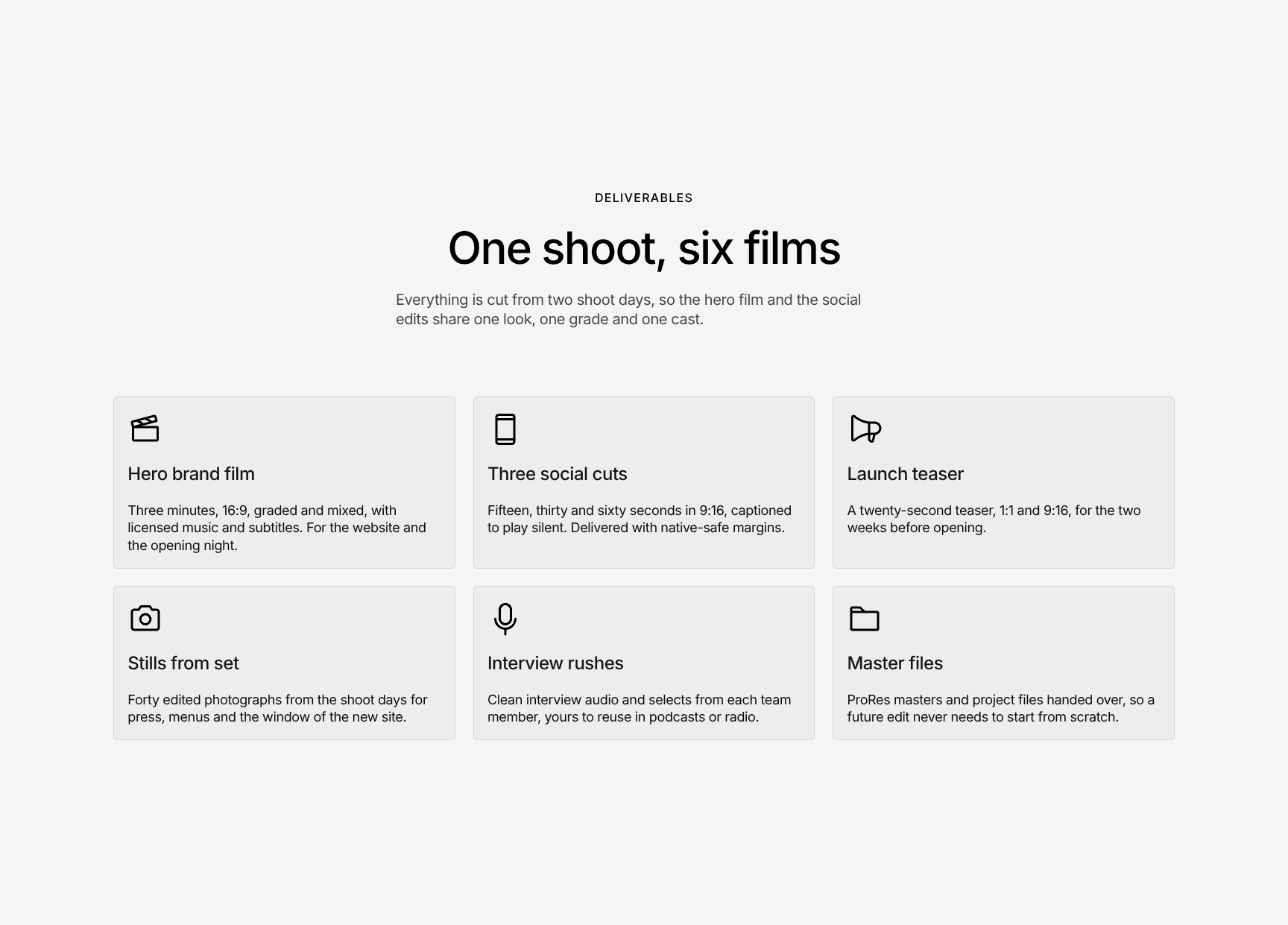
### Visual Style Gallery: Warm Light, Real Hands, No Gloss
A mood and look-and-feel gallery covering natural light, shallow focus and a true-to-roast grade. Helps clients visualise the finished film and approve the creative direction early, reducing revisions later.
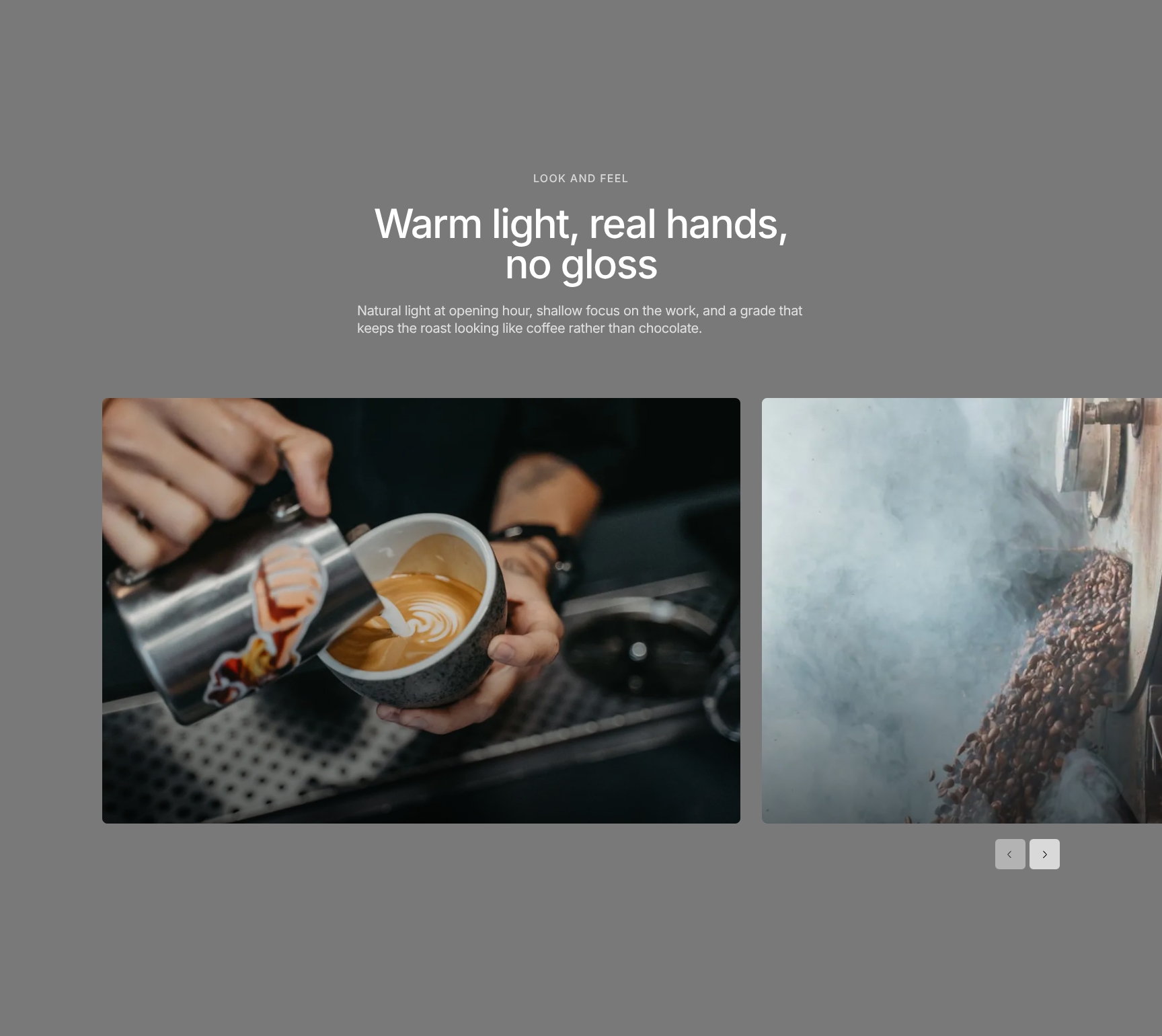
### Production Timeline: Eight Weeks from Brief to Opening Night
A five-stage production process, each ending with one clear client decision. Sets expectations on schedule and approvals, keeps the film free of surprises and lines delivery up with the opening date.
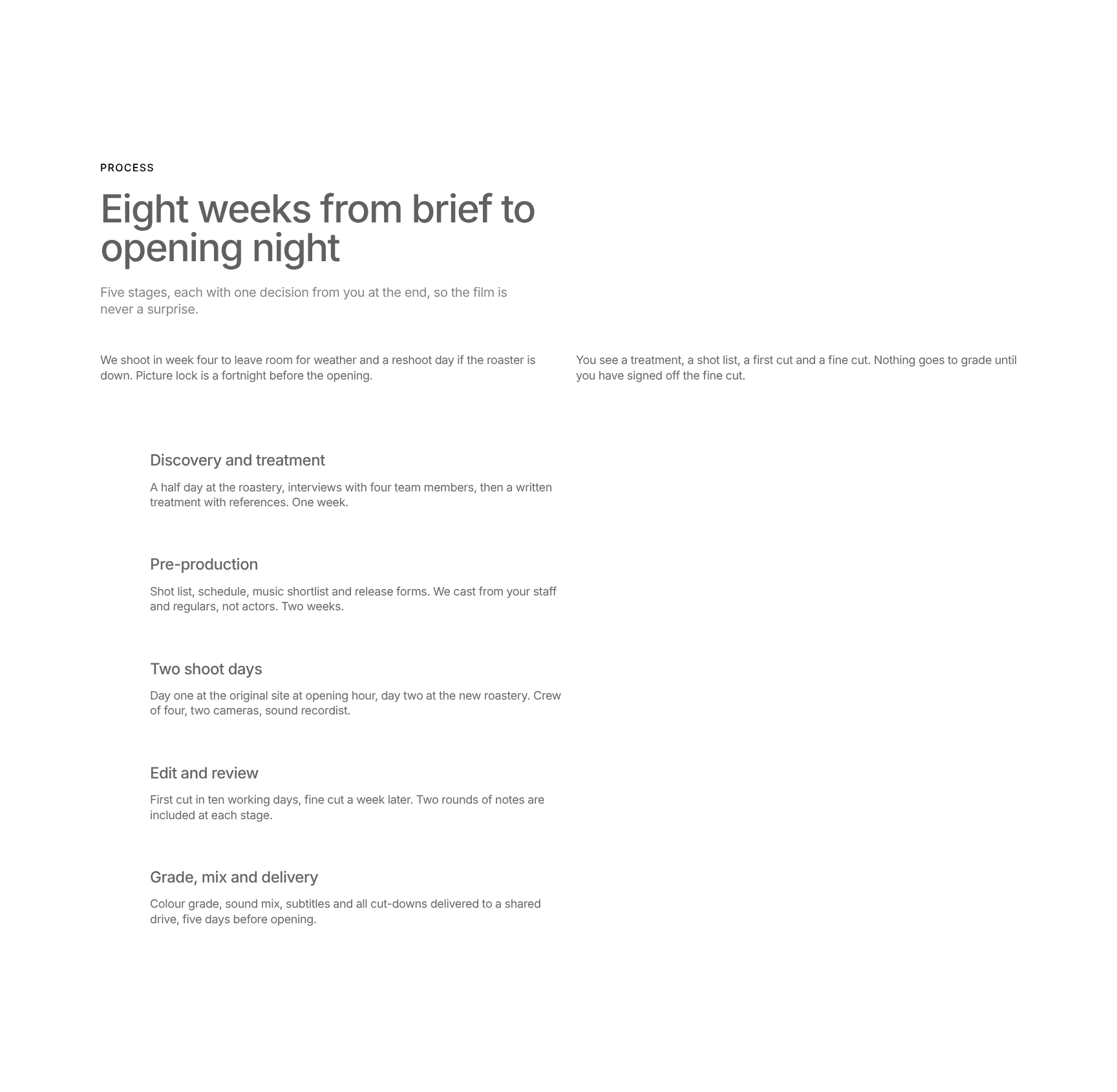
### Transparent Video Production Fees and Day Rates in GBP
A clear fee breakdown built from published day rates for director, DoP, sound and editor. Notes that travel, music licensing and catering are included and that VAT and third-party talent are separate, so there are no hidden costs.
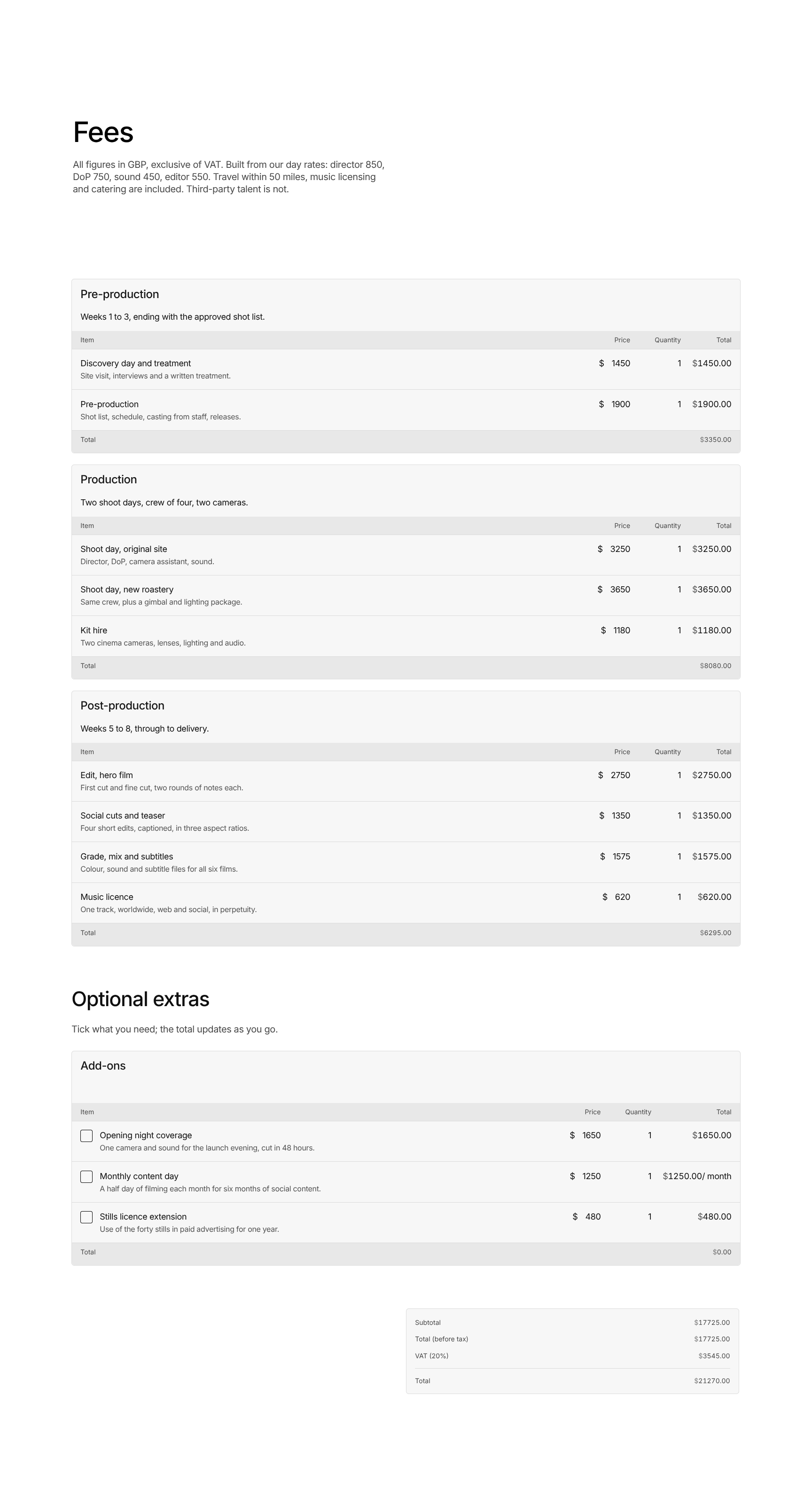
### Proposal Approval and Next Steps with Validity Date
States the proposal's validity until 12 October 2027 and what happens after sign-off, including the kick-off invite for the discovery day. Gives clients a simple route to approve and creates helpful urgency around crew availability.
## Find your answers
Answers to common questions about pitching brand films to hospitality and retail clients with a production proposal.
### What should be included in a proposal template?
A strong proposal includes a cover, a project brief, deliverables, look and feel, process, and fees. The cover sets a professional first impression, while the brief shows you understand the client's goals. Deliverables, process, and fees then set clear expectations on scope, timeline, and cost so there are no surprises.
### How do I customize this proposal template for my business?
Replace the placeholder text in each section with your own details, starting with the cover and the brief. Then update the look and feel section with your brand colors, fonts, and imagery. Adjust the deliverables, process steps, and fees to match each client's project, and duplicate or remove sections as needed.
### Can I export this proposal template to PDF or other formats?
Yes, you can export the finished proposal to PDF to send to clients, which keeps your layout and fonts intact. Depending on the editing tool you use, you can also export to formats such as Word or Google Docs for further editing. Send a PDF for final review and keep an editable version for revisions.
### Is this proposal template suitable for freelancers, agencies, and creative projects?
Yes, the template suits freelancers, design studios, marketing agencies, and consultants. The look and feel section is especially useful for creative work like branding, web design, and video production. You can easily adapt the brief, deliverables, and fees for other service industries.
### How do I write the fees section of a proposal?
List each deliverable with its price, or group them into clear packages, so the client can see exactly what they are paying for. State your payment terms, such as deposit amounts, milestone payments, and due dates. Add notes on what is not included, and mention any costs for revisions or extra work, to prevent scope creep.
## Related
- [Antwerp](https://formlio.com/templates/antwerp-photography-and-film-portfolio): Photo and film portfolio for creative studios
- [Oslo](https://formlio.com/templates/oslo-campaign-photography-estimate): Photography estimate with options for brands
- [Bristol](https://formlio.com/templates/bristol-launch-film-proposal): Launch film proposal for product marketing teams
- [Vancouver](https://formlio.com/templates/vancouver-video-production-statement-of-work): Multi-market commercial shoot statement of work
- [Lyon](https://formlio.com/templates/lyon-hotel-website-proposal): Website proposal for multi-property hotel groups
- [Bordeaux](https://formlio.com/templates/bordeaux-launch-event-pitch): Hybrid launch event pitch for brands
---
---
title: "Miami"
description: "Statement of work template for interior designers: define FF&E procurement scope, milestones, lead times, deposits and installation for residential projects."
canonical: "https://formlio.com/templates/miami-ffe-procurement-statement-of-work"
locale: "en"
type: "template"
lastModified: "2026-10-22"
category: "Interior design"
alternates:
fr: "https://formlio.com/fr/templates/miami-cahier-des-charges-dachat-ffe.md"
---
# Miami
Interior Design FF&E Procurement Statement of Work Template
Statement of work template for interior designers: define FF&E procurement scope, milestones, lead times, deposits and installation for residential projects.
- [Use this template](https://formlio.com/workspaces/claim?template=miami-ffe-procurement-statement-of-work)
- [Live preview](https://formlio.com/documents/miami-ffe-procurement-statement-of-work)
- **Categories:** [Interior design](https://formlio.com/templates/interior-design), [Proposals](https://formlio.com/templates/proposals)
- **Document goal:** Define FF&E procurement scope, lead times, deposits and installation so clients know exactly what to expect.
- **Blocks:** Typewriter, Single column, Grid 3x2 with icons, Vertical timeline, Itemized quote, Left-aligned, Scroll gradient, E-signature
- **Palette:** Warm Linen Background (#FBF8F4), Soft Blush Clay (#EBC7B4), Terracotta Accent (#C47459), Deep Forest Green (#3E5A3A), Midnight Evergreen Text (#15211A)
## Get more from every document
Lock down exactly what you're buying, when it ships, and who pays for what on every residential FF&E order. Milestones tied to lead times, an item tracker, and deposit terms sit ready to edit.
### Get the agreement signed on the page
Your client reads the scope, checks the price, and signs in the same document. No PDF to print, sign, scan, or lose.
### Assemble agreements from proven sections
Drop in pricing, steps, and terms blocks, then save your own payment schedule to reuse on every new client.
### Clients sign from any screen
Your terms, pricing tables, and steps stay readable on a laptop at the desk or a phone between meetings.
### See which terms your client lingers on
Heatmaps show whether they stall on pricing or the scope, so you know what to address before you follow up.
### Know the moment they sign
Get a ping when your client opens the agreement, comments on a clause, or signs, so you can start work right away.
### Finalize terms with your team live
You tweak the pricing while a teammate rewrites the deliverables, and the agreement is ready to send sooner.
## See how every part fits
The document opens with a cover and project scope, moves through milestones, budgets, and risk terms, and closes with signatures and deadlines. Keep what fits your project, drop what doesn't, and reorder anything.
### Statement of Work Cover Page for FF&E Procurement Project
A polished cover that names the project, client and scope: FF&E procurement and installation for a 9,800 sq ft waterfront house. It sets a professional tone and identifies the document at a glance.
### Parties, Dates and Scope of Work Overview
Defines who is involved, the nine-month timeline and what the agreement covers: buying 412 specified items, delivering them to Miami intact and placing each before move-in. Removes ambiguity up front.
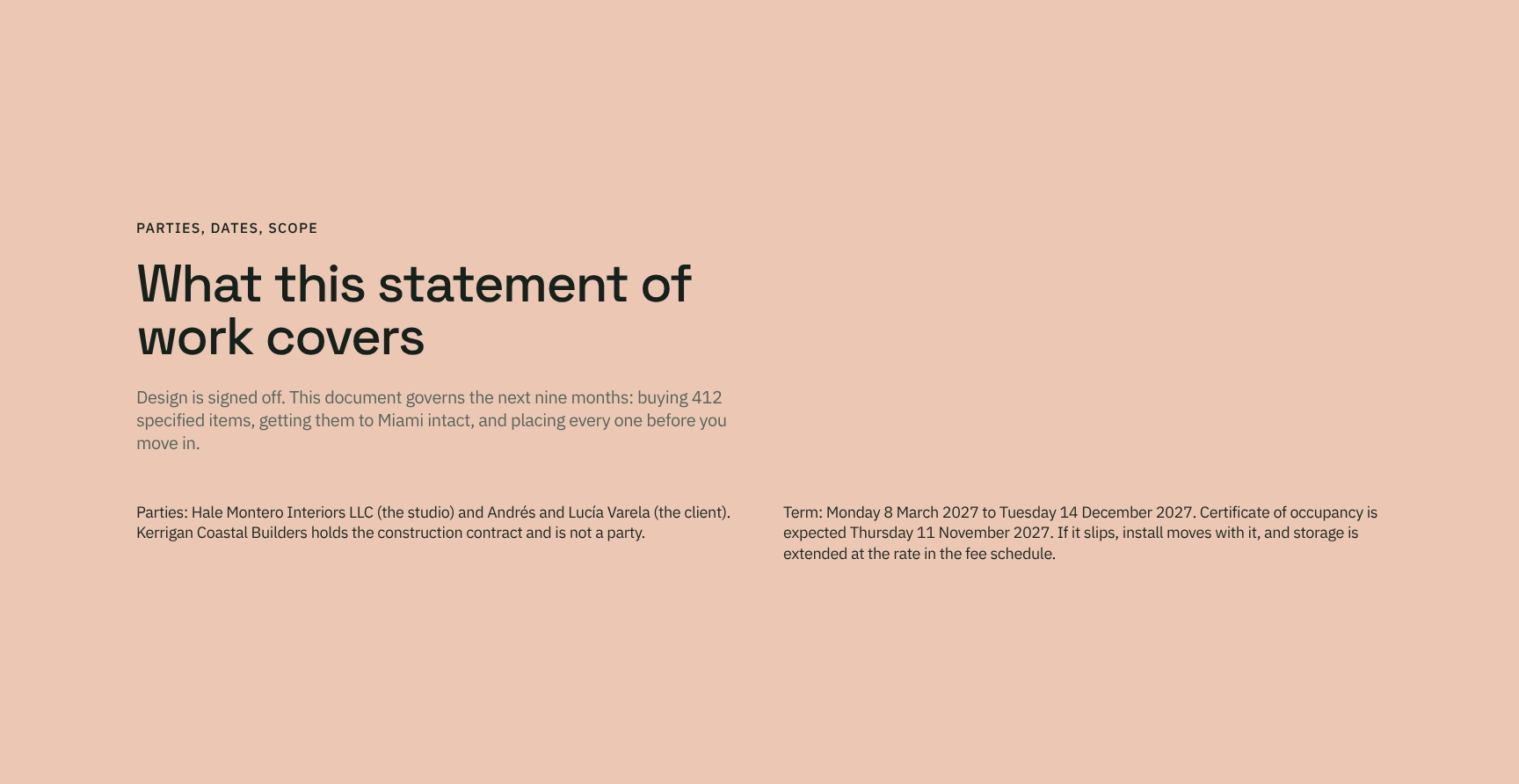
### Project Milestones Driven by Vendor Lead Times
Five clear milestones explain how the 16-week bespoke upholstery lead time sets the ordering sequence. Clients see why the schedule is what it is and what happens at each stage.
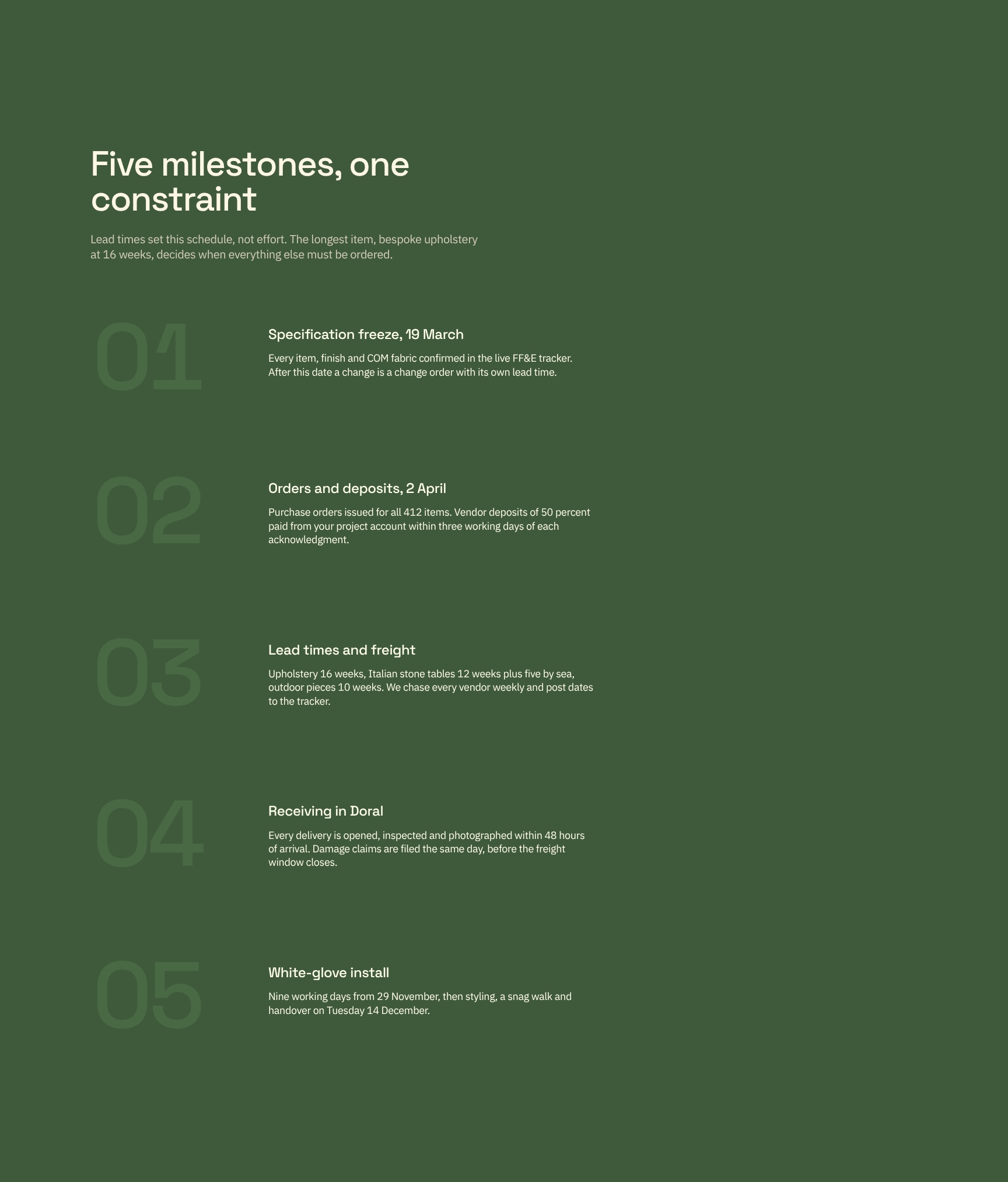
### FF&E Procurement Categories and Shared Item Tracker
Breaks 412 items into six categories, each tracked with vendor, lead time, deposit status and location. Round-the-clock visibility builds trust and cuts status-update requests.
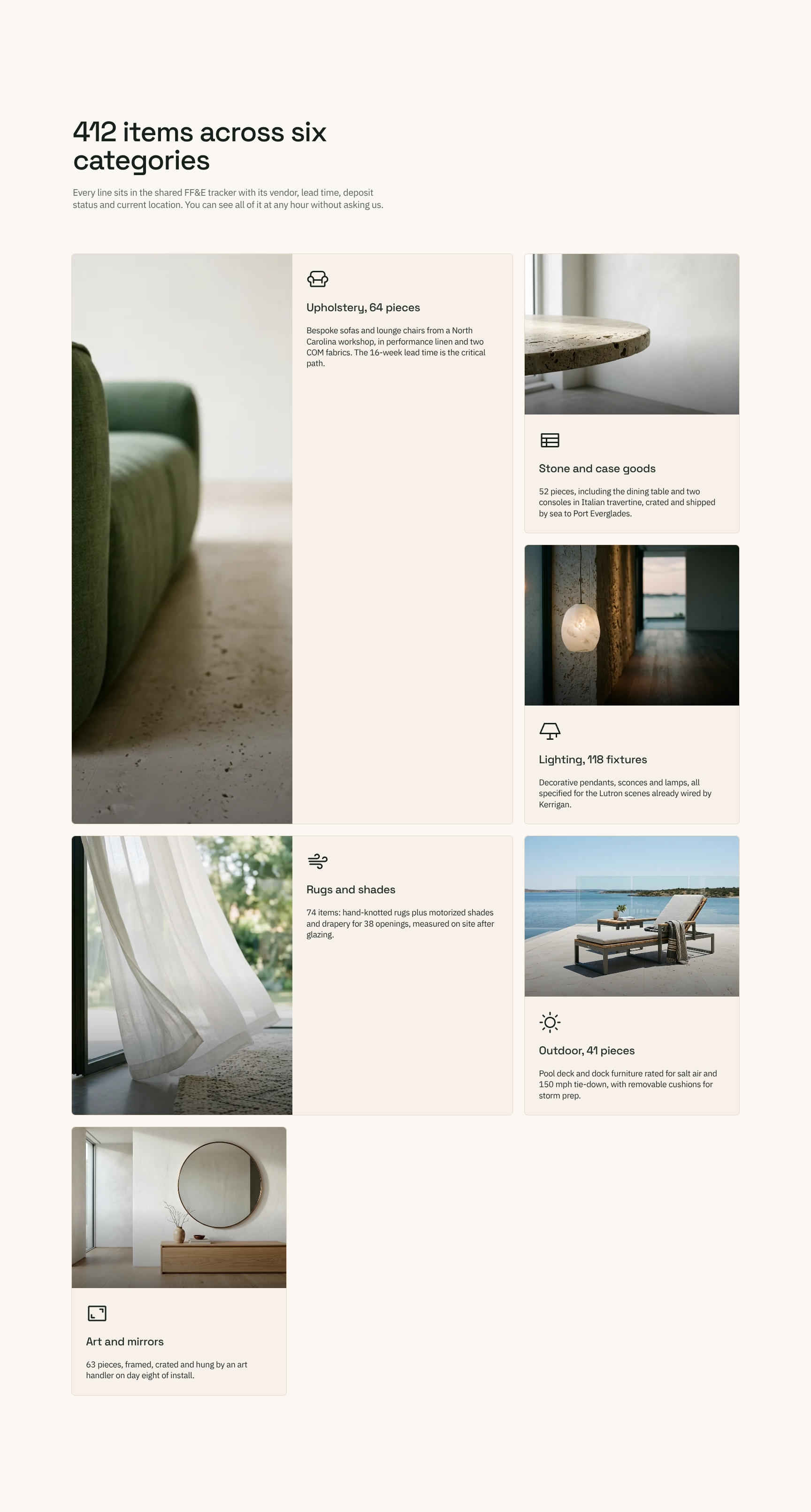
### Forty-Week Delivery and Installation Schedule
A task-by-task timeline with stated assumptions: sign-off on purchase order batches within three working days and a certificate of occupancy by 11 November. Shows the dependencies that protect the move-in date.
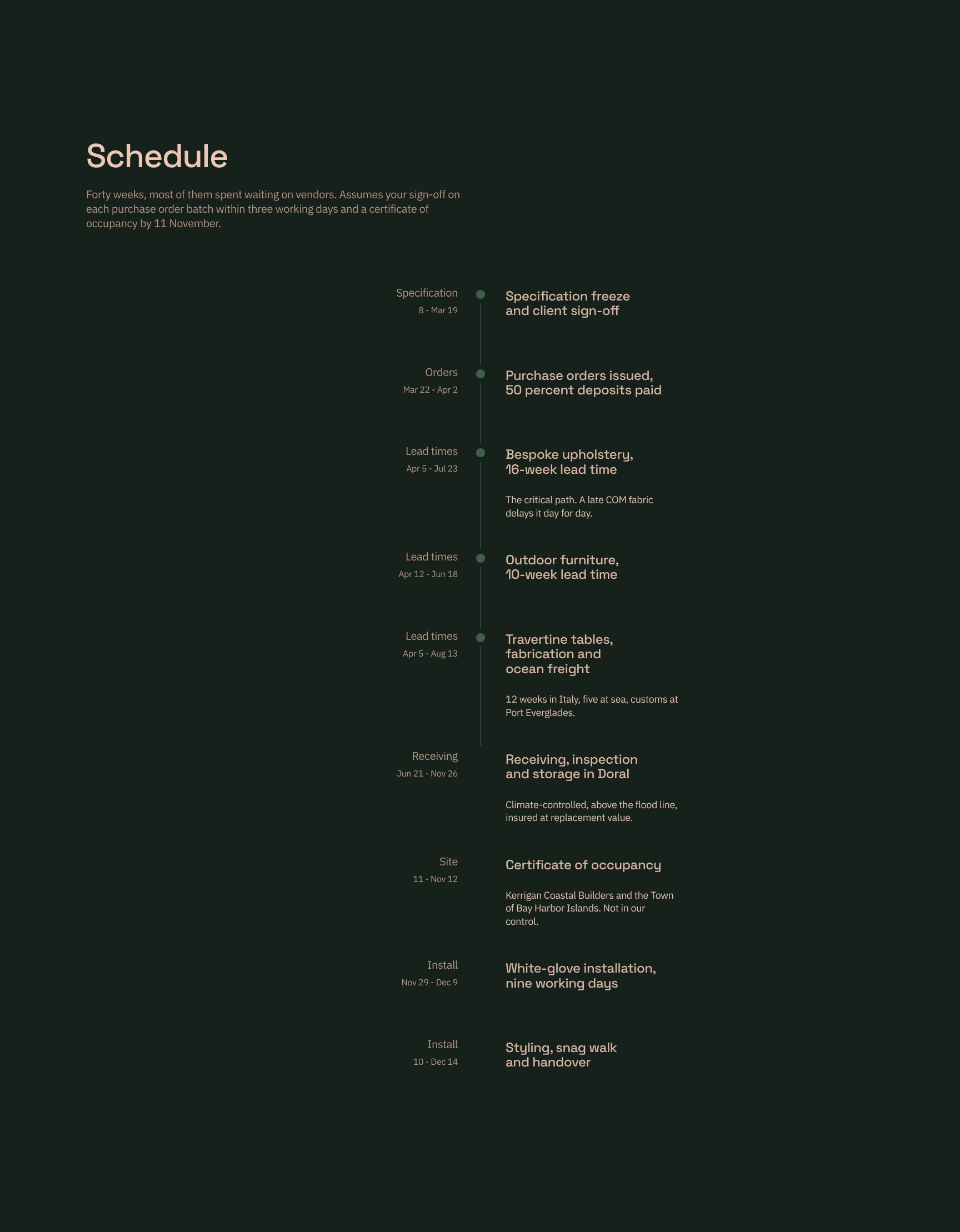
### Management Fees and Goods Budget in USD
Lays out the 14 percent management fee on goods value, recalculated at final invoice, and how goods are paid directly. Clear pricing logic keeps budgets transparent and avoids surprises.
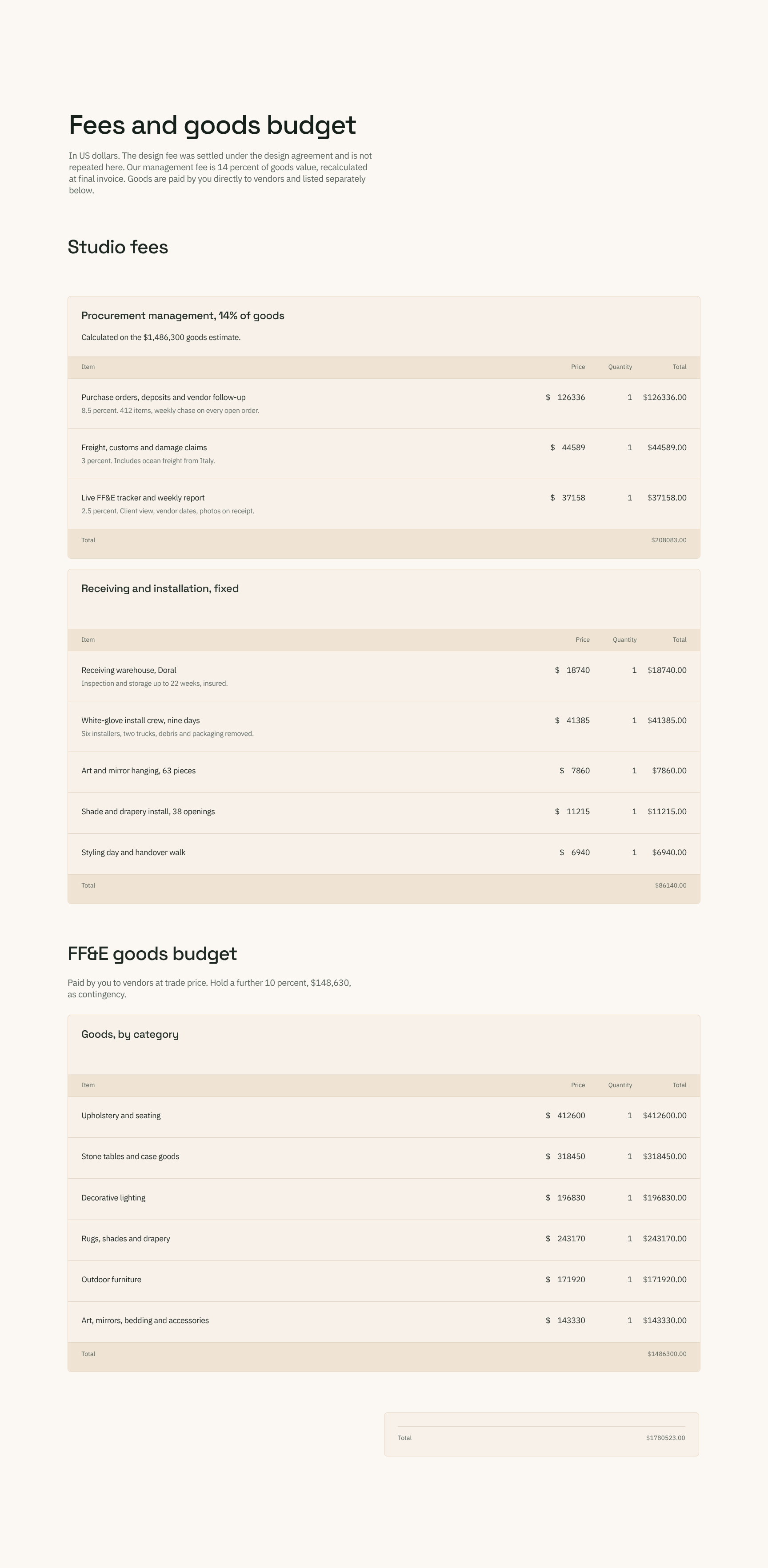
### Client and Contractor References and Testimonials
Real feedback from clients and contractors who have had installations handled, including a quick response to damaged marble. Social proof that shows how problems are caught and solved.
### Deposits, Risk and Storm Terms Explained
Expandable terms covering deposits, risk of loss and storm disruption between vendor and living room. Keeps the legal detail organized and easy to scan, so responsibilities are clear if things go wrong.
### Core Delivery Principle: Warehouse Staging in Doral
A single animated statement of the operating rule: every piece waits in Doral for the house, never the house for a piece. It memorably captures the project's approach to sequencing and risk.
### Approval and Signature Next Steps with Key Deadlines
A clear call to sign by 5 March 2027 to hold the 8 March specification freeze, with purchase orders following the week of 22 March. Turns agreement into action with firm dates.
## Find your answers
Answers to common questions about scoping, pricing, and managing FF&E procurement agreements for residential interior design projects.
### What should be included in a procurement agreement template?
A solid procurement agreement should include a cover page, the parties and scope of work, defined milestones, a clear description of what is being procured, a delivery schedule, and a fees section. Together these sections set expectations, assign responsibilities, and reduce disputes over deliverables, timing, and payment.
### How do I customize this agreement template for my project?
Start by replacing the placeholder names and details in the Cover and Parties and scope sections. Next, edit the Milestones, What we procure, and Schedule sections to match your deliverables and deadlines, then update the Fees section with your pricing and payment terms. Remove any sections you don't need and have a legal professional review the final version.
### Can I export this agreement to PDF or Word?
Yes, you can typically export the finished agreement to PDF for signing and sharing, or to Word format for further editing and redlining. Use PDF for a final, locked version and Word when the other party needs to propose changes. Check the export options in your editor for the exact formats supported.
### How do I set up milestones and payment fees in this agreement?
List each milestone with a clear deliverable, an acceptance criterion, and a due date in the Milestones and Schedule sections. Then link payments to those milestones in the Fees section, specifying amounts, currency, invoicing timelines, and late-payment terms. Tying fees to milestones keeps both parties accountable and protects cash flow.
### Is this agreement template suitable for different industries and legally binding?
Yes, the structure works for many industries, including IT services, construction, consulting, and manufacturing, because it focuses on scope, deliverables, schedule, and fees. It becomes legally binding once both parties sign, but laws vary by jurisdiction. Have a qualified attorney review it for industry-specific clauses such as liability, compliance, and IP.
## Related
- [Amsterdam](https://formlio.com/templates/amsterdam-show-apartment-design-proposal): Show apartment design proposal for property developers
- [Chicago](https://formlio.com/templates/chicago-workplace-interior-design-proposal): Workplace interiors proposal for law firms
- [Lisbon](https://formlio.com/templates/lisbon-interior-design-proposal): Full-service interiors proposal for homeowners
- [Stockholm](https://formlio.com/templates/stockholm-restaurant-interior-proposal): Restaurant interior concept proposal for chefs
- [London](https://formlio.com/templates/london-interior-design-retainer-proposal): Monthly design retainer for hospitality clients
- [Melbourne](https://formlio.com/templates/melbourne-interior-design-portfolio): Capabilities portfolio for interior design studios
---
---
title: "Amsterdam"
description: "Win developer clients with a show apartment interior design proposal template: options, lead-time constraints, FF&E and a clear recommendation for sales launches."
canonical: "https://formlio.com/templates/amsterdam-show-apartment-design-proposal"
locale: "en"
type: "template"
lastModified: "2026-10-22"
category: "Interior design"
alternates:
fr: "https://formlio.com/fr/templates/amsterdam-proposition-appartement-temoin.md"
---
# Amsterdam
Show Apartment Interior Design Proposal Template
Win developer clients with a show apartment interior design proposal template: options, lead-time constraints, FF&E and a clear recommendation for sales launches.
- [Use this template](https://formlio.com/workspaces/claim?template=amsterdam-show-apartment-design-proposal)
- [Live preview](https://formlio.com/documents/amsterdam-show-apartment-design-proposal)
- **Categories:** [Interior design](https://formlio.com/templates/interior-design), [Proposals](https://formlio.com/templates/proposals)
- **Document goal:** Win developer clients with a show apartment proposal that lays out options, lead times, FF&E and a clear recommendation.
- **Blocks:** Highlight, Single column, Scroll gradient, Carousel, Spotlight, Itemized quote, Horizontal timeline, Left-aligned, E-signature
- **Palette:** Misty Sage Background (#E4E8E6), Fresh Moss Accent Light (#A7B18A), Terracotta Spark Accent (#A9532F), Deep Forest Secondary (#3E4A35), Midnight Evergreen Text (#1C2422)
## Get more from every document
Pitch your show apartment scheme to developers with options, costs and a firm recommendation they can approve fast. Built-in lead-time framing, FF&E budgets and a sign-off step keep the sales launch date front and center.
### Get the yes without leaving the page
Your client reads the scope, reviews pricing, and signs the agreement section right there. No PDF, no printing, no chasing.
### Build proposals from blocks you trust
Drop in a pricing table, steps, or testimonials, then save your best-performing sections and reuse them in the next pitch.
### Your pitch looks sharp on any screen
Clients open your proposal on a phone between meetings, and the hero, pricing, and breakdown still read cleanly.
### See which section sells your proposal
Heatmaps show if they linger on pricing or skip the steps, and replays show how they read, so your follow-up lands on time.
### Know the moment they open it
Get a ping when your client views the proposal, comments on a price, or signs, so you call while the deal is warm.
### Write the proposal together, live
You tighten the scope while a teammate fills in pricing and tasks, in the same document at the same time.
## See how every part fits
The proposal opens with the brief and the lead-time constraint, moves through three delivery options and your recommendation, and closes with pricing, programme and sign-off. Keep, drop, or reorder any section to fit your project.
### Show Apartment Proposal Cover with Project Scope
Opens with the studio name, client project and scope: interior design, procurement and styling for a 58 m² studio, 84 m² two-bed and 132 m² penthouse. Sets context and professionalism immediately.
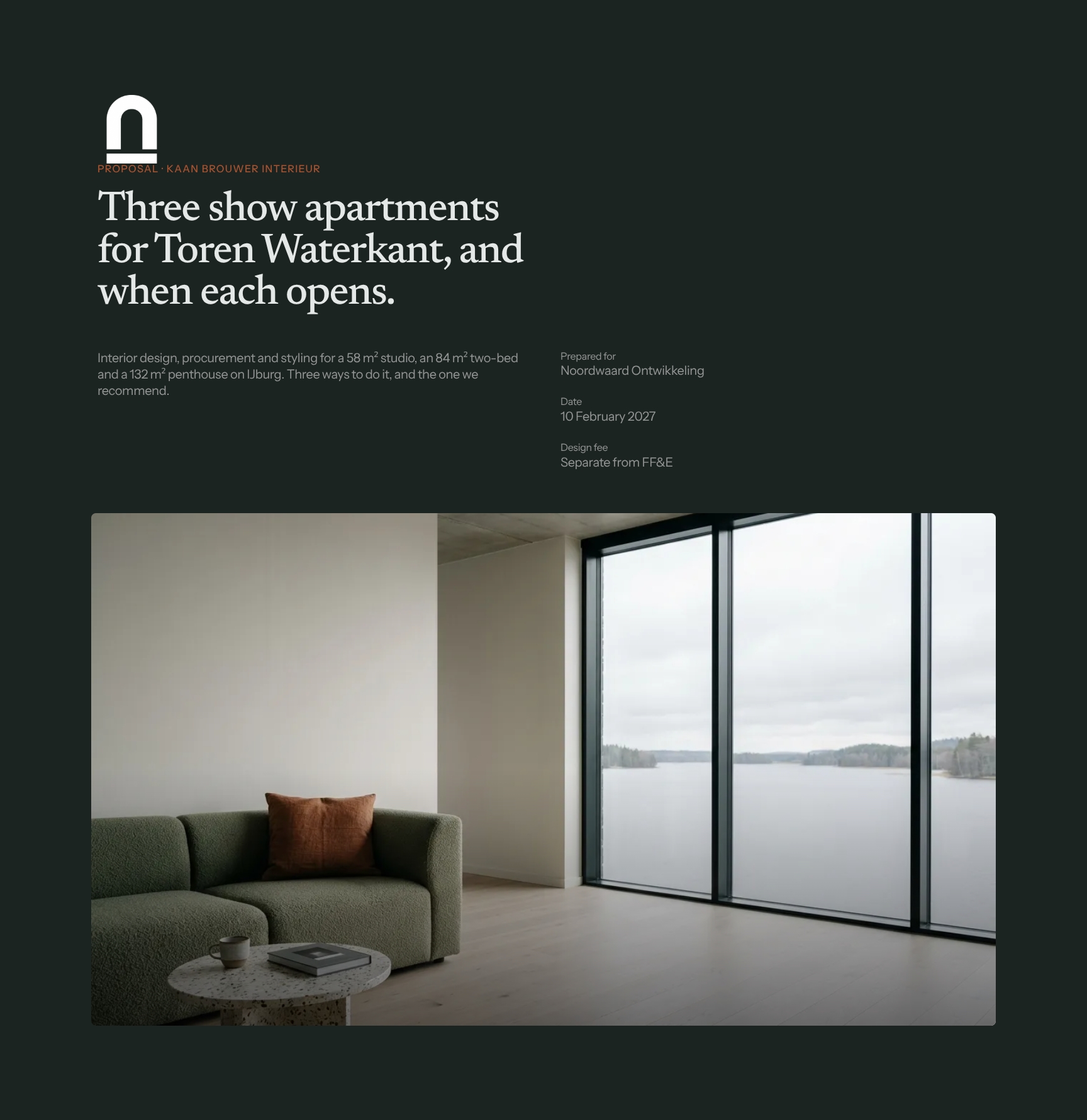
### Client Brief Summary: Three Apartments, 96 Homes
Plays the client's brief back to them: three furnished show apartments ready for the 7 June 2027 sales launch. Proves you listened and ties the design work to sales outcomes.
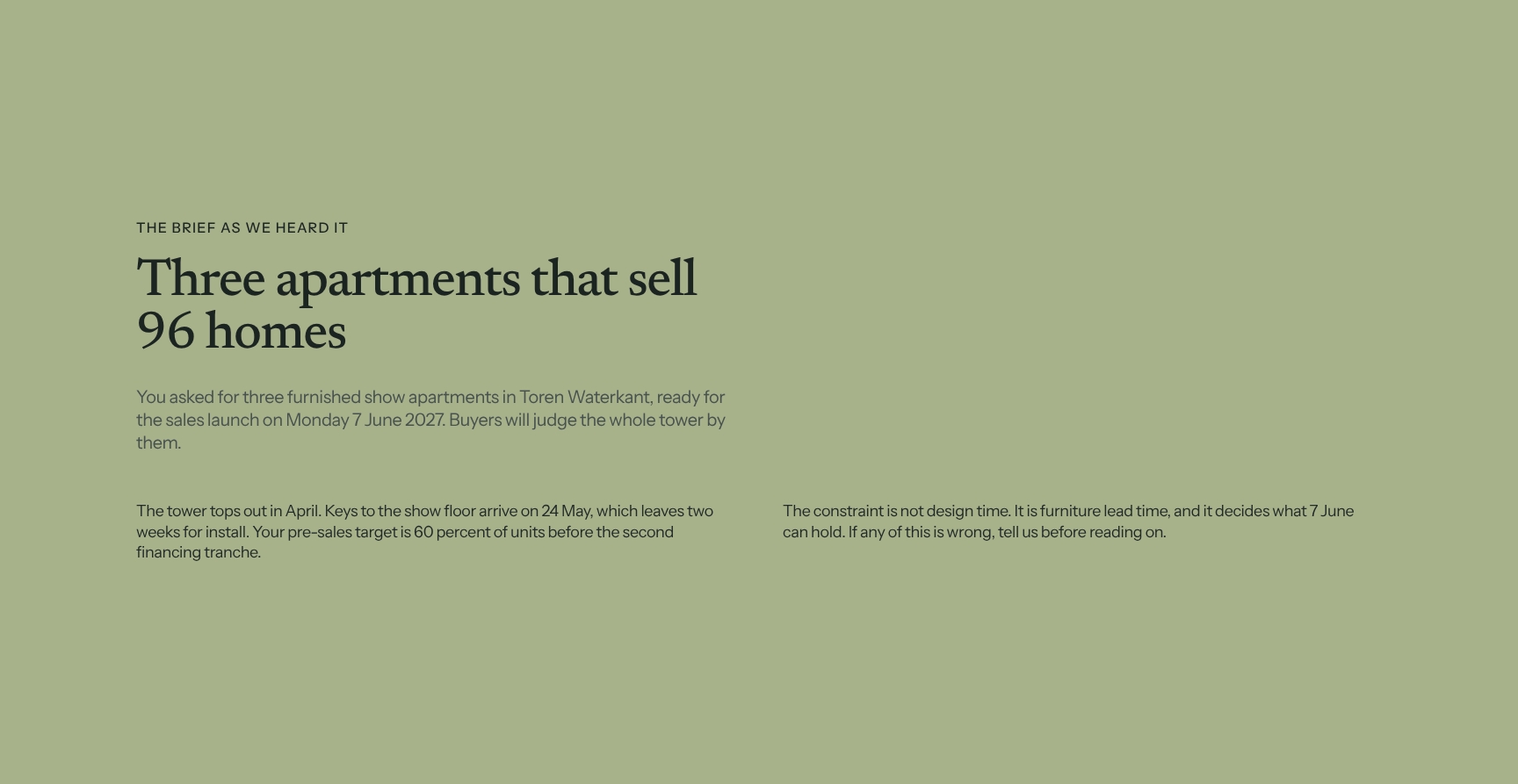
### Lead Time Constraint Statement
A single bold statement that frames the schedule risk: a sofa takes fourteen weeks to make. It positions the delivery date as the driver of every decision that follows.
### Three Delivery Options with Clear Recommendation
Compares three buildable options by what each one gives up, then recommends the third, backed by sales data: studio and two-bed types carry 81 of 96 sales. Makes the decision easy.
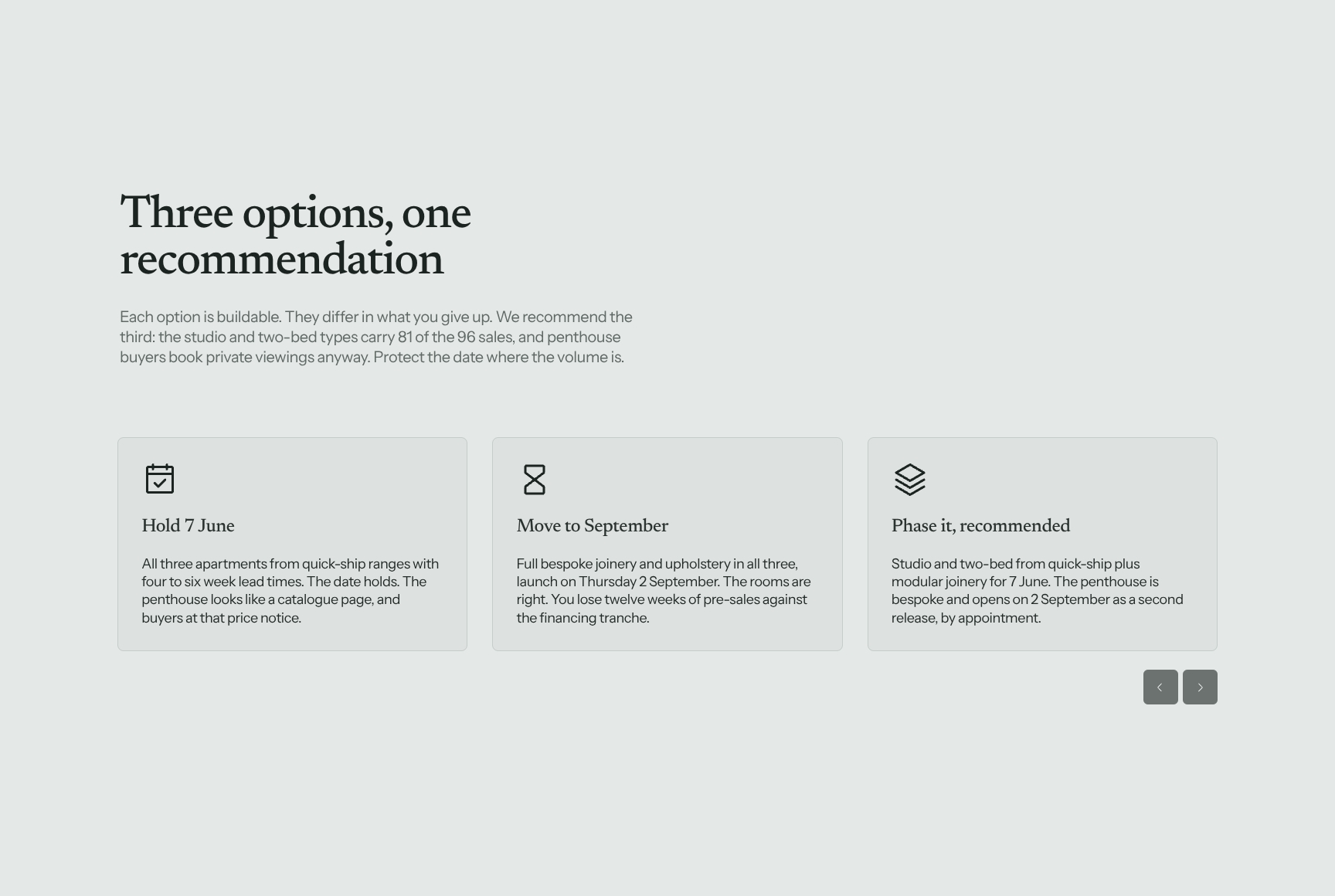
### Apartment-by-Apartment Design Breakdown and Material Palette
Details each apartment against a shared palette of pale oak, reed-green wool, rust linen and grey terrazzo. Shows how every home speaks to a different buyer while keeping the tower cohesive.
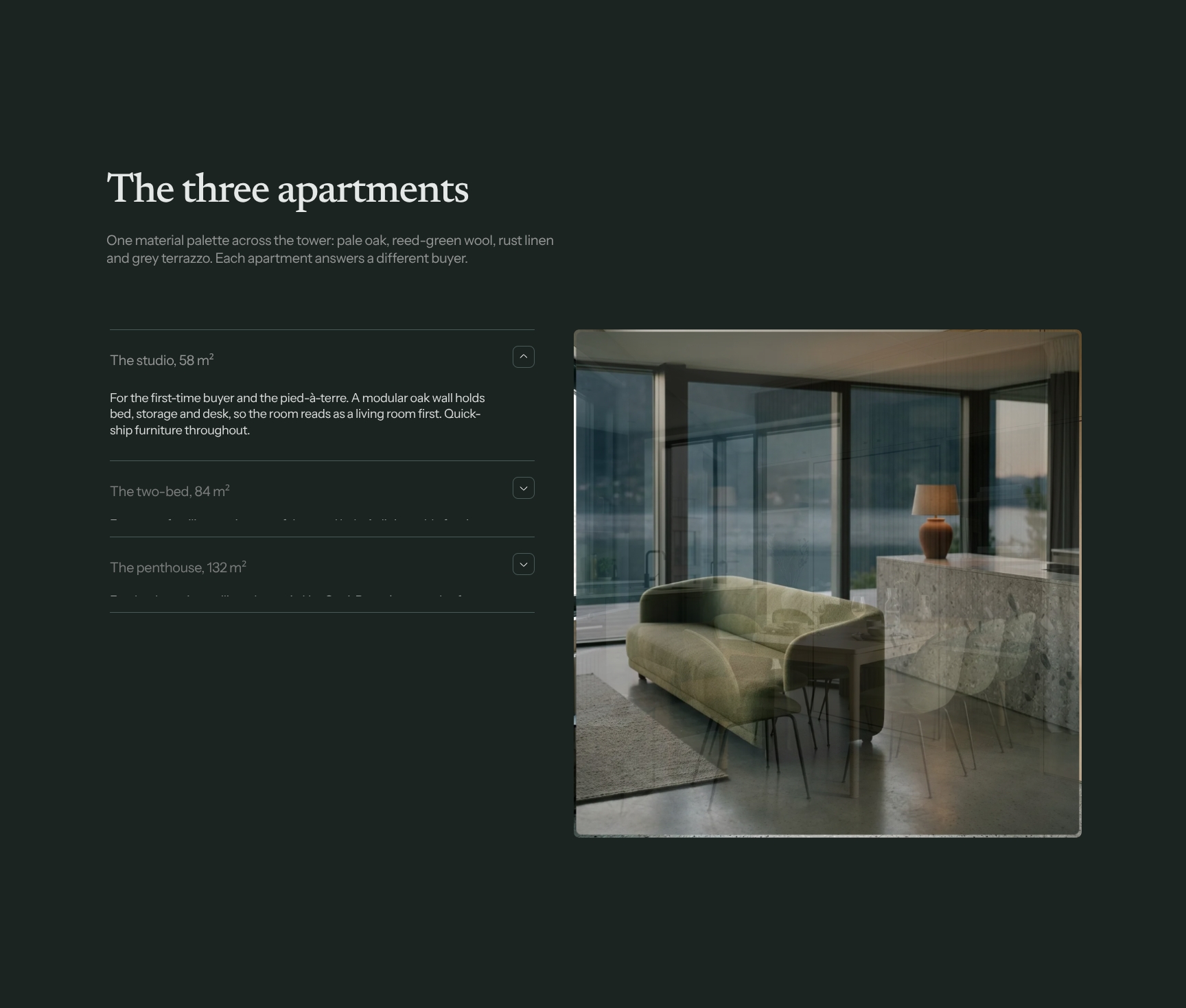
### Project Team and Working Approach
Introduces design lead Marit Kaan and procurement and site lead Sander Brouwer, plus the ten-person studio. Explains how the founders join every review with the sales team, building trust in delivery.
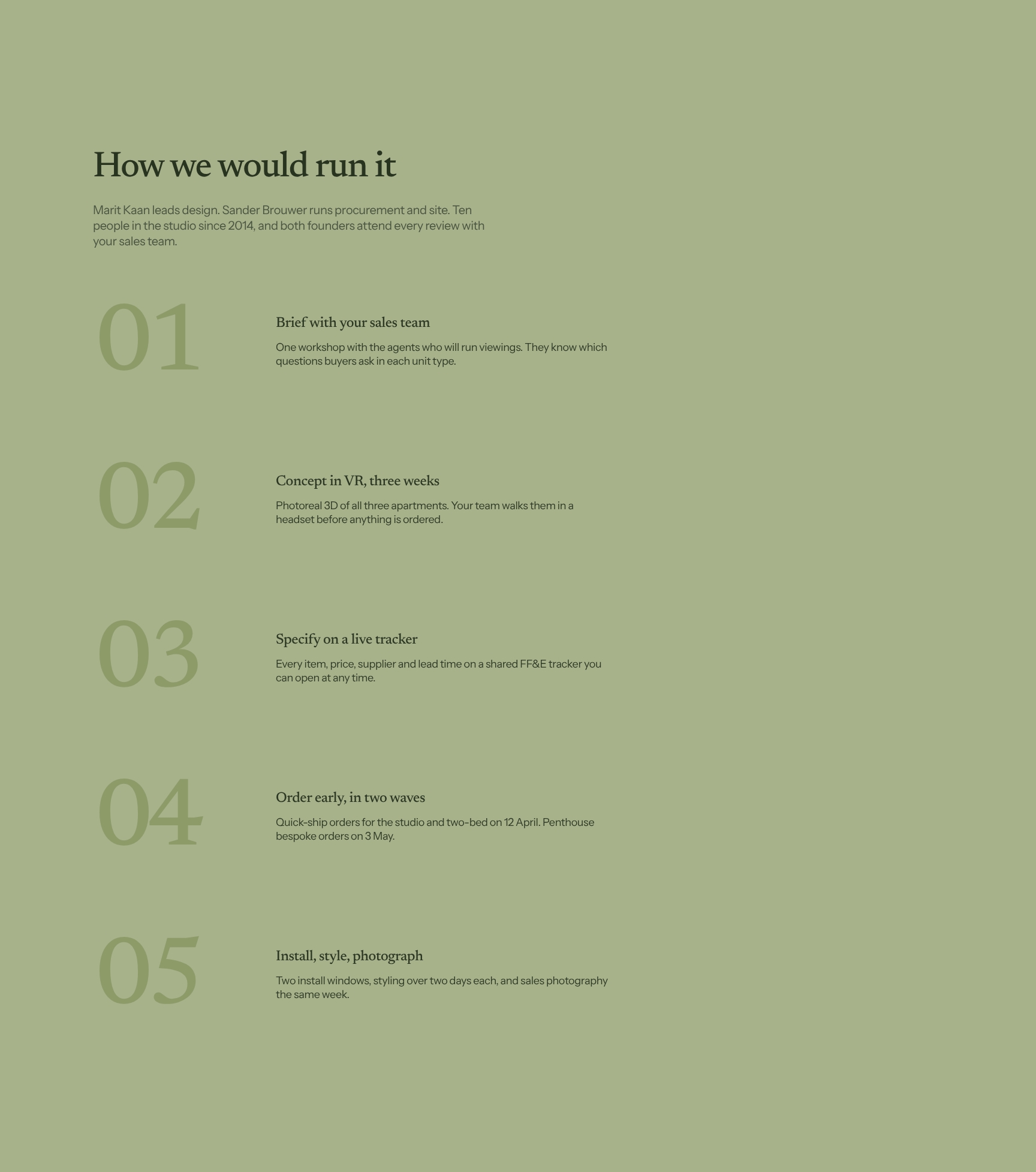
### Developer Testimonials and Sales Results
Quotes from developers the studio has furnished, with proof points such as 34 of 52 units sold in six weeks. Shows honest lead-time advice protects launches and builds credibility.
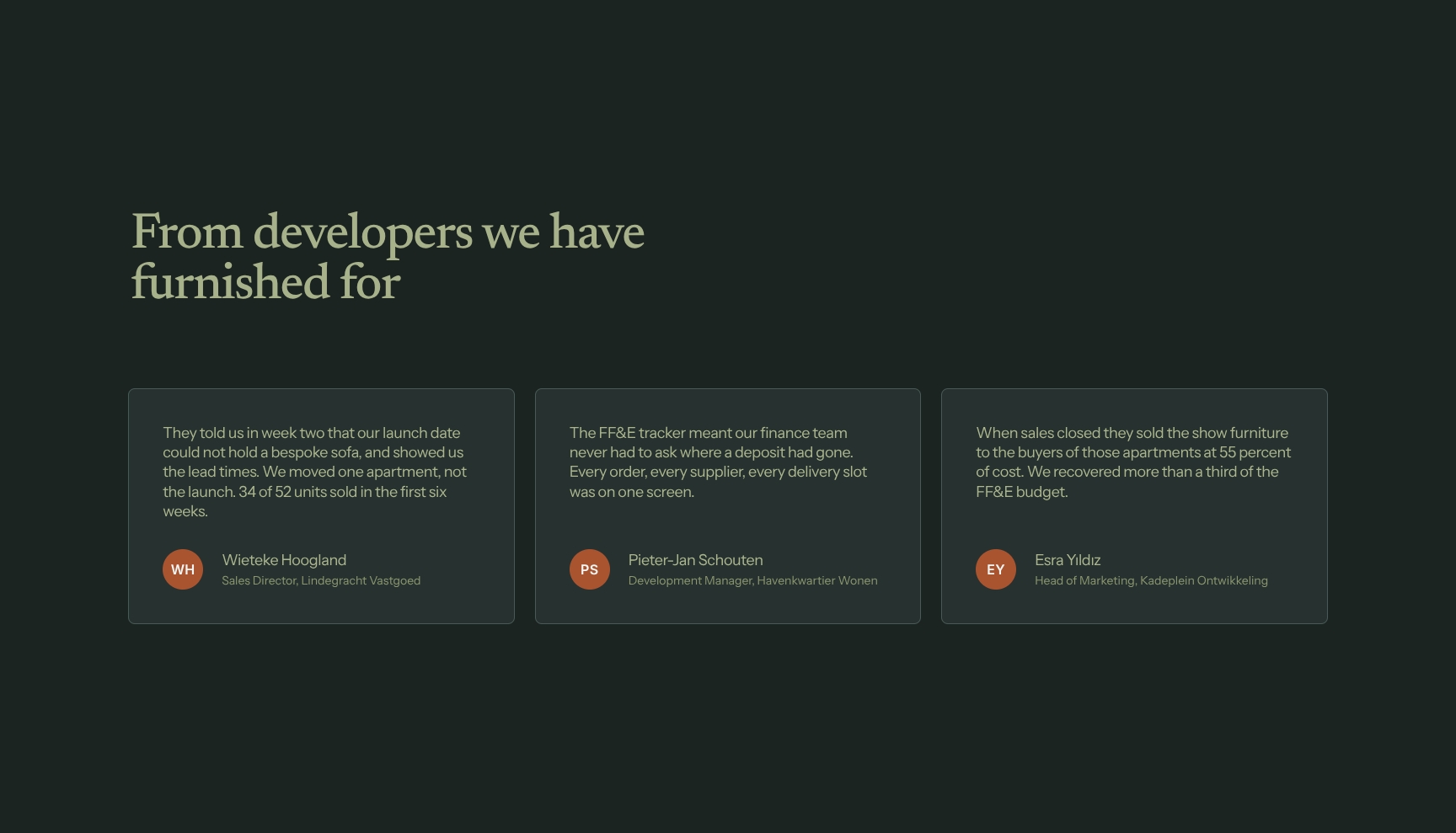
### Transparent Design Fee and FF&E Budget Pricing
Lays out day rates (senior designer €980, designer €720), the phased-option fee, and the separate €224,600 FF&E goods budget with 10 percent contingency. All in euros, excluding BTW.
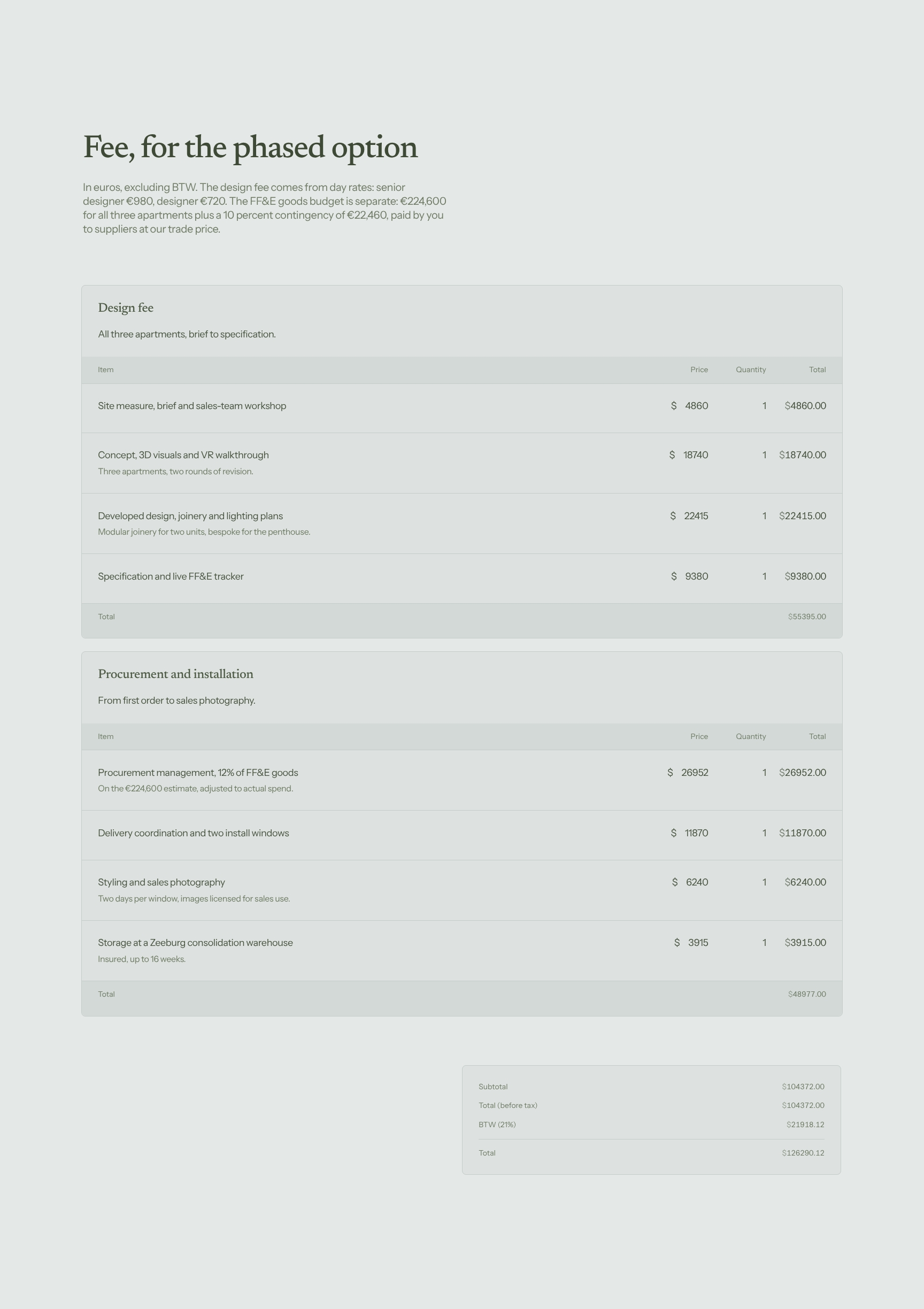
### Project Programme and Order Wave Timeline
Maps the schedule from the Monday 1 March start through two order waves: quick-ship in four to six weeks, bespoke upholstery in fourteen. States the three-working-day sign-off assumption.
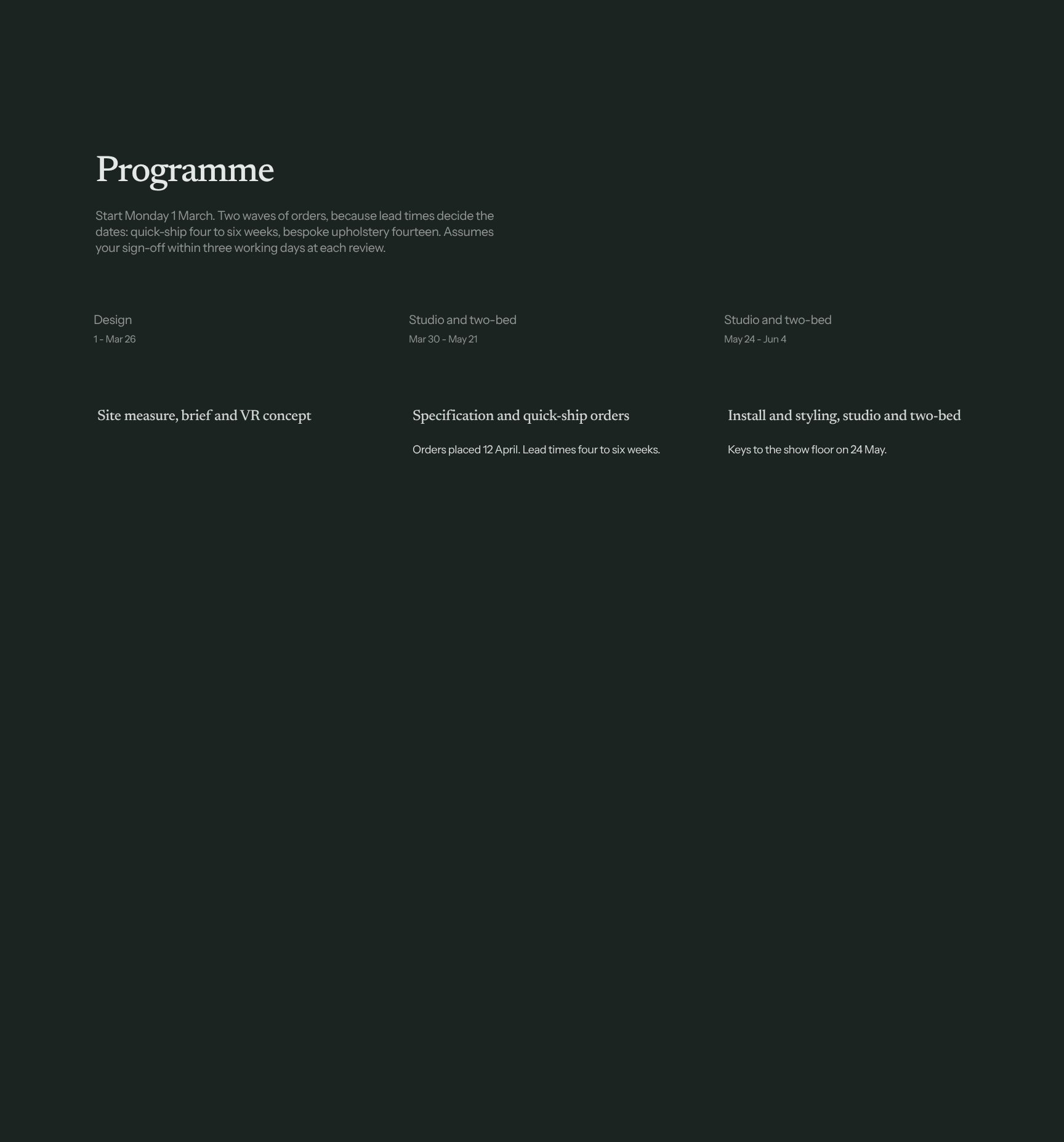
### Assumptions and Terms FAQ Accordion
Expandable terms covering what decides whether fee and dates hold, including what happens to the furniture after sales close. Keeps details accessible and removes surprises later.
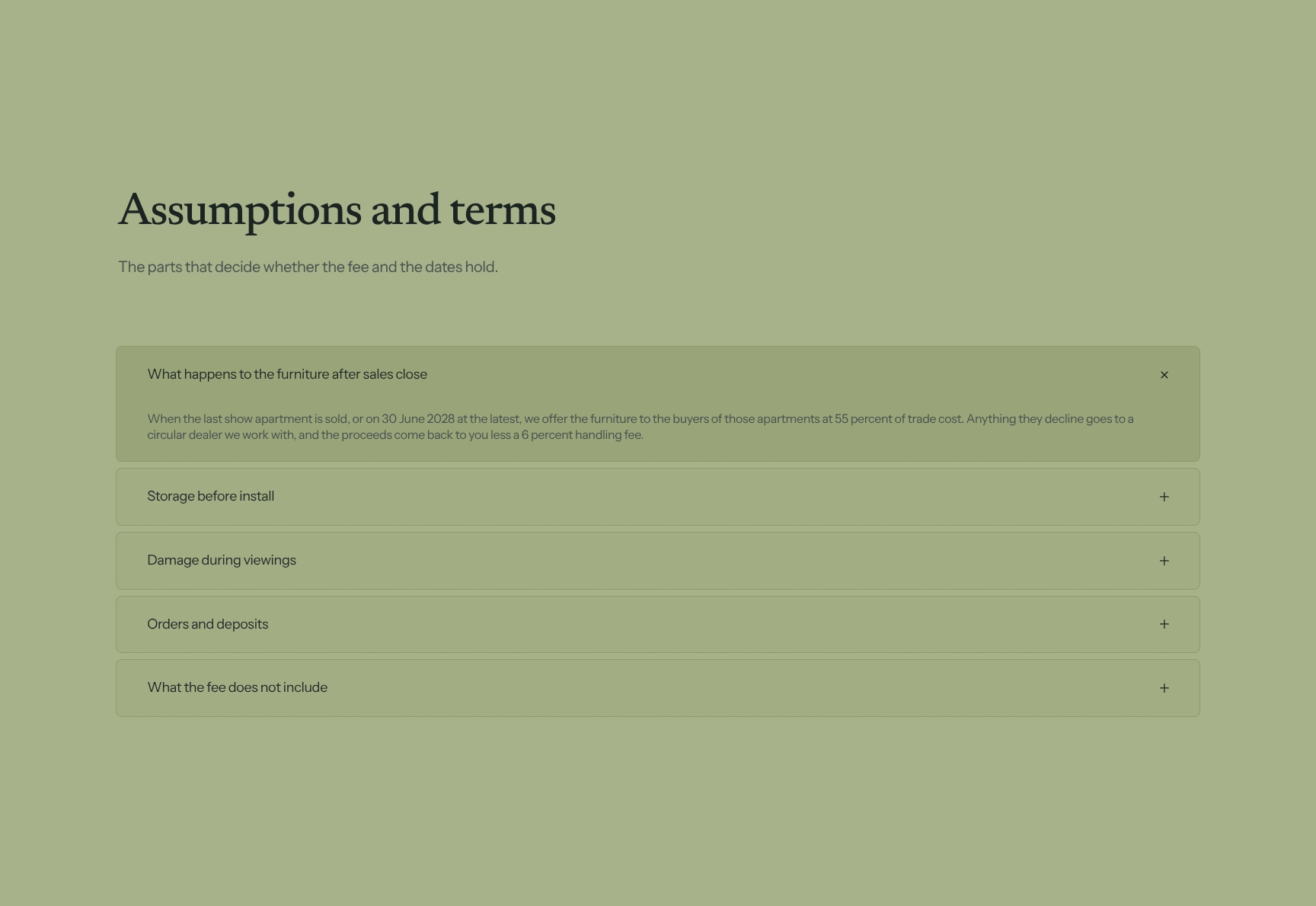
### Proposal Approval and Next Step Sign-Off
Confirms the proposal is valid until Friday 19 February 2027 and invites signature to book the first-week-of-March site measure. Offers a reissued fee if another option is preferred.
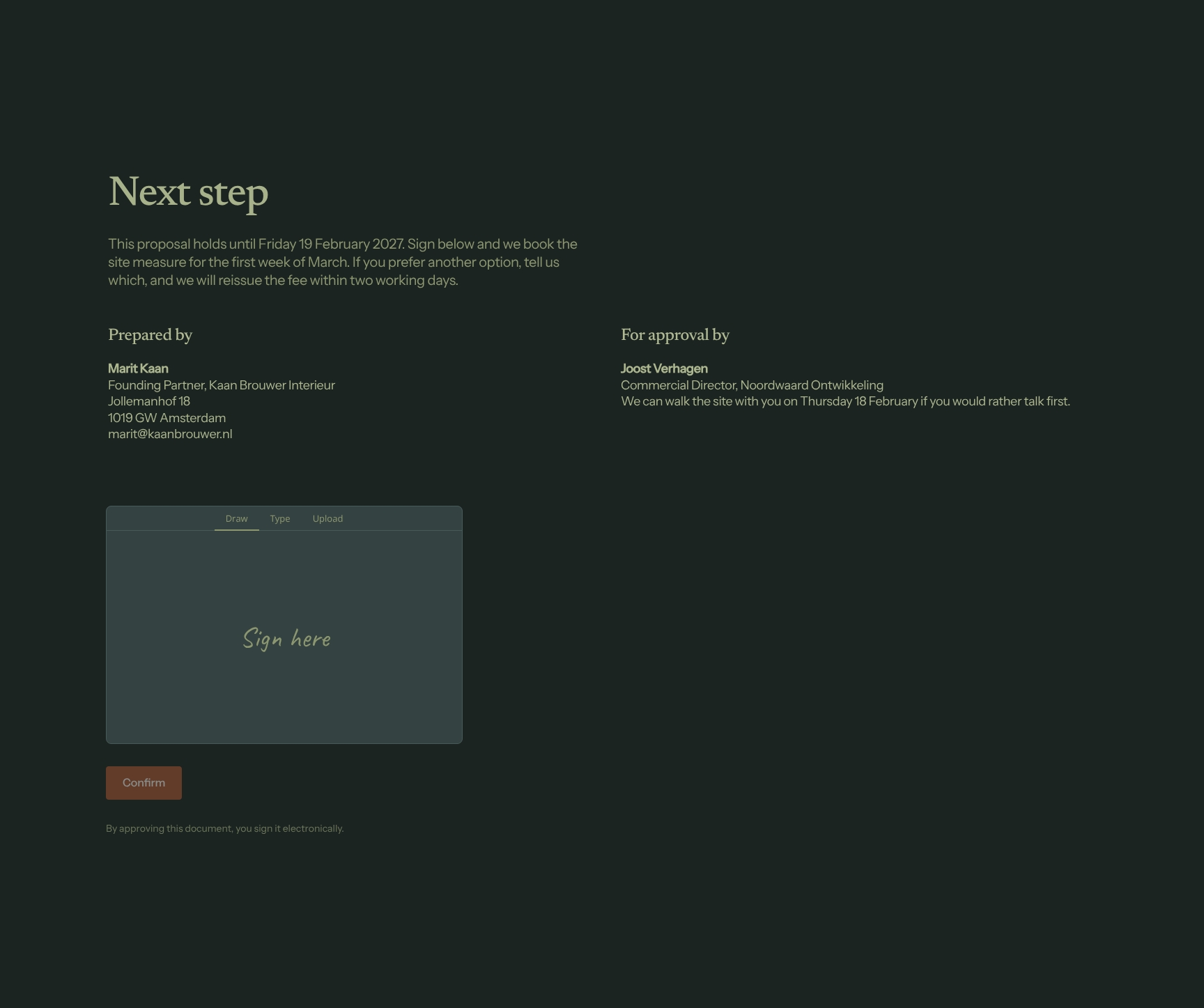
## Find your answers
Answers to common questions about writing show apartment design proposals for property developers, from lead times and FF&E to fees and approvals.
### What should be included in a design or real estate proposal?
A strong proposal opens with a cover and a clear brief that restates the client's goals. It should then outline any constraints such as budget, timeline, or site limits, and present options with a recommended approach. This template covers each of these: Cover, The brief, The constraint, Three options, The three apartments, and Approach.
### How do I customize this proposal template for my own project?
Replace the placeholder text in each section with your client's details, starting with the cover and the brief. Then update The constraint with real budget or timeline limits, and edit the three options and three apartments to match your own offerings. You can also change fonts, colors, and logos to match your brand.
### Why does a proposal offer three options instead of one?
Presenting three options gives clients a sense of choice and anchors the decision around which option fits best rather than whether to proceed. It typically includes an entry, a recommended, and a premium choice. This template's Three options section is structured to make that comparison easy to follow.
### Can I export this proposal template to PDF or other formats?
Yes, you can export the finished proposal to PDF to send to clients, which preserves layout and fonts across devices. Depending on the app you use, you may also be able to export to PowerPoint, Google Slides, or image files. Always review the exported file to confirm that spacing and images look correct.
### Is this proposal template suitable for architecture, interior design, or property projects?
Yes, the structure of a brief, a constraint, three options, and a section on the three apartments suits architects, interior designers, developers, and real estate agents. You can adapt The three apartments section to show unit types, layouts, or pricing tiers. For other industries, rename that section to present packages, sites, or deliverables.
## Related
- [Miami](https://formlio.com/templates/miami-ffe-procurement-statement-of-work): FF&E procurement statement of work for designers
- [Chicago](https://formlio.com/templates/chicago-workplace-interior-design-proposal): Workplace interiors proposal for law firms
- [Lisbon](https://formlio.com/templates/lisbon-interior-design-proposal): Full-service interiors proposal for homeowners
- [Stockholm](https://formlio.com/templates/stockholm-restaurant-interior-proposal): Restaurant interior concept proposal for chefs
- [London](https://formlio.com/templates/london-interior-design-retainer-proposal): Monthly design retainer for hospitality clients
- [Melbourne](https://formlio.com/templates/melbourne-interior-design-portfolio): Capabilities portfolio for interior design studios
---
---
title: "Chicago"
description: "Win law firm clients with an interior design proposal template covering office relocation, space planning, fee and move-in schedule. Built for design studios."
canonical: "https://formlio.com/templates/chicago-workplace-interior-design-proposal"
locale: "en"
type: "template"
lastModified: "2026-10-22"
category: "Interior design"
alternates:
fr: "https://formlio.com/fr/templates/chicago-proposition-damenagement-de-bureaux.md"
---
# Chicago
Law Firm Interior Design Proposal Template
Win law firm clients with an interior design proposal template covering office relocation, space planning, fee and move-in schedule. Built for design studios.
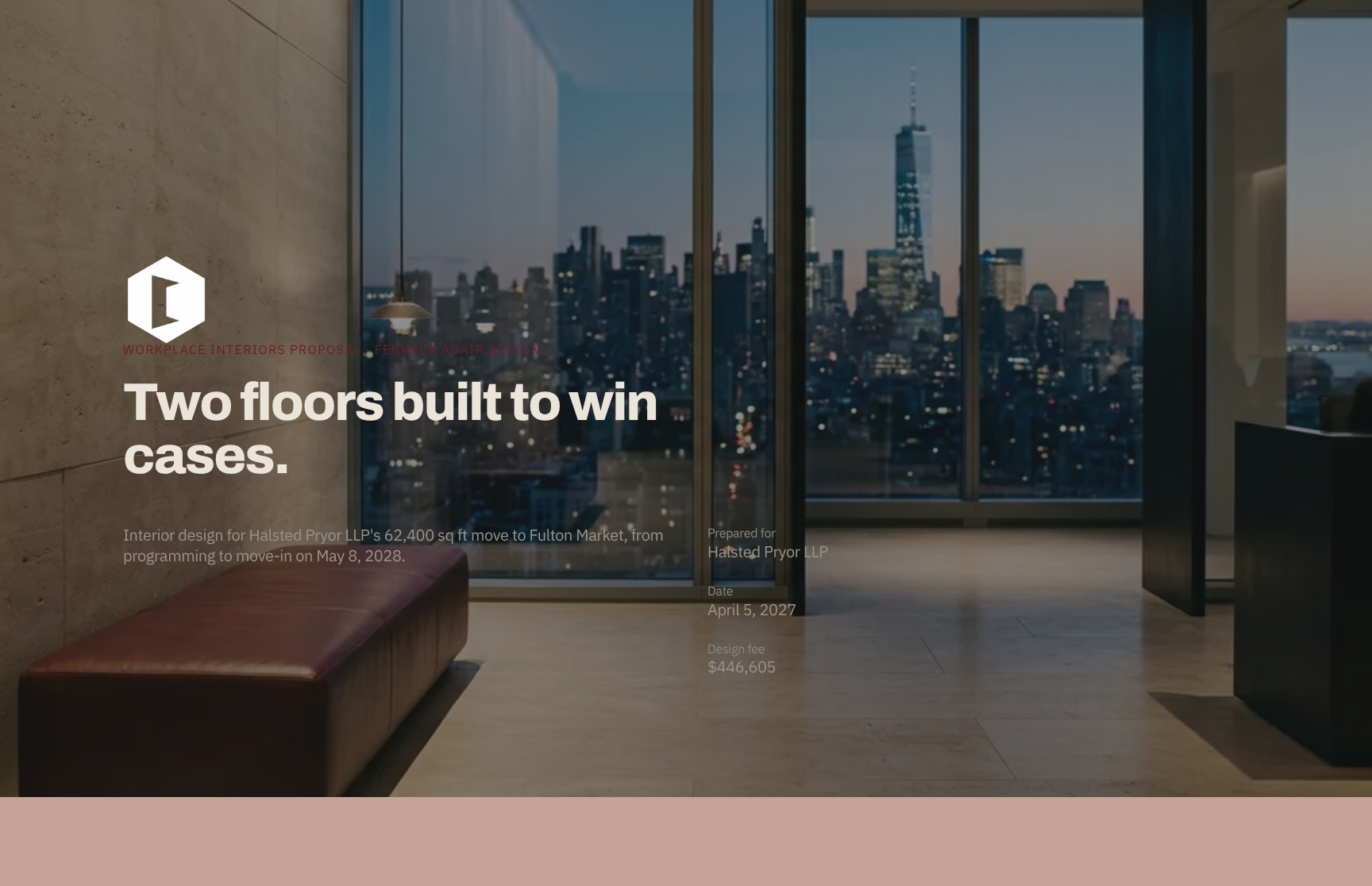
- [Use this template](https://formlio.com/workspaces/claim?template=chicago-workplace-interior-design-proposal)
- [Live preview](https://formlio.com/documents/chicago-workplace-interior-design-proposal)
- **Categories:** [Interior design](https://formlio.com/templates/interior-design), [Proposals](https://formlio.com/templates/proposals)
- **Document goal:** Win law firm clients with a proposal that lays out space planning, fees, and move-in dates.
- **Blocks:** Typewriter, Single column, Scroll gradient, Masonry, Fullscreen, Itemized quote, Gantt, Left-aligned, E-signature
- **Palette:** Warm Parchment Light (#EAE4D9), Dusty Rose Accent Light (#C7A296), Signature Burgundy (#6B1E24), Deep Oxblood Accent Dark (#3D1216), Charcoal Ink Dark (#1B1D1F)
## Get more from every document
Pitch a law firm on its next office and show exactly how you'll get them moved in on time. Fee tables, a milestone timeline, and e-signature approval sit ready below.
### Get the yes without leaving the page
Your client reads the scope, checks the price, and signs in the agreement section. No PDF printing, no email chase.
### Build proposals from blocks you trust
Drop in pricing tables, step timelines, and testimonials, then save your best-performing sections to reuse on the next pitch.
### Your pitch looks sharp on any screen
Your hero, pricing cards, and showcase hold their shape when a client opens the proposal on a phone between meetings.
### See which section sells the deal
Watch where prospects pause on pricing or replay the showcase, then follow up while your proposal is still on their mind.
### Know the moment they open it
Get a ping when a client views your proposal, leaves a comment on the scope, or signs the agreement.
### Write the proposal together, live
Your designer tweaks the showcase while you rework pricing and a teammate polishes the steps, all in the same document.
## See how every part fits
The proposal opens with the project scope and move-in date, then builds through the client brief, your concept, and proof, and closes on a signature deadline. Keep, drop, or reorder anything to fit the firm you're pitching.
### Workplace Interiors Proposal Cover with Project Scope and Move-In Date
Opens with the firm, the client and the 62,400 sq ft Fulton Market move. Sets the May 8, 2028 move-in date up front so the proposal reads as a plan to deliver, not a pitch.
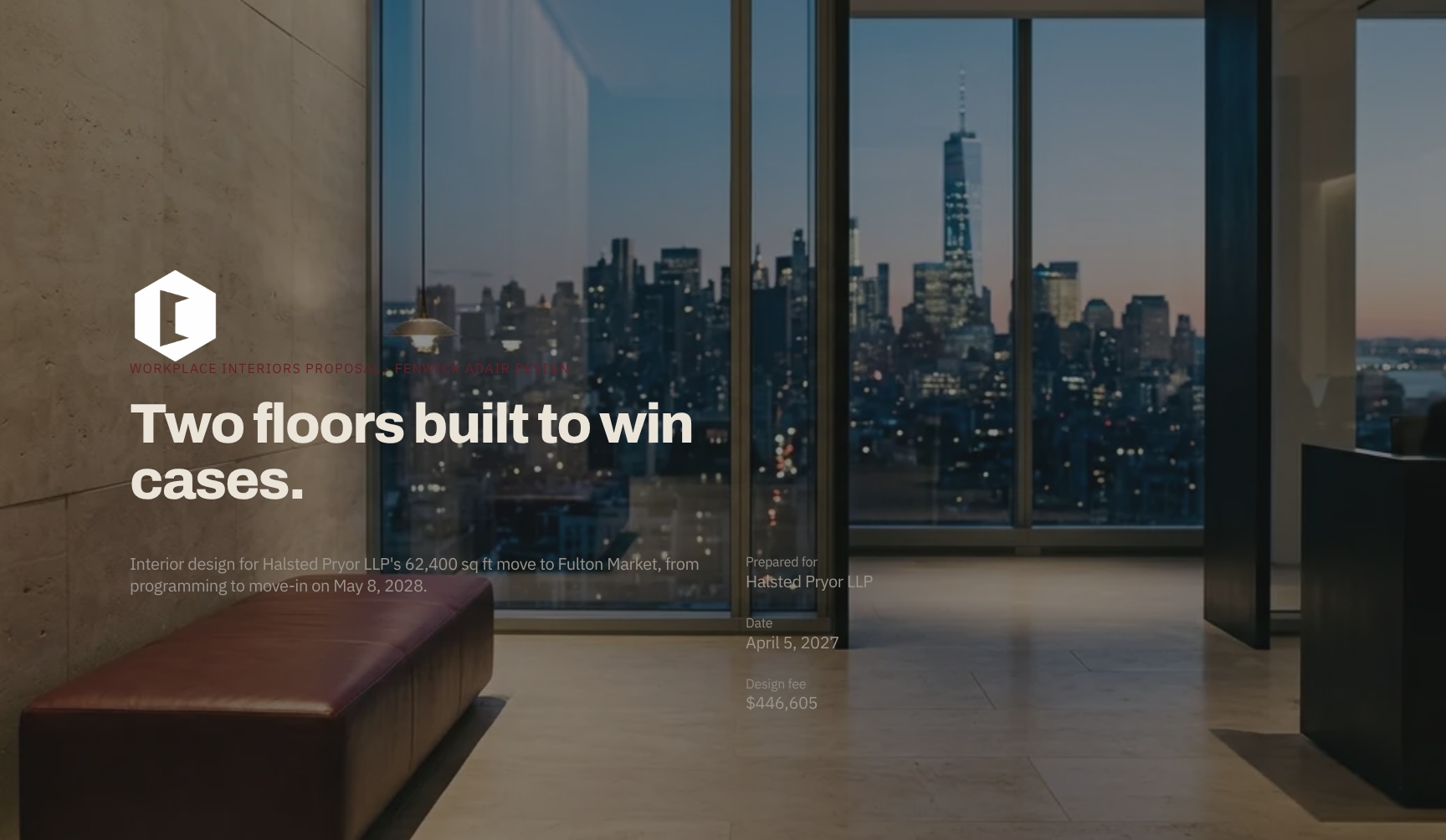
### Client Brief Summary: Law Firm Relocation Goals and Constraints
Restates the brief: 140 lawyers consolidating from four floors to two, with the same headcount and a fixed deadline. Shows the client they were heard and frames the problem before any solution.
### Design Concept: The Litigation Floor as a War Room
A single animated statement of the core design idea for a litigation-focused workplace. It gives the client a memorable concept to rally around and sets the tone for the design decisions that follow.

### About the Design Studio: Law Firm Interior Specialists
Introduces the twelve-person studio, its founders and its focus on law and advisory firms. Because principals lead every project and move-ins land on time, it builds confidence in who will do the work.
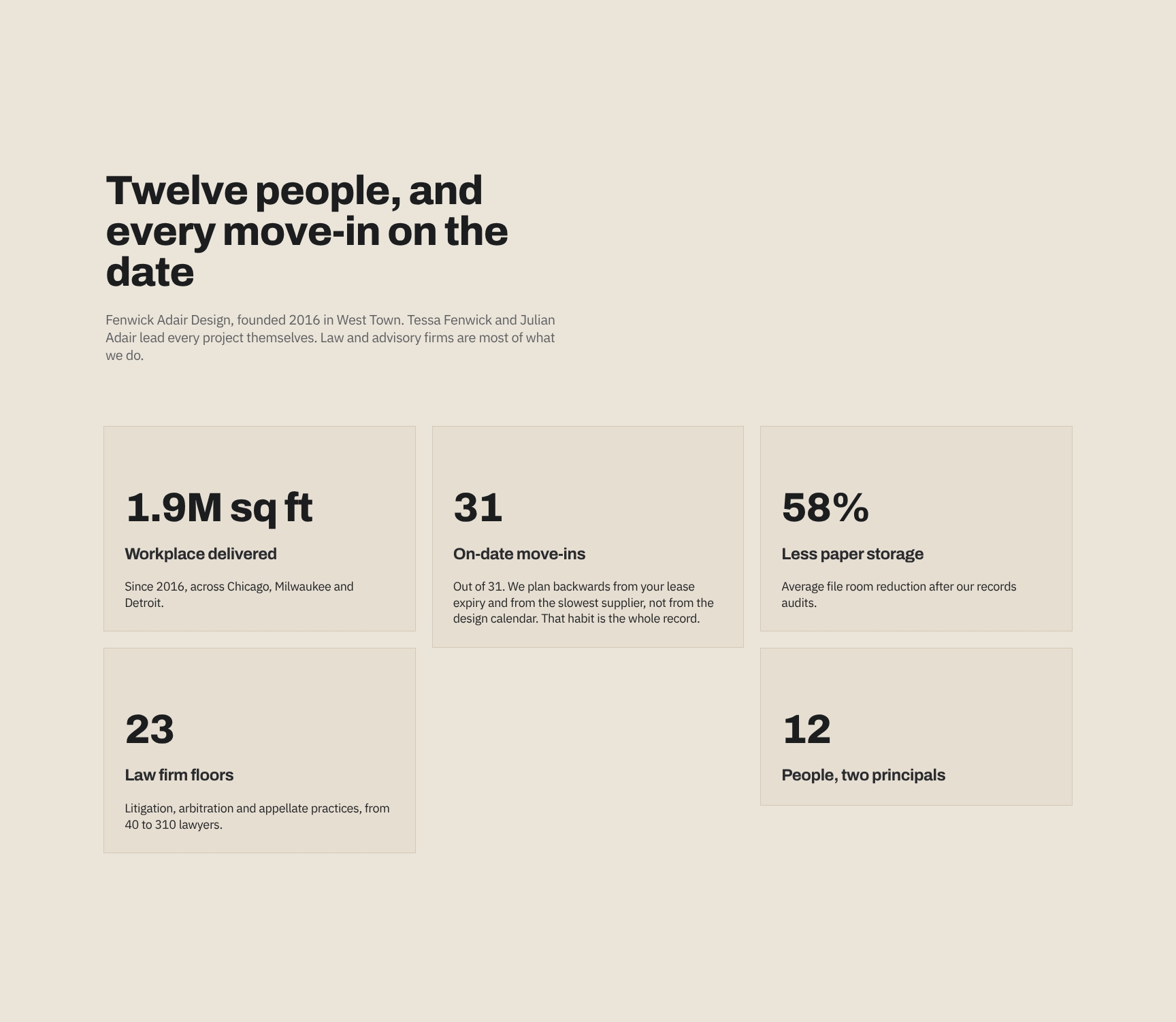
### Selected Law Firm Projects and Measurable Results
Case studies of comparable legal workplace projects, with outcomes such as consolidated floors, retained partner offices and rent savings. Concrete proof that the studio has solved this exact problem.
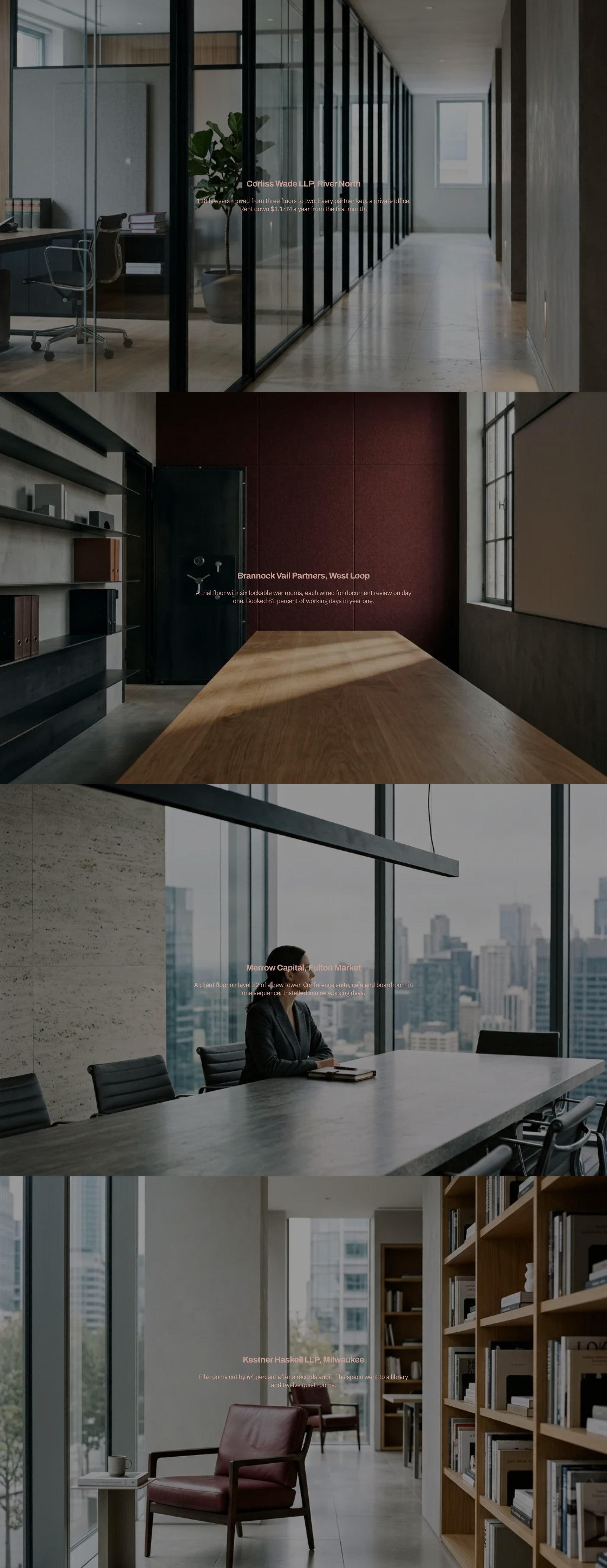
### Design and Delivery Approach: Phased Plan Built Around Furniture Lead Times
Walks through each project phase, sized around 12 to 16 week workstation and 10 week millwork lead times. Explains why furniture is locked early, so the client sees how the schedule is protected.
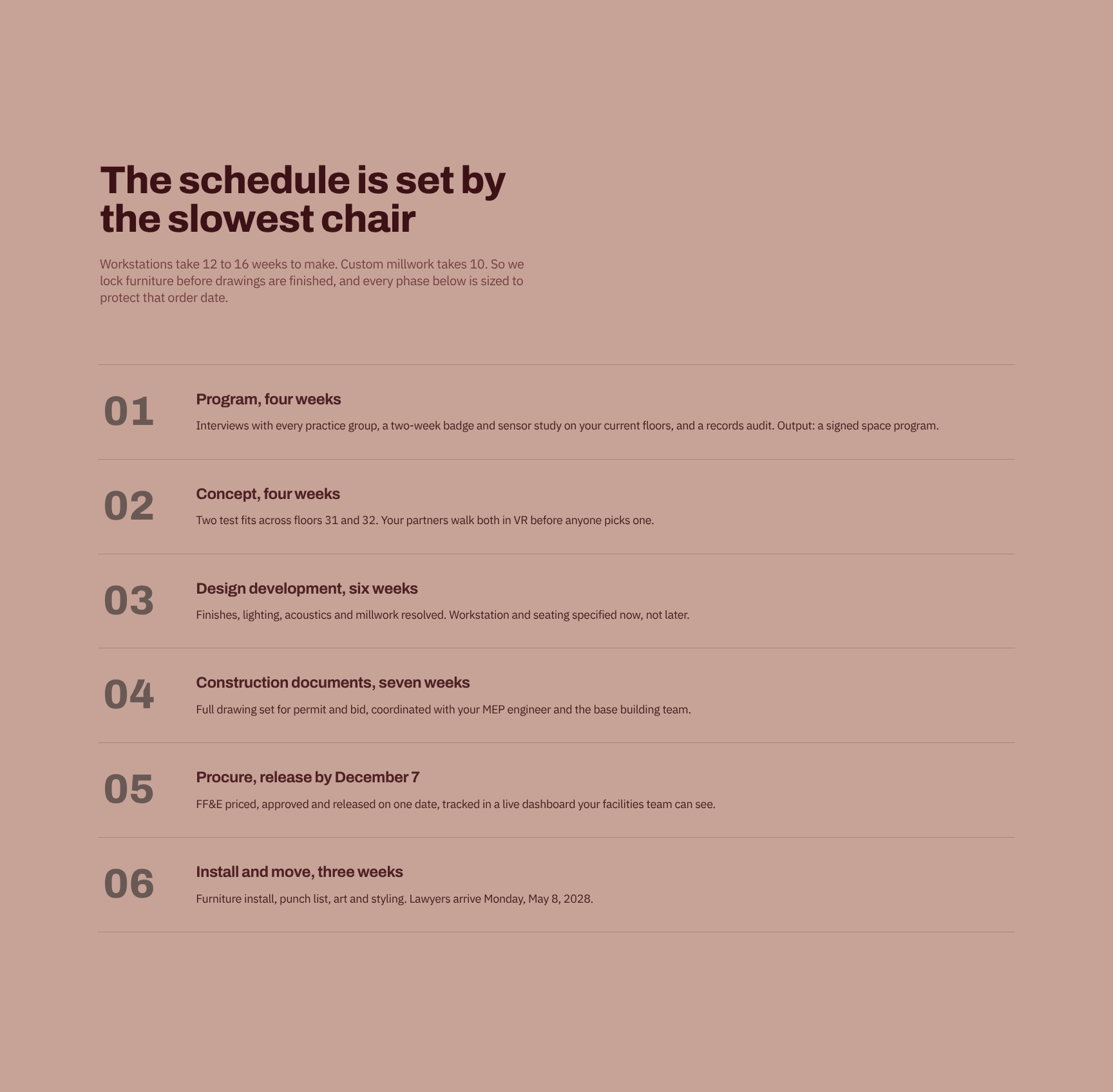
### Client Testimonials from Law Firm Managing Partners
First-hand quotes from COOs and managing partners on schedule reliability and problem-solving. Third-party endorsement reduces perceived risk and backs up the on-time delivery promise.
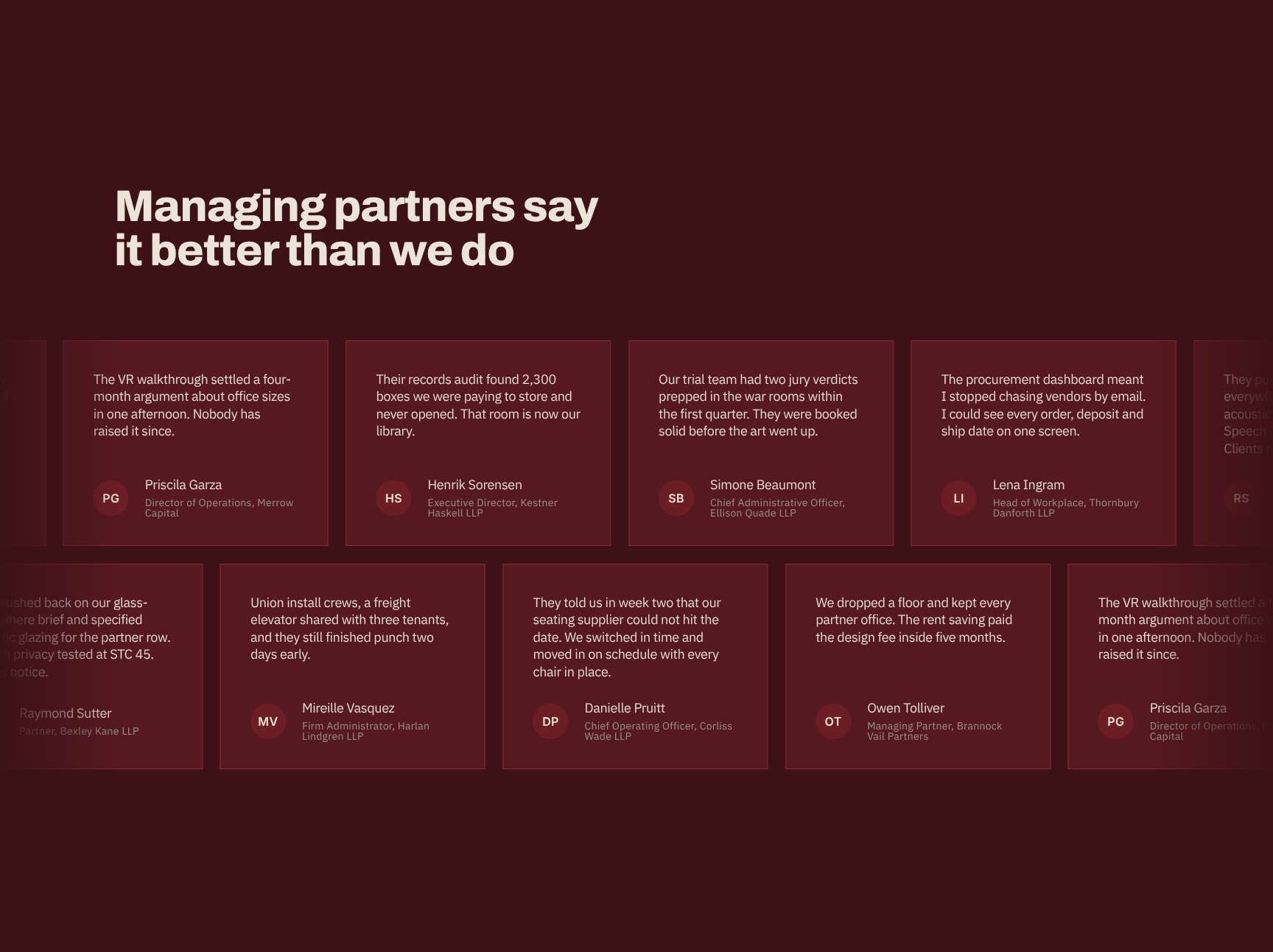
### Fixed Design Fee Pricing with Hourly Rates and Separate FF&E Budget
A transparent fixed fee of $7.16 per sq ft across 62,400 sq ft, with principal and designer rates shown. Furniture budget stays separate and under client control, so there are no pricing surprises.
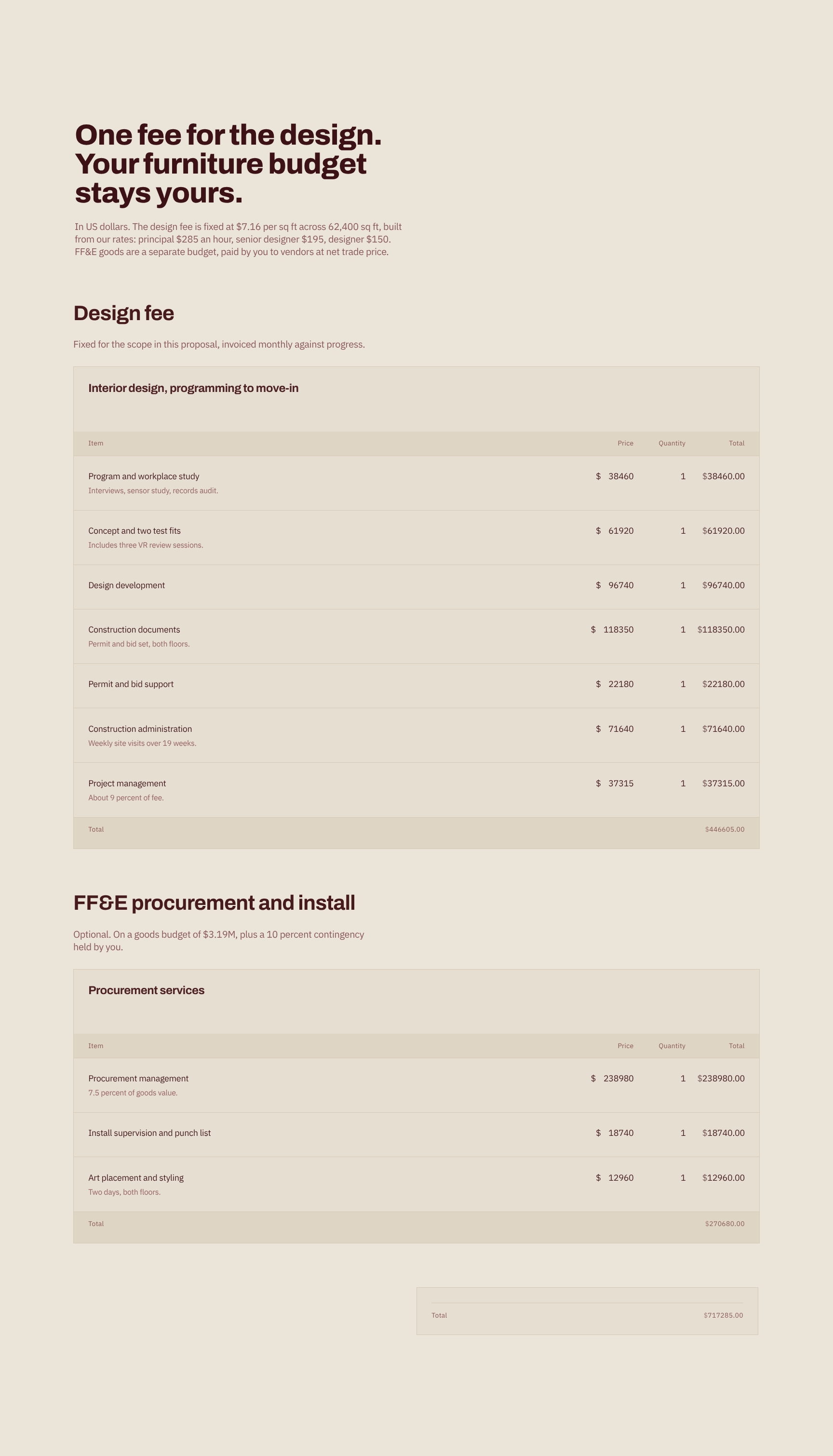
### Project Programme and Timeline: Key Milestones to May 8 Move-In
A dated schedule built around the December 7 FF&E order release, the milestone that decides move-in success. States the feedback assumptions so the client knows what keeps the project on track.
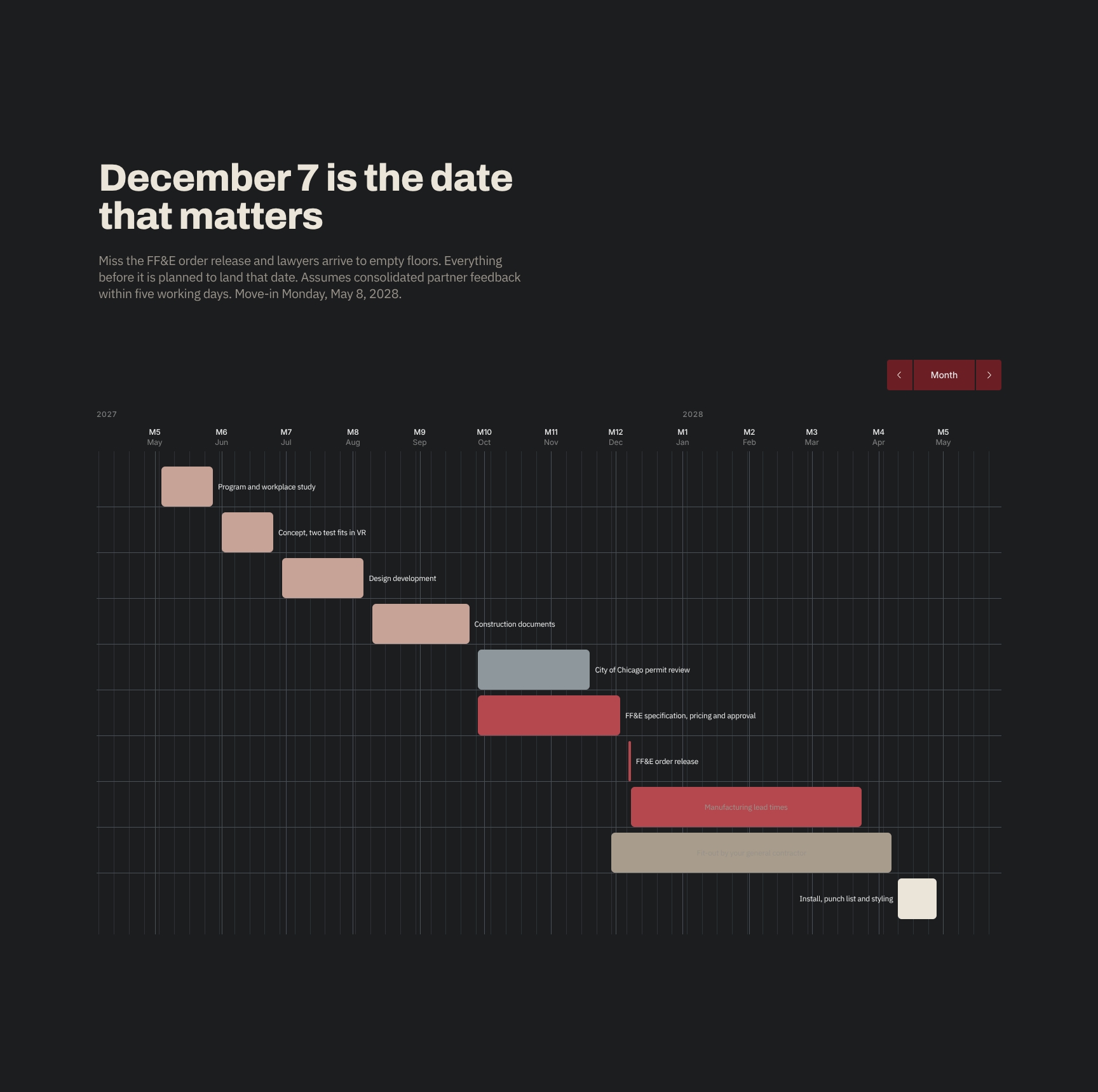
### Terms, Assumptions and FAQ in Plain Language
Expandable answers on the FF&E budget, change control and what keeps the fee and move-in date intact. Clear terms head off disputes and answer common client questions before they are asked.
### Proposal Approval and E-Signature with April 30 Deadline
The closing step: proposal validity through April 30, 2027, a signature block and a May 4 kickoff. Includes an offer to walk floor 31, giving the client a clear, low-friction way to say yes.
## Find your answers
Answers to common questions about pitching and winning workplace interior design projects for law firms.
### What should be included in a creative proposal template?
A strong creative proposal includes a cover, the client's brief, your core idea, a studio introduction, selected work samples, and your approach. This template covers all six sections in a logical order. Together they show you understand the problem, have a clear solution, and can deliver it.
### How do I customize this proposal template for my studio?
Replace the placeholder text in each section with your own copy, then swap in your logo, brand colors, and fonts on the cover and throughout. Update the Selected work section with images and short case studies that match the client's industry. You can duplicate, reorder, or delete sections to fit each pitch.
### Can I export this proposal template to PDF or other formats?
Yes, you can export the finished proposal as a PDF to send to clients, which keeps layout, fonts, and images intact. Depending on your editing software, you can also export to formats like PowerPoint or Google Slides for collaborative edits. Always check the PDF file size before emailing, since image-heavy portfolios can be large.
### Is this proposal template suitable for design agencies, freelancers, and other industries?
Yes, it works well for design studios, branding agencies, freelancers, photographers, and marketing consultancies. The structure of brief, idea, studio, work, and approach applies to any service business pitching a project. Adjust the tone and examples in each section to reflect your industry and client.
### How long does it take to complete this proposal template?
Most users can finish a tailored proposal in 1 to 3 hours once their studio bio and portfolio samples are ready. The Brief and Idea sections take the most time because they should be customized for each client. Reusing the Studio and Selected work sections speeds up future proposals.
## Related
- [Miami](https://formlio.com/templates/miami-ffe-procurement-statement-of-work): FF&E procurement statement of work for designers
- [Amsterdam](https://formlio.com/templates/amsterdam-show-apartment-design-proposal): Show apartment design proposal for property developers
- [Lisbon](https://formlio.com/templates/lisbon-interior-design-proposal): Full-service interiors proposal for homeowners
- [Stockholm](https://formlio.com/templates/stockholm-restaurant-interior-proposal): Restaurant interior concept proposal for chefs
- [London](https://formlio.com/templates/london-interior-design-retainer-proposal): Monthly design retainer for hospitality clients
- [Melbourne](https://formlio.com/templates/melbourne-interior-design-portfolio): Capabilities portfolio for interior design studios
---
---
title: "Lisbon"
description: "Win residential clients with an interior design proposal template covering brief, materials, timeline and team. Ideal for studios downsizing homes."
canonical: "https://formlio.com/templates/lisbon-interior-design-proposal"
locale: "en"
type: "template"
lastModified: "2026-10-21"
category: "Interior design"
alternates:
fr: "https://formlio.com/fr/templates/lisbon-proposition-de-decoration-dinterieur.md"
---
# Lisbon
Interior Design Proposal Template for Residential Projects
Win residential clients with an interior design proposal template covering brief, materials, timeline and team. Ideal for boutique studios and apartment projects.

- [Use this template](https://formlio.com/workspaces/claim?template=lisbon-interior-design-proposal)
- [Live preview](https://formlio.com/documents/lisbon-interior-design-proposal)
- **Categories:** [Interior design](https://formlio.com/templates/interior-design), [Proposals](https://formlio.com/templates/proposals)
- **Document goal:** Win residential clients with a proposal that lays out your brief, materials, timeline and team.
- **Blocks:** Highlight, Single column, Rectangle reveal, Grid tile scroll, Spotlight, Itemized quote, Gantt, Left-aligned, E-signature
- **Palette:** Warm Parchment Light (#F3F1EB), Sandstone Accent Light (#D7B893), Primary Brand Teal Blue (#1D4E6D), Deep Navy Accent (#12334A), Midnight Ink Dark (#0A1822)
## Get more from every document
Turn a homeowner's first conversation into a signed residential design engagement. Inside you get a materials gallery, clear pricing, a dated programme, and an approval step that closes the deal.
### Get a yes without leaving the page
Your client reads the pricing, scrolls to the agreement, and signs right there. No PDF download, no printing, no waiting.
### Build proposals from blocks you trust
Pull in a pricing table, steps, or testimonials in one click, then save your best versions to reuse on every pitch.
### Your pitch reads well on any screen
The client opens your proposal on a phone between meetings and the gallery, pricing, and steps still fit the screen.
### See which section sells your proposal
Heatmaps show if they lingered on pricing, and session replays let you watch the read, so your follow-up lands at the right time.
### Know the moment they open it
Get pinged when a client views your proposal, leaves a comment, or signs the agreement, so you can reply while it's fresh.
### Write the proposal together, live
Your designer tweaks the gallery while you rework the pricing, and you both see each change as it happens before sending.
## See how every part fits
The proposal opens with your cover and the client's brief, moves through concept, materials, process and pricing, and closes on a signature. Keep what fits the project, drop what doesn't, and reorder anything.
### Interior Design Proposal Cover with Project Overview
A polished cover introducing Estúdio Albarrã and the Cascais sea-view apartment project. It frames the full-service interiors offer, from first brief to the last cushion, and sets a confident, personal tone from page one.
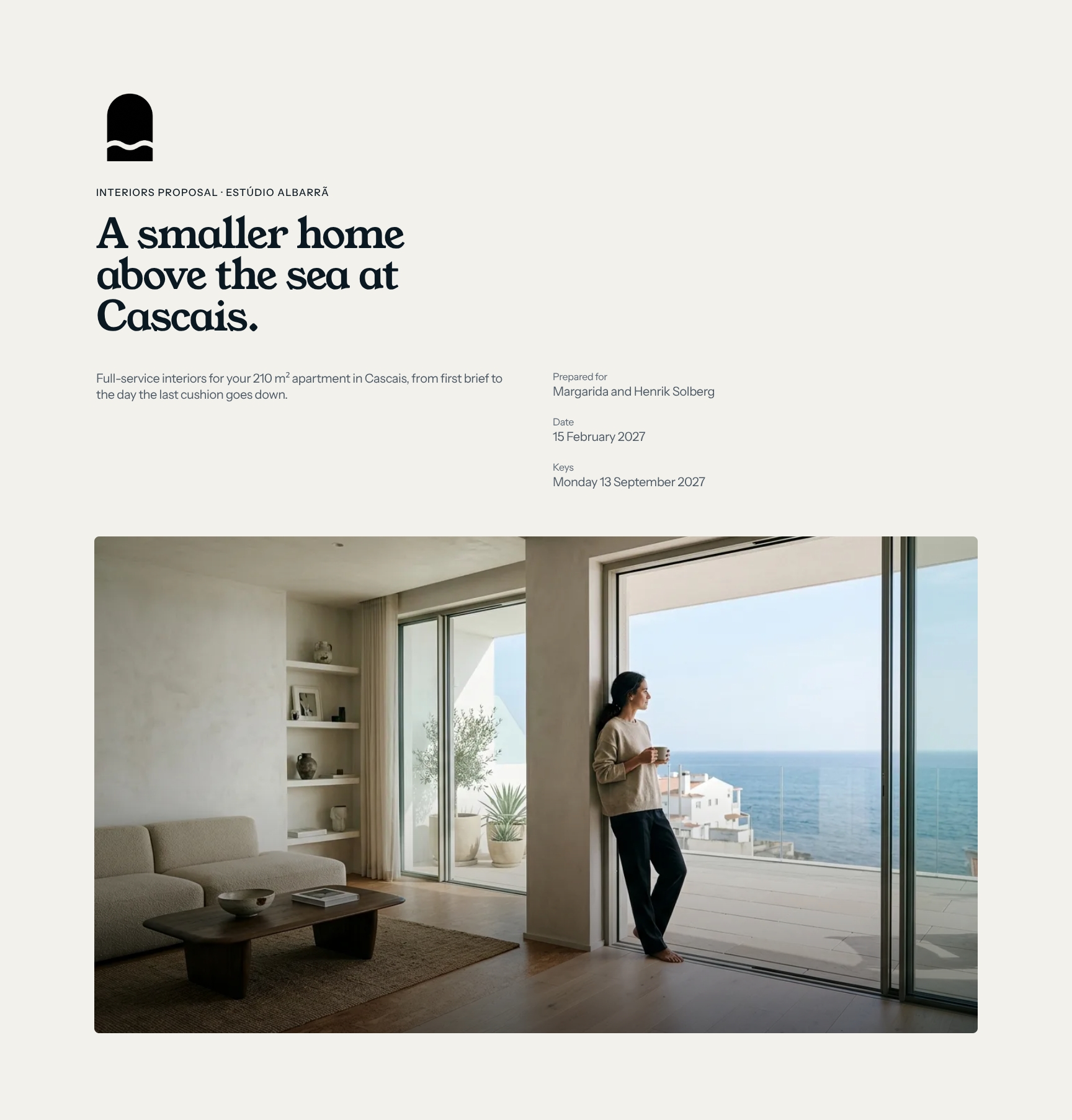
### Client Brief Summary: Downsizing Without Compromise
Reflects the client's needs back to them: moving from 420 m² to 210 m², three bedrooms, a sea-facing terrace and a fixed key date. It shows you listened and aligns both sides before design begins.
### Design Concept Statement and Guiding Idea
An animated statement of the core design idea: keeping the life you love in half the house. It gives the proposal an emotional anchor and makes the studio's creative vision memorable.
### Coastal Materials Palette Gallery
A visual gallery of six sea-air-ready materials: cork, oak, lime, Estremoz stone, linen and blue glaze. It shows taste and practicality, and promises physical samples once the concept is approved.
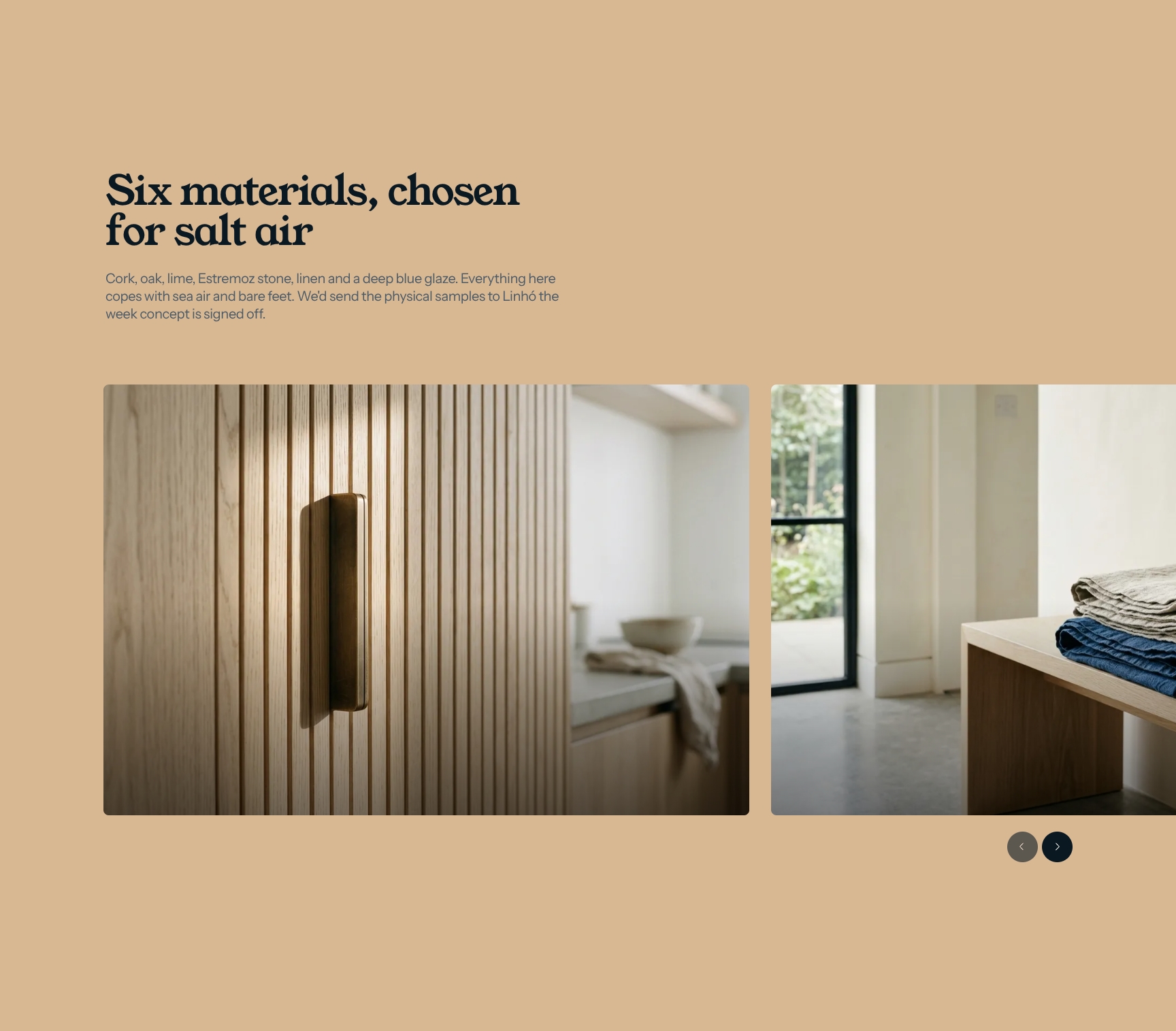
### Design Process and Seven-Month Working Method
Introduces the two leads, Joana on design and Miguel on procurement and site, and walks through the seven-month process step by step. Clients see who they'll work with and how the timeline is built around long lead times.
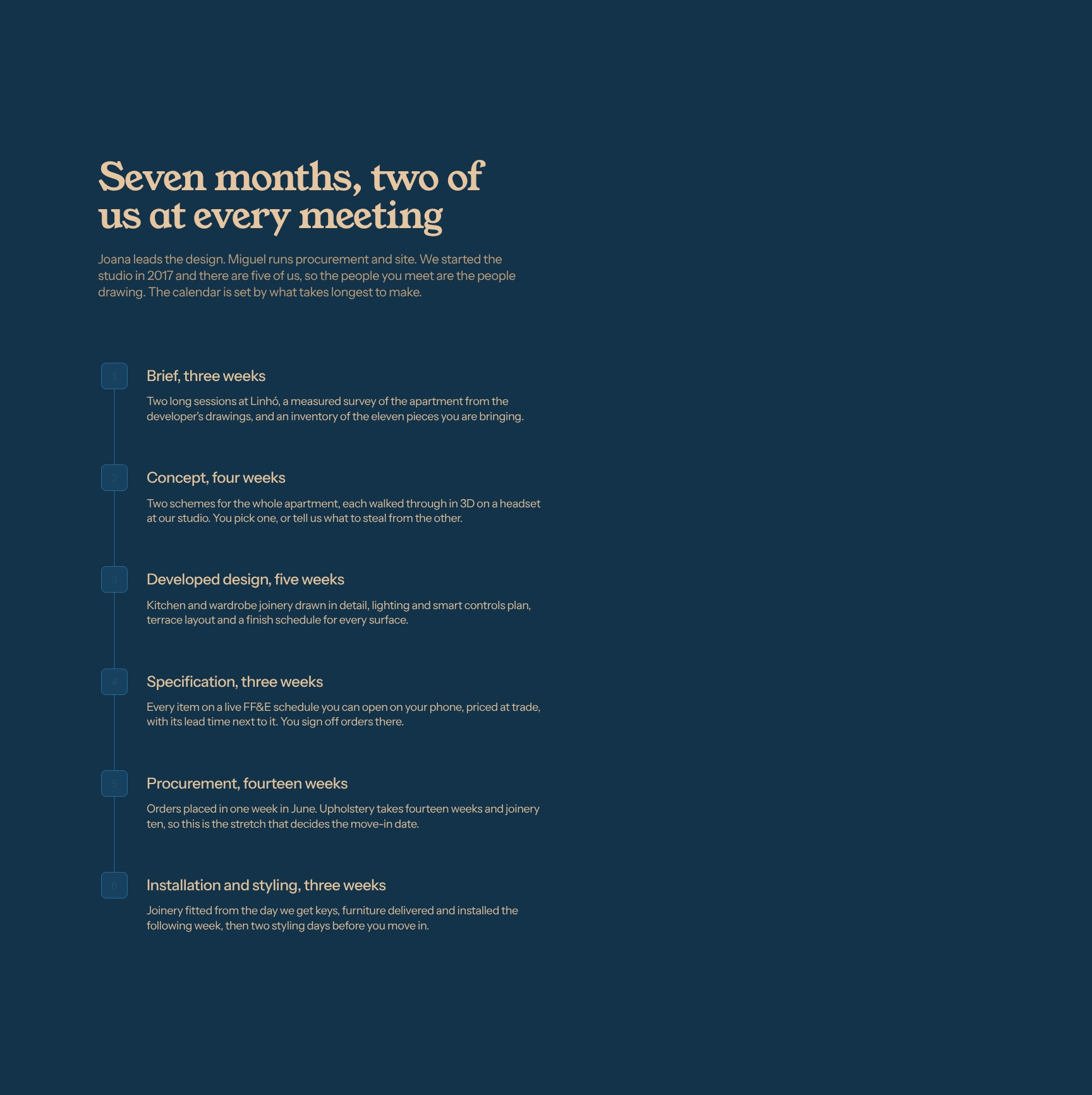
### Room-by-Room Design Direction
A breakdown of the studio's starting position for each space before concept. It makes the scope tangible, invites debate in the brief sessions, and helps clients picture every room.
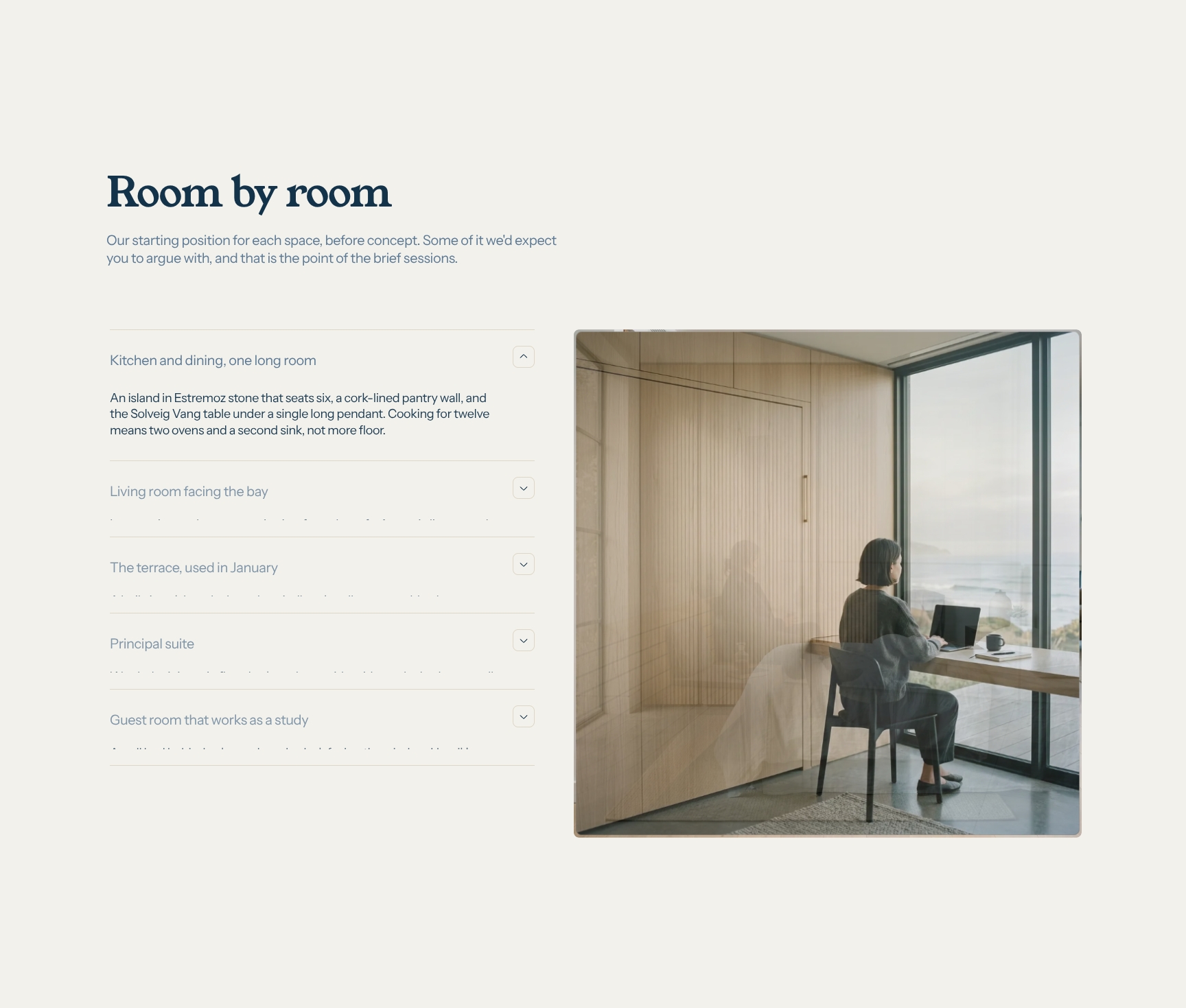
### Client Testimonials and Delivery Proof
Real words from past clients about moving in on time, including a sofa that arrived two days before the movers. Social proof that builds trust in the studio's procurement and deadline management.
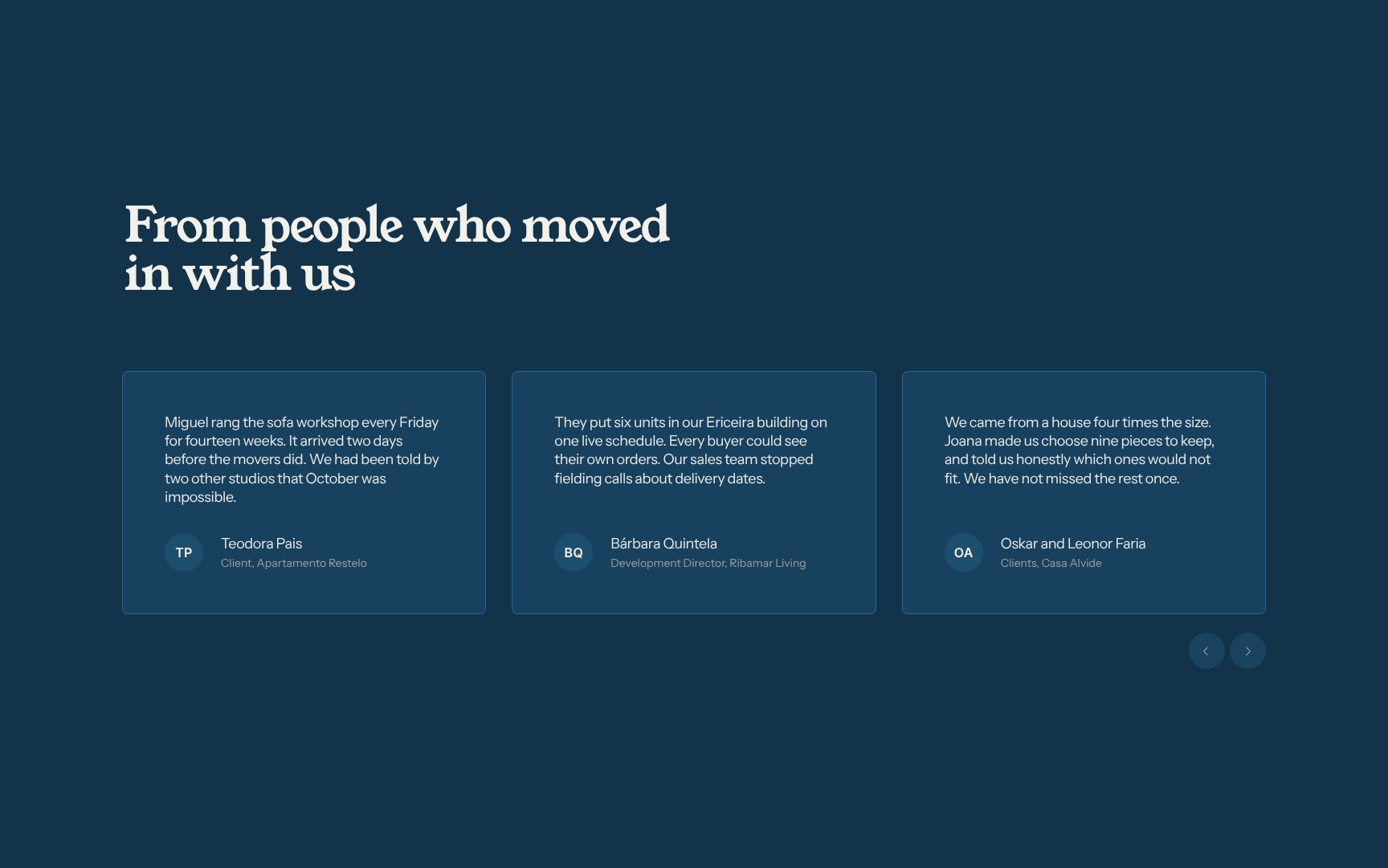
### Transparent Design Fee and Furniture Budget Pricing
A clear split between the fixed design fee, built from published day rates, and the client's furniture budget paid at trade price. Euro pricing plus 23% IVA, with no hidden markups, makes costs easy to understand.
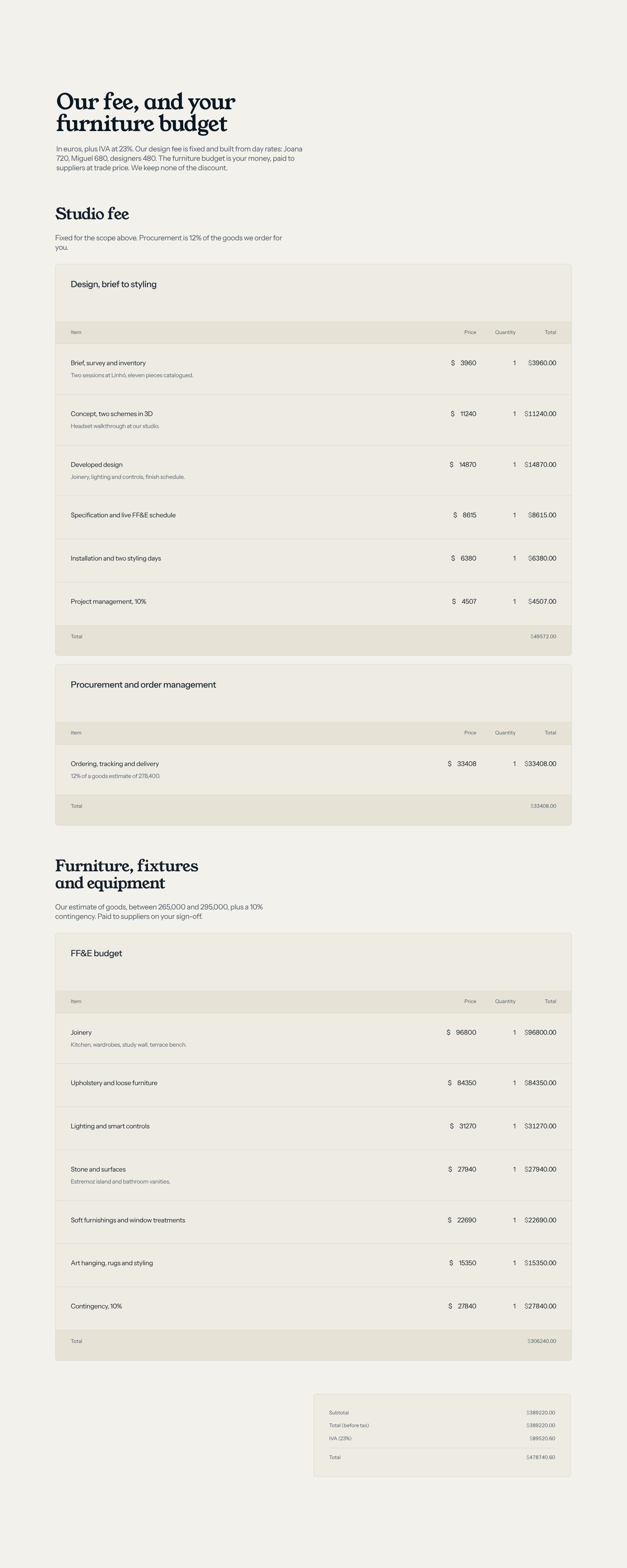
### Project Programme with Order Deadlines and Milestones
A task-based schedule showing key dates, such as the 18 June order deadline for the sofa and joinery. It sets review turnaround expectations and explains how late sign-offs affect move-in.
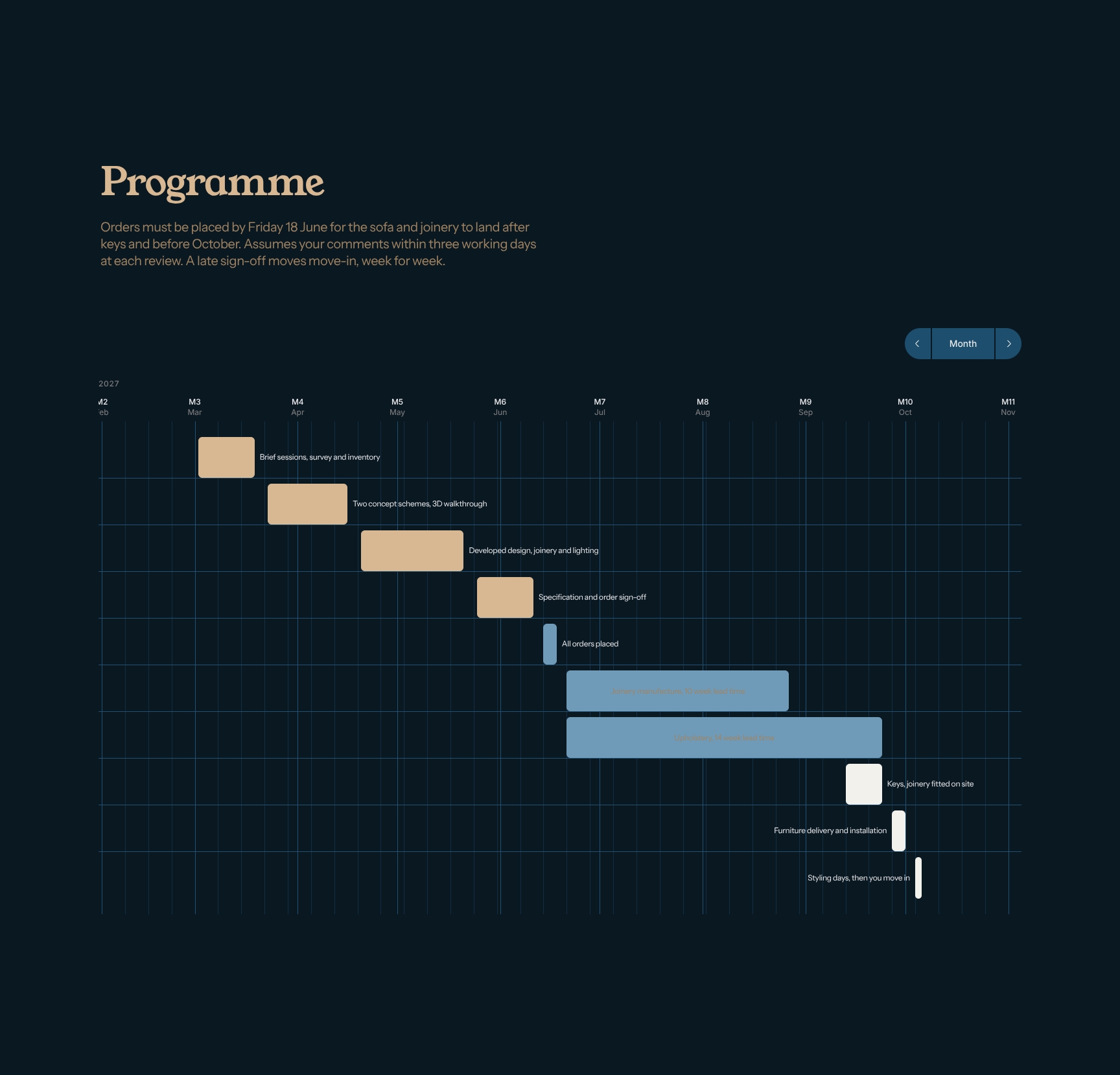
### Plain-Language Terms and FAQ Accordion
An expandable list answering the questions couples ask most once the excitement wears off. Terms are stated plainly, which reduces hesitation and shows the studio is open about the small print.
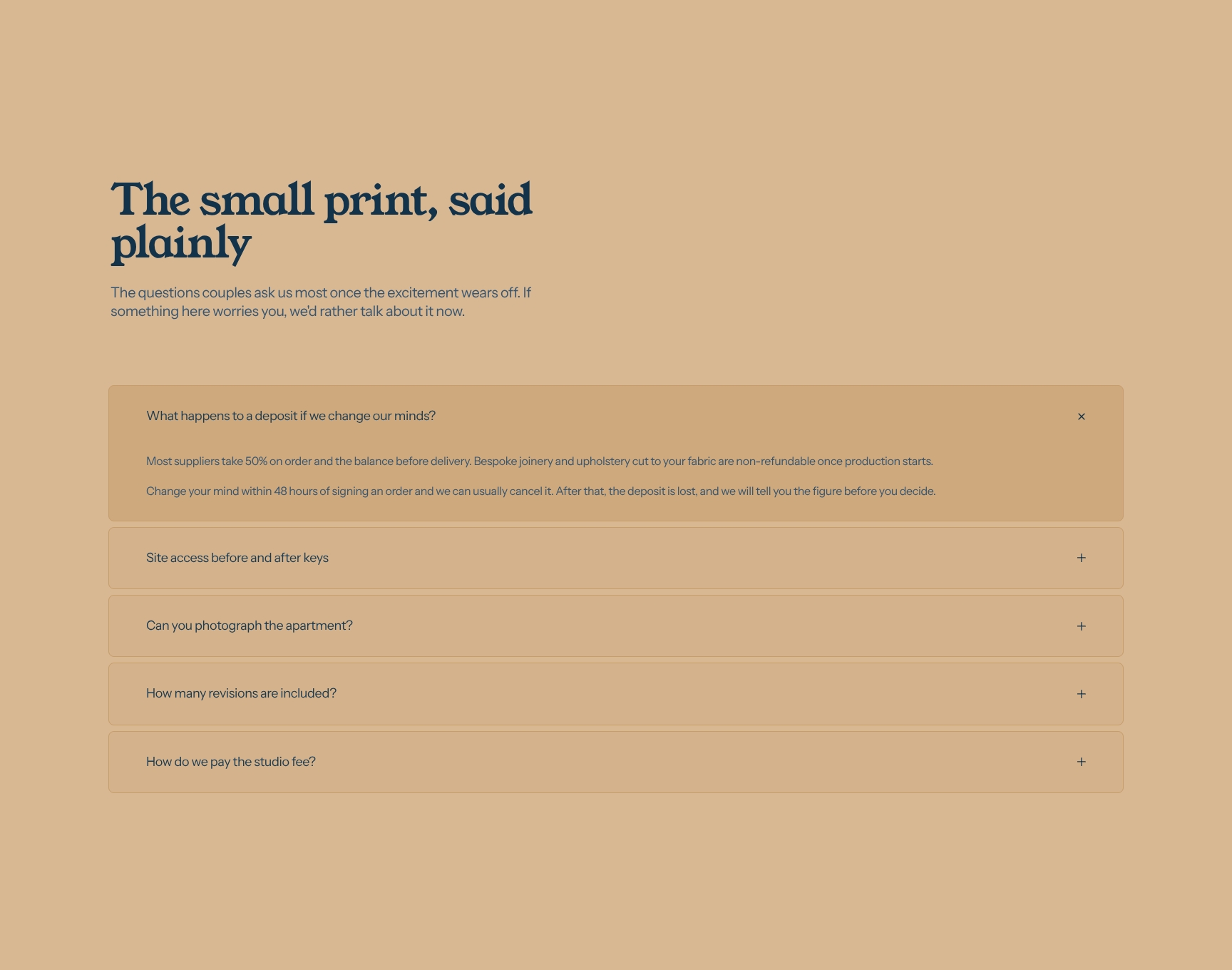
### Proposal Approval and E-Signature Next Step
A clear close with the proposal's validity date of 26 February 2027 and a sign-off area. Signing books the first brief session at Linhó for the week of 2 March, so the project starts immediately.
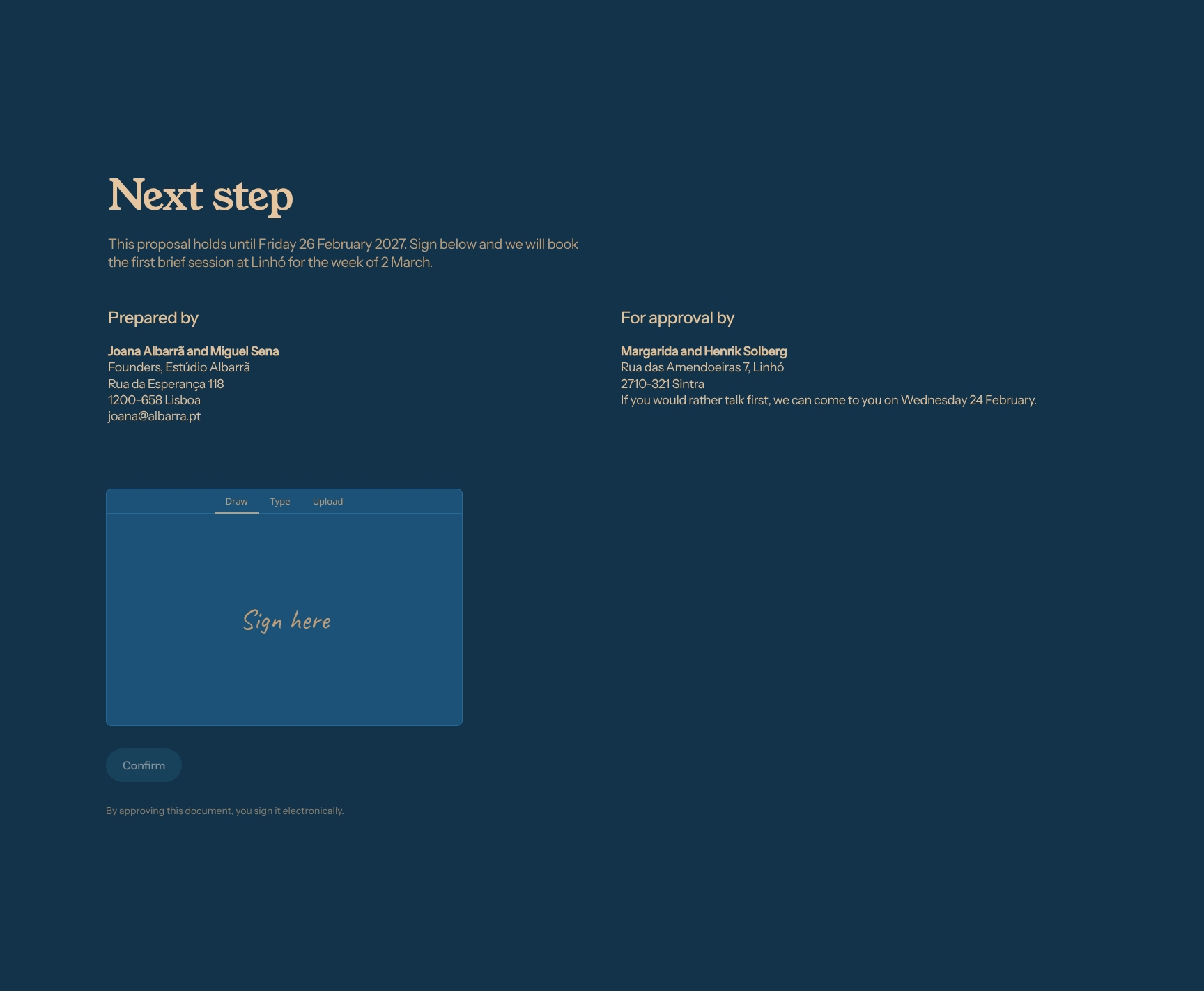
## Find your answers
Answers to common questions about writing and sending interior design proposals to homeowners for full-service residential projects.
### What should be included in a proposal template for interior design projects?
A strong interior design proposal includes a cover page, a project brief, a design concept, a materials selection, a working process, and a room-by-room breakdown. This template covers each of these sections: Cover, The brief, The idea, Materials, How we work, and Room by room. Together they show clients your vision, approach, and deliverables in a clear, logical order.
### How do I customize this proposal template for my own clients?
Replace the placeholder text in each section with your client's details, such as their goals in The brief and your design concept in The idea. Add your logo, brand colors, and fonts on the Cover, then update the Materials and Room by room sections with your own images, finishes, and scope. You can duplicate or delete room pages to match the size of each project.
### Can I export this proposal template to PDF or other formats?
Yes, you can export the finished proposal as a PDF to send to clients or print it for in-person presentations. PDF export keeps your layout, images, and fonts intact on any device. Check your editing tool for additional export options such as PowerPoint or image files.
### Is this proposal template suitable for freelancers and small design studios?
Yes, the template suits freelance designers, small studios, decorators, and renovation consultants. The How we work section lets you explain your process, timeline, and communication style, which builds trust with new clients. The Room by room section scales easily from a single-room refresh to a full-home project.
### How long does it take to complete this proposal template?
Most users can complete a tailored proposal in 1 to 3 hours once they have the client brief, mood images, and material selections ready. The structured sections guide your writing so you are not starting from a blank page. Reusing your Materials and How we work sections across clients cuts the time down even further.
## Related
- [Miami](https://formlio.com/templates/miami-ffe-procurement-statement-of-work): FF&E procurement statement of work for designers
- [Amsterdam](https://formlio.com/templates/amsterdam-show-apartment-design-proposal): Show apartment design proposal for property developers
- [Chicago](https://formlio.com/templates/chicago-workplace-interior-design-proposal): Workplace interiors proposal for law firms
- [Stockholm](https://formlio.com/templates/stockholm-restaurant-interior-proposal): Restaurant interior concept proposal for chefs
- [London](https://formlio.com/templates/london-interior-design-retainer-proposal): Monthly design retainer for hospitality clients
- [Melbourne](https://formlio.com/templates/melbourne-interior-design-portfolio): Capabilities portfolio for interior design studios
---
---
title: "Stockholm"
description: "Win restaurant fit-out briefs with an interior design proposal template covering concept, acoustics, floor plan figures and FF&E budget for chef-owners."
canonical: "https://formlio.com/templates/stockholm-restaurant-interior-proposal"
locale: "en"
type: "template"
lastModified: "2026-10-22"
category: "Interior design"
alternates:
fr: "https://formlio.com/fr/templates/stockholm-proposition-dinterieur-de-restaurant.md"
---
# Stockholm
Restaurant Interior Design Proposal Template
Win restaurant fit-out briefs with an interior design proposal template covering concept, acoustics, floor plan figures and FF&E budget for chef-owners.
- [Use this template](https://formlio.com/workspaces/claim?template=stockholm-restaurant-interior-proposal)
- [Live preview](https://formlio.com/documents/stockholm-restaurant-interior-proposal)
- **Categories:** [Interior design](https://formlio.com/templates/interior-design), [Architecture](https://formlio.com/templates/architecture), [Proposals](https://formlio.com/templates/proposals), [Pitch decks](https://formlio.com/templates/pitch-decks)
- **Document goal:** Win restaurant fit-out briefs with a proposal that lays out concept, acoustics, floor plan and FF&E budget for chef-owners.
- **Blocks:** Highlight, Marquee, Single column, Grid 3x2 with icons, Split, Grid tile scroll, E-signature
- **Palette:** Parchment Cream Background (#F1EBE0), Sandstone Accent Light (#D8C4A4), Terracotta Signature Accent (#9B3E27), Espresso Brown Secondary (#4B3628), Rich Charcoal Text (#1B1613)
## Get more from every document
Win restaurant fit-out briefs by showing chef-owners a room that works for the food before you draw a single chair. Acoustic and budget charts, floor plan figures, and a materials palette sit ready to edit.
### Get the yes without leaving the page
Your client reads the pricing, scrolls to the agreement section, and signs right there. No PDF, no printing, no waiting.
### Build proposals from sections you trust
Drop in a hero, steps, or testimonials block, then save your best pricing card to reuse on the next pitch.
### Your pitch looks sharp on any screen
Your showcase and gallery sections hold their shape when a client opens the proposal on a phone between meetings.
### See which section sells your proposal
Heatmaps show if they lingered on pricing or skipped the gallery, and replays let you time your follow-up.
### Know the moment they open it
Get a ping when your client views the proposal, leaves a comment, or signs, so your reply lands while it's fresh.
### Write the proposal together, live
Your designer tweaks the showcase while you rework the pricing cards, and you both finish before the deadline.
## See how every part fits
The proposal opens with a concept for the room, moves through the brief, numbers, and design routes, and closes on timeline, credentials, and fees. Keep what fits your pitch, drop what doesn't, and reorder anything.
### Concept Response Cover for Restaurant Interior Design
A branded opening page introducing Studio Aho Brenning Interiör's concept response for the 58-cover ground-floor restaurant at Kajhuset, Norra Djurgårdsstaden. It sets context and professionalism at first glance.
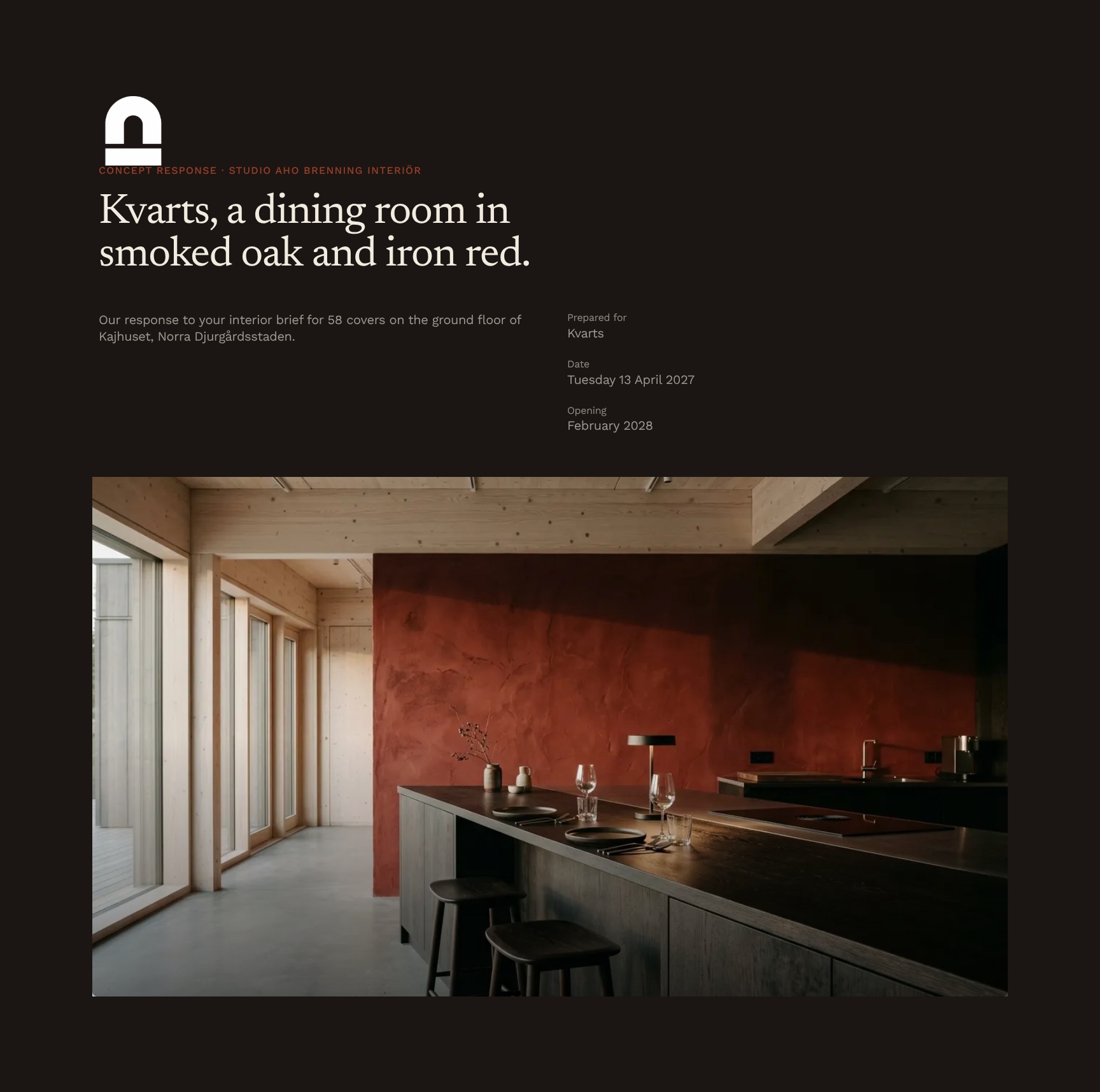
### Design Premise: A Room That Earns a Three-Hour Tasting Menu
An animated statement that frames the design philosophy: a room must hold guests for a full tasting menu. It sets the emotional tone and shows you understand fine-dining service.
### Client Brief Summary: Restaurant Built Around One Counter
Restates the brief as heard: a chef leaving a starred kitchen to run 58 covers on their own terms. Confirms shared understanding and shows the room should serve the menu, not compete with it.
### Key Room Metrics: Covers, Floor Plan and Noise Target
Four headline figures drawn from the floor plan and the 6 April 2027 site visit, including the acoustic target to be measured at first trial service. Grounds the concept in verifiable data.
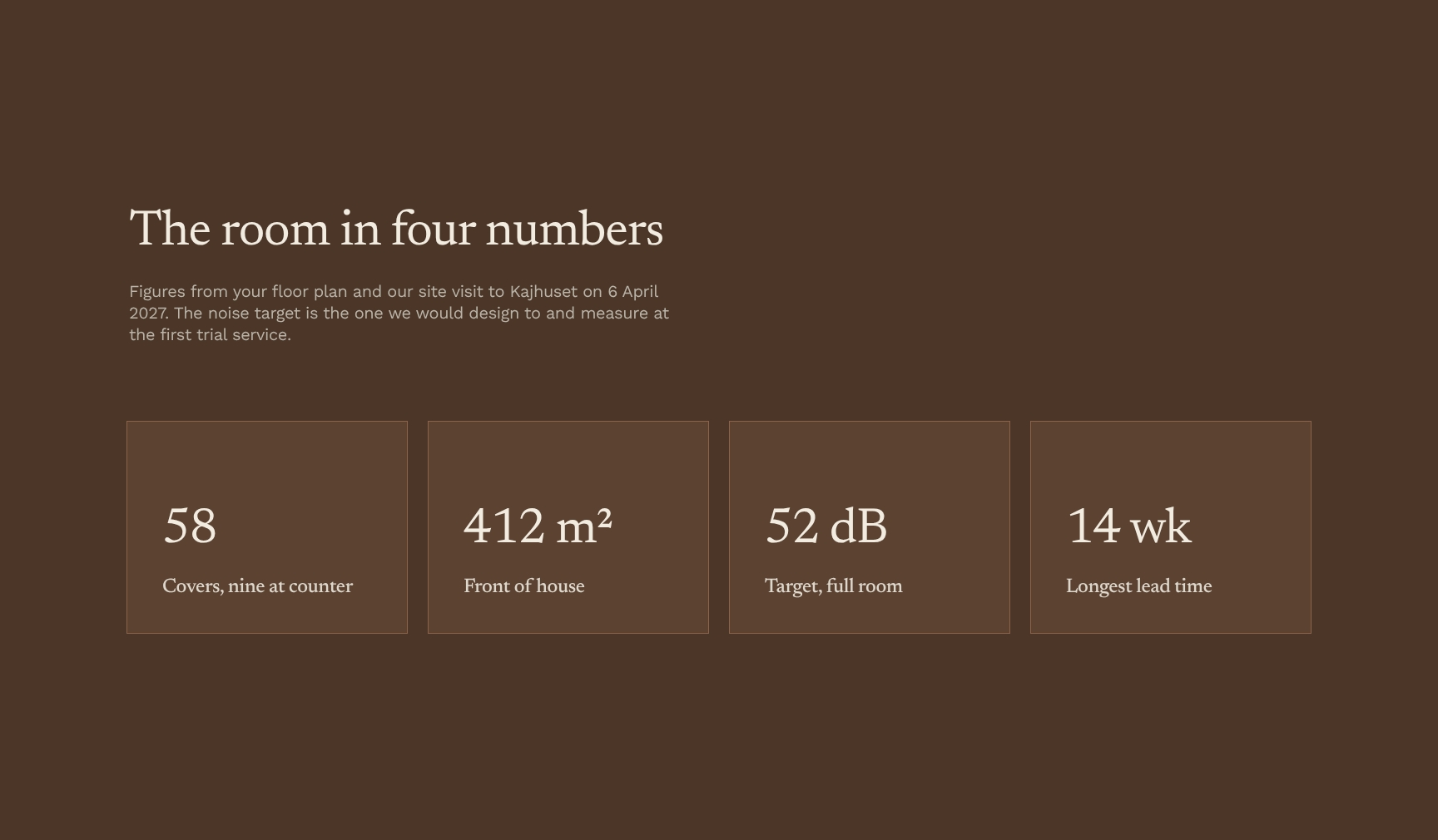
### Acoustic Model and FF&E Budget Charts for Timber Interiors
Charts show reverberation in the bare CLT room from the acoustic model, plus a first-estimate FF&E budget split in SEK thousands exkl. moms. Clarifies where sound and spend need attention.
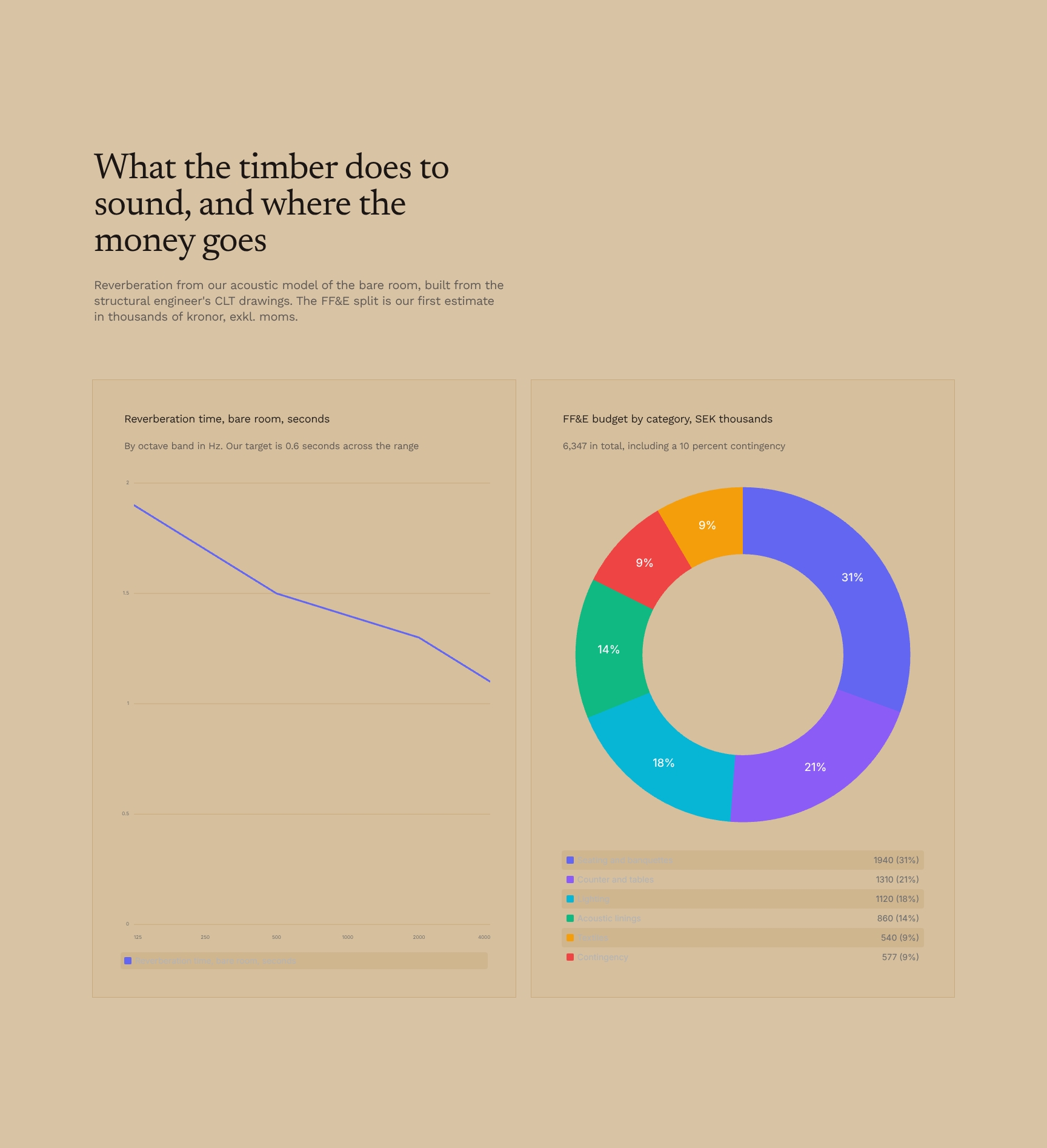
### Interior Concept Routes: Kärnved Smoked Oak Recommendation
Presents the recommended route, Kärnved: a hollowed block of smoked oak with the counter as heartwood and iron red lime plaster catching the light. Makes the concept tangible and easy to decide on.
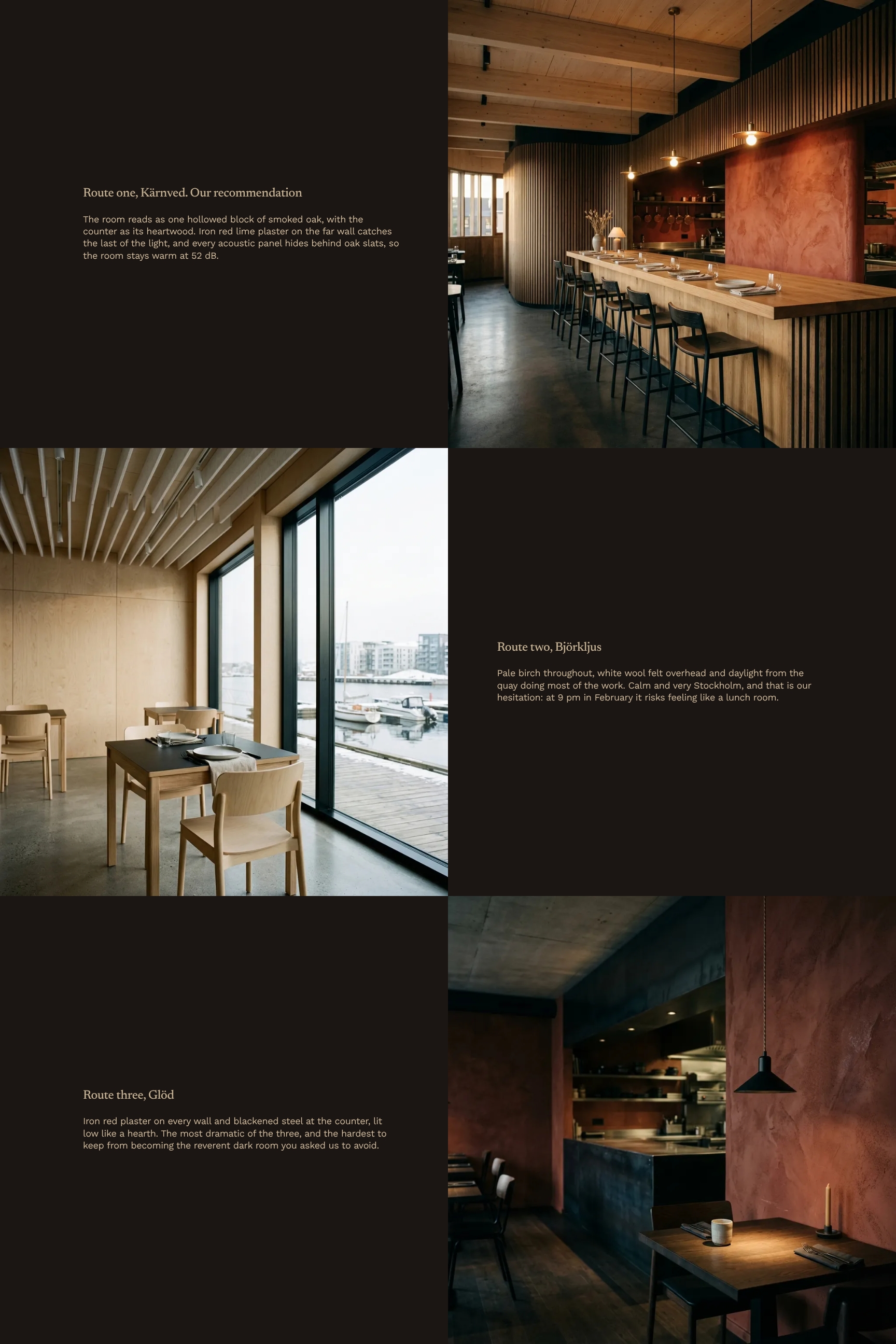
### Sustainable Materials Palette: Six Low-VOC, FSC-Certified Finishes
A gallery of the six Kärnved materials, all low-VOC, with FSC-certified oak and birch from Swedish and Finnish mills. Samples arrive 3 May so you can judge texture and quality in person.
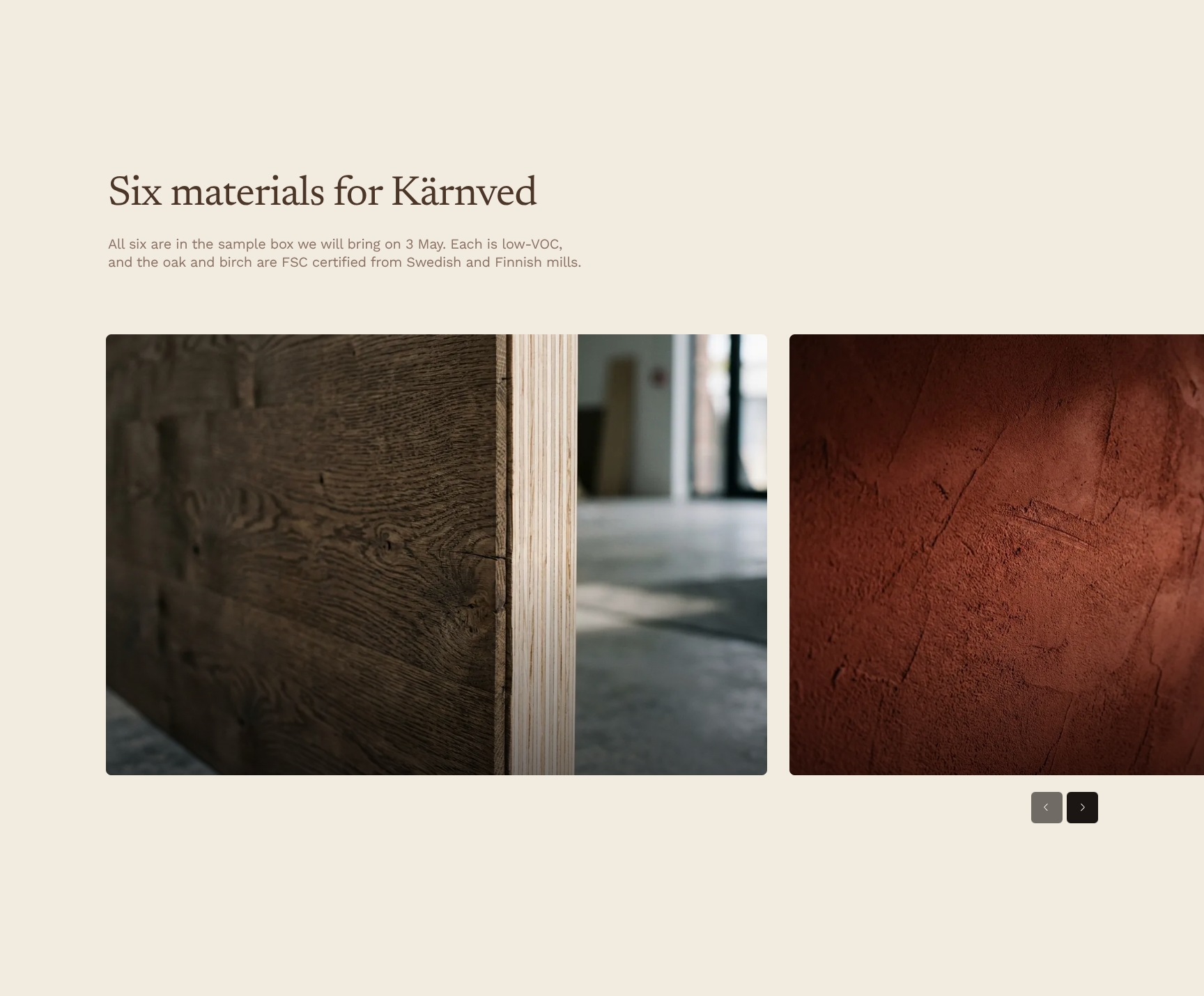
### Project Timeline to Opening: Lead-Time Schedule for Joinery and Upholstery
A stage-by-stage plan worked back from lead times, with all long-lead orders due by 3 September 2027. Shows why early decisions matter and keeps the opening date protected.
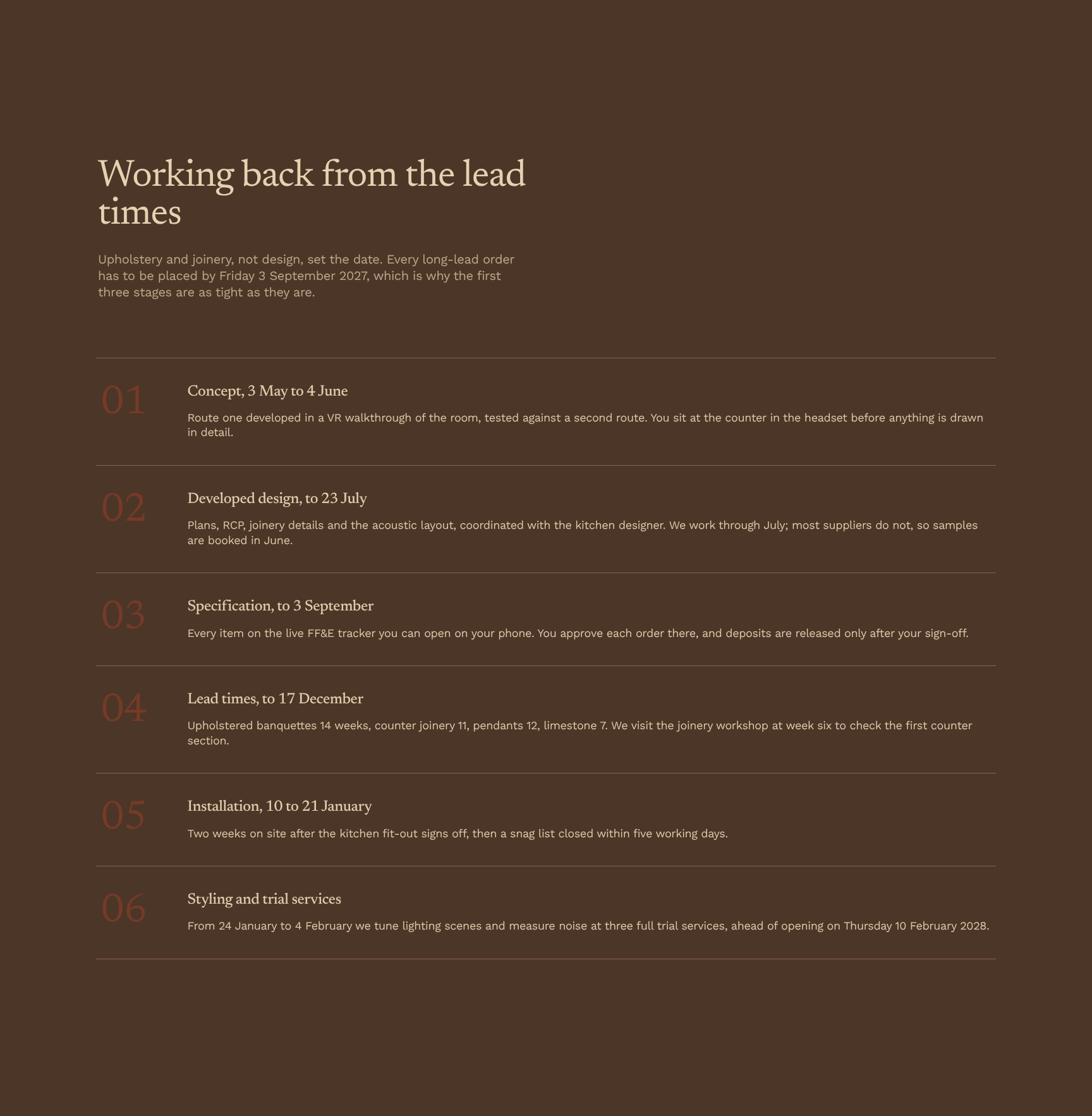
### Studio Credentials and Client Testimonials from Opened Restaurants
Introduces the eight-person Södermalm studio, founded 2018, led by Liisa Aho and Johan Brenning from first sketch to trial service, with feedback from rooms already opened. Builds trust and credibility.
### Design Fees and Agreement Terms: Concept and Later-Stage Pricing
Transparent fees: concept SEK 412,750 and later-stage SEK 1,284,900, both exkl. moms at 25%, plus what the fee excludes such as the FF&E budget. Clear scope and a simple next step to approve.
## Find your answers
Answers to common questions about writing interior design proposals for chef-owners, from concept framing and acoustic targets to FF&E budgets and fees.
### What should be included in a proposal for a room or venue design project?
A strong room design proposal should include a cover, the premise, a clear brief, key room measurements, sound and budget details, and concept routes. This template covers each of these sections so clients see the vision, constraints, and options in one document. It helps you present decisions in a logical order, from context to creative direction.
### How do I customize this proposal template for my own client?
Start by replacing the cover details with your client's name, project title, and branding. Then update The premise and The brief with their goals, and fill in The room in numbers with actual dimensions, capacity, and layout data. Finish by adjusting Sound and budget figures and editing the Concept routes to reflect your own design options.
### What goes in the 'room in numbers' and 'sound and budget' sections?
The room in numbers should list measurable facts such as floor area, ceiling height, capacity, and number of seats or zones. The sound and budget section should outline acoustic goals, equipment or treatment needs, and cost ranges or allowances. Together they ground the creative ideas in real technical and financial limits.
### How many concept routes should I present in a design proposal?
Presenting two to three concept routes is usually ideal. This gives clients meaningful choice without causing decision fatigue. For each route, describe the idea, mood, and how it responds to the brief, sound requirements, and budget.
### Can I use this proposal template for different industries and export it as a PDF?
Yes, the structure works for venues, studios, restaurants, offices, event spaces, and other interior or acoustic projects. Simply adapt the language in The premise and The brief to suit your industry. Once finished, you can export or save the proposal as a PDF to share with clients and keep formatting consistent across devices.
## Related
- [Miami](https://formlio.com/templates/miami-ffe-procurement-statement-of-work): FF&E procurement statement of work for designers
- [Amsterdam](https://formlio.com/templates/amsterdam-show-apartment-design-proposal): Show apartment design proposal for property developers
- [Chicago](https://formlio.com/templates/chicago-workplace-interior-design-proposal): Workplace interiors proposal for law firms
- [Lisbon](https://formlio.com/templates/lisbon-interior-design-proposal): Full-service interiors proposal for homeowners
- [London](https://formlio.com/templates/london-interior-design-retainer-proposal): Monthly design retainer for hospitality clients
- [Melbourne](https://formlio.com/templates/melbourne-interior-design-portfolio): Capabilities portfolio for interior design studios
---
---
title: "London"
description: "Win ongoing hospitality work with an interior design retainer proposal template: explain the retainer, scope, monthly fee and selected work for multi-site clients."
canonical: "https://formlio.com/templates/london-interior-design-retainer-proposal"
locale: "en"
type: "template"
lastModified: "2026-10-20"
category: "Interior design"
alternates:
fr: "https://formlio.com/fr/templates/london-proposition-de-contrat-de-suivi-en-architecture-dinterieur.md"
---
# London
Interior Design Retainer Proposal Template
Win ongoing hospitality work with an interior design retainer proposal template: explain the retainer, scope, monthly fee and selected work for multi-site clients.
- [Use this template](https://formlio.com/workspaces/claim?template=london-interior-design-retainer-proposal)
- [Live preview](https://formlio.com/documents/london-interior-design-retainer-proposal)
- **Categories:** [Interior design](https://formlio.com/templates/interior-design), [Proposals](https://formlio.com/templates/proposals)
- **Document goal:** Win ongoing hospitality work with a clear retainer proposal that lays out scope, monthly fee and past projects.
- **Blocks:** Highlight, Single column, Marquee, Grid 3x2 with icons, Fullscreen, Itemized quote, Left-aligned, E-signature
- **Palette:** Warm Linen Background (#F1E9DD), Sandstone Accent Light (#D8C4A8), Primary Forest Green (#2E5A47), Deep Evergreen Accent (#1C3A2E), Midnight Forest Text (#0E1D17)
## Get more from every document
Turn a one-off project into a monthly design relationship with a proposal your hospitality client can approve in one sitting. Scope cards, fixed pricing, and a signature block are already built in.
### Get a yes without leaving the page
Your client reads the scope, checks the price, and signs in the agreement section. No PDF, no printing, no waiting.
### Build proposals from blocks you trust
Drop in pricing, steps, and testimonials in minutes, then save your best-performing sections to reuse on the next pitch.
### Your pitch looks right on every screen
Clients open your proposal on a phone between meetings, and the hero, cards, and pricing table still hold their shape.
### See which section sells your proposal
Heatmaps show where prospects linger on pricing or the showcase, so you follow up with the right pitch at the right time.
### Know the moment your client opens it
Get pinged when they view, comment, or sign, so your follow-up call lands while the proposal is fresh.
### Write the proposal together, live
Your designer tweaks the showcase while you tighten the pricing, all in one document before the deadline.
## See how every part fits
The proposal opens with a clear case for a retainer and closes with a signature, with your scope, work, and fees in between. Keep what fits, drop what doesn't, and reorder anything to suit the client.
### Design Retainer Cover Page for Multi-Site Interiors
A branded cover introducing the monthly interiors retainer for both Hollin houses, Marylebone and Shoreditch. It sets the timeline from March 2027 through opening and the first winter, so clients see the scope at a glance.
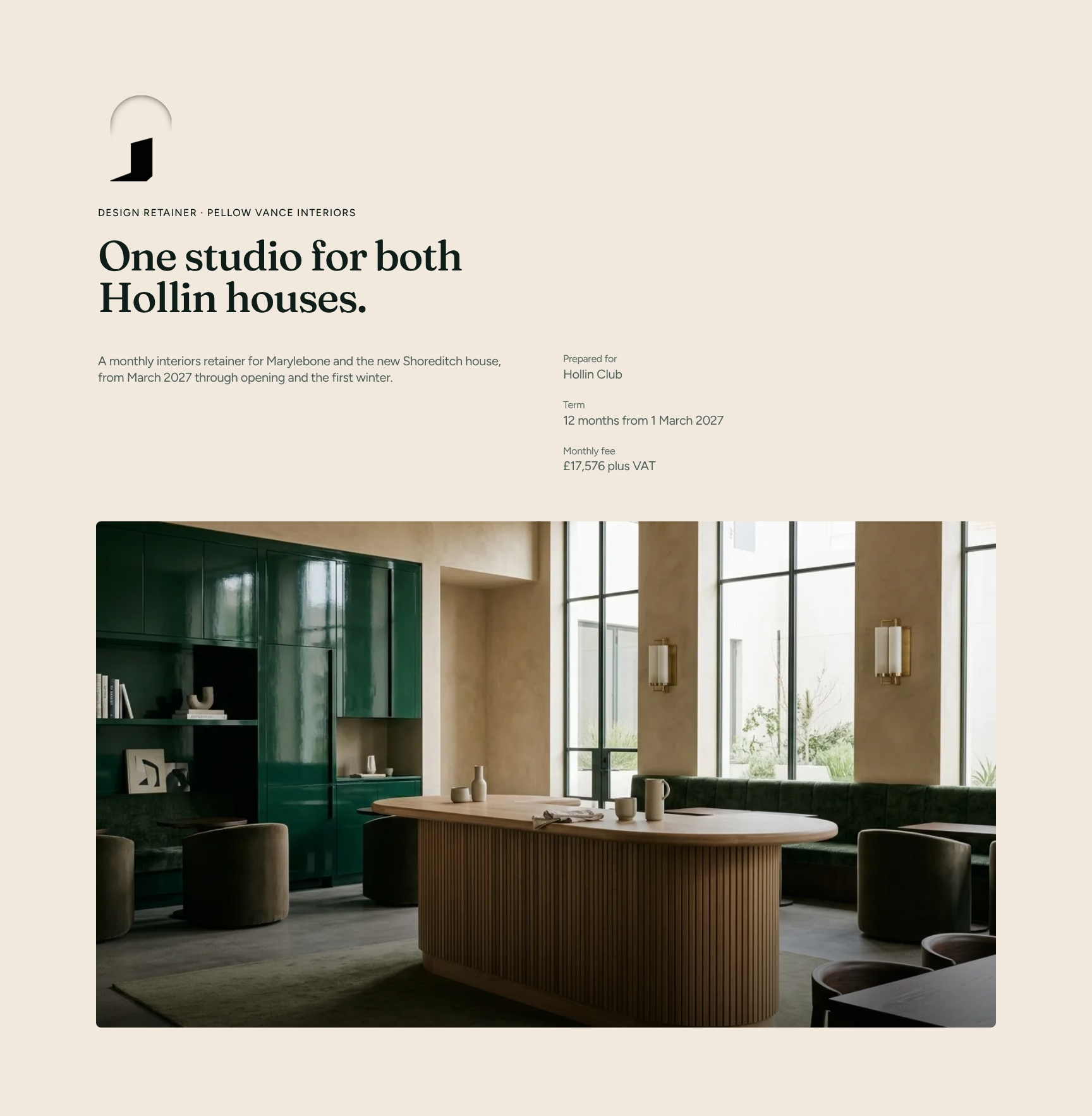
### Why a Retainer Instead of a Project: Value Rationale
Makes the case for one ongoing studio over two fixed-fee projects. Explains how a retainer avoids double handovers and keeps both houses watched while Shoreditch opens and Marylebone keeps trading.
### Animated Big Idea Statement: One Club, Two Addresses
A short animated statement that distills the proposal's concept: same club, two addresses, one hand on every detail. It gives the client a memorable, shareable way to describe the approach.
### Retainer Scope Cards: Six Areas of Interior Design Work
Six cards outline the areas of work drawn from one shared pool of days. It shows how effort shifts to Shoreditch until opening, then back to Marylebone, so the client knows exactly what the retainer covers.
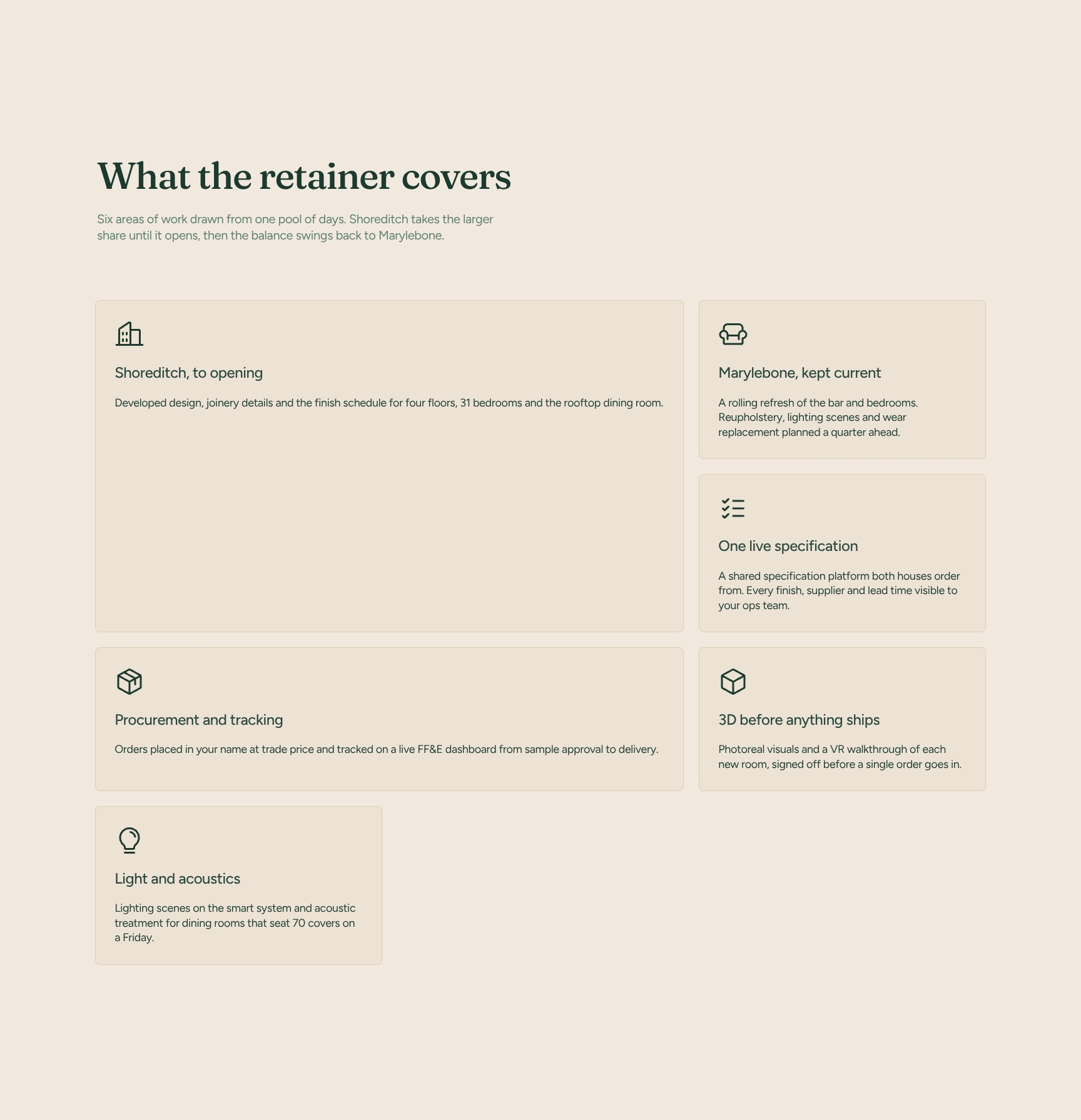
### Selected Hospitality Interiors Portfolio and Case Studies
Proof of work on comparable members' venues, including Wexley House in King's Cross and Brindle in Canary Wharf. Results such as on-time opening and a closed waitlist build confidence in delivery.
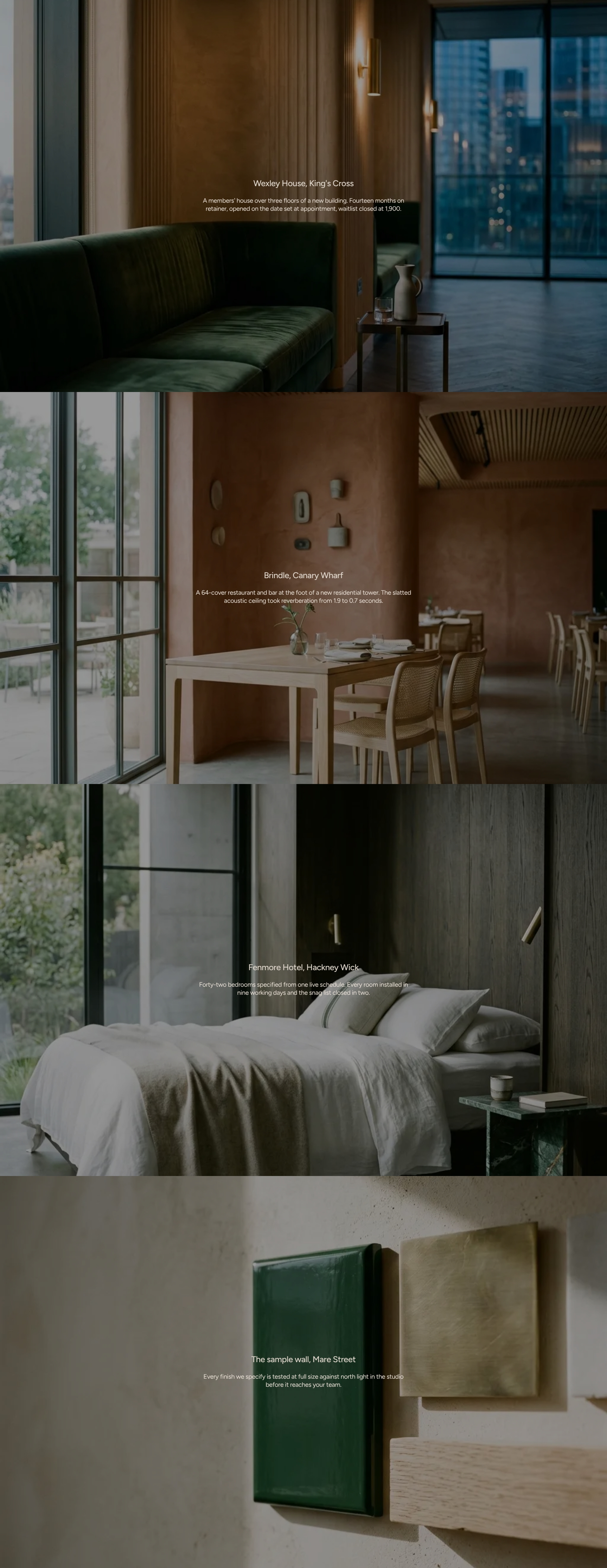
### Monthly Retainer Workflow: How Each Month Runs
A step-by-step view of the repeating monthly rhythm, timed around the client's operations meeting. It shows when decisions are made and how work moves, making the ongoing service predictable and easy to manage.
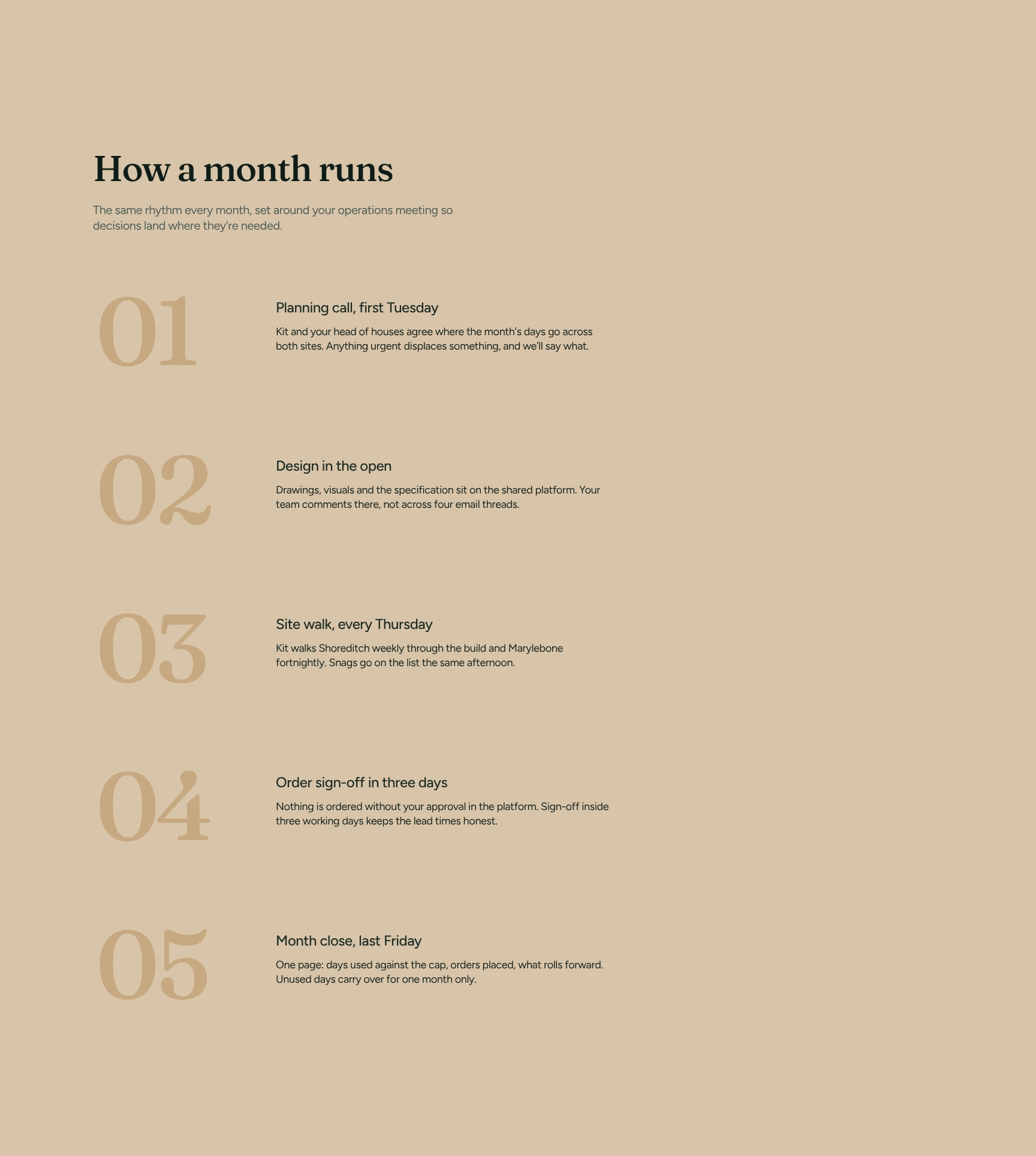
### Client Testimonials from Retainer Relationships
Quotes from founders the studio has worked with on retainer, including a story about catching a 16-week bar stool lead time early. They show how the model prevents costly surprises and delivers on-date openings.
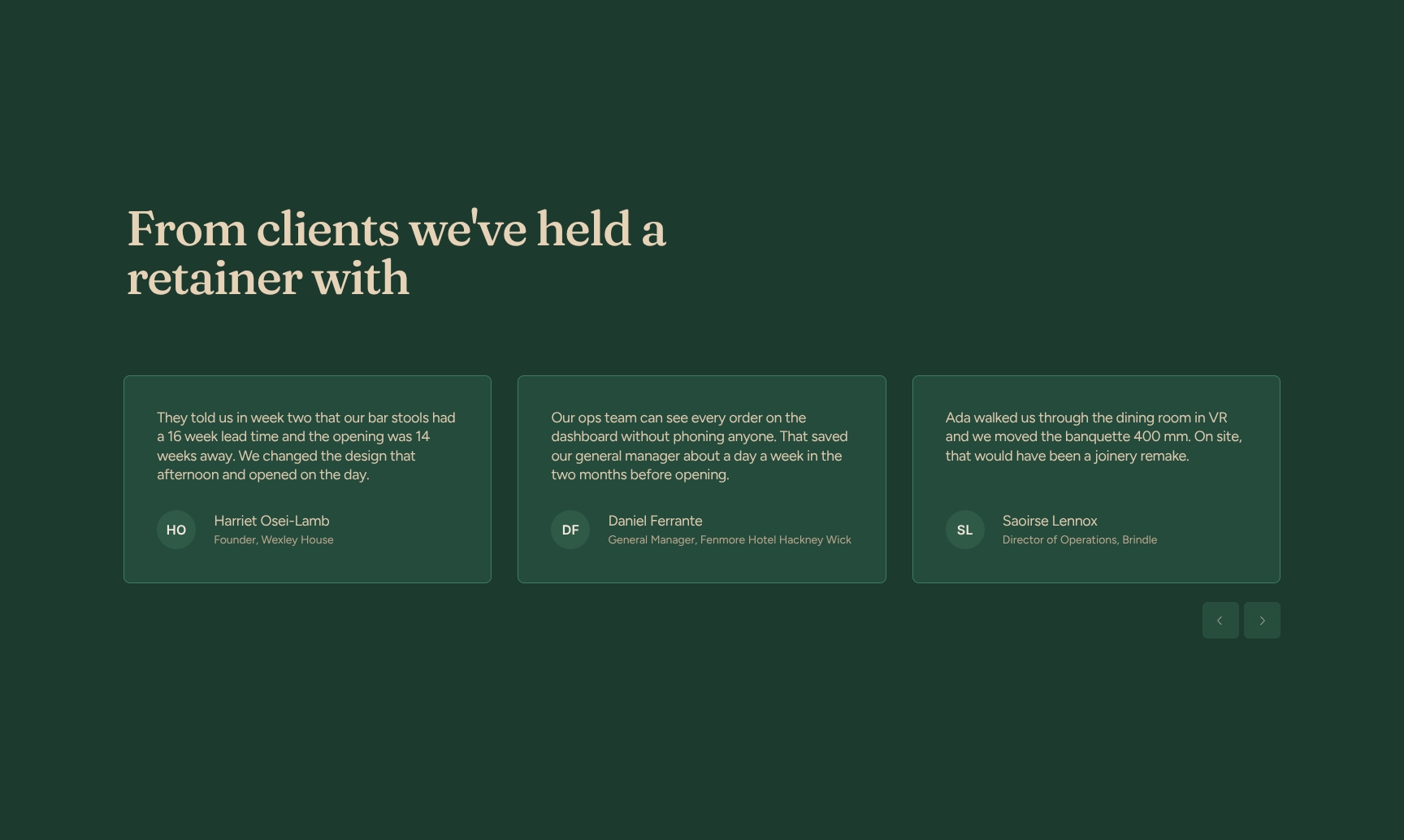
### Transparent Monthly Fee and Day-Rate Pricing in GBP
The monthly fee in GBP plus VAT, built from published day rates for creative director, account lead, designers and procurement. It also clarifies that FF&E goods are invoiced separately at trade price, so there are no pricing surprises.
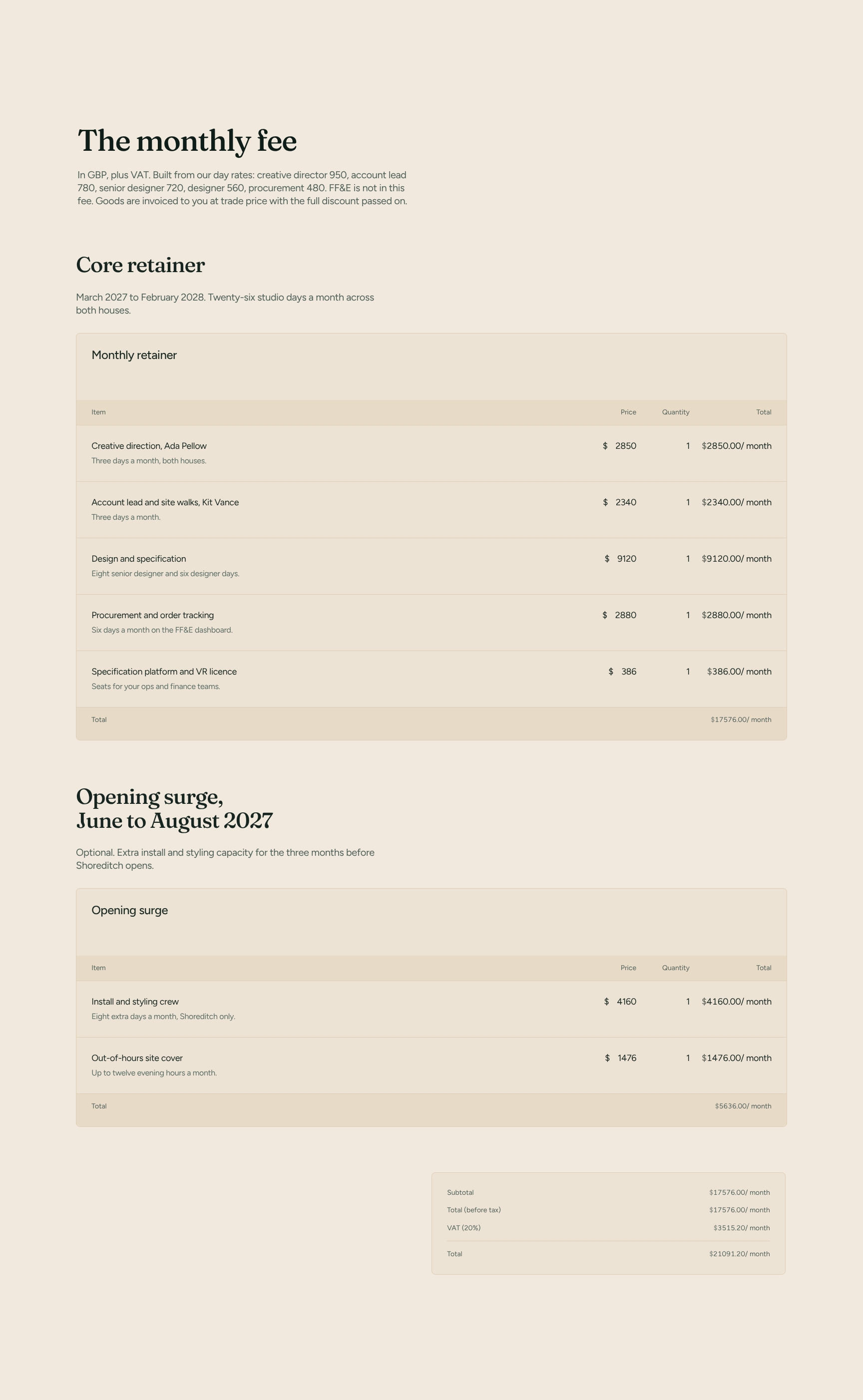
### Retainer Terms FAQ: Notice, Scope and Out-of-Hours Work
Expandable terms covering notice periods, scope limits and what happens when a month needs more than 26 days. They set clear expectations up front, keeping the retainer fair and a good deal for both sides.
### Proposal Approval and E-Signature Next Steps
A clear close with the proposal's validity date of 19 February 2027 and a signature block. Signing triggers the first planning call on Tuesday 2 March at Marylebone, turning agreement into immediate action.
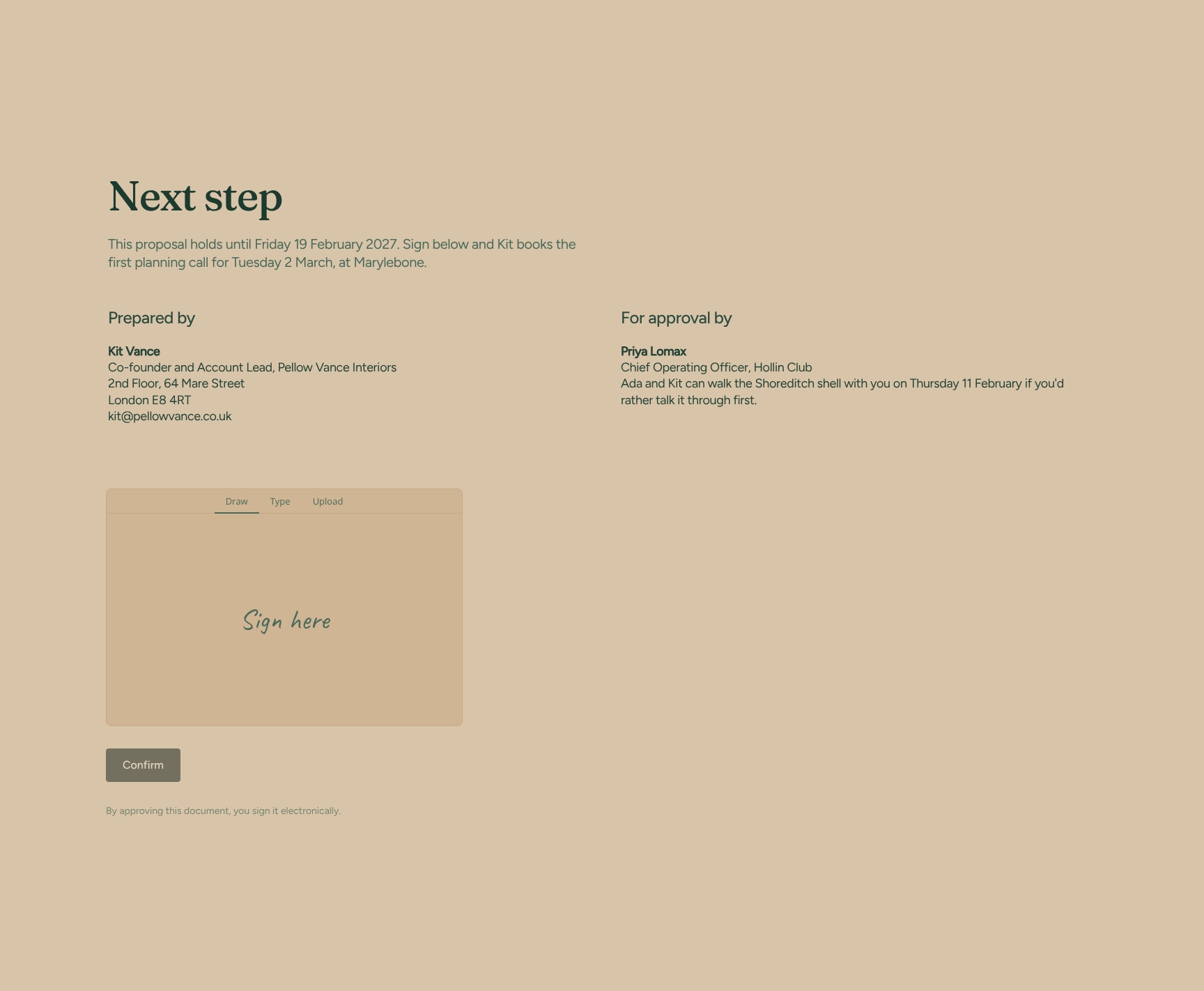
## Find your answers
Answers to the questions hospitality clients ask before signing a monthly interior design retainer, from notice periods to out-of-hours work.
### What should be included in a retainer proposal template?
A strong retainer proposal should include a cover page, a clear case for why a retainer beats one-off projects, the core idea or service model, a detailed scope of what the retainer covers, selected work as proof of results, and a walkthrough of how a typical month runs. This template includes all six sections so clients can see the value, scope, and workflow at a glance.
## Related
- [Miami](https://formlio.com/templates/miami-ffe-procurement-statement-of-work): FF&E procurement statement of work for designers
- [Amsterdam](https://formlio.com/templates/amsterdam-show-apartment-design-proposal): Show apartment design proposal for property developers
- [Chicago](https://formlio.com/templates/chicago-workplace-interior-design-proposal): Workplace interiors proposal for law firms
- [Lisbon](https://formlio.com/templates/lisbon-interior-design-proposal): Full-service interiors proposal for homeowners
- [Stockholm](https://formlio.com/templates/stockholm-restaurant-interior-proposal): Restaurant interior concept proposal for chefs
- [Melbourne](https://formlio.com/templates/melbourne-interior-design-portfolio): Capabilities portfolio for interior design studios
---
---
title: "Melbourne"
description: "Interior design portfolio template with studio stats, selected residential and hospitality projects, and a process section to win clients and hotel developers."
canonical: "https://formlio.com/templates/melbourne-interior-design-portfolio"
locale: "en"
type: "template"
lastModified: "2026-10-20"
category: "Interior design"
alternates:
fr: "https://formlio.com/fr/templates/melbourne-portfolio-design-dinterieur.md"
---
# Melbourne
Interior Design Studio Portfolio Template
Interior design portfolio template with studio stats, selected residential and hospitality projects, and a process section to win clients and hotel developers.
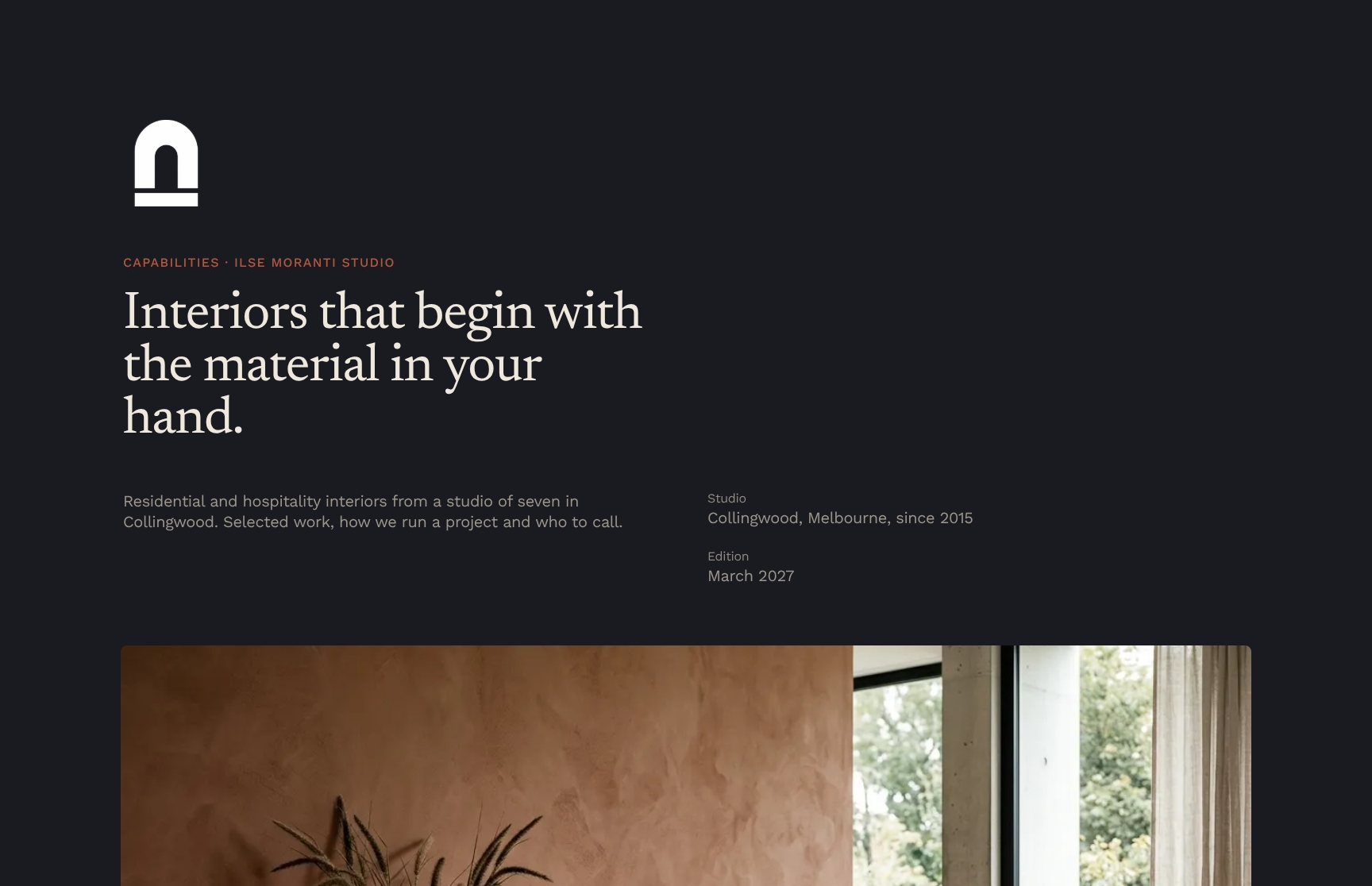
- [Use this template](https://formlio.com/workspaces/claim?template=melbourne-interior-design-portfolio)
- [Live preview](https://formlio.com/documents/melbourne-interior-design-portfolio)
- **Categories:** [Interior design](https://formlio.com/templates/interior-design), [Portfolio](https://formlio.com/templates/portfolio)
- **Document goal:** Win residential and hospitality clients by showing your studio's projects, results, and process in one portfolio.
- **Blocks:** Highlight, Scroll gradient, Grid 3x2 with icons, Fullscreen, Spotlight, Grid tile scroll, Single column
- **Palette:** Warm Linen Background (#EFE8DC), Soft Terracotta Blush (#DDAE92), Burnt Sienna Accent (#B4583C), Deep Umber Contrast (#6B2E20), Midnight Ink Dark (#191B21)
## Get more from every document
Show hotel developers and homeowners that your studio delivers rooms on budget and on schedule. Studio stats, project showcases, a materials library, and a timeline are built in so you can start from proof.
### Match your style to every project
Swap colours, type, and layout in seconds so your case studies look like your work, not a template.
### Build your portfolio from proven sections
Drop in a hero, gallery, or breakdown, then save your best case study layouts and reuse them on the next pitch.
### Your work looks sharp on every screen
Your gallery and showcase images hold their composition on a client's phone, a tablet, or a studio monitor.
### See which projects hold their attention
Heatmaps show which case studies get lingered on, so you can follow up while your work is fresh in their mind.
### Know the moment they open your work
Get pinged when a client views your portfolio, leaves a comment, or signs off, so you reply while they're still looking.
### Build the portfolio with your team
Writers, designers, and producers edit the same case studies together, and credits and testimonials get filled in live.
## See how every part fits
The page opens with your studio's capabilities and philosophy, moves through projects, process, and materials, and closes with a invitation to visit your library. Keep what fits, drop what doesn't, and reorder anything.
### Interior Design Studio Hero with Capabilities Overview
A bold cover introducing Ilse Moranti Studio, a seven-person Collingwood practice for residential and hospitality interiors. The material-led tagline sets the tone and points visitors to selected work and process.
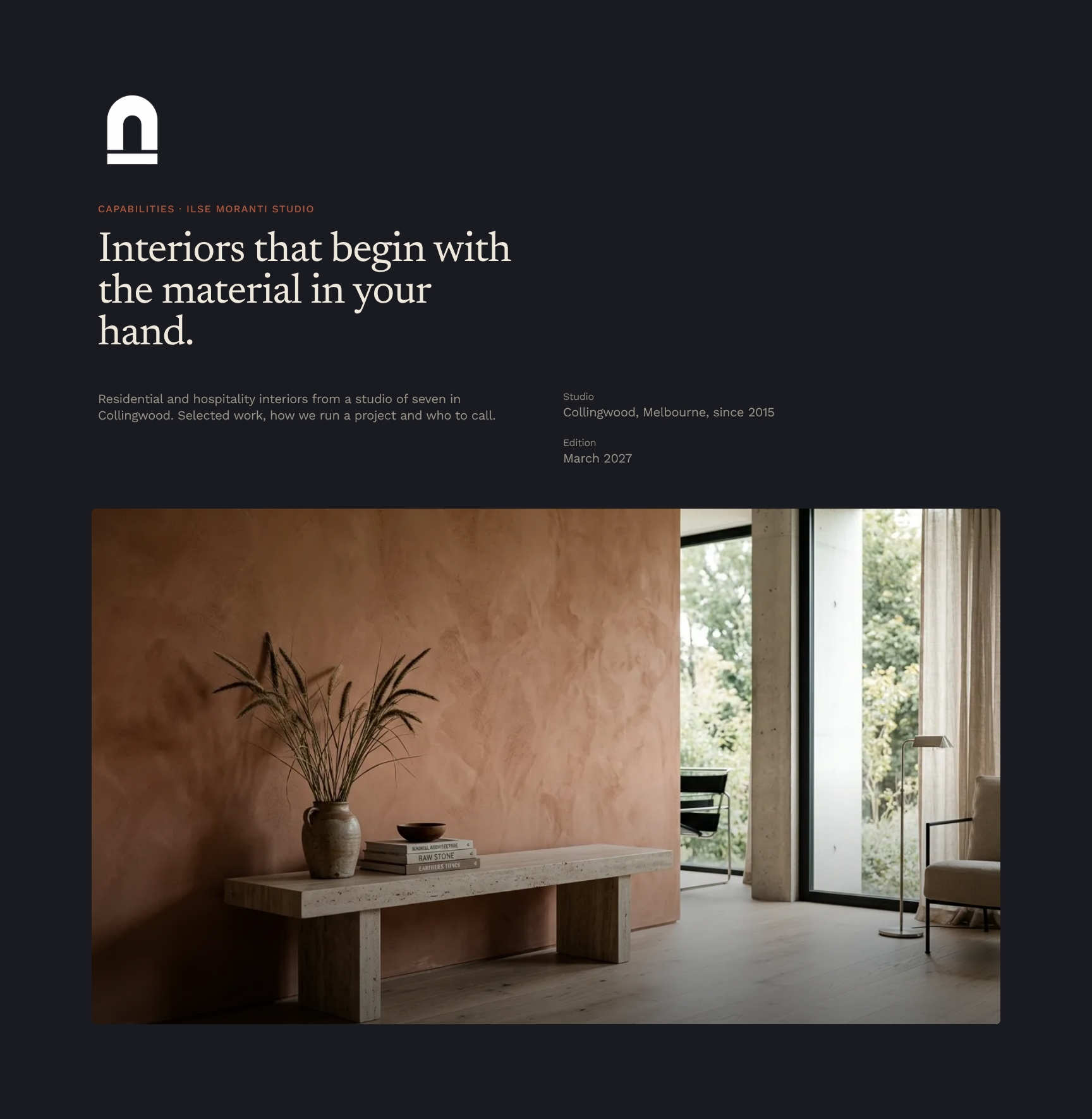
### Design Philosophy Statement with Animated Text
An animated statement on touch and memory that captures the studio's tactile, material-first point of view. It builds emotional resonance and sets the studio apart from image-driven competitors.

### Studio in Numbers: Team Size and Key Metrics
Stat cards showing the studio's deliberately small team and hands-on approach. Prospective clients see that the principal draws on every project and the presenter is the one on site at install.
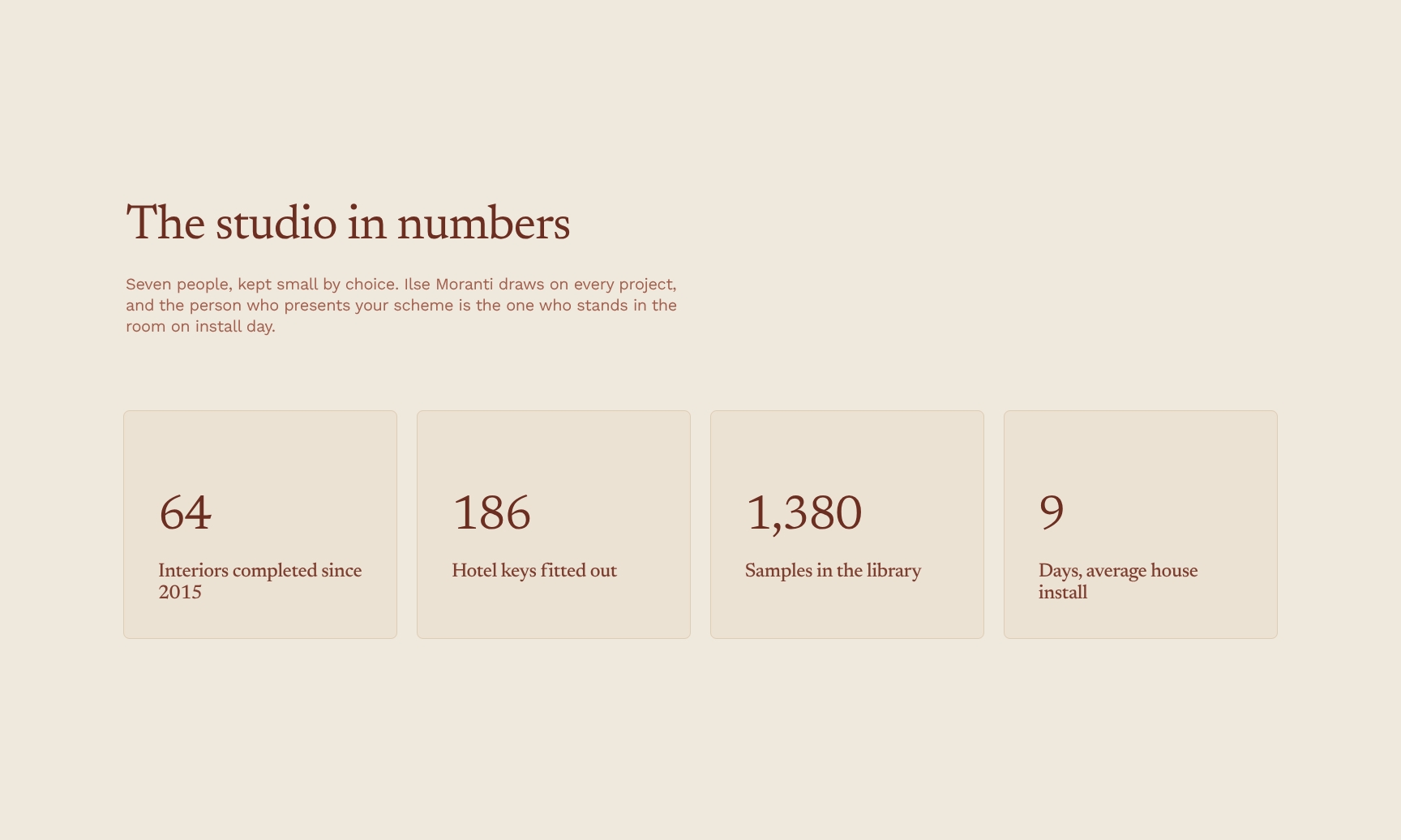
### Selected Hospitality and Residential Project Showcase
Featured case studies such as Hotel Ardent in Fitzroy, with materials, scale and outcomes. Proof of on-time delivery and a cohesive material palette helps hospitality and residential clients trust your work.
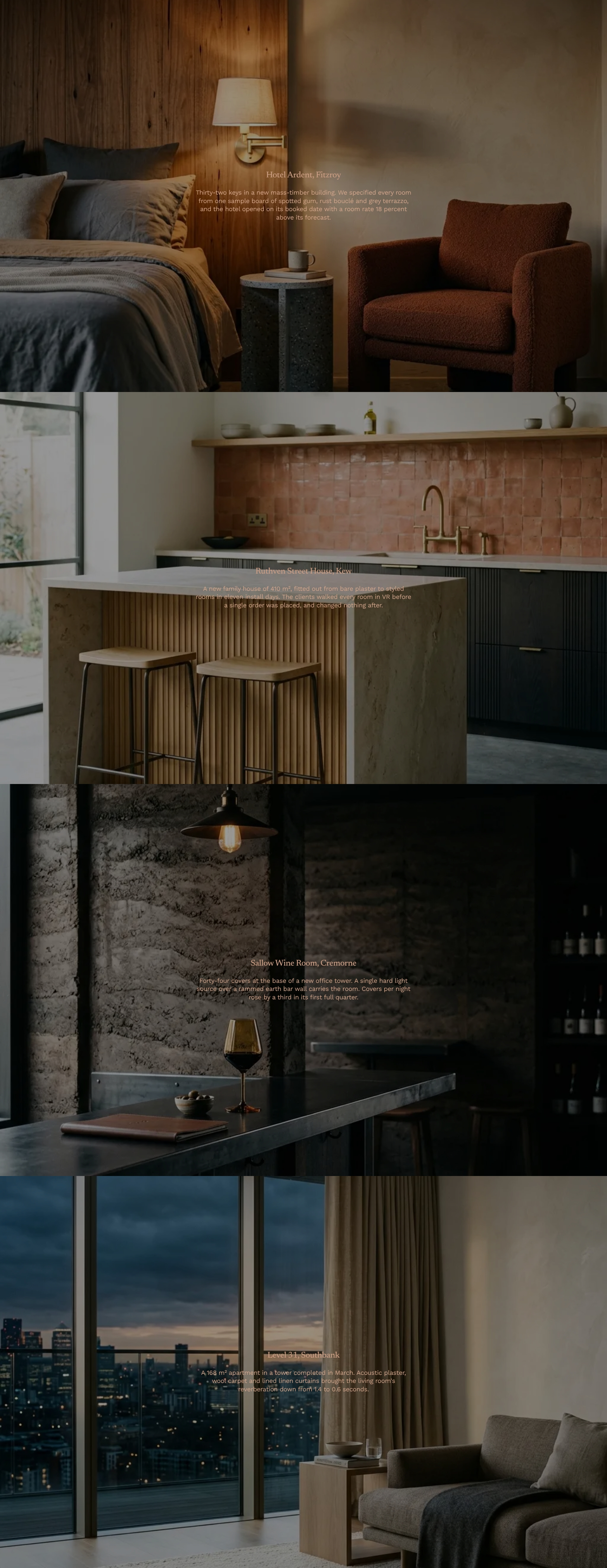
### How We Work: Four Design Habits That Protect Budget
A breakdown of four practical habits that keep schemes lasting and budgets under control. It positions the studio as disciplined and long-term focused, not just stylish, and speaks to cost-conscious clients.
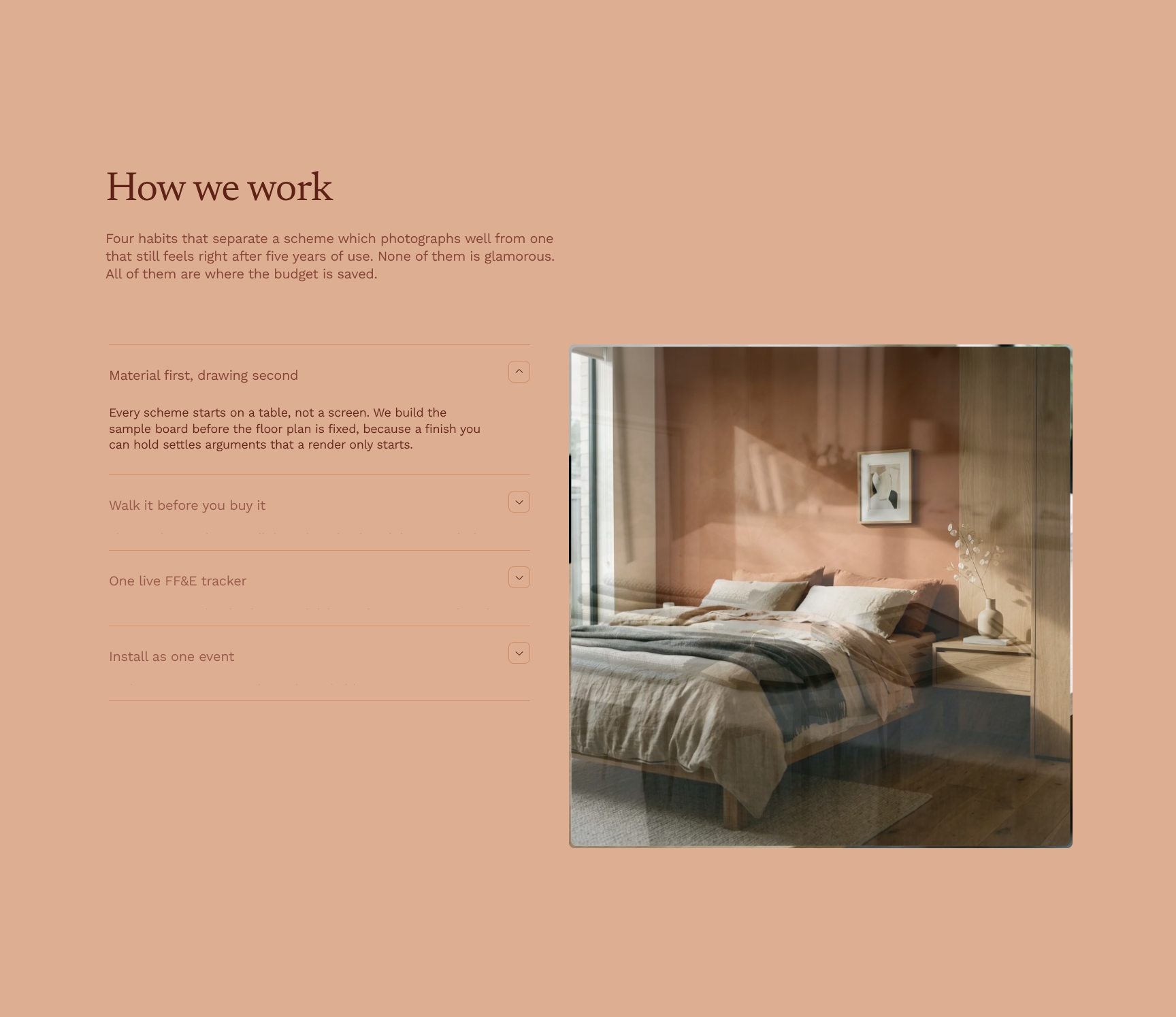
### Physical and Digital Materials Library Gallery
A visual gallery of the 1,380-sample library, catalogued digitally and held in the studio. It highlights Australian-made and low-VOC options and lead times on every label, showing sourcing depth and sustainability.
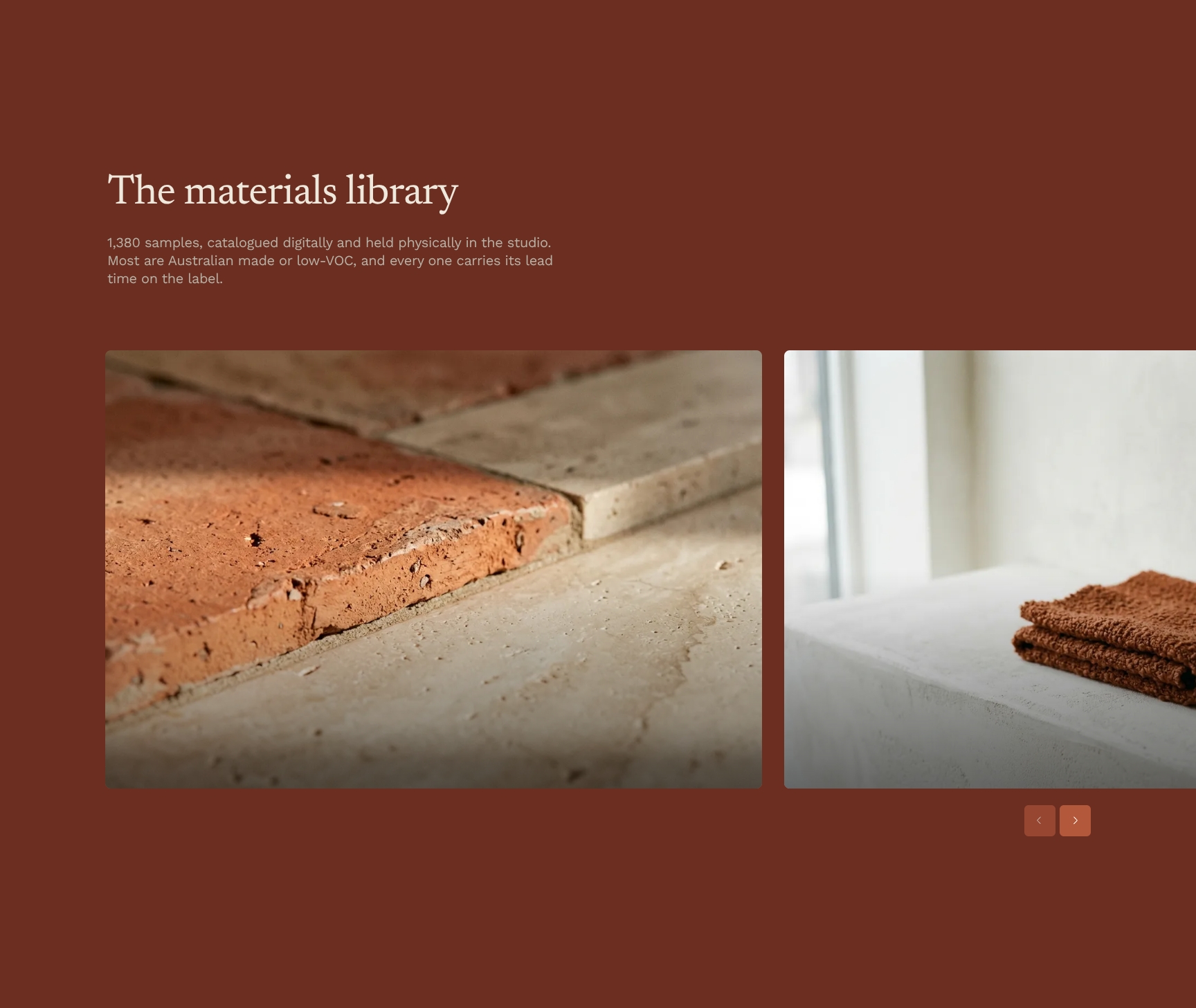
### Project Timeline: Brief to Styled Rooms in 22 to 28 Weeks
A step-by-step view of how a full-house project runs, from brief to styled rooms. It sets realistic expectations, explains why lead times drive the schedule, and shows ordering is planned around them.
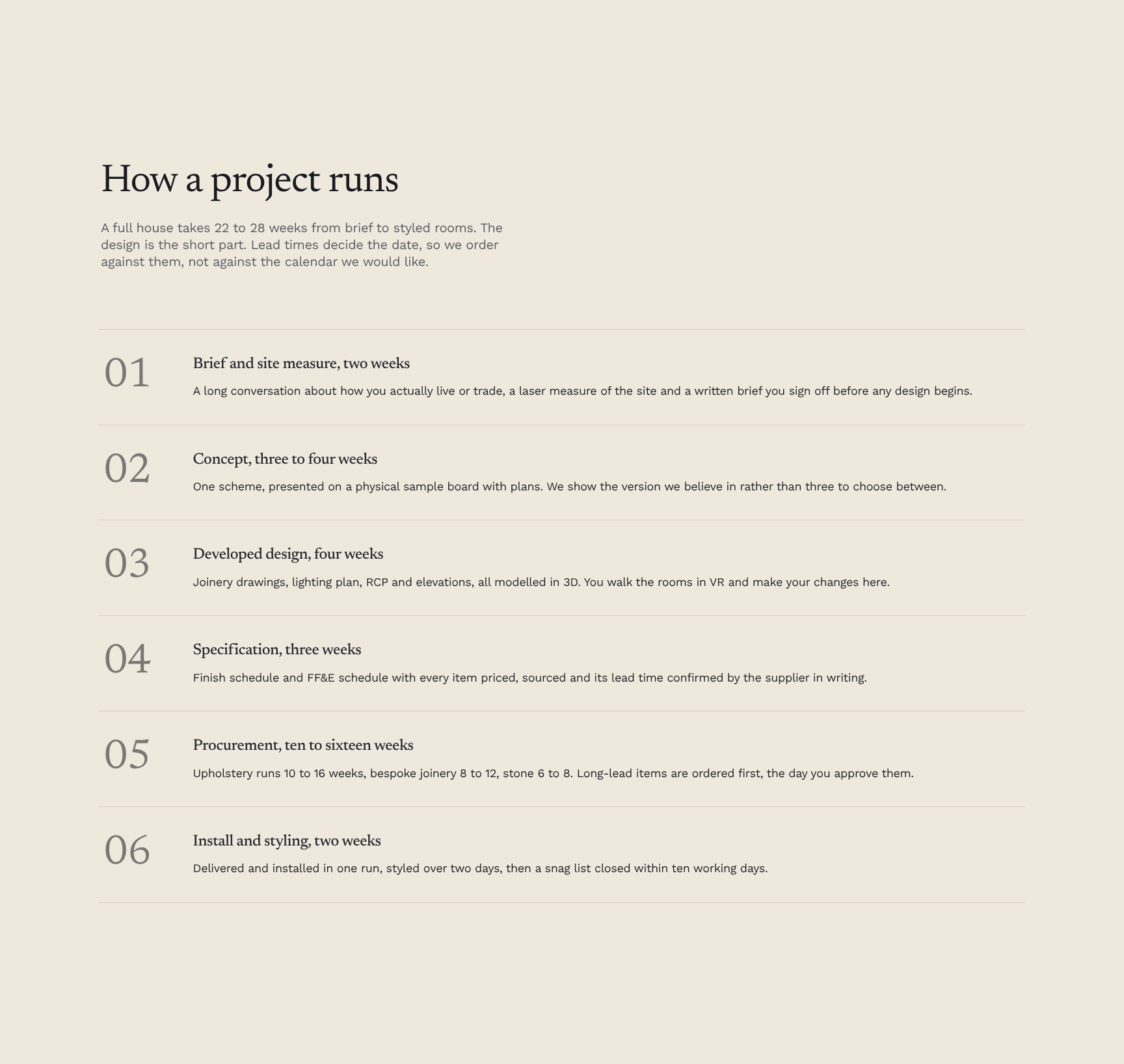
### Client Testimonials on Delivery and Project Management
Real quotes from clients such as a hotel general manager, showing how proactive tracking and quick problem-solving saved an opening date. Social proof that builds confidence in reliability under pressure.
### Contact Call to Action: Book a Materials Library Visit
An inviting closing section that suggests a first meeting at the library table with plans open and samples to hand. It gives prospects a clear, low-pressure next step and turns interest into enquiries.
## Find your answers
Answers to common questions about building an interior design studio portfolio that wins residential and hospitality clients.
### What should be included in a portfolio template?
A strong portfolio should open with a cover, a clear position statement, and proof of impact such as key numbers. This template adds Selected work to showcase projects, How we work to explain your process, and a Materials library for supporting assets. Together these sections tell clients who you are, what you deliver, and how you deliver it.
### How do I customize this portfolio template?
Replace the placeholder text, images, and metrics in each section: Cover, Position, In numbers, Selected work, How we work, and Materials library. Update colors, fonts, and logos to match your brand, and duplicate or remove Selected work entries to fit your project count. Keep layouts consistent so the portfolio looks polished.
### Can I export this portfolio template to PDF or other formats?
Yes, you can export the finished portfolio to PDF for easy sharing with clients and recruiters, and most editors also support PowerPoint or image exports. PDF preserves your layout, fonts, and imagery across devices. For email, compress the file to keep it under 10 MB.
### Is this portfolio template suitable for agencies, freelancers, and studios?
Yes, the structure works for design agencies, consultancies, freelancers, architects, and creative studios. The Position and How we work sections let you communicate your approach, while In numbers and Selected work provide credibility. You can adapt the tone and visuals to fit your industry.
### What is the Materials library section in a portfolio and how should I use it?
The Materials library is a reference section that gathers supporting assets such as case study links, brand guidelines, templates, decks, or sample deliverables. Use it to give prospective clients deeper proof of your work without cluttering Selected work. Organize items by category and add short descriptions or links so they are easy to find.
## Related
- [Miami](https://formlio.com/templates/miami-ffe-procurement-statement-of-work): FF&E procurement statement of work for designers
- [Amsterdam](https://formlio.com/templates/amsterdam-show-apartment-design-proposal): Show apartment design proposal for property developers
- [Chicago](https://formlio.com/templates/chicago-workplace-interior-design-proposal): Workplace interiors proposal for law firms
- [Lisbon](https://formlio.com/templates/lisbon-interior-design-proposal): Full-service interiors proposal for homeowners
- [Stockholm](https://formlio.com/templates/stockholm-restaurant-interior-proposal): Restaurant interior concept proposal for chefs
- [London](https://formlio.com/templates/london-interior-design-retainer-proposal): Monthly design retainer for hospitality clients
---
---
title: "Sydney"
description: "Win hotel design pitches with a concept proposal template covering the brief, lead times, FF&E budget and opening timeline for developers and investors."
canonical: "https://formlio.com/templates/sydney-hotel-design-concept-proposal"
locale: "en"
type: "template"
lastModified: "2026-10-20"
category: "Interior design"
alternates:
fr: "https://formlio.com/fr/templates/sydney-proposition-de-concept-de-design-hotelier.md"
---
# Sydney
Hotel Design Concept Proposal Template
Win hotel projects with a concept proposal template covering the brief, design idea, lead times and FF&E budget, built for design studios pitching to hotel owners.
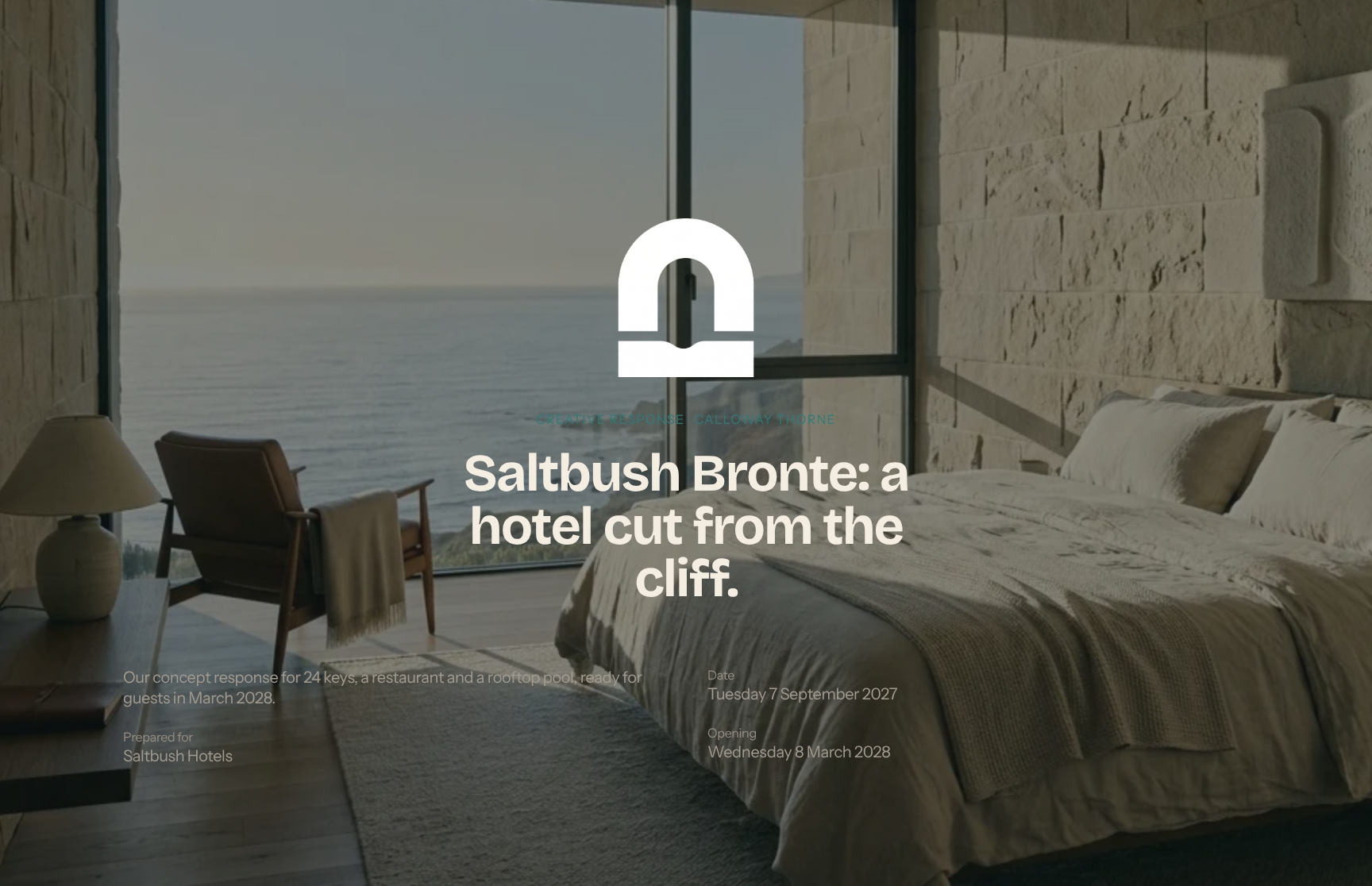
- [Use this template](https://formlio.com/workspaces/claim?template=sydney-hotel-design-concept-proposal)
- [Live preview](https://formlio.com/documents/sydney-hotel-design-concept-proposal)
- **Categories:** [Interior design](https://formlio.com/templates/interior-design), [Architecture](https://formlio.com/templates/architecture), [Proposals](https://formlio.com/templates/proposals), [Pitch decks](https://formlio.com/templates/pitch-decks)
- **Document goal:** Win hotel design pitches with a proposal that lays out your concept, FF&E budget, and opening timeline for developers.
- **Blocks:** Typewriter, Rectangle reveal, Single column, Grid 3x2 with icons, Split, Grid tile scroll, E-signature
- **Palette:** Warm Linen Background (#F4EDE1), Sandstone Accent Light (#DCC7A4), Primary Teal Accent (#2C7C78), Deep Forest Teal (#164B4A), Midnight Green Dark (#121D1C)
## Get more from every document
You pitch a hotel interior concept to developers and investors with the numbers and timeline already built in. Brief recap, FF&E charts, design routes and a material gallery sit ready for your project.
### Get your yes without leaving
Your client reads the pricing, reaches the agreement section, and signs right there. No PDF, no printing, no waiting.
### Build proposals from blocks you trust
Pull in a hero, steps, or testimonials block, then save your best pricing cards to reuse in your next pitch.
### Your pitch lands on any screen
Charts, galleries, and showcases reflow cleanly when your client opens the proposal on a phone between meetings.
### See which section sold them
Heatmaps show who lingered on pricing or your gallery, and session replays tell you when to send that follow-up.
### Know the moment they open it
Get pinged when a client views your proposal, leaves a comment, or signs, so you reply while the deal is warm.
### Write the pitch together, live
Your designer tweaks the showcase while you refine the scope and pricing, all in the same proposal at once.
## See how every part fits
The proposal opens on your big idea and closes on a signed next step, with budget, lead times and design routes building the case in between. Keep what fits the pitch, drop what doesn't, and reorder anything.
### Hotel Concept Proposal Cover Page
A bold opening cover for the Saltbush Bronte creative response, framing the 24-key hotel, restaurant and rooftop pool. Sets a confident, premium tone and names the client and studio at first glance.
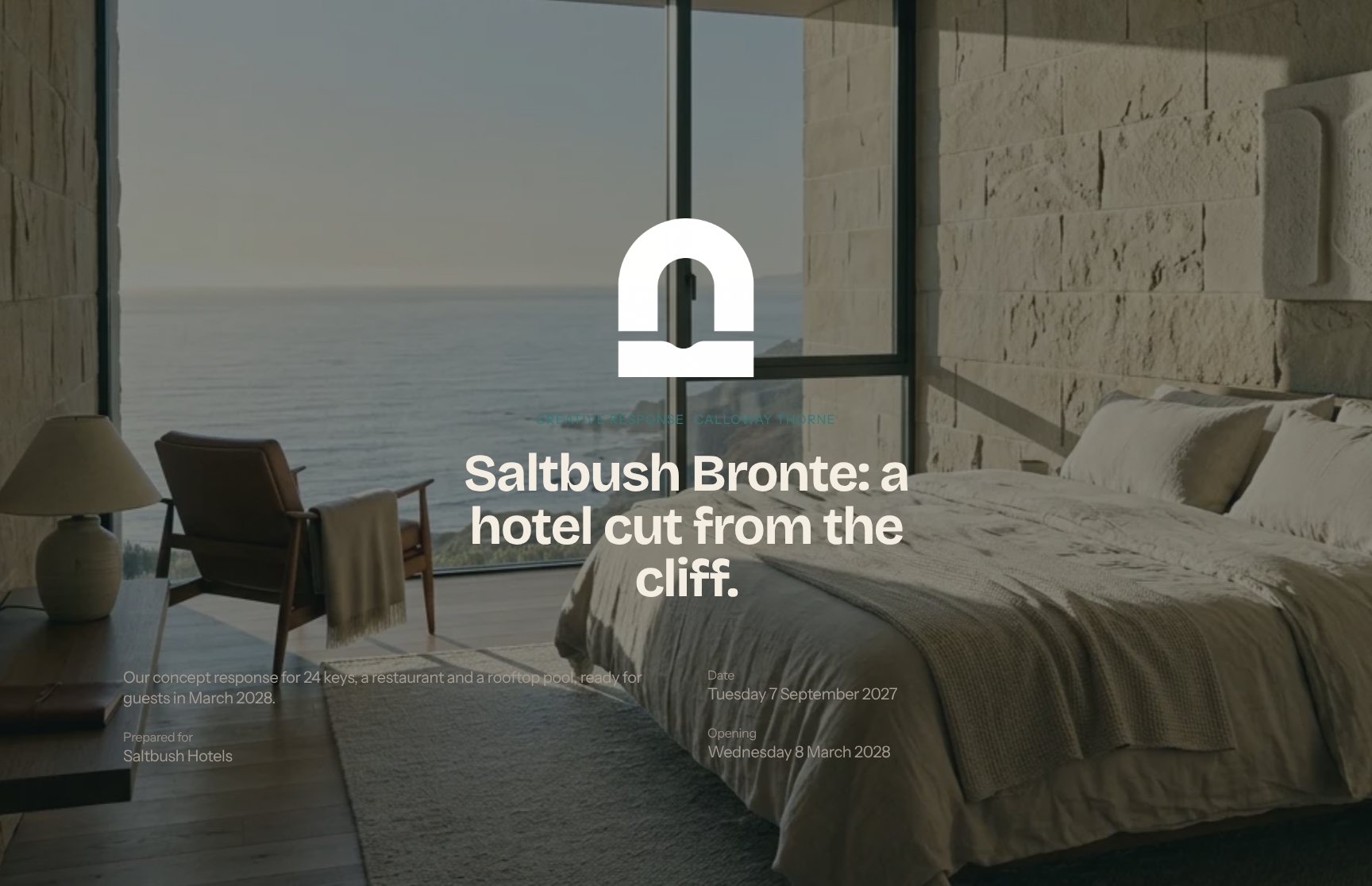
### Big Idea & Design Concept Statement
An animated statement that distills the core design concept into one memorable line. It gives investors and stakeholders a clear creative anchor before any detail, making the vision easy to remember and repeat.
### Client Brief Recap & Investor Feedback
Reflects the brief back to the client, including why investors rejected the first concept and how it can be fixed. Proves you listened, names the real problem and builds trust before presenting solutions.
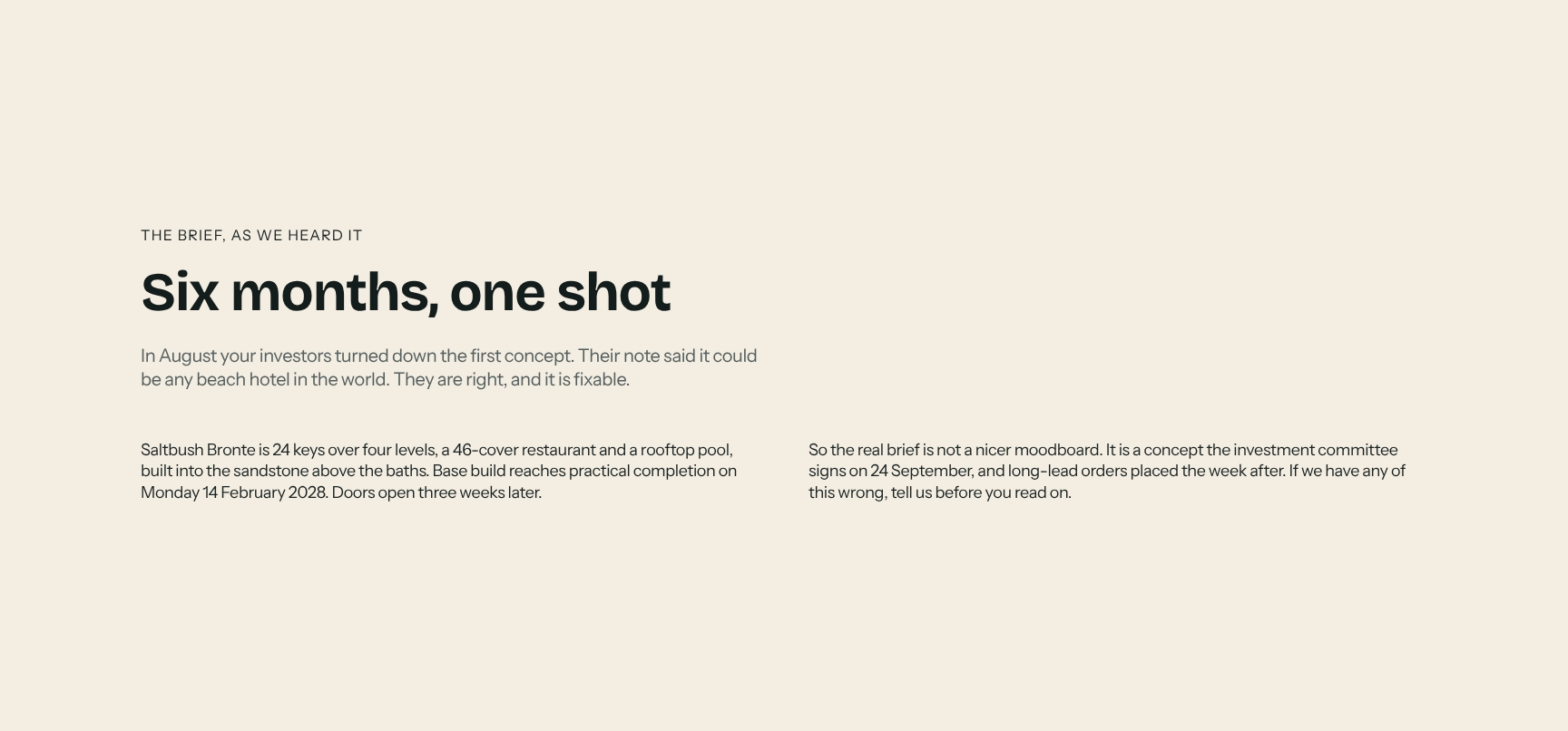
### Key Project Numbers & Constraints Cards
Four headline figures drawn from the investor pack and base-build programme, shown as scannable cards. Highlights the constraint that drives every decision so stakeholders see the logic behind the plan.
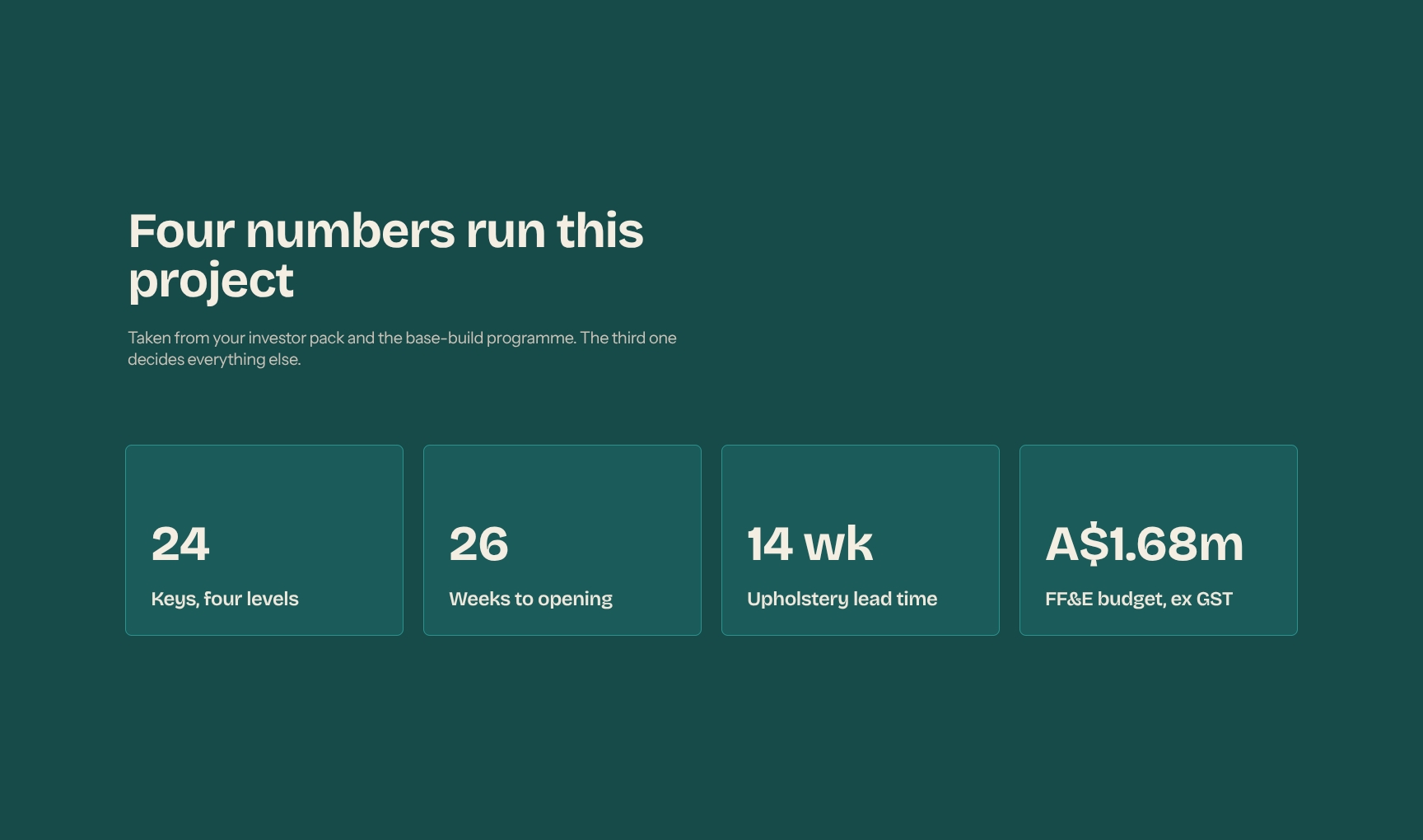
### FF&E Lead Times & Budget Charts
Charts of supplier lead times and the FF&E budget split by area, with the 4 October ordering deadline called out. Turns procurement risk into clear visuals so the schedule drives the design decisions.
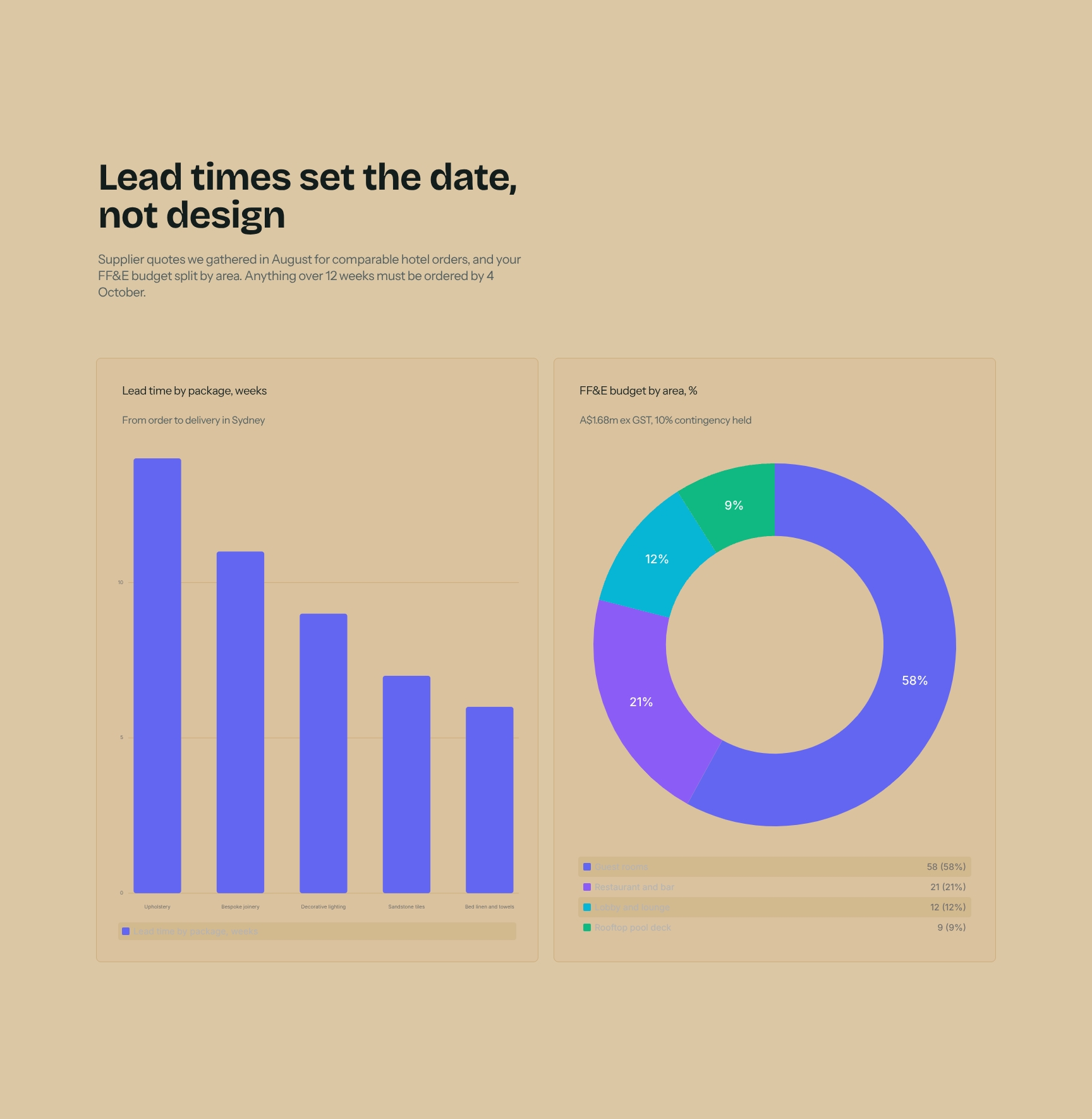
### Three Design Routes with Recommendation
Presents three design directions, led by the recommended Quarry route: sandstone walls, carved bedheads and green glazed tile. Gives clients a real choice while guiding them to the option investors can back.
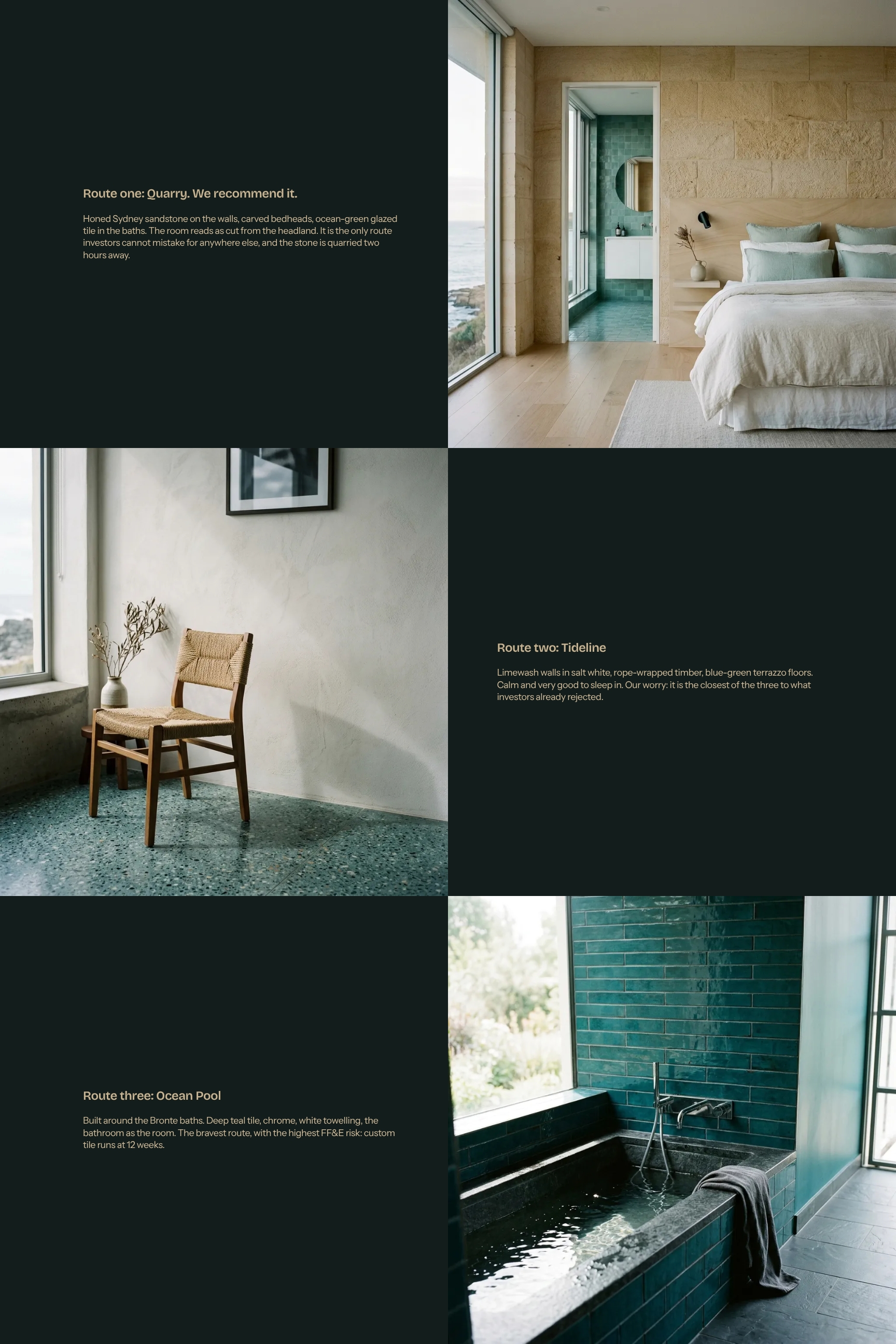
### Quarry Material Palette Gallery
A visual gallery of six specified materials, each sourced from suppliers who can meet the October order. Includes the sample box delivery date, making the palette tangible, buildable and ready for approval.
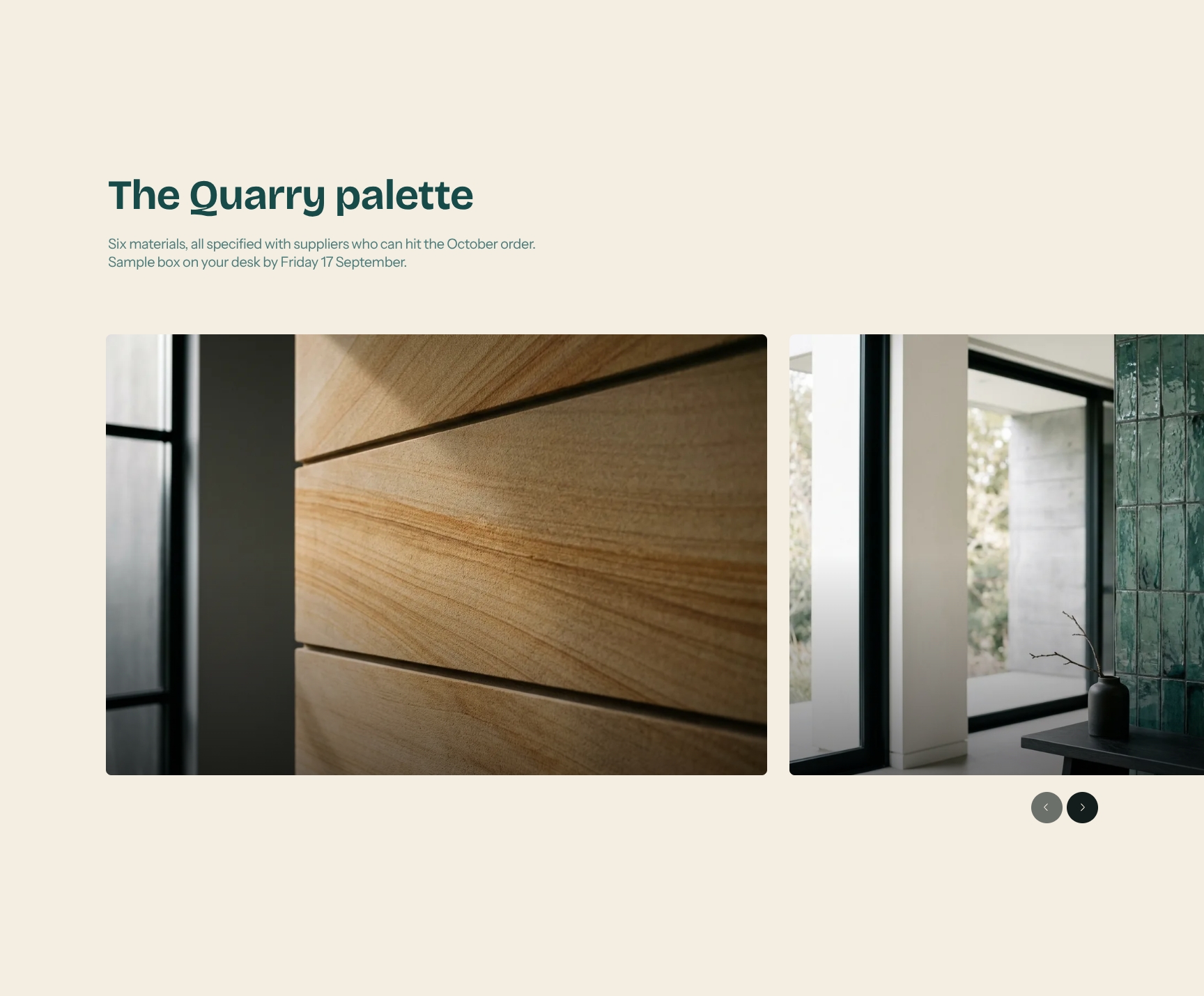
### Studio Credentials & Fast-Opening Track Record
Social proof showing the eleven-person studio's history: seven hotels opened, none late. Reassures nervous investors that the team can deliver on a tight timeline, backed by founders and real results.
### Accelerated Delivery Timeline & Process Steps
A step-by-step plan that compresses a 30-week sequence into 26 weeks by ordering long-lead items on a signed frame and fabric first. Shows exactly how the schedule is protected without losing design quality.
### Proposal Sign-Off & Next Step Agreement
A clear call to action with a sign-by deadline of Friday 10 September and the consequences of delay. Includes e-signature, and kicks off the VR model and sample box on Monday to keep momentum.
## Find your answers
Answers to common questions about building hotel concept proposals for developers, investors and hospitality clients.
### What should be included in a business proposal template?
A strong proposal includes a cover, the core idea, a clear brief, the numbers, lead times, and options for the client to choose from. This template covers each of these in six sections: Cover, The Idea, The Brief, The Numbers, Lead Times, and Three Routes. Together they show the client what you propose, what it costs, and when it will be delivered.
### How do I customize this proposal template for my own clients?
Replace the placeholder text in each section with your client's details, then update the pricing in The Numbers and the timelines in Lead Times. Add your logo, brand colors, and fonts to the Cover and adjust the layout to match your style. You can rename, reorder, or remove sections to fit the scope of each project.
### What are the 'Three Routes' in this proposal and why use them?
The Three Routes section presents three options at different levels of scope, budget, or speed, such as Essential, Recommended, and Premium. Offering choices shifts the client's decision from 'yes or no' to 'which option', which often raises close rates and average deal size. Each route can be tied back to the pricing in The Numbers and the schedule in Lead Times.
### How do I present pricing and timelines clearly in a proposal?
Use The Numbers section to itemize costs by deliverable, with a clear total and any payment terms. Pair it with Lead Times to show milestones and delivery dates for each phase. Keeping the two sections side by side lets clients see the cost and the schedule without hunting through the document.
### Is this proposal template suitable for creative agencies, freelancers, and consultants?
Yes, the structure works for any service business that pitches projects, including design studios, marketing agencies, freelancers, and consultants. The idea-first flow, with a brief, budget, schedule, and options, adapts easily to branding, web, content, and strategy work. Adjust the tone and the level of detail to match your industry and the client's expectations.
## Related
- [Miami](https://formlio.com/templates/miami-ffe-procurement-statement-of-work): FF&E procurement statement of work for designers
- [Amsterdam](https://formlio.com/templates/amsterdam-show-apartment-design-proposal): Show apartment design proposal for property developers
- [Chicago](https://formlio.com/templates/chicago-workplace-interior-design-proposal): Workplace interiors proposal for law firms
- [Lisbon](https://formlio.com/templates/lisbon-interior-design-proposal): Full-service interiors proposal for homeowners
- [Stockholm](https://formlio.com/templates/stockholm-restaurant-interior-proposal): Restaurant interior concept proposal for chefs
- [London](https://formlio.com/templates/london-interior-design-retainer-proposal): Monthly design retainer for hospitality clients
---
---
title: "Seattle"
description: "Statement of work template for commercial interior design: scope, fixed fee, delivery method and phased deliverables from test fit to move-in for office clients."
canonical: "https://formlio.com/templates/seattle-interior-design-statement-of-work"
locale: "en"
type: "template"
lastModified: "2026-10-20"
category: "Interior design"
alternates:
fr: "https://formlio.com/fr/templates/seattle-cahier-des-charges-darchitecture-dinterieur.md"
---
# Seattle
Interior Design Statement of Work Template
Scope commercial office fit-outs with this interior design statement of work template: phased deliverables, FF&E management, delivery method and fixed fee.
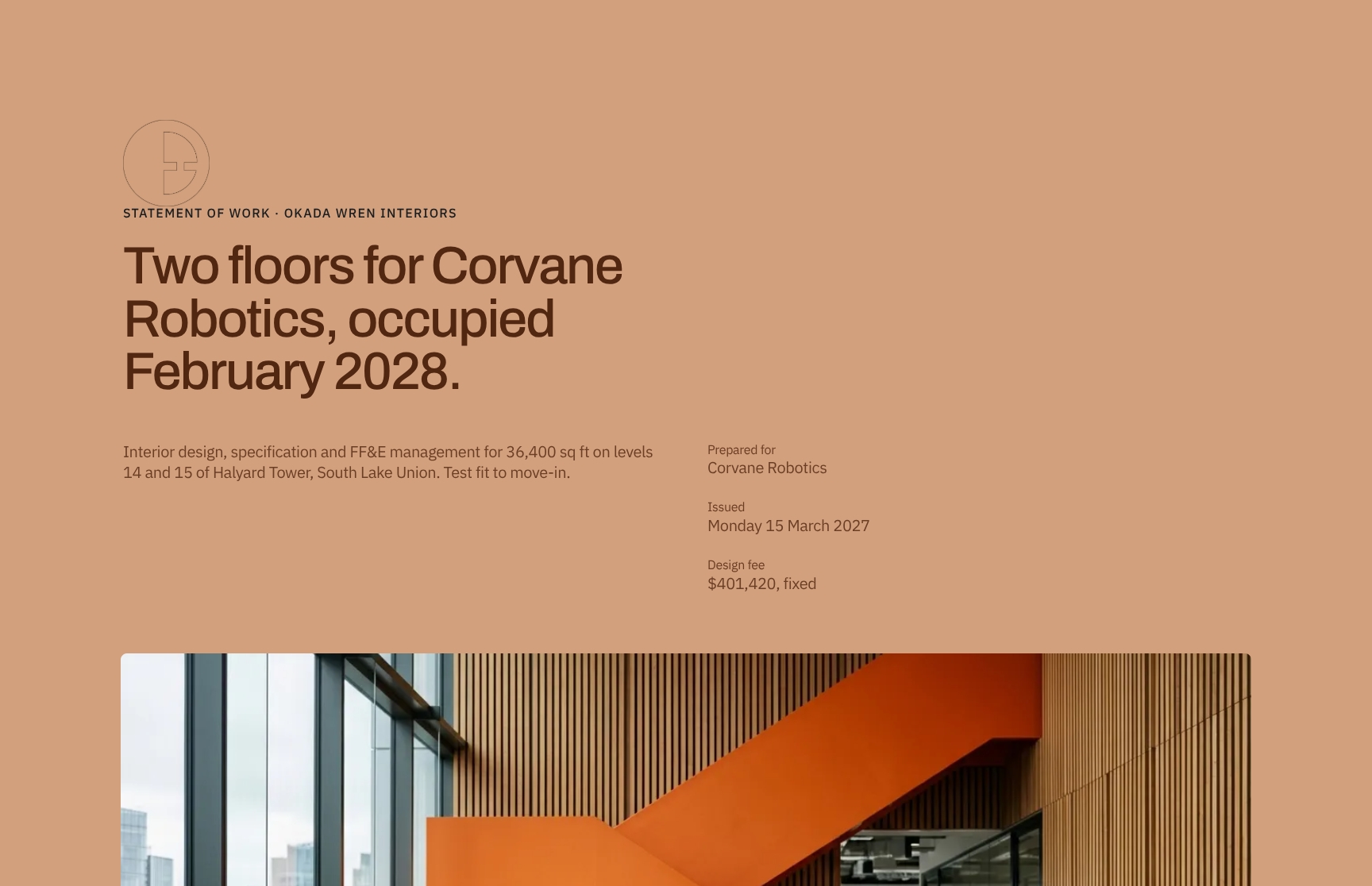
- [Use this template](https://formlio.com/workspaces/claim?template=seattle-interior-design-statement-of-work)
- [Live preview](https://formlio.com/documents/seattle-interior-design-statement-of-work)
- **Categories:** [Interior design](https://formlio.com/templates/interior-design), [Proposals](https://formlio.com/templates/proposals)
- **Document goal:** Lock in scope, fees, and phased deliverables with office clients, from test fit to move-in, before design work begins.
- **Blocks:** Highlight, Single column, Scroll gradient, Spotlight, Gantt, Itemized quote, Left-aligned, Masonry, E-signature
- **Palette:** Soft Stone Background (#E3E4E1), Warm Sandstone Accent (#D2A07C), Vibrant Ember Orange (#E5561C), Rich Espresso Brown (#6B3D26), Midnight Charcoal Text (#1B1E20)
## Get more from every document
Lock in scope, fee and schedule for an office fit-out before the first drawing goes out. Phased deliverables, sign-off gates, and an FF&E order deadline keep both sides working from the same page.
### Get the yes without the PDF
Your client reads the scope, checks the price, and signs on the same page, so no printing, scanning, or email chase.
### Assemble agreements from proven sections
Drop in pricing, steps, and terms blocks, then save your own versions to reuse on every new client agreement.
### Clients sign cleanly on any screen
Your scope, pricing, and terms stay readable on a phone in a cab or a laptop at the desk, with one layout.
### See which terms your client lingers on
Heatmaps show whether they stall on pricing or the accordion FAQ, so your follow-up lands before doubts settle.
### Know the second they open it
Get pinged when your client views, comments, or signs, so you can answer a question while the project is still warm.
### Draft the agreement with your team
You tune pricing while your producer fills in tasks and steps, all in the same document, live, before it goes out.
## See how every part fits
The SOW opens with project scope and the FF&E deadline, then moves through delivery, phases, fees and terms, and closes on a signature date. Keep, drop, or reorder any section to fit your project.
### Interior Design SOW Cover Page with Project Overview
Opens with the client, the studio and the project at a glance: 36,400 sq ft across two floors, with a February 2028 occupancy. Sets the scope and the deadline before the reader goes any further.
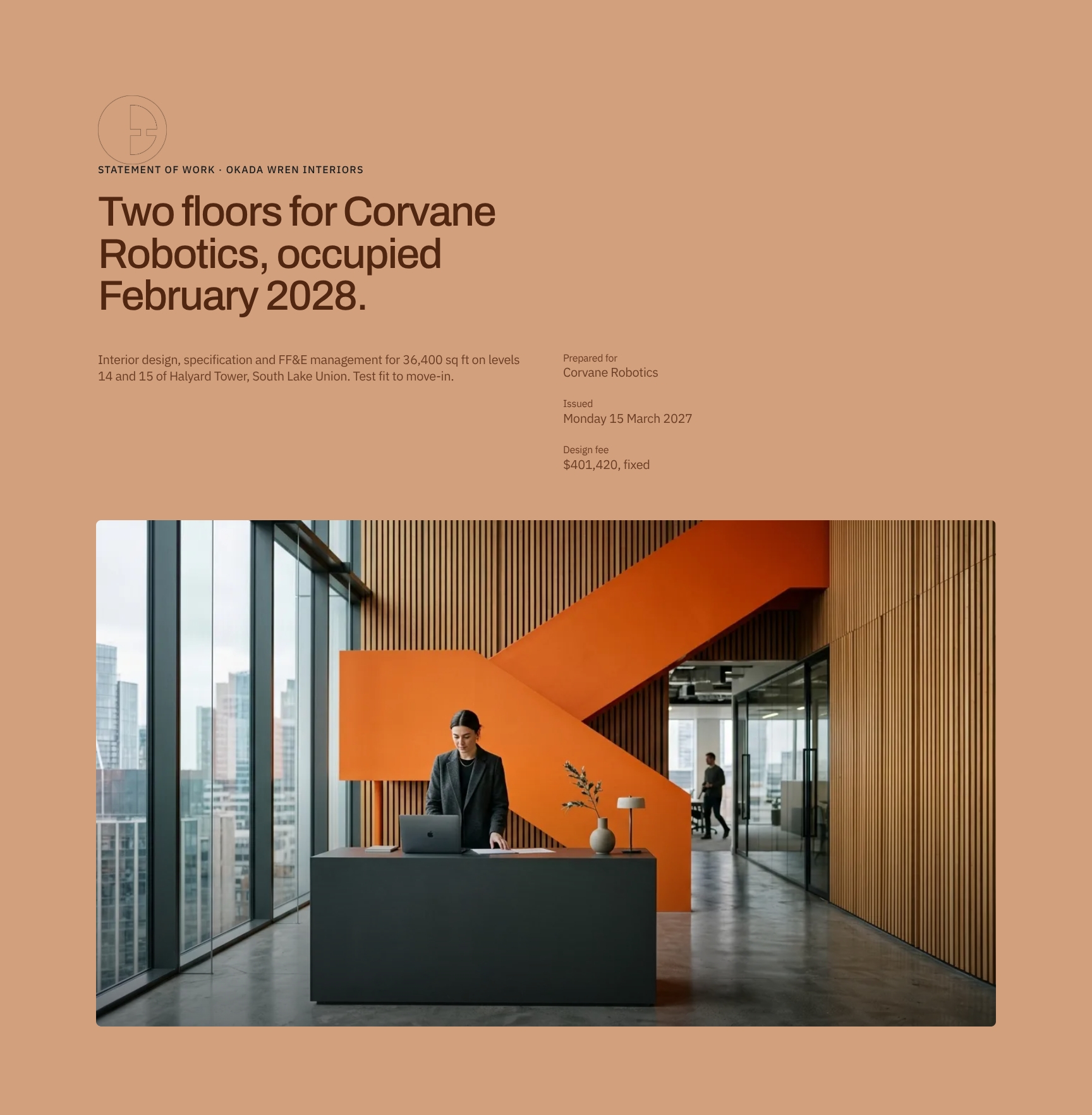
### Parties, Dates and Scope of Work Under the MSA
Names the parties, ties the SOW to the master services agreement and states which document governs in a conflict. Defines the scope and key dates so both sides start from the same baseline.
### Critical Constraint: FF&E Lead Time and Order Deadline
A short, memorable statement of the one fact that drives the schedule: chair lead times set the date, so orders go in September. Gives the client an early reason to decide on time.

### Delivery Method: Negotiated GC with Design-Assist
Explains why a negotiated general contractor with design-assist was chosen. It costs slightly more up front but removes bid surprises, which matters when the occupancy date is fixed.
### Deliverables by Phase with Sign-Off Gates
Lists what the client receives and approves at the end of each design phase. Each sign-off releases the next fee stage, so progress, approvals and payment stay linked.
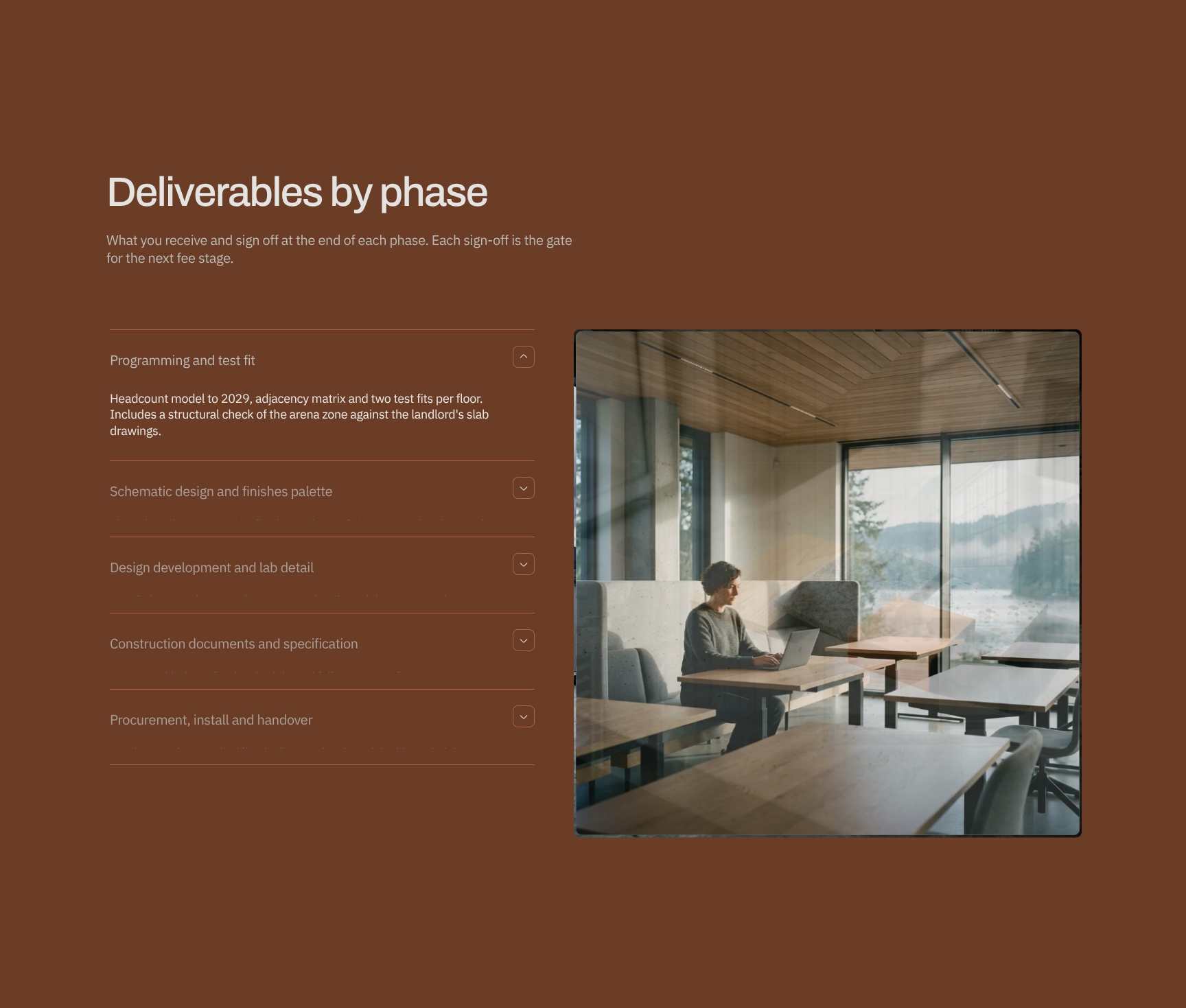
### 45-Week Project Programme and Schedule Assumptions
Lays out the path to occupancy and the two waits that drive it: SDCI permit review and FF&E lead times. States the assumed three-working-day client sign-off so responsibilities are clear.
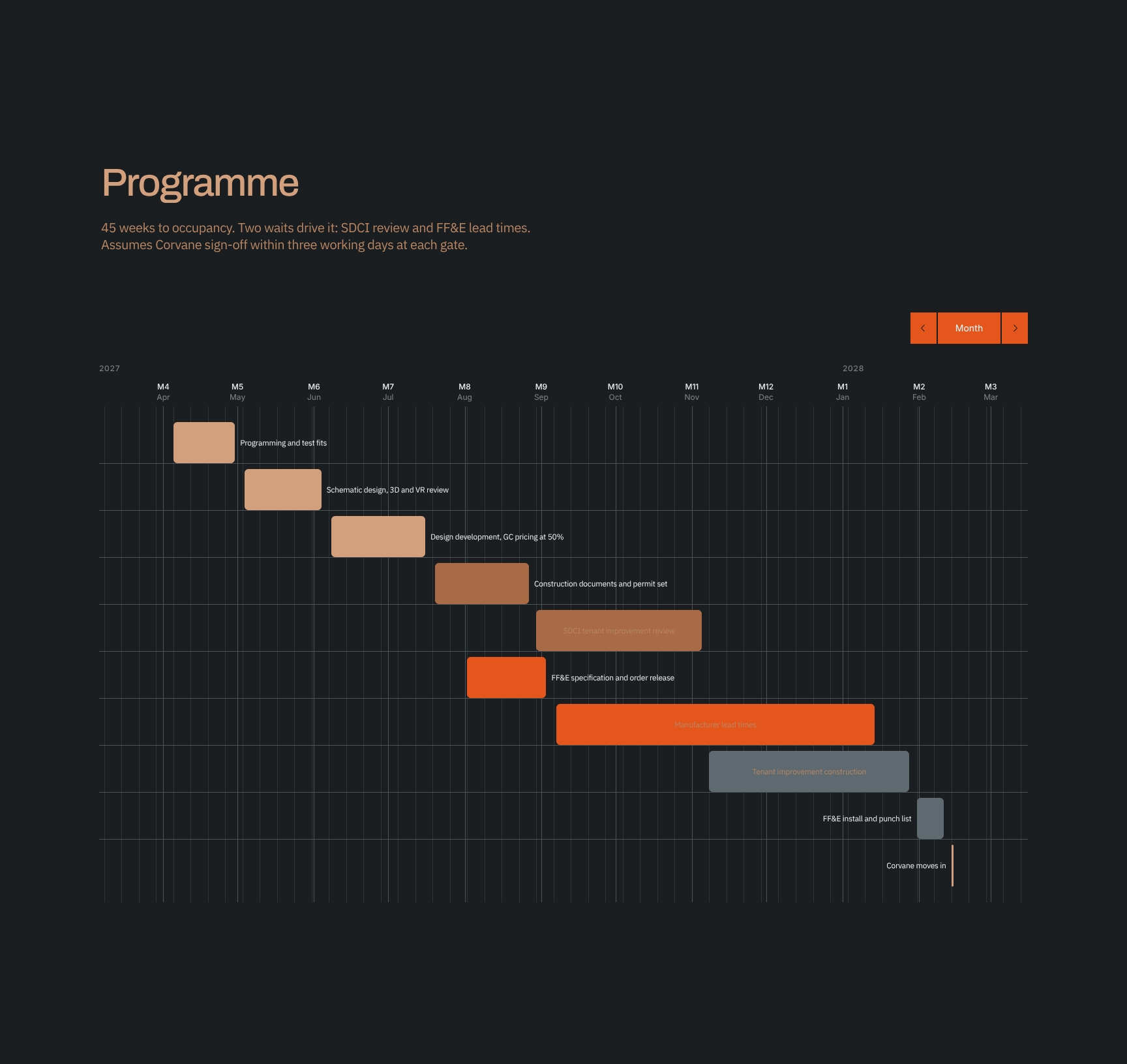
### Fixed Fee and Payment Schedule with FF&E Budget
Sets a fixed fee of $11.03 per usable sq ft, including the architect of record and MEP engineers. Separates the $1.36m–$1.52m FF&E budget plus 10% contingency, bought at trade pricing.
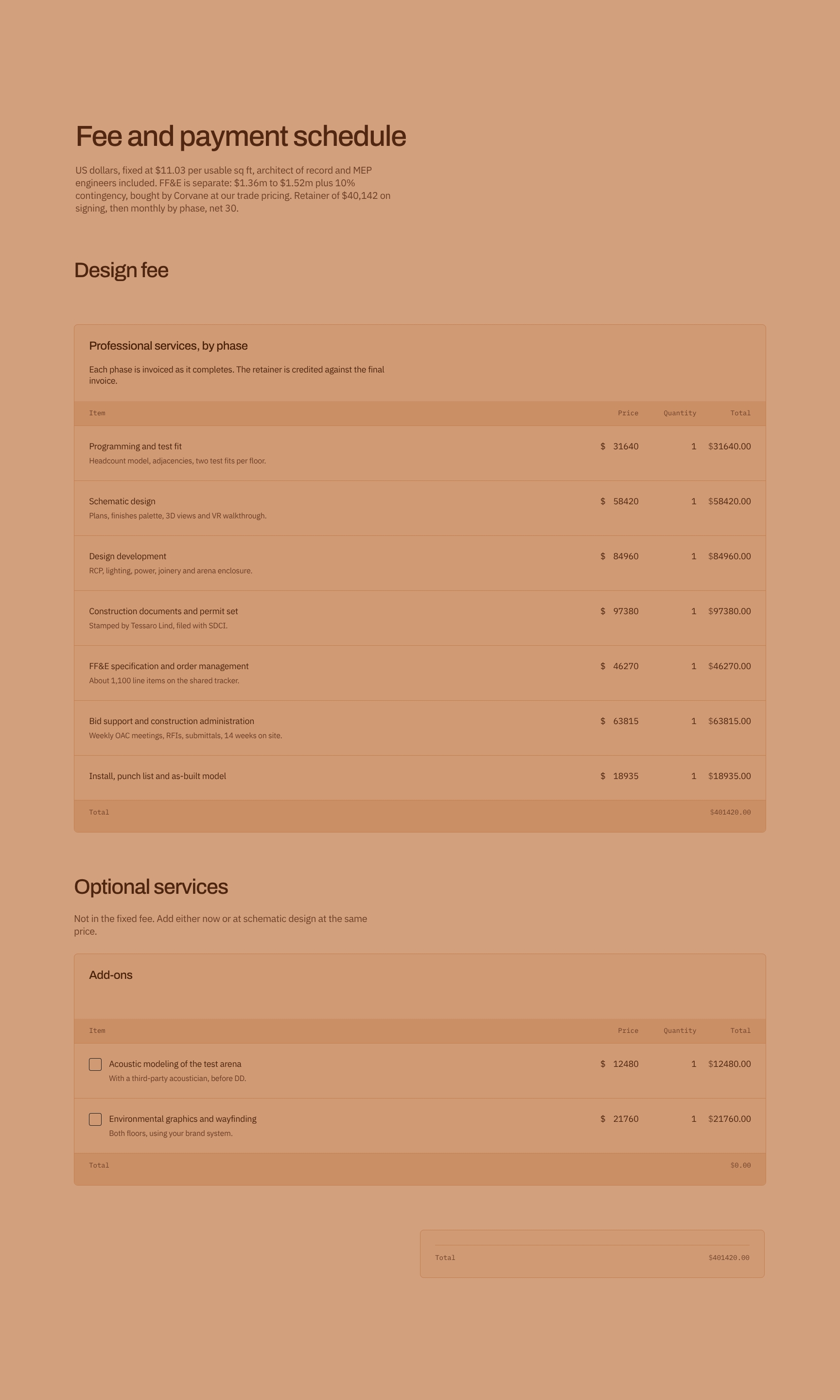
### Client References from Fixed-Date Workplace Fit-Outs
Offers three callable references from workplace and lab fit-outs delivered to fixed occupancy dates. Contact details come in the reference pack sent with the countersigned SOW.
### SOW-Specific Terms That Protect Fee and Schedule
Collapsible clauses covering only the points that decide whether the fee and February date hold. Everything else defers to the MSA, so the document stays short and easy to review.
### Measurable Handover Commitments and Performance Targets
Six figures the design targets, tests on site and reports in the closeout pack. If one misses, the studio explains why and what it costs to fix, which keeps accountability concrete.
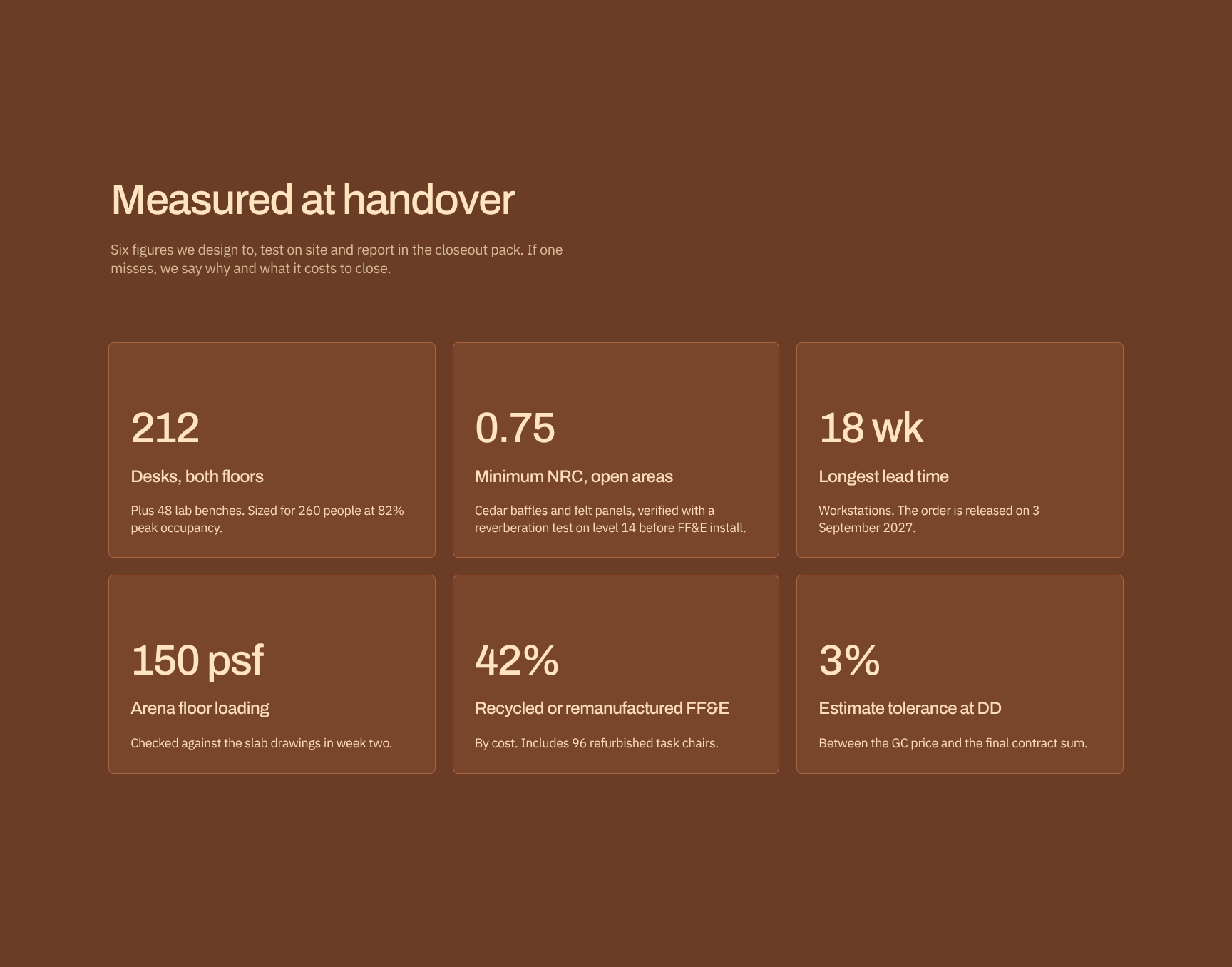
### Next Step: SOW Acceptance and Signature Deadline
Gives the validity date of 26 March 2027 and explains why: after it, the September order release and the February date need re-checking. Prompts a timely countersignature.
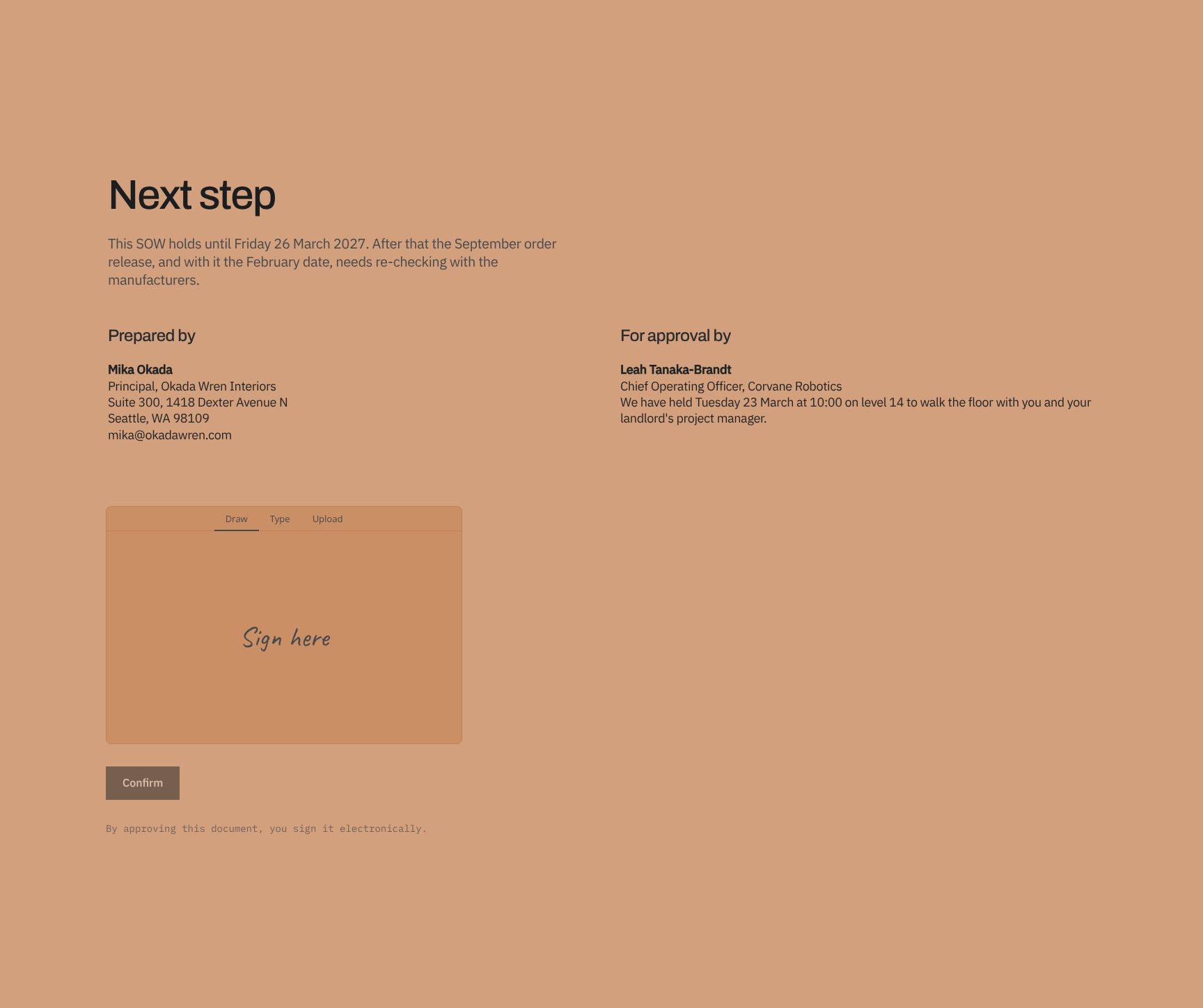
## Find your answers
Answers to common questions about writing a commercial interior design statement of work for office clients, from fixed fees to phased sign-offs.
### What should be included in a project agreement template?
A solid project agreement should include a cover page, the parties and scope of work, any constraints (such as budget, time, or resources), the delivery method, a list of deliverables, and a programme or timeline. Together these sections set clear expectations, define responsibilities, and reduce the risk of disputes.
### How do I customize this agreement template for my project?
Replace the placeholder text on the cover and in the Parties and scope section with your own names, project details, and boundaries. Then edit The constraint, Delivery method, Deliverables, and Programme sections to match your project's requirements. Delete any sections you don't need and add clauses where your project calls for them.
### What is the 'constraint' section in a project agreement and why does it matter?
The constraint section states the key limits the project must work within, such as budget, deadline, regulatory requirements, or resource availability. Documenting it up front aligns both parties on what is realistic and gives you a reference point if scope changes or delays occur.
### Can I use this template for different industries and project types?
Yes. The structure of scope, constraints, delivery method, deliverables, and programme applies to construction, consulting, software development, creative services, and more. Adjust the terminology and deliverables to suit your industry, and have a legal professional review it if your project carries specific regulatory or liability requirements.
### How do I set a realistic programme and deliverables schedule in the agreement?
List each deliverable separately, assign a clear completion date or milestone to it, and link those dates to the overall programme. Allow buffer time for reviews, approvals, and dependencies, and make sure the dates respect the limits set out in The constraint section. Both parties should agree to the schedule before signing.
## Related
- [Miami](https://formlio.com/templates/miami-ffe-procurement-statement-of-work): FF&E procurement statement of work for designers
- [Amsterdam](https://formlio.com/templates/amsterdam-show-apartment-design-proposal): Show apartment design proposal for property developers
- [Chicago](https://formlio.com/templates/chicago-workplace-interior-design-proposal): Workplace interiors proposal for law firms
- [Lisbon](https://formlio.com/templates/lisbon-interior-design-proposal): Full-service interiors proposal for homeowners
- [Stockholm](https://formlio.com/templates/stockholm-restaurant-interior-proposal): Restaurant interior concept proposal for chefs
- [London](https://formlio.com/templates/london-interior-design-retainer-proposal): Monthly design retainer for hospitality clients
---
---
title: "Paris"
description: "Win flagship boutique projects with an interior design estimate template covering scope, six project phases and design fees. Built for retail design studios."
canonical: "https://formlio.com/templates/paris-retail-interior-design-estimate"
locale: "en"
type: "template"
lastModified: "2026-10-20"
category: "Interior design"
alternates:
fr: "https://formlio.com/fr/templates/paris-devis-de-design-dinterieur-pour-commerce.md"
---
# Paris
Retail Interior Design Estimate Template
Win flagship boutique projects with an interior design estimate template covering scope, six project phases and design fees. Built for retail design studios.
- [Use this template](https://formlio.com/workspaces/claim?template=paris-retail-interior-design-estimate)
- [Live preview](https://formlio.com/documents/paris-retail-interior-design-estimate)
- **Categories:** [Interior design](https://formlio.com/templates/interior-design), [Proposals](https://formlio.com/templates/proposals)
- **Document goal:** Win flagship boutique projects with a clear estimate covering scope, six project phases and design fees.
- **Blocks:** Typewriter, Single column, Marquee, Itemized quote, Vertical timeline, Left-aligned, E-signature
- **Palette:** Warm Parchment Light (#F2EFE9), Antique Gold Accent (#C4A266), Regal Plum Primary (#5D4C6A), Deep Aubergine Shade (#3A3044), Midnight Ink Dark (#1B1820)
## Get more from every document
Win flagship boutique projects with an estimate that shows clients exactly what they get and what it costs. Scope, six project phases, euro day rates, and milestone dates sit in one document.
### Get a yes without leaving the proposal
Your client reads the pricing, then signs in the agreement section right there. No PDF, no printing, no waiting on email.
### Build proposals from sections you trust
Drop in a hero, steps, or pricing block, then save your best-performing versions and reuse them in the next pitch.
### Your pitch looks right on every screen
Your client opens the proposal on a phone between meetings and the pricing and steps read as clearly as on a desktop.
### See which pricing section made them pause
Heatmaps show where clients linger, and session replays let you watch them read, so you call right when interest peaks.
### Know the moment they open your proposal
Get pinged when a client views, comments, or signs, so your follow-up lands while the proposal is on their screen.
### Write the proposal together, live
Your designer tunes the hero while you rework the pricing and a teammate fills in tasks, all in the same document.
## See how every part fits
The estimate opens with a boutique cover and site handover, moves through concept, method, fees, and programme, and closes on exclusions and sign-off. Keep what fits your studio, drop what doesn't, and reorder anything.
### Boutique Interior Design Estimate Cover Page
A polished cover framing the Ondée flagship project: 140 m² on rue de Marignan, November opening, and a design-fee-only estimate in euros HT. Sets scope and tone from the first glance.
### Project Scope and Site Handover Summary
Defines exactly what the estimate covers: one 140 m² shell-and-core boutique, handover date of 3 May 2027 and a 4 November opening. Prevents scope creep by aligning both sides on the brief.
### Retail Design Concept and Material Philosophy
A concise statement of the design idea: three materials, one testing bar, nothing on display that is not for sale. Gives the client a memorable, sales-driven rationale for the studio's approach.

### Six-Phase Design Method and Studio Team
Walks through the six design phases from site measure to opening day, introducing the leads who attend every review. Builds confidence in process, accountability and the studio's experience since 2018.
### Transparent Design Fee and Day Rates in Euros HT
Itemised design fee with TVA noted and day rates for director, designer and visualiser. Clarifies that the FF&E and joinery budget of €212,000 to €236,000 is separate, so there are no pricing surprises.
### Lead-Time Programme and Opening Date Milestones
Shows how supplier lead times drive the schedule, including the fourteen-week bench and the 11 June order deadline. Highlights the three-day sign-off assumption so clients know what protects the November opening.
### Exclusions and Assumptions Disclosure
An expandable list of what is not included, such as shell works, services and permits. Read before signing, it keeps expectations clear and shows whether the fee and date will hold.
### Estimate Approval and Sign-Off Next Step
A clear call to action: the estimate holds until 4 March 2027, and signing triggers the laser scan booking for the week of 8 March. Turns agreement into immediate momentum.
## Find your answers
Answers to common questions about pricing, phasing, and presenting estimates for retail interior design projects and boutique fit-outs.
### What should be included in a project proposal template?
A strong proposal includes a Cover, Scope, The Idea, Method, Fee, and Programme. The Cover sets out who the proposal is for and from. The Scope defines deliverables, The Idea explains your concept, the Method shows how you will deliver it, the Fee sets out costs, and the Programme gives the timeline and milestones.
### How do I customize this proposal template for my own business?
Replace the placeholder text in each section with your project details, then add your logo, brand colors, and fonts on the Cover. Edit the Scope, Method, and Fee sections to match your services, and adjust the Programme to your real milestones. You can delete or reorder sections to suit the client's brief.
### Can I export this proposal template to PDF or Word?
Yes. You can export the finished proposal to PDF to send a polished, non-editable version to clients. If you need to collaborate or let clients make edits, you can also export to an editable format such as Word or Google Docs. Check formatting after export to confirm fonts and layout carry over.
### Is this proposal template suitable for creative, consulting, and architecture projects?
Yes. The structure of Scope, The Idea, Method, Fee, and Programme works well for design studios, architects, consultants, agencies, and freelancers. Any service-based work with defined deliverables, a pricing structure, and a timeline fits this format. Adapt the language and level of detail to your industry's conventions.
### How should I present the Fee and Programme sections in a proposal?
In the Fee section, break pricing down by phase or deliverable, state what is included and excluded, and note payment terms. In the Programme section, show key milestones, durations, and client review points in a simple timeline or table. Clear fees and dates reduce client questions and speed up approval.
## Related
- [Miami](https://formlio.com/templates/miami-ffe-procurement-statement-of-work): FF&E procurement statement of work for designers
- [Amsterdam](https://formlio.com/templates/amsterdam-show-apartment-design-proposal): Show apartment design proposal for property developers
- [Chicago](https://formlio.com/templates/chicago-workplace-interior-design-proposal): Workplace interiors proposal for law firms
- [Lisbon](https://formlio.com/templates/lisbon-interior-design-proposal): Full-service interiors proposal for homeowners
- [Stockholm](https://formlio.com/templates/stockholm-restaurant-interior-proposal): Restaurant interior concept proposal for chefs
- [London](https://formlio.com/templates/london-interior-design-retainer-proposal): Monthly design retainer for hospitality clients
---
---
title: "Brighton"
description: "Architecture statement of work template for RIBA Stages 3 and 4: scope, deliverables by stage, programme and fees. Built for architects and their clients."
canonical: "https://formlio.com/templates/brighton-architecture-statement-of-work"
locale: "en"
type: "template"
lastModified: "2026-10-20"
category: "Architecture"
alternates:
fr: "https://formlio.com/fr/templates/sydney-cahier-des-charges-darchitecture.md"
---
# Brighton
Architecture Statement of Work Template (RIBA Stages 3-4)
Architecture statement of work template for RIBA Stages 3 and 4: scope, BIM deliverables, programme and fees. Built for architects and clients.
- [Use this template](https://formlio.com/workspaces/claim?template=brighton-architecture-statement-of-work)
- [Live preview](https://formlio.com/documents/brighton-architecture-statement-of-work)
- **Categories:** [Architecture](https://formlio.com/templates/architecture), [Proposals](https://formlio.com/templates/proposals)
- **Document goal:** Agree scope, deliverables, programme and fees for RIBA Stages 3 and 4 in one clear document your client can sign.
- **Blocks:** Image reveal, Single column, Scroll gradient, Spotlight, Vertical timeline, Itemized quote, Grid 3x2 with icons
- **Palette:** Soft Mist Background (#EEF0EC), Golden Highlight Accent (#E6D36A), Primary Brand Teal (#3B5B5A), Deep Forest Shadow (#213736), Midnight Charcoal Text (#141716)
## Get more from every document
Define exactly what you will design, deliver and charge for across RIBA Stages 3 and 4 before work starts. Stage deliverables, a gated programme, GBP fees and acceptance criteria are already structured for you.
### Get the agreement signed on the page
Your client reads the scope, checks the price, and signs in the same document. No printing, no PDF attachments.
### Assemble agreements from sections you trust
Pull in pricing, steps, and terms blocks, then save your tweaked versions to reuse on the next client deal.
### Terms read cleanly on any screen
Your client can review the breakdown and sign from a phone between meetings, with no layout rework from you.
### See which terms your client lingers on
Heatmaps show if they stalled on pricing or the accordion, so you know what to address in your follow-up.
### Know the moment they sign
Get a ping when your client opens the agreement, leaves a comment, or signs, so you can reply while it's fresh.
### Finalize terms with your team together
You, your producer, and legal can edit scope, pricing, and clauses in the same agreement at the same time.
## See how every part fits
The document opens with a branded cover and a clear scope summary, then moves through deliverables, programme and fees, and closes with contract terms and signatures. Keep what fits, drop what doesn't, and reorder anything to match your project.
### Branded Statement of Work Cover for RIBA Stages 3 and 4
Opens with the project name, client, studio location and RIBA stages covered, plus a one-line summary of scope, deliverables, programme and fees. Sets a professional first impression and orients the reader immediately.
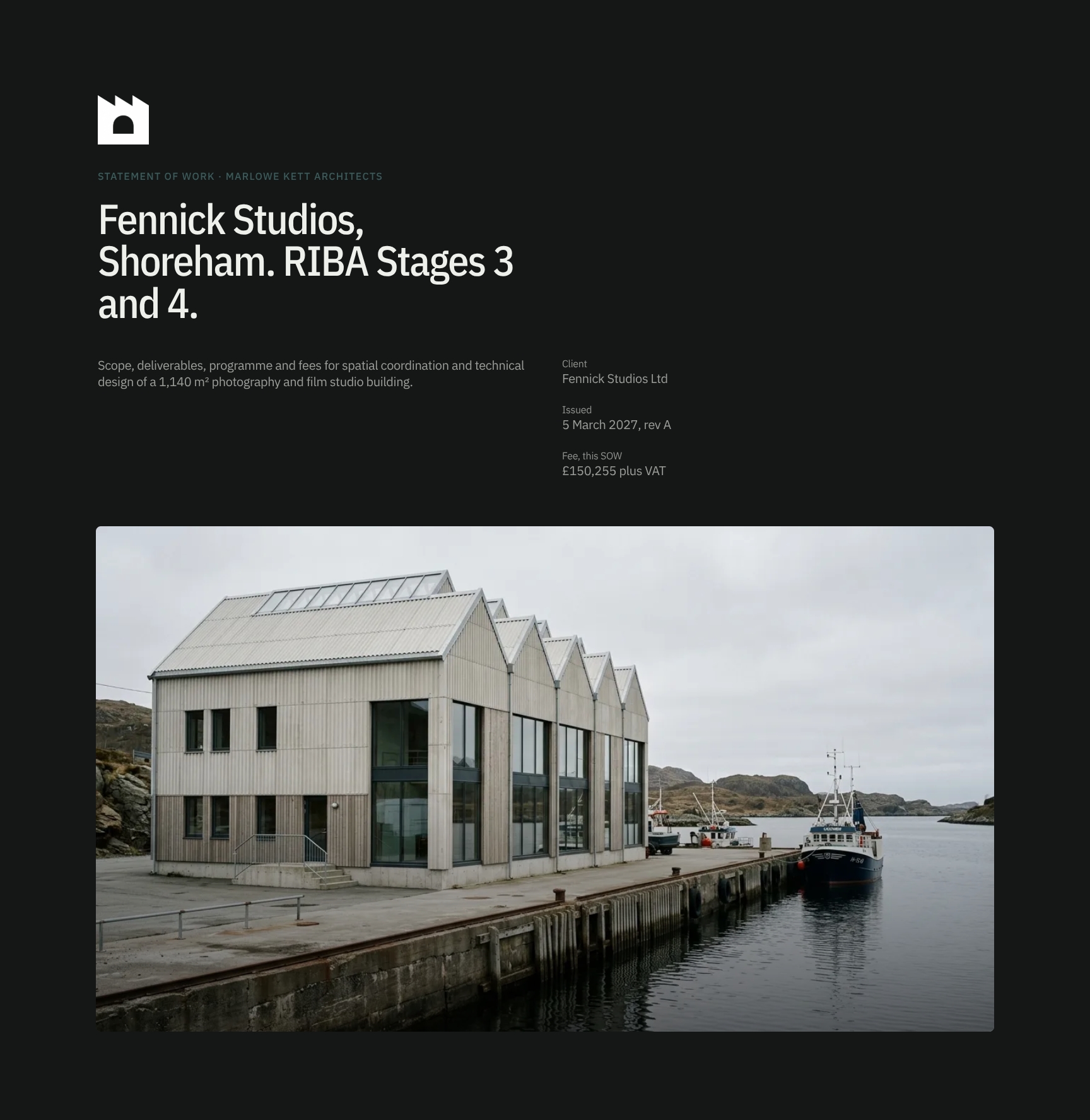
### Executive Summary of Scope and Stage Boundaries
Summarises what this SOW covers, confirms Stage 2 sign-off, and clarifies that Stages 5 and 6 follow under a separate SOW. Removes ambiguity about scope so both parties start aligned.
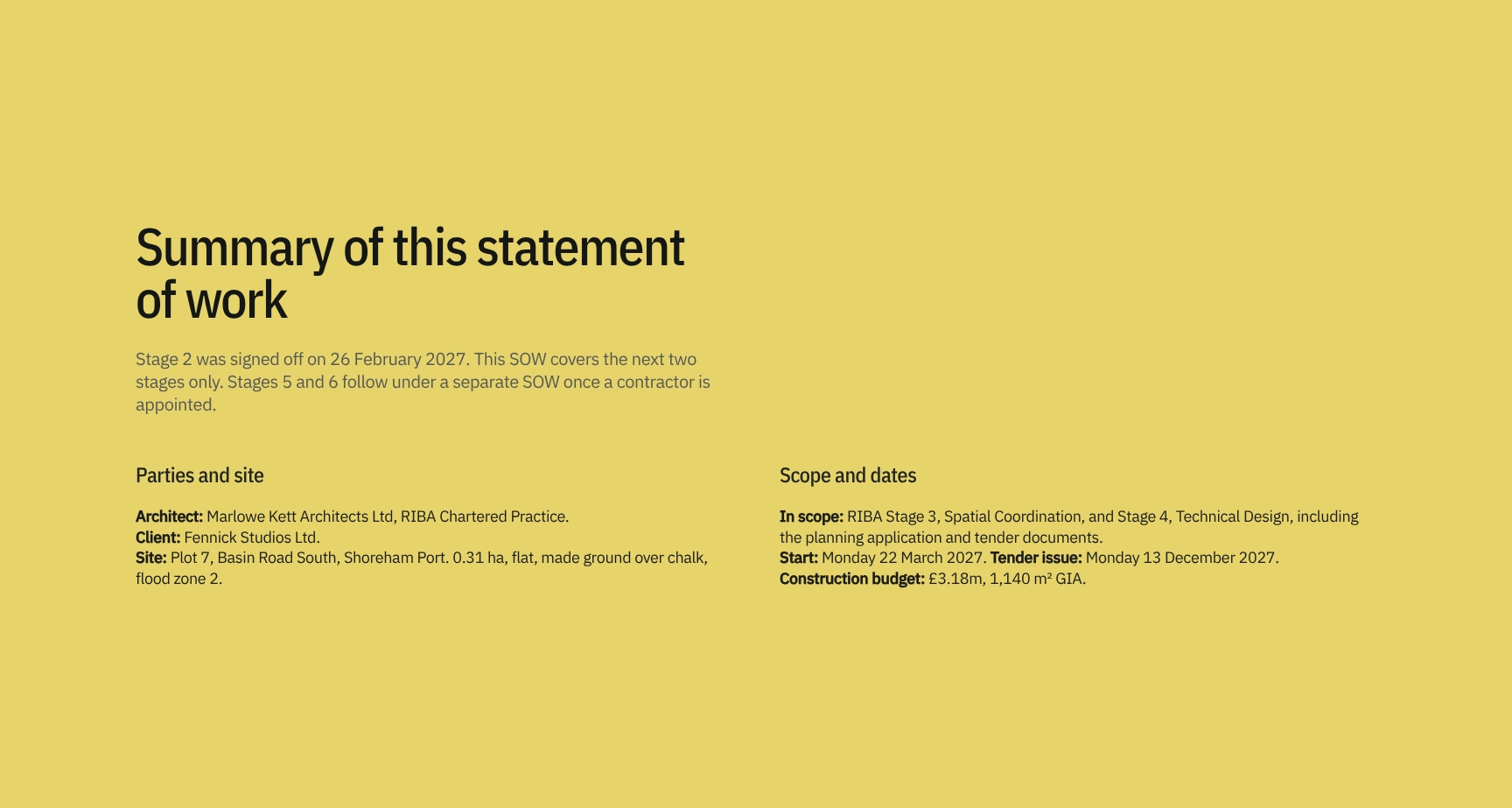
### Guiding Principle: Spatial Coordination to Buildable Design
A concise statement that Stage 3 fixes the building and Stage 4 makes it buildable. Gives clients a memorable way to understand the difference between the two stages.

### Stage-by-Stage Deliverables from a Federated IFC Model
Itemises every deliverable for Stages 3 and 4, all issued as views of a single federated IFC model. Clients see exactly what they receive and how coordinated BIM data prevents mismatched drawings.
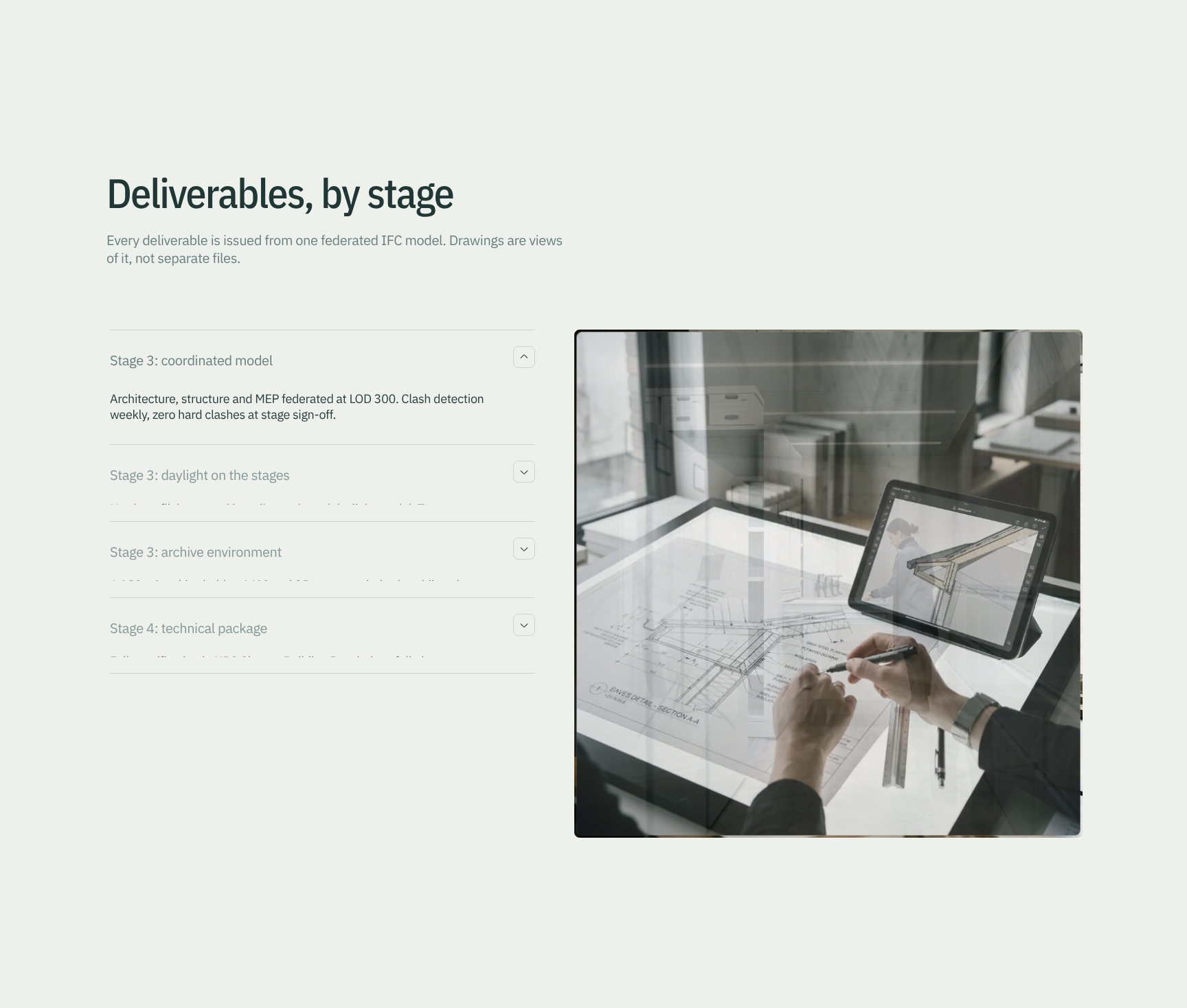
### Delivery Method and Project Team Contacts
Introduces project director Oona Kett as single point of contact and Sam Marlowe as technical design lead, with context on the eight-person practice. Clear accountability and communication builds client confidence.
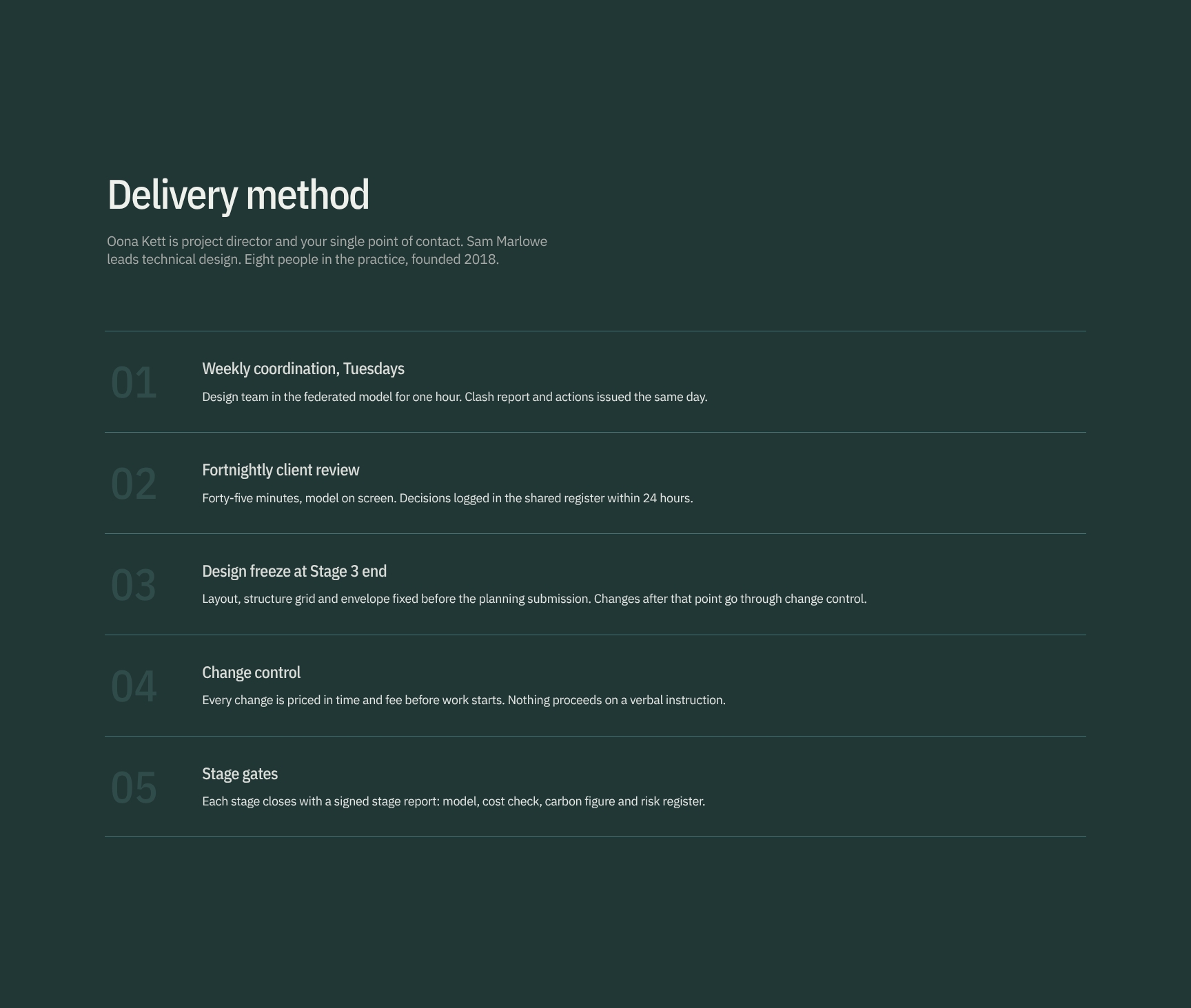
### Project Programme with Planning-Consent Gating
Lays out the timeline for each stage, with Stage 4 starting only after planning consent so no fee is spent at risk. States the assumption of client comments within five working days to keep dates realistic.
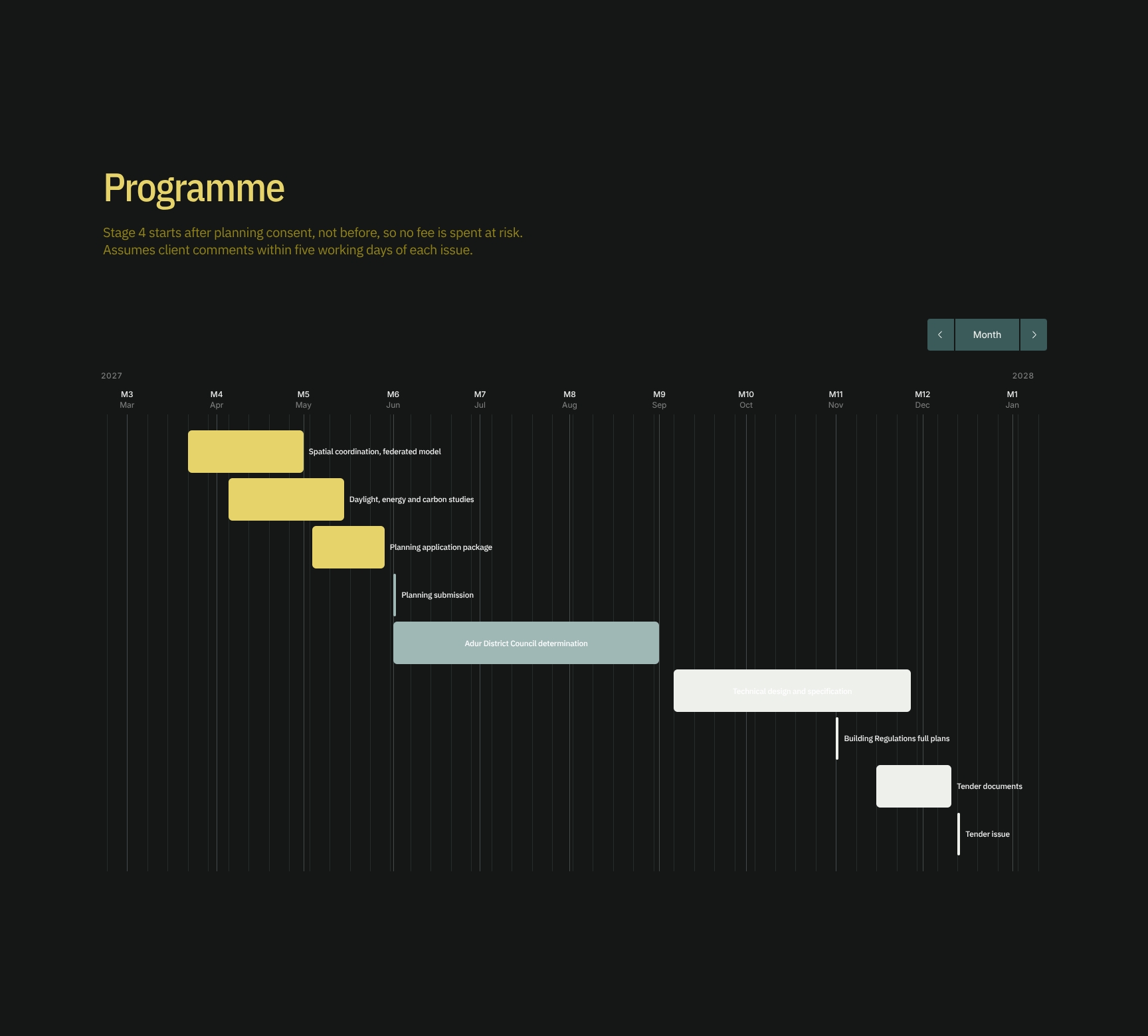
### Architect Fees and Payment Schedule in GBP
Sets out fees in pounds sterling plus VAT, based on 10.5% of a £3.18m construction cost, split 20% for Stage 3 and 25% for Stage 4, invoiced monthly against progress. Transparent budgeting with no surprises.
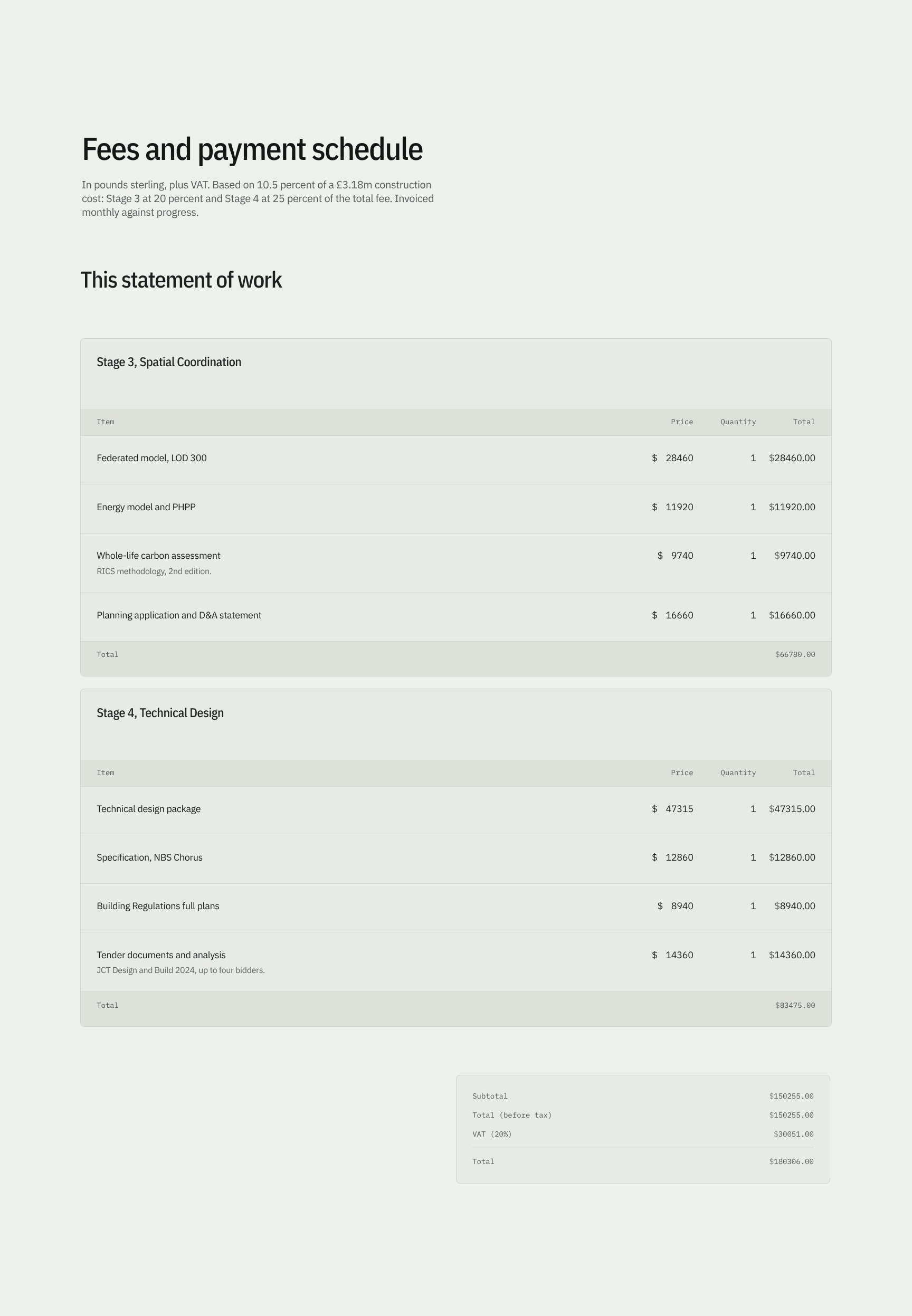
### Stage Completion and Acceptance Criteria Checklist
Defines four measurable conditions for completing each stage, including a Navisworks clash report, and requires a signed stage report. Gives both sides objective sign-off criteria and avoids disputes.
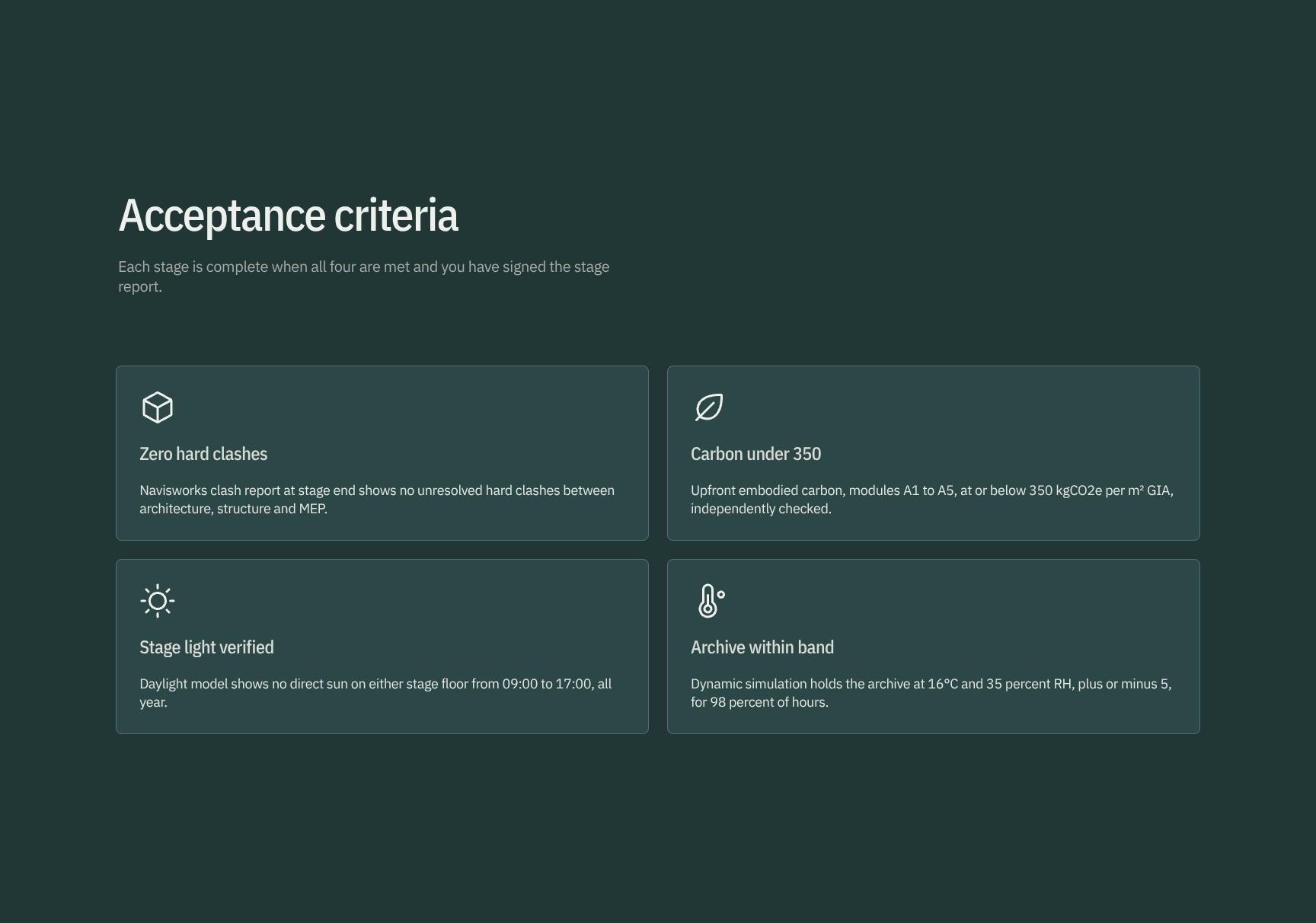
### Contract Terms Under RIBA Professional Services Contract 2020
Expandable terms confirming the SOW sits under the RIBA Standard Professional Services Contract 2020, signed 4 January 2027, with the contract governing any conflicts. Keeps legal detail accessible and organised.
### Authorisation and Director Signature Block
Captures the authorised director's signature for Fennick Studios Ltd, required before Stage 3 begins, with the offer valid until 19 March 2027. A clear close that turns agreement into action.
## Find your answers
Answers to common questions about scoping, pricing and agreeing RIBA Stage 3 and 4 architectural services with design clients.
### What should be included in an agreement template?
A solid agreement template should include a Cover, a Summary of the arrangement, the guiding Principle behind it, clearly defined Deliverables, the Method for carrying out the work, and a Programme setting out timelines and milestones. Together these sections define scope, expectations, and accountability for all parties. Keeping each section specific reduces disputes later.
### How do I customize this agreement template for my project?
Start with the Cover by adding party names, project title, and date. Then update the Summary and Principle to reflect your goals, list your exact Deliverables, and adjust the Method and Programme to match your workflow and schedule. Replace all placeholder text and remove any sections that do not apply.
### Can I export this agreement template to Word or PDF?
Yes, the template can typically be edited in common word processors such as Microsoft Word or Google Docs and exported to PDF for sharing and signing. Edit in the original format first, then export a final PDF to preserve layout and formatting. Check that fonts and page breaks display correctly before sending.
### Is this agreement template suitable for consulting, creative, or construction projects?
Yes, the structure of Deliverables, Method, and Programme suits consulting, creative services, construction, and other project-based work. Adapt the wording and technical detail to your industry, such as specifying drawings, design files, or reports as deliverables. For regulated industries or high-value contracts, have a legal professional review the final document.
### How long does it take to complete this agreement template?
Most users can complete the template in 30 to 60 minutes if project details are already defined. The Deliverables and Programme sections usually take the longest because they require specific scopes and dates. Gathering this information beforehand speeds up the process.
## Related
- [Stockholm](https://formlio.com/templates/stockholm-restaurant-interior-proposal): Restaurant interior concept proposal for chefs
- [Sydney](https://formlio.com/templates/sydney-hotel-design-concept-proposal): Hotel concept response for hospitality investors
- [Porto](https://formlio.com/templates/porto-architecture-services-proposal): Architecture proposal for winery tasting rooms
- [Austin](https://formlio.com/templates/austin-architecture-shortlist-proposal): Architecture shortlist proposal for corporate clients
- [Edinburgh](https://formlio.com/templates/edinburgh-temporary-venue-build-estimate): Temporary venue build estimate for festivals
- [Lyon](https://formlio.com/templates/lyon-hotel-website-proposal): Website proposal for multi-property hotel groups
---
---
title: "Porto"
description: "Win winery and hospitality commissions with an architecture proposal template covering client brief, key targets and design moves, from brief to handover."
canonical: "https://formlio.com/templates/porto-architecture-services-proposal"
locale: "en"
type: "template"
lastModified: "2026-10-20"
category: "Architecture"
alternates:
fr: "https://formlio.com/fr/templates/lisbon-proposition-de-services-darchitecture.md"
---
# Porto
Architecture Services Proposal Template
Win winery and hospitality commissions with an architecture proposal template covering the client brief, design moves, key targets and fee basis.
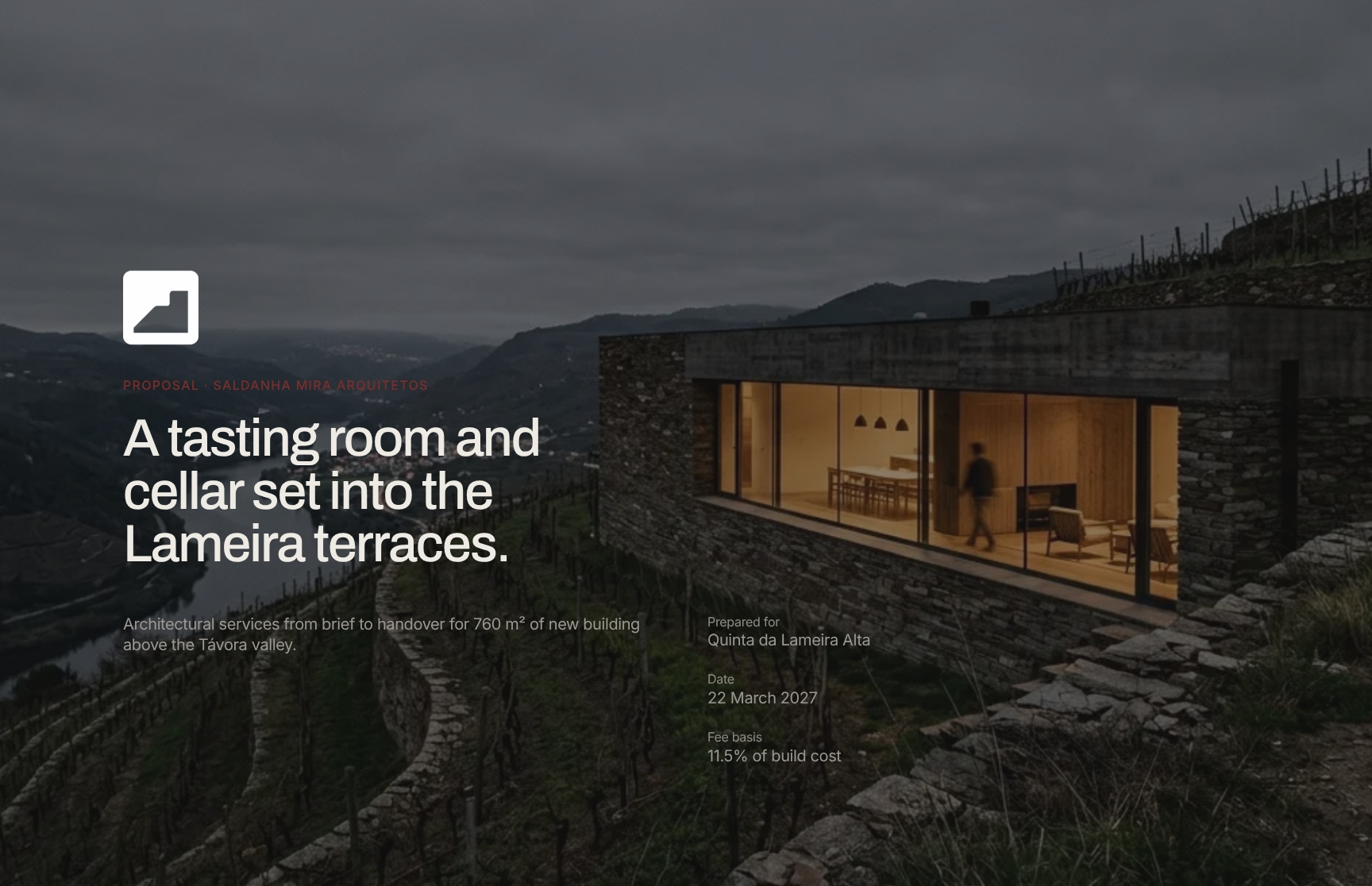
- [Use this template](https://formlio.com/workspaces/claim?template=porto-architecture-services-proposal)
- [Live preview](https://formlio.com/documents/porto-architecture-services-proposal)
- **Categories:** [Architecture](https://formlio.com/templates/architecture), [Proposals](https://formlio.com/templates/proposals)
- **Document goal:** Win winery and hospitality commissions with a proposal that lays out your brief, targets and design moves.
- **Blocks:** Typewriter, Single column, Scroll gradient, Grid 3x2 with icons, Spotlight, Fullscreen, Itemized quote, Gantt, Left-aligned, E-signature
- **Palette:** Warm Linen Background (#EEEAE4), Sandstone Accent Light (#CDBBA8), Burgundy Brand Accent (#7A2E2A), Deep Mahogany Accent Dark (#46201D), Charcoal Ink Text (#1B1A19)
## Get more from every document
Win winery and hospitality commissions with a proposal that shows clients how you'll take their brief from first sketch to handover. Built-in fee tables, a phased timeline, and a signature block keep the pitch and the paperwork in one document.
### Get a yes without leaving the proposal
Your client reads the pricing, then signs in the agreement section. No PDF download, no printing, no lost email.
### Assemble proposals from blocks you trust
Pull in pricing, steps, and testimonials sections, then save your best-performing versions to reuse on the next pitch.
### Pitch looks sharp on any screen
Your hero, showcase, and pricing tables hold their shape when a client opens the proposal on a phone between meetings.
### See which section sold them
Watch where prospects linger on pricing or the showcase, then follow up while the proposal is still on their mind.
### Know the moment they open it
Get a ping when a client views the proposal, leaves a comment, or signs, so your follow-up lands on time.
### Write the proposal with your team
Your designer tweaks the showcase while you rework pricing, both in the same document, before the deadline hits.
## See how every part fits
The proposal opens with your vision for the project and closes with a signed go-ahead, moving from the client's brief through design, proof, price, and schedule. Keep what fits, drop what doesn't, and reorder anything.
### Architecture Proposal Cover with Project Vision
Opens with the studio name, project title and scope: a tasting room and cellar on the Lameira terraces, 760 m² of new build above the Távora valley. Sets a confident first impression and frames the whole engagement.
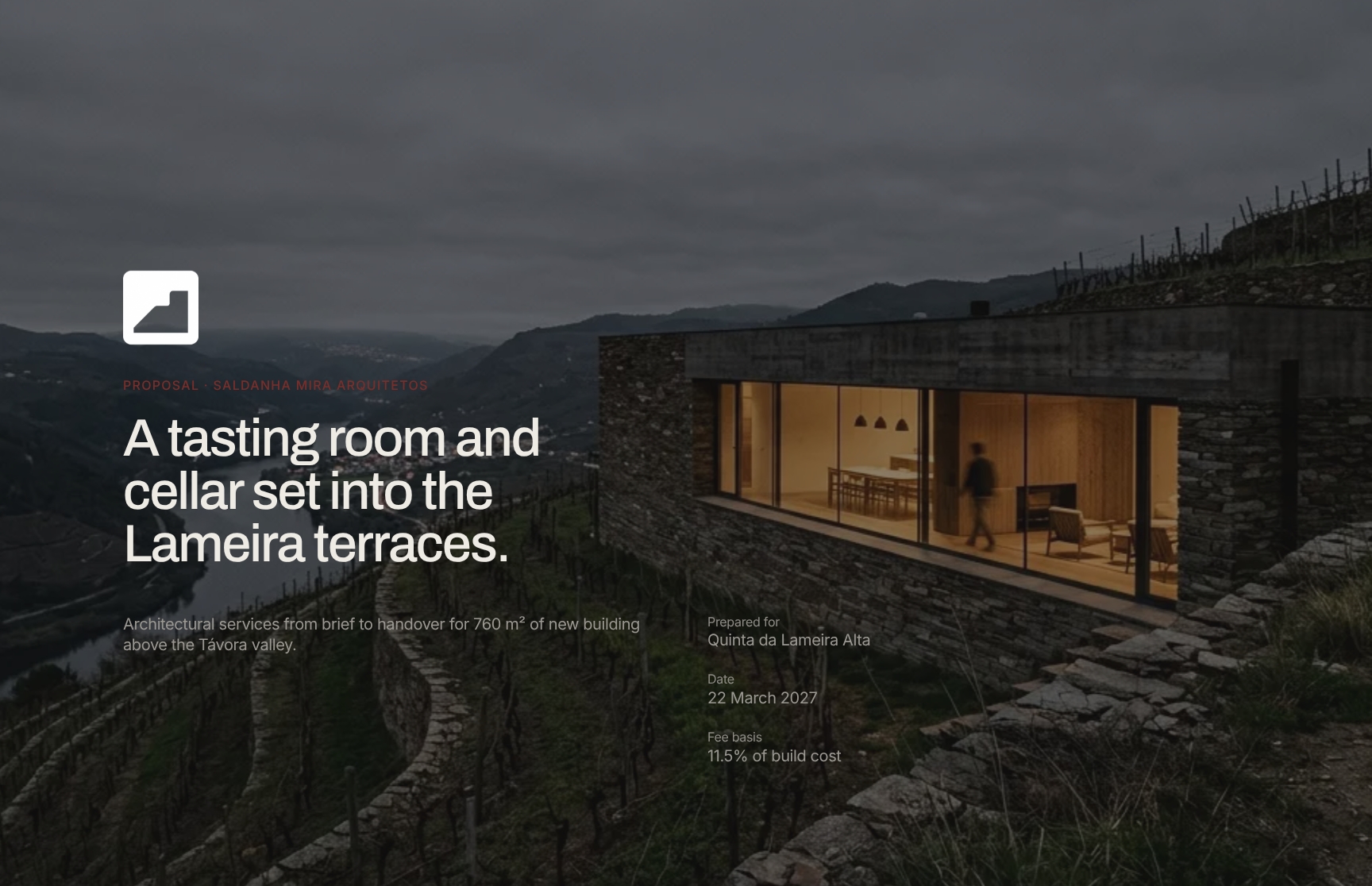
### Client Brief Summary: Winery Tasting Room and Cellar
Restates the client's brief in plain terms: 420 m² tasting room and kitchen, 340 m² barrel cellar, ready for the 2029 harvest. Shows you listened and aligns both sides before design begins.
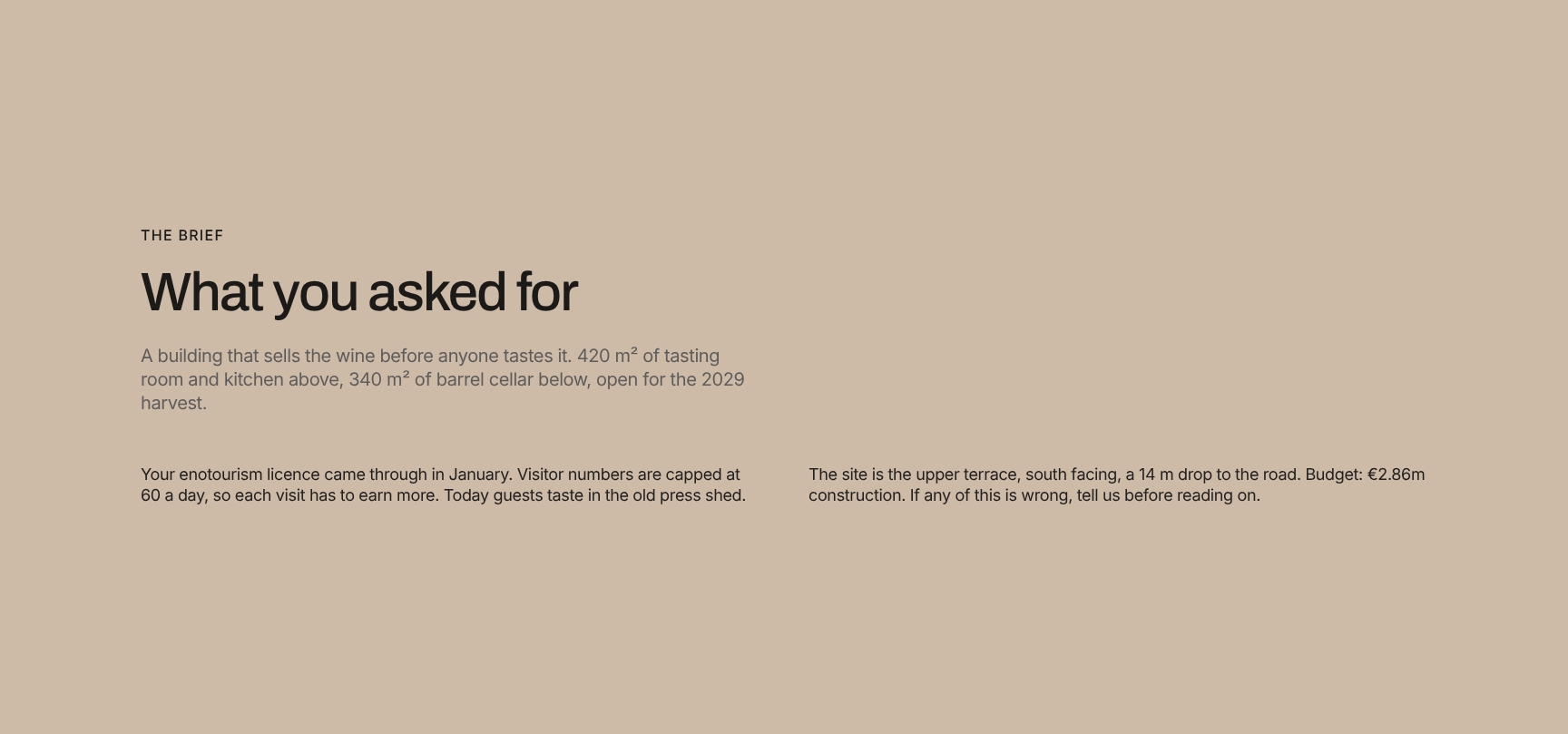
### Core Design Concept Statement
A short animated statement of the big idea: one more terrace on the hill, with glass on the valley side only. Gives the client a memorable concept that sums up the architectural approach at a glance.

### Key Project Targets and Performance Metrics
Four measurable targets the building will be designed to and reported against at every phase, including embodied carbon across structure, envelope and finishes. Turns ambition into accountable goals.
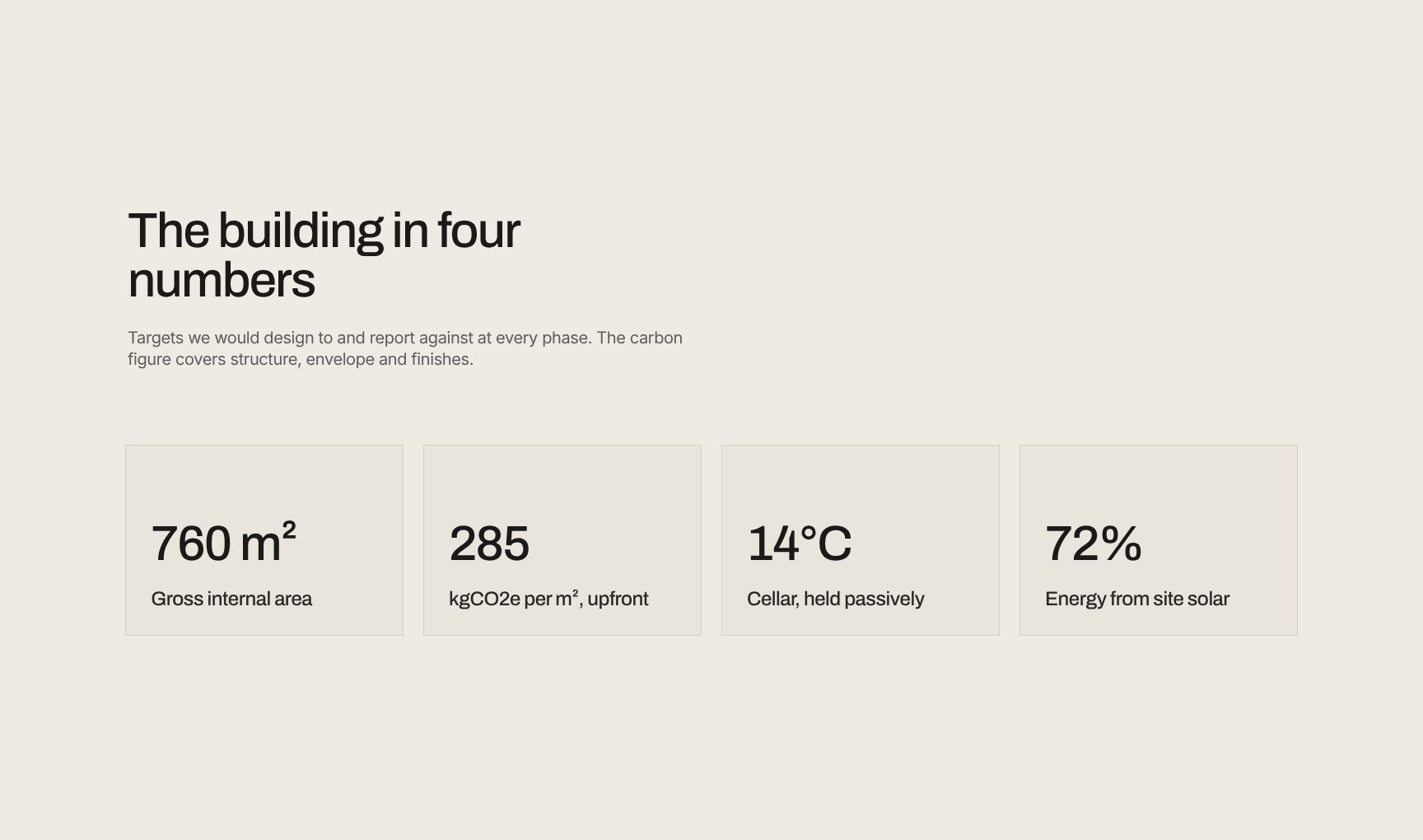
### Four Design Moves and Starting Strategy
Presents the studio's four opening design decisions, tested on the site model before the proposal was written. Each is open to challenge in Programa Base, showing rigour and a collaborative process.
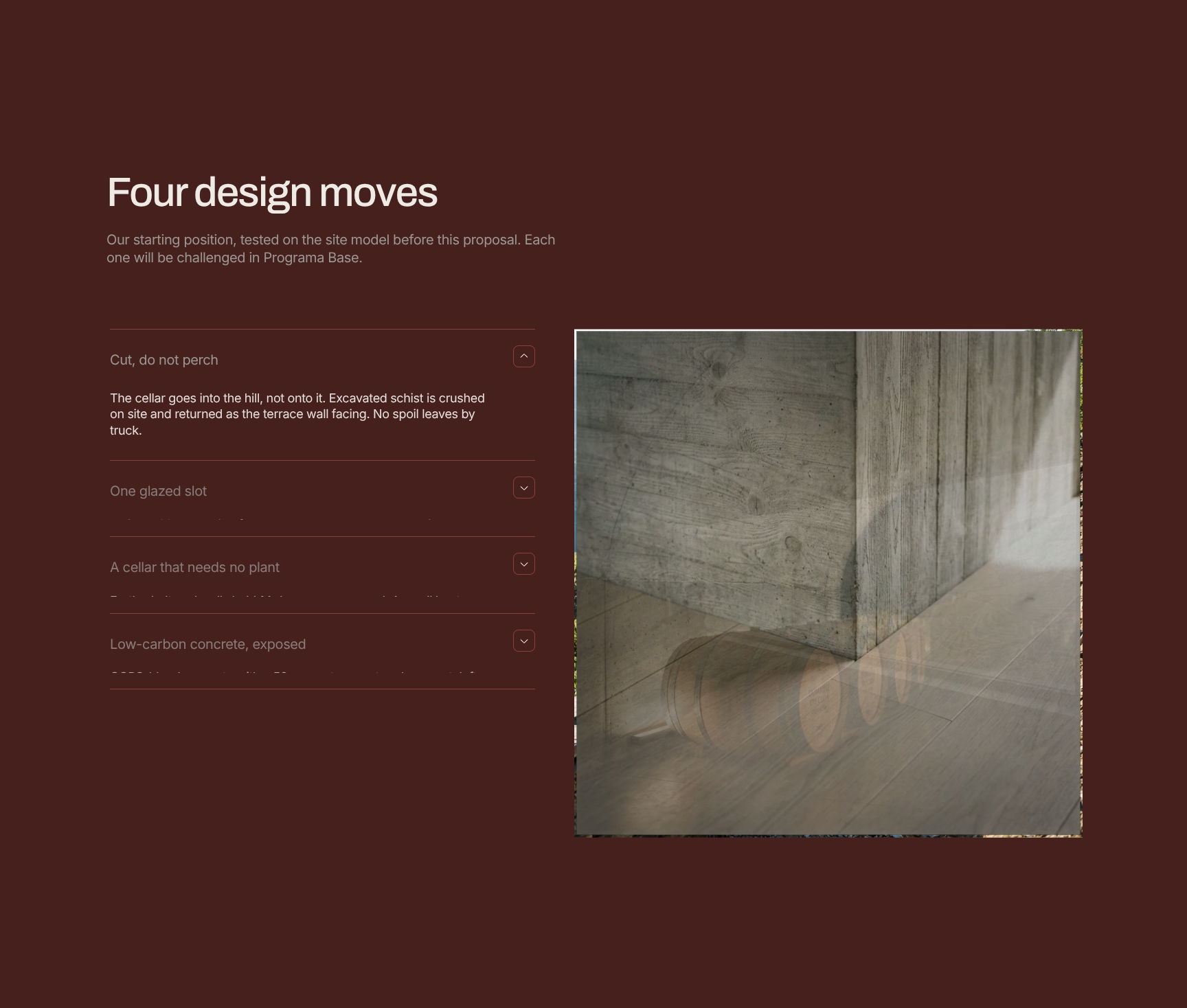
### Selected Winery and Hospitality Portfolio
Relevant past projects with real outcomes, such as Adega Cova Funda: a 1,180 m² winery opened within 14 months of licence, with paid tastings up 3.4 times. Proves sector experience with results.
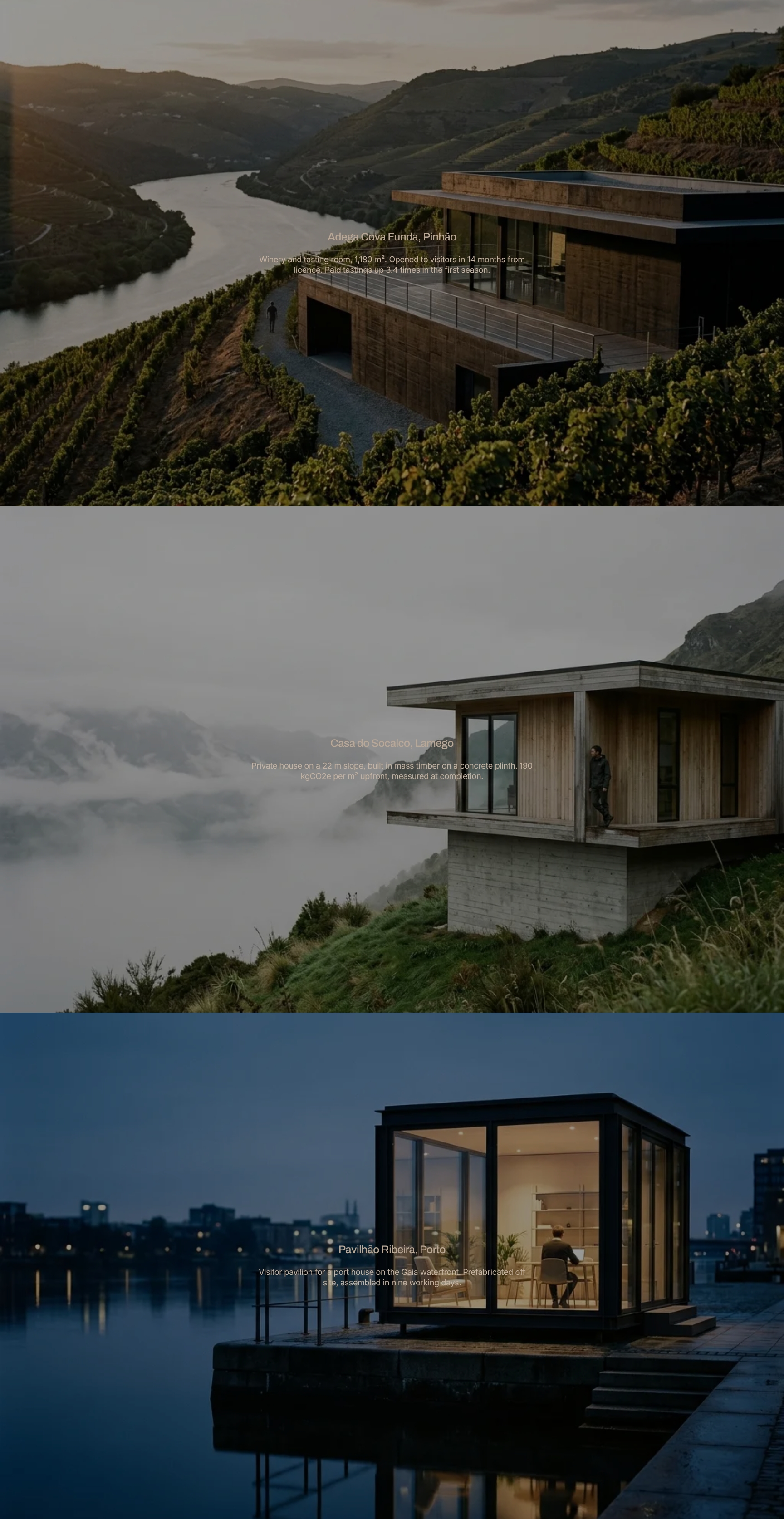
### Five-Phase Design Approach and Team Structure
Walks through five phases from brief to handover, led by Inês Saldanha on design and Rui Mira on licensing and site. Clarifies who is accountable, and how a nine-person studio stays at every client review.
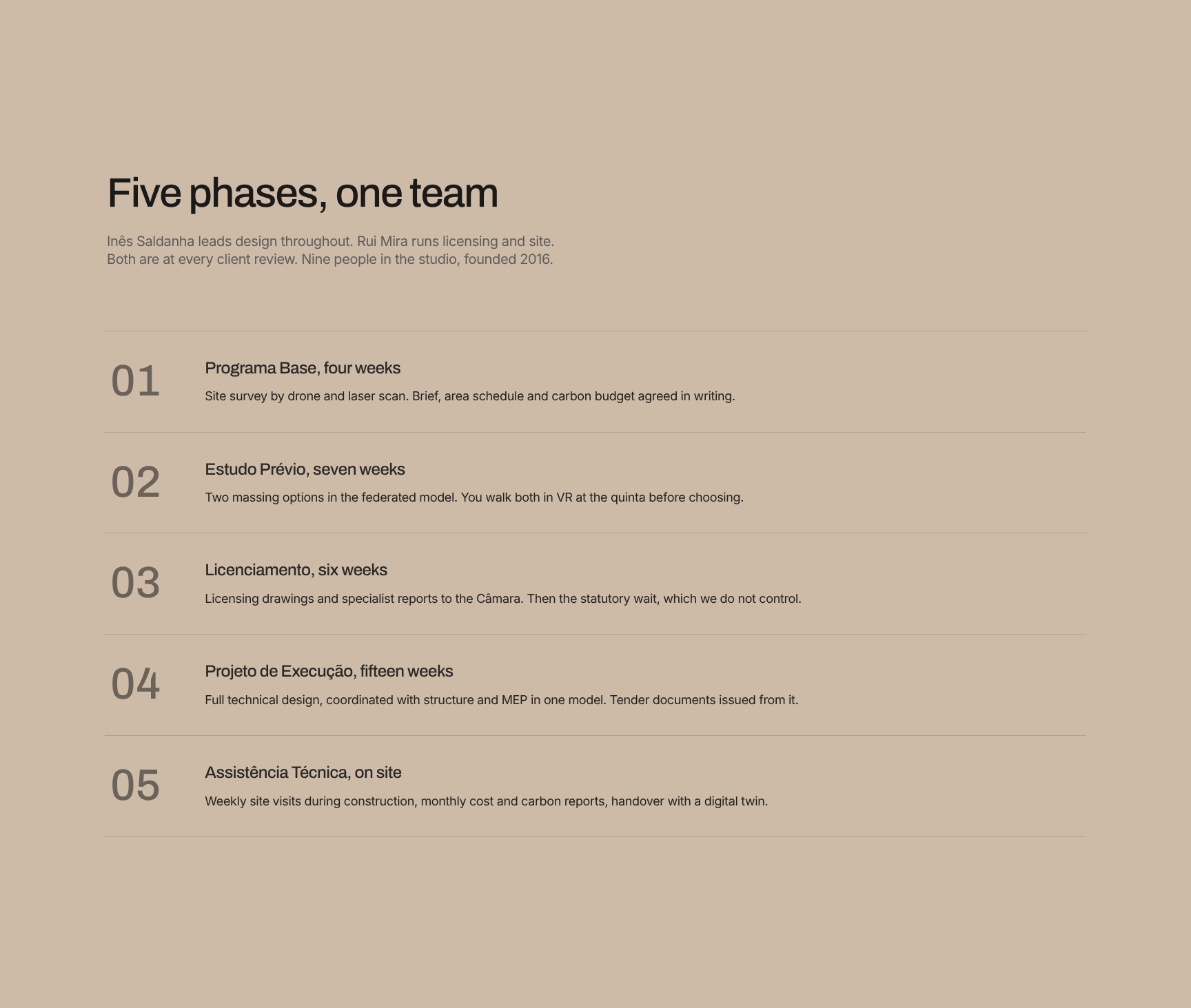
### Client Testimonials and Proven Results
Quotes from past clients about concrete value delivered, like a laser scan finding a spring line that saved a drainage contract and about two months. Builds trust with specific, credible evidence.
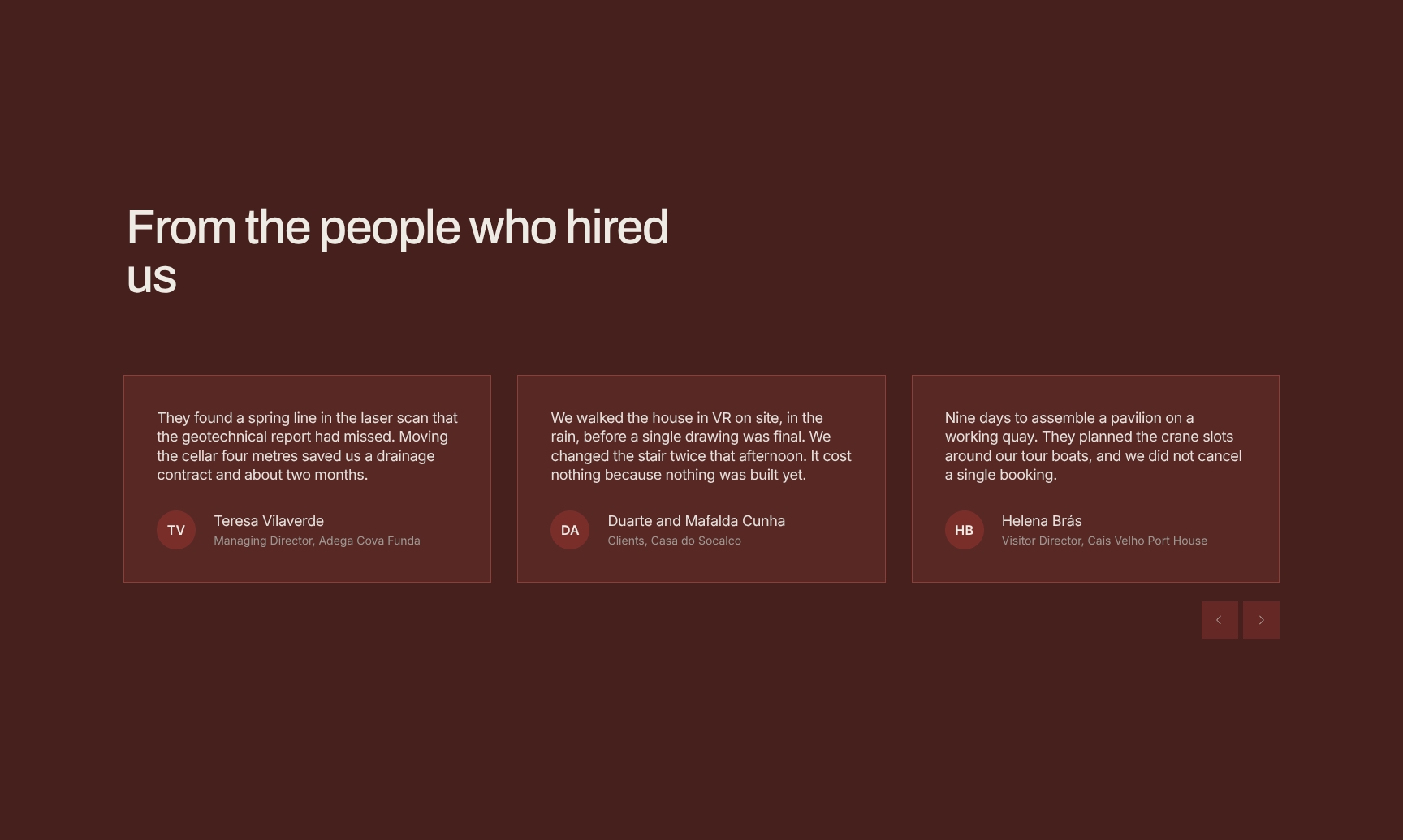
### Transparent Architect Fee and Phase Pricing
Sets the fee at 11.5 percent of a €2.86m construction budget, split by phase, in euros excluding IVA. A written recalculation clause for budget shifts over 5 percent keeps pricing clear and fair.
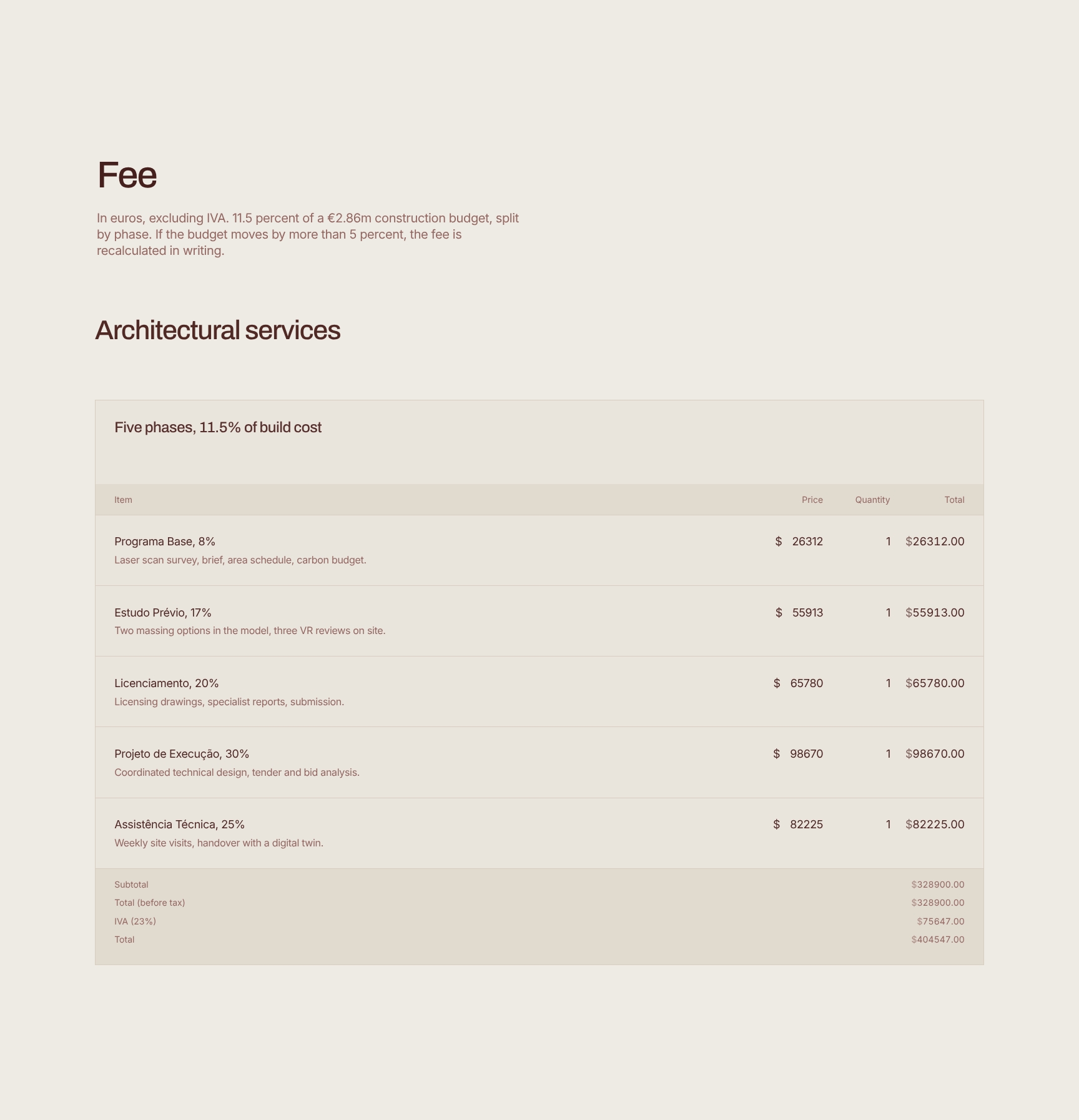
### Project Programme and Construction Timeline
Lays out thirteen months to a May 2028 construction start, leaving fourteen months to build for the 2029 harvest. States the review-turnaround assumption so the client knows how to protect the schedule.
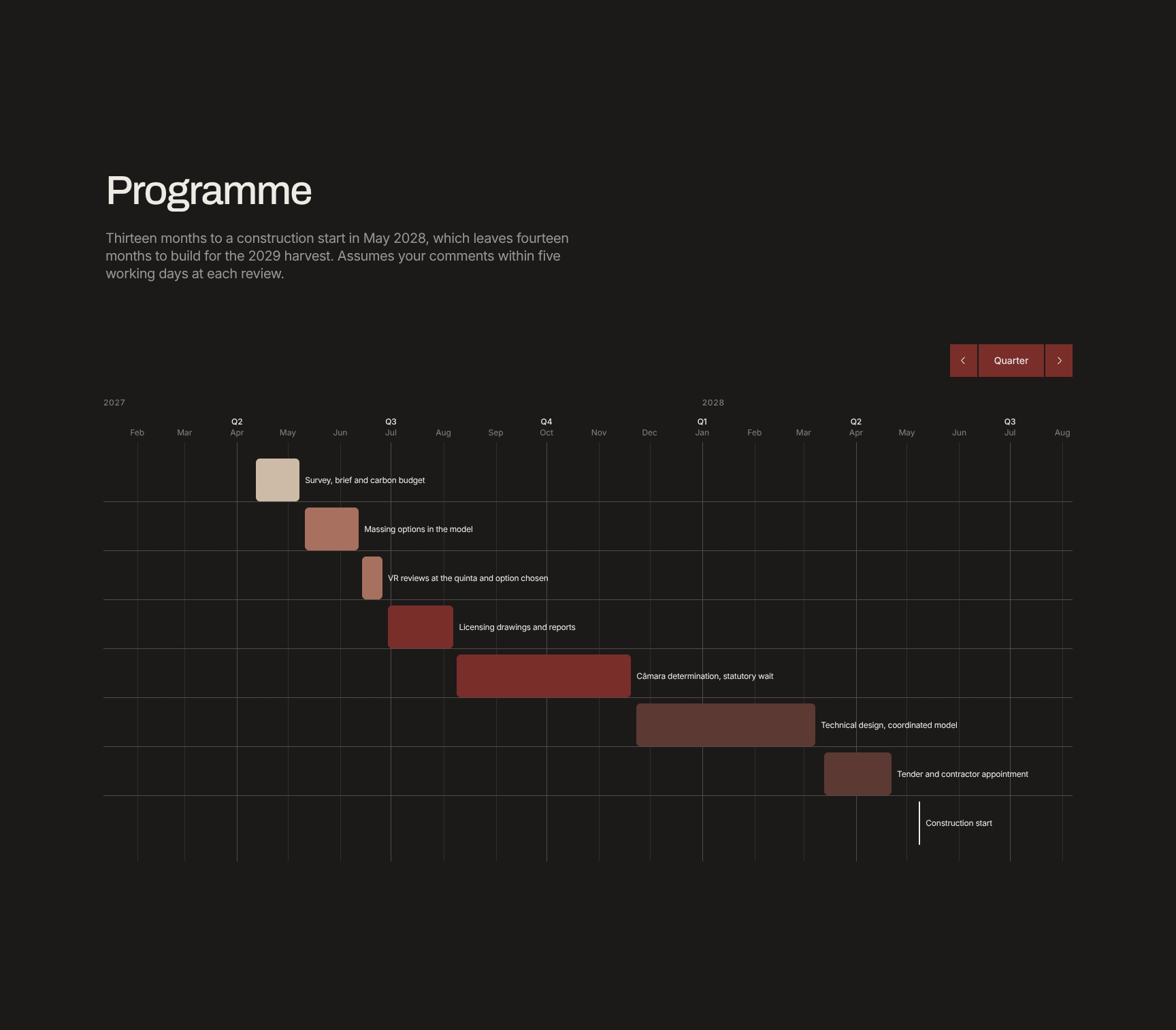
### Assumptions, Exclusions and Fee Conditions
An expandable list of what decides whether fee and dates hold, including exclusions such as Câmara licensing fees and geotechnical investigation. Prevents surprises and reduces scope disputes later.
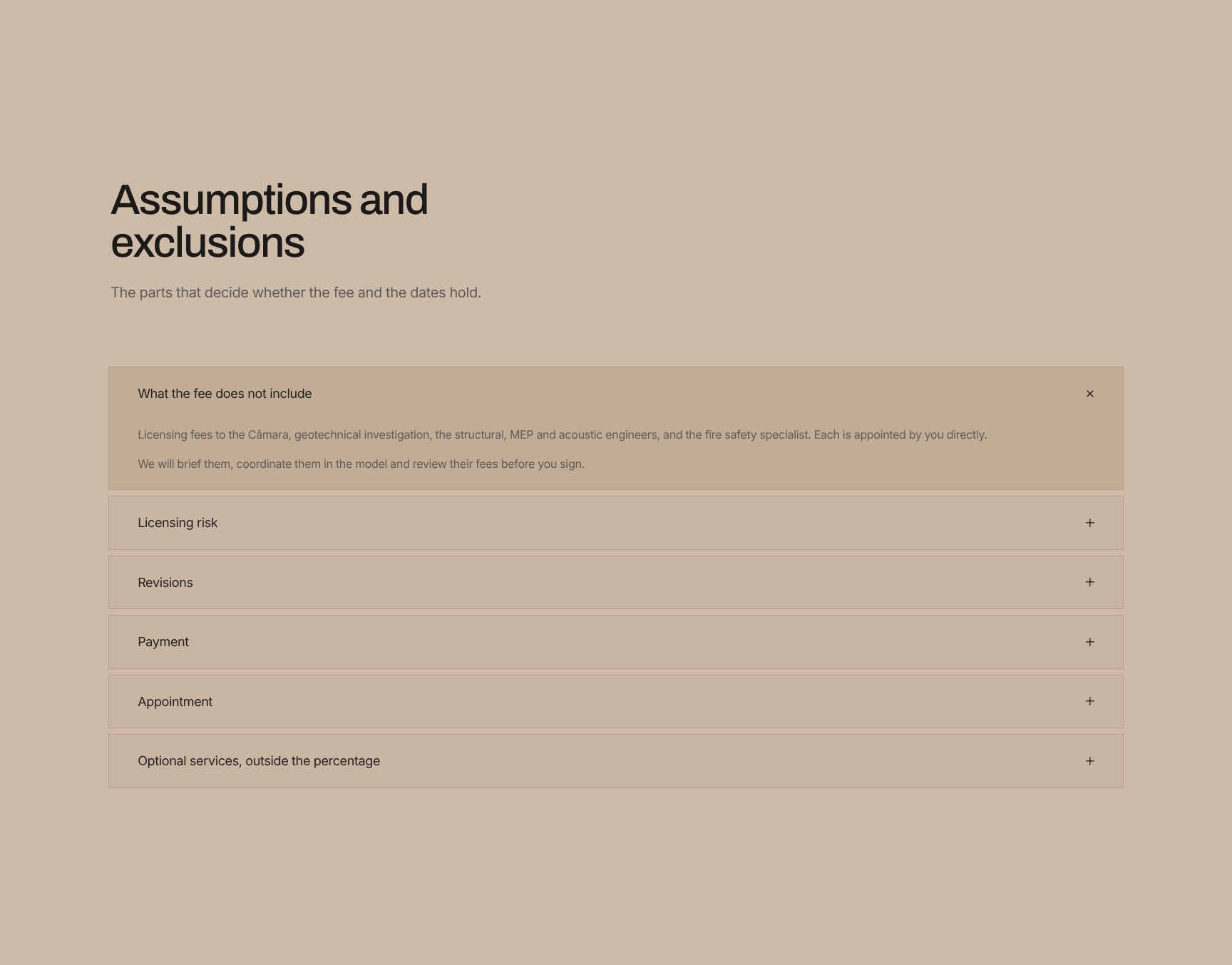
### Proposal Approval and Next Step Signature
Closes with the validity date of 9 April 2027 and a simple sign-off. Signing books the drone survey for the first dry week after start, giving the client a clear action and immediate momentum.
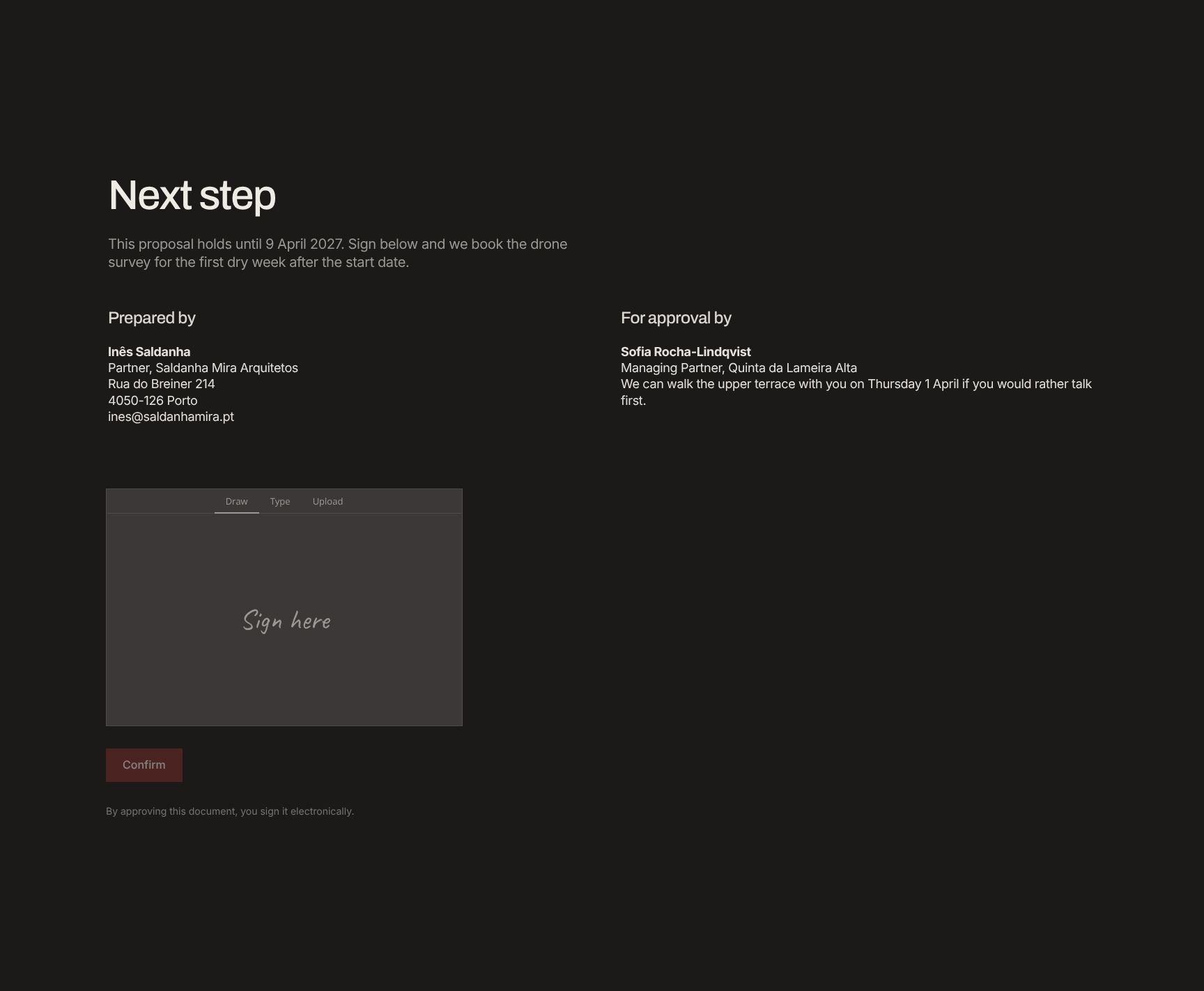
## Find your answers
Answers to common questions about writing, pricing, and presenting an architecture proposal for winery and hospitality projects.
### What should be included in a proposal template?
A strong proposal should include a cover, a summary of the client's brief, your core idea, measurable targets, a clear action plan, and proof of past results. This template covers all six: Cover, The brief, The idea, Targets, Four moves, and Selected work. Together they take a client from understanding the problem to trusting your solution.
### How do I customize this proposal template for my own client?
Start with the Cover by adding your client's name, project title, and your branding. Then rewrite The brief in your own words to show you understand their goals, and update The idea, Targets, and Four moves to match your strategy. Finally, swap in relevant examples under Selected work so each section reflects the specific client.
### What is the 'Four moves' section in this proposal and how do I write it?
The Four moves section breaks your approach into four clear, actionable steps, such as discover, design, launch, and optimize. Give each move a short title, a one- or two-sentence description, and an expected outcome or timeline. Keeping it to four steps makes your plan easy to scan and easy for clients to approve.
### Can I export this proposal template to PDF or other formats?
Yes, you can export the finished proposal as a PDF to send to clients, which keeps layout and fonts consistent on any device. Depending on your editing software, you can also export to formats like PowerPoint or Word for further edits. Always preview the exported file to check that images and spacing look correct.
### Is this proposal template suitable for agencies, freelancers, and consultants?
Yes, the structure works for creative agencies, freelancers, consultants, and other service businesses pitching projects. The brief-to-idea-to-targets flow adapts easily to marketing, design, branding, web, and strategy work. Simply adjust the Targets, Four moves, and Selected work sections to fit your industry and services.
## Related
- [Stockholm](https://formlio.com/templates/stockholm-restaurant-interior-proposal): Restaurant interior concept proposal for chefs
- [Sydney](https://formlio.com/templates/sydney-hotel-design-concept-proposal): Hotel concept response for hospitality investors
- [Brighton](https://formlio.com/templates/brighton-architecture-statement-of-work): Architect statement of work for design stages
- [Austin](https://formlio.com/templates/austin-architecture-shortlist-proposal): Architecture shortlist proposal for corporate clients
- [Edinburgh](https://formlio.com/templates/edinburgh-temporary-venue-build-estimate): Temporary venue build estimate for festivals
- [Lyon](https://formlio.com/templates/lyon-hotel-website-proposal): Website proposal for multi-property hotel groups
---
---
title: "Austin"
description: "Win your next interview with an architecture proposal template for mass-timber HQs: client stakes, design concept, and modeled carbon and energy results."
canonical: "https://formlio.com/templates/austin-architecture-shortlist-proposal"
locale: "en"
type: "template"
lastModified: "2026-10-20"
category: "Architecture"
alternates:
fr: "https://formlio.com/fr/templates/austin-proposition-darchitecture-pour-preselection.md"
---
# Austin
Architecture Shortlist Proposal Template for Commercial HQs
Win your next interview with an architecture proposal template for mass-timber HQs: client brief, design concept, and energy modeling for corporate clients.
- [Use this template](https://formlio.com/workspaces/claim?template=austin-architecture-shortlist-proposal)
- [Live preview](https://formlio.com/documents/austin-architecture-shortlist-proposal)
- **Categories:** [Architecture](https://formlio.com/templates/architecture), [Proposals](https://formlio.com/templates/proposals), [Pitch decks](https://formlio.com/templates/pitch-decks)
- **Document goal:** Win the shortlist interview with a proposal that pairs your design concept with modeled carbon and energy results.
- **Blocks:** Image reveal, Single column, Marquee, Split, Grid tile scroll, Grid 3x2 with icons, Itemized quote
- **Palette:** Warm Linen Background (#F3EFE7), Soft Apricot Highlight (#F2B48F), Terracotta Accent (#B5471F), Deep Umber Depth (#6E2A12), Charcoal Ink Text (#161616)
## Get more from every document
This template helps you turn a shortlist invitation into a proposal that wins the interview. Built-in spots for client stakes, modeled performance data, materials, and fees keep your pitch concrete.
### Get the yes without leaving
Your client reads the pricing, scrolls to the agreement, and signs right there. No PDF download, no printing, no chasing.
### Build proposals from proven sections
Pull in a pricing table or steps timeline, then save your best-performing hero and testimonials to reuse on the next pitch.
### Your pitch looks right everywhere
Your showcase images and pricing cards hold their shape when a client opens the proposal on a phone between meetings.
### See which section sells the job
Watch heatmaps show if they lingered on pricing or skipped the gallery, then follow up while the proposal is still on their mind.
### Know the moment they open it
A ping tells you when your client views the proposal, leaves a comment, or signs, so you call while they're reading.
### Write the proposal together, live
Your designer polishes the gallery while you tweak pricing and steps, all in the same proposal before the deadline.
## See how every part fits
The proposal opens with the client's lease deadline and your big idea, then closes with a clear August start hold. Keep, drop, or reorder any section to fit your pitch.
### Shortlist Response Cover with Mass-Timber HQ Vision
A bold opening that frames the pitch: a 68,000 sq ft mass-timber HQ and test lab heated and cooled from the ground beneath it. Sets the tone, names the practice, and signals a client-specific response.
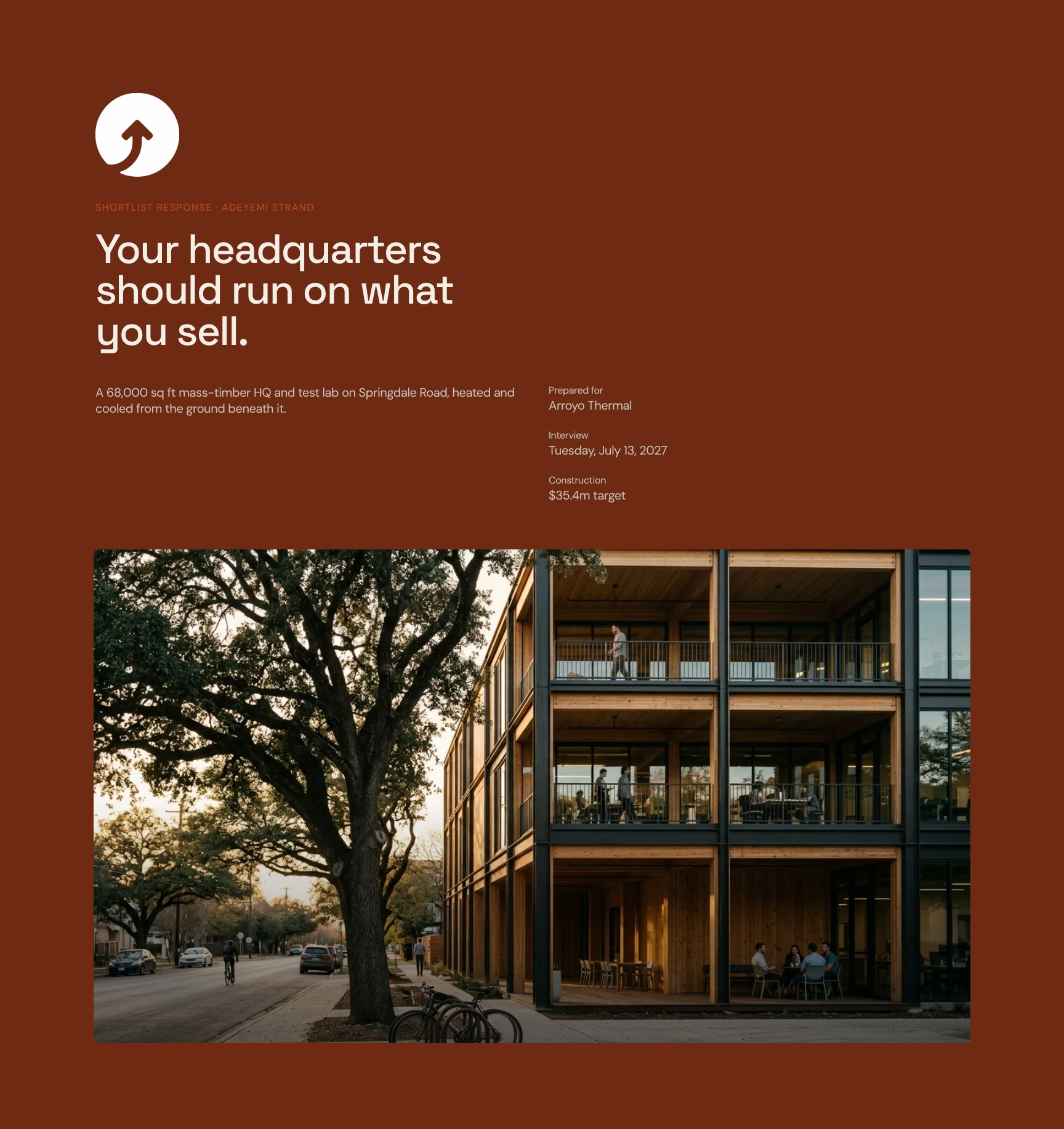
### Client Brief: Series C Growth, Lease Deadline and Stakes
Restates the client's situation in their own terms: $140m Series C, 310 staff across three floors, a rented test lab, and a 2029 lease end. Proves you listened and frames the real decision at stake.
### Big Idea Statement: Geothermal Design with No Gas Line
A punchy animated statement of the core concept: no gas line, no cooling tower, 212 bores under the plaza. Makes the central strategy memorable and easy to repeat inside the client's team.
### Design Concept Showcase: The Heat Hall Public Room
Presents the signature idea: an 8,000 sq ft street-level Heat Hall with the heat pump plant behind glass and live gauges. Shows how the building becomes a product demo, with tours starting here and four floors of CLT above.
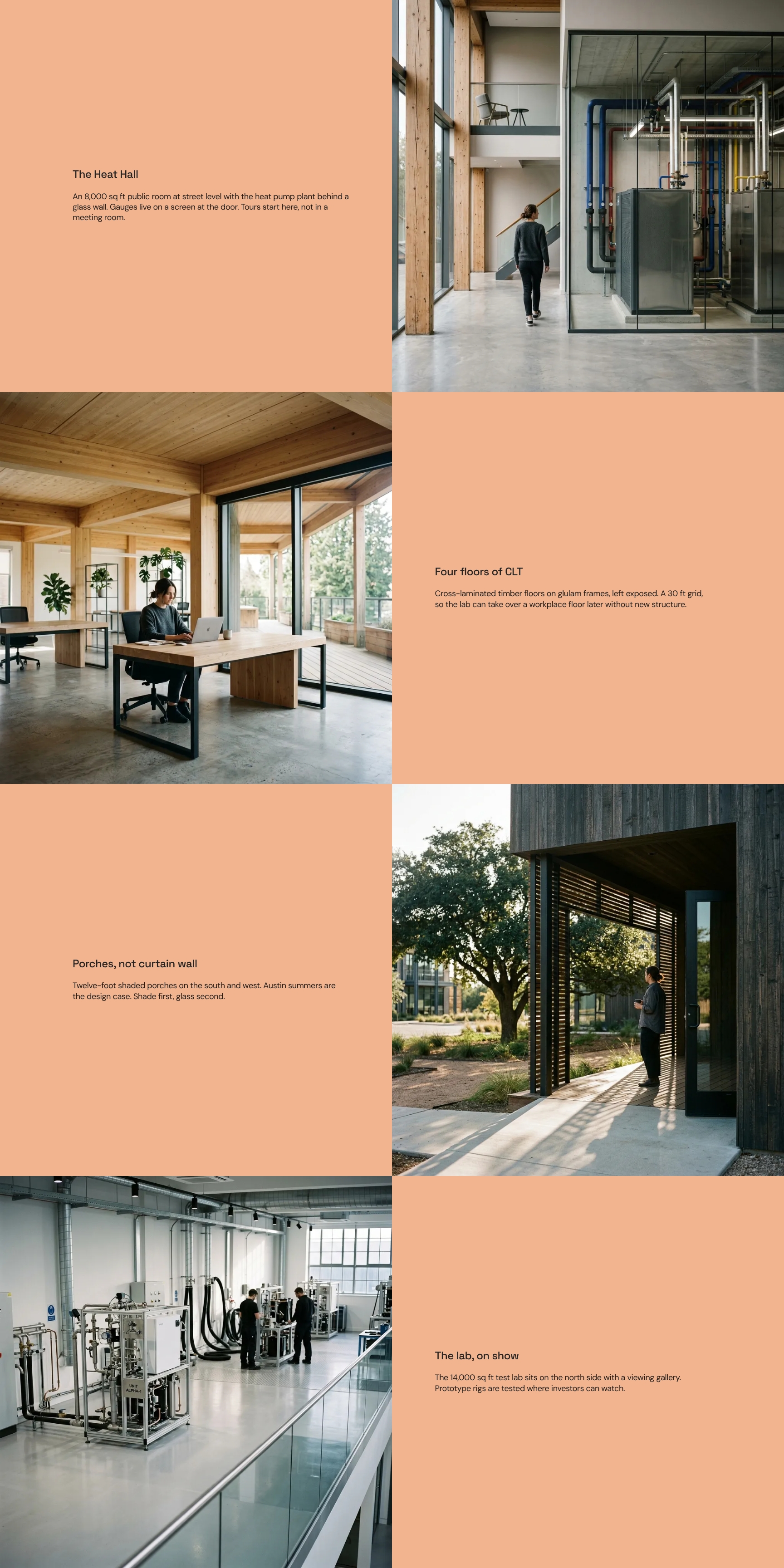
### Modeled Carbon and Energy Performance Charts
Charts built from an early whole-building energy model and a One Click LCA run on the concept massing. Backs the concept with credible numbers and commits to rerunning both at every design phase.
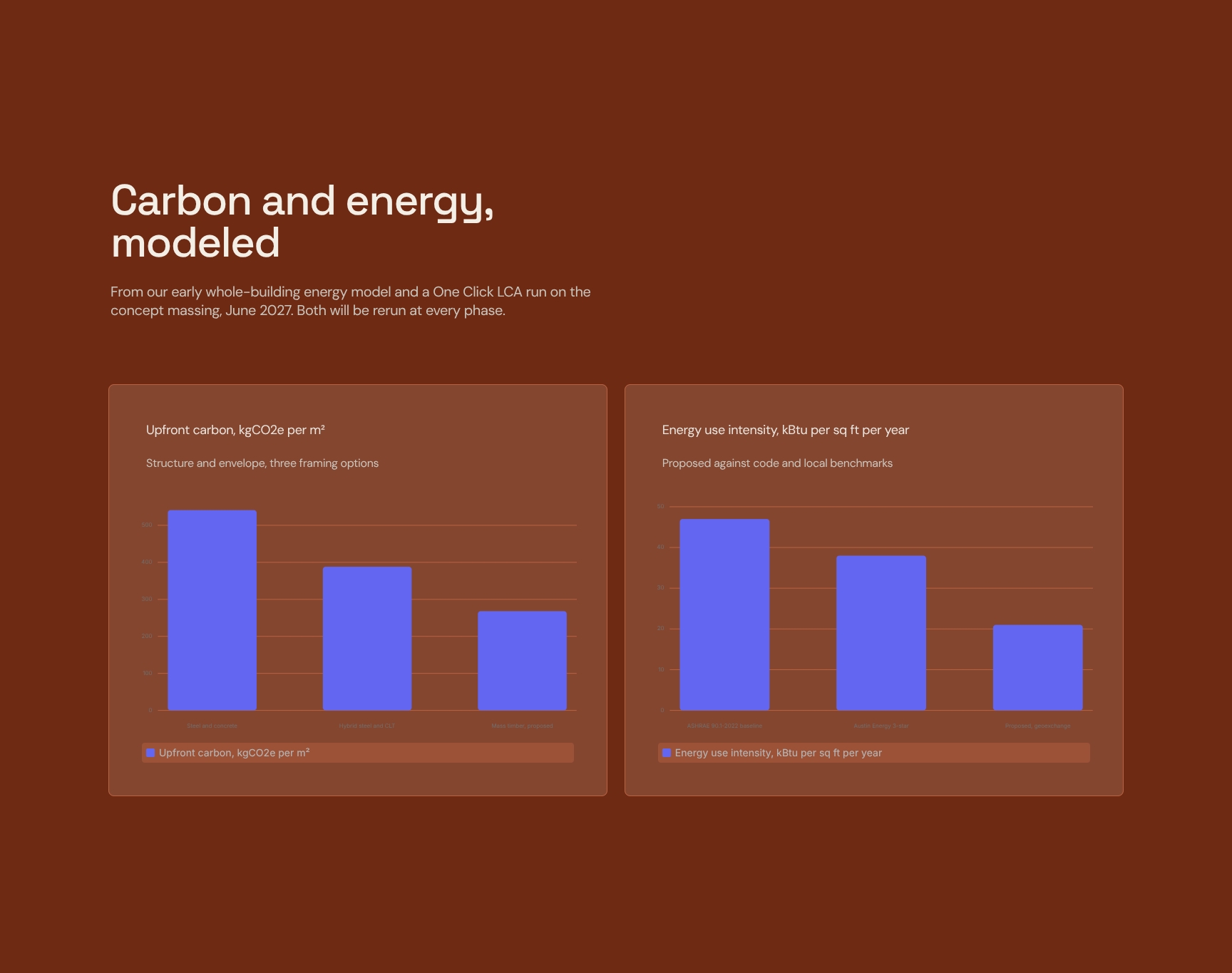
### Material Palette Gallery: Five Low-Carbon Materials
A focused gallery of southern yellow pine CLT, low-carbon concrete, Texas limestone, weathering steel screens and clear glass. Explains how fewer materials mean fewer trades and less embodied carbon.
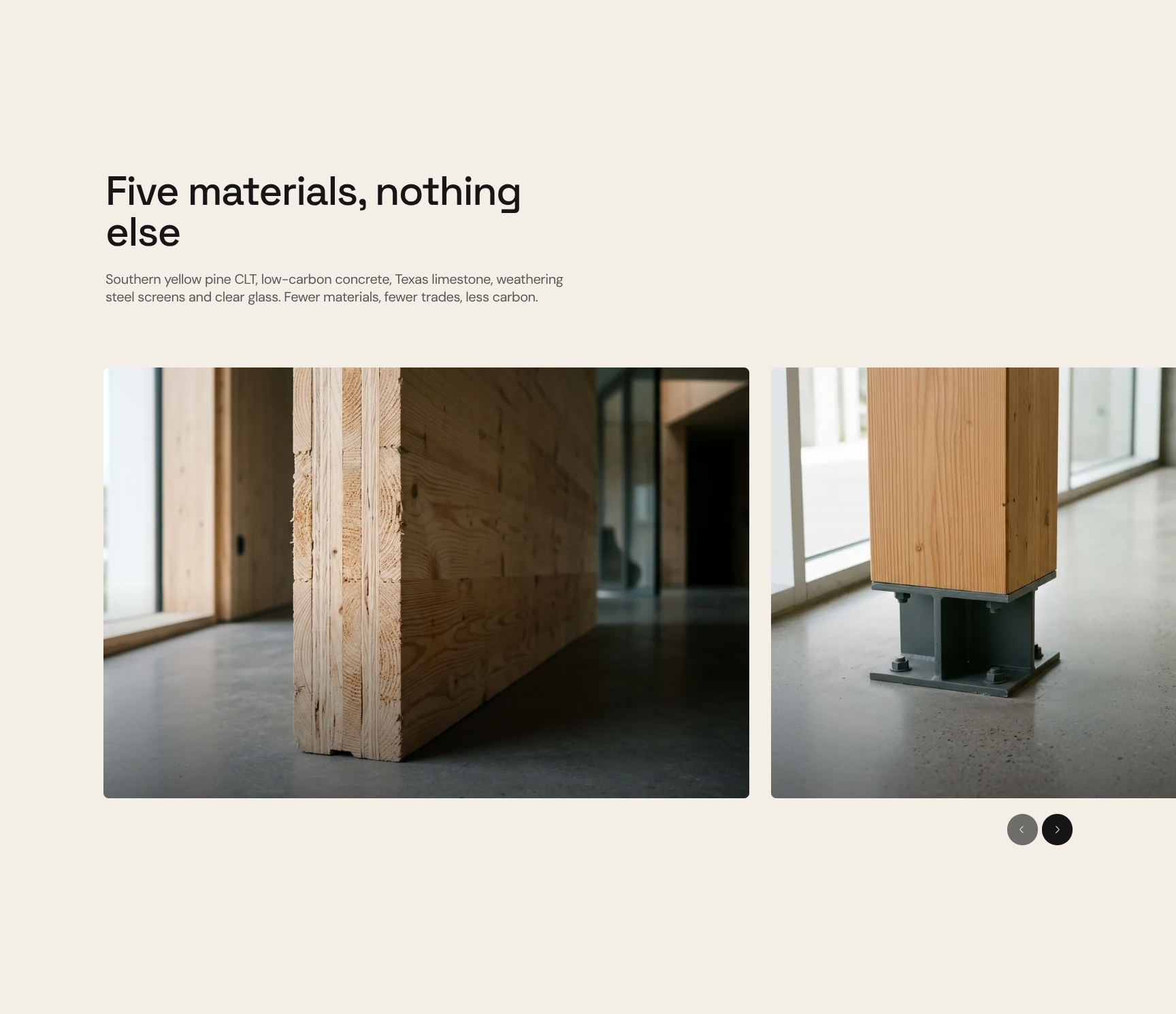
### Why Us: Founding Partners Hands-On Every Week
Introduces Folake Adeyemi (design) and Erik Strand (delivery), founders since 2017, who both work on your project weekly. Builds confidence through senior attention and clear split of responsibility.
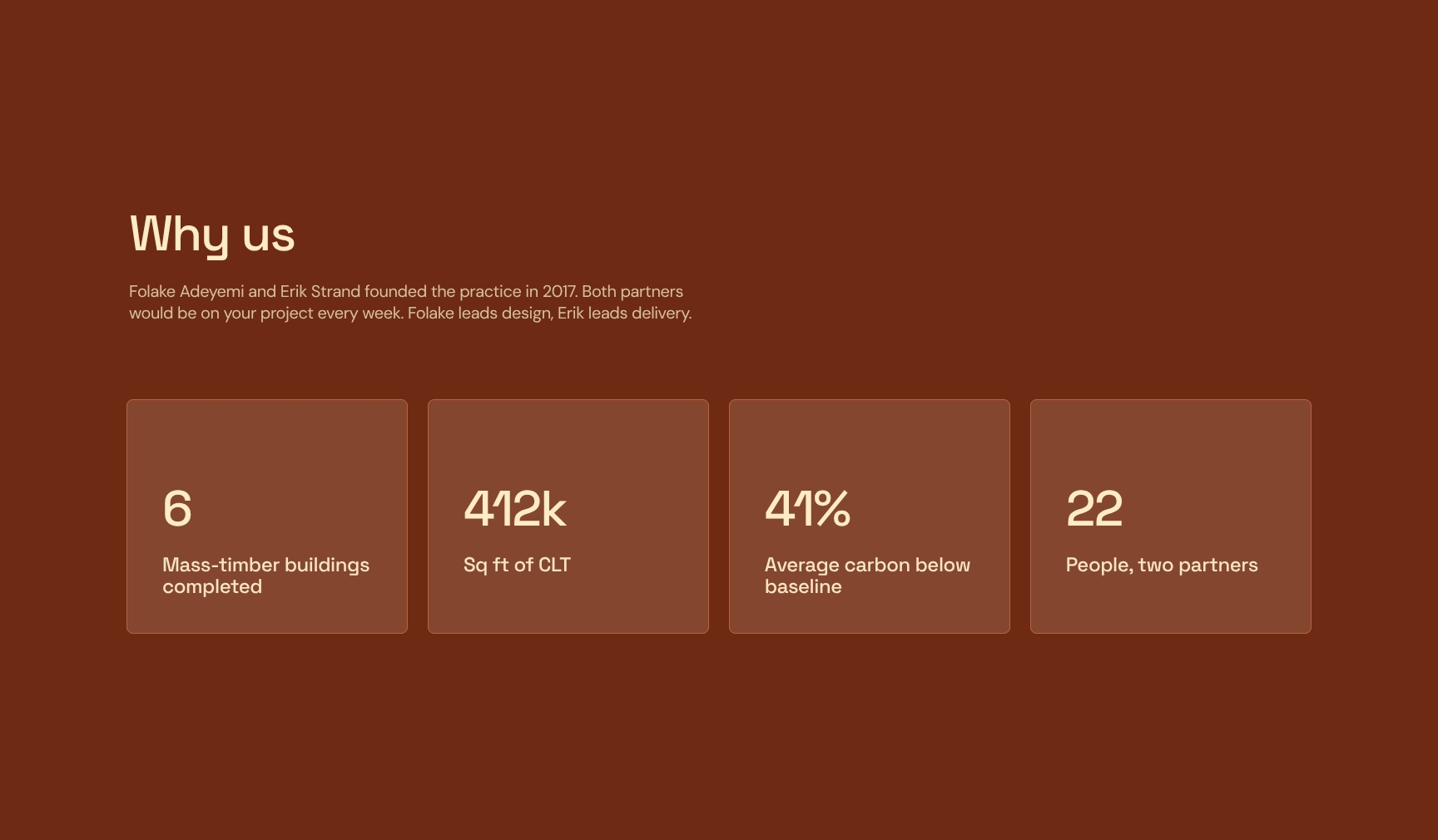
### Client Testimonials from Mass-Timber and Cleantech Projects
Quotes from past clients, including a COO at Lumenfold Batteries who credits the practice with a program cut that paid for the design fee. Provides social proof of honest advice and delivered results.
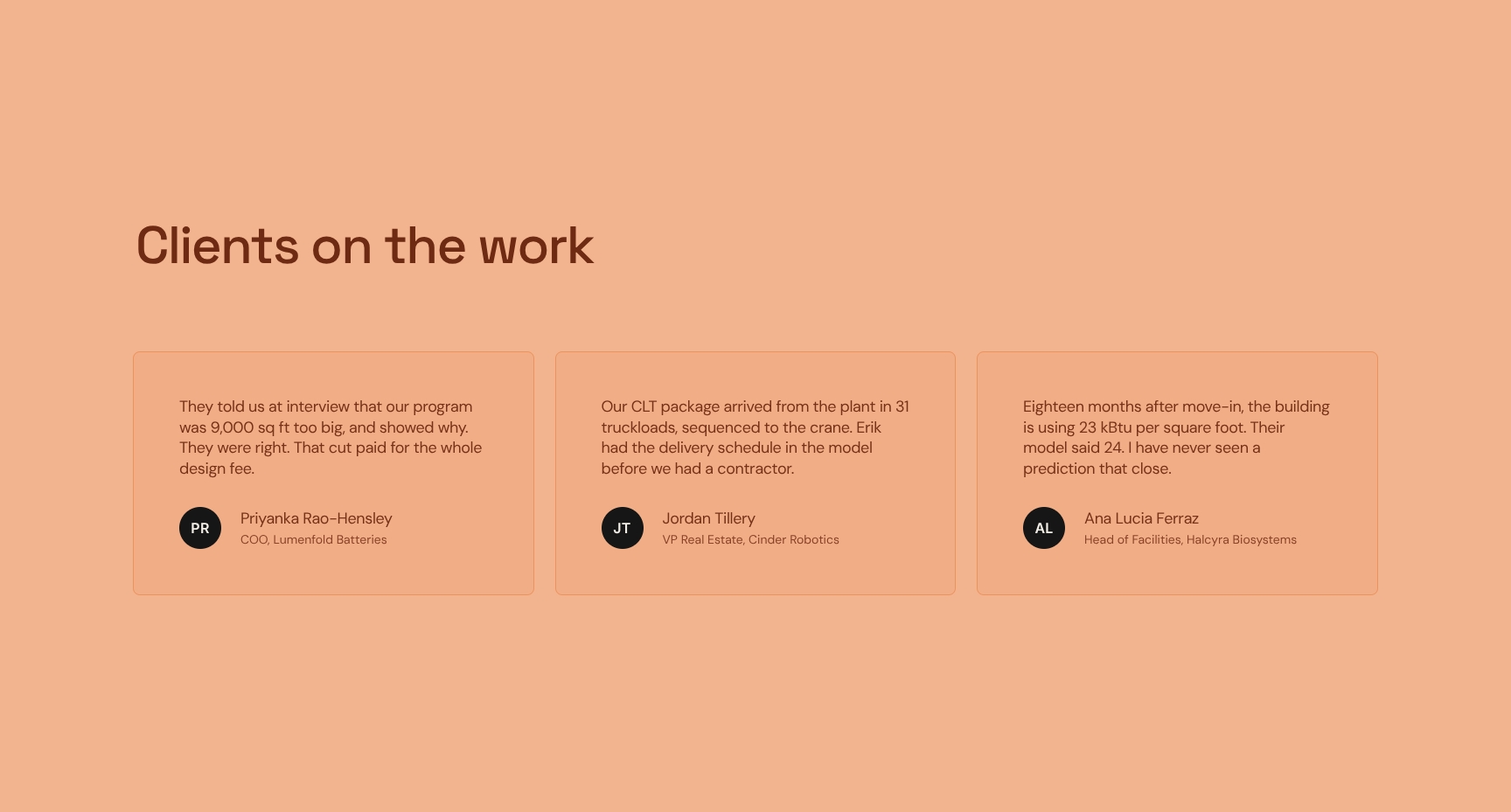
### Transparent Fee Proposal by AIA Phase
A clear fee at 6.4% of a $35.4m construction cost, split by AIA phase, in US dollars. Lists exclusions such as engineering and itemizes whole-life carbon reporting ($38,750) and live energy add-ons.
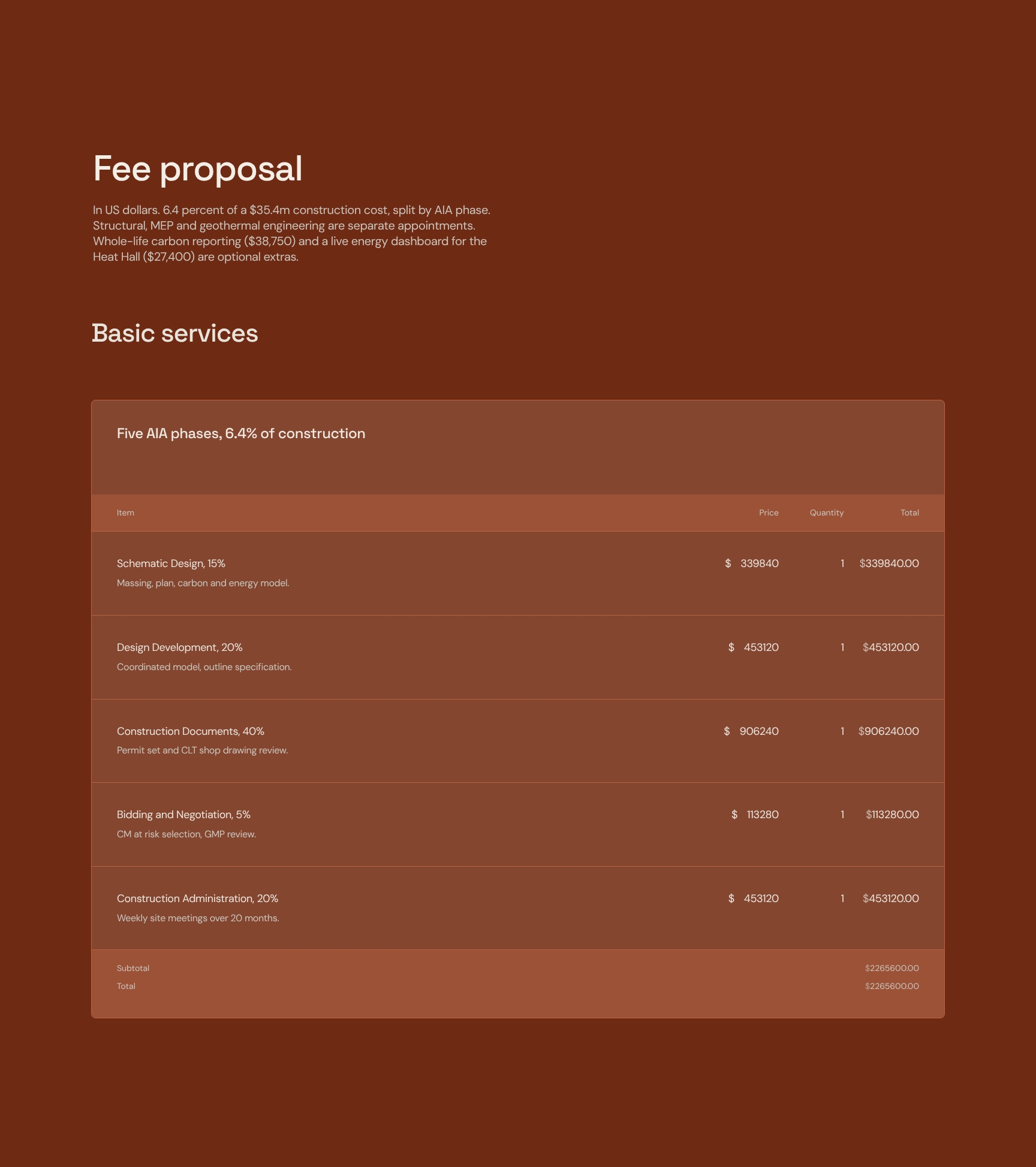
### First 90 Days Schematic Design Roadmap
A dated step-by-step plan from the August 2, 2027 Schematic Design start to the October 29 full presentation. Shows the client exactly what happens, when, and what they receive early on.
### Next Steps After the Interview: August Start Hold
Closes with a clear call to action: the August start is held until Friday, July 30, after which the mass-timber team is committed until January. Creates honest urgency and a simple path to appointment.
## Find your answers
Answers to common questions about writing architecture shortlist proposals for commercial clients and mass-timber headquarters projects.
### What should be included in a proposal template?
A strong proposal should include a cover, a clear brief that restates the client's needs, your core idea, a detailed concept showing how you'll deliver it, the numbers (pricing and timeline), and supporting materials. This template covers all six sections so nothing important is missed. Together they take a client from understanding the problem to approving the budget.
### How do I customize this proposal template for my own brand?
Replace the placeholder text in each section, such as the cover, the brief, and the idea, with your own content. Then update the fonts, colors, and logo to match your brand identity. You can also duplicate, reorder, or delete sections like Materials so the layout fits each client.
### What should I write in the brief section of a proposal?
The brief section should summarize the client's goals, challenges, audience, and expectations in your own words. Keep it to a short, focused overview that proves you understand their needs. Confirming the brief up front helps avoid scope disagreements later.
### How do I present pricing in the numbers section?
Break your costs into clear line items tied to deliverables, then show the total, payment terms, and timeline. Offering package options or tiers helps clients compare choices easily. Keep the section simple and transparent so the budget is easy to approve.
### Is this proposal template suitable for creative, agency, and freelance projects?
Yes, the structure of brief, idea, concept, numbers, and materials works well for design, marketing, branding, and consulting pitches. Freelancers and agencies can adapt the tone and depth to fit the project size. The Materials section lets you add portfolios, references, or mockups to support your pitch.
## Related
- [Stockholm](https://formlio.com/templates/stockholm-restaurant-interior-proposal): Restaurant interior concept proposal for chefs
- [Sydney](https://formlio.com/templates/sydney-hotel-design-concept-proposal): Hotel concept response for hospitality investors
- [Brighton](https://formlio.com/templates/brighton-architecture-statement-of-work): Architect statement of work for design stages
- [Porto](https://formlio.com/templates/porto-architecture-services-proposal): Architecture proposal for winery tasting rooms
- [Edinburgh](https://formlio.com/templates/edinburgh-temporary-venue-build-estimate): Temporary venue build estimate for festivals
- [Lyon](https://formlio.com/templates/lyon-hotel-website-proposal): Website proposal for multi-property hotel groups
---
---
title: "Denver"
description: "Win residential clients with an interior design FF&E proposal template: compare service options, show room-by-room concepts, set budgets and a clear timeline."
canonical: "https://formlio.com/templates/denver-interior-design-ffe-proposal"
locale: "en"
type: "template"
lastModified: "2026-10-20"
category: "Interior design"
alternates:
fr: "https://formlio.com/fr/templates/denver-proposition-ffe-decoration-dinterieur.md"
---
# Denver
Interior Design FF&E Proposal Template
Win residential clients with an interior design FF&E proposal template: compare service options, show room-by-room concepts, set budgets and a clear timeline.
- [Use this template](https://formlio.com/workspaces/claim?template=denver-interior-design-ffe-proposal)
- [Live preview](https://formlio.com/documents/denver-interior-design-ffe-proposal)
- **Categories:** [Interior design](https://formlio.com/templates/interior-design), [Proposals](https://formlio.com/templates/proposals)
- **Document goal:** Win homeowner clients with a proposal that shows room-by-room concepts, service options, budgets, and a clear timeline.
- **Blocks:** Horizontal gallery, Single column, Scroll gradient, Spotlight, Carousel, Itemized quote, Gantt, Left-aligned, E-signature
- **Palette:** Soft Linen Background (#F3F2EC), Sage Mist Secondary (#CFD5C3), Botanical Moss Accent (#6f7f5c), Deep Forest Emphasis (#3E4A33), Midnight Evergreen Text (#1E211B)
## Get more from every document
Win residential clients with a proposal that shows your design thinking, budget, and timeline in one document. Compare service options, present room-by-room concepts, and let homeowners approve right on the page.
### Get the yes without leaving
Your client reads the pricing, agrees to the terms, and signs in the same scroll. No printing, no PDF chase.
### Build proposals from blocks you trust
Pull in pricing, steps, and testimonial sections, then save your best-performing ones to reuse on the next pitch.
### Your pitch looks right on any screen
Hero images and pricing tables hold up when a client opens your proposal on a phone between meetings.
### Know which section sold them
See if they lingered on pricing or skipped the timeline, then follow up while the proposal is fresh in their mind.
### Follow up the moment they open
Get pinged when a client views your proposal, leaves a comment, or signs the agreement, so you reply while they're engaged.
### Write the proposal together, live
Your designer tunes the hero while you finalize the pricing and tasks, all in the same document at once.
## See how every part fits
The proposal opens with a personal cover and the client's brief, then moves through your concepts, pricing, and proof, and closes with a clear approval and start date. Keep, drop, or reorder anything to match your project.
### Personalized Interior Design & FF&E Proposal Cover
A branded cover naming the Desai Kowalczyk House, Pinyon Studio in Denver, the clients and the proposal date. It sets a polished, professional first impression and frames the proposal.
### Client Brief & Three Project Options Overview
Restates the brief: a 5,400 sq ft home, 14 rooms, an October completion and a $560,000 FF&E budget. Then lays out three ways to run the project so clients can compare and choose with confidence.
### Design Philosophy & Strategic Point of View
A bold animated statement of the studio's view: open spaces need fewer, better pieces, ordered early. It shows expertise and shapes how the client reads the rest of the proposal.
### Room-by-Room Design Scheme & Concept Direction
A first view of the scheme for each room, drawn from walkthroughs and the lifestyle questionnaire. It shows the client has been heard and that 3D concept testing comes before anything is specified.
### Project Process & 35-Week Delivery Roadmap
Walks through how the project runs from the first site visit on 2 March to styling in late October. It explains how lead times drive the move-in date, so expectations are set early.
### Portfolio of Furnished Homes & Owner-Verified Results
Four completed houses, each designed, ordered, installed and styled by the named team. Outcomes are the owners' own numbers, shared with permission, giving credible proof of delivery.
### Meet Your Dedicated Interior Design Team
Introduces the five people from the nine-person Denver studio who will run the project, from the first site measure to the last cushion. Clients know exactly who will be in their home.
### Transparent Design Fee & FF&E Budget Pricing
Itemized USD pricing with a design fee built from day rates and an FF&E budget paid at trade price with no markup. Clear numbers build trust and make options easy to compare.
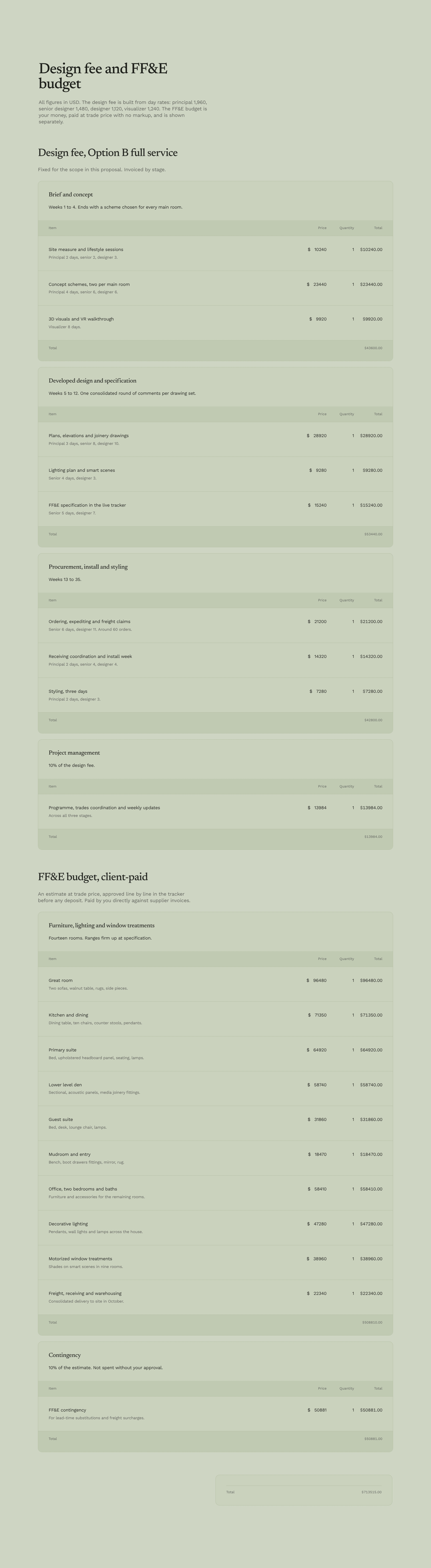
### Lead-Time-Driven Project Programme & Timeline
A task-by-task schedule across 35 weeks, from 2 March to 29 October 2027. It states the assumptions, such as consolidated feedback and an October completion, so the move-in date stays on track.
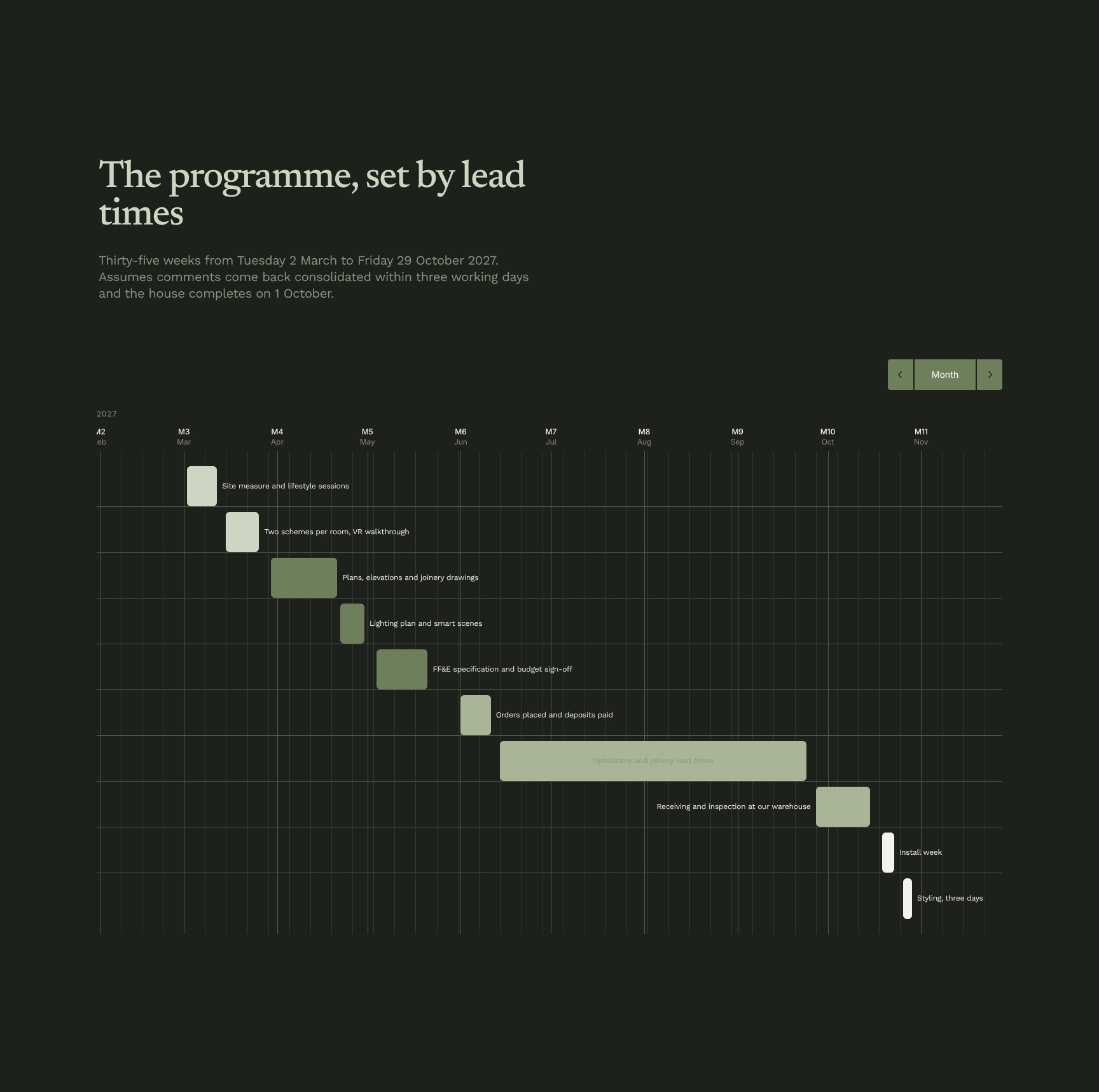
### Project Assumptions, Terms & Risk Safeguards
Expandable terms covering the parts of a furnishing project that cause the most trouble. Settling them before anything is ordered prevents disputes and surprises later.
### Homeowner Testimonials & Social Proof
Quotes from owners who have lived with the result, including one on how the team handled a late delivery calmly. Real client stories reassure buyers about communication and reliability.
### Approve Option B & Reserve Your 2 March Start
A clear call to action with a validity date of 26 February 2027. Approving secures the 2 March site measure and first lifestyle session, and gives clients a simple, time-bound next step.
## Find your answers
Answers to common questions about building FF&E proposals for residential interior design clients, from pricing options to timelines and approvals.
### What should be included in a proposal template?
A strong proposal includes a cover, a summary of the client's brief and options, your point of view, an introduction to your team or company, a plan for how the work will run, and past work as proof. This template covers each of these in its six sections: Cover, Brief and options, Our view, The house, How it runs, and Past work. Together they take a client from understanding the problem to trusting you to deliver.
### How do I customize this proposal template for my own business?
Start by replacing the cover details with your client's name, project title, and your branding. Then edit the Brief and options section to reflect the client's goals, and rewrite Our view in your own voice. Update The house, How it runs, and Past work with your team, process, timelines, and relevant case studies. Delete or reorder sections to fit the project.
### Can I export this proposal template to PDF or other formats?
Yes, you can export the finished proposal to PDF for sending to clients, which keeps layout and fonts consistent on any device. Depending on the tool you use, you can also export to formats such as PowerPoint, Word, or Google Slides. Check your PDF before sending to confirm images, links, and page breaks look right.
### Is this proposal template suitable for agencies, consultants, and creative studios?
Yes, it works well for any service business that pitches custom projects, including agencies, consultancies, design studios, and freelancers. The Brief and options section lets you offer tiered scopes, and Past work lets you show industry-specific examples. Adjust the tone and case studies to match each client's sector.
### How long does it take to complete this proposal template?
Most users can complete a tailored proposal in 1 to 3 hours if they have their case studies, team bios, and pricing ready. The Brief and options and Our view sections take the most time because they must be specific to each client. Once you have reusable content for The house, How it runs, and Past work, later proposals can be done faster.
## Related
- [Miami](https://formlio.com/templates/miami-ffe-procurement-statement-of-work): FF&E procurement statement of work for designers
- [Amsterdam](https://formlio.com/templates/amsterdam-show-apartment-design-proposal): Show apartment design proposal for property developers
- [Chicago](https://formlio.com/templates/chicago-workplace-interior-design-proposal): Workplace interiors proposal for law firms
- [Lisbon](https://formlio.com/templates/lisbon-interior-design-proposal): Full-service interiors proposal for homeowners
- [Stockholm](https://formlio.com/templates/stockholm-restaurant-interior-proposal): Restaurant interior concept proposal for chefs
- [London](https://formlio.com/templates/london-interior-design-retainer-proposal): Monthly design retainer for hospitality clients
---
---
title: "Florence"
description: "Win boutique hotel projects with an interior design proposal template covering brief, concept, materials and working method. Built for hospitality design studios."
canonical: "https://formlio.com/templates/florence-hotel-interior-design-proposal"
locale: "en"
type: "template"
lastModified: "2026-10-20"
category: "Interior design"
alternates:
fr: "https://formlio.com/fr/templates/florence-proposition-de-design-dinterieur-hotel.md"
---
# Florence
Hospitality Interior Design Proposal Template
Win boutique hotel commissions with an interior design proposal template covering brief, concept, materials and process. Built for studios pitching hospitality.
- [Use this template](https://formlio.com/workspaces/claim?template=florence-hotel-interior-design-proposal)
- [Live preview](https://formlio.com/documents/florence-hotel-interior-design-proposal)
- **Categories:** [Interior design](https://formlio.com/templates/interior-design), [Proposals](https://formlio.com/templates/proposals)
- **Document goal:** Win boutique hotel projects with a proposal that lays out your brief, concept, materials and working method.
- **Blocks:** Perspective grid, Single column, Scroll gradient, Split, Sticky scroll, Grid 3x2 with icons, Itemized quote, Vertical timeline, Left-aligned, E-signature
- **Palette:** Soft Linen Background (#F4EFE9), Blush Rose Highlight (#E6C7BE), Signature Mulberry Accent (#8A4B57), Deep Burgundy Contrast (#4C2530), Espresso Noir Text (#1C1316)
## Get more from every document
Pitch your studio to boutique hotel operators with a proposal that moves from brief to signed appointment in one document. Animated text, fee tables, and an accordion for terms keep it clear to read and quick to approve.
### Get the yes without leaving the page
Your client reads the pricing, scrolls to the agreement, and signs right there. No PDF download, no printing, no waiting.
### Build proposals from your best sections
Drop in hero images, pricing, and steps, then save your own winning blocks and reuse them in the next pitch.
### Your pitch looks sharp on any screen
Your client opens the proposal on a phone between meetings and the showcase and pricing still read cleanly.
### See which section wins the deal
Heatmaps show if they lingered on pricing, and session replays let you follow up while your proposal is on their mind.
### Know the moment they open it
Get a ping when your client views the proposal, leaves a comment, or signs, so you reply while the interest is fresh.
### Write the proposal with your team
Your designer tweaks the showcase while you rework the pricing, in the same document, at the same time.
## See how every part fits
The proposal opens on a hero image and the client's brief, then moves through concept, process, and fees, and closes on testimonials and acceptance. Keep, drop, or reorder anything to fit your studio and the project.
### Hotel Interior Design Proposal Cover with Hero Imagery
An immersive cover introducing the Sterpaia Ospitalità 26-room hotel project in Greve in Chianti, with studio credit and date. It sets an elegant, confident tone and frames the proposal from the first glance.
### Client Brief Summary: Rooms, Restaurant, Spa and Opening Date
Restates the client's brief: 26 rooms, a 40-cover restaurant, a spa and four pavilions opening June 2028. Shows you listened closely and builds trust before any design is presented.
### Design Philosophy Statement with Animated Text Reveal
A single, memorable statement of the studio's point of view, revealed with animated text. It gives the proposal a clear emotional anchor around a sense of place and sets the creative direction.

### Interior Design Concept Showcase for Hotel Guest Rooms
Presents the core design concept, such as rooms planned around the window and the view. Showcase blocks explain how ideas translate into guest experience, making the vision tangible and easy to approve.
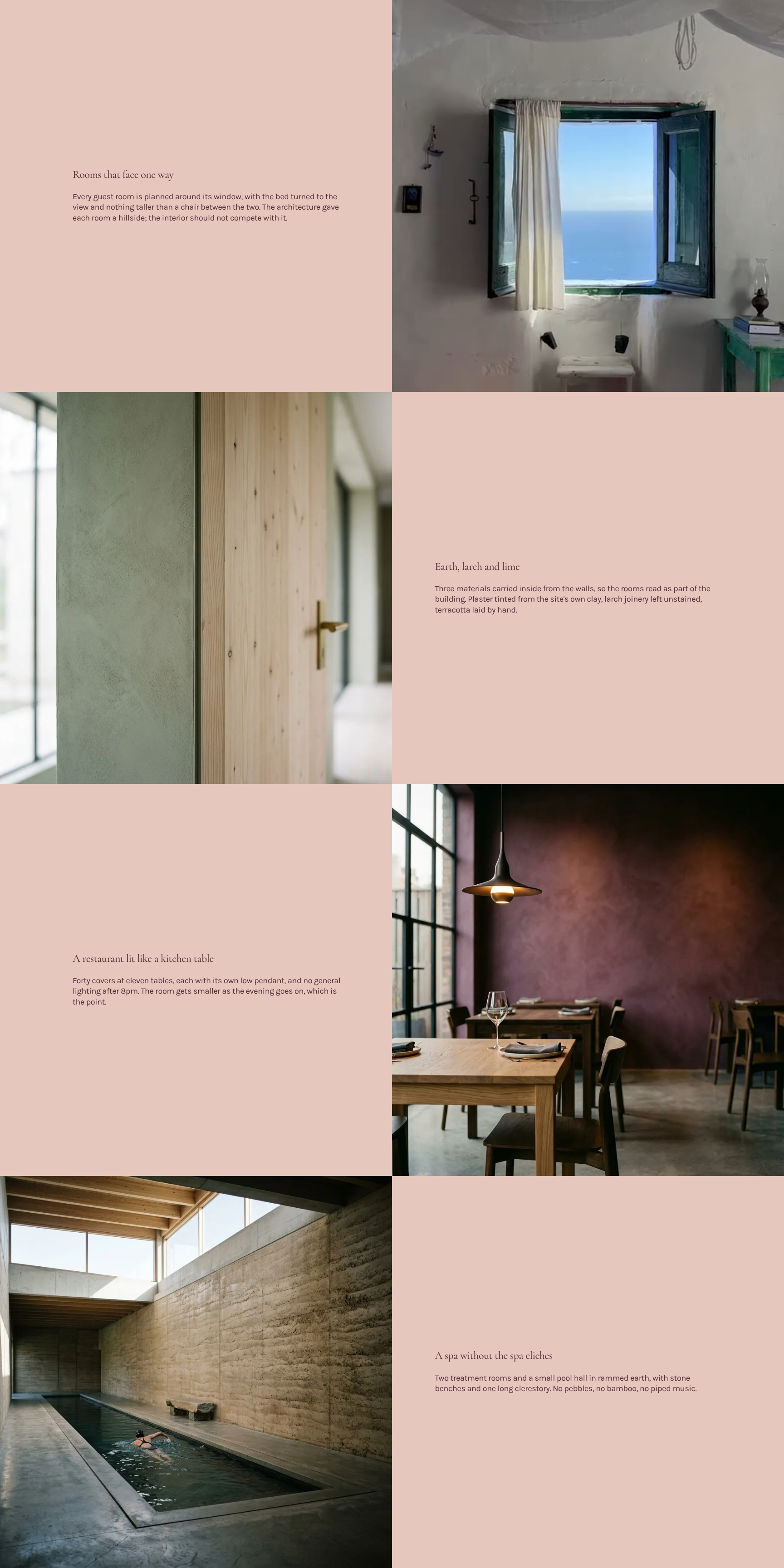
### Step-by-Step Design Approach and 53-Week Process
Outlines how the work unfolds from the first site walk to the final snag, including full-size prototype rooms before specification. Clients see a disciplined method that reduces risk and costly rework.
### Hospitality Portfolio Case Studies with Operator-Verified Results
Three recently opened hotels with interiors and FF&E by the studio, backed by figures shared by the operators. Proves track record in new-build hospitality and shows measurable outcomes.
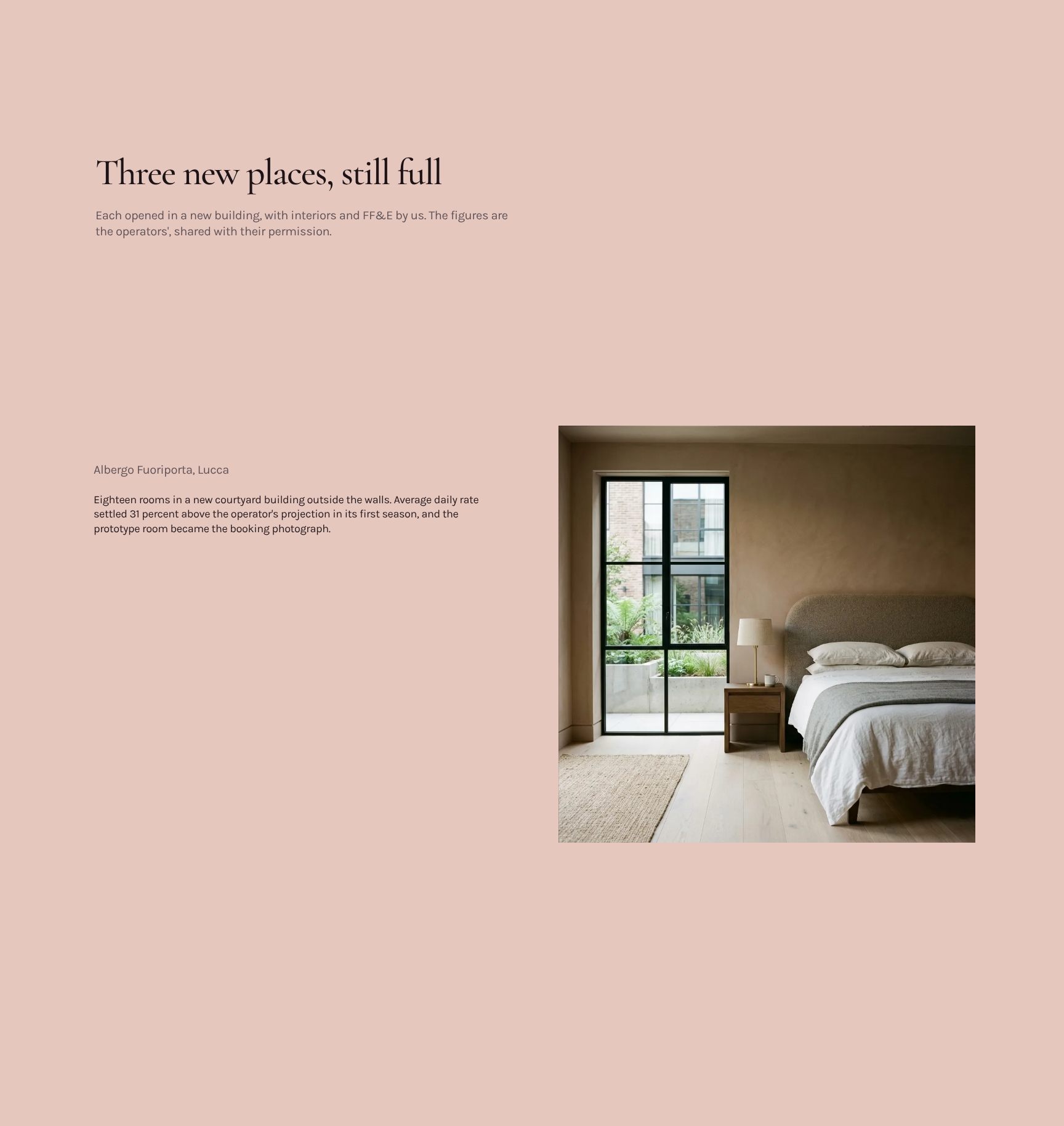
### Meet the Hotel Interior Design Team
Profiles the five people who would work on Sterpaia, with the studio's Florence background and size. Puts faces and responsibilities to the proposal and reassures clients about continuity from first walk to opening.
### Transparent Design Fee Breakdown with Day Rates in EUR
A clear fee table built from role-based day rates, shown in EUR excluding IVA and set against the EUR 4.6M interiors and FF&E budget. Transparent pricing makes comparison and approval simple.
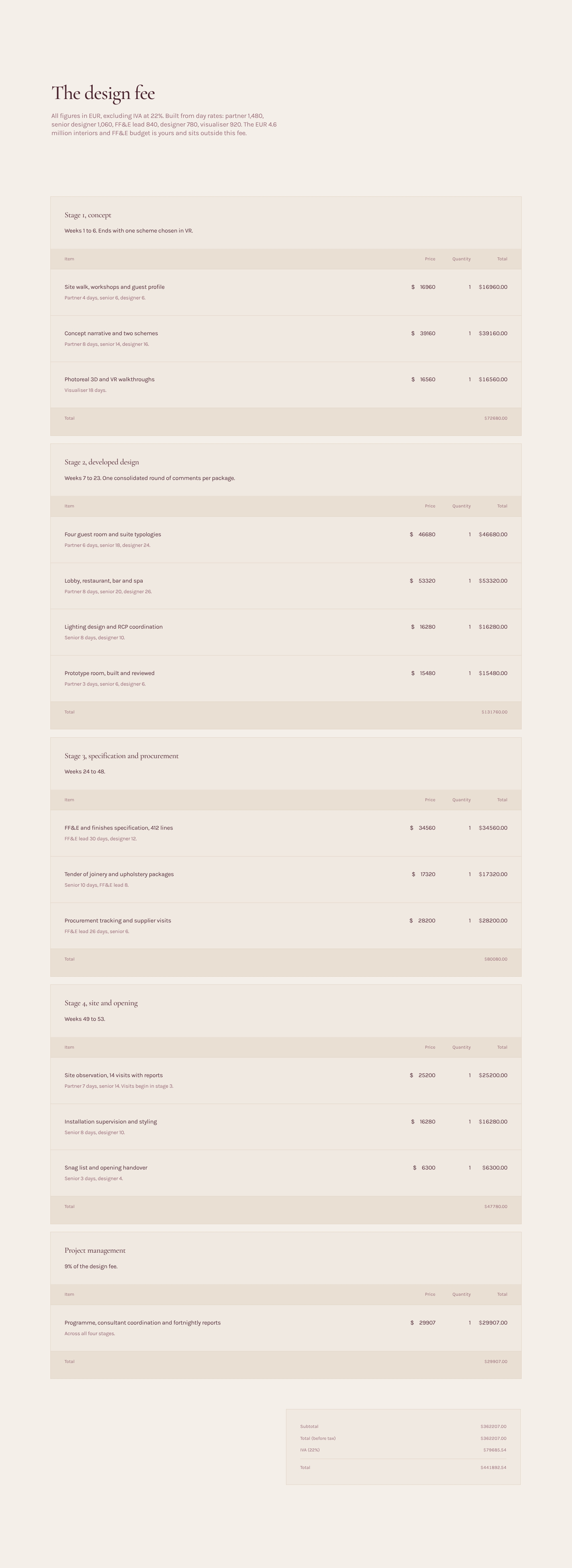
### Project Programme and Timeline to Hotel Opening
A dated schedule from 10 May 2027 to 12 May 2028, accounting for the Ferragosto closure and 14 to 16 week upholstery lead times. Helps clients plan around real constraints and protect the opening season.
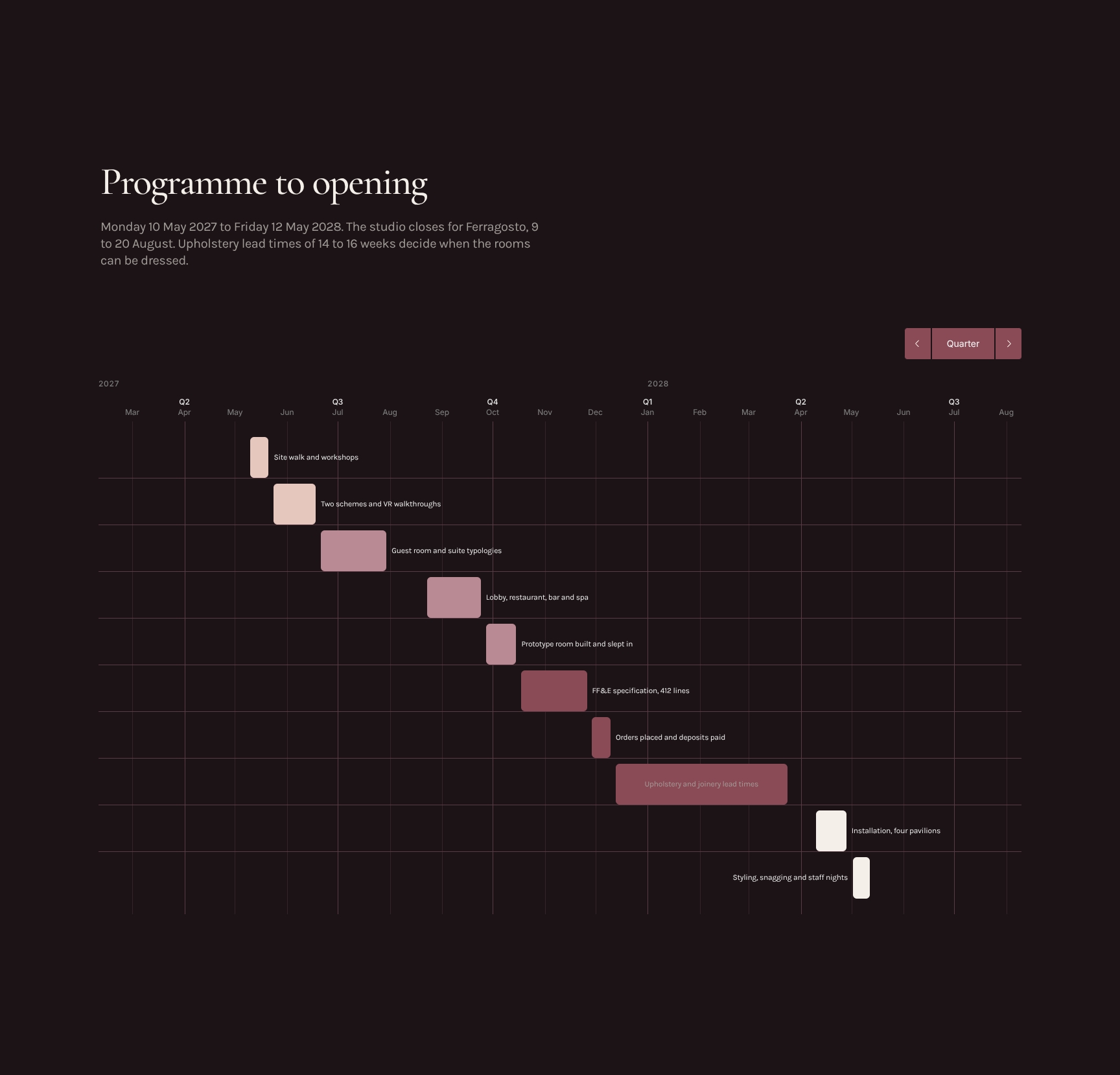
### Assumptions, Terms and Conditions Accordion
Expandable terms covering the conditions behind the fee, with a focus on timing risks. Keeps the page clean while giving clients full clarity on responsibilities, dependencies and what could change.
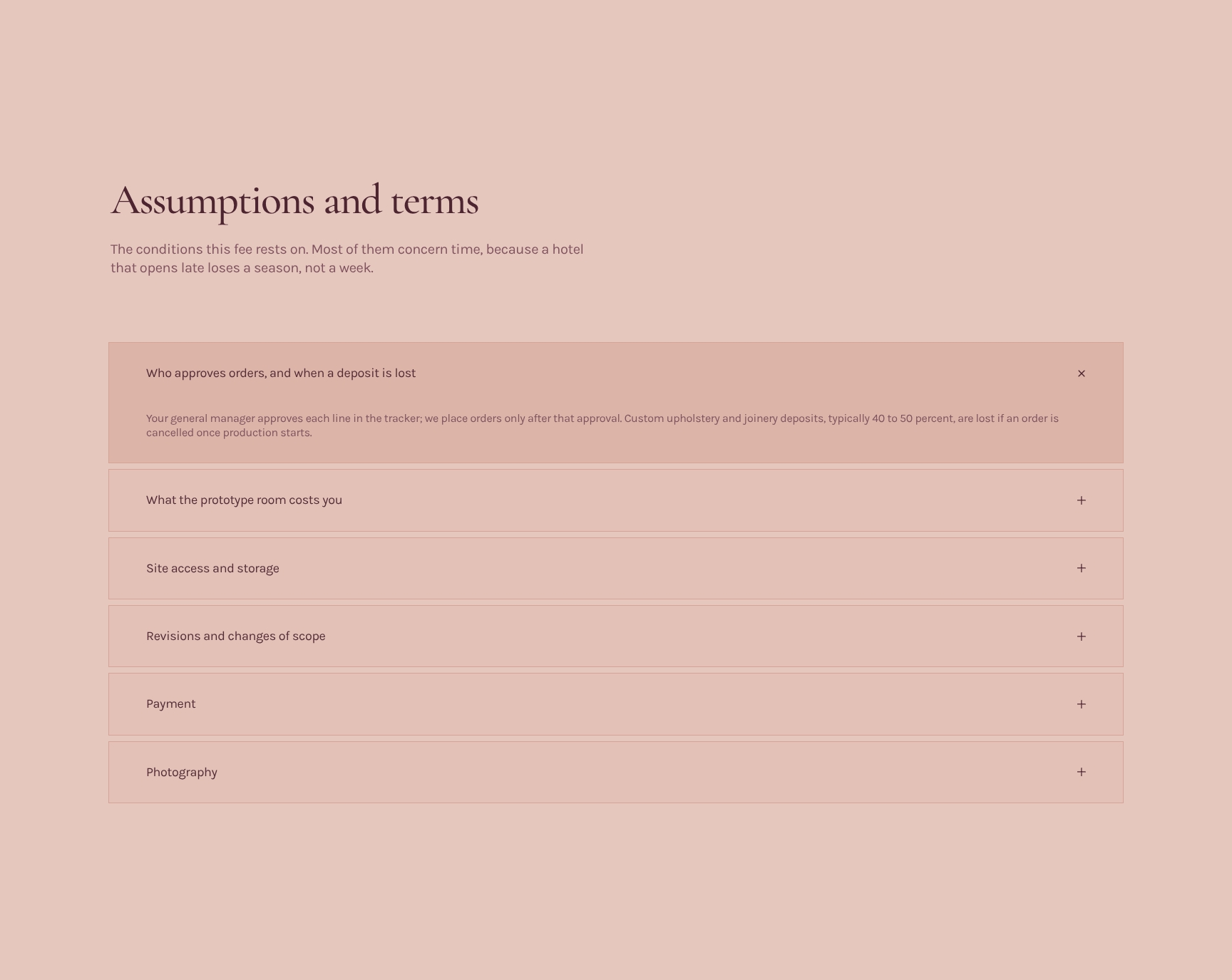
### Hotel Operator Testimonials and Client Proof
Quotes from general managers reflecting on results a year after opening, including the benefit of prototype-room testing. Adds credible third-party validation that reduces perceived risk.
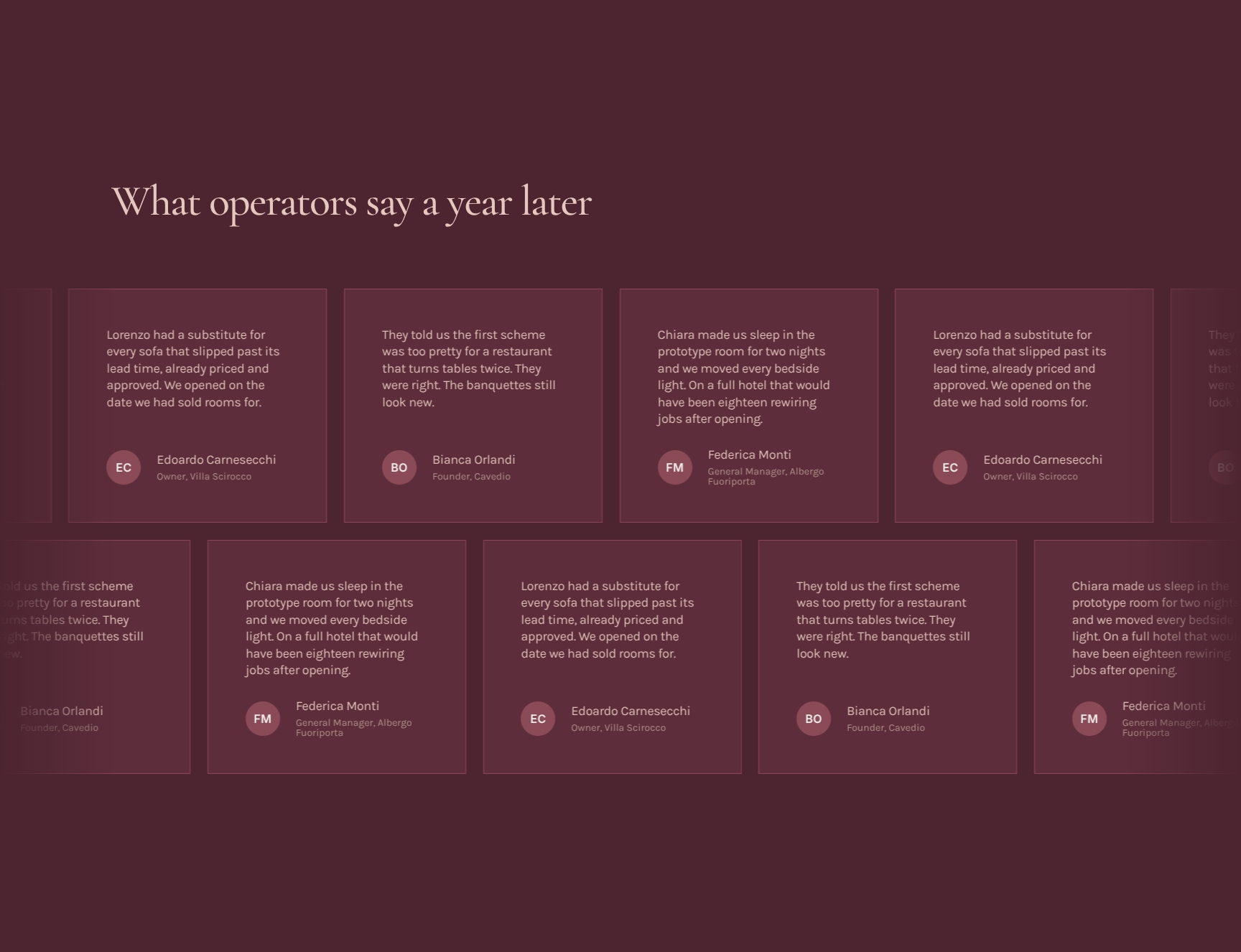
### Project Appointment and Acceptance Agreement
A clear call to action with a proposal validity date of 30 April 2027 and a first site walk on 10 May. Creates urgency, explains next steps and lets clients appoint the studio with confidence.
## Find your answers
Answers to common questions about writing and sending interior design proposals to boutique hotel owners and operators.
### What should be included in a creative proposal template?
A strong creative proposal includes a cover, a summary of the client's brief, your point of view, the core concept, your approach, and relevant past work. This template covers all six sections in a logical order that moves from understanding the problem to proving you can deliver. Each section is designed to build trust and lead the client toward approval.
### How do I customize this proposal template for my own brand?
Replace the placeholder text, logos, colors, and fonts in each section to match your brand identity. You can reorder, duplicate, or delete sections such as Past work or Approach to suit each client. Start with the Cover and The brief, then tailor The concept and Our view to the specific project.
### What should I write in the 'Our view' section of a proposal?
The 'Our view' section should state your perspective on the client's challenge, market, or audience in a few confident paragraphs. Highlight an insight the client may not have considered and show how it shapes your recommended direction. Keep it specific and evidence-based rather than generic, so it differentiates you from competing proposals.
### Can I export this proposal template to PDF or PowerPoint?
Yes, you can export the finished proposal as a PDF to send to clients, which preserves layout and fonts across devices. Depending on the tool you use, you can also export to formats like PowerPoint or Google Slides for further editing or live presentations. Always review the exported file to confirm that images and fonts display correctly before sending.
### Is this proposal template suitable for agencies, freelancers, and consultants?
Yes, the structure works for agencies, freelancers, consultants, and studios pitching creative, marketing, branding, or design projects. The sections are flexible enough to scale from a short one-person pitch to a detailed team proposal. Adjust the depth of The approach and Past work to match the size and complexity of the engagement.
## Related
- [Miami](https://formlio.com/templates/miami-ffe-procurement-statement-of-work): FF&E procurement statement of work for designers
- [Amsterdam](https://formlio.com/templates/amsterdam-show-apartment-design-proposal): Show apartment design proposal for property developers
- [Chicago](https://formlio.com/templates/chicago-workplace-interior-design-proposal): Workplace interiors proposal for law firms
- [Lisbon](https://formlio.com/templates/lisbon-interior-design-proposal): Full-service interiors proposal for homeowners
- [Stockholm](https://formlio.com/templates/stockholm-restaurant-interior-proposal): Restaurant interior concept proposal for chefs
- [London](https://formlio.com/templates/london-interior-design-retainer-proposal): Monthly design retainer for hospitality clients
---
---
title: "Perth"
description: "Win restaurant and bar fit-out projects with an interior design proposal template covering brief, budget, concept and timeline. Built for design studios."
canonical: "https://formlio.com/templates/perth-interior-design-pitch"
locale: "en"
type: "template"
lastModified: "2026-10-20"
category: "Interior design"
alternates:
fr: "https://formlio.com/fr/templates/perth-pitch-de-design-dinterieur.md"
---
# Perth
Hospitality Interior Design Proposal Template
Win restaurant and bar fit-out projects with an interior design proposal template covering brief, budget, concept and timeline. Built for design studios.
- [Use this template](https://formlio.com/workspaces/claim?template=perth-interior-design-pitch)
- [Live preview](https://formlio.com/documents/perth-interior-design-pitch)
- **Categories:** [Interior design](https://formlio.com/templates/interior-design), [Proposals](https://formlio.com/templates/proposals), [Pitch decks](https://formlio.com/templates/pitch-decks)
- **Document goal:** Win restaurant and bar fit-out projects with a proposal that lays out your brief, budget, concept, and timeline.
- **Blocks:** Image reveal, Single column, Grid 3x2 with icons, Fullscreen, Alternating column, Masonry, Itemized quote, E-signature
- **Palette:** Warm Parchment Background (#F4EEE6), Soft Apricot Highlight (#F2C9A4), Terracotta Accent (#C2552B), Deep Rust Emphasis (#7A2E14), Espresso Text Dark (#1B1512)
## Get more from every document
Pitch restaurant and bar operators with a proposal that shows your concept, budget and timeline in one document. Built-in brief, fee breakdown and portfolio layouts keep every page ready for the room.
### Get the yes without leaving the page
Your client reads the pricing, scrolls to the agreement, and signs right there. No PDF download, no printing, no waiting.
### Build proposals from sections you've proven
Pull in a hero, pricing table, or steps block, then save your best testimonials layout and reuse it on the next pitch.
### Your portfolio looks right on any screen
Your gallery and showcase images hold their shape when a client opens the proposal on a phone between meetings.
### See which section sells your client
Heatmaps show if they linger on pricing or skip the portfolio, so your follow-up lands when interest peaks.
### Know the moment they open it
Get a ping when your client views the proposal, leaves a comment, or signs the agreement, so you can reply while it's fresh.
### Write the pitch together, live
Your designer tweaks the gallery while you rework the pricing, and both edits appear on the page as they happen.
## See how every part fits
The proposal opens with a cover and the client's brief, then moves through concept, proof and fees before closing on a clear next step. Keep what fits, drop what doesn't, and reorder anything to suit your pitch.
### Interior Design Pitch Cover for Hospitality Clients
A striking hero cover naming the client, Kurrajong Hospitality, the Perth studio, Ochre Index, and the presentation date. It sets a polished, professional tone from the first screen.
### Client Design Brief: Restaurant and Bar Scope
Restates the brief: a 120-cover seafood room, a 48-seat bar above it, the podium handover date and the February 2028 opening. It shows the client they were heard and locks in the project scope.
### Operator Numbers and Key Project Metrics
Cards presenting the client's own figures from the operator brief dated 17 February 2027. Each design decision is tied back to covers, budget and trading data, so the pitch is grounded in commercial reality.
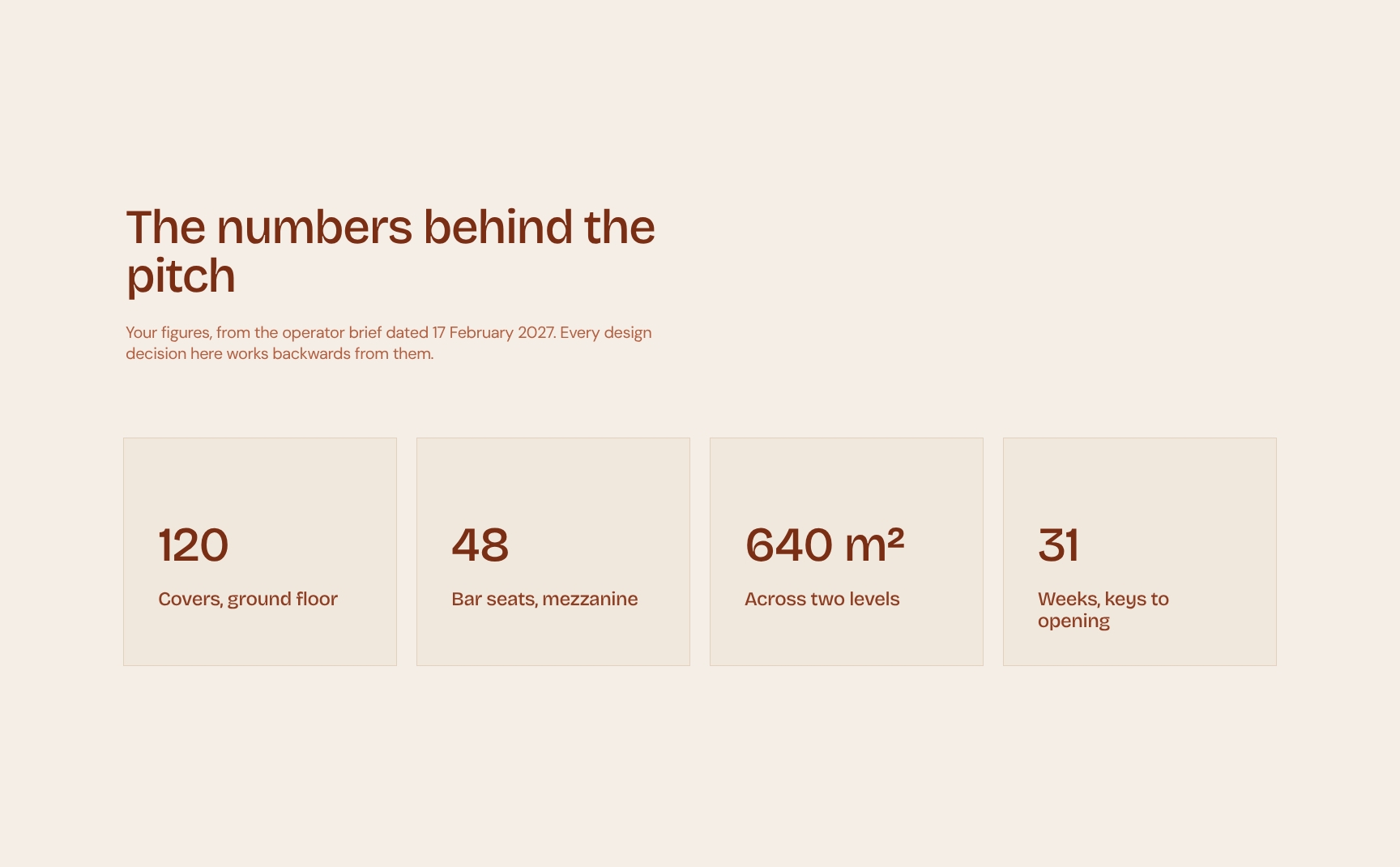
### Design Concept Showcase: Limestone Wall and Bar
Presents the core design concept, a 22-metre limestone wall catching western light and a bar visible from the street. Descriptive copy and visuals make the vision concrete and memorable.
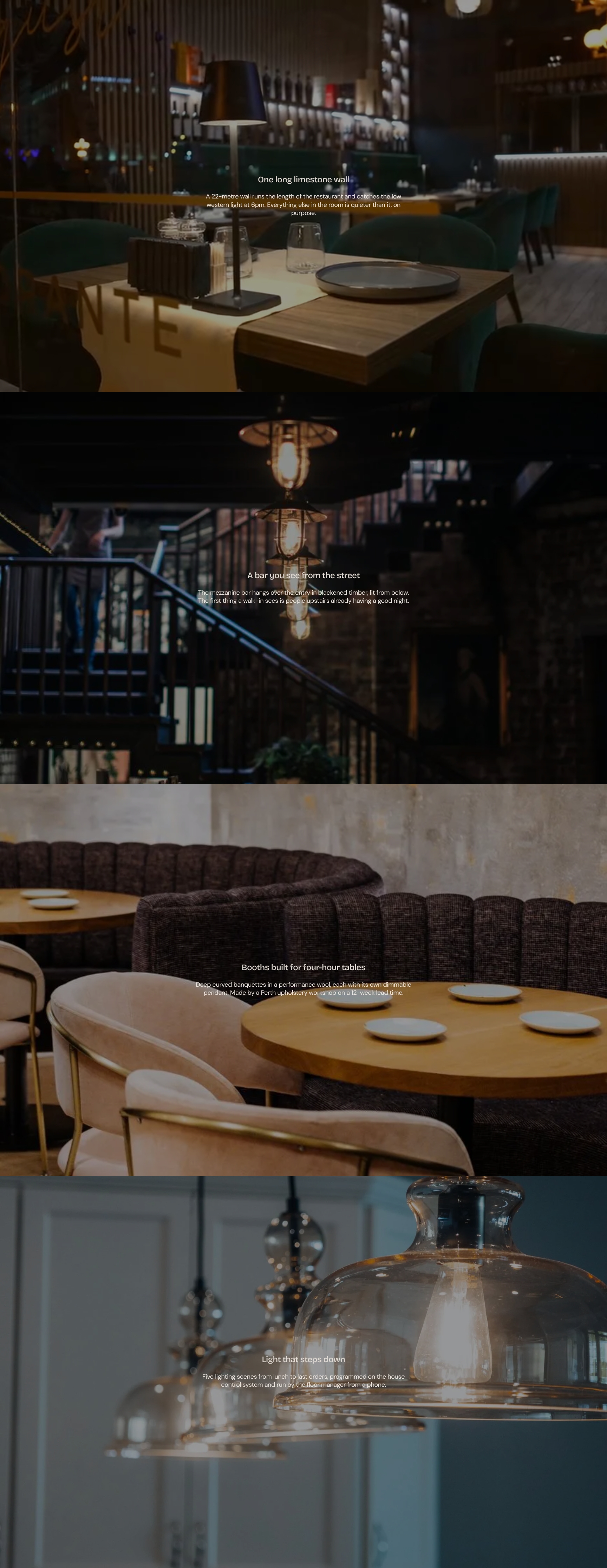
### Hospitality Portfolio: Venues We Have Opened
Four past venues, each still trading on its original fit-out, with operator-shared results used with permission. It builds credibility with proof of durable, commercially successful hospitality design.
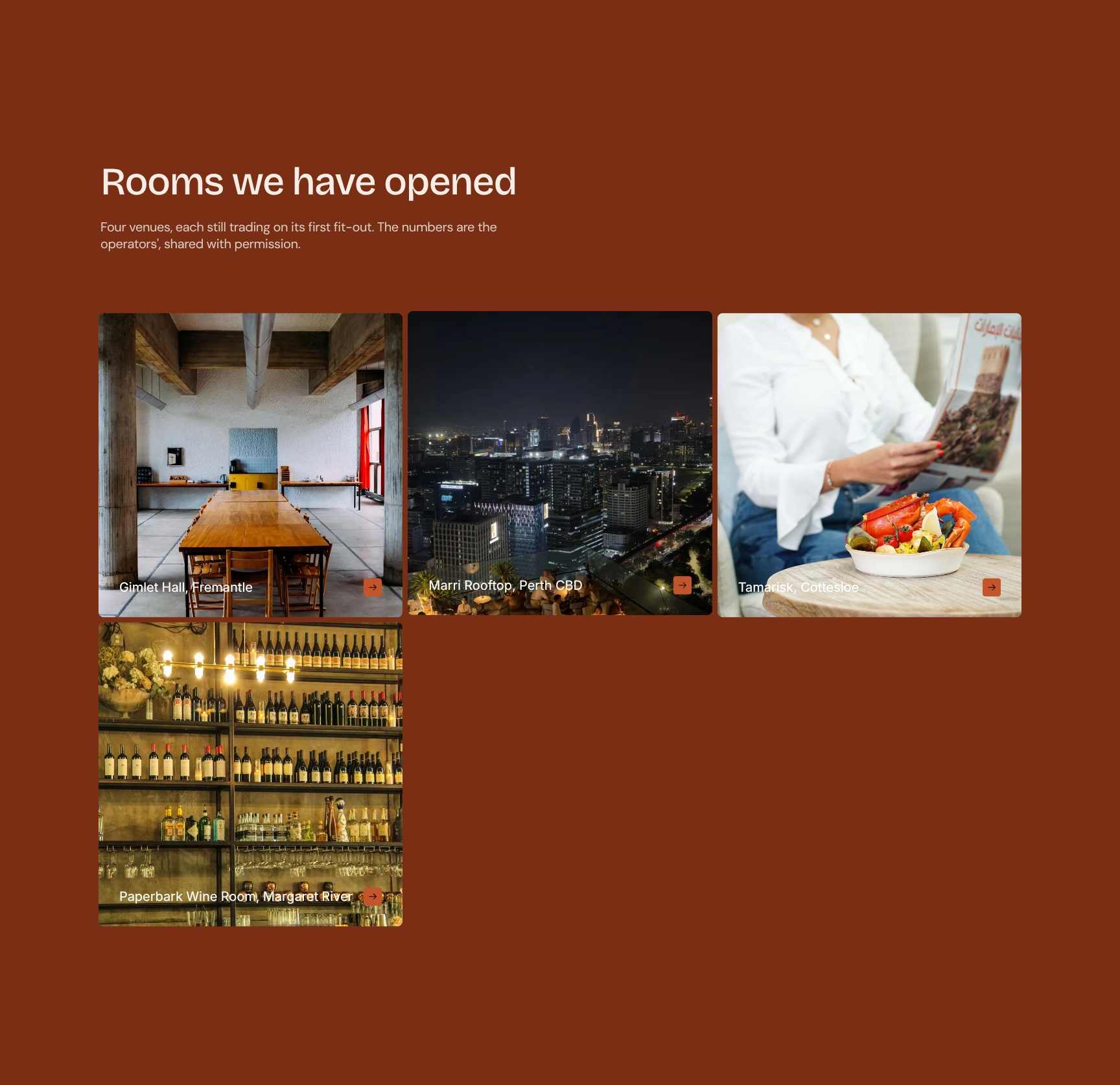
### Meet the Design Team Behind Your Project
Profiles of the people who pitch and then deliver the project, with a clear promise of no handover after signing. It reassures clients on continuity, accountability and senior-level attention.
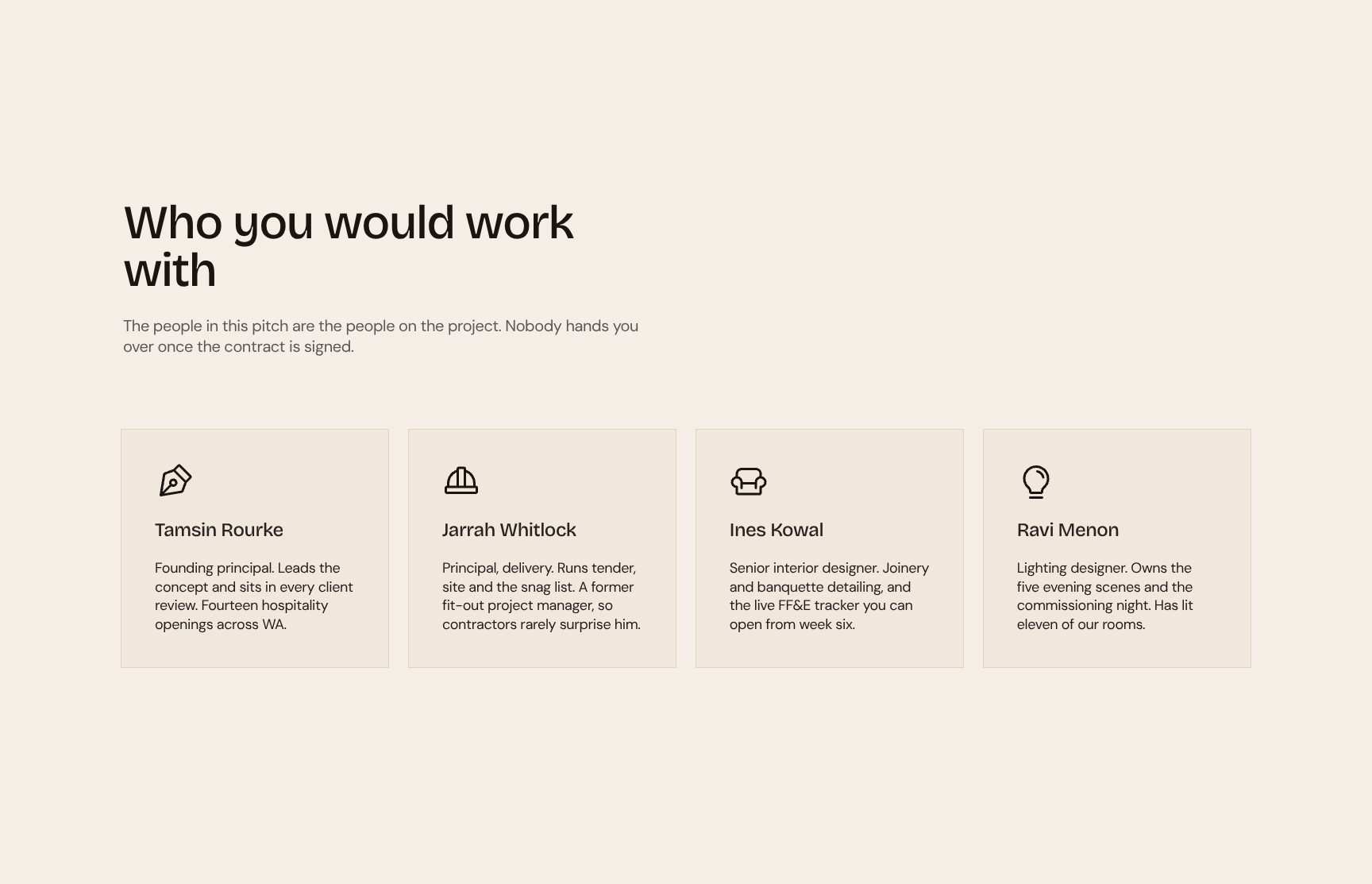
### Project Timeline: 44 Weeks from Workshop to Opening
A step-by-step roadmap from the first workshop on 6 April 2027 to the February 2028 opening, paced by supplier lead times. It sets realistic expectations and shows delivery discipline.
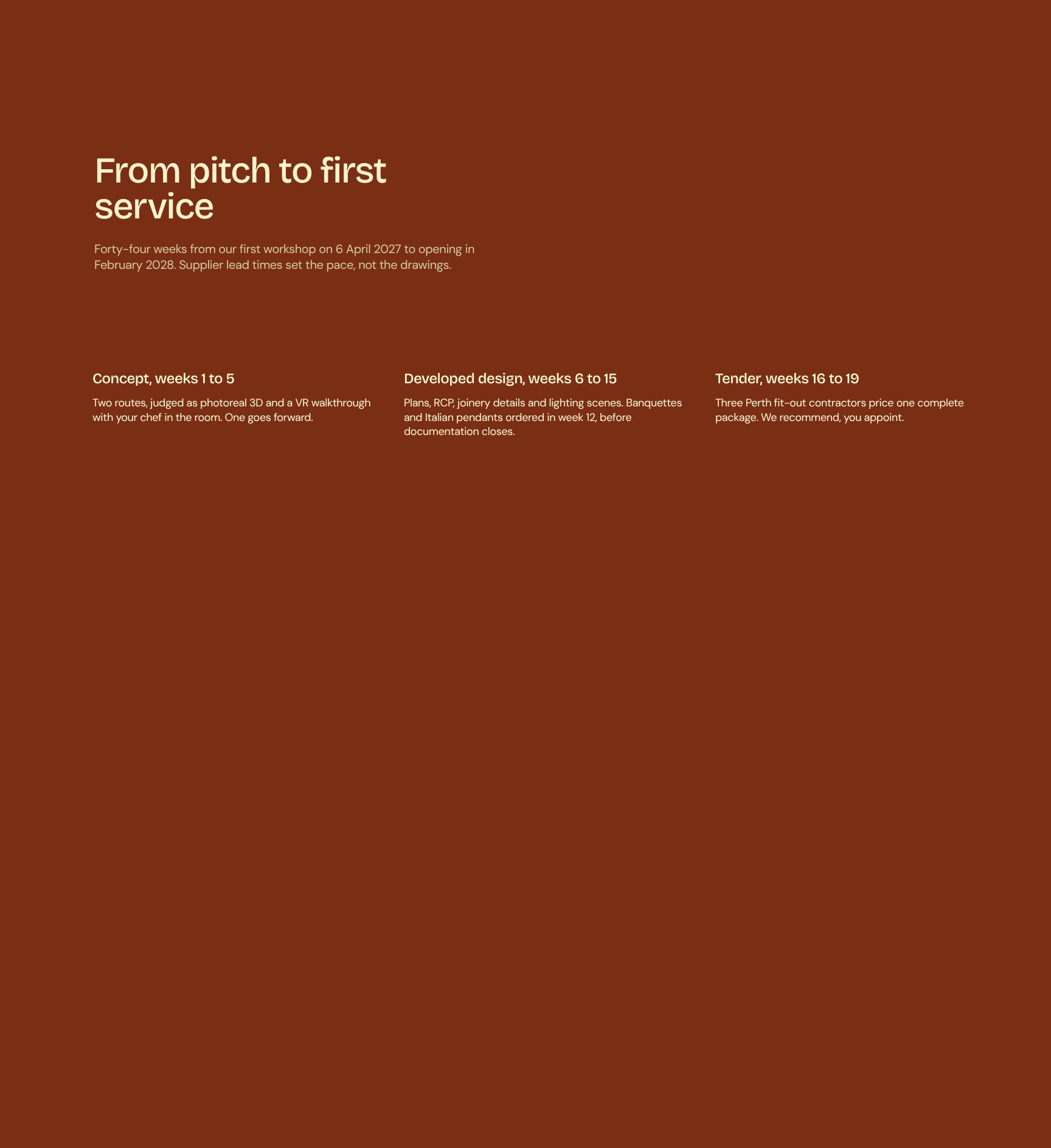
### Transparent Design Fee Breakdown in AUD
A clear fee schedule built from published day rates for principal, senior designer, designer, visualiser and lighting designer, set against the AUD 2.38 million fit-out budget. GST is shown separately.
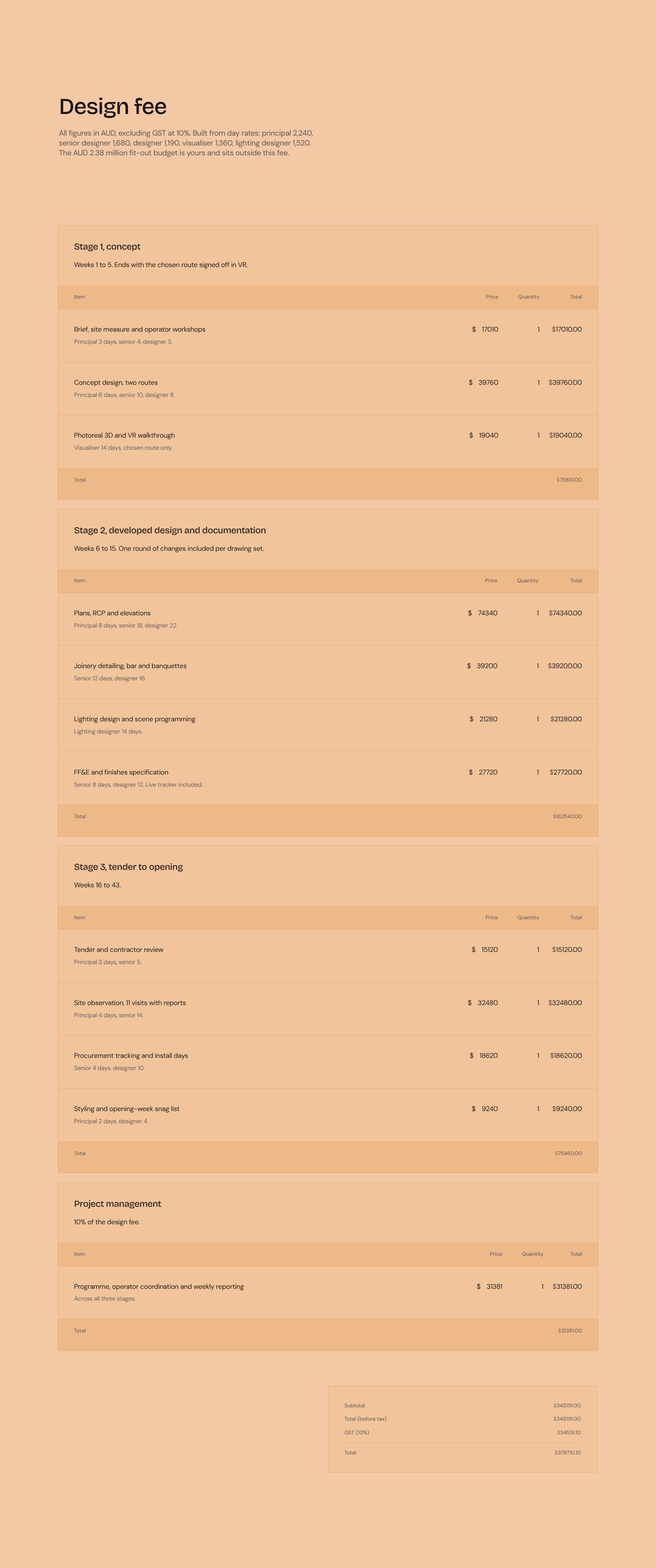
### Operator Testimonials and Client Success Stories
Real quotes from hospitality operators, including a story of a problem caught in week nine and an on-time opening. Social proof that shows how the team solves site issues under pressure.
### Appointment Call to Action and Next Steps
Closes with a clear decision deadline of 2 April 2027 and a defined kickoff: a half-day podium site workshop with the chef and operations lead. It turns interest into a confident, time-bound commitment.
## Find your answers
Answers to common questions about building interior design proposals for restaurant and bar fit-out projects.
### What should be included in a proposal template?
A strong proposal includes a cover, a project brief, your core idea, pricing or numbers, a visual or strategic concept, and supporting materials. This template covers all six: Cover, The brief, The idea, The numbers, The concept, and Materials. Together they walk a client from understanding their problem to approving your solution and budget.
### How do I customize this proposal template for my own client?
Start with the Cover by adding your logo, client name, and brand colors. Then replace the placeholder text in The brief, The idea, and The concept with details specific to the client's goals. Update The numbers with your own pricing and timeline, and swap in your own images or files in Materials.
### Can I export this proposal template to PDF or other formats?
Yes, you can export the finished proposal as a PDF to send to clients and keep layout and fonts intact. Depending on your editing tool, you can also export to formats like PowerPoint, Google Slides, or image files. Check your final file for correct fonts and spacing before sending.
### Is this proposal template suitable for creative agencies, freelancers, and consultants?
Yes, the structure works for any service-based business, including design, marketing, branding, consulting, and web development. The brief and idea sections suit creative pitches, while The numbers section handles scope, pricing, and timelines for consultants. You can rename or reorder sections to fit your industry.
### How long does it take to complete this proposal template?
Most users can finish a tailored proposal in 1 to 3 hours, depending on how much research and design work is needed. The pre-structured sections reduce writing time, and you can reuse content from The numbers and Materials across projects. Spend the most time on The brief and The idea, since they show the client you understand their needs.
## Related
- [Miami](https://formlio.com/templates/miami-ffe-procurement-statement-of-work): FF&E procurement statement of work for designers
- [Amsterdam](https://formlio.com/templates/amsterdam-show-apartment-design-proposal): Show apartment design proposal for property developers
- [Chicago](https://formlio.com/templates/chicago-workplace-interior-design-proposal): Workplace interiors proposal for law firms
- [Lisbon](https://formlio.com/templates/lisbon-interior-design-proposal): Full-service interiors proposal for homeowners
- [Stockholm](https://formlio.com/templates/stockholm-restaurant-interior-proposal): Restaurant interior concept proposal for chefs
- [London](https://formlio.com/templates/london-interior-design-retainer-proposal): Monthly design retainer for hospitality clients
---
---
title: "Toronto"
description: "Win consumer brand relaunch pitches with a creative proposal template covering the brief, survey data, and campaign routes for retail launches and DTC growth."
canonical: "https://formlio.com/templates/toronto-brand-relaunch-proposal"
locale: "en"
type: "template"
lastModified: "2026-10-20"
category: "Marketing"
alternates:
fr: "https://formlio.com/fr/templates/toronto-proposition-de-relancement-de-marque.md"
---
# Toronto
Consumer Brand Relaunch Creative Proposal Template
Win consumer brand relaunch pitches with a creative proposal template covering the brief, survey data, and campaign routes for retail launches and DTC growth.
- [Use this template](https://formlio.com/workspaces/claim?template=toronto-brand-relaunch-proposal)
- [Live preview](https://formlio.com/documents/toronto-brand-relaunch-proposal)
- **Categories:** [Marketing](https://formlio.com/templates/marketing), [Creative & design](https://formlio.com/templates/creative-design), [Proposals](https://formlio.com/templates/proposals), [Pitch decks](https://formlio.com/templates/pitch-decks)
- **Document goal:** Win brand relaunch pitches with a proposal that lays out the brief, survey data, and campaign routes clearly.
- **Blocks:** Horizontal gallery, Rectangle reveal, Single column, Sticky scroll, Carousel, Itemized quote, Approval slider
- **Palette:** Warm Cream Canvas (#FFF6EC), Soft Apricot Glow (#FFD3B0), Vibrant Ember Accent (#E2522B), Deep Terracotta Shade (#8A2A12), Espresso Midnight Dark (#1A1210)
## Get more from every document
Win a consumer brand relaunch pitch with a proposal that shows the brief, the data, and the big idea in one document. Animated headlines, survey charts, and fee tables are ready to fill with your work.
### Close the deal on the same page
Your client reads the pricing, agrees to the terms, and signs in the proposal itself. No printing, no PDF email chain.
### Build proposals from sections you trust
Pull in a pricing table, steps timeline, or testimonials block, then save your own versions and reuse them on the next pitch.
### Your pitch looks right on any screen
Hero images, charts, and pricing hold their shape whether your client opens the proposal on a laptop, tablet, or phone.
### See which section wins them over
Heatmaps show if they lingered on pricing, replays show how they read, and you follow up while the proposal is still on their mind.
### Know the moment they open it
Get pinged when a client views the proposal, leaves a comment on a section, or signs the agreement, so you reply while they're engaged.
### Write the proposal together, live
Your designer tunes the hero while you rework pricing and a teammate polishes the steps, all in one document at once.
## See how every part fits
The proposal opens with your big idea and the client's challenge, then builds proof, plan, and price, and closes on a decision deadline. Keep what fits your pitch, drop what doesn't, and reorder anything.
### Branded Proposal Cover with Client Name and Pitch Date
A full-bleed cover that names the client, the agency, the location and the presentation date. It sets a confident tone and shows the proposal was made for this brand alone.

### Big Idea Statement with Animated Headline
One animated line states the core creative idea before any detail. It gives decision-makers a memorable takeaway and frames everything that follows.

### Client Brief Recap and Campaign Challenge
Restates the client's goals, deadline and retail footprint in their own terms. It proves you listened and aligns both sides on the problem before you pitch the solution.
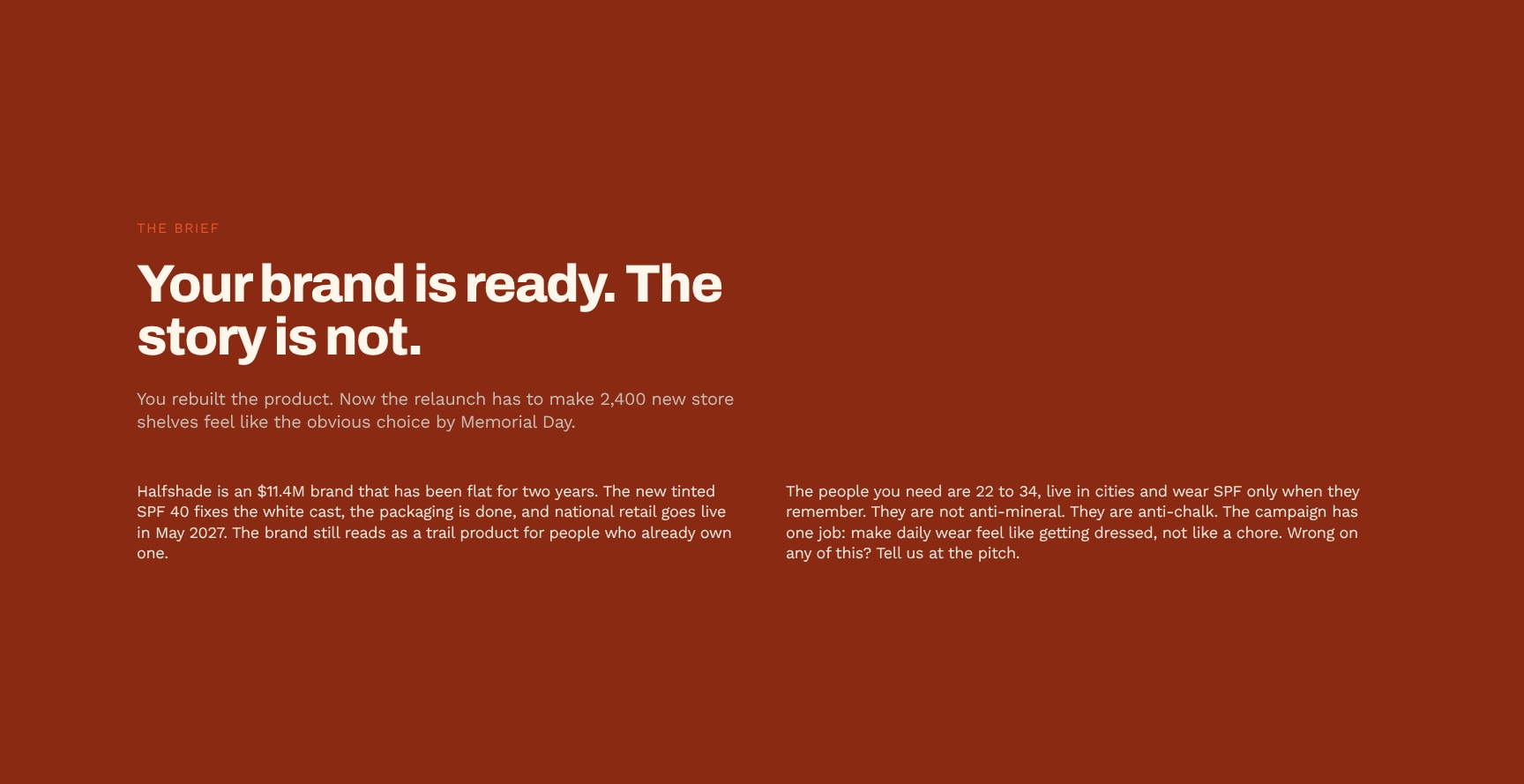
### Audience Research Charts and Channel Performance Data
Survey findings and sales-channel splits shown as clear charts. Data-backed insight on the barrier to purchase makes the strategy credible and easy to defend internally.
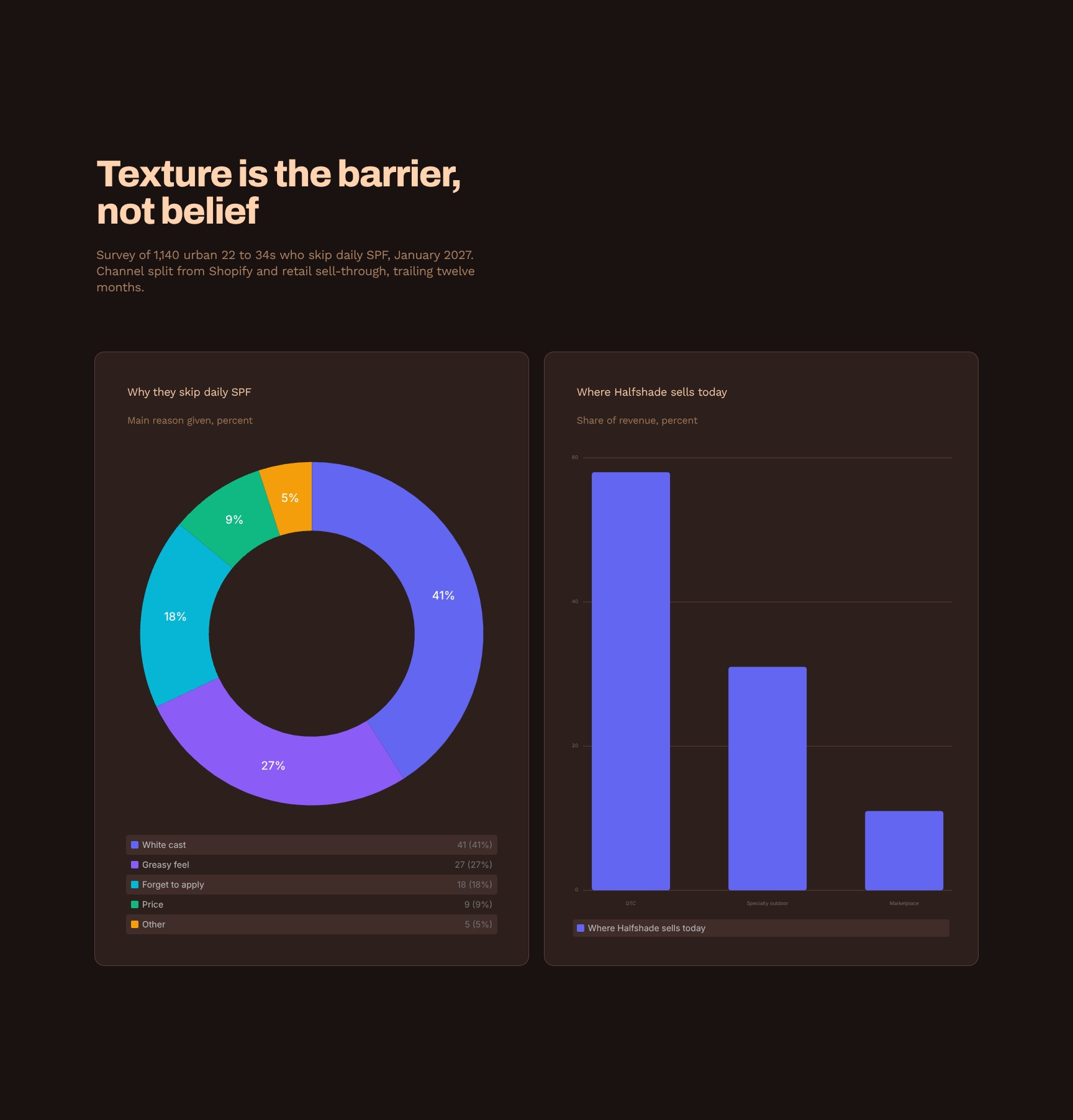
### Past Work Case Studies: Brand Relaunch Portfolio
Four relaunch examples, each with a better product and a reputation that lagged behind. They show relevant experience and results, which lowers the perceived risk of hiring you.

### Meet the Team: Dedicated Account and Creative Leads
Introduces the agency and the five people who will own the project. Clients see exactly who will be in the room and doing the work, which builds trust and accountability.
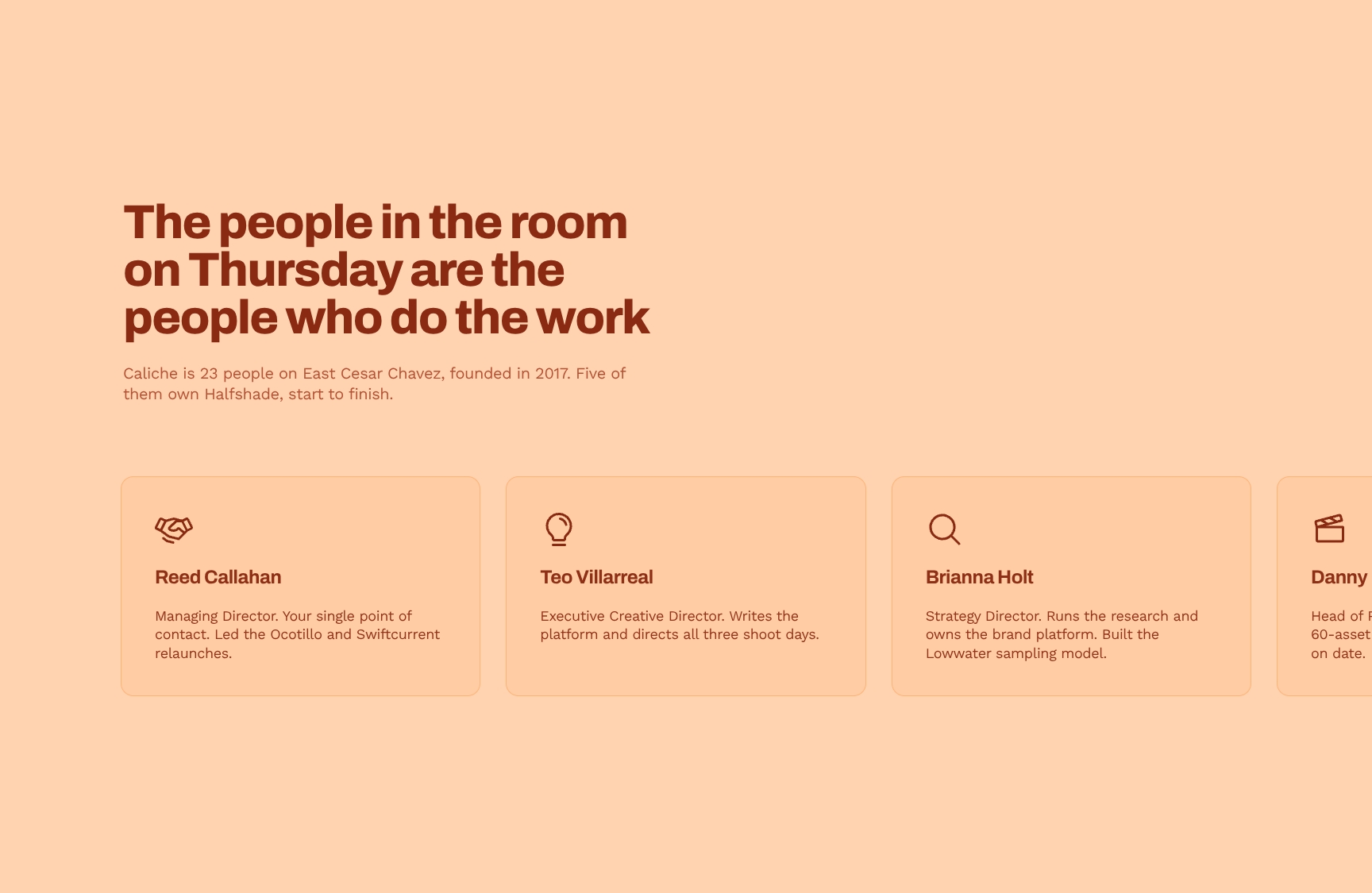
### Project Timeline and Phased Work Plan to Launch
A 20-week roadmap with dated phases, key activities and a firm go-live date. It makes the process concrete and shows the schedule will hit the retail launch window.
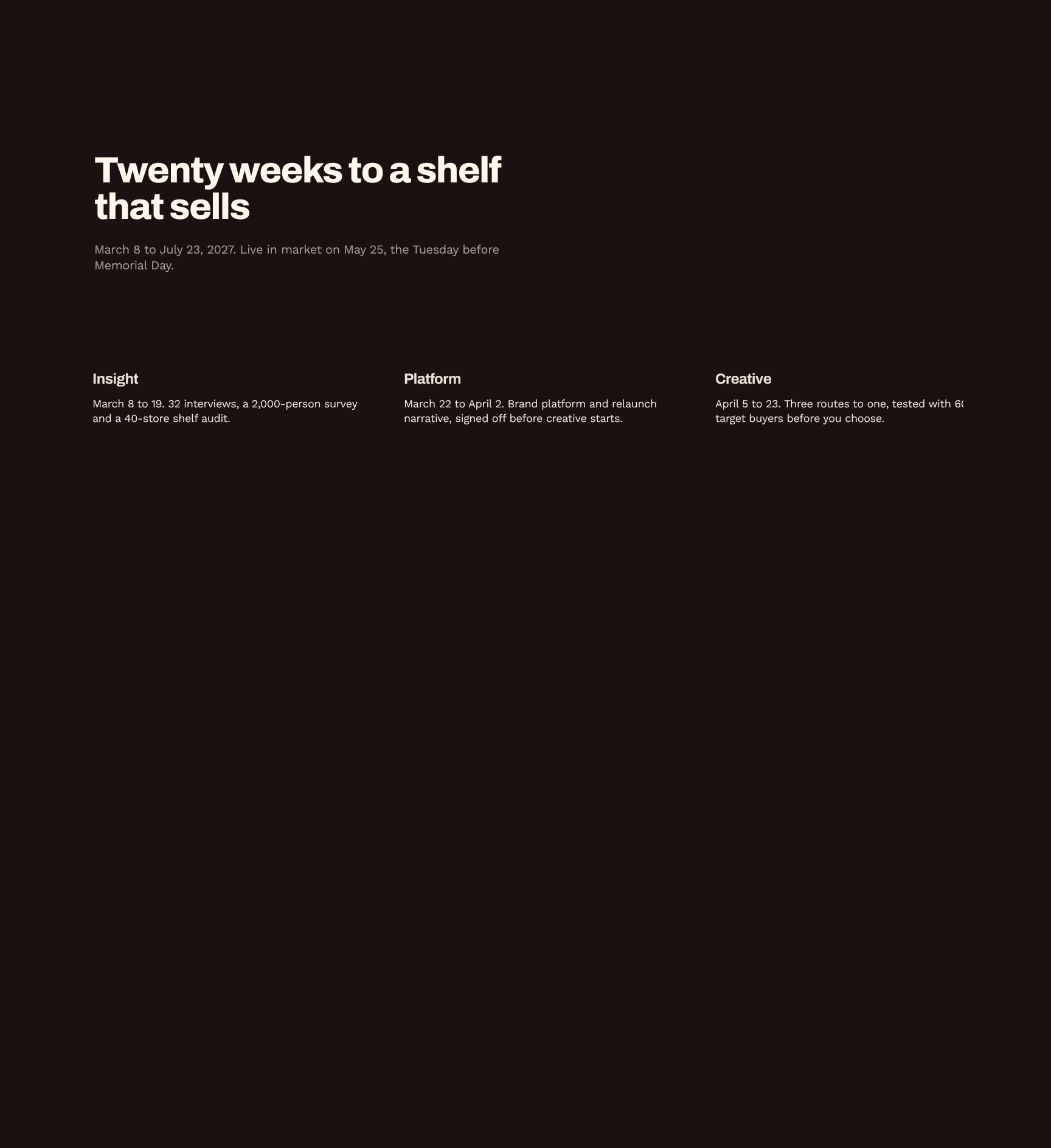
### Transparent Fee Breakdown with Day Rates and Media Budget
Itemized pricing built from published day rates and tied to the client's media budget. Clear numbers remove surprises and speed up budget approval.
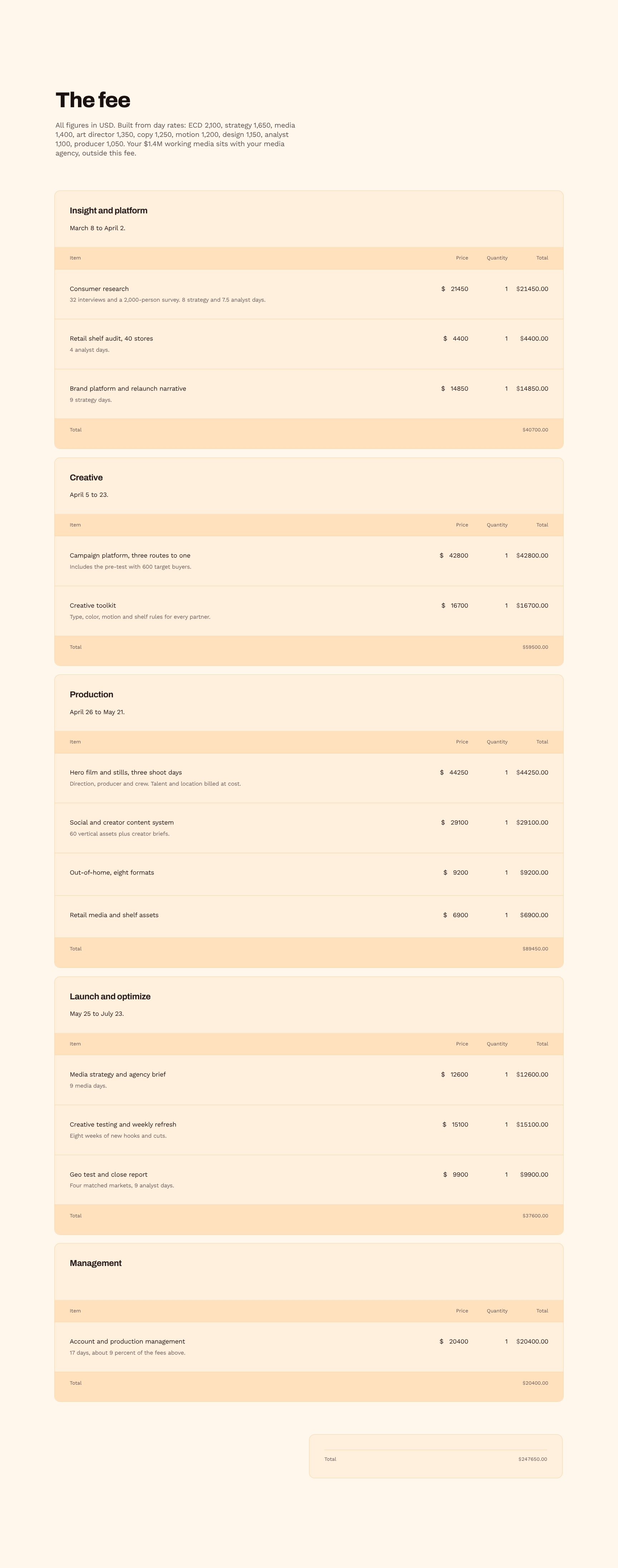
### Client Testimonials and Proof of Results
Quotes from past clients with names, titles and measurable outcomes. Third-party proof backs up your claims and reassures buyers who are still deciding.
### Next Steps and Agreement with Decision Deadline
Closes with a clear decision date, a reserved start slot, revision terms and an ownership guarantee. A defined call to action moves the client from reading to signing.
## Find your answers
Answers to common questions about building creative proposals and pitch decks for consumer brand relaunches, retail launches, and DTC growth campaigns.
### What should be included in a business proposal template?
A strong proposal includes a cover, the core idea, a clear brief, supporting numbers, audience data, and options for the client to choose from. This template covers all six: Cover, The Idea, The Brief, The Numbers, Audience Data, and Three Routes. Together they move a client from concept to decision in a logical flow.
### How do I customize this proposal template for my own brand and client?
Replace the cover details with your logo, client name, and brand colors, then edit each section's text directly. Update The Numbers and Audience Data with figures specific to your project, and adjust the Three Routes to match your real service tiers or strategic options. Keep fonts and spacing consistent so the finished document looks polished.
### What is the purpose of the 'Three Routes' section in a proposal?
The Three Routes section presents three distinct options, such as essential, recommended, and premium, so clients choose between approaches rather than whether to proceed. It anchors pricing, clarifies trade-offs, and typically raises the chance of approval. Highlight your preferred route to guide the decision.
### Can I export this proposal template to PDF or other formats?
Yes, you can export the finished proposal to PDF for sharing and to common editable formats like PowerPoint or Word, depending on the platform you use. PDF is best for sending final proposals because it preserves layout and fonts. Keep an editable copy so you can reuse it for future clients.
### Is this proposal template suitable for marketing, creative, and consulting projects?
Yes. The structure of an idea, a brief, numbers, audience data, and options works for marketing campaigns, creative pitches, agency work, and consulting engagements. The Audience Data and Numbers sections are especially useful for proving ROI and market fit. Simply tailor the language and metrics to your industry.
## Related
- [Boston](https://formlio.com/templates/boston-event-retainer-proposal): Monthly event retainer proposal for brands
- [Cambridge](https://formlio.com/templates/cambridge-design-studio-portfolio): Web design studio portfolio for research clients
- [Portland](https://formlio.com/templates/portland-app-redesign-proposal): App redesign pitch for subscription startups
- [Milan](https://formlio.com/templates/milan-headless-commerce-proposal): Headless ecommerce proposal for luxury brands
- [Dublin](https://formlio.com/templates/dublin-launch-campaign-proposal): Integrated launch campaign proposal for consumer brands
- [Antwerp](https://formlio.com/templates/antwerp-photography-and-film-portfolio): Photo and film portfolio for creative studios
---
---
title: "Dublin"
description: "Win consumer product launches with a campaign proposal template covering brief, strategy, KPI targets and a staged 22-week plan. Built for agencies and marketers."
canonical: "https://formlio.com/templates/dublin-launch-campaign-proposal"
locale: "en"
type: "template"
lastModified: "2026-10-20"
category: "Marketing"
alternates:
fr: "https://formlio.com/fr/templates/dublin-proposition-de-campagne-de-lancement.md"
---
# Dublin
Product Launch Campaign Proposal Template
Win consumer product launches with a campaign proposal template covering brief, strategy, KPI targets and a staged 22-week plan. Built for agencies and marketers.
- [Use this template](https://formlio.com/workspaces/claim?template=dublin-launch-campaign-proposal)
- [Live preview](https://formlio.com/documents/dublin-launch-campaign-proposal)
- **Categories:** [Marketing](https://formlio.com/templates/marketing), [Creative & design](https://formlio.com/templates/creative-design), [Proposals](https://formlio.com/templates/proposals)
- **Document goal:** Win consumer product launches with a proposal that lays out strategy, KPI targets, and a clear 22-week plan.
- **Blocks:** Ring, Single column, Scroll gradient, Grid 3x2 with icons, Spotlight, Masonry, Itemized quote, Gantt, Left-aligned, Approval slider
- **Palette:** Soft Linen Background (#F2F1EC), Misty Sage Tint (#CFE3D8), Evergreen Accent (#1F6B52), Deep Forest Emphasis (#0F3B2E), Midnight Ink Text (#0D1210)
## Get more from every document
Pitch a consumer product launch and win the room with a proposal that ties big ideas to hard numbers. Animated headlines, KPI baselines, EUR day rates, and a staged roadmap are ready to edit.
### Get a yes without leaving the page
Your client reads the pricing, reaches the agreement, and signs right there. No PDF download, no printing, no waiting.
### Build proposals from sections you trust
Pull in pricing, steps, and testimonials in seconds, then save your best-performing blocks to reuse on the next pitch.
### Your pitch looks sharp on any screen
Hero images, pricing tables, and accordions reflow for the phone your client checks between meetings.
### See which pricing section holds attention
Heatmaps show where prospects linger, and session replays let you watch them read, so your follow-up lands at the right moment.
### Know the second your client opens it
Get pinged when they view the proposal, leave a comment, or sign the agreement, and call while you're fresh in mind.
### Write the proposal together, live
Your designer tweaks the hero while you rework the pricing, all in the same document, before the deadline hits.
## See how every part fits
The proposal opens with the client's own brief and the big idea, then moves through strategy, proof, and fees before closing on a dated approval ask. Keep, drop, or reorder anything to match your pitch.
### Branded Proposal Cover with Campaign Title and Date
A confident opening page naming the Tolka T2 launch campaign, the client, the agency (Coldframe, Dublin) and the presentation date. It sets a professional first impression and frames the proposal immediately.

### Client Brief Recap: Goals, Launch Date and Markets
Restates the brief in the client's own terms: launch in Dublin and Cork on 18 May 2027 and turn 9% prompted awareness into test rides. Proves you listened and aligns everyone before the strategy begins.
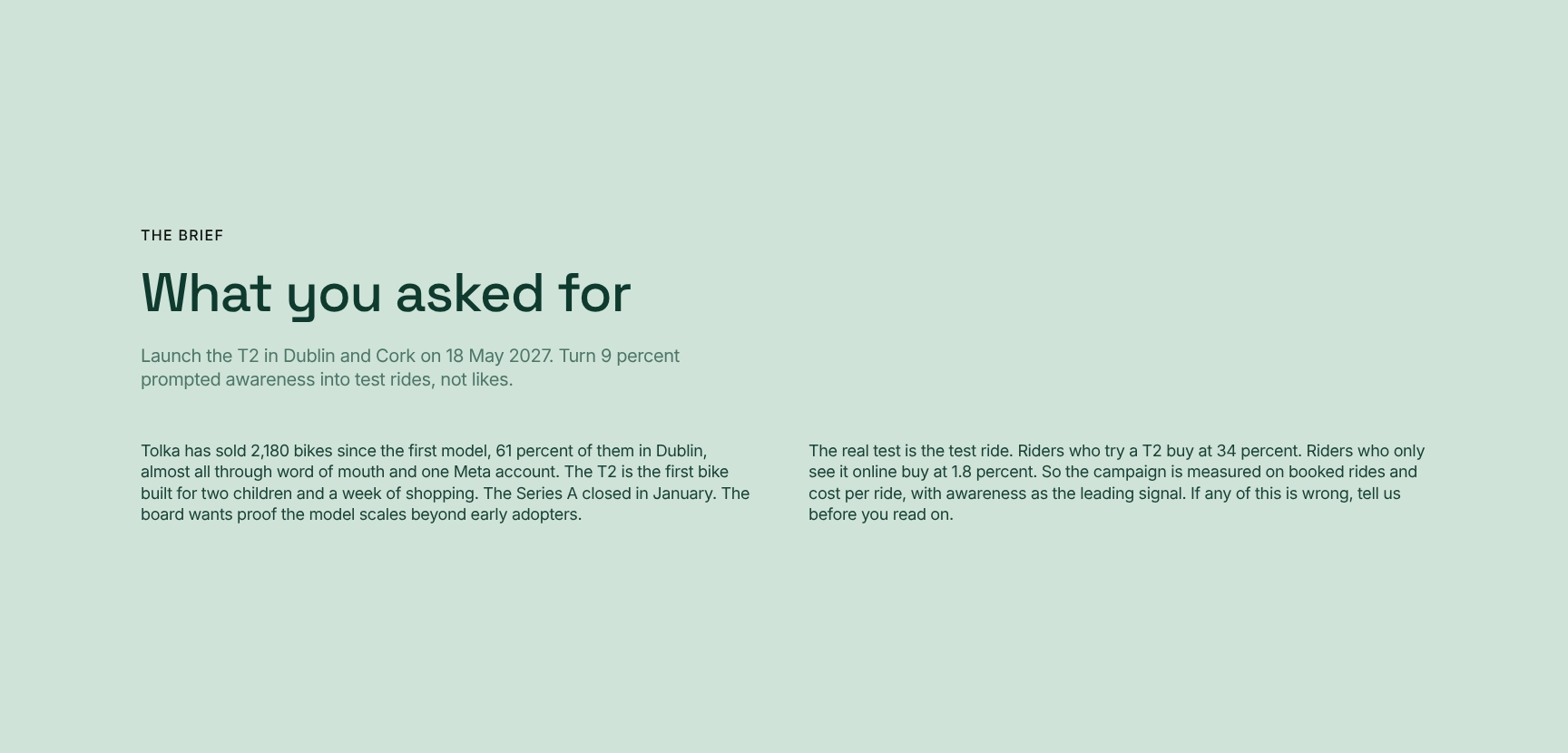
### Big Creative Idea Statement with Animated Headline
An animated single-line campaign concept, 'Ride it once. Then try going back to the car.' It gives the big idea room to land and makes the creative direction memorable and easy to repeat internally.

### Measurable Campaign Targets and KPI Baselines
Four accountable numbers, with baselines drawn from Shopify, GA4 and the brand tracker, and targets for the ten in-market weeks. Builds trust by tying the work to commercial results, not vanity metrics.
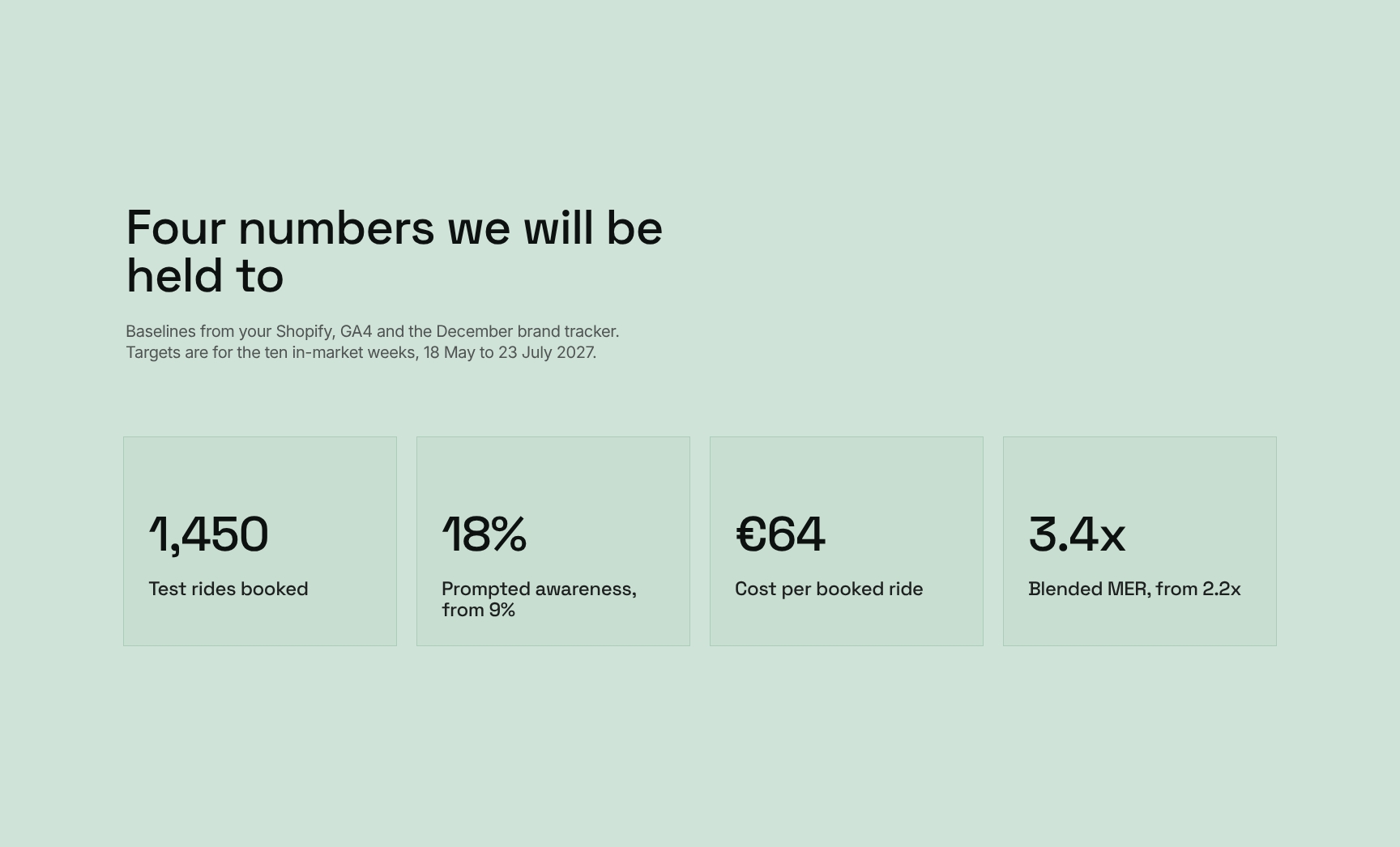
### Six-Stage Campaign Approach and 22-Week Roadmap
Walks through each stage from insight to close, with durations, activities and one client decision per stage. Shows how the work progresses from 1 March to 30 July 2027 and keeps approvals clear.
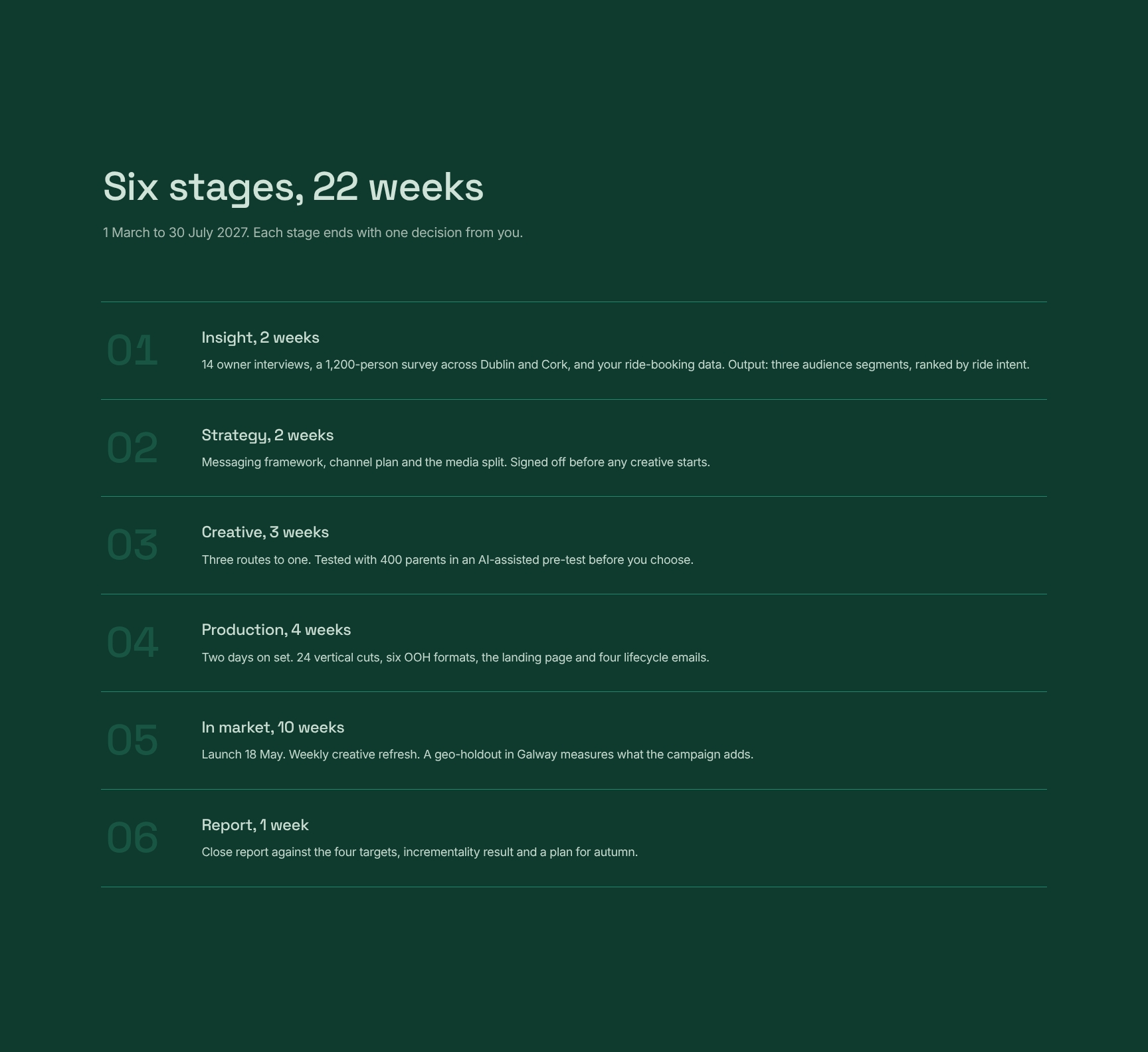
### Past Work Case Studies with Commercial Results
Four recent launches, each measured on a commercial number rather than reach. Gives credible proof of past performance and shows the agency can deliver outcomes that matter to the business.
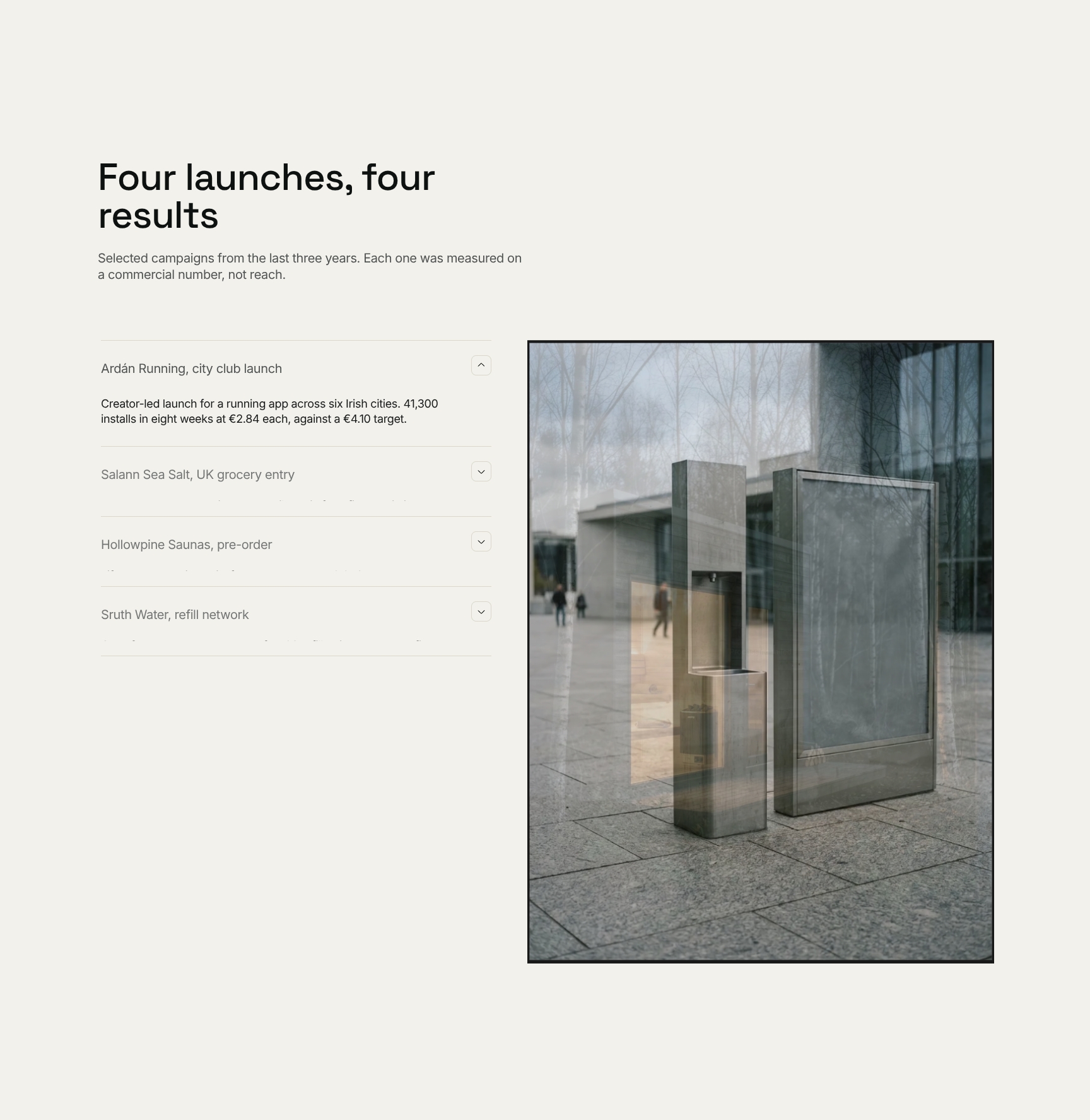
### Dedicated Account Team and Agency Introduction
Introduces Coldframe, an eleven-person Dublin studio founded in 2018, and the four people who run the account from start to close report. Reassures the client about continuity and senior attention.
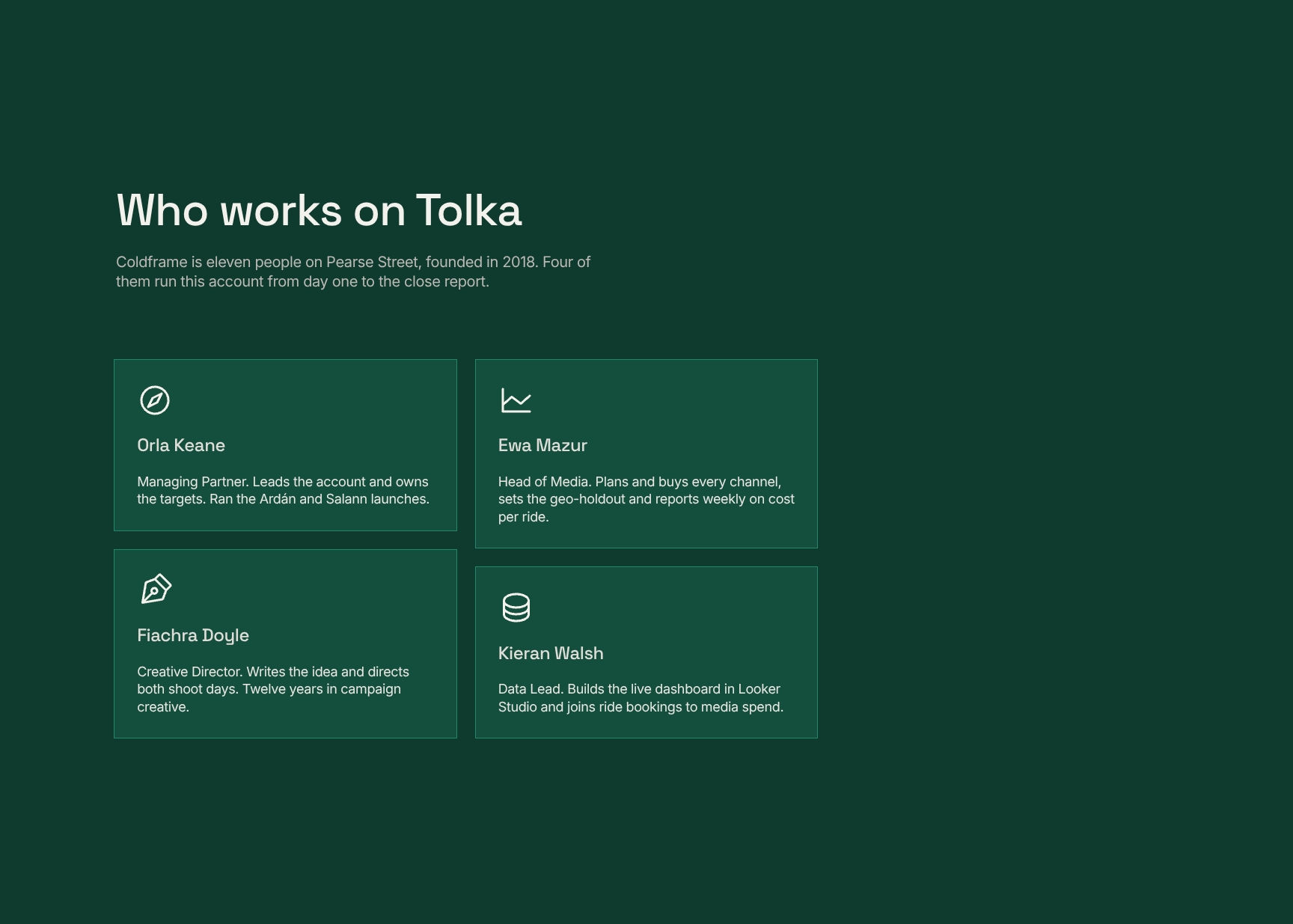
### Transparent Fee Breakdown with Day Rates in EUR
A clear fee table built from published day rates by role, with VAT stated and media spend handled separately. Removes pricing ambiguity and lets the client see exactly how the budget is built.
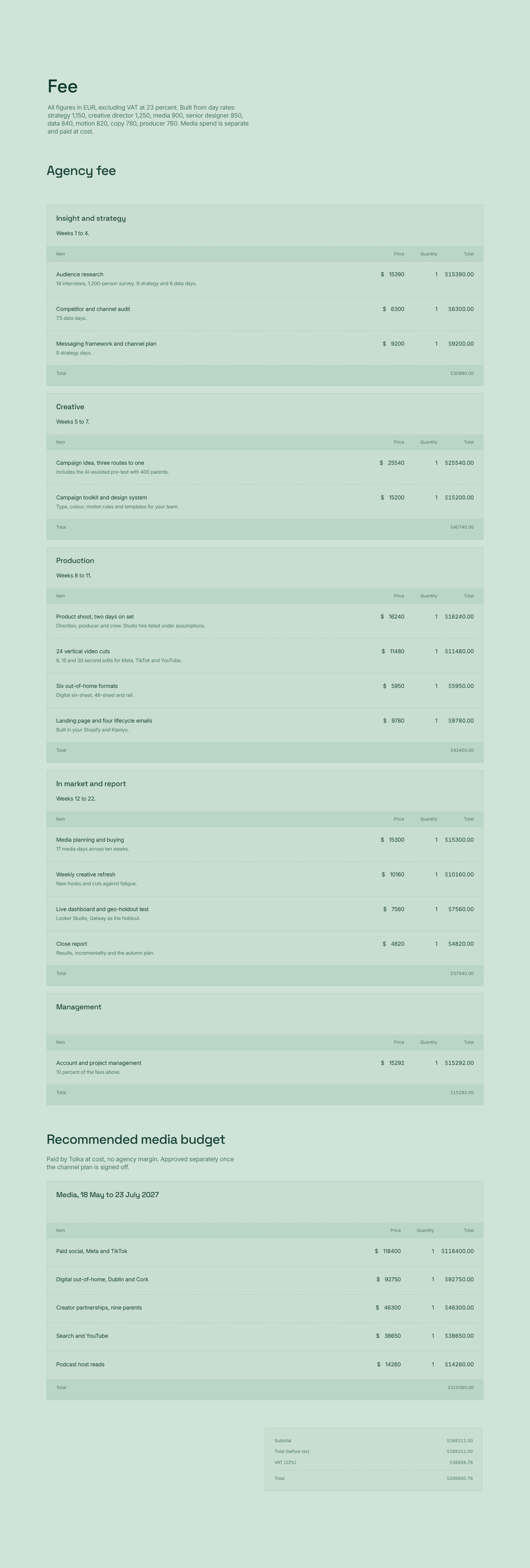
### Project Programme and Delivery Timeline
A dated schedule from 1 March to 30 July 2027 with feedback windows and bank holidays built in. Sets clear expectations for sign-offs and protects the launch date.
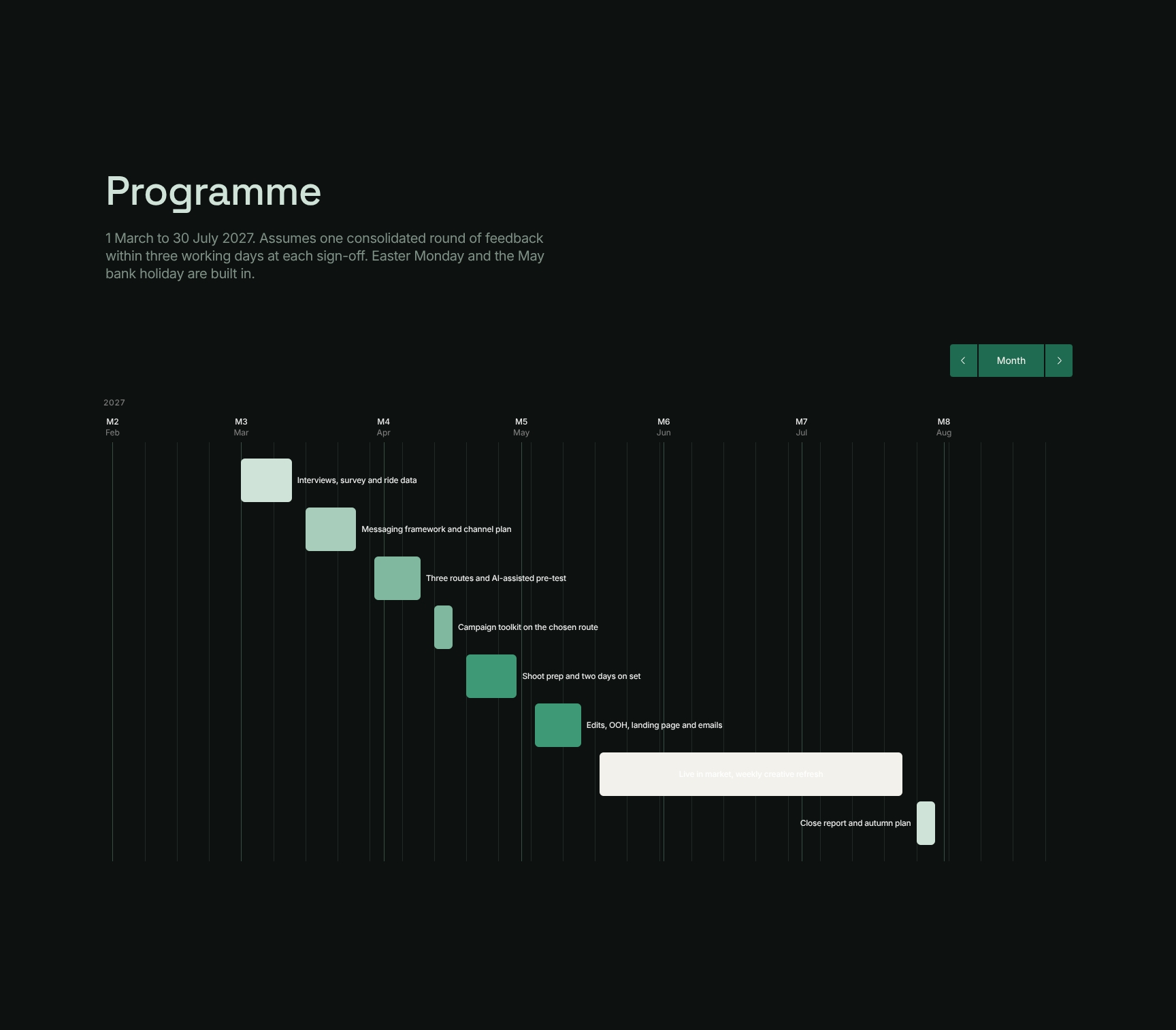
### Assumptions, Exclusions and Commercial Terms
Expandable panels covering what the fee excludes, such as studio hire and talent usage, plus the conditions that keep dates on track. Heads off scope disputes and keeps terms easy to scan.
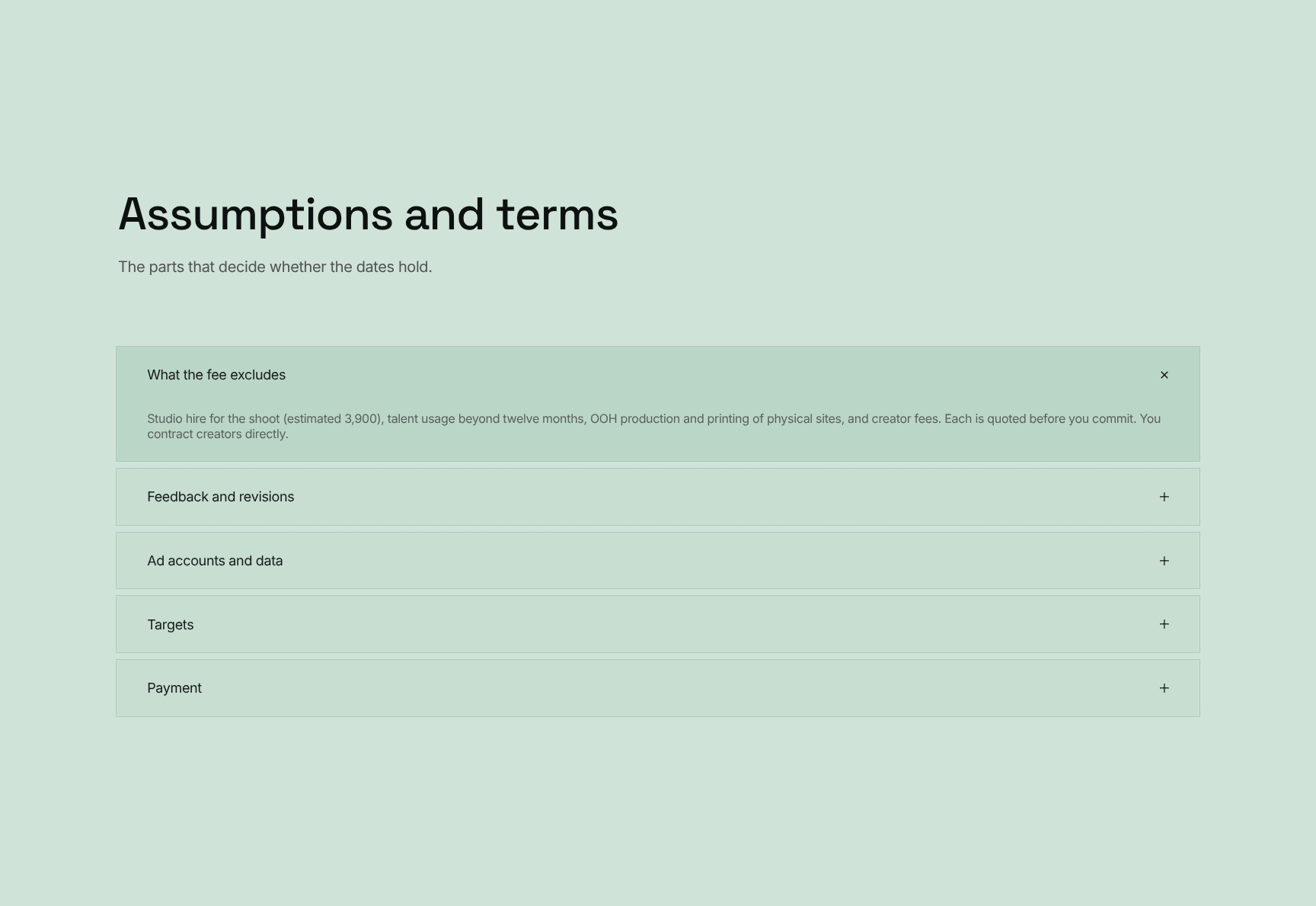
### Client Testimonials and Social Proof
Quotes from clients behind the featured work, with named roles and concrete results like cost per install. Adds third-party validation that strengthens confidence in the proposal.
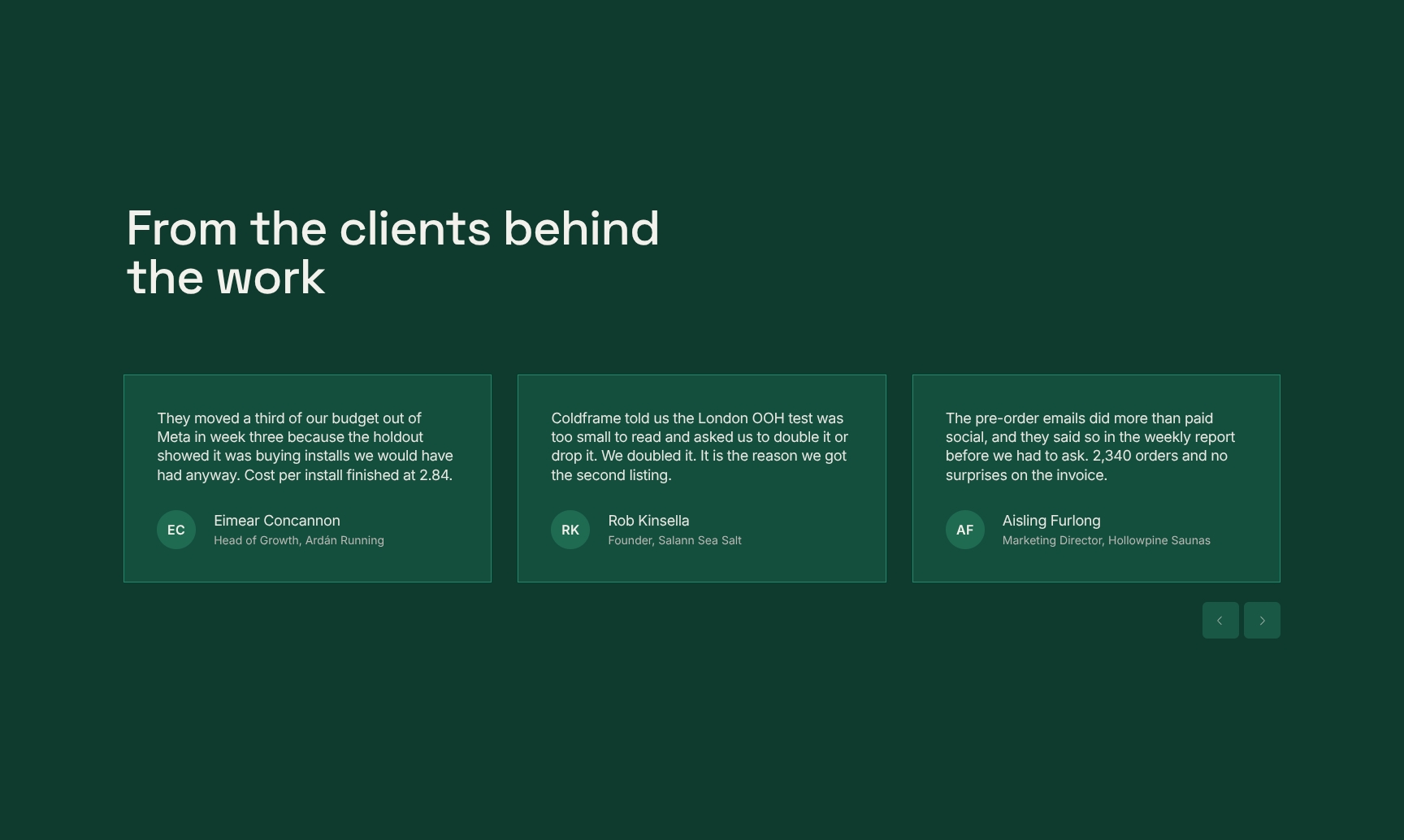
### Approval Call to Action with Deadline
A clear next step: approve by Friday 19 February 2027 to hold the 1 March start and 18 May launch. The deadline creates urgency and makes sign-off simple.
## Find your answers
Answers to common questions about building launch campaign proposals for consumer brands, from pricing and KPIs to timelines and terms.
### What should be included in a business proposal template?
A strong proposal includes a cover, a summary of the client's brief, your proposed idea, measurable targets, your approach or process, and examples of past work. This template covers all six sections so you can present a clear, persuasive pitch. Each section is built to answer the client's key questions: what you understand, what you'll do, and why you're credible.
### How do I customize this proposal template for my own business?
Replace the placeholder text in each section with your client's details, then update the cover with your logo, brand colors, and fonts. Rewrite 'The brief' in your client's own language, tailor 'The idea' to their specific problem, and swap in relevant projects under 'Past work'. You can duplicate, reorder, or delete sections to fit each pitch.
### Can I export this proposal template to PDF or other formats?
Yes, you can export the finished proposal to PDF for easy sharing and consistent formatting on any device. Depending on the tool you use, you can usually also download it as an editable document or presentation file. PDF is recommended for sending final proposals to clients.
### Is this proposal template suitable for freelancers, agencies, and consultants?
Yes, the structure works for freelancers, creative and marketing agencies, consultants, and other service businesses. The brief-idea-targets-approach flow suits projects like branding, web design, marketing campaigns, and strategy work. Adjust the tone and level of detail to match your industry and the size of the project.
### How long does it take to complete this proposal template?
Most users can complete a tailored proposal in 1 to 3 hours, depending on how much research and past work you need to gather. Reusing your standard 'Approach' and 'Past work' sections speeds up future proposals. The most time should go into 'The brief' and 'The idea', since these show clients you understand their needs.
## Related
- [Boston](https://formlio.com/templates/boston-event-retainer-proposal): Monthly event retainer proposal for brands
- [Cambridge](https://formlio.com/templates/cambridge-design-studio-portfolio): Web design studio portfolio for research clients
- [Portland](https://formlio.com/templates/portland-app-redesign-proposal): App redesign pitch for subscription startups
- [Milan](https://formlio.com/templates/milan-headless-commerce-proposal): Headless ecommerce proposal for luxury brands
- [Toronto](https://formlio.com/templates/toronto-brand-relaunch-proposal): Creative campaign proposal for consumer brands
- [Antwerp](https://formlio.com/templates/antwerp-photography-and-film-portfolio): Photo and film portfolio for creative studios
---
---
title: "Edinburgh"
description: "Win festival contracts with a temporary venue construction proposal template covering scope, exclusions, weather terms and build sequence for event organisers."
canonical: "https://formlio.com/templates/edinburgh-temporary-venue-build-estimate"
locale: "en"
type: "template"
lastModified: "2026-10-20"
category: "Events & experiential"
alternates:
fr: "https://formlio.com/fr/templates/edinburgh-devis-de-construction-de-lieu-temporaire.md"
---
# Edinburgh
Temporary Venue Construction Proposal Template
Win festival contracts with a temporary venue build estimate template covering scope, exclusions, weather risk and build sequence for event organisers.
- [Use this template](https://formlio.com/workspaces/claim?template=edinburgh-temporary-venue-build-estimate)
- [Live preview](https://formlio.com/documents/edinburgh-temporary-venue-build-estimate)
- **Categories:** [Events & experiential](https://formlio.com/templates/events-experiential), [Architecture](https://formlio.com/templates/architecture), [Proposals](https://formlio.com/templates/proposals)
- **Document goal:** Win festival contracts with a clear proposal covering scope, exclusions, weather terms and build sequence.
- **Blocks:** Ring, Left-aligned, Scroll gradient, Sticky scroll, Itemized quote, E-signature
- **Palette:** Soft Cloud Background (#F0F1F3), Periwinkle Mist Highlight (#BCC8F5), Confident Royal Blue Accent (#2446C8), Deep Midnight Indigo (#14246B), Midnight Ink Text (#0D0F14)
## Get more from every document
Win festival contracts by showing organisers exactly what you'll build, when, and what it costs. Scope accordions, a staged timeline, and an itemised estimate keep every assumption visible before anyone signs.
### Get the yes without leaving the page
Your client reads the pricing, scrolls to the agreement, and signs right there. No PDF download, no printing, no waiting.
### Assemble proposals from proven sections
Pull in a hero, steps, or pricing section, then save your best-performing ones and reuse them in your next pitch.
### Your pitch looks sharp on any screen
Hero images, pricing tables, and testimonials hold their shape when a client opens your proposal on a phone between meetings.
### See which section wins the deal
Heatmaps show who lingers on pricing, and session replays let you call while the client is still thinking it over.
### Know the moment they open it
Get a ping when your client views the proposal, leaves a comment, or signs the agreement, so you reply while it's fresh.
### Write the pitch with your whole team
Your designer tweaks the hero while you tighten the pricing breakdown, both in the same proposal, live.
## See how every part fits
The proposal opens with the project and its scope, moves through your design thinking, build sequence, team and pricing, and closes on references and payment terms. Keep, drop, or reorder anything to fit the job.
### Venue Build Cover Page with Project Overview
Opens the proposal with the project name, client, 1,200-capacity Leith waterfront venue and 6 to 29 August 2027 run. Sets context immediately so the client knows exactly what the estimate covers.
### Scope, Basis and Exclusions Accordion
Expandable panels set out what is built, capacities, the 12-day build, 24 live days and 5-day clearance, plus assumptions and exclusions. Lets clients check scope before reading the price and avoids disputes.
### Design Principle Statement for Temporary Venues
An animated text statement that frames the build philosophy: a temporary building should sound permanent. Gives the proposal a memorable point of view and signals quality before the detail begins.

### Six-Stage Build Sequence and Fixed Timeline
Walks through six stages from laser survey and 3D design in May to doors opening on Friday 6 August. Fixed dates make the schedule concrete and show clients how risk is managed along the way.
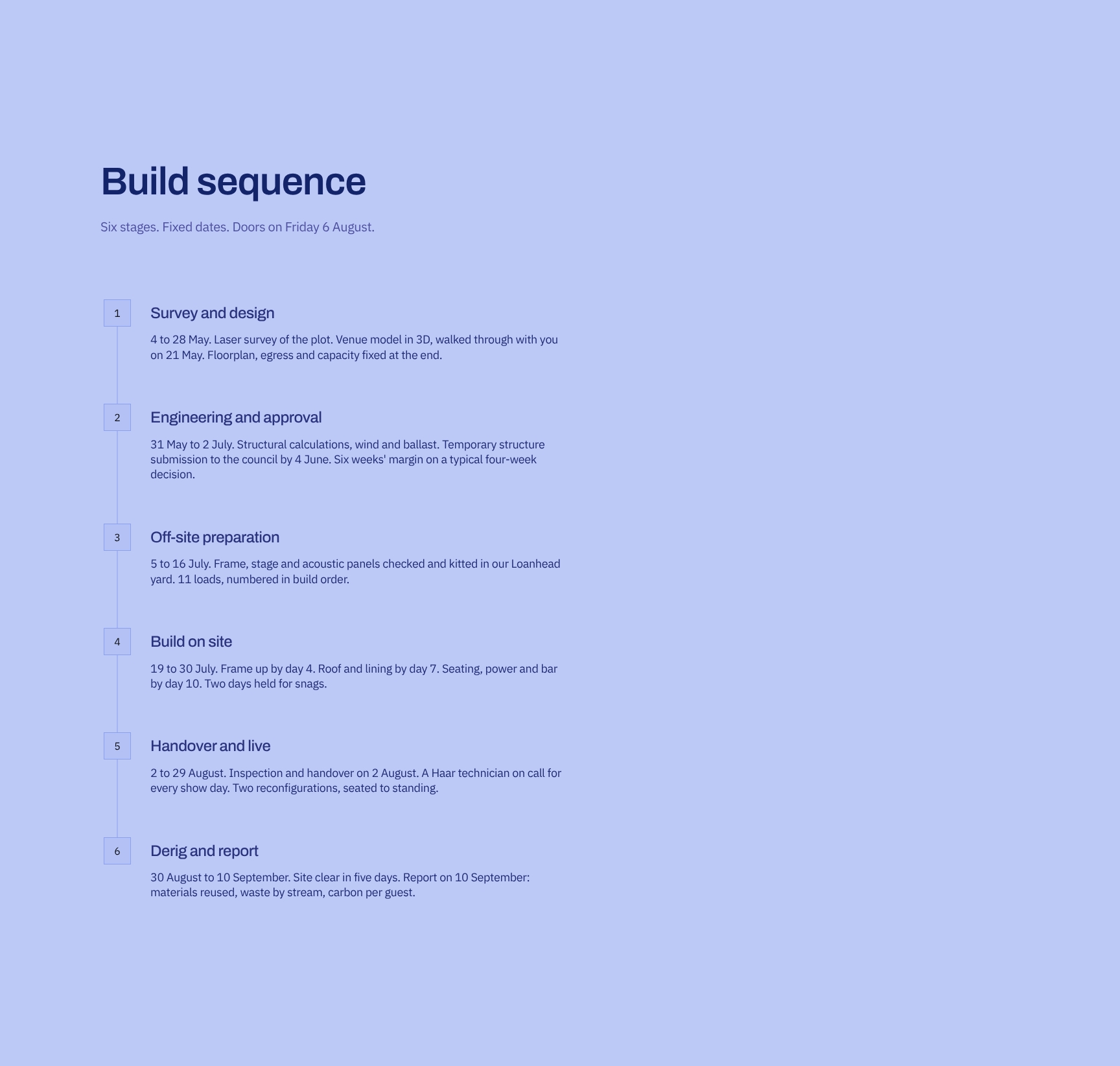
### Past Builds and Delivery Team Profiles
Introduces Haar Structures, founded 2016 with 11 staff and a Loanhead yard, then three comparable builds and the three people who would run the project. Builds trust through proof of experience and named accountability.
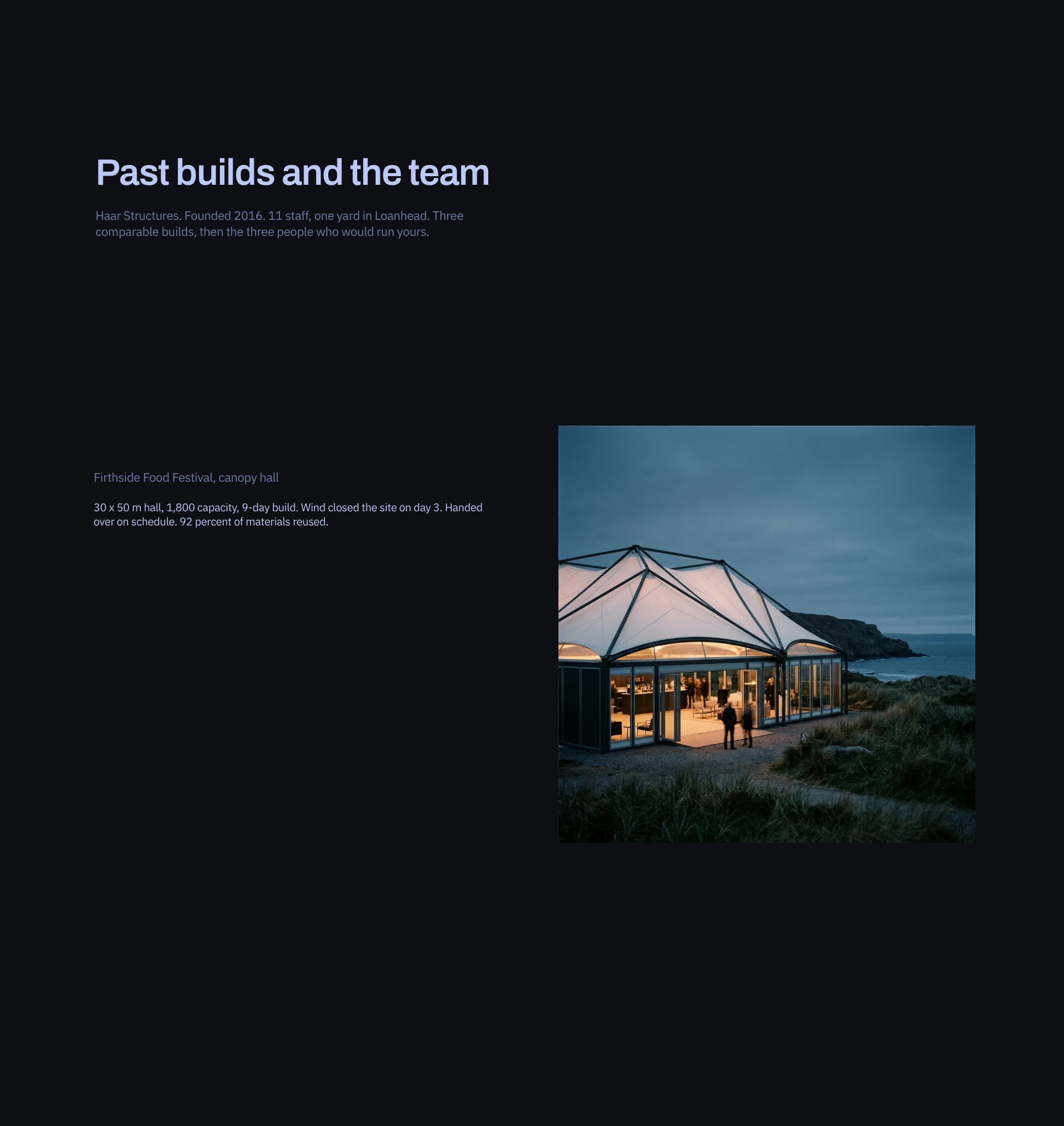
### Itemised Estimate with Day Rates and Structure Hire
A transparent GBP estimate excluding 20 percent VAT, with day rates from designer to rigger plus structure hire costs. Clear line items let clients compare, audit and approve the budget with confidence.
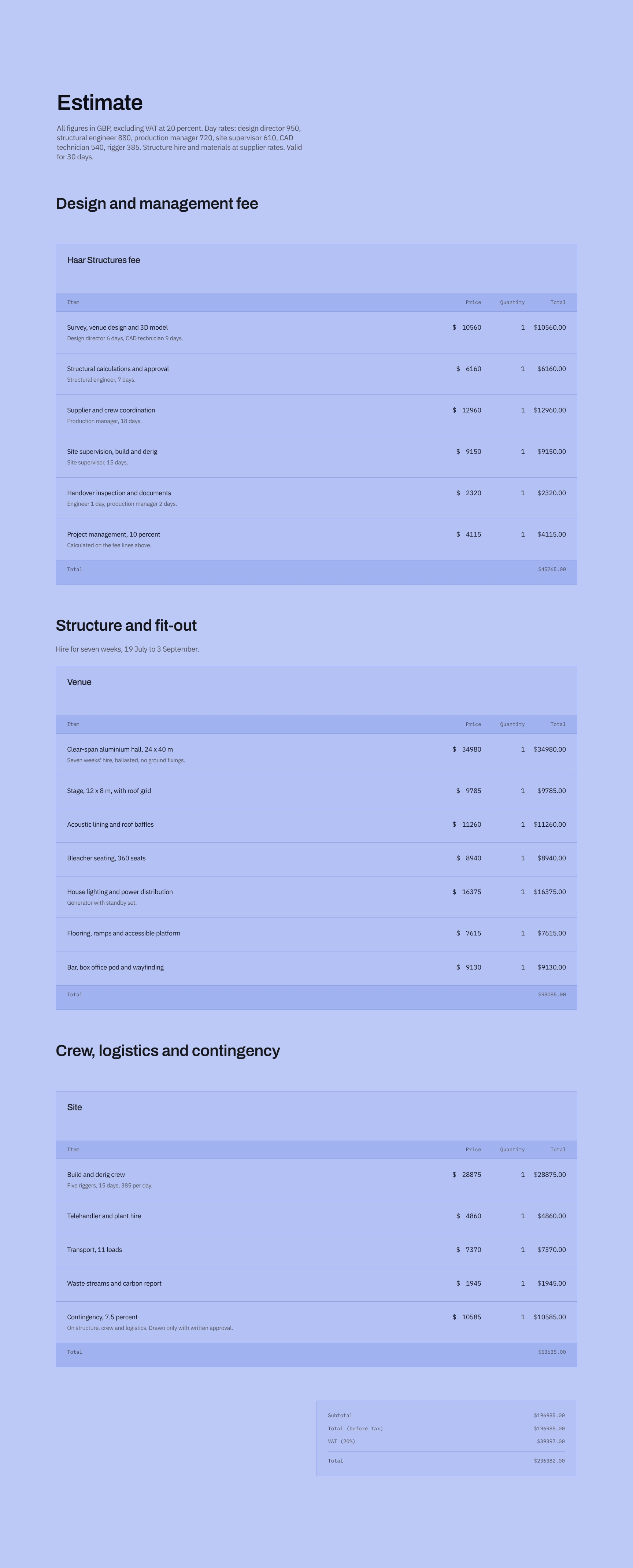
### Client References and Testimonials
Real quotes from past clients, including a story of resequencing a roof lift around high winds and still handing over on time. Provides credible third-party proof of reliability under pressure.
### Acceptance Terms and Payment Schedule
States the offer is valid until Friday 23 April 2027, with the structure reserved until then, and a 50/30/20 payment schedule. Makes the next step clear and lets the client accept with confidence.
## Find your answers
Answers to common questions about pricing, scoping, and presenting temporary venue builds to festival organisers and event producers.
### What should be included in a construction or build proposal template?
A strong build proposal includes a cover page, a clear scope of work, the guiding principle or approach, a build sequence, past builds and team credentials, and a detailed estimate. Together these sections show clients what you will deliver, how you will deliver it, who will do the work, and what it will cost.
### How do I customize this proposal template for my own projects?
Replace the placeholder text in each section with your project details, starting with the cover and scope. Update the build sequence with your actual phases and timeline, add your own past builds and team bios, and adjust the estimate line items to match your pricing. You can also swap in your logo, brand colors, and fonts for a consistent look.
### How do I write the scope and build sequence sections so clients understand them?
In the scope, list exactly what is included and excluded, using specific deliverables and measurable outcomes. In the build sequence, break the project into numbered phases with start and end dates, dependencies, and milestones. Plain language and short bullet points help clients quickly see what happens and when.
### Can I export this proposal template to PDF or Word?
Yes. You can typically export the finished proposal as a PDF for sending to clients and as an editable Word or Google Docs file for further changes. PDF keeps formatting intact and is best for final delivery, while an editable format is ideal for collaboration and revisions.
### How do I create an accurate estimate section for a build proposal?
Itemize labor, materials, subcontractors, permits, and a contingency allowance (commonly 5–15%) so clients see where costs come from. State whether pricing is fixed or time-and-materials, and include payment terms, assumptions, and how long the estimate is valid. Clear line items build trust and reduce pricing objections.
## Related
- [Bordeaux](https://formlio.com/templates/bordeaux-launch-event-pitch): Hybrid launch event pitch for brands
- [Boston](https://formlio.com/templates/boston-event-retainer-proposal): Monthly event retainer proposal for brands
- [Cardiff](https://formlio.com/templates/cardiff-website-care-plan-proposal): Monthly care plan proposal for festival organisers
- [Liverpool](https://formlio.com/templates/liverpool-live-events-portfolio): Event studio portfolio for launches and conferences
- [Berlin](https://formlio.com/templates/berlin-product-launch-event-proposal): Multi-city launch event proposal for hardware brands
- [Stockholm](https://formlio.com/templates/stockholm-restaurant-interior-proposal): Restaurant interior concept proposal for chefs
---
---
title: "Antwerp"
description: "Showcase stills and motion work with this photography and film portfolio template: studio stats, point of view, reel and case studies for brand-focused studios."
canonical: "https://formlio.com/templates/antwerp-photography-and-film-portfolio"
locale: "en"
type: "template"
lastModified: "2026-10-20"
category: "Video & photography"
alternates:
fr: "https://formlio.com/fr/templates/antwerp-portfolio-photo-et-film.md"
---
# Antwerp
Photography & Film Studio Portfolio Template
Showcase stills and motion in one photography and film portfolio template with studio stats, reel, and case studies. Built for studios pitching brands.
- [Use this template](https://formlio.com/workspaces/claim?template=antwerp-photography-and-film-portfolio)
- [Live preview](https://formlio.com/documents/antwerp-photography-and-film-portfolio)
- **Categories:** [Video & photography](https://formlio.com/templates/video-photography), [Creative & design](https://formlio.com/templates/creative-design), [Portfolio](https://formlio.com/templates/portfolio)
- **Document goal:** Show your stills and motion work side by side and win brand clients with a portfolio that leads with your reel.
- **Blocks:** Image reveal, Rectangle reveal, Carousel, Single column, Fullscreen, Sticky scroll, Grid tile scroll, Grid 3x2 with icons
- **Palette:** Linen Canvas Light (#EFE9E1), Sandstone Neutral (#D8C3A5), Terracotta Accent (#9C4A2F), Espresso Depth (#4A2418), Charcoal Ink Dark (#17130F)
## Get more from every document
Show your stills and motion work side by side in one portfolio that wins brand commissions. Studio stats, a reel, case studies, and a gallery sit ready for your own images and footage.
### Dress each case study in its mood
Swap palettes and typefaces to match a project's tone, from moody photography to bright brand work, without opening a design app.
### Stack your portfolio from proven sections
Drop in hero images, showcases, and breakdowns, then save your best case study layout to reuse on the next project.
### Your work looks sharp on any screen
Gallery grids and full-bleed hero images reflow from desktop to phone, so a client opening your link on the train sees it right.
### See which projects hold their attention
Heatmaps show which case study they lingered on, and session replays let you follow up while your work is fresh in mind.
### Know the moment a client looks
Get pinged when a prospect opens your portfolio, leaves a comment, or signs off, so you can reply while they're interested.
### Build the portfolio alongside your team
Your copywriter tightens project text while you reorder the gallery, both editing the same page live.
## See how every part fits
The portfolio opens with a hero image and a clear stance on shooting stills and film together, then closes with how to book you. Keep, drop, or reorder any section to fit your studio.
### Photography & Film Studio Cover with Hero Imagery
A bold full-bleed cover introducing Kaai Zeven, an Antwerp photography and film studio, with a portfolio and reel tagline. It sets a confident, visual-first tone for brands that want to be looked at.
### Animated Positioning Statement: Stills and Motion
A kinetic text statement that sums up the studio's offer in one line: one shoot, one light, two crafts. Visitors grasp the unique value of combined stills and film within seconds.
### Studio in Numbers: Team Size and Credentials
Key facts about the eight-person Antwerp dockside studio, presented as scannable cards. Builds trust by showing that the person who pitches is the person behind the camera.
### Point of View: Why Shoot Stills and Film Together
A manifesto-style text section explaining the problem with two separate crews and mismatched moods. It positions the studio's integrated approach as a smarter, more cohesive choice.
### Showreel Showcase: Moving Image and Behind the Scenes
A ninety-second reel spanning fashion, fragrance, hotel openings and a battery-powered ferry, with notes from after-dark sets. Proves range and gives prospects a feel for the craft.
### Selected Work Case Studies with Results Breakdown
Four commissions shot as stills and film on the same days, each with what was made and what it did for the client. Connects creative output to measurable outcomes.
### Photography Gallery: Stills from the Dock Studio
A six-frame image gallery of this year's shoots, all lit with the studio's daylight wall. Lets visitors judge the photographic style and consistency at a glance.
### Commission Process: Four-Step Creative Workflow
A step-by-step view of how a commission runs, from first conversation to delivery, whether it's one studio day or three weeks on the road. Sets clear expectations and reduces booking friction.
### Client Testimonials: Praise for Combined Stills and Film
Quotes from founders and brand clients about the savings and consistency of a single lighting plan. Adds social proof that reinforces the studio's efficiency and quality.
### How to Commission Us: Booking Info and Call to Action
Booking dates for spring 2028 and four essentials to know before getting in touch, including what a brief needs. Turns interest into well-prepared inquiries.
## Find your answers
Answers to common questions about building a photography and film studio portfolio that brings in brand clients.
### What should be included in a portfolio template?
A strong portfolio needs a clear cover, a positioning statement, proof of impact, your perspective, and examples of your work. This template covers each of these with six sections: Cover, Position, In numbers, Point of view, Reel, and Selected work. Together they introduce who you are, what you do, and why clients or employers should hire you.
### How do I customize this portfolio template?
Replace the placeholder text, images, and video in each section with your own content, then adjust fonts, colors, and layout to match your personal brand. Start with the Cover and Position sections to set your tone, then update Selected work with your strongest projects. You can reorder, duplicate, or remove sections to fit your needs.
### What goes in the 'In numbers' section of a portfolio?
The 'In numbers' section highlights measurable results such as revenue growth, audience reach, projects delivered, years of experience, or client retention. Choose 3 to 5 metrics that best prove your impact. Short, specific figures with brief context are more credible and easier to scan than long explanations.
### Is this portfolio template suitable for designers, creatives, and consultants?
Yes. The structure works for designers, filmmakers, photographers, marketers, consultants, and other professionals who need to show both results and creative work. The Reel and Selected work sections suit visual and video-based fields, while Position, In numbers, and Point of view help strategic and service-based professionals stand out.
### Can I export or share this portfolio as a PDF or online link?
Yes. You can export the finished portfolio as a PDF for email applications and client pitches, or share it as a link so viewers see the latest version. For the Reel section, include a video link or embed so the file stays small and playback stays smooth. Always check the exported file to confirm fonts, images, and layouts display correctly.
## Related
- [Cambridge](https://formlio.com/templates/cambridge-design-studio-portfolio): Web design studio portfolio for research clients
- [Portland](https://formlio.com/templates/portland-app-redesign-proposal): App redesign pitch for subscription startups
- [Milan](https://formlio.com/templates/milan-headless-commerce-proposal): Headless ecommerce proposal for luxury brands
- [Brooklyn](https://formlio.com/templates/brooklyn-brand-film-proposal): Brand film proposal for hospitality clients
- [Toronto](https://formlio.com/templates/toronto-brand-relaunch-proposal): Creative campaign proposal for consumer brands
- [Dublin](https://formlio.com/templates/dublin-launch-campaign-proposal): Integrated launch campaign proposal for consumer brands
---
---
title: "Oslo"
description: "Campaign photography estimate template with three priced options, image counts, licensing, schedule and payment terms. Ideal for studios pitching retail brands."
canonical: "https://formlio.com/templates/oslo-campaign-photography-estimate"
locale: "en"
type: "template"
lastModified: "2026-10-20"
category: "Video & photography"
alternates:
fr: "https://formlio.com/fr/templates/oslo-devis-photo-de-campagne.md"
---
# Oslo
Campaign Photography Estimate Template
Win campaign shoots with a photography estimate template: three priced options, scope, licensing, timeline and payment terms for studios pitching retail brands.
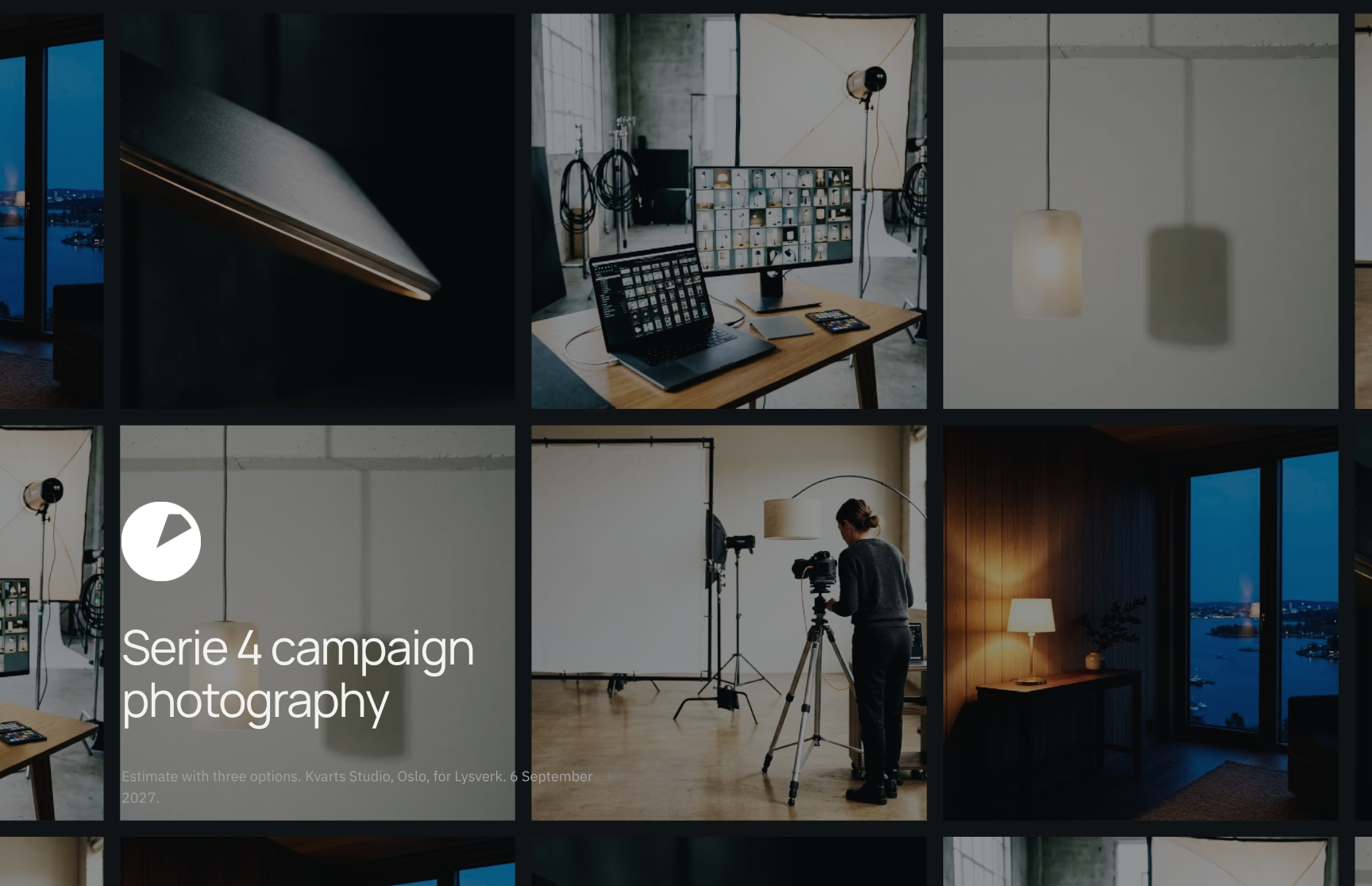
- [Use this template](https://formlio.com/workspaces/claim?template=oslo-campaign-photography-estimate)
- [Live preview](https://formlio.com/documents/oslo-campaign-photography-estimate)
- **Categories:** [Video & photography](https://formlio.com/templates/video-photography), [Proposals](https://formlio.com/templates/proposals)
- **Document goal:** Win campaign shoots by giving brand clients three clear priced options, with licensing, schedule and payment terms laid out.
- **Blocks:** Infinite grid, Left-aligned, Scroll gradient, Spotlight, Itemized quote, E-signature
- **Palette:** Soft Porcelain Background (#F2F3F1), Misty Slate Tint (#D5DCE0), Steel Blue Accent (#3E5C6E), Deep Harbor Navy (#22323C), Midnight Ink Text (#0F1316)
## Get more from every document
Win campaign work by putting three clear priced options in front of a retail client. Image counts, licensing, schedule, and payment terms sit alongside the numbers, so nothing gets negotiated blind.
### Get the yes without leaving
Your client reads the pricing, scrolls to the agreement, and signs right there. No PDF download, no printing, no waiting.
### Build proposals from proven sections
Pull in a hero, steps, or pricing section, then save your best-performing versions and reuse them on the next pitch.
### Your pitch looks right on any screen
Hero images, pricing, and testimonials hold their shape when a client opens your proposal on a phone between meetings.
### See which section sold them
Heatmaps show who lingered on pricing, replays show how they read, and you follow up while the interest is warm.
### Know the moment they open it
Get a ping when your client views the proposal, leaves a comment, or signs the agreement, so you call at the right time.
### Write the proposal together, live
Your designer tweaks the hero while you rework the pricing breakdown, both in the same document, at the same time.
## See how every part fits
The estimate opens with a project summary and closes on approval with a validity date, with pricing and proof in between. Keep what fits your pitch, drop what doesn't, and reorder anything.
### Campaign Photography Proposal Cover with Project Summary
Opens with the Serie 4 campaign photography estimate, naming Kvarts Studio, the client Lysverk, the date, and the three-option structure. The client sees at once what the document covers.
### Project Brief and Estimate Scope with Launch Deadlines
An expandable accordion that confirms the brief: the February 2028 launch in 140 Nordic stores and online, and the 8 November image deadline. It sets scope and assumptions so the client can correct them before work starts.
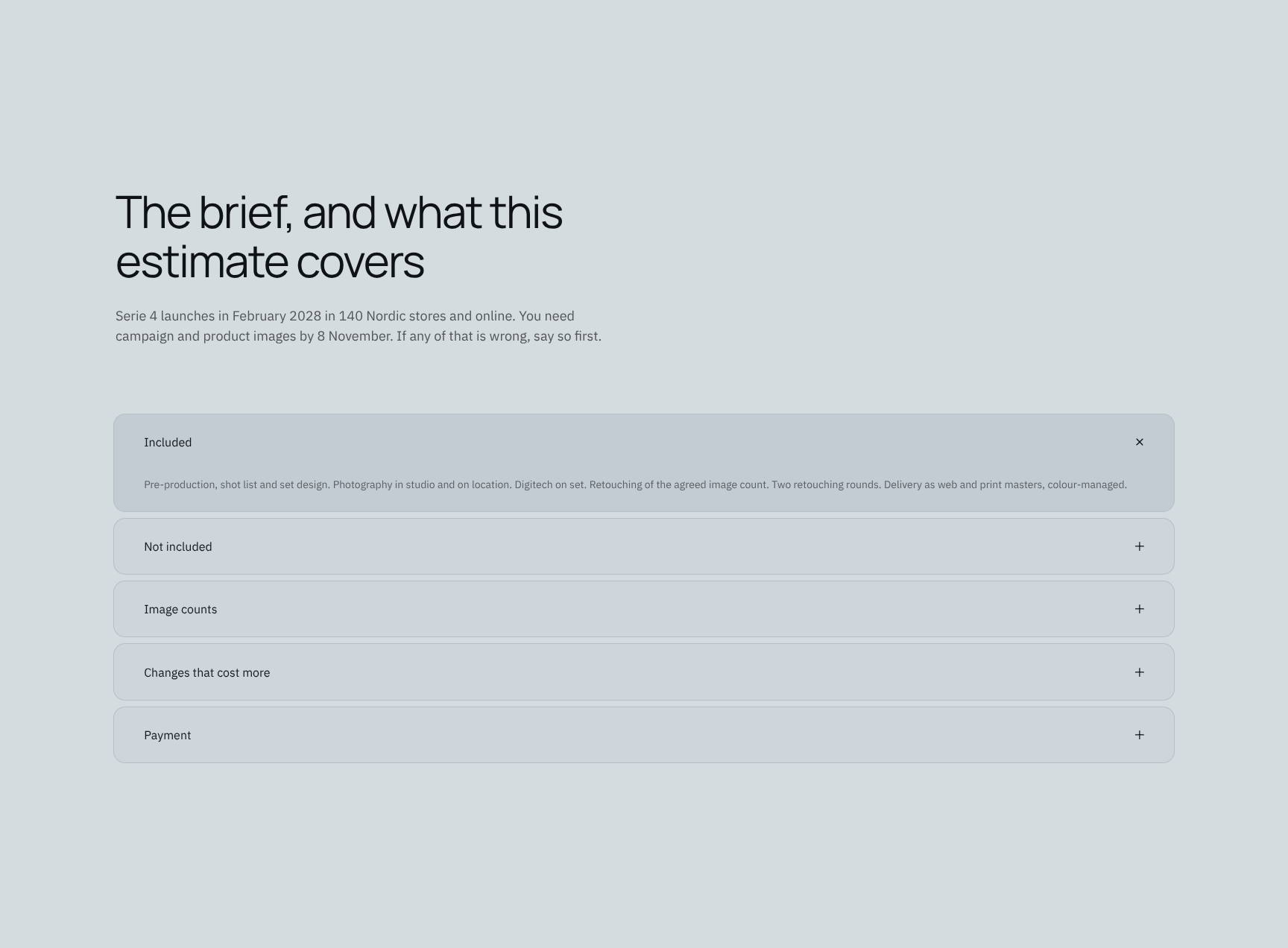
### Creative Approach and Photography Philosophy Statement
A short animated statement of the lighting and styling approach: light the room with the lamp and add nothing it would not give. It conveys the studio's point of view in two lines.

### Seven-Week Production Timeline and Project Plan
A step-by-step plan for option B, running 20 September to 8 November 2027. It notes that options A and C follow the same plan with one day fewer or one day more, so scheduling and delivery are clear.
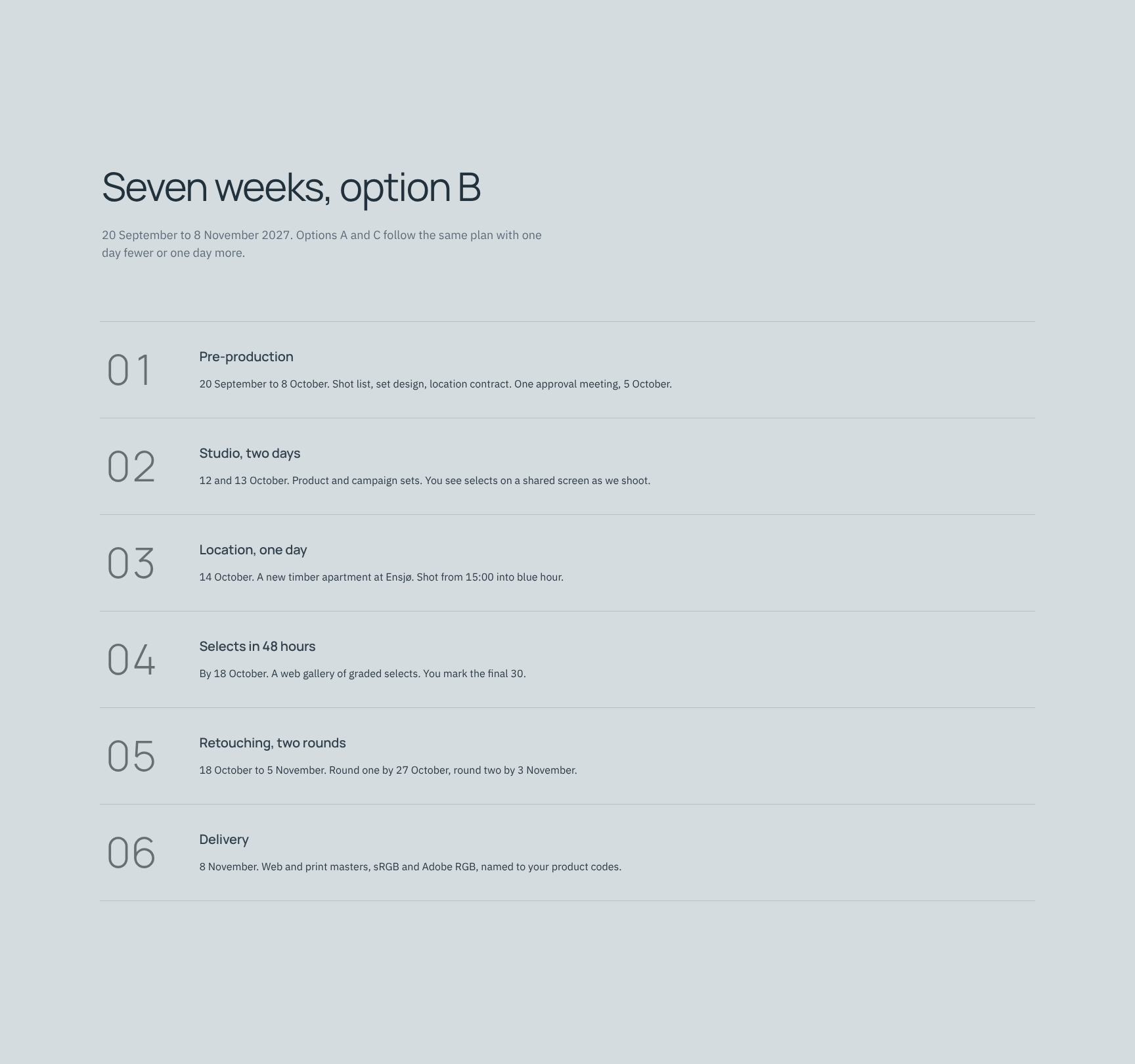
### Studio Team Profile and Relevant Campaign Experience
Introduces Kvarts Studio, a six-person Grünerløkka studio founded in 2017. It highlights two earlier campaigns and the two people the client will work with, building trust through proven, relevant work.
### Transparent Photography Pricing with Day Rates and Three Options
Itemised NOK estimate excluding 25% MVA. It lists day rates for photographer, producer, set designer, stylist, assistant and digitech, plus retouching at 2,450 per image, so the client can compare options A, B and C.
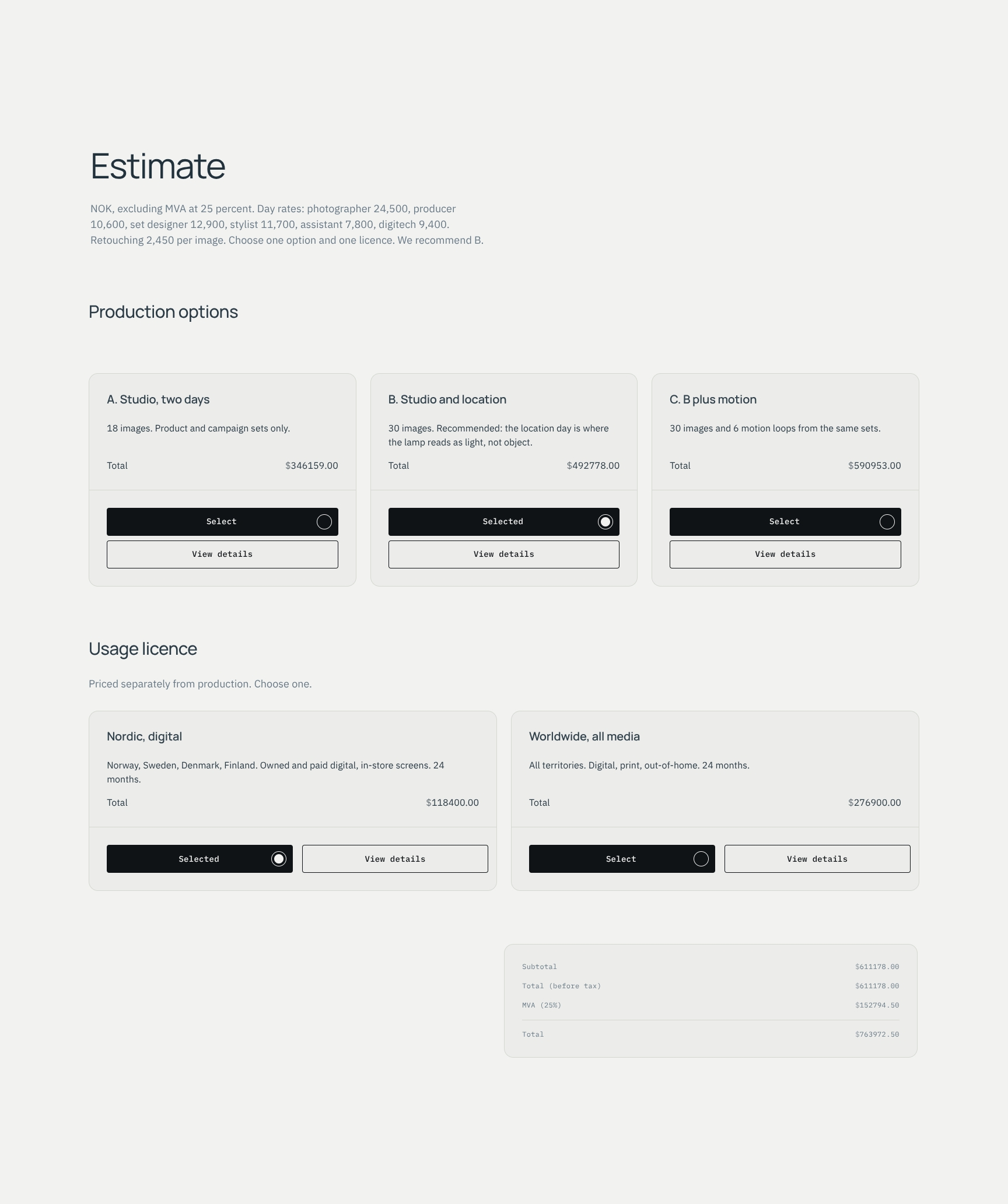
### Client Testimonials on Budget Accuracy and Reliable Delivery
Quotes from past clients such as Lars Eide of Nordlinje Møbler, citing an estimate of 384,000 against an invoice of 379,650 and a forty-image shoot with zero reshoots. They show budget honesty and dependable delivery.
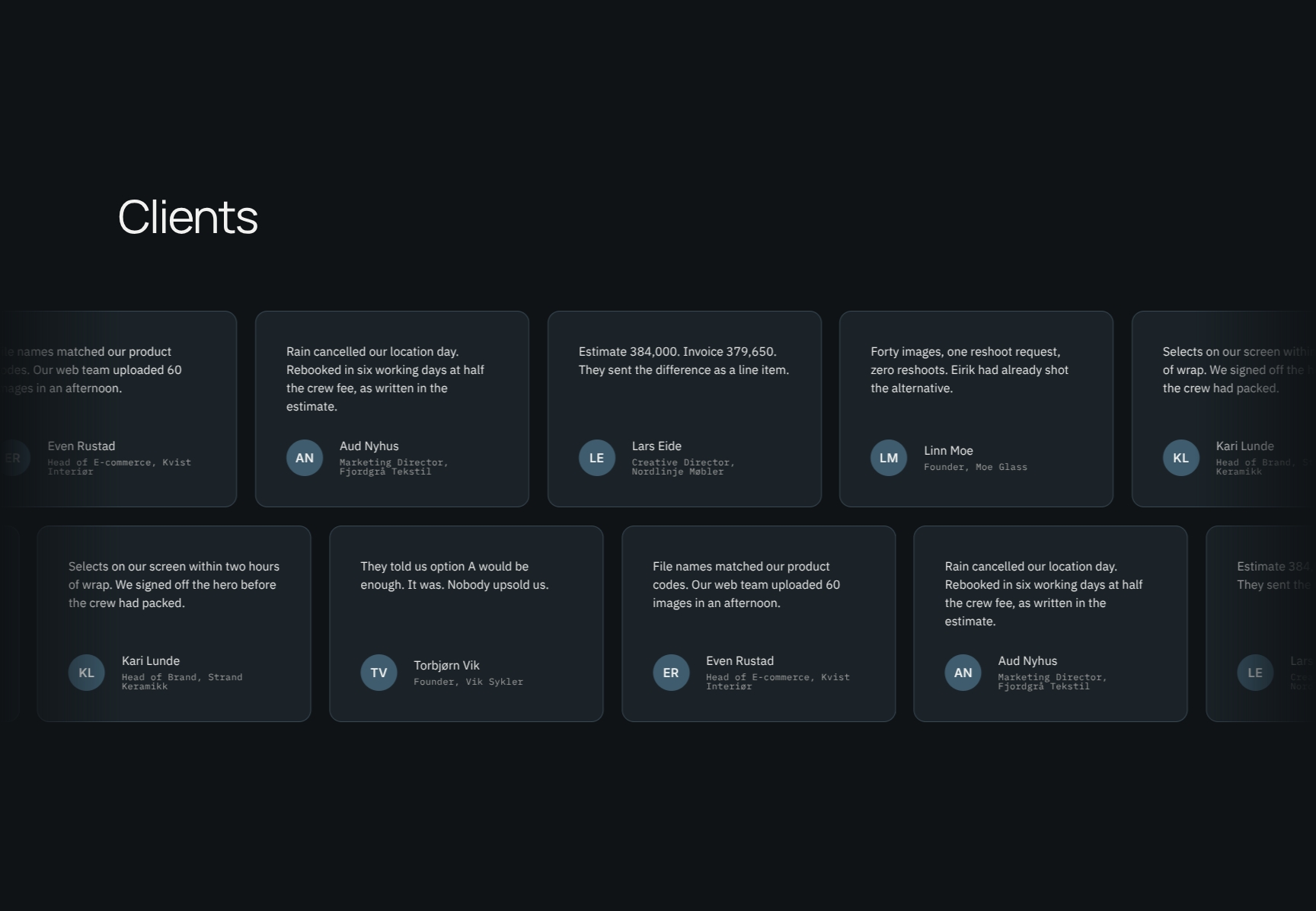
### Proposal Approval and Next Steps with Validity Date
Closes with the offer valid until 17 September 2027 and the studio held until then. It explains that choosing option A or C, or the worldwide licence, changes the figure, with a same-day reissue so the client can approve quickly.
## Find your answers
Answers to common questions about pricing options, licensing, and sending campaign photography estimates to retail brand clients.
### What should be included in a business proposal template?
A strong proposal includes a cover page, scope of work, your approach, a project plan, background on who is involved and what has been done before, and a cost estimate. This template covers all six sections in a logical order so clients can quickly see what you will deliver, how, and for how much. Fill in each section with project-specific details to keep the proposal clear and persuasive.
### How do I customize this proposal template for my own project?
Start by replacing the cover details with your company name, logo, client name, and project title. Then edit the Scope, Approach, Plan, and Estimate sections to match your deliverables, methods, timeline, and pricing. You can reorder, remove, or duplicate sections and adjust fonts and colors to match your brand.
### Can I export this proposal template to PDF or Word?
Yes, you can export the finished proposal to PDF for sending to clients, which keeps formatting consistent on any device. You can also download an editable version, such as Word or Google Docs, if you need to make further changes or collaborate. Always review the exported file to confirm that layout, fonts, and images appear as expected.
### Is this proposal template suitable for freelancers, agencies, and consultants?
Yes, the template is flexible enough for freelancers, agencies, consultants, and small businesses in industries such as design, marketing, IT, construction, and professional services. The Scope, Approach, and Estimate sections can be adapted to hourly, fixed-price, or retainer-based work. Adjust the language and level of detail to suit your industry and the size of the project.
### How do I write the scope and estimate sections of a proposal?
In the Scope section, list specific deliverables, project boundaries, and any exclusions so both sides share the same expectations. In the Estimate section, break costs down by task, phase, or deliverable, and include timelines, payment terms, and any assumptions. Being specific in both sections reduces misunderstandings and helps clients approve the proposal faster.
## Related
- [Brooklyn](https://formlio.com/templates/brooklyn-brand-film-proposal): Brand film proposal for hospitality clients
- [Antwerp](https://formlio.com/templates/antwerp-photography-and-film-portfolio): Photo and film portfolio for creative studios
- [Bristol](https://formlio.com/templates/bristol-launch-film-proposal): Launch film proposal for product marketing teams
- [Vancouver](https://formlio.com/templates/vancouver-video-production-statement-of-work): Multi-market commercial shoot statement of work
- [Lyon](https://formlio.com/templates/lyon-hotel-website-proposal): Website proposal for multi-property hotel groups
- [Bordeaux](https://formlio.com/templates/bordeaux-launch-event-pitch): Hybrid launch event pitch for brands
---
---
title: "Manchester"
description: "Statement of work template for paid media and lifecycle marketing. Define scope, baseline and target path, delivery stages and acceptance tests for ecommerce clients."
canonical: "https://formlio.com/templates/manchester-marketing-statement-of-work"
locale: "en"
type: "template"
lastModified: "2026-10-20"
category: "Marketing"
alternates:
fr: "https://formlio.com/fr/templates/manchester-cahier-des-charges-marketing.md"
---
# Manchester
Marketing Agency Statement of Work Template
Statement of work template for paid media and lifecycle marketing: scope, baseline and target path, and staged delivery with acceptance tests. For agencies.
- [Use this template](https://formlio.com/workspaces/claim?template=manchester-marketing-statement-of-work)
- [Live preview](https://formlio.com/documents/manchester-marketing-statement-of-work)
- **Categories:** [Marketing](https://formlio.com/templates/marketing), [Proposals](https://formlio.com/templates/proposals)
- **Document goal:** Lock in scope, targets, and acceptance tests so ecommerce clients sign off on paid media and lifecycle work.
- **Blocks:** Infinite grid, Single column, Scroll gradient, Left-aligned, Gantt, Spotlight, Grid 3x2 with icons, Itemized quote, E-signature
- **Palette:** Soft Cloud Background (#EEF0F2), Periwinkle Mist Highlight (#C9D3FF), Vivid Royal Blue Accent (#3446D6), Deep Indigo Depth (#1B2575), Midnight Ink Text (#0B0D14)
## Get more from every document
This template helps you turn a paid media and lifecycle engagement into a signed scope with clear targets and acceptance tests. Charts, task dates, fees, and a single dashboard sit ready to edit.
### Get the agreement signed on the page
Your client reads the scope, checks the pricing, and signs in the same document. No PDF to print, sign, scan, or lose.
### Assemble agreements from sections you trust
Pull in pricing, steps, and terms blocks, then save your tuned scope section and reuse it on every new client.
### Clients sign from any screen
Your pricing tables, charts, and timelines hold their shape when a client opens the agreement on a phone between meetings.
### See which terms your client lingers on
Heatmaps show if they stalled at pricing, and session replays let you follow up before a doubt turns into a delay.
### Know the moment they open or sign
Get a ping when your client views the agreement, comments on a clause, or signs, so your follow-up lands on time.
### Draft scope and pricing together, live
You tweak the deliverables while your producer adjusts the pricing breakdown, both in one document, before it goes out.
## See how every part fits
The document opens with a branded cover and a scope summary, then moves through method, terms, and fees before closing on testimonials and signatures. Keep, drop, or reorder anything to match your engagement.
### Branded SOW Cover with Project Reference and Date
Opens the statement of work for Ashlar Running with the SOW-ASH-01 reference, Manchester location and issue date. Sets a professional first impression and makes the document easy to file and trace.
### Scope Summary: Ten-Week Build and Six-Month Managed Run
Summarises how the SOW sits under the master services agreement, with build dates of 12 July to 17 September 2027 and a six-month paid media and lifecycle run. Aligns both parties on scope from the first page.
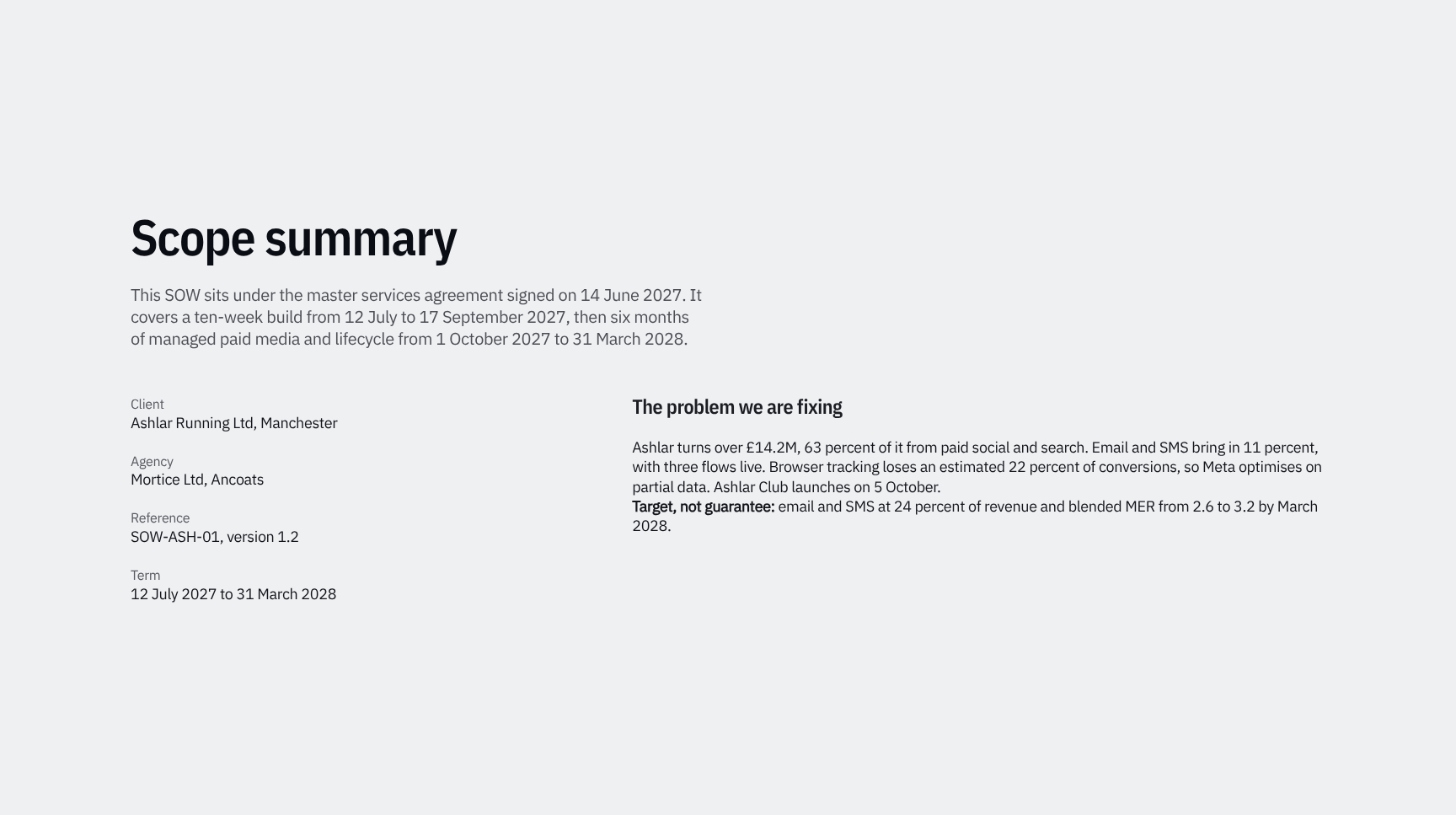
### Guiding Principle: Measure, Spend, Automate
A short statement of the working philosophy: fix measurement first, then spend, then automate what works. It frames every decision in the SOW and shows clients how the agency prioritises.
### Revenue Baseline and MER Target Path Charts
Charts revenue from Shopify and GA4 for the twelve months to 31 May 2027 and defines MER. Sets a target path reviewed monthly, giving both sides a clear, measurable starting point for success.
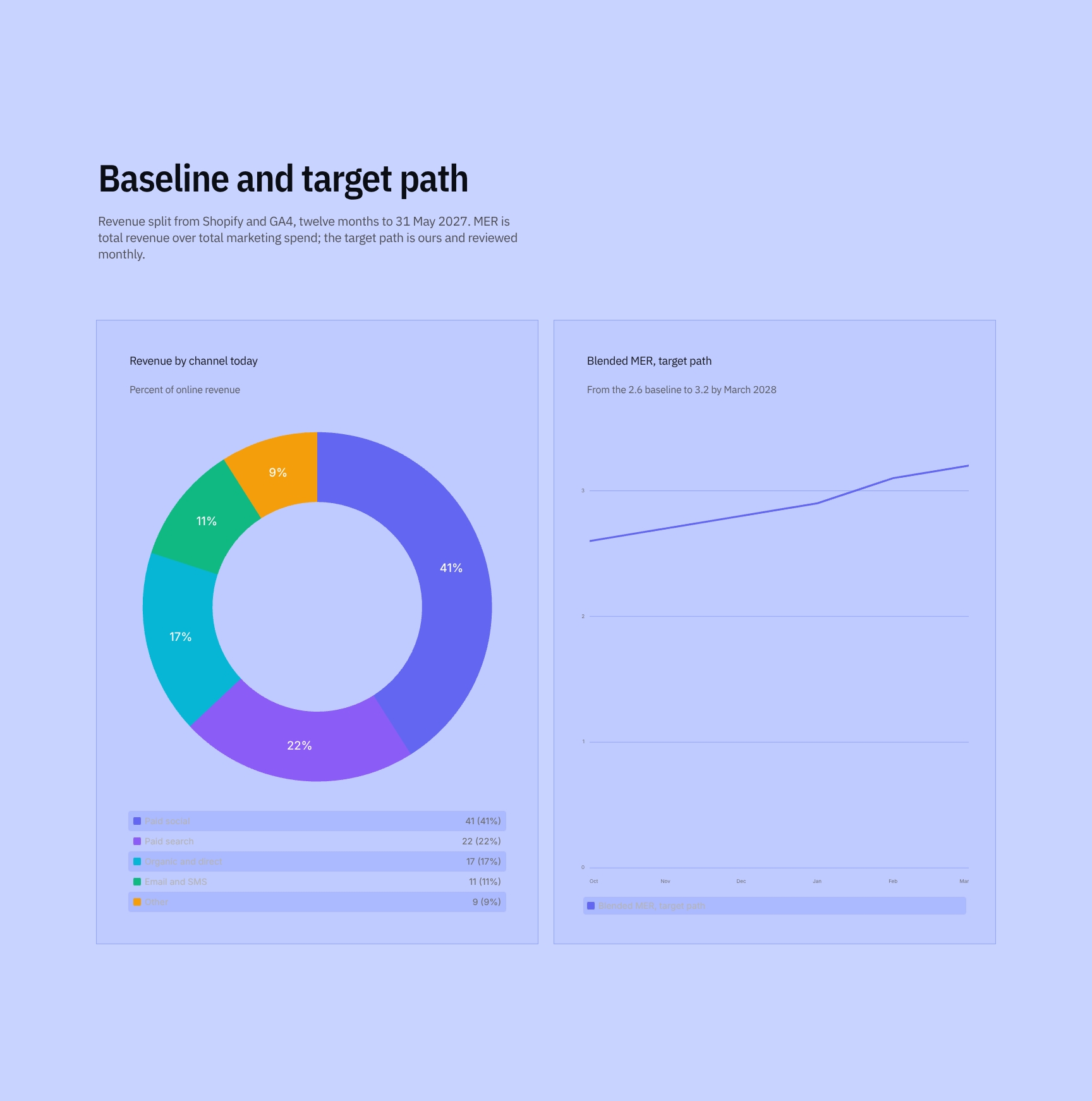
### Six-Stage Delivery Method with Acceptance Gates
Walks through six delivery stages, from auditing GA4, Shopify and Klaviyo onward. Nothing goes live until it passes the acceptance tests, reducing risk and setting clear expectations.
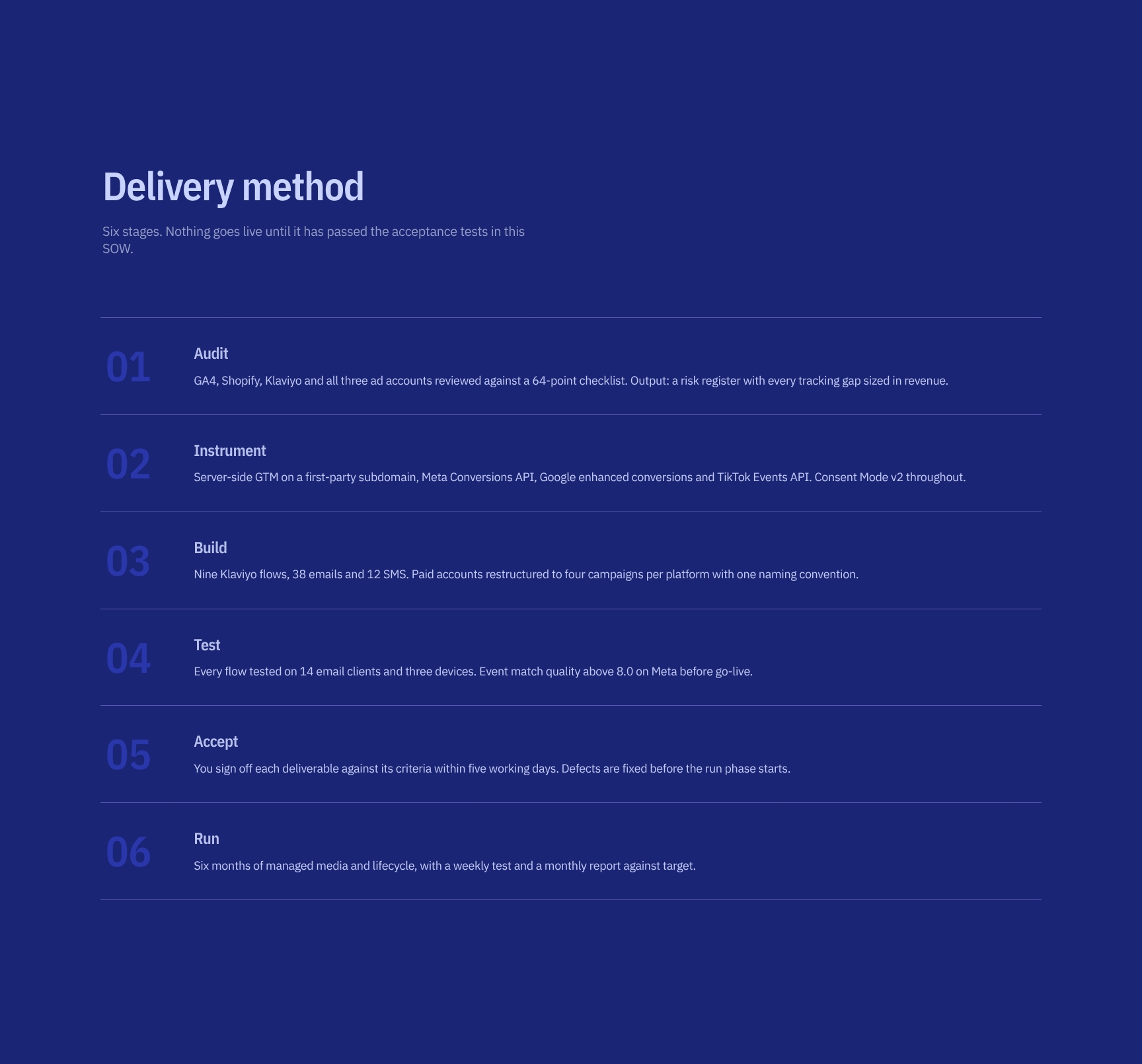
### Acceptance, Data Ownership and Change Control Terms
Expandable terms covering acceptance, data handling and change control, with this SOW overriding the master services agreement where they differ. Keeps contract detail easy to scan and removes ambiguity.
### Project Task List with Build and Run Dates
Lays out tasks and dates for the build (12 July to 17 September 2027) and run (1 October 2027 to 31 March 2028). States assumptions such as admin access by 9 July and named approvers per phase.
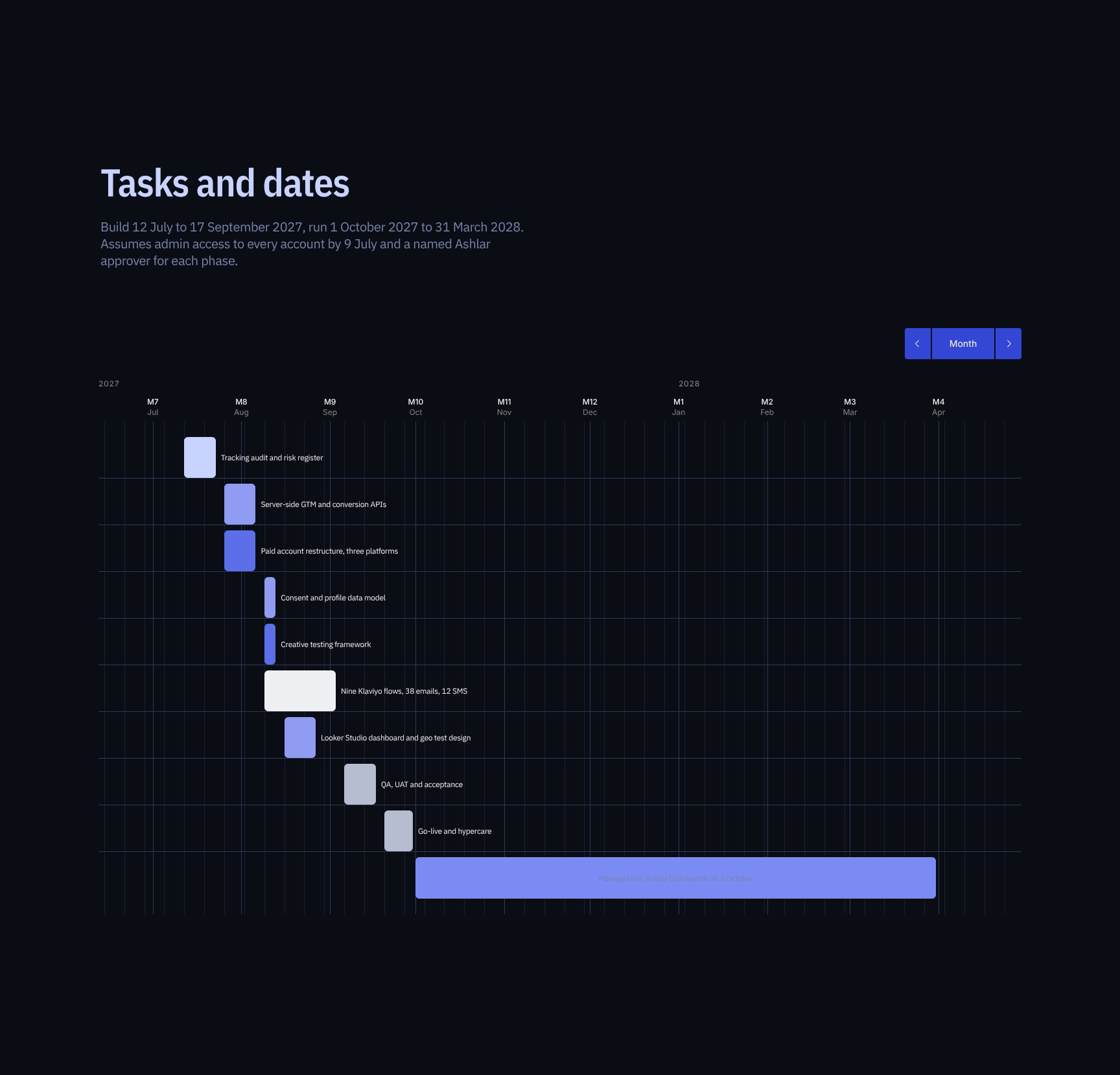
### Comparable Builds and Named Delivery Team
Names Imran Shah as accountable Technical Director, alongside the CRM, paid media, tracking and delivery leads. Pairs the team with comparable past builds to build confidence in who does the work.
### Reporting Cadence with Single Looker Studio Dashboard
Fixes the reporting rhythm for the run phase, with every figure drawn from one Looker Studio dashboard. One source of truth ends disputes over whose numbers are right.
### Transparent Fees, Day Rates and Payment Schedule
Details fees in GBP plus 20 percent VAT, with day rates by role from technical director to QA. Covers planned media spend and payment timing so there are no budget surprises.
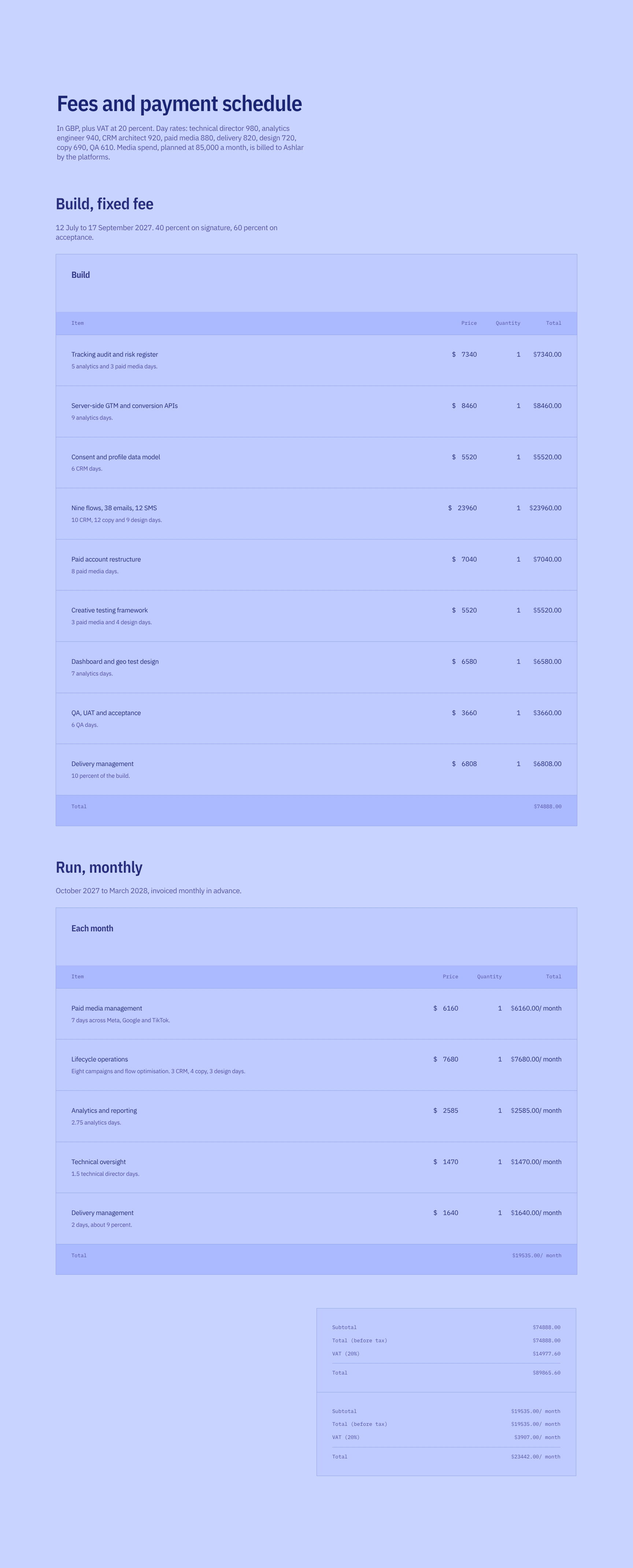
### Client Testimonials from Signed Mortice SOWs
Quotes from clients who signed Mortice SOWs, including a tracking fix that cut CPA from 31.40 to 24.90. Concrete results offer social proof at the moment of decision.
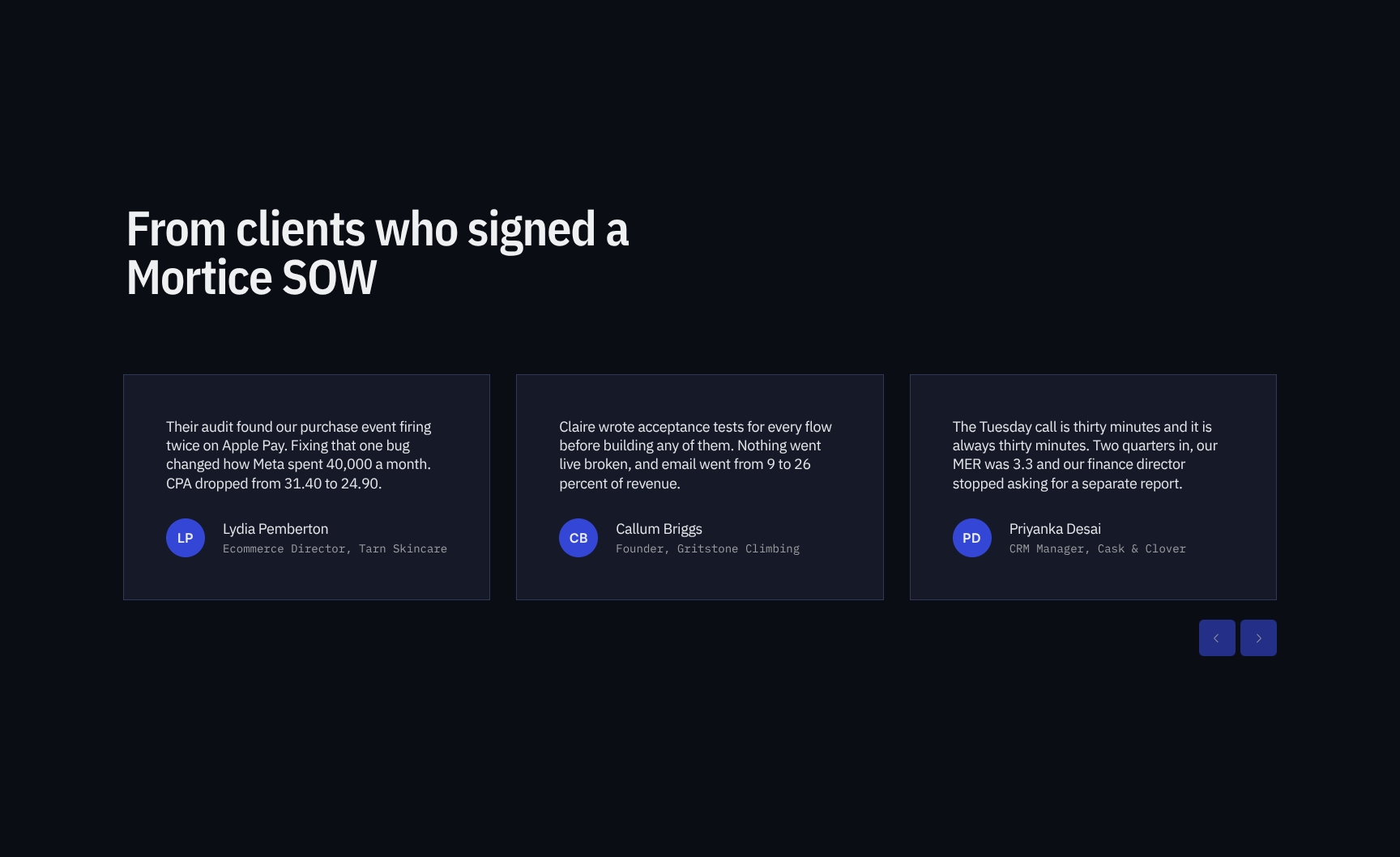
### Signature Block with Start Deadline and Access Checklist
Asks for signature by Friday 2 July 2027 to hold the 12 July start, and lists the account access needed by 9 July. Explains that delays move go-live day for day, prompting prompt action.
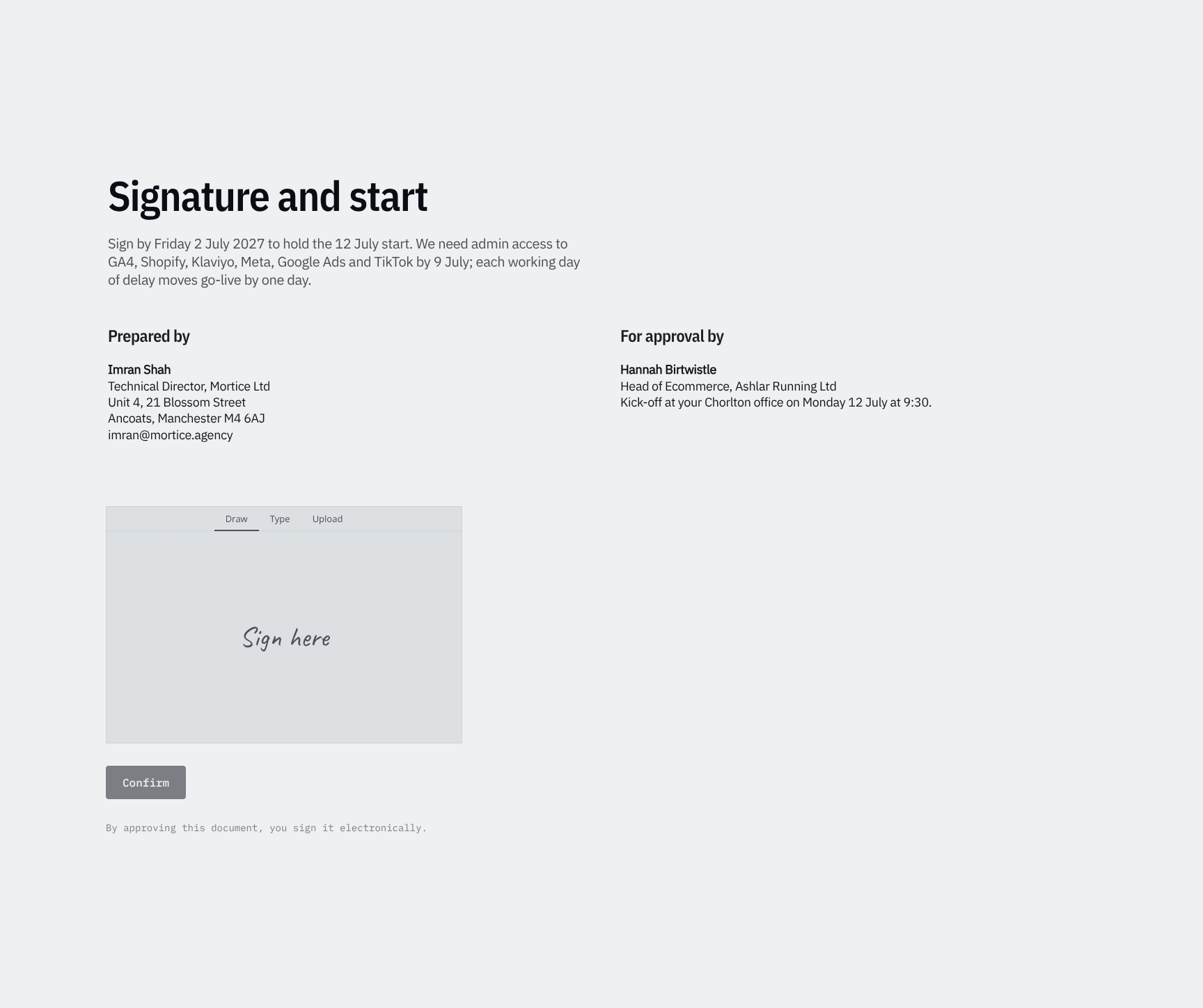
## Find your answers
Answers to common questions about scoping, pricing, and getting sign-off on paid media and lifecycle statements of work for ecommerce clients.
### What should be included in an agreement template with baseline and acceptance criteria?
A solid agreement should include a cover page, a summary of the deal, guiding principles, a baseline defining the starting scope or standards, a delivery method, and acceptance and data terms. The baseline sets measurable expectations, while the acceptance section explains how deliverables are approved or rejected. Together these sections reduce disputes and keep both parties aligned.
### How do I customize this agreement template for my project?
Start with the Cover and Summary to enter party names, dates, and a short overview of the engagement. Then adjust the Baseline to reflect your scope, standards, or starting conditions, and edit the Delivery method to match how work will be handed over. Finish by tailoring the Acceptance and data section with your review timelines, approval criteria, and data-handling terms.
### What is the baseline section of an agreement and why does it matter?
The baseline is the agreed reference point that defines the current state, scope, or performance standards before work begins. It matters because any later changes, improvements, or deviations are measured against it. A clear baseline prevents scope creep and gives both parties objective evidence if disagreements arise.
### How does the acceptance process work in this agreement?
The acceptance section defines how and when the receiving party reviews a deliverable and confirms it meets the agreed criteria. It typically sets a review window, outlines how to report defects, and states what happens if no response is given. Customize the timelines and criteria to fit your project so approval is clear and documented.
### Is this agreement template suitable for handling data and different industries?
Yes, the Acceptance and data section can be adapted for industries such as software, consulting, marketing, and professional services that exchange deliverables or information. You should specify what data is shared, how it is stored and protected, and any regulations that apply, such as GDPR or HIPAA. For regulated or high-value deals, have a qualified legal professional review the final document.
## Related
- [Boston](https://formlio.com/templates/boston-event-retainer-proposal): Monthly event retainer proposal for brands
- [Toronto](https://formlio.com/templates/toronto-brand-relaunch-proposal): Creative campaign proposal for consumer brands
- [Dublin](https://formlio.com/templates/dublin-launch-campaign-proposal): Integrated launch campaign proposal for consumer brands
- [Bristol](https://formlio.com/templates/bristol-launch-film-proposal): Launch film proposal for product marketing teams
- [Portfolio template](https://formlio.com/templates/portfolio-template): Showcase Your Best Work with Strategic Project Presentation
- [Detailed proposal template](https://formlio.com/templates/detailed-proposal-template): Complete Business Engagement Framework with Strategy & Execution
---
---
title: "Bristol"
description: "Win product launch film pitches with a creative proposal template: brief analysis, proof-driven data, and three creative routes with a clear recommendation."
canonical: "https://formlio.com/templates/bristol-launch-film-proposal"
locale: "en"
type: "template"
lastModified: "2026-10-20"
category: "Video & photography"
alternates:
fr: "https://formlio.com/fr/templates/bristol-proposition-de-film-de-lancement.md"
---
# Bristol
Product Launch Film Creative Proposal Template
Win product launch film projects with a creative proposal template featuring a client brief, data-backed rationale, and three creative routes with a recommendation.
- [Use this template](https://formlio.com/workspaces/claim?template=bristol-launch-film-proposal)
- [Live preview](https://formlio.com/documents/bristol-launch-film-proposal)
- **Categories:** [Video & photography](https://formlio.com/templates/video-photography), [Marketing](https://formlio.com/templates/marketing), [Proposals](https://formlio.com/templates/proposals), [Pitch decks](https://formlio.com/templates/pitch-decks)
- **Document goal:** Win product launch film pitches with three clear creative routes and a recommendation your client can say yes to.
- **Blocks:** Perspective grid, Marquee, Single column, Grid 3x2 with icons, Fullscreen, Sticky scroll, Masonry, Itemized quote, Vertical timeline, E-signature
- **Palette:** Warm Linen Background (#F4F1EC), Soft Apricot Highlight (#FFB38A), Vibrant Ember Accent (#E8572A), Deep Rust Contrast (#8E2A12), Midnight Ink Dark (#0E0E10)
## Get more from every document
Pitch a launch film that wins the room and the budget. Brief reframing, data cards, three creative routes, and a costed production plan keep your argument tight from cover to sign-off.
### Close the deal on the page
Your client signs the agreement right under the pricing section, so a yes never gets lost in an inbox.
### Assemble proposals from proven sections
Drop in a hero, pricing table, or testimonial block, then save your best steps and breakdowns to reuse on the next pitch.
### Your pitch looks sharp everywhere
Hero images, showcases, and pricing stay crisp whether the client opens it on a laptop or between meetings on a phone.
### See which section sells your work
Watch where clients linger on pricing or your showcase, then follow up the moment their interest peaks.
### Know the second they open it
Get a ping when a client views your proposal, leaves a comment, or signs the agreement, so you reply while it's fresh.
### Write the proposal together, live
Your designer tweaks the showcase while you rework the pricing and timeline, all in the same document at once.
## See how every part fits
The proposal opens with a bold cover and a single big idea, then builds through proof, routes, and cost, and closes on approval and a booking deadline. Keep what fits your pitch, drop what doesn't, and reorder anything.
### Cinematic Cover Page for a Product Launch Film Proposal
A bold hero cover with imagery and the campaign line "Dinner without a flame..." sets the creative tone immediately and makes the client feel the idea before reading a word.
### The Big Idea: Animated Creative Concept Statement
An animated text moment that delivers the core concept in one line: boiling in under ninety seconds, one take, no cuts. It makes the pitch memorable and easy to repeat internally.

### Creative Brief Reframe: What You Asked For vs. What Is at Stake
Restates the client's request and reframes it around the real business goal. It shows strategic thinking, builds trust, and aligns everyone on the problem the film must solve.
### Proof Points: Survey and Test Kitchen Data Cards
Card-based highlights of the client's own waitlist survey and test kitchen figures. Each number becomes a claim the film can prove on camera, grounding the concept in evidence.
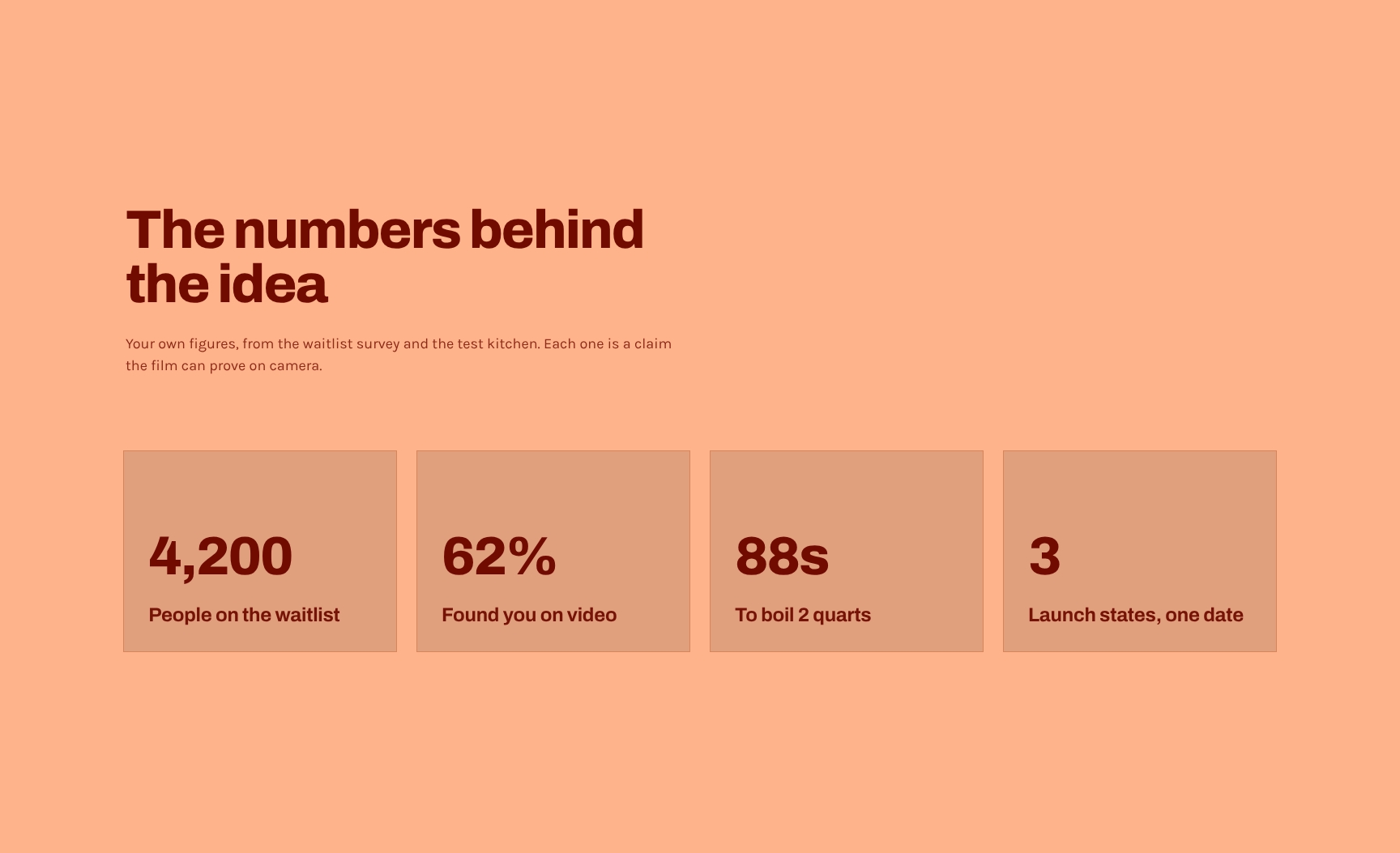
### Three Creative Routes with Recommended Option
Presents Route A (The Clock, recommended) alongside Routes B and C. Clients can compare concepts, understand the tradeoffs, and decide with confidence rather than guesswork.
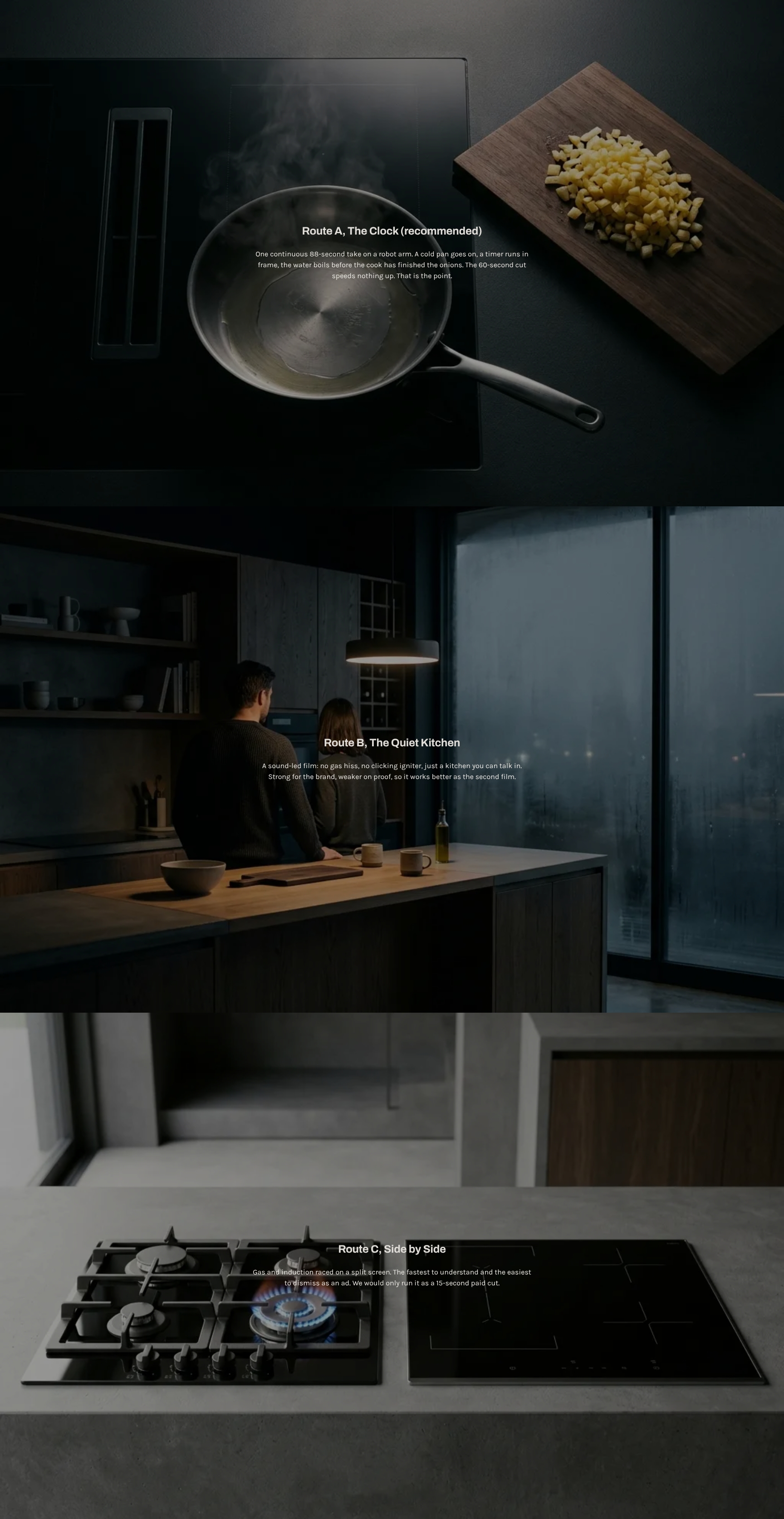
### 14-Week Production Roadmap to Launch Day
A step-by-step process anchored to the August stage date and built backward from October 12. It shows a tight, realistic plan and where the client's input matters most.
### Hardware Launch Case Studies and Portfolio Results
Three past hardware launches, each solving a different problem and judged on preorders rather than views. Proves relevant experience and a focus on commercial outcomes.
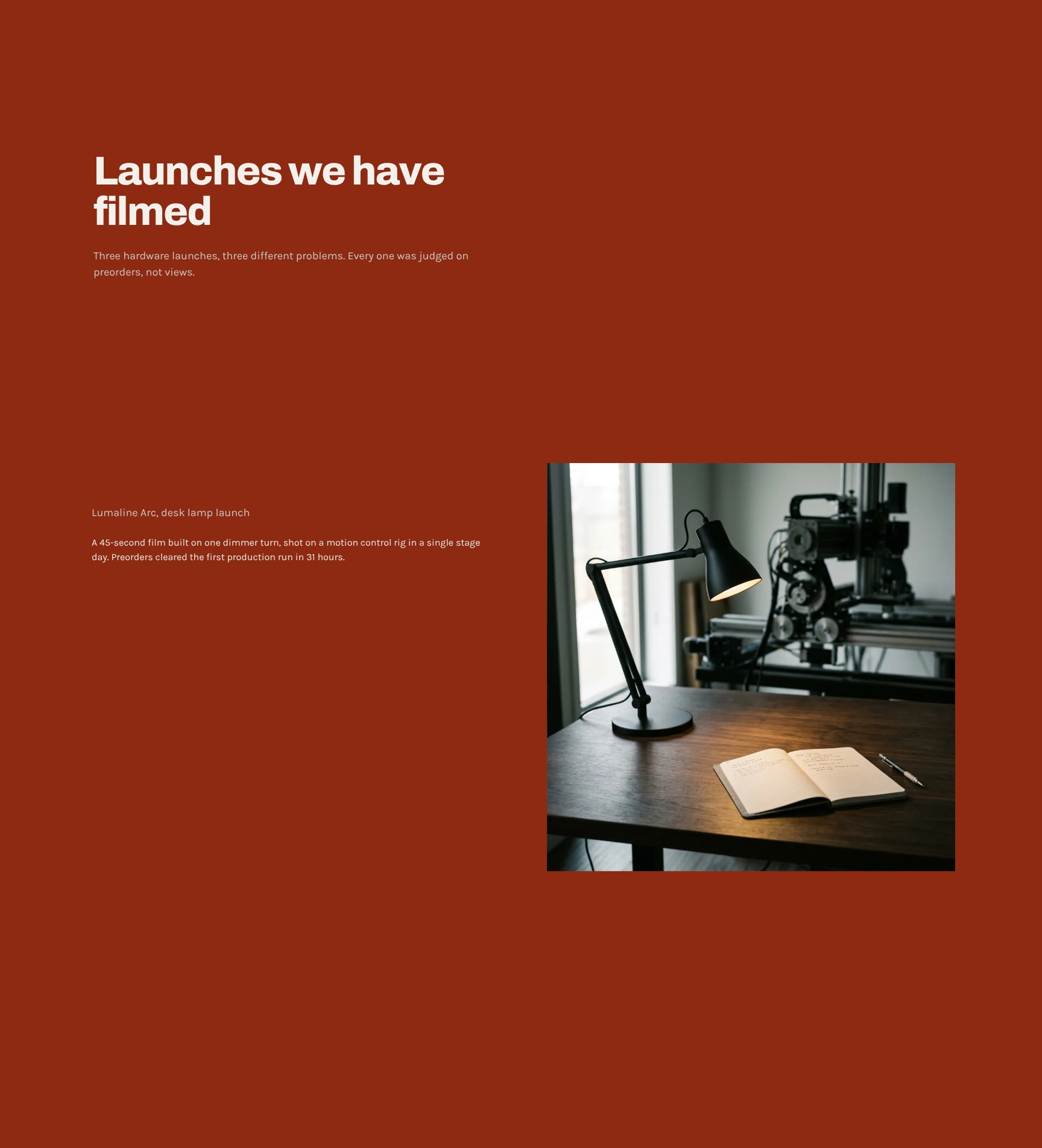
### Meet the Production Team Behind Your Film
Profiles of the four Fogline people staying on the project from previs to delivery. Highlights continuity, accountability, and the senior talent the client will actually work with.
### Transparent Production Cost Breakdown for Route A
A line-item USD budget built from published day rates for director, DP, producer, editor, and colorist. Talent usage and music are licensed separately, so every dollar is visible.
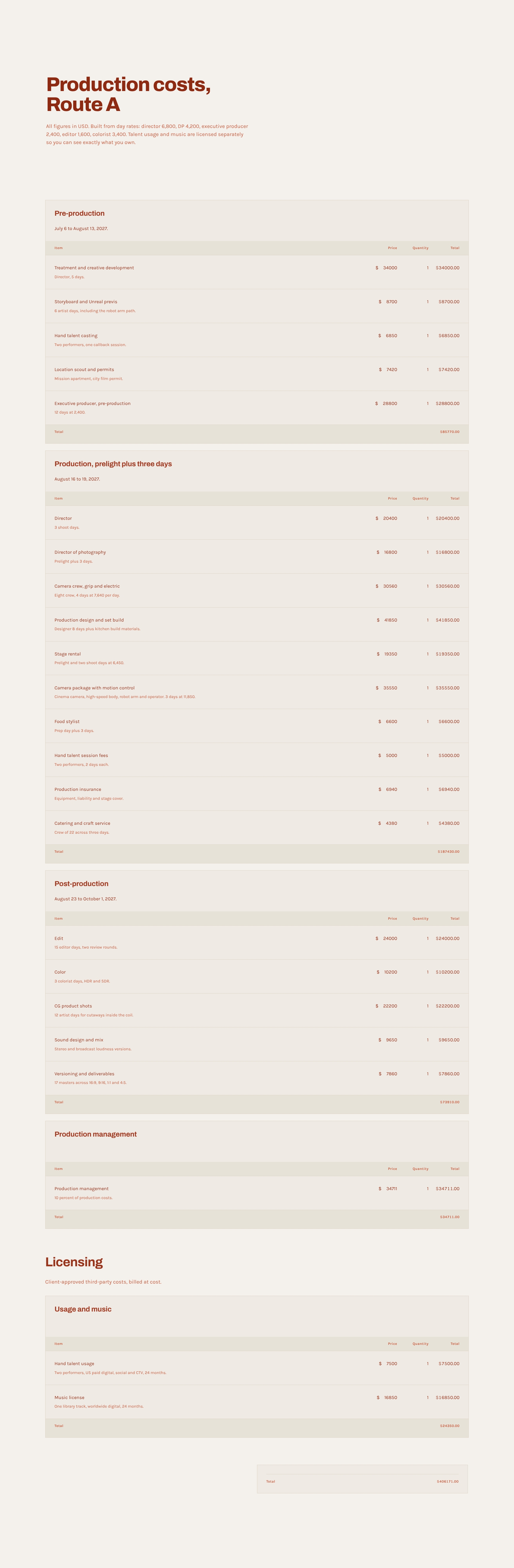
### Review Schedule and Feedback Timeline to Launch
A task-based schedule with review rounds and feedback deadlines that protects the October 1 delivery. Clear expectations help the client avoid delays that would cost a week.
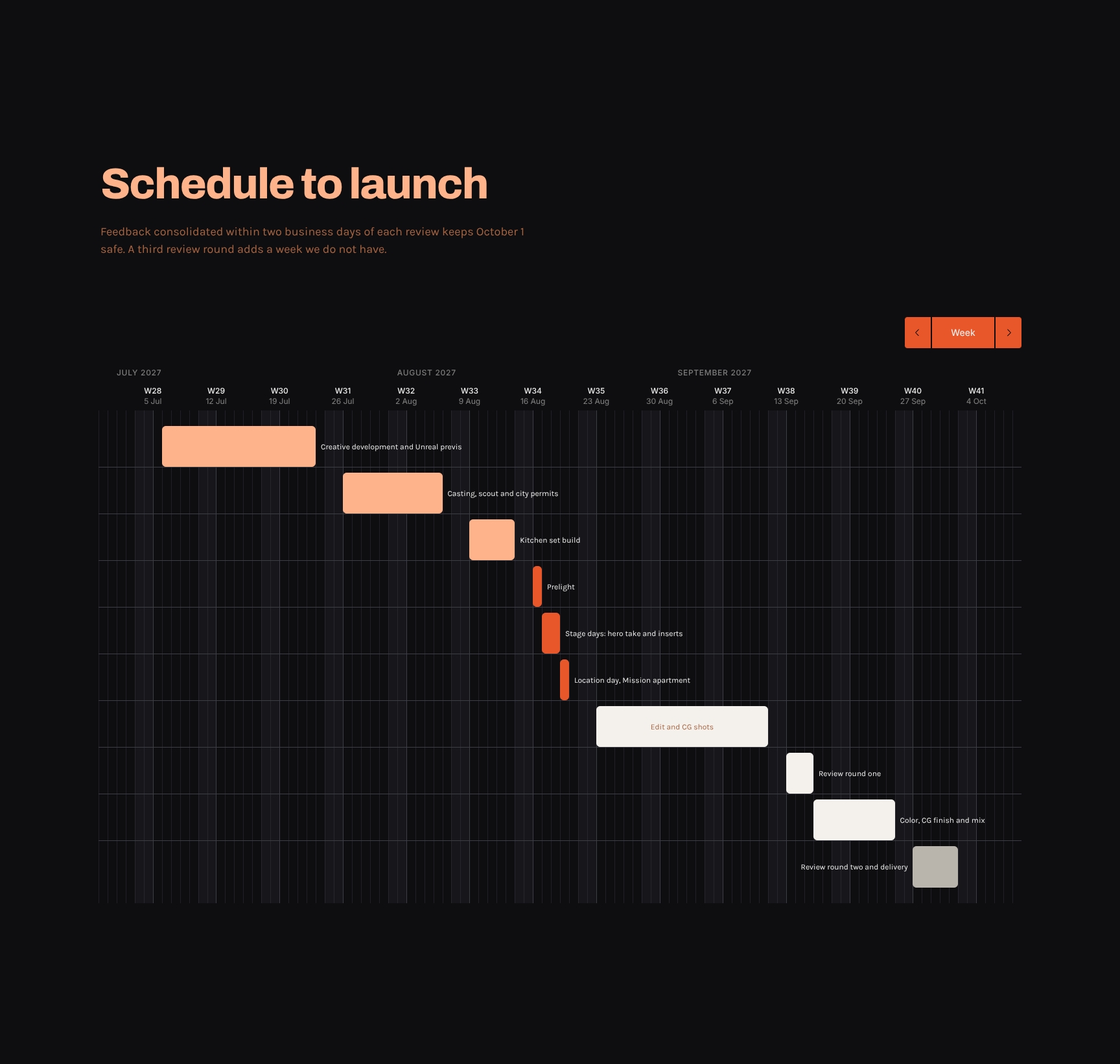
### Client Testimonials from Successful Product Launches
Quotes from brands that launched with Fogline, including a CMO whose film sold out the first run in 31 hours. Social proof reassures the client that bold creative advice pays off.
### Project Approval and Stage Booking Deadline
A clear call to action: approve by June 25, 2027 to lock the Bayview stage. It explains the cost of waiting and offers a fast rebudget if the client prefers Route B or C.
## Find your answers
Answers to common questions about writing and presenting a product launch film proposal to consumer brand clients.
### What should be included in a business proposal template?
A strong proposal includes a cover, a clear core idea, a summary of the client's brief, the financials, options to choose from, and an implementation plan. This template covers all six: Cover, The Idea, The Brief, The Numbers, Three Routes, and How We Get There. Together they show you understand the problem, justify the cost, and make the next step easy for the client.
### How do I customize this proposal template for my own clients?
Replace the placeholder text in each section with your client's details, then update the colors, fonts, and logo on the Cover to match your brand. Start with The Brief to reflect the client's goals in their own words, then tailor The Numbers and Three Routes to your pricing and services. Delete or duplicate sections as needed to fit the project's scope.
### What are the 'Three Routes' in a proposal and why use them?
Three Routes is a tiered options section that presents three ways to achieve the client's goal, such as essential, recommended, and premium. Offering choices shifts the client's decision from 'yes or no' to 'which option,' which often raises close rates and average deal size. Label your preferred route as recommended and tie each option to its price in The Numbers.
### Can I export this proposal template to PDF or other formats?
Yes, you can export the finished proposal as a PDF to send to clients, which keeps the layout and fonts intact on any device. Depending on the tool you use, you can also share it as a link or download an editable version. Always review the exported file to check that page breaks, images, and numbers display correctly before sending.
### Is this proposal template suitable for agencies, freelancers, and consultants?
Yes, the structure works for any service-based business that pitches projects, including creative agencies, freelancers, consultants, and marketing firms. The flow from idea to brief to numbers to options to timeline is flexible enough for design, strategy, development, and campaign work. Adjust the language and deliverables in each section to match your industry's terminology.
## Related
- [Boston](https://formlio.com/templates/boston-event-retainer-proposal): Monthly event retainer proposal for brands
- [Brooklyn](https://formlio.com/templates/brooklyn-brand-film-proposal): Brand film proposal for hospitality clients
- [Toronto](https://formlio.com/templates/toronto-brand-relaunch-proposal): Creative campaign proposal for consumer brands
- [Dublin](https://formlio.com/templates/dublin-launch-campaign-proposal): Integrated launch campaign proposal for consumer brands
- [Antwerp](https://formlio.com/templates/antwerp-photography-and-film-portfolio): Photo and film portfolio for creative studios
- [Oslo](https://formlio.com/templates/oslo-campaign-photography-estimate): Photography estimate with options for brands
---
---
title: "Vancouver"
description: "Video production statement of work template with parties, fee, delivery method, review and acceptance terms. Built for production companies pitching multi-market shoots."
canonical: "https://formlio.com/templates/vancouver-video-production-statement-of-work"
locale: "en"
type: "template"
lastModified: "2026-10-21"
category: "Video & photography"
alternates:
fr: "https://formlio.com/fr/templates/vancouver-cahier-des-charges-de-production-video.md"
---
# Vancouver
Video Production Statement of Work Template
Video production statement of work template with fee, delivery method, review rounds and acceptance terms for multi-market launch shoots. Built for production companies.
- [Use this template](https://formlio.com/workspaces/claim?template=vancouver-video-production-statement-of-work)
- [Live preview](https://formlio.com/documents/vancouver-video-production-statement-of-work)
- **Categories:** [Video & photography](https://formlio.com/templates/video-photography), [Proposals](https://formlio.com/templates/proposals)
- **Document goal:** Win multi-market shoots with a clear statement of work covering fees, delivery, review, and acceptance.
- **Blocks:** Ring, Single column, Marquee, Spotlight, Grid 3x2 with icons, Itemized quote, Gantt, Left-aligned, E-signature
- **Palette:** Misty Canvas Light (#EEF2EF), Fresh Mint Accent Light (#BFE3D0), Vibrant Emerald Accent (#127A5B), Deep Forest Accent Dark (#0B3F31), Midnight Evergreen Dark (#0A1412)
## Get more from every document
Pitch a multi-market video shoot with a statement of work that locks in scope, fees, and sign-off. Day rates, a deliverables checklist, and change-order rules keep clients clear on what they get and when.
### Get the yes without leaving the page
Your client reads the pricing, reaches the agreement section, and signs right there. No PDF, no printing, no chasing.
### Build proposals from blocks you trust
Drop in a pricing table, steps, or testimonials, then save your best sections and reuse them in the next pitch.
### Your pitch looks sharp on any screen
Hero images, pricing, and timelines hold their shape when a client opens your proposal on a phone between meetings.
### Know when to follow up
See which pricing section they reread, watch session replays, and call while your proposal is still on their mind.
### Hear the moment they open it
Get a ping when a client views your proposal, leaves a comment, or signs, so you reply while the deal is warm.
### Write the proposal together, live
Your designer tweaks the hero while you rework the pricing, all in one document before the deadline hits.
## See how every part fits
The document opens with the project and parties, moves through your method, team, deliverables, and fees, and closes on references and signatures. Keep what fits your shoot, drop what doesn't, and reorder anything.
### Multi-Market Production Cover Page with Project Overview
Opens the statement of work with project name, version 1.2, parties and issue date. Sets a professional tone and makes the document easy to identify and file.
### Parties, Contract Term and Fee Summary
Names the client and production company, then states the term and headline fee. Both sides see who is bound and what is agreed before reading the detail.
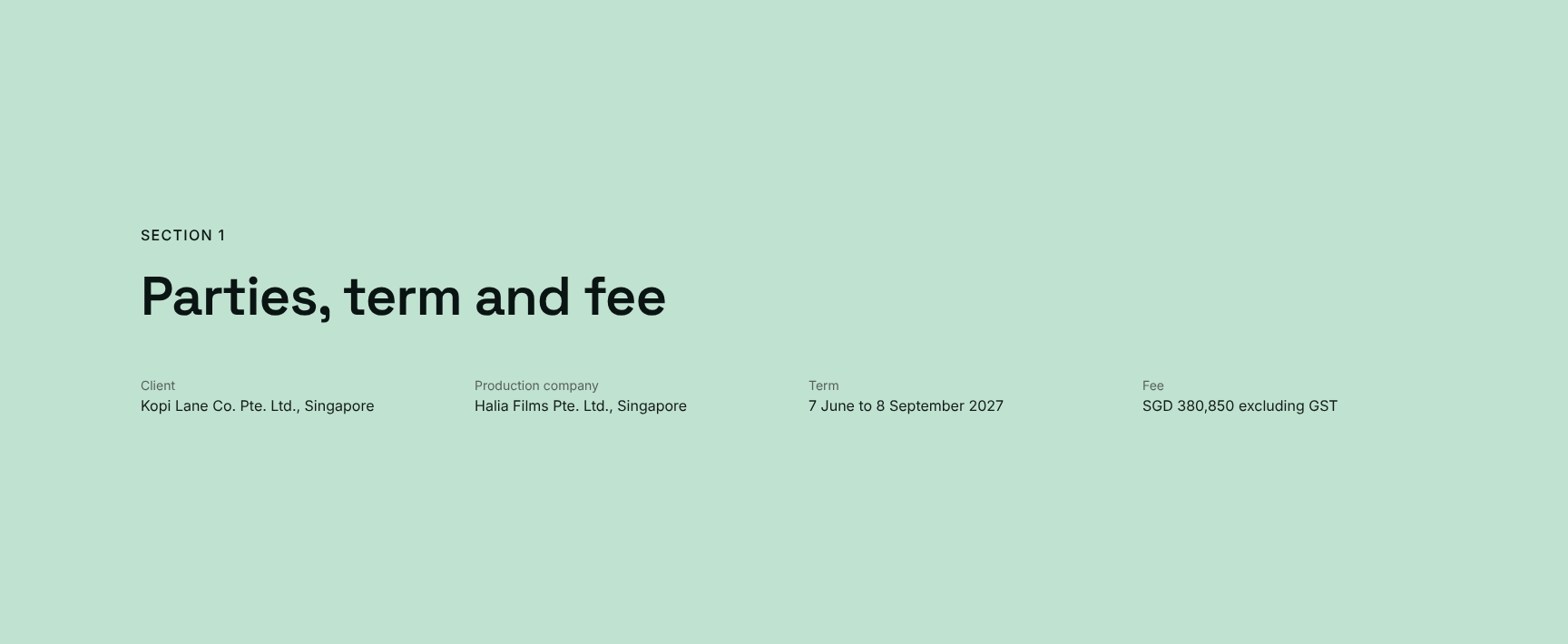
### Guiding Principle: One Shoot, Four Markets, Zero Reshoots
A bold statement that sums up the value of the approach: 120 deliverables from a single shoot. It gives decision-makers a memorable promise before the delivery detail.

### Delivery Method: Four-Day Shoot with Post-Production Localisation
Explains how one Singapore shoot with talent from four cities is localised in post rather than reshot. States the main risk, late script sign-off, so expectations are clear.
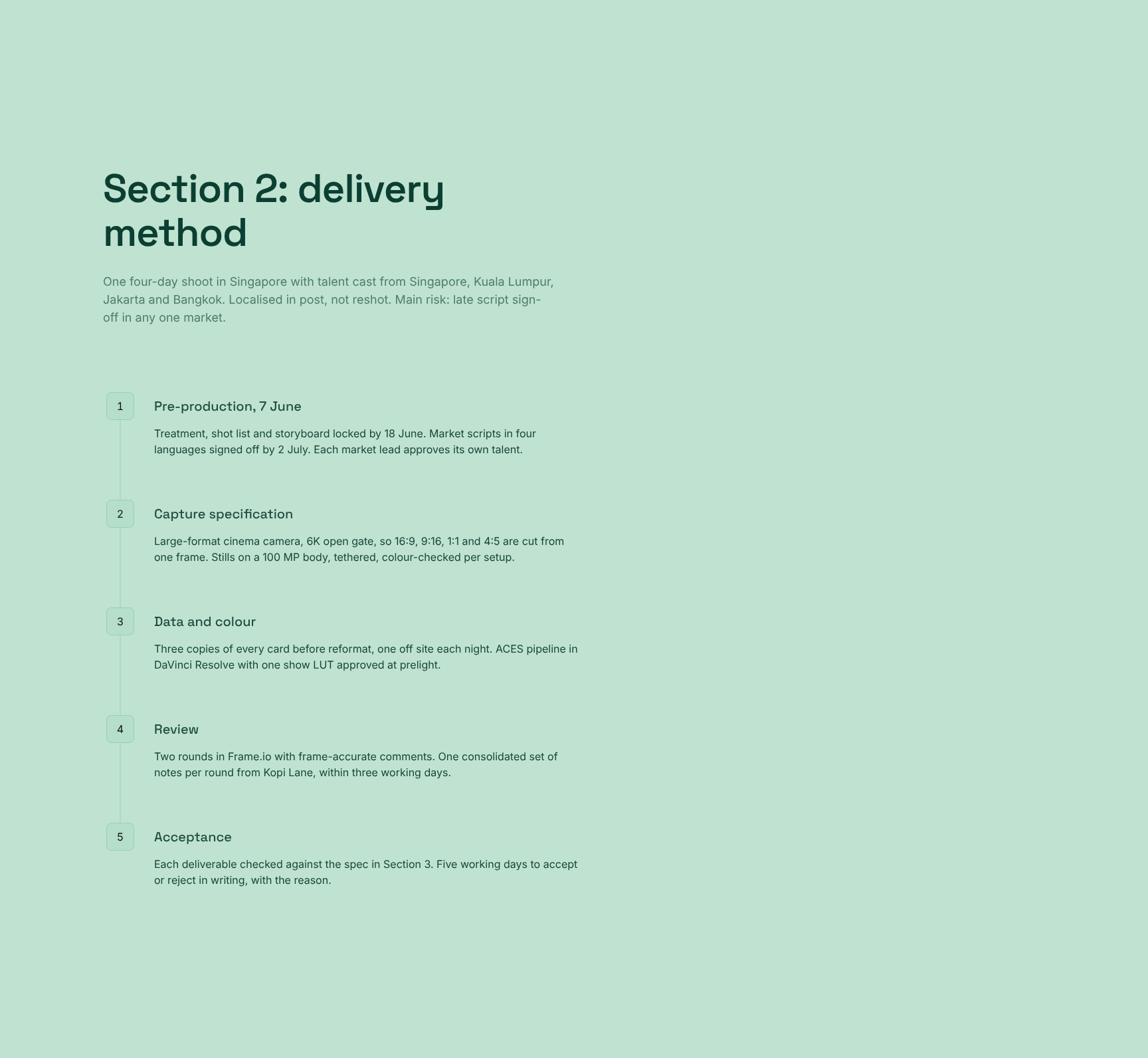
### Production Team Profile and Comparable Track Record
Introduces Halia Films, with its founding year, size and location, plus two comparable multi-market jobs. Names the two people accountable, which builds confidence in delivery.
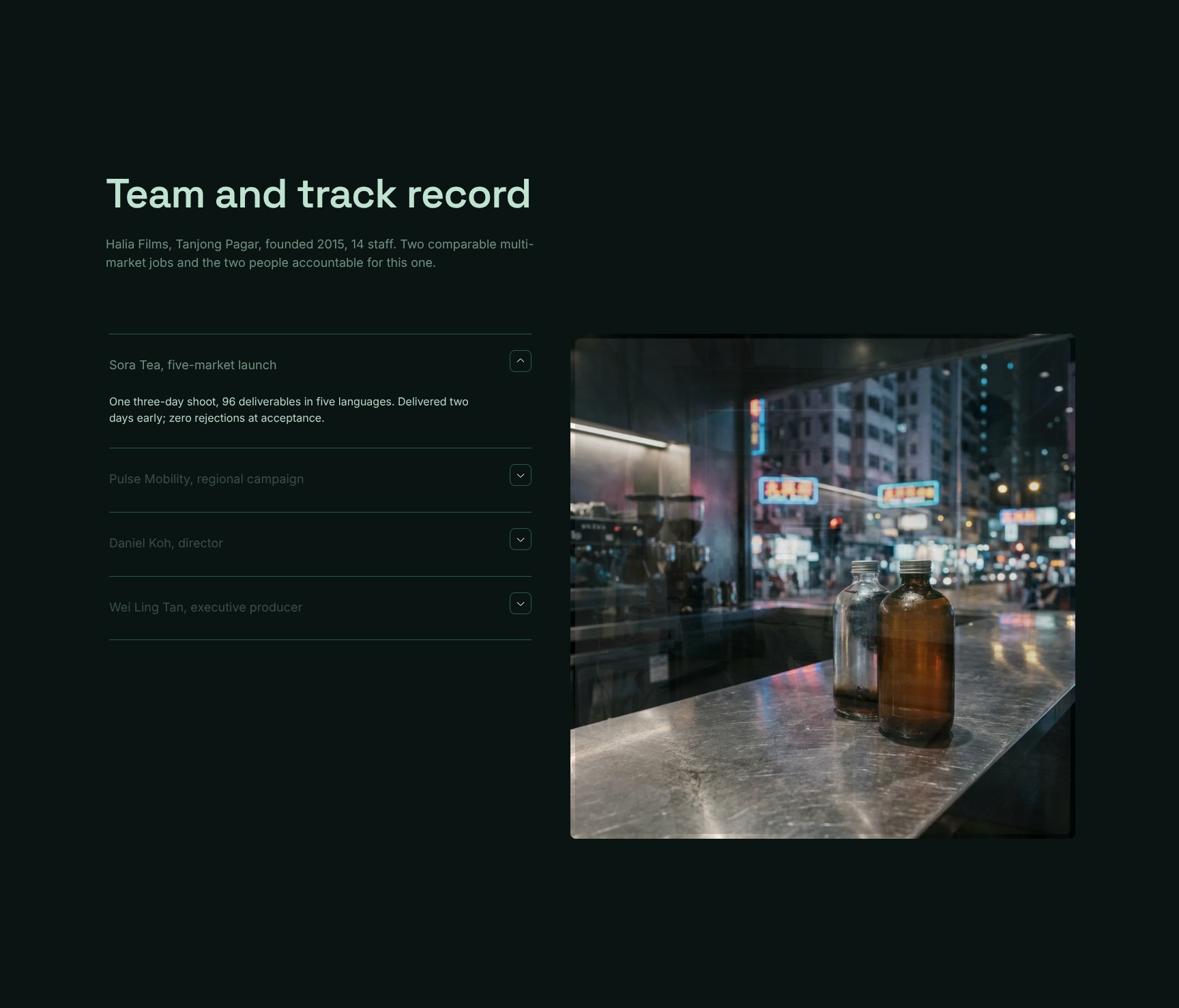
### Deliverables Specification and Acceptance Checklist
Lists all 120 deliverables by format, length and aspect ratio per market. Acceptance is checked line by line, which prevents scope disputes at handover.
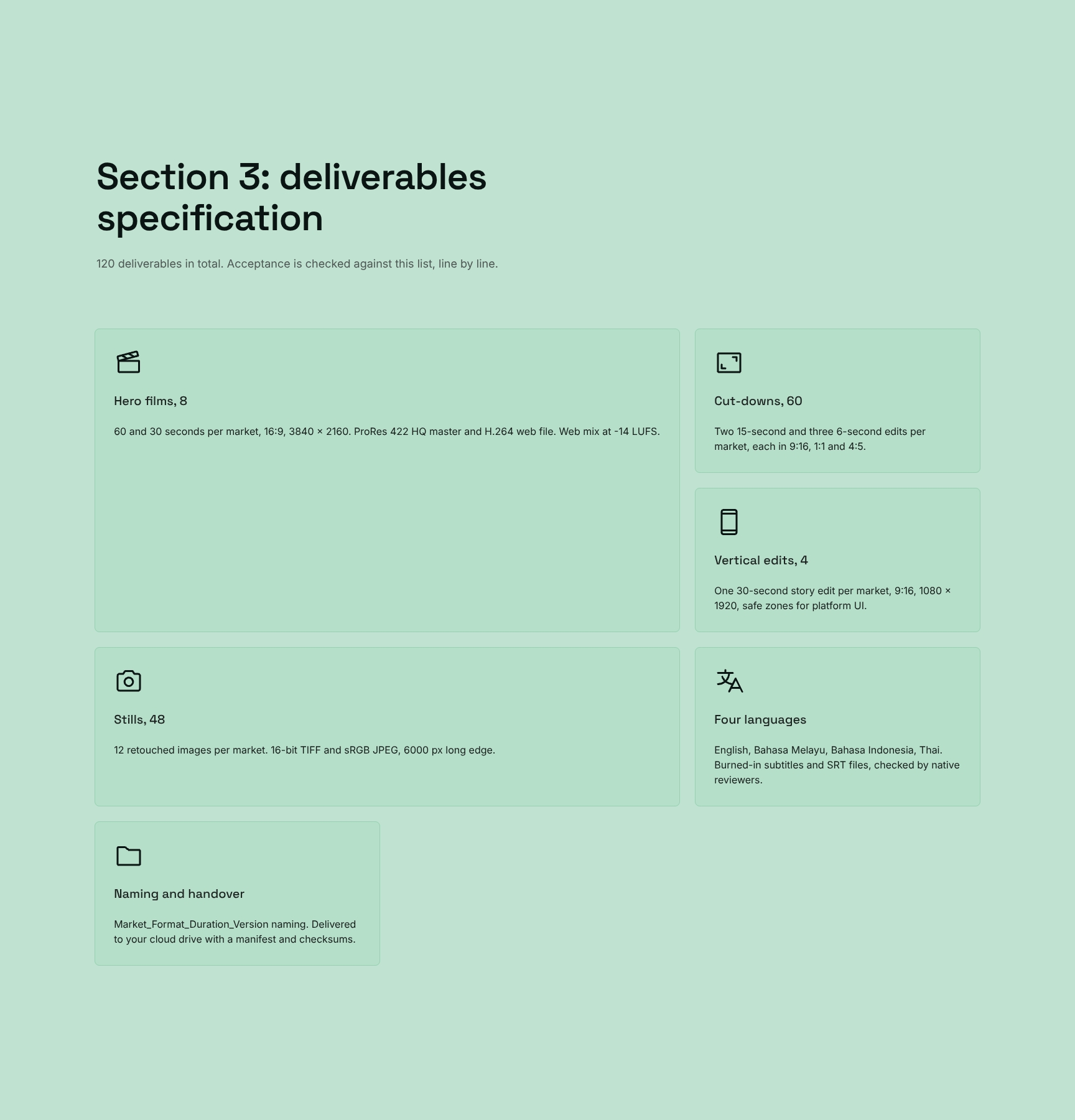
### Fees, Day Rates and Payment Schedule in SGD
Gives transparent day rates for director, DP, photographer, producer, editor and colourist, with GST treatment. Sets out the 40/40 milestone payment structure for clear cash-flow planning.
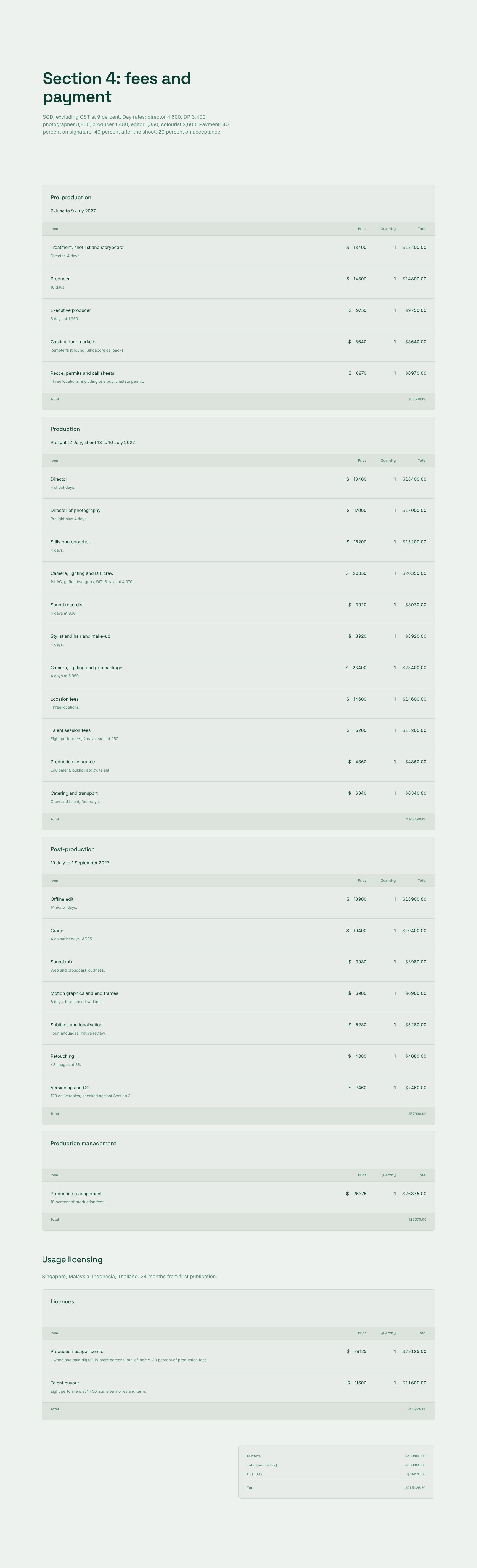
### Production Schedule with Fixed Dates and Change-Order Rules
Fixes the prelight and four shoot days and explains the effect of late script sign-off. A script signed after 2 July moves the shoot a week and is charged as a change order.
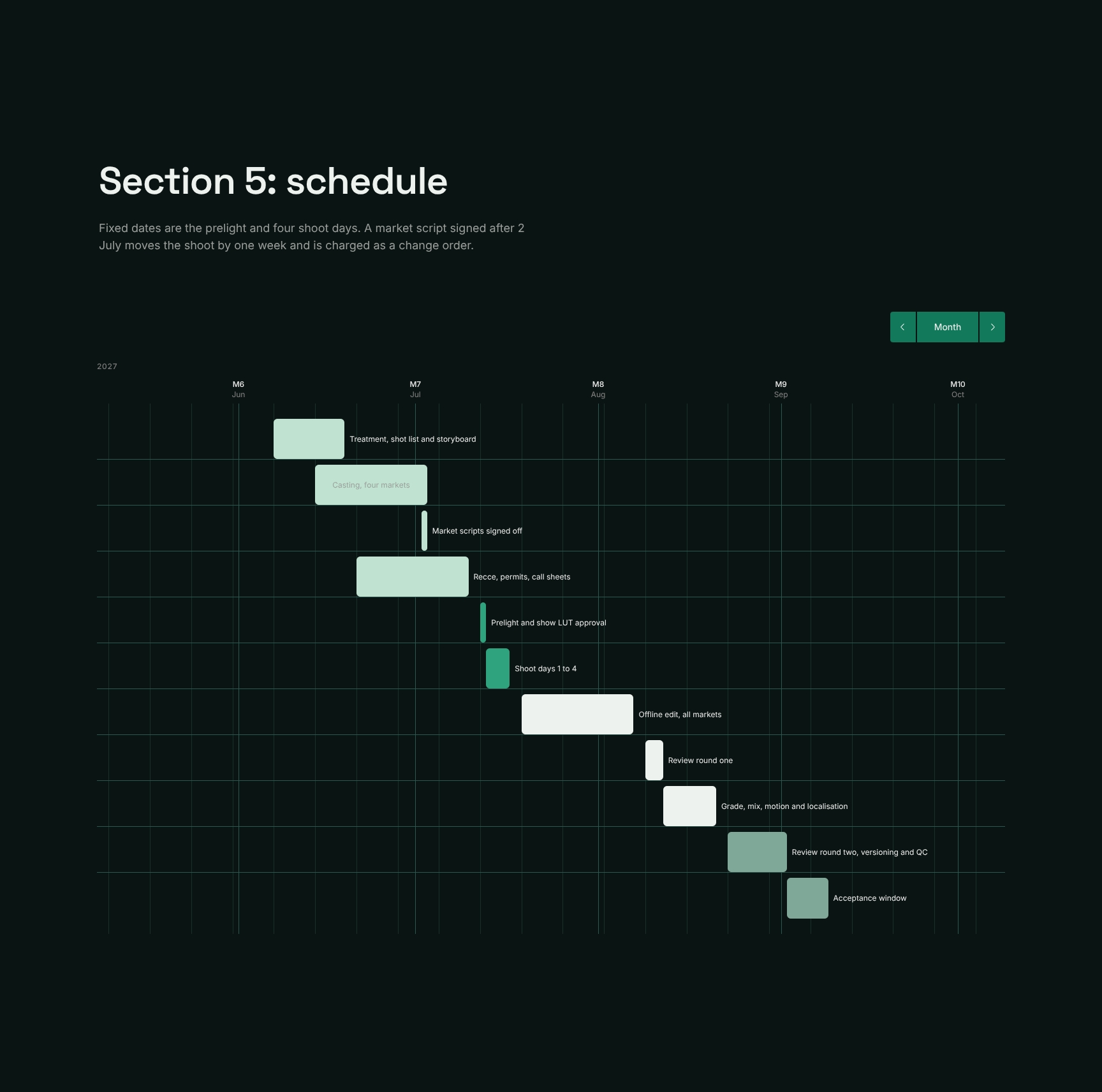
### Contract Terms: Usage Rights, Acceptance and Change Control
Expandable clauses covering usage, acceptance and changes in an easy-to-scan format. States that this SOW takes precedence over the 3 March 2027 master services agreement.
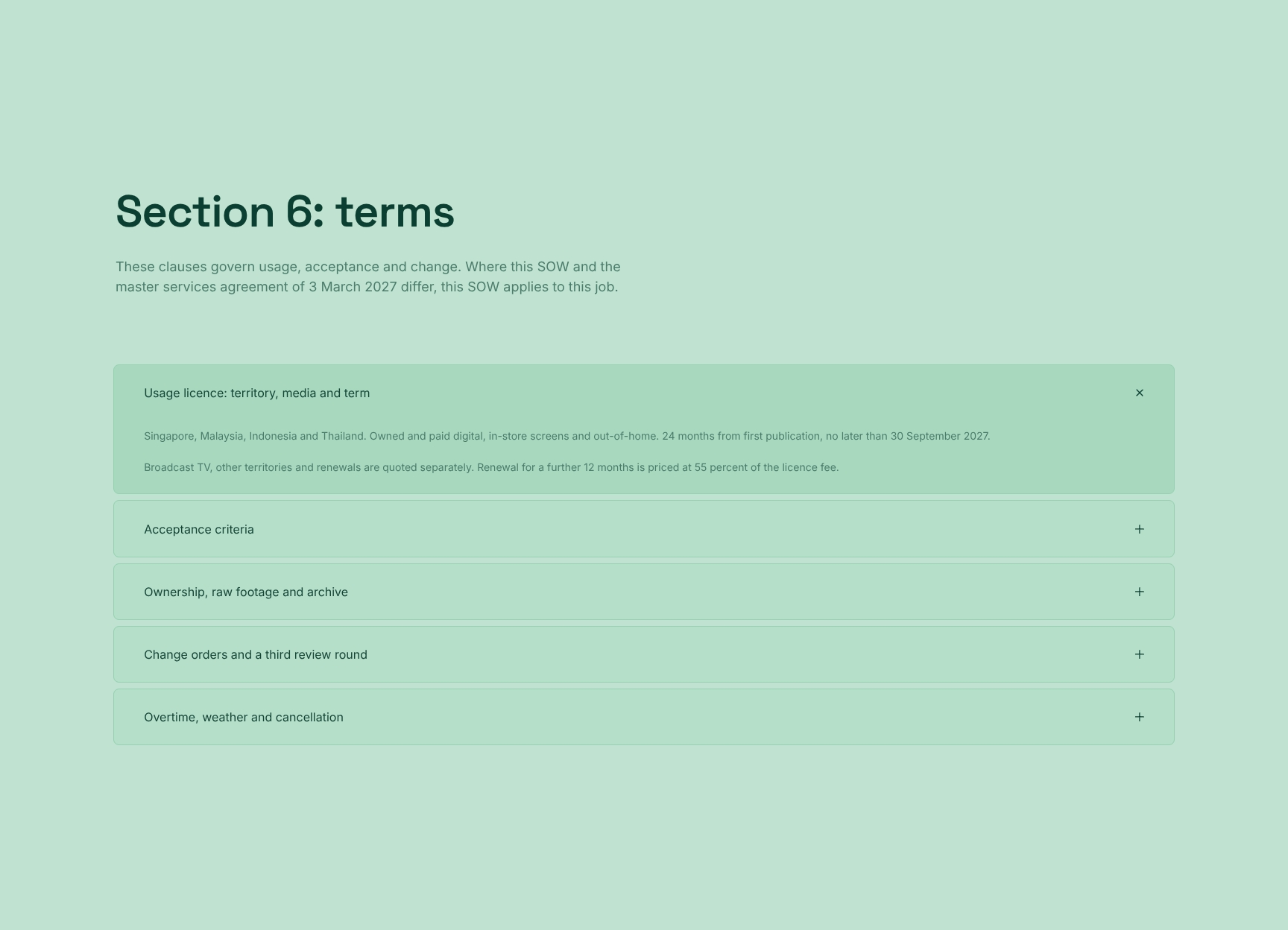
### Regional Client References and Testimonials
Quotes from regional marketing leaders confirm results on past multi-market work, including 96 deliverables with no rejections. Real proof that reduces perceived risk before signing.
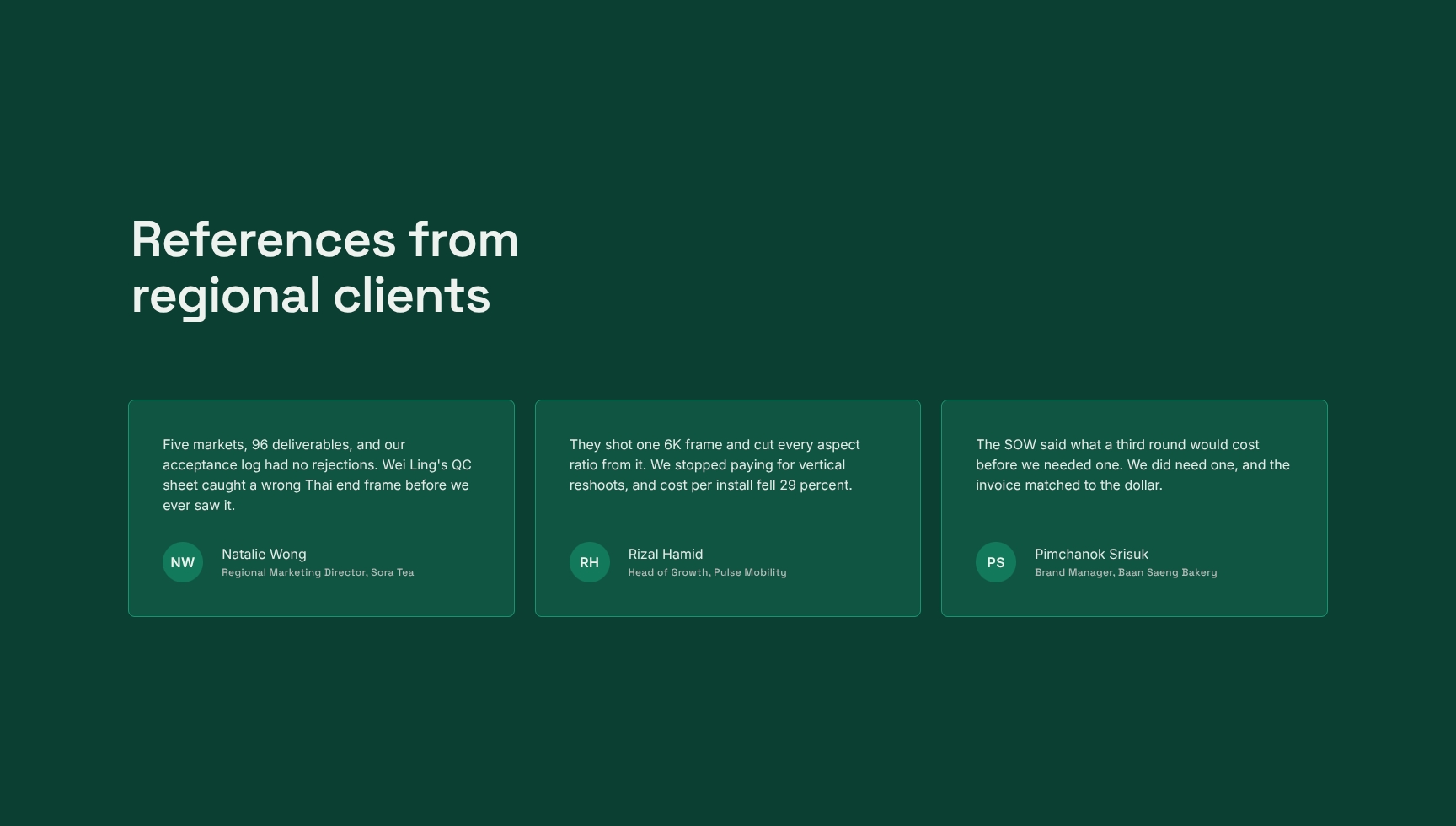
### Signature Block and Offer Validity Confirmation
Confirms the SOW is valid until 31 May 2027 and that crew and stage holds for 12 to 16 July are released on that date. Signing activates the schedule and gives a clear call to action.
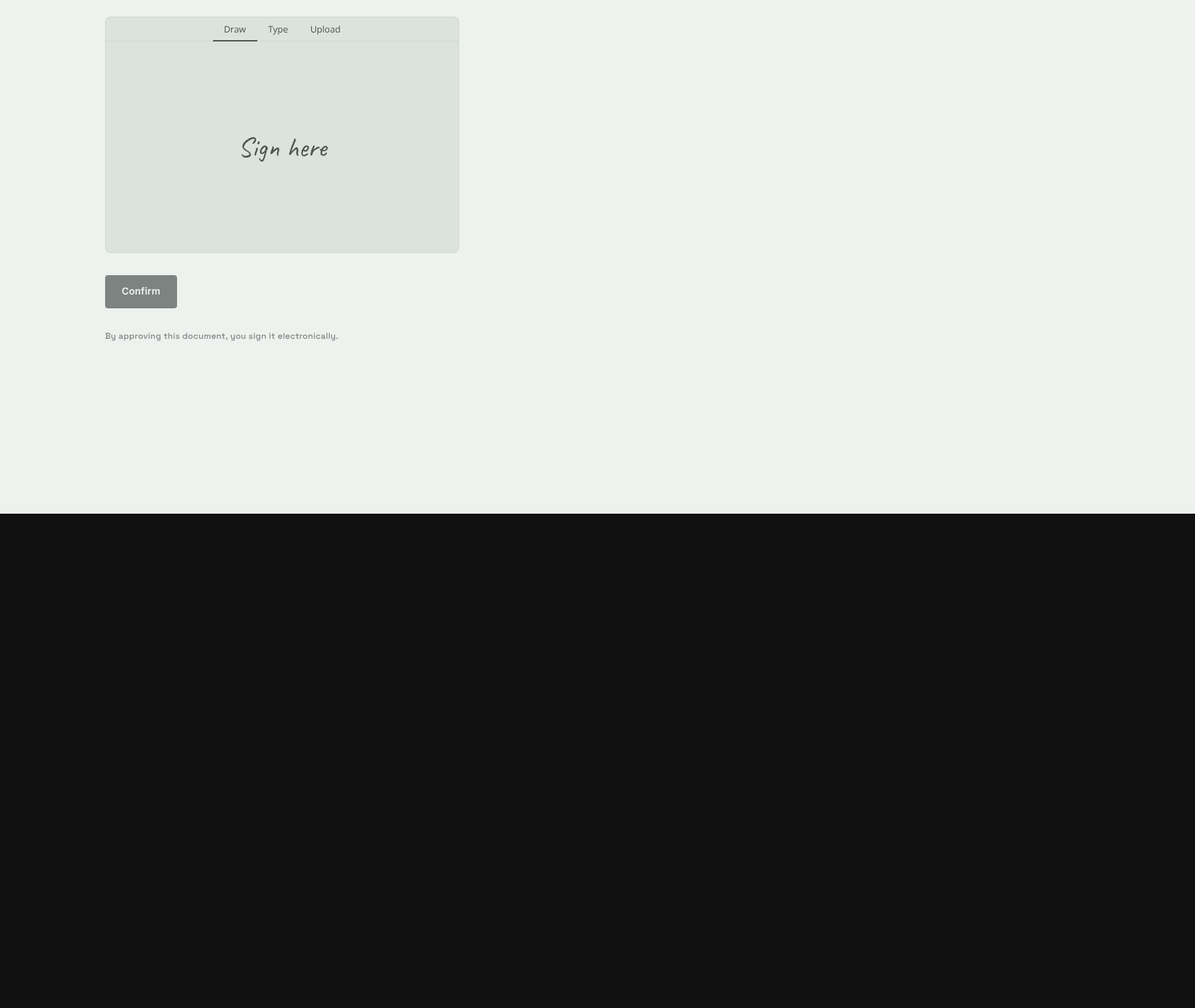
## Find your answers
Answers to common questions about writing and sending a statement of work for multi-market video shoots.
### What should be included in a business proposal template?
A strong business proposal includes a cover page, a parties and scope section, a statement of principle or approach, a delivery method, a team and track record section, and a detailed deliverables specification. Together these sections show the client who is involved, what you will do, how you will do it, and why you are qualified. Clear deliverables prevent scope creep and speed up approval.
### How do I customize this proposal template for my own business?
Start by replacing the cover details with your logo, brand colors, client name, and project title. Then edit each section: define the parties and scope, adjust the principle to match your approach, outline your delivery method, and add your team bios and past results. Finish by tailoring the deliverables spec with timelines, quantities, and acceptance criteria for the specific project.
### Can I export this proposal template to PDF or Word?
Yes, you can typically export the finished proposal to PDF for polished, client-ready sharing and to Word (.docx) for further editing or collaboration. PDF preserves your layout and fonts, while Word lets clients add comments or tracked changes. Always review page breaks and images after exporting to confirm the formatting stays intact.
### Is this proposal template suitable for freelancers, agencies, and consultants?
Yes, the structure works across industries including consulting, marketing, design, software development, and professional services. The parties and scope, delivery method, and deliverables spec sections can be adapted to project-based, retainer, or fixed-fee work. Freelancers can shorten the team section, while agencies can expand it with detailed bios and case studies.
### How do I write the team and track record section of a proposal?
Introduce the key people on the project with their roles, relevant experience, and one-line credentials. Add 2-3 past projects with measurable results, such as revenue growth, time saved, or delivery on schedule. Keep it focused on experience that matches the client's needs to build trust and justify your pricing.
## Related
- [Brooklyn](https://formlio.com/templates/brooklyn-brand-film-proposal): Brand film proposal for hospitality clients
- [Antwerp](https://formlio.com/templates/antwerp-photography-and-film-portfolio): Photo and film portfolio for creative studios
- [Oslo](https://formlio.com/templates/oslo-campaign-photography-estimate): Photography estimate with options for brands
- [Bristol](https://formlio.com/templates/bristol-launch-film-proposal): Launch film proposal for product marketing teams
- [Lyon](https://formlio.com/templates/lyon-hotel-website-proposal): Website proposal for multi-property hotel groups
- [Bordeaux](https://formlio.com/templates/bordeaux-launch-event-pitch): Hybrid launch event pitch for brands
---
---
title: "Portfolio template"
description: "Present your agency's capabilities with confidence. This portfolio template helps creative studios, design agencies, and consultancies display completed projects, core values, and service offerings in a format that builds trust and wins clients."
canonical: "https://formlio.com/templates/portfolio-template"
locale: "en"
type: "template"
lastModified: "2026-06-20"
category: "Marketing"
alternates:
fr: "https://formlio.com/fr/templates/portfolio-template.md"
---
# Portfolio template
Professional Portfolio Template for Agencies & Studios
Professional portfolio template designed for agencies, designers, and consultants. Features project showcases, company values, service offerings, and process workflows to present your work strategically and win clients.
- [Use this template](https://formlio.com/workspaces/claim?template=portfolio-template)
- [Live preview](https://formlio.com/documents/portfolio-template)
- **Categories:** [Marketing](https://formlio.com/templates/marketing), [Proposals](https://formlio.com/templates/proposals), [Colorful](https://formlio.com/templates/colorful)
- **Document goal:** Show your best work and win new clients with a portfolio that highlights results and builds trust.
- **Blocks:** Highlight, Scroll gradient, Grid 4x3, Six columns, Embed video, Grid flip-in, Marquee
- **Palette:** Deep Charcoal Black (#000000), Pure Canvas White (#FFFFFF), Refreshing Mint Accent (#8dd9bf), Sophisticated Espresso (#28211E), Soft Pearl Gray (#F5F5F5)
## Get more from every document
This template helps you present finished work and capabilities in a way that builds client confidence. It combines case studies, service details, and brand storytelling into a portfolio that moves prospects toward a conversation.
### Match every project's aesthetic
Adjust colors and type to reflect each body of work—no design software, no exports.
### Reuse your best layouts
Save hero sections, project grids, and case studies once, then drop them into new portfolios in seconds.
### Show work beautifully everywhere
Galleries, videos, and text adapt to any screen—clients see your projects as intended, always.
### See which projects hold attention
Heatmaps show which pieces prospects study longest so you know what resonates before the call.
### Know when clients open your book
Get pinged the moment a prospect views your portfolio or leaves a comment on a project.
### Build portfolios with your team
Edit case studies, swap images, and refine copy together in real time—no file ping-pong.
## See how every part fits
The structure opens with a bold brand statement and closes with a direct call to collaborate, guiding visitors from philosophy through process to action. You can drop sections, reorder them, or keep only what serves your studio's story.
### Bold Opening Statement with Animated Brand Message
Eye-catching hero section featuring large animated 'DISCOVER' text and compelling tagline that immediately communicates your agency's value proposition. Includes scrolling text effect and clear mission statement to capture visitor attention and set professional tone.

### Core Values and Philosophy Statement
Animated text section that articulates your agency's working principles and client relationship approach. Emphasizes trust, transparency, and quality delivery to build credibility and align expectations with potential clients before they see your work.
### Featured Project Showcase with Case Studies
Comprehensive portfolio grid displaying nine diverse projects with visual previews. Demonstrates range across strategy, design, and delivery services while providing quick access to detailed case studies that prove your expertise and results.
### Service Offerings and Capabilities Overview
Clear breakdown of your focused service areas with detailed descriptions. Helps prospects quickly understand what you offer and whether you're the right fit, reducing qualification time and attracting ideal clients who need your specific expertise.
### Behind-the-Scenes Process Video Section
Engaging video content showcasing your team, methodology, and working style. Builds personal connection and trust by giving prospects insight into how you operate and why clients return, differentiating you from competitors through transparency.
### Visual Work Samples and Brand Photography
Curated image gallery displaying additional work samples, team photos, or project details. Provides visual proof of quality and professionalism while breaking up text-heavy sections to maintain engagement throughout the page.
### Collaboration Call-to-Action with Impact Statement
Animated partnership invitation that transitions visitors from browsing to action. Creates momentum toward contact by reinforcing your collaborative approach and positioning the next step as a conversation rather than a sales pitch.

### Contact Form with Response Time Guarantee
Dedicated contact section with clear headline, responsive form, and one-business-day response commitment. Reduces friction in reaching out while setting professional expectations and demonstrating reliability before the first conversation.
## Find your answers
Common questions about building and customizing portfolios for creative agencies and studios.
### How do I customize the portfolio template sections?
This portfolio template includes fully editable sections for Intro, Our Values, Portfolio showcase, Process overview, and Gallery. You can easily modify text, images, colors, and layouts to match your brand identity. Each section is designed with flexible components that adapt to your content needs. Simply replace placeholder content with your own work samples and company information.
### What file formats can I export this portfolio template to?
The portfolio template supports export to multiple professional formats including PDF, PNG, and web-ready HTML/CSS. PDF exports maintain high-resolution quality perfect for client presentations and print materials. Web exports are optimized for responsive display across all devices and can be directly integrated into your website.
### Can I use this portfolio template for commercial client projects?
Yes, this portfolio template comes with a commercial license allowing use for both personal and client projects. You can customize and rebrand the template for multiple clients without additional fees. The license covers unlimited projects, making it ideal for agencies and freelancers serving various industries.
### Is this portfolio template suitable for creative agencies and freelancers?
Absolutely. The template is specifically designed for creative professionals including designers, photographers, agencies, and consultants. The Portfolio and Gallery sections showcase visual work effectively, while Our Values and Process sections establish credibility and methodology. The flexible structure adapts to various creative industries from graphic design to architecture.
### Does this portfolio template work with design software like Figma or Adobe XD?
Yes, the portfolio template is compatible with major design tools including Figma, Adobe XD, Sketch, and Canva. All design elements are fully editable vectors and organized in clearly labeled layers for easy customization. You can seamlessly integrate the template into your existing design workflow and modify it using your preferred software.
## Related
- [Boston](https://formlio.com/templates/boston-event-retainer-proposal): Monthly event retainer proposal for brands
- [Toronto](https://formlio.com/templates/toronto-brand-relaunch-proposal): Creative campaign proposal for consumer brands
- [Dublin](https://formlio.com/templates/dublin-launch-campaign-proposal): Integrated launch campaign proposal for consumer brands
- [Manchester](https://formlio.com/templates/manchester-marketing-statement-of-work): Paid media and lifecycle SOW for agencies
- [Bristol](https://formlio.com/templates/bristol-launch-film-proposal): Launch film proposal for product marketing teams
- [Detailed proposal template](https://formlio.com/templates/detailed-proposal-template): Complete Business Engagement Framework with Strategy & Execution
---
---
title: "Creative pitch template"
description: "Professional creative agency pitch template featuring brand analysis, moodboard sections, and strategic positioning. Perfect for design studios and creative teams pitching brand partnerships, visual identity projects, and creative direction services to clients seeking premium brand transformation."
canonical: "https://formlio.com/templates/creative-pitch-template"
locale: "en"
type: "template"
lastModified: "2026-07-12"
alternates:
fr: "https://formlio.com/fr/templates/creative-pitch-template.md"
---
# Creative pitch template
Creative Agency Pitch Template
Professional creative pitch template for agencies presenting brand transformation strategies. Includes visual identity assessment, competitive positioning analysis, and creative direction frameworks to win premium clients.

- [Use this template](https://formlio.com/workspaces/claim?template=creative-pitch-template)
- [Live preview](https://formlio.com/documents/creative-pitch-template)
- **Categories:** [Dark](https://formlio.com/templates/dark), [Minimal](https://formlio.com/templates/minimal), [Modern](https://formlio.com/templates/modern), [Monochromatic](https://formlio.com/templates/monochromatic)
- **Document goal:** Pitch your creative vision and win brand partnership projects with a strategic proposal.
- **Blocks:** Highlight, Six columns, Grid flip-in, Scroll gradient, Grid 4x3, Tiered packages, Marquee
- **Palette:** Pure Black Foundation (#000000), Clean White Canvas (#FFFFFF), Sophisticated Silver (#d9d9d9), Professional Charcoal (#797979), Whisper Gray Background (#F5F5F5)
## Get more from every document
This template helps you pitch brand partnerships that show you understand the client's challenge before proposing your solution. It pairs strategic analysis with visual direction so your creative vision lands with clarity.
### Match your client's brand instantly
Swap colours and fonts to mirror the prospect's identity—show them you've done your homework.
### Reuse your best proposal sections
Drop in your proven case studies, pricing tables, and testimonials so every pitch feels custom but ships in minutes.
### Clients read proposals on their phone
Your layout stays sharp whether they open it in the boardroom or on the train home.
### See which services they linger on
Heatmaps show the pricing tier they re-read and the portfolio piece that held their attention longest.
### Know the moment they open it
Get pinged when the decision-maker views your proposal so you can follow up while you're top of mind.
### Your team refines the pitch together
Copywriter, designer, and account lead all edit live so the proposal goes out polished and on-message.
## See how every part fits
The structure opens with the client's brand challenge, builds through your creative process and philosophy, and closes with pricing and next steps. Keep the sections that match your pitch style, drop what doesn't fit, or reorder them to follow your agency's rhythm.
### Creative Partnership Introduction & Pitch Overview
Opening hero section that establishes the creative vision and partnership approach. Sets the tone for the entire proposal with bold typography and compelling messaging that positions your agency as the right team to elevate their brand presence.
### Brand Challenge Analysis & Opportunity Statement
Diagnostic section identifying the gap between client's product excellence and their current visual identity. Clearly articulates the problem your creative services will solve, building urgency and demonstrating deep understanding of their business needs.
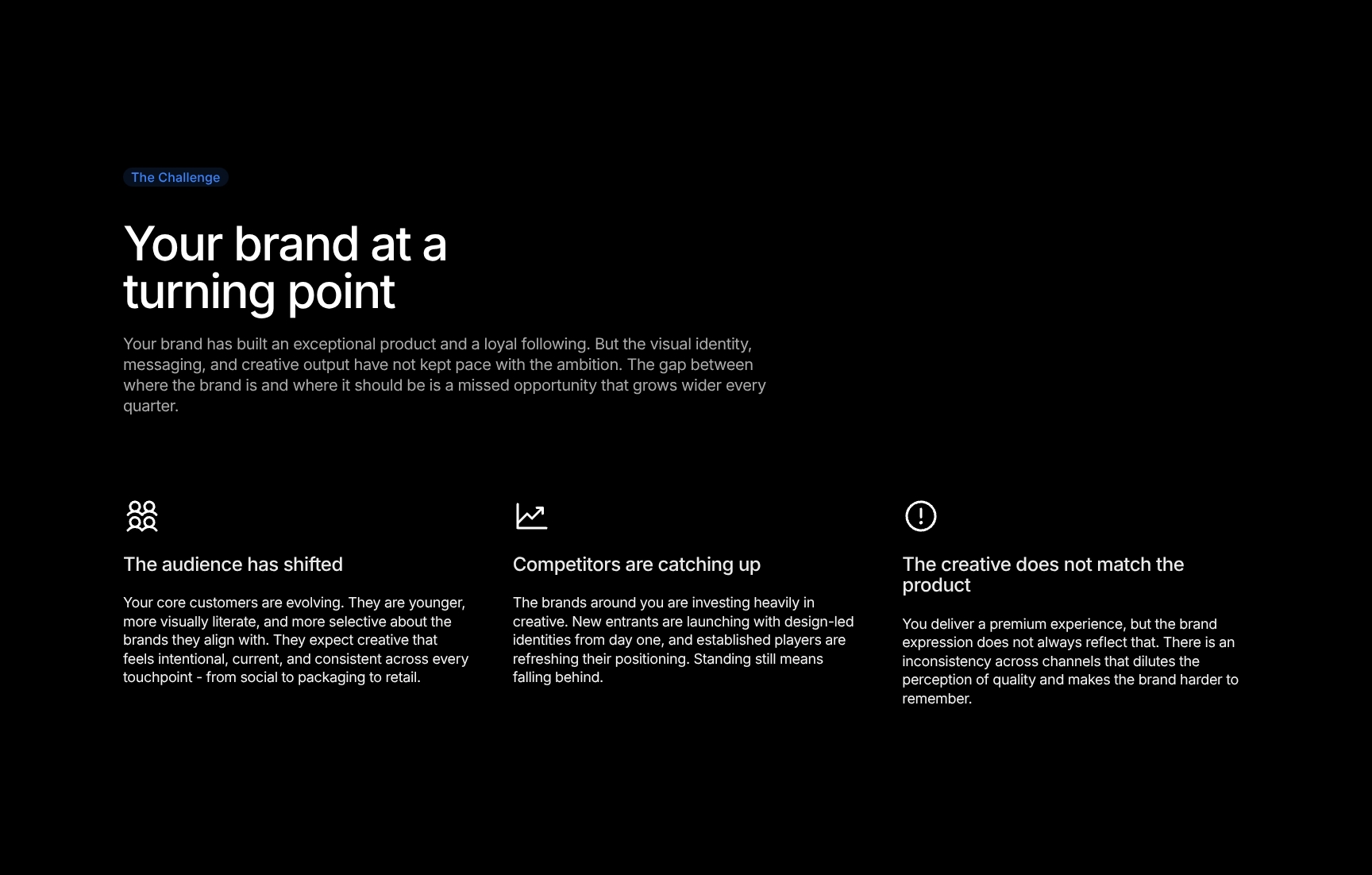
### Agency Mission Statement & Brand Promise
Impactful hero section showcasing your core value proposition with minimal, confident messaging. Communicates what makes your agency different and why brands choose to work with you through powerful visual design.

### Visual Moodboard & Creative Direction Strategy
Gallery-based section presenting curated visual inspiration and creative direction for the client's brand. Shows quiet confidence aesthetic with distinctive imagery that demonstrates your strategic vision and sets design expectations for the engagement.
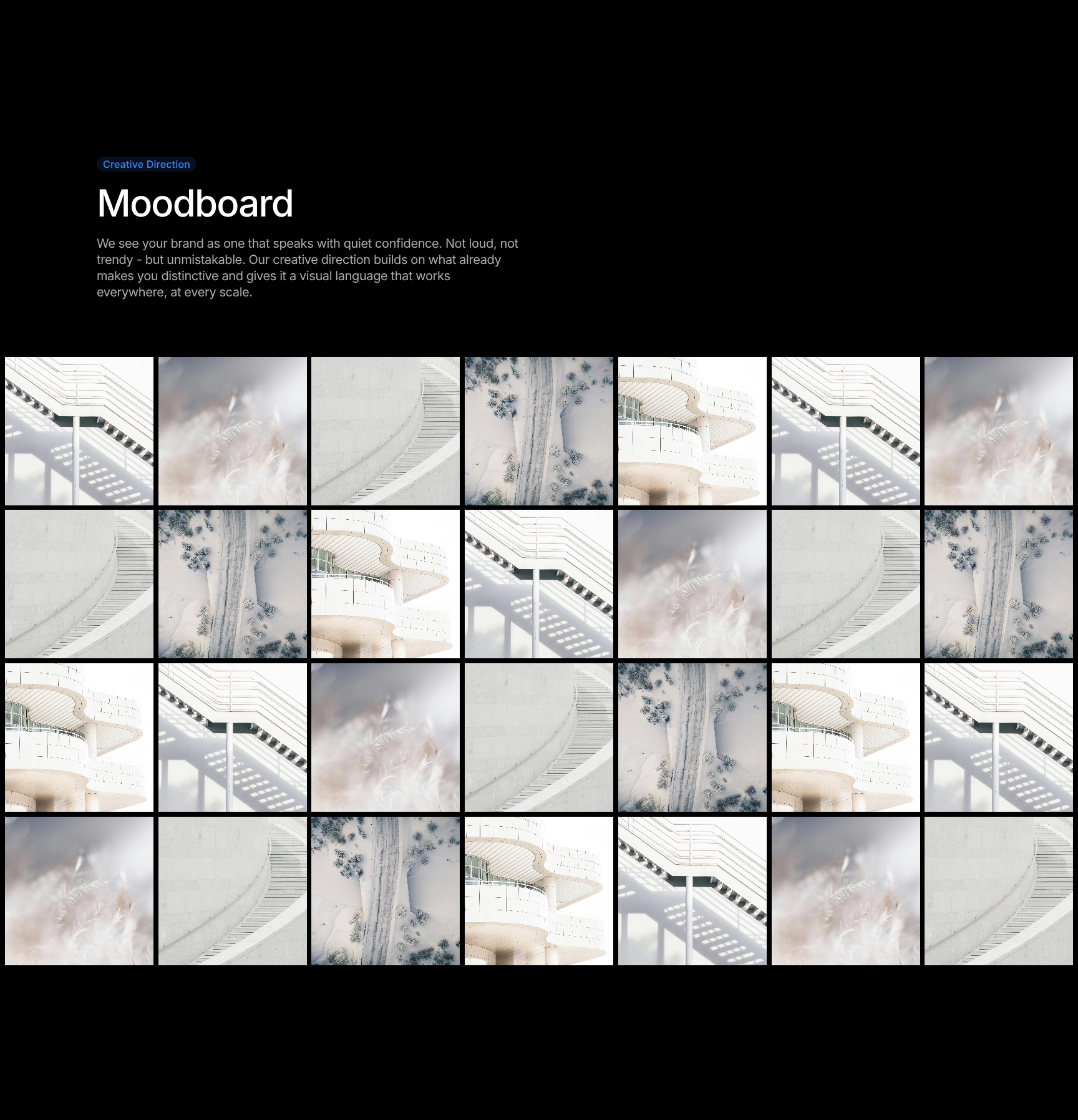
### Structured Creative Process & Project Workflow
Process overview section detailing your agency's methodology from insight through execution. Removes uncertainty by clearly outlining phases, deliverables, and collaboration touchpoints so clients know exactly what to expect at every stage.
### Brand Consistency Philosophy & Values Statement
Animated text section emphasizing your commitment to cohesive brand building across all touchpoints. Reinforces that great brands are built through consistent small moments, highlighting your attention to detail and strategic thinking.
### Premium Brand Case Studies & Portfolio Showcase
Portfolio section featuring three relevant case studies of premium products that needed elevated creative identities. Demonstrates proven experience with similar challenges and showcases tangible results delivered for comparable brands.
### Agency Track Record & Performance Metrics
Credibility-building section presenting quantitative proof of your decade-plus experience and impact. Includes studio statistics and key performance indicators that validate your expertise and demonstrate the measurable value you deliver to clients.
### Dedicated Account Team & Key Personnel
Portfolio-style team introduction ensuring clients know exactly who will work on their account from pitch through delivery. Builds trust by showcasing senior-level commitment and eliminating concerns about work being delegated to junior staff.

### Detailed Pricing Breakdown & Investment Scope
Transparent pricing section breaking down the full engagement scope by deliverable with clear fee structure. Shows exactly where budget is allocated against the brief, eliminating surprises and demonstrating value for every line item.
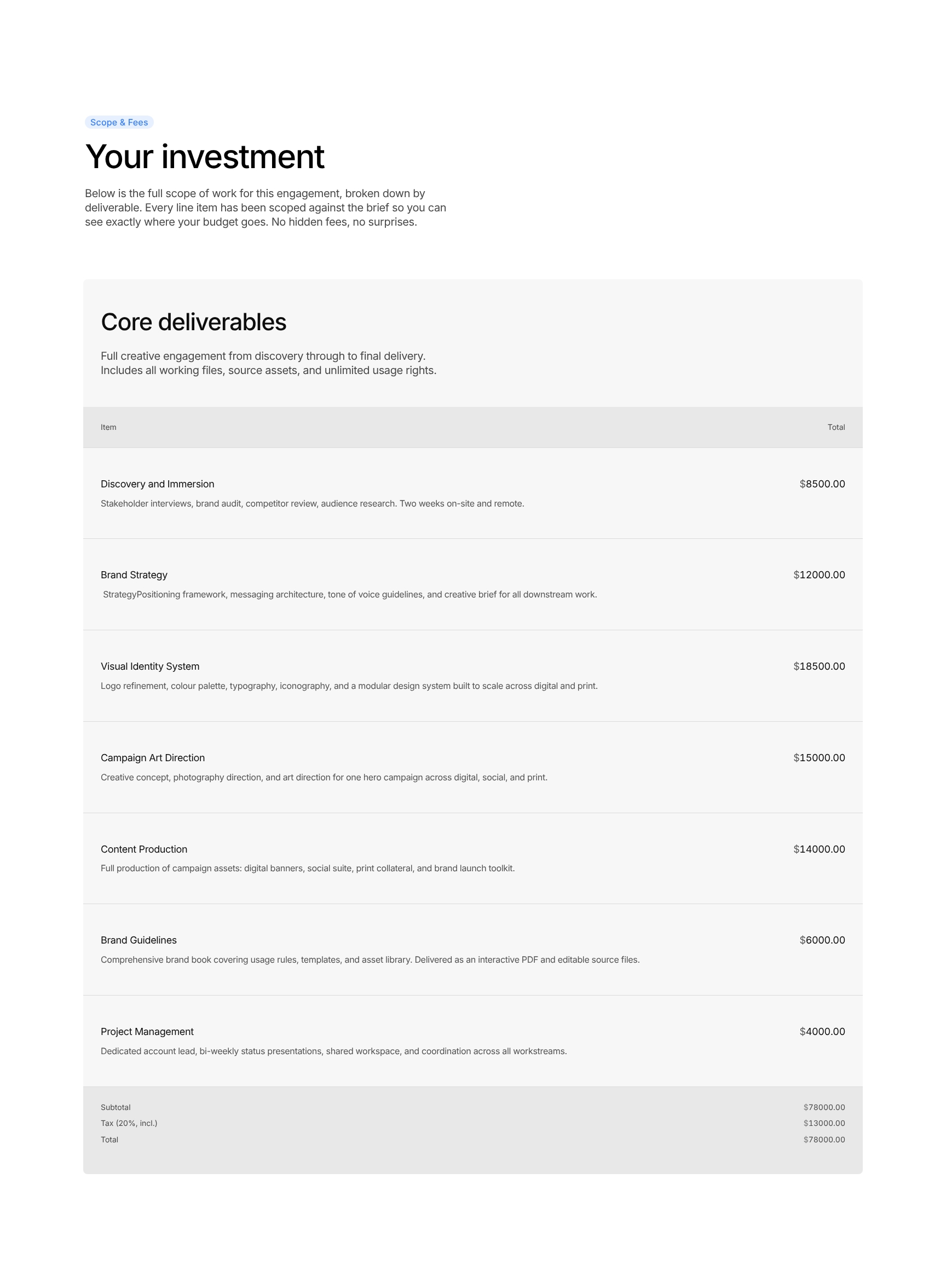
### Next Steps & Engagement Timeline
Clear call-to-action section outlining exactly what happens after approval. Demonstrates your ability to move quickly while keeping clients informed, reducing friction in the decision-making process and setting expectations for project kickoff.
### Closing Thank You & Final Impression
Gracious closing section with animated typography that leaves a lasting positive impression. Reinforces professionalism and appreciation while maintaining the elevated creative aesthetic established throughout the proposal.
## Find your answers
Common questions about pitching creative agency services and structuring brand partnership proposals.
### What should be included in a professional proposal template?
A professional proposal template should include a compelling hero section with your value proposition, detailed project scope and methodology sections, visual galleries to showcase past work or concepts, and a clear values statement that demonstrates your company's principles. This template structure includes all essential components: executive summary, project details, pricing, timeline, and terms that help convert prospects into clients.
### How do I customize this proposal template for my business?
You can fully customize every section of this template including the hero banner, text content, image galleries, and values statements to match your brand identity. Simply replace the placeholder content with your company information, add your logo and brand colors, and modify the sections to highlight your specific services and unique selling propositions. The flexible layout adapts to various industries from consulting to creative services.
### Can I export this proposal template to PDF or other formats?
Yes, this proposal template can be exported to multiple formats including PDF for client presentation, Word/DOCX for collaborative editing, and HTML for web-based delivery. The export functionality preserves all formatting, images, and layout integrity, ensuring your proposal looks professional across all platforms and devices your clients may use to review it.
### Is this proposal template suitable for different industries?
This template works across multiple industries including consulting, marketing, design, development, construction, and professional services. The modular section structure with hero areas, detailed text sections, galleries, and values statements can be adapted to emphasize industry-specific requirements, whether showcasing technical capabilities, creative portfolios, or service methodologies.
### How long does it take to complete a proposal using this template?
With this pre-structured template, you can create a professional proposal in 30-60 minutes instead of starting from scratch. Simply fill in your project-specific details in the text sections, upload relevant images to the gallery, and customize the hero and values sections with your company information. The time-saving structure allows you to focus on crafting compelling content rather than design and formatting.
## Related
- [Lyon](https://formlio.com/templates/lyon-hotel-website-proposal): Website proposal for multi-property hotel groups
- [Bordeaux](https://formlio.com/templates/bordeaux-launch-event-pitch): Hybrid launch event pitch for brands
- [Boston](https://formlio.com/templates/boston-event-retainer-proposal): Monthly event retainer proposal for brands
- [Cardiff](https://formlio.com/templates/cardiff-website-care-plan-proposal): Monthly care plan proposal for festival organisers
- [Cambridge](https://formlio.com/templates/cambridge-design-studio-portfolio): Web design studio portfolio for research clients
- [Portland](https://formlio.com/templates/portland-app-redesign-proposal): App redesign pitch for subscription startups
---
---
title: "Detailed proposal template"
description: "Comprehensive project proposal template for agencies and consultants. Includes strategy roadmap, scope of work, deliverables breakdown, and phased engagement structure. Perfect for presenting multi-phase projects with clear KPIs and measurable outcomes."
canonical: "https://formlio.com/templates/detailed-proposal-template"
locale: "en"
type: "template"
lastModified: "2026-10-20"
category: "Marketing"
alternates:
fr: "https://formlio.com/fr/templates/detailed-proposal-template.md"
---
# Detailed proposal template
Business Project Proposal Template
Comprehensive project proposal template for agencies and consultants. Includes phased engagement structure, scope of work, deliverables mapping, and stakeholder alignment sections to win clients and deliver measurable results.
- [Use this template](https://formlio.com/workspaces/claim?template=detailed-proposal-template)
- [Live preview](https://formlio.com/documents/detailed-proposal-template)
- **Categories:** [Marketing](https://formlio.com/templates/marketing), [Proposals](https://formlio.com/templates/proposals), [Animated](https://formlio.com/templates/animated), [Large Type](https://formlio.com/templates/large-type), [Typographic](https://formlio.com/templates/typographic)
- **Document goal:** Win client projects with a structured proposal that breaks down strategy, deliverables, and timelines.
- **Blocks:** Highlight, Marquee, Six columns, Grid tile scroll, Carousel, Scroll gradient, Alternating column, Gantt, Tiered packages, E-signature, Itemized quote
- **Palette:** Pure Black Foundation (#000000), Clean White Canvas (#FFFFFF), Warm Taupe Accent (#9c8b7e), Rich Espresso Dark (#352D28), Soft Linen Light (#D5D2CD)
## Get more from every document
This template helps you close client projects with a proposal that covers strategy, scope, and execution in one document. You get timeline builders, pricing tables, and approval flows built in.
### Close the deal in-document
Client signs your proposal without leaving the page—no PDF email chains, no friction between yes and done.
### Reuse your best proposal sections
Drop in your proven case studies, pricing tables, and scope blocks—ship polished proposals in half the time.
### Clients read on any device
Your proposal looks sharp whether they open it on their phone during lunch or at their desk after hours.
### See which sections win clients
Watch where prospects pause on pricing, replay their session, and follow up when interest peaks.
### Know the moment they open it
Get pinged when your proposal is viewed, when they leave a comment, or when they're ready to sign.
### Build proposals with your team
You draft scope, your designer tweaks visuals, your PM adds timelines—all live, no version chaos.
## See how every part fits
The proposal opens with your capabilities and situation analysis, moves through scope and team credentials, then closes with timeline, pricing, and signature. Keep every section, drop what doesn't fit your project, or reorder to match how you sell.
### Executive Project Proposal Header with Visual Impact
Professional opening section featuring bold project title, executive summary preview, and compelling value proposition. Sets the tone with immediate credibility and clear positioning of your comprehensive proposal approach.
### Service Capabilities Showcase with Dynamic Animation
Eye-catching animated display of core service offerings including strategy, design, copywriting, launch, and ongoing support. Creates visual interest while communicating your full-service capabilities at a glance.

### Situation Analysis and Partnership Overview
Strategic overview section addressing client's current challenges, growth stage, and transformation needs. Positions your proposal as the solution to bridge their gap between current state and future goals with partnership-focused messaging.
### Detailed Scope of Work and Deliverables Breakdown
Comprehensive deliverables section organized by workstreams with clear milestones. Provides complete transparency on what's included, eliminating ambiguity and setting clear expectations for project phases and outputs.
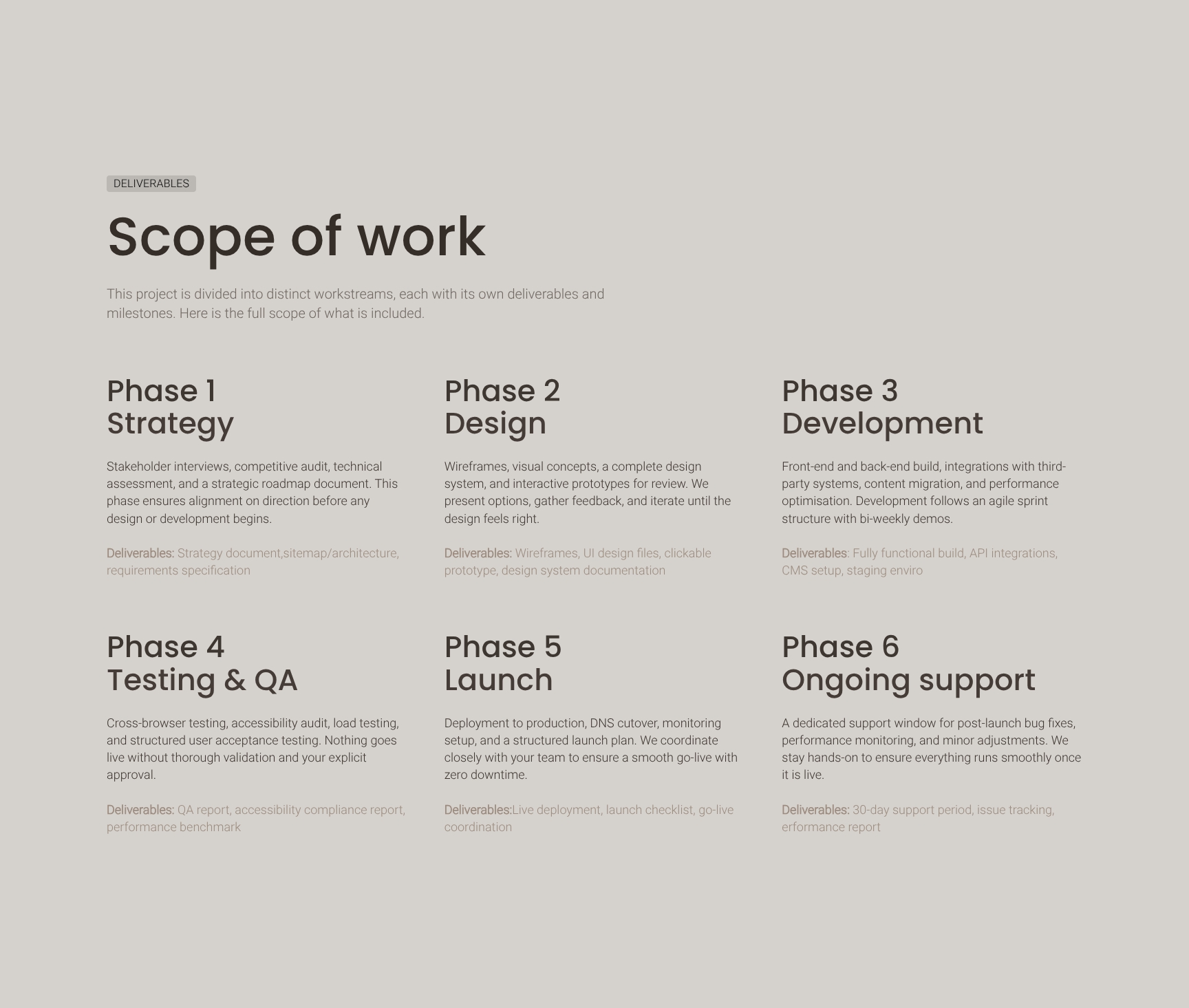
### Portfolio Gallery with Recent Project Showcase
Visual gallery displaying recent work samples that demonstrate quality, attention to detail, and range. Builds confidence by showing tangible examples of deliverables created through your structured collaborative process.
### Dedicated Team Member Profiles and Expertise
Introduces key team members who will drive the project from kickoff to launch. Personalizes the proposal by showcasing the specific experts, their roles, and qualifications assigned to this engagement.
### Partnership Philosophy and Collaboration Statement
Animated section emphasizing collaborative approach and partnership values. Reinforces that great results require combined expertise and vision, positioning the engagement as a true partnership rather than vendor relationship.
### Case Studies and Proven Track Record Portfolio
Showcases previous multi-phase engagements across industries that mirror the proposed scope. Demonstrates experience with similar complexity and builds credibility through relevant past project success stories.
### Studio Credentials and Impact Metrics
Data-driven section featuring years in business, key statistics, and measurable impact delivered. Provides quantifiable proof points about studio capabilities and the tangible results your work generates for clients.
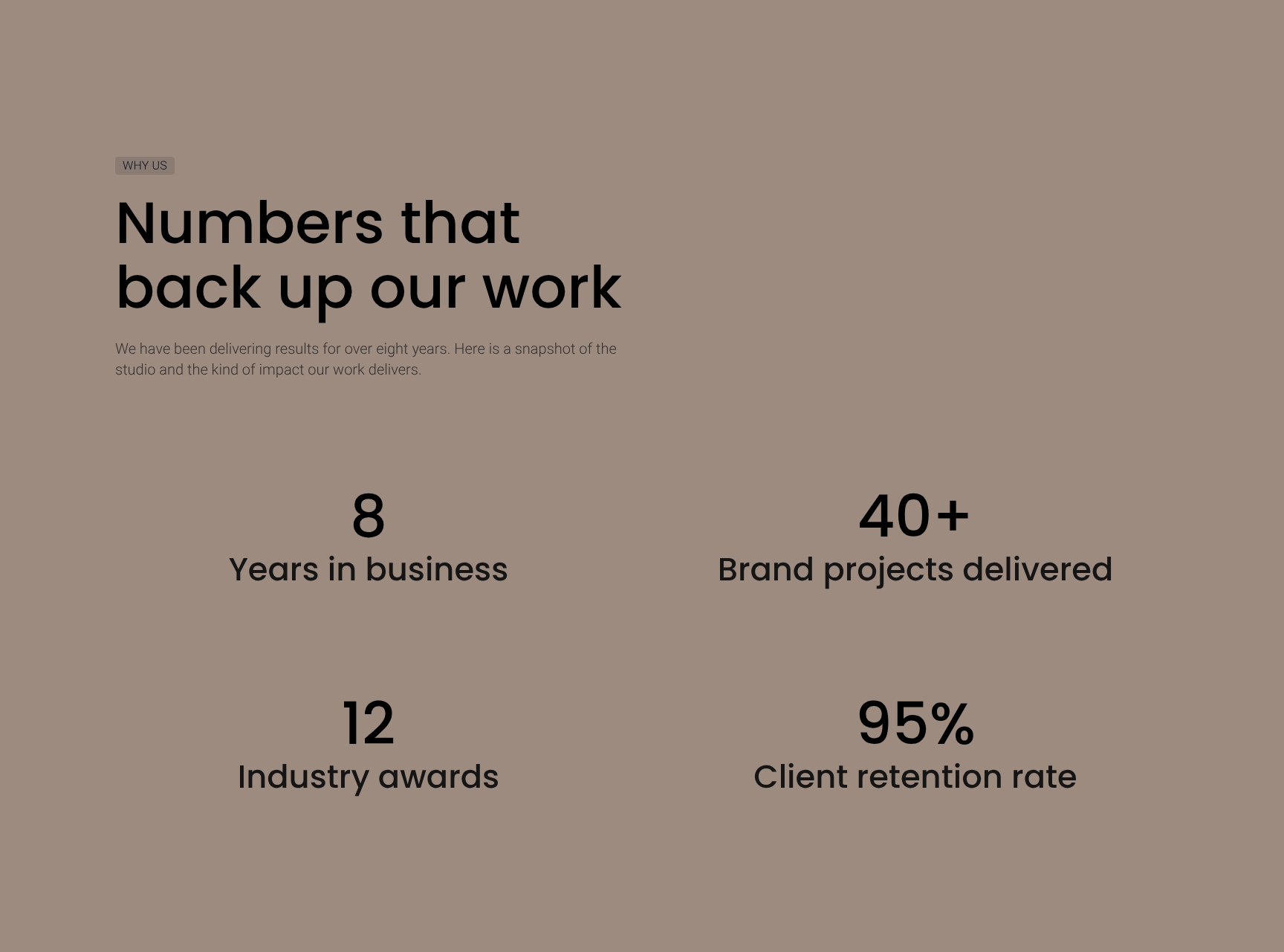
### Phased Timeline with 7-Week Project Roadmap
Visual timeline breaking down the 7-week engagement into clear phases with milestones and review points. Shows exact scheduling from project start with stage-by-stage progression for complete timeline transparency.
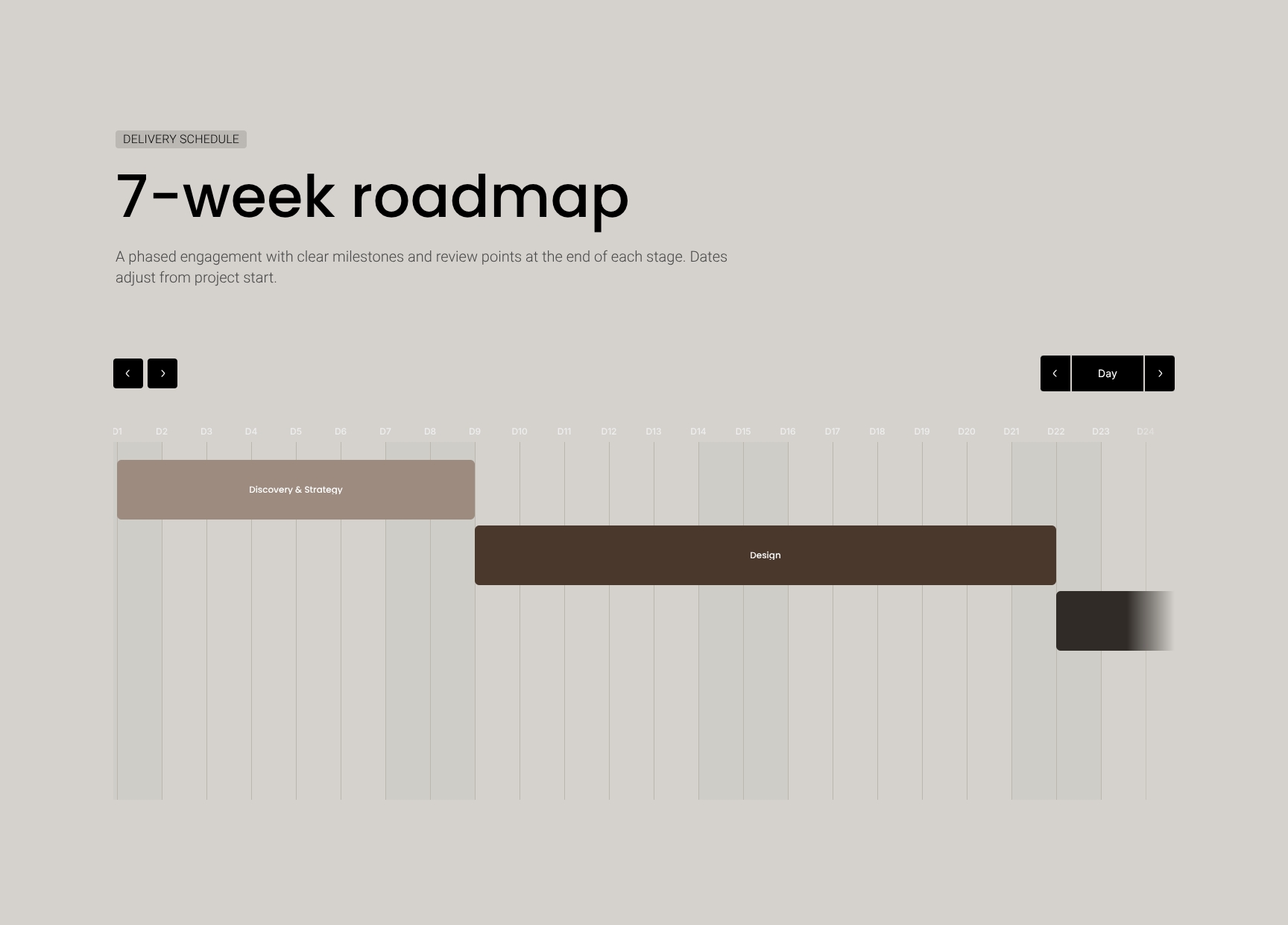
### Itemized Pricing and Investment Breakdown
Transparent pricing section with complete cost itemization mapped to scope and timeline. No hidden fees or surprises—every line item clearly explained and directly tied to specific deliverables and project phases.
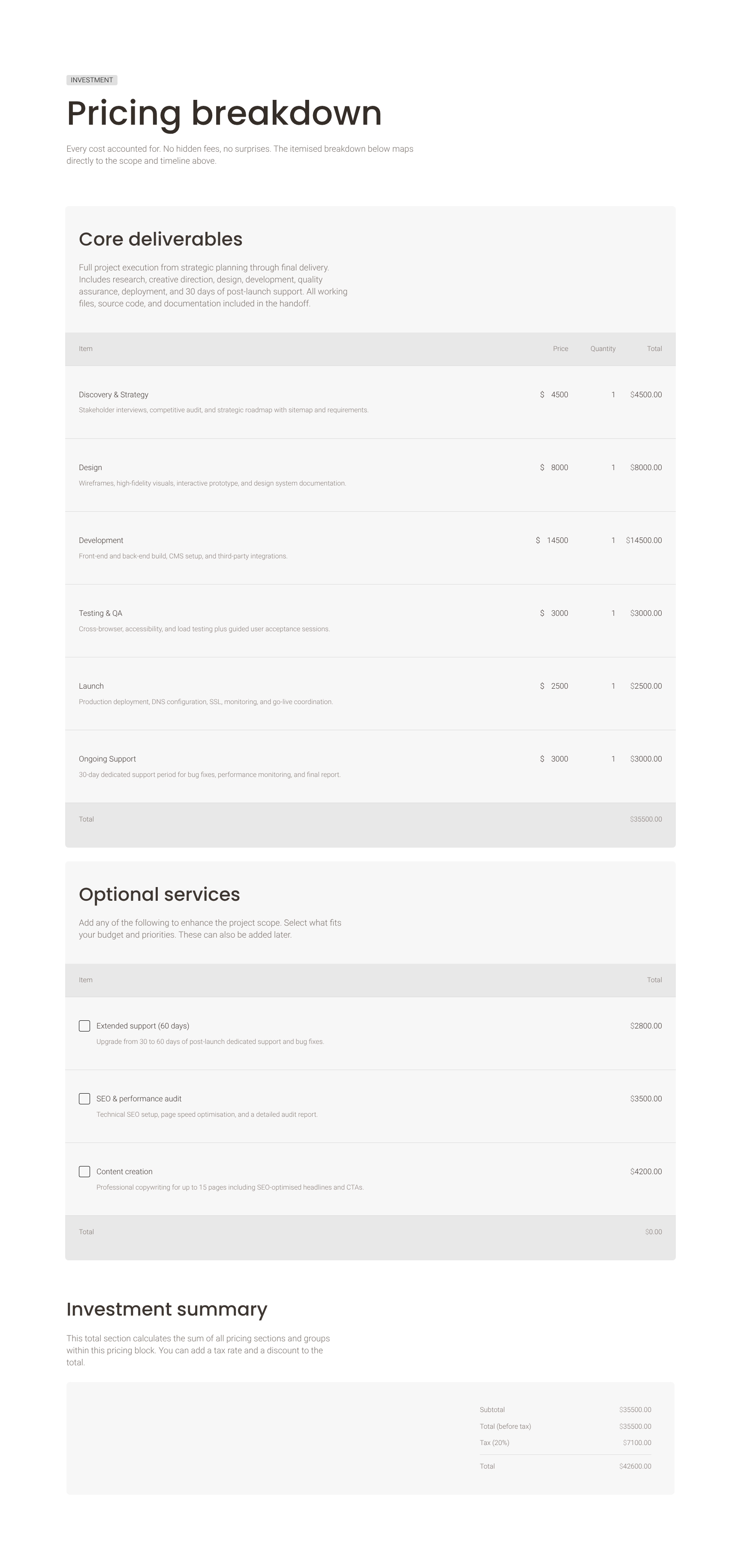
### Digital Approval and Agreement Section
Formal approval section for client sign-off on scope, pricing, optional services, and timeline. Streamlines contract process with clear confirmation of all proposal terms and next steps including statement of work and payment schedule.
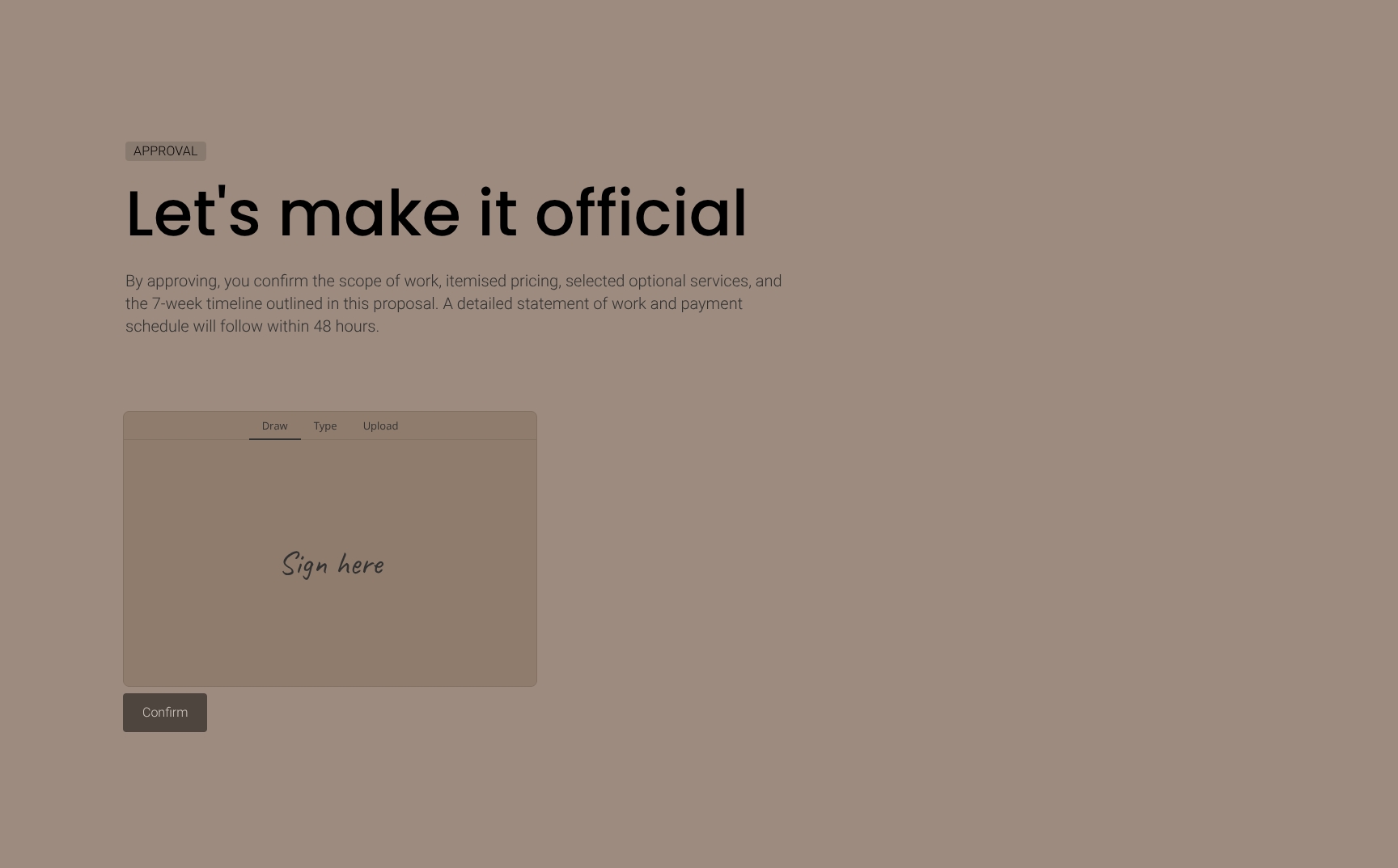
## Find your answers
Common questions about building proposals that win agency and consulting work.
### What should be included in a professional proposal template?
A comprehensive proposal template should include an introduction that establishes credibility, a clear overview of your solution, detailed project scope with specific deliverables, team credentials showcasing relevant expertise, and visual elements like galleries to demonstrate past work. The template should also prominently feature your company values to build trust and differentiate your approach from competitors.
### How do I customize this proposal template for my industry?
You can customize each section by replacing placeholder text with your specific content, adding your brand colors and logo, and modifying the gallery section with industry-relevant project examples. The modular structure allows you to reorder sections, remove unnecessary components, or duplicate sections like team profiles to match your business needs without requiring design skills.
### Can I export this proposal template to PDF or other formats?
Yes, this template supports export to multiple formats including PDF for client presentations, Word documents for collaborative editing, and standard web formats for online sharing. The layout maintains professional formatting across all export options, ensuring your proposal looks polished whether viewed digitally or printed.
### Is this proposal template suitable for small businesses and freelancers?
Absolutely. The template is designed to scale from solo freelancers to large agencies, with sections that can be easily adapted or removed based on your business size. Small businesses and freelancers particularly benefit from the values and team sections, which help establish credibility and personal connection even without extensive corporate resources.
### How long does it take to complete a proposal using this template?
Most users complete a customized proposal in 30-60 minutes after gathering their content. The pre-structured sections eliminate design work and formatting decisions, allowing you to focus solely on writing compelling content. For subsequent proposals, you can reuse customized sections, reducing completion time to 15-20 minutes.
## Related
- [Boston](https://formlio.com/templates/boston-event-retainer-proposal): Monthly event retainer proposal for brands
- [Toronto](https://formlio.com/templates/toronto-brand-relaunch-proposal): Creative campaign proposal for consumer brands
- [Dublin](https://formlio.com/templates/dublin-launch-campaign-proposal): Integrated launch campaign proposal for consumer brands
- [Manchester](https://formlio.com/templates/manchester-marketing-statement-of-work): Paid media and lifecycle SOW for agencies
- [Bristol](https://formlio.com/templates/bristol-launch-film-proposal): Launch film proposal for product marketing teams
- [Portfolio template](https://formlio.com/templates/portfolio-template): Showcase Your Best Work with Strategic Project Presentation
---
---
title: "Simple Proposal Template"
description: "Streamlined project proposal template for agencies and consultants. Includes discovery process, scope of work, timeline breakdown, and pricing structure. Perfect for client presentations requiring clear deliverables and professional formatting."
canonical: "https://formlio.com/templates/simple-proposal-template"
locale: "en"
type: "template"
lastModified: "2026-06-20"
alternates:
fr: "https://formlio.com/fr/templates/simple-proposal-template.md"
---
# Simple Proposal Template
Business Project Proposal Template
Ready-to-use project proposal template designed for agencies and consultants. Includes structured sections for scope, timeline, and deliverables with clear value propositions that win client approval faster.
- [Use this template](https://formlio.com/workspaces/claim?template=simple-proposal-template)
- [Live preview](https://formlio.com/documents/simple-proposal-template)
- **Categories:** [Proposals](https://formlio.com/templates/proposals)
- **Document goal:** Present your project scope, timeline, and pricing in a format that gets clients to yes.
- **Blocks:** Highlight, Six columns, Scroll gradient, Grid 4x3, Vertical timeline, Tiered packages, Approval slider
- **Palette:** Forest Professional (#284F3F), Warm Canvas (#FEFAF6), Golden Highlight (#e9a843), Dusty Rose Accent (#D394AB), Cream Whisper (#F8EDE0)
## Get more from every document
This template helps you close clients with proposals that answer their questions before they ask. You get built-in sections for scope, timeline, pricing, and sign-off that keep decision-makers reading.
### Close the deal in-document
Client signs your proposal on the spot—no email lag, no PDF shuffle, just one click to yes.
### Reuse your best proposals
Save your strongest scope, pricing, and testimonial blocks, then drop them into every new pitch in seconds.
### Clients read on any device
Prospect reviews your proposal on their phone during lunch—every section stays sharp and readable.
### See which services they want
Heatmaps show you the pricing tier they studied longest, so you tailor your follow-up call.
### Know when they're deciding
Get pinged the moment your prospect opens the proposal or leaves a comment about budget.
### Build proposals with your team
You draft scope while your partner updates pricing—both of you in the doc at once, no version chaos.
## See how every part fits
The template opens with the project overview and closes with a digital signature block, walking clients from problem to solution to commitment. Keep the full structure, drop what doesn't fit your work, or reorder sections to match how you sell.
### Executive Summary & Project Overview
Opens with a compelling headline and clear value proposition. Sets the professional tone and immediately communicates what the proposal covers, why it matters, and what outcomes to expect. Perfect for capturing attention and establishing credibility from the first impression.
### Tailored Solution & Approach Overview
Explains your understanding of the client's needs and how your solution addresses them specifically. Demonstrates that you've listened and crafted a focused response. Builds trust by showing alignment between their requirements and your proposed approach.
### Core Values & Partnership Commitment
Showcases your company's foundational principles with engaging animated presentation. Communicates your commitment to transparency, trust, and long-term relationships. Differentiates your approach by emphasizing partnership over transactional delivery.
### Relevant Portfolio & Case Studies
Displays similar projects you've successfully delivered with visual examples and outcomes. Provides social proof and demonstrates your capability to execute work of this scope. Helps clients visualize what success looks like based on your track record.
### Project Timeline & Milestone Breakdown
Presents a clear, phase-by-phase roadmap from kickoff to delivery with specific tasks and deadlines. Shows clients exactly what happens when, reducing uncertainty and demonstrating your organized approach. Makes complex projects feel manageable and transparent.
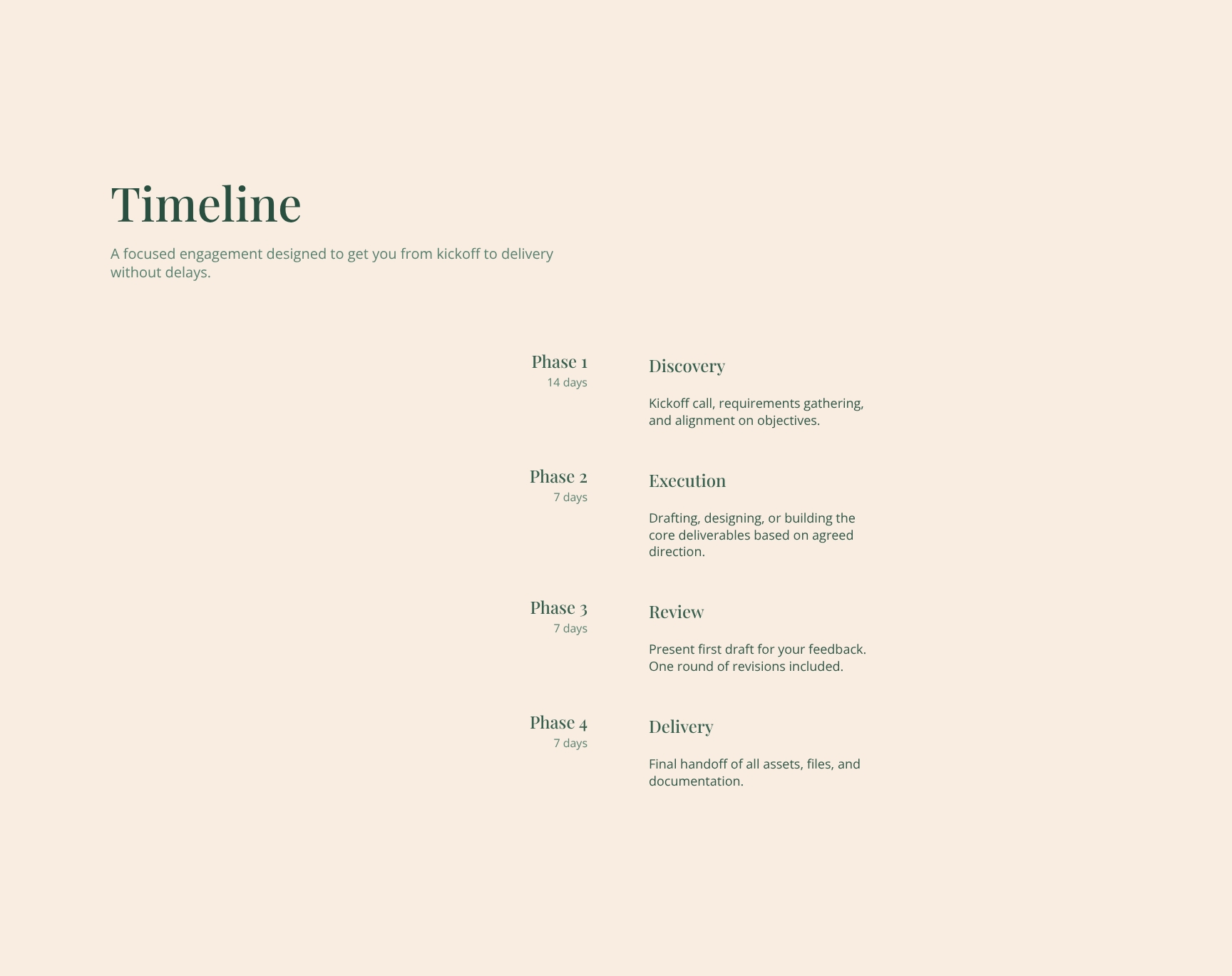
### Transparent Pricing & Investment Details
Breaks down all costs with complete transparency and no hidden fees. Shows exactly what's included in each package or service tier. Makes budgeting easy and builds confidence by eliminating surprises or unclear pricing structures.
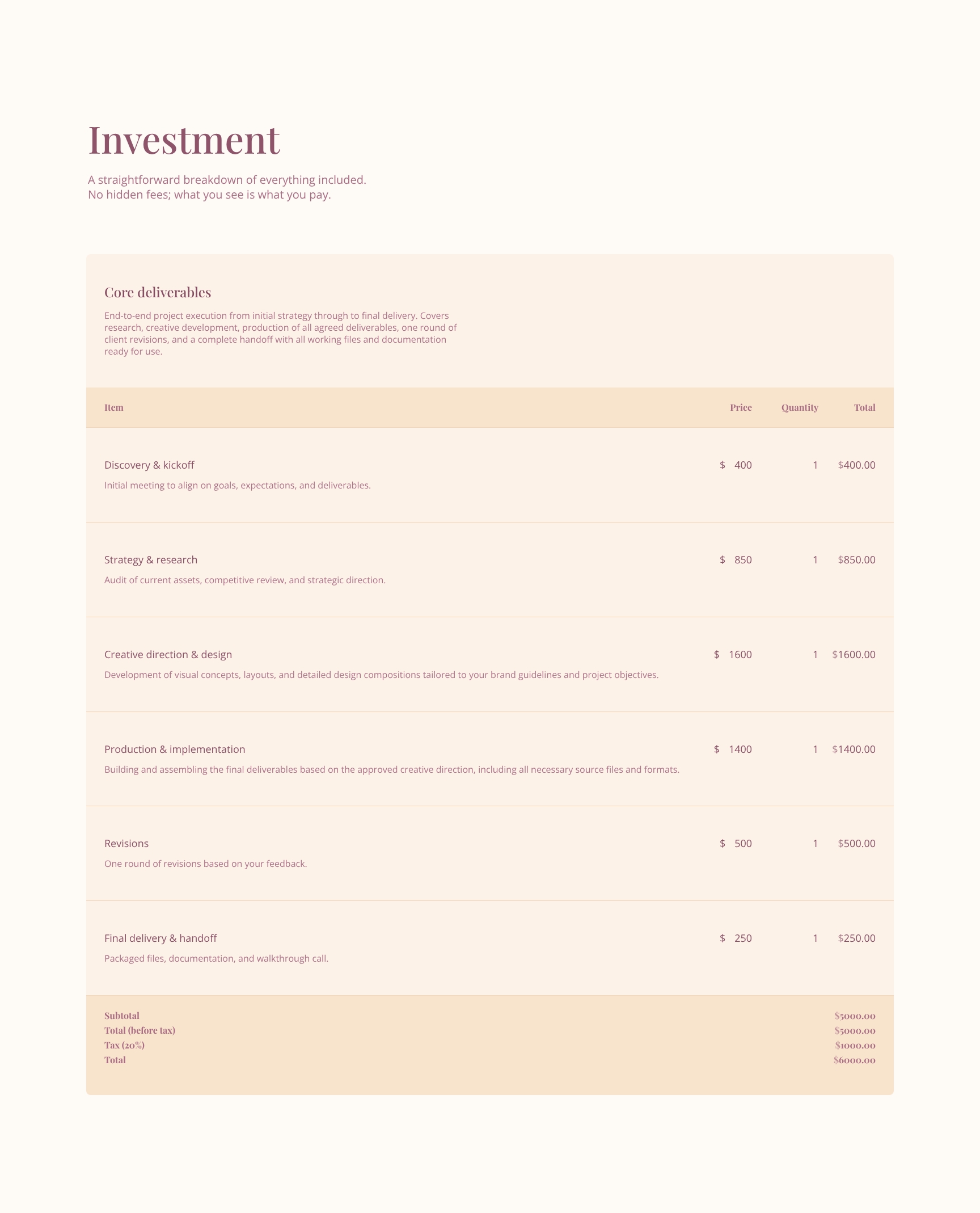
### Digital Agreement & Next Steps
Provides a streamlined approval process with clear terms confirmation. Outlines what happens immediately after approval and expected response times. Makes it easy for clients to move forward with confidence and start the project quickly.

## Find your answers
Common questions about writing proposals that win client work and structure projects clearly.
### What should be included in a professional proposal template?
A comprehensive proposal template should include an introduction, reversed brief (understanding client needs), company values, portfolio showcasing relevant work, detailed timeline with milestones, and clear investment/pricing breakdown. This structure ensures clients understand both your approach and deliverables while building trust through transparency. The reversed brief section is particularly important as it demonstrates you've listened to and understood the client's specific requirements.
### How do I customize this proposal template for different industries?
You can customize this template by replacing the portfolio section with industry-specific case studies, adjusting the values section to reflect sector priorities, and tailoring the timeline to match typical project durations in your field. The reversed brief section should be rewritten for each client to address their unique challenges and goals. All sections are fully editable, allowing you to modify language, add your branding, and include industry-specific terminology.
### Can I export this proposal template to PDF or other formats?
Yes, this template supports export to PDF, Word (DOCX), and other common formats for professional client delivery. PDF export is recommended for final proposals as it preserves formatting across all devices and prevents accidental editing. You can also save in editable formats like DOCX if you need to collaborate with team members before finalizing.
### Is this proposal template suitable for creative agencies and consultants?
Absolutely. This template is specifically designed for creative agencies, consultants, and service-based businesses that need to showcase their process and portfolio. The reversed brief and values sections help differentiate your approach, while the portfolio area allows you to highlight relevant past work. The investment section can be adapted for project-based pricing, retainers, or hourly rates depending on your business model.
### How long does it take to complete and customize this proposal template?
Most users can customize this template in 30-60 minutes once they have their content prepared (portfolio items, pricing, timeline details). The first-time setup takes longer as you'll personalize the values and intro sections, but subsequent proposals using the same template take only 15-30 minutes to tailor for specific clients. Having your case studies, pricing structures, and standard timelines ready beforehand significantly speeds up the process.
## Related
- [Lyon](https://formlio.com/templates/lyon-hotel-website-proposal): Website proposal for multi-property hotel groups
- [Bordeaux](https://formlio.com/templates/bordeaux-launch-event-pitch): Hybrid launch event pitch for brands
- [Boston](https://formlio.com/templates/boston-event-retainer-proposal): Monthly event retainer proposal for brands
- [Cardiff](https://formlio.com/templates/cardiff-website-care-plan-proposal): Monthly care plan proposal for festival organisers
- [Portland](https://formlio.com/templates/portland-app-redesign-proposal): App redesign pitch for subscription startups
- [Copenhagen](https://formlio.com/templates/copenhagen-headless-ecommerce-proposal): Headless storefront proposal for ecommerce brands
---
---
title: "Video & photography"
description: "Treatments and quotes for filmmakers and photographers. Embedded reels, day rates, signed bookings — all in one document."
canonical: "https://formlio.com/templates/video-photography"
locale: "en"
type: "industry"
alternates:
fr: "https://formlio.com/fr/templates/video-photography.md"
---
# Video & photography
Built for production companies, filmmakers, and photographers. Send treatments and quotes that play the work — motion, gallery, and pricing in one branded document.
## Related
- [Brooklyn](https://formlio.com/templates/brooklyn-brand-film-proposal): Brand film proposal for hospitality clients
- [Antwerp](https://formlio.com/templates/antwerp-photography-and-film-portfolio): Photo and film portfolio for creative studios
- [Oslo](https://formlio.com/templates/oslo-campaign-photography-estimate): Photography estimate with options for brands
- [Bristol](https://formlio.com/templates/bristol-launch-film-proposal): Launch film proposal for product marketing teams
- [Vancouver](https://formlio.com/templates/vancouver-video-production-statement-of-work): Multi-market commercial shoot statement of work
---
---
title: "Marketing"
description: "Marketing pitches that read like a plan. Retainer scope, campaign roadmaps, signed agreements — all in one branded document."
canonical: "https://formlio.com/templates/marketing"
locale: "en"
type: "industry"
alternates:
fr: "https://formlio.com/fr/templates/marketing.md"
---
# Marketing
Built for marketing, social, and content agencies. Pitch retainers and campaigns in proposals that show the strategy and the craft of the agency in one place.
## Related
- [Boston](https://formlio.com/templates/boston-event-retainer-proposal): Monthly event retainer proposal for brands
- [Toronto](https://formlio.com/templates/toronto-brand-relaunch-proposal): Creative campaign proposal for consumer brands
- [Dublin](https://formlio.com/templates/dublin-launch-campaign-proposal): Integrated launch campaign proposal for consumer brands
- [Manchester](https://formlio.com/templates/manchester-marketing-statement-of-work): Paid media and lifecycle SOW for agencies
- [Bristol](https://formlio.com/templates/bristol-launch-film-proposal): Launch film proposal for product marketing teams
- [Portfolio template](https://formlio.com/templates/portfolio-template): Showcase Your Best Work with Strategic Project Presentation
- [Detailed proposal template](https://formlio.com/templates/detailed-proposal-template): Complete Business Engagement Framework with Strategy & Execution
---
---
title: "Interior design"
description: "Interior design pitches that hold the room. Moodboards, FF&E, signed approvals — all branded, all in one document."
canonical: "https://formlio.com/templates/interior-design"
locale: "en"
type: "industry"
alternates:
fr: "https://formlio.com/fr/templates/interior-design.md"
---
# Interior design
Built for interior design studios. Pitch moodboards, fee phases, and procurement lists in one branded document — the way you'd present them in person.
## Related
- [Miami](https://formlio.com/templates/miami-ffe-procurement-statement-of-work): FF&E procurement statement of work for designers
- [Amsterdam](https://formlio.com/templates/amsterdam-show-apartment-design-proposal): Show apartment design proposal for property developers
- [Chicago](https://formlio.com/templates/chicago-workplace-interior-design-proposal): Workplace interiors proposal for law firms
- [Lisbon](https://formlio.com/templates/lisbon-interior-design-proposal): Full-service interiors proposal for homeowners
- [Stockholm](https://formlio.com/templates/stockholm-restaurant-interior-proposal): Restaurant interior concept proposal for chefs
- [London](https://formlio.com/templates/london-interior-design-retainer-proposal): Monthly design retainer for hospitality clients
- [Melbourne](https://formlio.com/templates/melbourne-interior-design-portfolio): Capabilities portfolio for interior design studios
- [Sydney](https://formlio.com/templates/sydney-hotel-design-concept-proposal): Hotel concept response for hospitality investors
- [Seattle](https://formlio.com/templates/seattle-interior-design-statement-of-work): Commercial interior design SOW for office clients
- [Paris](https://formlio.com/templates/paris-retail-interior-design-estimate): Boutique interior design estimate for retail brands
- [Denver](https://formlio.com/templates/denver-interior-design-ffe-proposal): Interior design and FF&E proposal for homeowners
- [Florence](https://formlio.com/templates/florence-hotel-interior-design-proposal): Interior design proposal for boutique hotels
- [Perth](https://formlio.com/templates/perth-interior-design-pitch): Interior design pitch for restaurant operators
---
---
title: "Events & experiential"
description: "Event and experiential pitches that move. Embedded references, layered budgets, fast approvals — all in one branded document."
canonical: "https://formlio.com/templates/events-experiential"
locale: "en"
type: "industry"
alternates:
fr: "https://formlio.com/fr/templates/events-experiential.md"
---
# Events & experiential
Built for event and experiential agencies. Pitch concept, schedule, and budget in proposals that move with the energy of the event itself.
## Related
- [Bordeaux](https://formlio.com/templates/bordeaux-launch-event-pitch): Hybrid launch event pitch for brands
- [Boston](https://formlio.com/templates/boston-event-retainer-proposal): Monthly event retainer proposal for brands
- [Cardiff](https://formlio.com/templates/cardiff-website-care-plan-proposal): Monthly care plan proposal for festival organisers
- [Liverpool](https://formlio.com/templates/liverpool-live-events-portfolio): Event studio portfolio for launches and conferences
- [Berlin](https://formlio.com/templates/berlin-product-launch-event-proposal): Multi-city launch event proposal for hardware brands
- [Edinburgh](https://formlio.com/templates/edinburgh-temporary-venue-build-estimate): Temporary venue build estimate for festivals
---
---
title: "Digital & web design"
description: "Web and product proposals that read clean. Phased scope, embedded prototypes, signed sign-off — all in one branded document."
canonical: "https://formlio.com/templates/digital-web-design"
locale: "en"
type: "industry"
alternates:
fr: "https://formlio.com/fr/templates/digital-web-design.md"
---
# Digital & web design
Built for digital, web, and product studios. Walk clients through scope, screens, and phased pricing in proposals that don't drown the design in spec.
## Related
- [Lyon](https://formlio.com/templates/lyon-hotel-website-proposal): Website proposal for multi-property hotel groups
- [Cardiff](https://formlio.com/templates/cardiff-website-care-plan-proposal): Monthly care plan proposal for festival organisers
- [Cambridge](https://formlio.com/templates/cambridge-design-studio-portfolio): Web design studio portfolio for research clients
- [Portland](https://formlio.com/templates/portland-app-redesign-proposal): App redesign pitch for subscription startups
- [Copenhagen](https://formlio.com/templates/copenhagen-headless-ecommerce-proposal): Headless storefront proposal for ecommerce brands
- [Milan](https://formlio.com/templates/milan-headless-commerce-proposal): Headless ecommerce proposal for luxury brands
---
---
title: "Creative & design"
description: "Creative pitches that match the work. Embed concept boards, scope rounds, signed approvals — all branded, all in one document."
canonical: "https://formlio.com/templates/creative-design"
locale: "en"
type: "industry"
alternates:
fr: "https://formlio.com/fr/templates/creative-design.md"
---
# Creative & design
Built for creative and design studios. Pitch brand strategy and design work in proposals that look like the work itself — concept-led, on-brand, ready to react to.
## Related
- [Cambridge](https://formlio.com/templates/cambridge-design-studio-portfolio): Web design studio portfolio for research clients
- [Portland](https://formlio.com/templates/portland-app-redesign-proposal): App redesign pitch for subscription startups
- [Milan](https://formlio.com/templates/milan-headless-commerce-proposal): Headless ecommerce proposal for luxury brands
- [Toronto](https://formlio.com/templates/toronto-brand-relaunch-proposal): Creative campaign proposal for consumer brands
- [Dublin](https://formlio.com/templates/dublin-launch-campaign-proposal): Integrated launch campaign proposal for consumer brands
- [Antwerp](https://formlio.com/templates/antwerp-photography-and-film-portfolio): Photo and film portfolio for creative studios
---
---
title: "Architecture"
description: "Architecture proposals that close. Phase fees, embedded designs, board sign-off — all branded, all in one document."
canonical: "https://formlio.com/templates/architecture"
locale: "en"
type: "industry"
alternates:
fr: "https://formlio.com/fr/templates/architecture.md"
---
# Architecture
Built for architecture studios. Share proposals as precise as your drawings — phase fees, embedded designs, signed approvals, all in one branded document.
## Related
- [Stockholm](https://formlio.com/templates/stockholm-restaurant-interior-proposal): Restaurant interior concept proposal for chefs
- [Sydney](https://formlio.com/templates/sydney-hotel-design-concept-proposal): Hotel concept response for hospitality investors
- [Brighton](https://formlio.com/templates/brighton-architecture-statement-of-work): Architect statement of work for design stages
- [Porto](https://formlio.com/templates/porto-architecture-services-proposal): Architecture proposal for winery tasting rooms
- [Austin](https://formlio.com/templates/austin-architecture-shortlist-proposal): Architecture shortlist proposal for corporate clients
- [Edinburgh](https://formlio.com/templates/edinburgh-temporary-venue-build-estimate): Temporary venue build estimate for festivals
---
---
title: "Proposals"
description: "Send proposals that close. Embed video, structure pricing as scope blocks, capture e-signatures — all branded, all in one document."
canonical: "https://formlio.com/templates/proposals"
locale: "en"
type: "useCase"
alternates:
fr: "https://formlio.com/fr/templates/propositions-commerciales.md"
---
# Proposals
Win more work with proposals that read like the work itself. Embed video, structure pricing as scope blocks, and capture e-signatures inside the document — not split across email and a separate contract.
## Related
- [Lyon](https://formlio.com/templates/lyon-hotel-website-proposal): Website proposal for multi-property hotel groups
- [Bordeaux](https://formlio.com/templates/bordeaux-launch-event-pitch): Hybrid launch event pitch for brands
- [Boston](https://formlio.com/templates/boston-event-retainer-proposal): Monthly event retainer proposal for brands
- [Cardiff](https://formlio.com/templates/cardiff-website-care-plan-proposal): Monthly care plan proposal for festival organisers
- [Portland](https://formlio.com/templates/portland-app-redesign-proposal): App redesign pitch for subscription startups
- [Copenhagen](https://formlio.com/templates/copenhagen-headless-ecommerce-proposal): Headless storefront proposal for ecommerce brands
- [Berlin](https://formlio.com/templates/berlin-product-launch-event-proposal): Multi-city launch event proposal for hardware brands
- [Milan](https://formlio.com/templates/milan-headless-commerce-proposal): Headless ecommerce proposal for luxury brands
- [Brooklyn](https://formlio.com/templates/brooklyn-brand-film-proposal): Brand film proposal for hospitality clients
- [Miami](https://formlio.com/templates/miami-ffe-procurement-statement-of-work): FF&E procurement statement of work for designers
- [Amsterdam](https://formlio.com/templates/amsterdam-show-apartment-design-proposal): Show apartment design proposal for property developers
- [Chicago](https://formlio.com/templates/chicago-workplace-interior-design-proposal): Workplace interiors proposal for law firms
- [Lisbon](https://formlio.com/templates/lisbon-interior-design-proposal): Full-service interiors proposal for homeowners
- [Stockholm](https://formlio.com/templates/stockholm-restaurant-interior-proposal): Restaurant interior concept proposal for chefs
- [London](https://formlio.com/templates/london-interior-design-retainer-proposal): Monthly design retainer for hospitality clients
- [Sydney](https://formlio.com/templates/sydney-hotel-design-concept-proposal): Hotel concept response for hospitality investors
- [Seattle](https://formlio.com/templates/seattle-interior-design-statement-of-work): Commercial interior design SOW for office clients
- [Paris](https://formlio.com/templates/paris-retail-interior-design-estimate): Boutique interior design estimate for retail brands
- [Brighton](https://formlio.com/templates/brighton-architecture-statement-of-work): Architect statement of work for design stages
- [Porto](https://formlio.com/templates/porto-architecture-services-proposal): Architecture proposal for winery tasting rooms
- [Austin](https://formlio.com/templates/austin-architecture-shortlist-proposal): Architecture shortlist proposal for corporate clients
- [Denver](https://formlio.com/templates/denver-interior-design-ffe-proposal): Interior design and FF&E proposal for homeowners
- [Florence](https://formlio.com/templates/florence-hotel-interior-design-proposal): Interior design proposal for boutique hotels
- [Perth](https://formlio.com/templates/perth-interior-design-pitch): Interior design pitch for restaurant operators
- [Toronto](https://formlio.com/templates/toronto-brand-relaunch-proposal): Creative campaign proposal for consumer brands
- [Dublin](https://formlio.com/templates/dublin-launch-campaign-proposal): Integrated launch campaign proposal for consumer brands
- [Edinburgh](https://formlio.com/templates/edinburgh-temporary-venue-build-estimate): Temporary venue build estimate for festivals
- [Oslo](https://formlio.com/templates/oslo-campaign-photography-estimate): Photography estimate with options for brands
- [Manchester](https://formlio.com/templates/manchester-marketing-statement-of-work): Paid media and lifecycle SOW for agencies
- [Bristol](https://formlio.com/templates/bristol-launch-film-proposal): Launch film proposal for product marketing teams
- [Vancouver](https://formlio.com/templates/vancouver-video-production-statement-of-work): Multi-market commercial shoot statement of work
- [Portfolio template](https://formlio.com/templates/portfolio-template): Showcase Your Best Work with Strategic Project Presentation
- [Detailed proposal template](https://formlio.com/templates/detailed-proposal-template): Complete Business Engagement Framework with Strategy & Execution
- [Simple Proposal Template](https://formlio.com/templates/simple-proposal-template): Streamlined Business Proposal Format for Client Projects
---
---
title: "Portfolio"
description: "Portfolios that play. Embed video, frame projects in context, track who watches — all in one branded document."
canonical: "https://formlio.com/templates/portfolio"
locale: "en"
type: "useCase"
alternates:
fr: "https://formlio.com/fr/templates/portfolio.md"
---
# Portfolio
Show your work in a portfolio that does what your work does. Embedded films, high-res stills, written context — all in one branded document.
## Related
- [Cambridge](https://formlio.com/templates/cambridge-design-studio-portfolio): Web design studio portfolio for research clients
- [Liverpool](https://formlio.com/templates/liverpool-live-events-portfolio): Event studio portfolio for launches and conferences
- [Melbourne](https://formlio.com/templates/melbourne-interior-design-portfolio): Capabilities portfolio for interior design studios
- [Antwerp](https://formlio.com/templates/antwerp-photography-and-film-portfolio): Photo and film portfolio for creative studios
---
---
title: "Pitch decks"
description: "Pitch decks that move. Embed video, render concepts, capture sign-off — all branded, all in one document."
canonical: "https://formlio.com/templates/pitch-decks"
locale: "en"
type: "useCase"
alternates:
fr: "https://formlio.com/fr/templates/pitch-decks.md"
---
# Pitch decks
Pitch the vision in a deck that moves. Embed video, render concepts, sign approvals — all in one branded document.
## Related
- [Bordeaux](https://formlio.com/templates/bordeaux-launch-event-pitch): Hybrid launch event pitch for brands
- [Portland](https://formlio.com/templates/portland-app-redesign-proposal): App redesign pitch for subscription startups
- [Stockholm](https://formlio.com/templates/stockholm-restaurant-interior-proposal): Restaurant interior concept proposal for chefs
- [Sydney](https://formlio.com/templates/sydney-hotel-design-concept-proposal): Hotel concept response for hospitality investors
- [Austin](https://formlio.com/templates/austin-architecture-shortlist-proposal): Architecture shortlist proposal for corporate clients
- [Perth](https://formlio.com/templates/perth-interior-design-pitch): Interior design pitch for restaurant operators
- [Toronto](https://formlio.com/templates/toronto-brand-relaunch-proposal): Creative campaign proposal for consumer brands
- [Bristol](https://formlio.com/templates/bristol-launch-film-proposal): Launch film proposal for product marketing teams
---
---
title: "Typographic"
canonical: "https://formlio.com/templates/typographic"
locale: "en"
type: "style"
alternates:
fr: "https://formlio.com/fr/templates/typographique.md"
---
# Typographic
## Related
- [Detailed proposal template](https://formlio.com/templates/detailed-proposal-template): Complete Business Engagement Framework with Strategy & Execution
---
---
title: "Monochromatic"
canonical: "https://formlio.com/templates/monochromatic"
locale: "en"
type: "style"
alternates:
fr: "https://formlio.com/fr/templates/monochrome.md"
---
# Monochromatic
## Related
- [Creative pitch template](https://formlio.com/templates/creative-pitch-template): Brand Redefining Partnership Presentation
---
---
title: "Modern"
canonical: "https://formlio.com/templates/modern"
locale: "en"
type: "style"
alternates:
fr: "https://formlio.com/fr/templates/moderne.md"
---
# Modern
## Related
- [Creative pitch template](https://formlio.com/templates/creative-pitch-template): Brand Redefining Partnership Presentation
---
---
title: "Minimal"
canonical: "https://formlio.com/templates/minimal"
locale: "en"
type: "style"
alternates:
fr: "https://formlio.com/fr/templates/minimaliste.md"
---
# Minimal
## Related
- [Creative pitch template](https://formlio.com/templates/creative-pitch-template): Brand Redefining Partnership Presentation
---
---
title: "Large Type"
canonical: "https://formlio.com/templates/large-type"
locale: "en"
type: "style"
alternates:
fr: "https://formlio.com/fr/templates/grande-typographie.md"
---
# Large Type
## Related
- [Detailed proposal template](https://formlio.com/templates/detailed-proposal-template): Complete Business Engagement Framework with Strategy & Execution
---
---
title: "Dark"
canonical: "https://formlio.com/templates/dark"
locale: "en"
type: "style"
alternates:
fr: "https://formlio.com/fr/templates/sombre.md"
---
# Dark
## Related
- [Creative pitch template](https://formlio.com/templates/creative-pitch-template): Brand Redefining Partnership Presentation
---
---
title: "Colorful"
canonical: "https://formlio.com/templates/colorful"
locale: "en"
type: "style"
alternates:
fr: "https://formlio.com/fr/templates/colore.md"
---
# Colorful
## Related
- [Portfolio template](https://formlio.com/templates/portfolio-template): Showcase Your Best Work with Strategic Project Presentation
---
---
title: "Animated"
canonical: "https://formlio.com/templates/animated"
locale: "en"
type: "style"
alternates:
fr: "https://formlio.com/fr/templates/anime.md"
---
# Animated
## Related
- [Detailed proposal template](https://formlio.com/templates/detailed-proposal-template): Complete Business Engagement Framework with Strategy & Execution